





Abstract

To the Editor:
Nepal, a landlocked country in Southeast Asia, is known for its biodiversity due to its geographical position, altitudinal, and climatic gradients. Fatal and nonfatal injuries sustained from wild animal attacks are not uncommon in Nepal, but lack of reporting of a specific pattern of injuries sustained and their management have made it appear as a rare phenomenon. Among the wild animals, various species of bear reside in Nepal. Among them are the sloth bear (Melursus ursinus), which inhabits Terai, the southern lowland (<1500 m), the Asiatic black bear (Ursus thibetanus) that is found in the hilly region in Nepal (up to the tree line, 1500 m to 3500 m), and the brown bear (Ursus arctos), which resides in the Trans-Himalayan region (altitude range from 3800 m to 5500 m). 1 Black bears and brown bears, listed as endangered and conserved species, have been depleted as a result of exploitation and deforestation that led to habitat destruction, poaching, and retaliatory killings to minimize human and livestock depredations. As the habitats of humans and wild animals have begun to merge, encounters with wild animals have risen. Bear mauling or bites occur when people enter the wilderness to collect firewood or tend grazing cattle.1,2
Bears are thought to be intelligent mammals that target the upper body to weaken the enemy and prevent retaliation. The majority of victims sustain devastating facial disfigurement. Bears may attack suddenly when encountered and without provocation, and cause specific patterns of nonfatal injuries readily distinguishable from those of other animal attacks. 3 Tearing, cutting, or penetration by claws (Figure 1) and teeth occurs singly or in combination. Teeth and claws are the natural weapons for bears. Long slender canine teeth can penetrate as far as 1.5 cm into the body. Long strong claws can penetrate up to 4 cm. 4
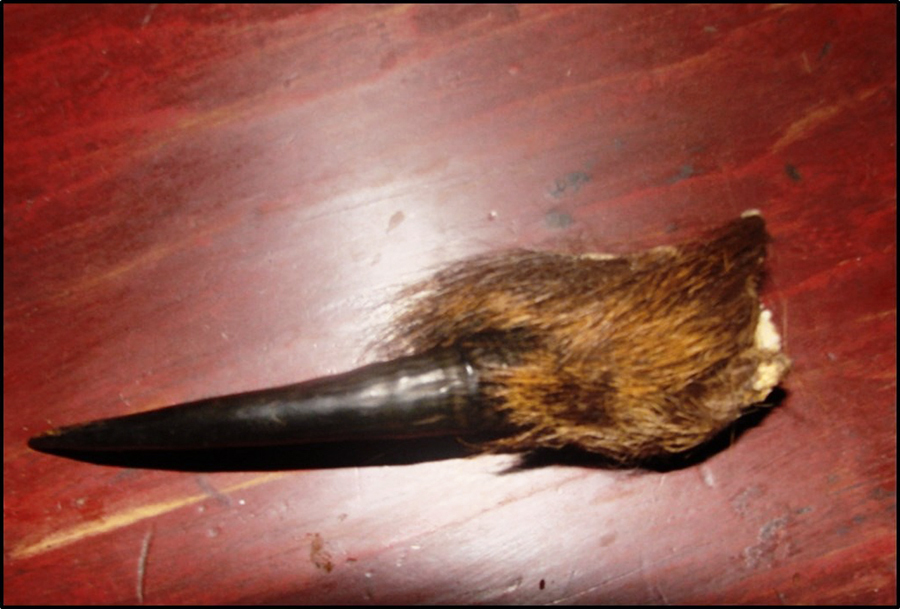
Specimen of a brown bear claw recovered from the Upper Mustang Region.
Two cases of brown bear attacks were registered in 2014 in Manipal Teaching Hospital Pokhara. The hospital is the first tertiary care center for people residing in the Upper Mustang Region, which is located in the Dhaulagiri-Annapurna mountain range in the northwestern part of the country. Permanent facial disfigurement was the feature common to both victims, who were then referred to higher medical centers for plastic reconstruction. Delayed medical attention because of geographical inaccessibility of transportation (Figure 2) may lead to life-threatening complications of the injuries. Because these areas typically do not have a trauma center, victims must endure time-consuming transportation to receive help.
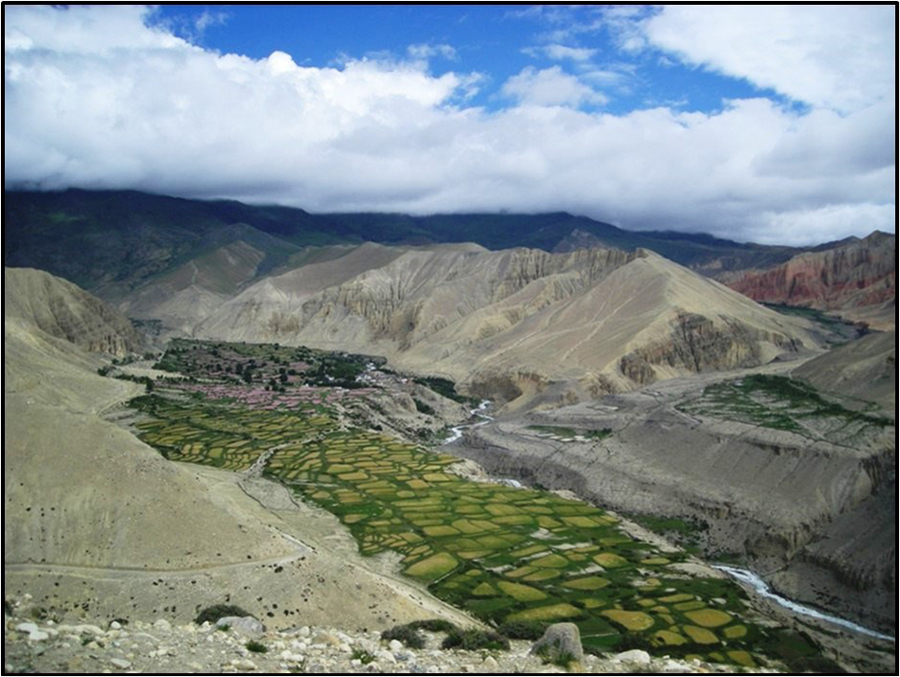
Landscape of Upper Mustang Region, which is the habitat of the brown bear (Ursus arctos).
The government of Nepal provides compensation and relief funds in cases of injury or death of humans or livestock caused by wild animals. According to the Wildlife Damage Relief Guideline 2069 (2012–13), immediate relief is provided in the amount of 10,000 Nepalese rupees for human injuries and 50,000 to 300,000 Nepalese rupees for human death. 2 False reporting of bear attacks for compensation remains a possibility, and therefore needs to be ruled out based on detailed medicolegal investigations. Case reporting should be encouraged to provide photographic evidence of the injuries. Detailed investigation into the circumstances may prevent wrongful recordings and prevent compensation from reaching the wrong hands.
Footnotes
Acknowledgments
The authors are indebted to Dr Achyut Aryal, who has done in-depth study of brown bears in Nepal, for the critical appraisal of this review. Dr Alok Atreya wishes to acknowledge Annapurna Conservation Area Project, Lomanthang, Upper Mustang, for the courtesy of  , which is a specimen of brown bear claw recovered from the region in 2010. The corresponding author of this review, Dr. Tanuj Kanchan and the other authors wish to acknowledge their respective institutions for promoting research and publications in journals of repute and standing.