






Abstract
Objective
Backcountry travelers should carry a standard set of safety gear (transceiver, shovel, and probe) to improve rescue chances and reduce mortality risk. Many backcountry enthusiasts are using other advanced equipment such as an artificial air pocket (eg, the AvaLung) or an avalanche air bag. Our goal was to determine the numbers of backcountry users carrying advanced equipment and their perceptions of mortality and morbidity benefit while carrying this gear.
Methods
A convenience sample of backcountry skiers, snowboarders, snowshoers, and snowmobilers was surveyed between February and April 2014. Participants of this study were backcountry mountain users recruited at trailheads in the Wasatch and Teton mountain ranges of Utah and Wyoming, respectively. Questions included prior avalanche education, equipment carried, and perceived safety benefit derived from advanced equipment.
Results
In all, 193 surveys were collected. Skiers and snowboarders were likely to have taken an avalanche safety course, whereas snowshoers and snowmobilers were less likely to have taken a course. Most backcountry users (149, 77.2%), predominantly skiers and snowboarders, carried standard safety equipment. The AvaLung was carried more often (47 users) than an avalanche air bag (10 users). The avalanche air bag had a more favorable perceived safety benefit. A majority of participants reported cost as the barrier to obtaining advanced equipment.
Conclusions
Standard avalanche safety practices, including taking an avalanche safety course and carrying standard equipment, remain the most common safety practices among backcountry users in the Wasatch and Tetons. Snowshoers remain an ideal target for outreach to increase avalanche awareness and safety.
Introduction
The mountains are an outdoor destination for backcountry enthusiasts in the wintertime. These mountains can pose a serious threat from avalanches to skiers, snowboarders, snowshoers, snowmobilers, and other backcountry users. The standard avalanche safety equipment consists of a transceiver, shovel, and probe, which serve to increase the probability of companion rescue. 1 Transceivers transmit and receive signals and must be carried by the buried party and the rescuers to locate the victim. 1 Once located, a probe and shovel are used to dig the victim out. In addition to this, many backcountry users are carrying advanced safety equipment to increase their likelihood of survival if caught in an avalanche. The chance of surviving an avalanche depends on the grade of burial, duration of burial, presence of an air pocket, and severity of mechanical injuries. 1 The grade of burial (defined as critical with airway obstruction versus noncritical with unobstructed airways) is the strongest factor in avalanche survival. 2
The avalanche air bag (Figure 1) attempts to avoid complete burial by “inverse segregation,” which distributes larger particles to the surface. 3 It consists of bags that inflate when triggered with the goal of remaining on the surface of the snow or to be only partially buried. 3 Critical burial is associated with an increased mortality. 2 Among those critically buried, asphyxia has been reported to cause 75% to 95% of deaths. 4 –6 The AvaLung (Black Diamond, Salt Lake City, UT) (Figure 2) is designed to increase survival through an artificial air pocket. 3 It extracts air from the snowpack and diverts expired carbon dioxide away from the oral cavity. 3
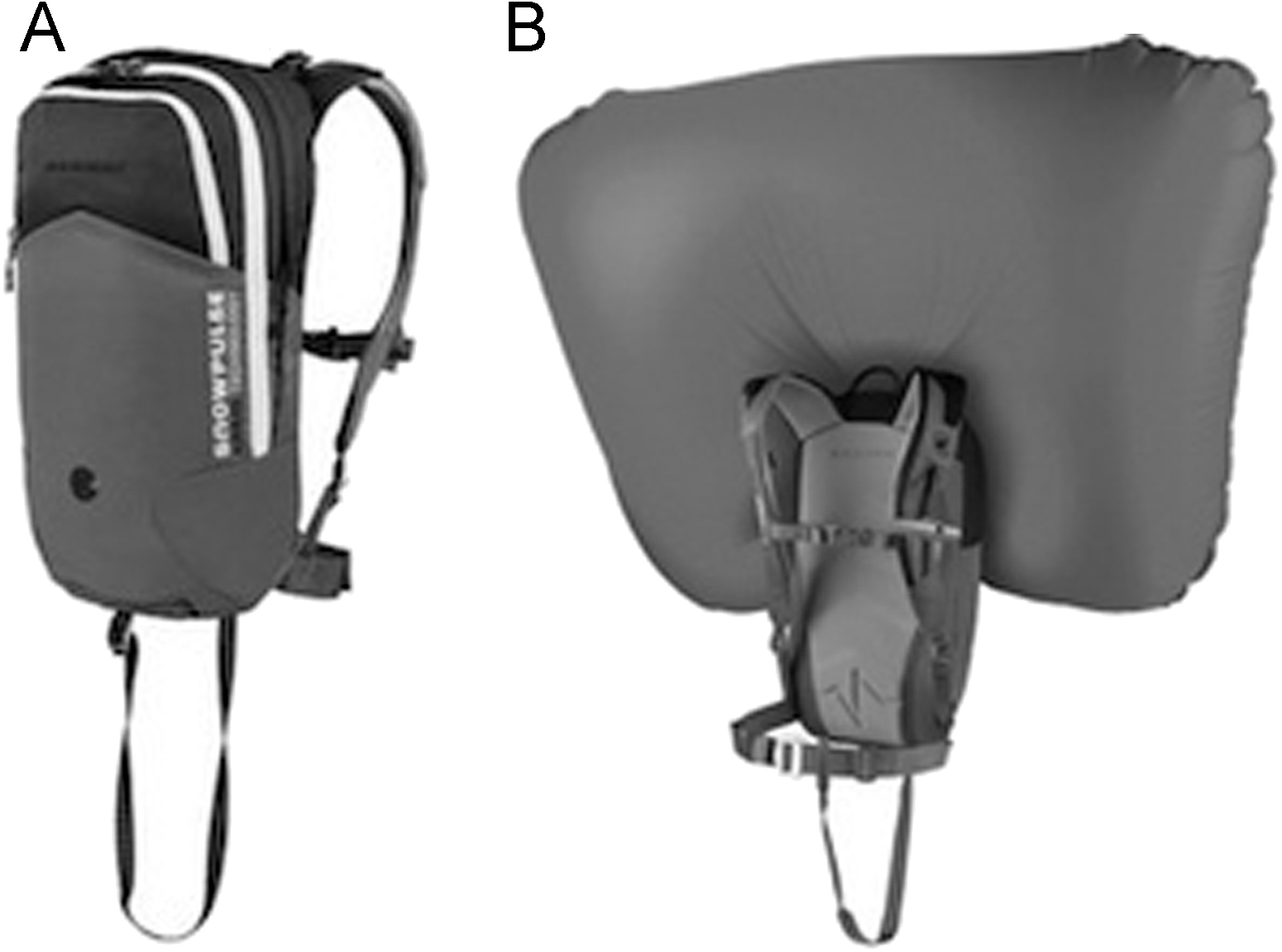
(A) Rocker Removable Avalanche Air Bag system (Mammut, Seon, Switzerland) stowed in a backpack on the left. (B) The avalanche air bag system after deployment.
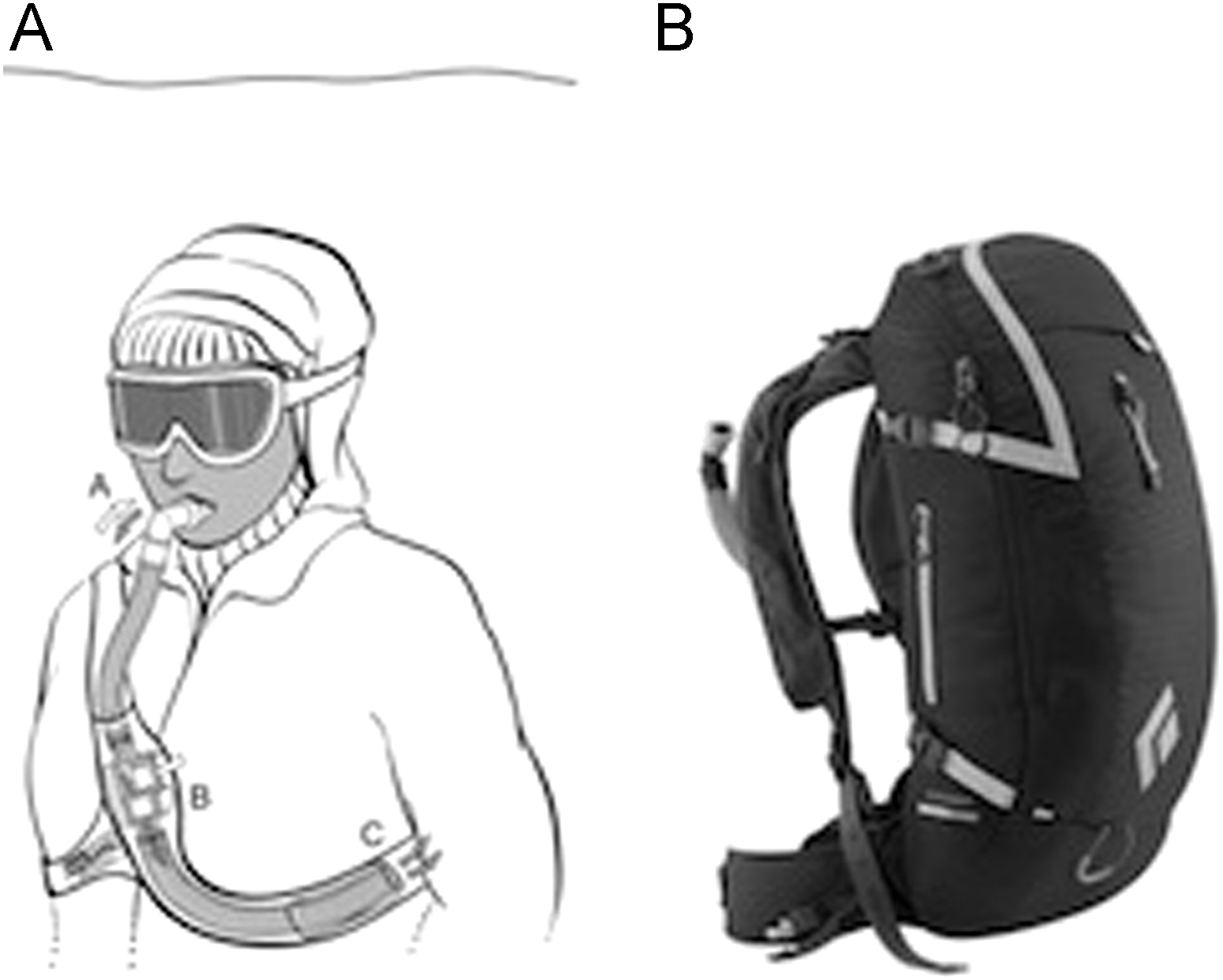
(A) The artificial breathing device (AvaLung, Black Diamond Equipment, Salt Lake City, UT) used during snow burial is shown. White arrows show flow of inspiratory air and dark arrows show flow of expiratory air. The subject breathes in and out through the mouthpiece (A). Inhaled air enters from the snowpack through the one-way inspiratory valve (B) on the side of the housing inside the mesh-protected harness on the chest. Expired air leaves the lungs through the mouthpiece and travels down the respiratory tubing to the housing and then passes through an expiratory one-way valve located at the bottom of the housing (B) and travels through respiratory tubing inside the harness around to the back (C). (B) A backpack with a built-in AvaLung (Covert AvaLung Pack, Black Diamond Equipment).
The purpose of this study was to survey backcountry users to determine avalanche safety courses taken, types of avalanche safety equipment carried, and perceived mortality benefit of advanced backcountry avalanche equipment.
Methods
A convenience sample of backcountry users in the Wasatch and Teton mountain ranges of Utah and Wyoming was identified between February and April of 2014. Trailheads were selected that encompassed varied terrain utilized by all backcountry recreationalists. Inclusion criteria were backcountry recreation users 18 years of age or older traveling in areas of avalanche hazard. Participants completed the survey only once. Backcountry skiers, snowboarders, snowshoers, and snowmobilers were surveyed in person to determine whether they had undergone avalanche safety training, what types of avalanche safety equipment they carried, and what their perceptions were on the use of advanced safety equipment. An avalanche safety course included any of the following: an avalanche awareness course, a 1-day avalanche course, or a level I or level II certification. A level I course (24 hours) covers backcountry travel techniques and basic rescue procedures; level II certification (32 hours) further builds on this knowledge with discussion of snowpack metamorphism and stability assessment. We defined standard avalanche safety equipment as a transceiver, probe, and shovel, and advanced equipment as an AvaLung or avalanche air bag.
The survey was developed by the authors in conjunction with the Utah Avalanche Center. It was a 2-page questionnaire with multiple-choice and dichotomous (yes/no) questions. (The full survey can be viewed online at
Results
In all, 193 surveys were collected. The demographics of the backcountry users are shown in Table 1. Table 2 outlines the safety equipment carried by these backcountry users on the day they were surveyed. Standard avalanche safety equipment was carried by 149 participants (77.2%). The AvaLung was carried by 47 participants (24.3%) whereas 10 (5.2%) carried an avalanche air bag. One snowboarder in the Wasatch carried both an AvaLung and avalanche air bag along with a transceiver. Table 3 demonstrates the number of participants who have taken an avalanche safety course and are carrying standard avalanche safety equipment. The majority of skiers (89.5% in the Tetons and 78.1% in the Wasatch) and snowboarders (94.1% in the Tetons, 68.2% in the Wasatch) had taken an avalanche safety course. These users were also likely to carry standard safety equipment (more than 90% of both skiers and snowboarders in both regions). Snowshoers were the user group with the lowest numbers to have taken a course (26.7%). Among skiers and snowboarders who did not take an avalanche safety course, standard safety equipment was still often carried (100% of skiers and snowboarders in the Tetons, 88.9% of skiers and 50% of snowboarders in the Wasatch), suggesting awareness of the standard equipment required and the inherent risk of backcountry travel. In comparison, of the 22 snowshoers who did not take an avalanche course, 0% carried standard equipment (Table 3).
Description and demographics of backcountry users surveyed
Avalanche safety equipment carried
Transceiver, shovel, probe.
Avalanche safety course and standard avalanche safety equipment
Figure 3 demonstrates the regional perceived improvement in survival if caught in an avalanche with each of the advanced safety devices. A large proportion of backcountry users appear to believe that both devices impart some effect on improved survival. In both the Tetons and Wasatch region, more participants believed that an avalanche air bag would greatly improve outcome as compared with the AvaLung. Table 4 summarizes the reasons for not owning advanced equipment among participants. Of the 136 participants without an AvaLung or avalanche air bag, the majority (96, 70.6%) reported cost as the reason.
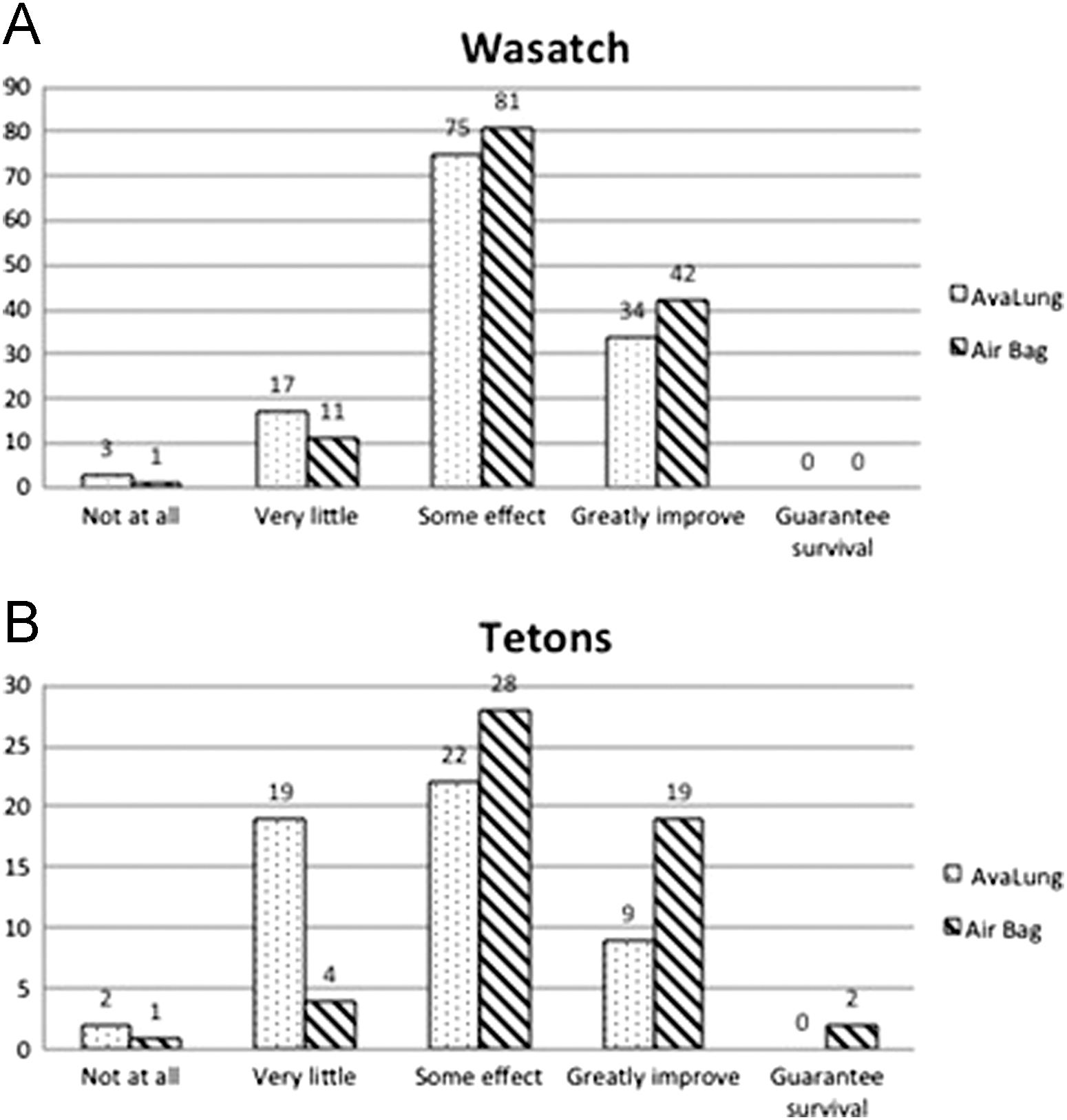
Participant responses to the following survey questions in the (A) Wasatch range and (B) Teton range. Question 10: How much will an avalanche air bag improve survival if caught in an avalanche? Question 11: How much will an AvaLung improve survival if caught in an avalanche? Dotted bars indicate AvaLung; hatched bars indicate air bag. The x-axis represents the multiple choice answers offered to the participants on the survey. The instructions were to circle one of the possible answers only. The y-axis demonstrates the number of responses.
Reasons for not owning advanced avalanche safety equipment
Among participants without advanced equipment.
Discussion
This study demonstrates that the standard avalanche safety equipment (transceiver, probe, and shovel) remains the most common equipment carried by backcountry users. Avalanche courses are still commonly taken among participants who ski and snowboard, but a significant minority of backcountry users have not. A large number of snowshoers have not taken an avalanche course, nor do they carry standard equipment, as has been found by prior studies. 7 Although snowshoers typically travel in low-risk terrain, they remain an ideal target for increasing avalanche awareness and safety.
The finding that the AvaLung is more commonly carried as compared with the avalanche air bag may be related to its lower cost and lighter weight. A 2007 study reporting asphyxia as the cause of most avalanche deaths in Utah may have influenced the increased use of the device in the Wasatch area. 6 The use of artificial air pocket devices has been shown to extend the time to asphyxia during snow burial, from 5 to 14 minutes without a device to as long as 60 minutes with a device, extending the potential extrication time of the buried victim. 8 There are several anecdotal reports of avalanche survival of buried victims using the AvaLung, supporting a potential survival benefit associated with the device but by no means a guarantee in survival.3,9
Perceptions of the safety benefit of these advanced safety devices suggest that the avalanche air bag has a greater perceived mortality benefit among participants. The avalanche air bag has been reported to reduce mortality by decreasing the likelihood of complete burial. 3 A recent study shows that this mortality reduction is less than what was previously demonstrated, with an absolute mortality reduction of 11% instead of 16%.1,2 This study only evaluated avalanches with the potential for critical burial and also excluded users who were marginally involved in an avalanche, thus focusing on optimal conditions for an avalanche air bag to be effective, which may have led to an inflated mortality reduction. Moreover, 83% of these data are from Europe, and only 15% from North America. Comparisons of avalanche survival in Canada and Switzerland have demonstrated a difference in the prevalence of trauma and regional variations in snow climate. 10 Given the additional factors of varied terrain and regional differences in injury patterns, the applicability of these studies to the participants in this region may be limited.
No device can guarantee survival, and the availability of advanced equipment should not deter one from obtaining education regarding avalanche safety. Although cost is the limiting factor among participants (AvaLung $150–$300, avalanche air bag $700–$1300), studies do suggest some improvement in survival chances with these devices in certain avalanche conditions. Further studies involving varied terrain and snow climates, specifically in North America, may be of benefit to better understand the utility of these devices.
Study Limitations
A limitation to this study is the convenience sampling method. Attempts were made to survey participants at different locations, times of day, and days of the week. For maximal yield, however, the majority of participants were surveyed on weekends. The trailheads selected may have favored skiers and snowboarders and affected our results. Furthermore, the results of this study represent only the practices in Utah and Wyoming, specifically the greater Salt Lake City and Jackson areas, respectively, and may not be representative of all backcountry users.
Conclusion
This study shows that standard avalanche safety practices, including taking an avalanche safety course and carrying standard equipment, remain the most common safety practices among backcountry users in Utah and Wyoming. Snowshoers remain an ideal target for further education in avalanche awareness and safety. The AvaLung and avalanche air bag have a favorable perceived mortality benefit among these users but have not yet been adopted for widespread use. Further studies in other geographic regions over time may be beneficial in following the evolving trends of backcountry safety practices.
Footnotes
Acknowledgments
The authors would like to extend their thanks to Daryl McLaren, Jay Pistono, and Jacob Urban for their assistance in data collection.
Supplementary data
Supplementary data associated with this article can be found in the online version at
References
Supplementary Material
Please find the following supplemental material available below.
For Open Access articles published under a Creative Commons License, all supplemental material carries the same license as the article it is associated with.
For non-Open Access articles published, all supplemental material carries a non-exclusive license, and permission requests for re-use of supplemental material or any part of supplemental material shall be sent directly to the copyright owner as specified in the copyright notice associated with the article.
