






Abstract
Objective
The purpose of this study was to compare the cardiovascular (CV) demands of 2 deer retrieval methods.
Methods
Twelve male participants (weight 86 ± 24 kg, age 21 ± 1 years) performed a maximum treadmill test on day 1 to determine baseline fitness levels. On day 2, all participants first towed, then dragged a 45-kg simulated deer carcass for 457 m at a self-selected pace. The tow condition utilized a shoulder harness system with a 2-m strap connecting the harness to the carcass, allowing the participant to walk upright as he towed the load. The dragging condition required the participants to flex their trunk, grasp the legs of the deer with both hands, and drag the carcass the length of the course. Heart rate and oxygen consumption (V
Results
The CV responses of towing were significantly less compared with those of dragging for V
Conclusions
The results of this study suggest towing a deer with a shoulder harness results in significant reductions in CV demand and lower perceived exertion compared with traditional deer dragging techniques. Deer hunters who are deconditioned or have CV risk factors are strongly encouraged to consider deer retrieval methods utilizing a shoulder harness and tow rope to mitigate the increased demands commonly found with traditional retrieval methods.
Introduction
According to the US Fish and Wildlife Service, approximately 10.8 million Americans participate in deer hunting annually. 1 For many deer hunters, the retrieval of game can be a major struggle due to the emotional, environmental, and physical stresses associated with hunting. 2 Owing to the rugged terrain frequented by hunters, motorized vehicles are seldom able to assist in the retrieval of game. Therefore, when hunters find themselves miles away from base camp or roads, dragging the deer by the antlers or limbs are two of the most common retrieval strategies utilized.
According to the Minnesota Department of Natural Resources, the average white-tailed deer weighs 68 to 90 kg, and in some cases, may weigh more than 180 kg. 3 After removing the internal organs to preserve the meat by field dressing, a mature deer may still weigh 45 kg or more. 4 Previous research has found dramatic elevations in the cardiovascular (CV) responses of hunters, particularly while dragging a deer carcass through the woods. Haapaniemi et al 2 demonstrated that deer hunting activities result in dramatic increases in heart rate and metabolic responses, leading to increased risk of sudden cardiac death for deconditioned hunters. Likewise, Peterson et al 5 also found dramatic elevations in the CV and hemodynamic responses of deer hunters. To date, alternatives to deer dragging that are less metabolically taxing have not been investigated. Therefore, the purpose of this study was to compare the CV demands of dragging a simulated deer carcass versus towing a simulated deer carcass with a shoulder harness on an indoor track.
Methods
The University of Minnesota’s Institutional Review Board approved this within-subjects study. Healthy male participants (n = 12, weight 85.7 ± 23.6 kg, age 21.5 ± 1.3 years) with a background in deer hunting were recruited for this study. Pilot testing in conjunction with previous deer hunting studies indicated that, with expected effect sizes of d = 1.0, 10 participants would yield a statistical power of 80%. All participants signed informed consent documents and completed the Physical Activity Readiness Questionnaire before participation. Those with any musculoskeletal injuries or other health problems that would inhibit their ability to perform deer retrieval tasks were excluded from the study. Participants were instructed to perform three tasks: 1) a treadmill test to determine CV fitness; 2) a towing condition in which the participant was fitted with a shoulder harness and towed a simulated deer carcass; and 3) a dragging condition in which the participant dragged a simulated deer carcass. All 12 participants successfully completed each of the three conditions and reported no injuries throughout the course of the study.
Because of hygienic and decomposition concerns, a simulated 45-kg deer carcass was used. It was constructed from sand encased in plastic bags, wrapped in a blanket, and held together with a strap. Two wooden dowels covered with felt were affixed to the strap to replicate the legs of a deer.
On day 1, participants performed a graded exercise test according to an incremental treadmill protocol to determine baseline fitness levels. Maximum heart rate (HRmax) and maximal aerobic capacity (V
On day 2, participants towed, rested for 20 minutes, and then dragged the deer carcass for 457 m at a self-selected pace around an indoor track. The tow condition utilized a shoulder harness system (Deer Drag Harness, Heavy Hauler Outdoor Gear, Kingsley, IA, USA) with a 2-m strap connecting the shoulder harness to the carcass, allowing the subject to walk upright while towing the load (Figure 1). The dragging condition required the subjects to flex the trunk, grasp the legs of the simulated deer with both hands, and drag it the length of the course (Figure 2). Heart rate and oxygen consumption for each condition were measured by portable indirect calorimetry (Fitmate PRO). Rating of perceived exertion (RPE) using the Borg 6 to 20 RPE scale was obtained upon the completion of each condition. 6
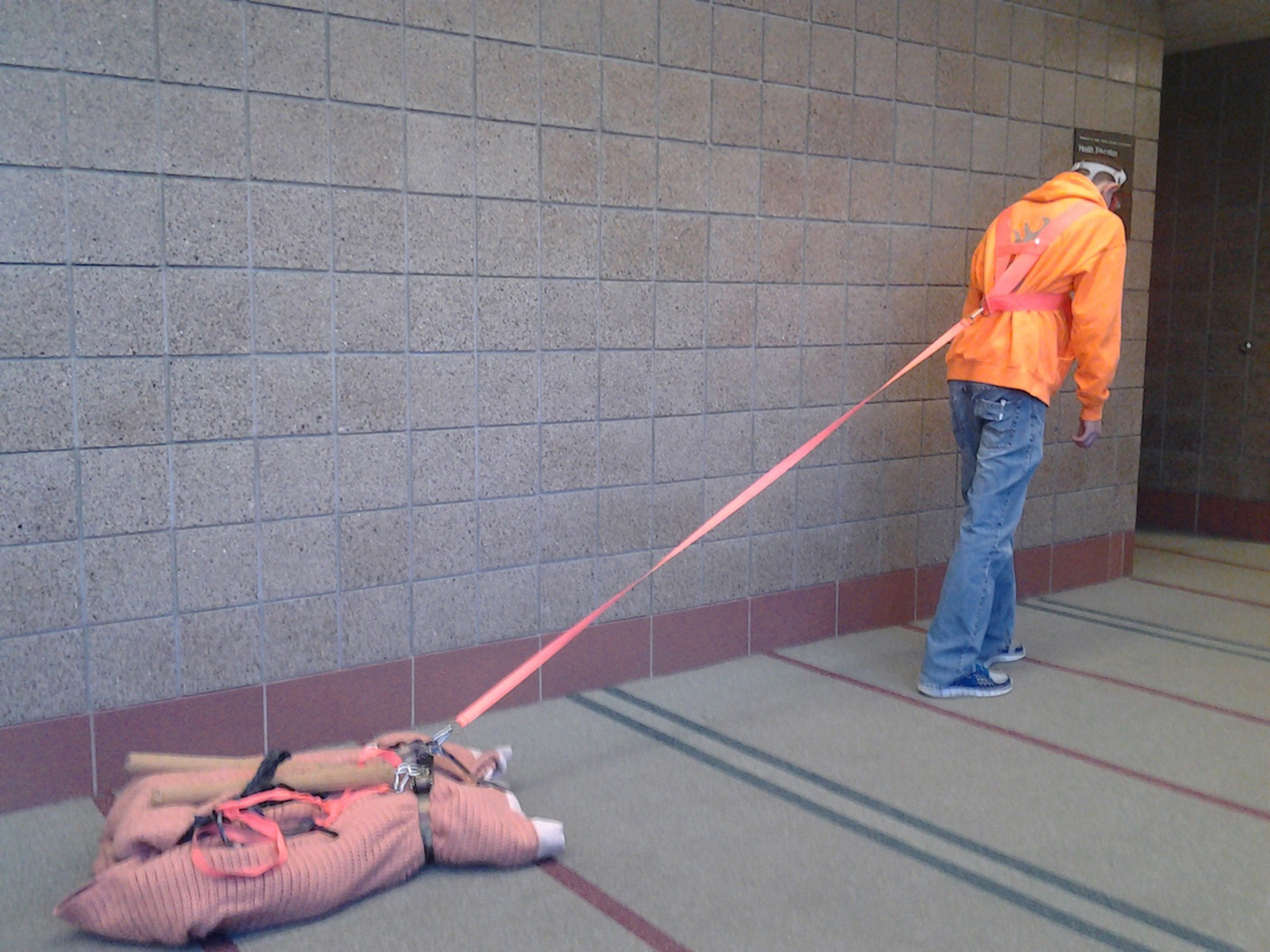
Towing condition.
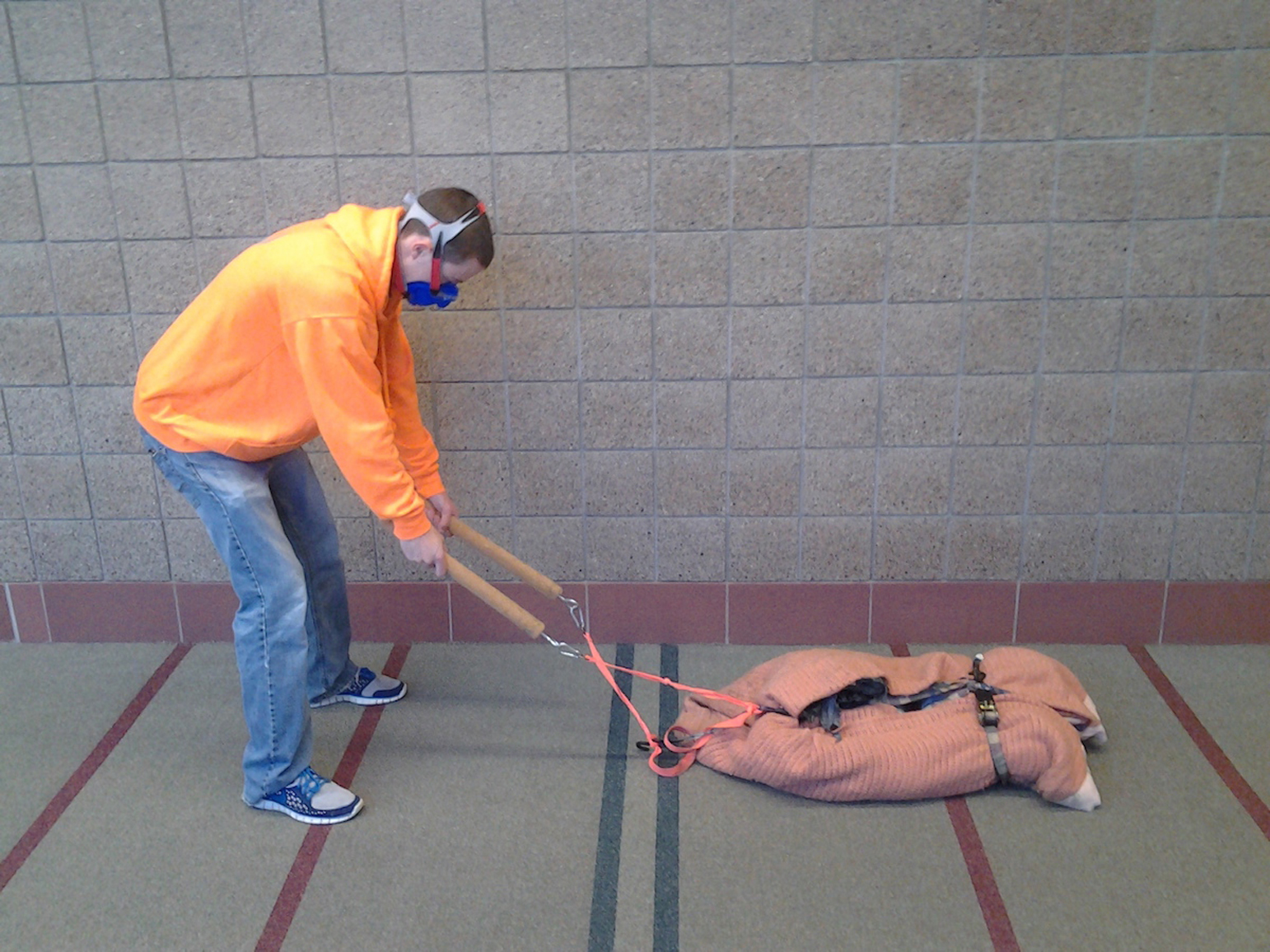
Dragging condition.
Statistics
All data were analyzed using IBM SPSS Statistics (Version 21, IBM Corp, Armonk, NY, USA). Paired-samples t tests were performed to compare the differences between the dragging and the towing conditions. The level of significance was P < 0.05. Cohen’s d effect sizes were calculated (d = pooled mean/pooled SD) to assess the meaningfulness of significant differences, in which d = 0.2, 0.5, and 0.8, representing small, medium, and large effects, respectively. 7
Results
The cardiovascular demands between the towing and dragging conditions are presented in Table 1. All data are presented as mean ± SD with 95% confidence interval. Paired-samples t tests indicated that the CV responses of towing were significantly less when compared with dragging for V
Cardiovascular demands compared between towing and dragging conditions
Values are mean ± SD (95% confidence interval).
V
Reflects each condition’s peak/average as compared with treadmill fitness test, V
P < .01.
P < .05.
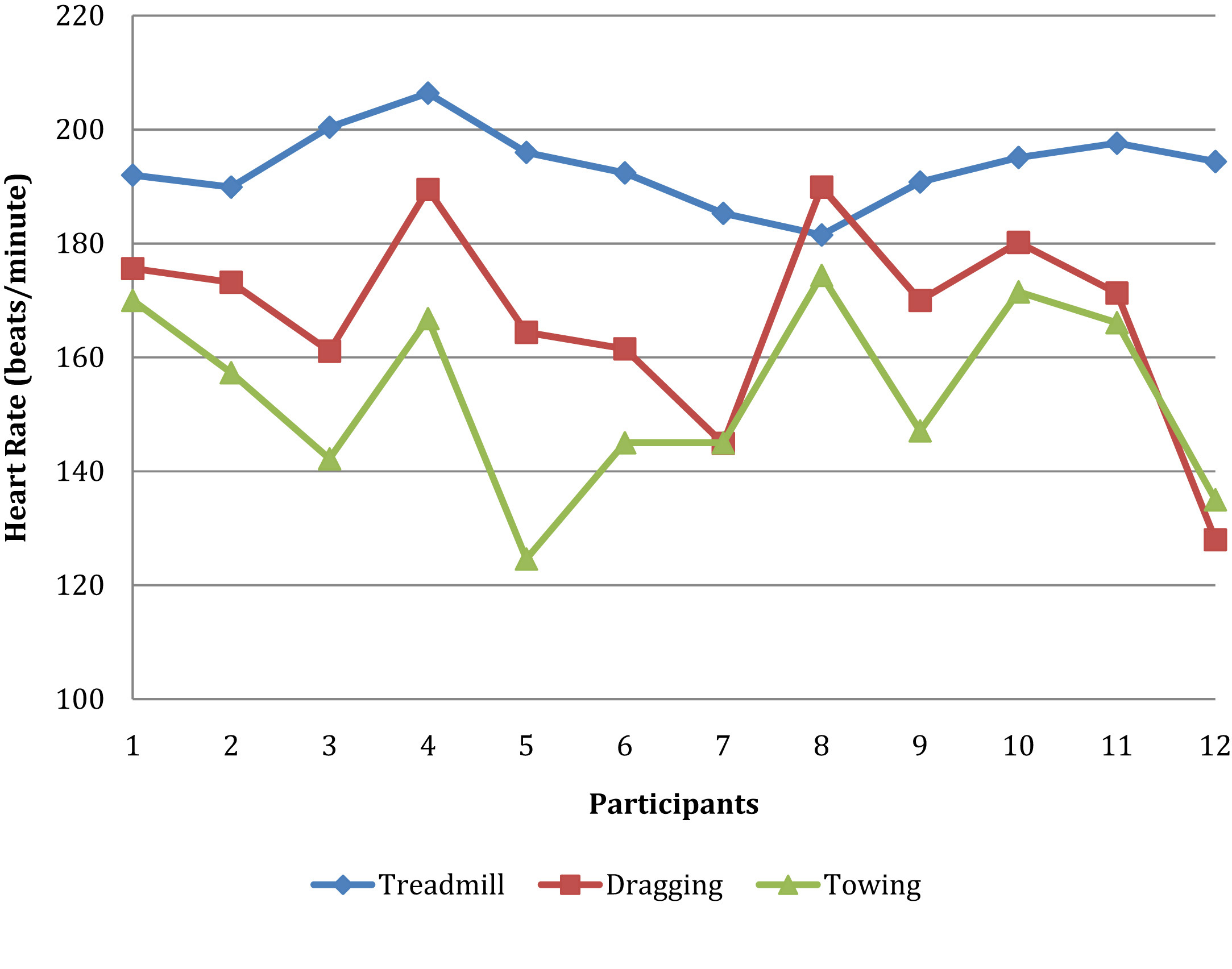
Individual variability in peak heart rate responses for treadmill (blue line), dragging (red line), and towing (green line) conditions.
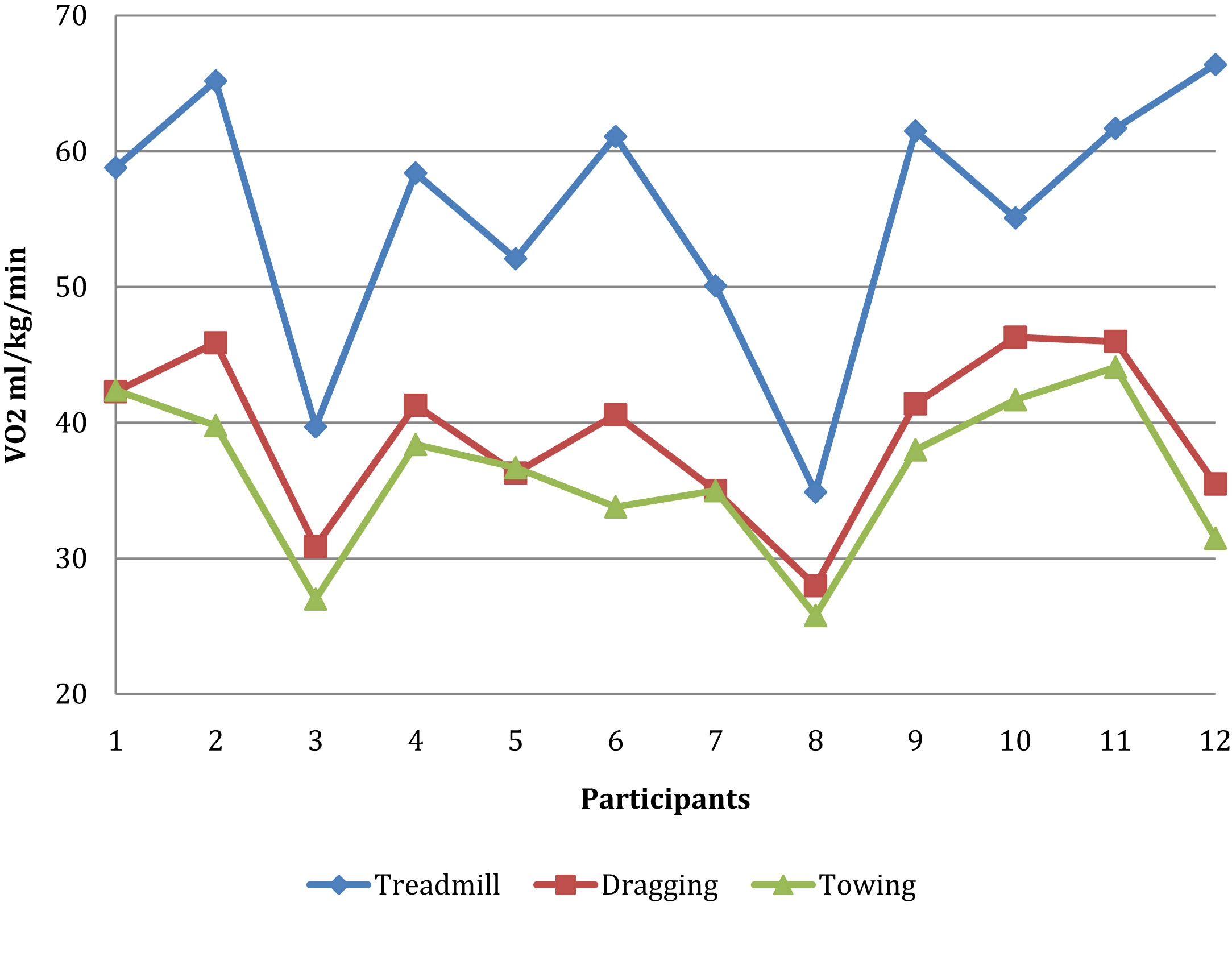
Individual variability in peak oxygen consumption (V
Discussion
According to American College of Sports Medicine (ACSM) standards for cardiorespiratory fitness, the CV demands of both deer retrieval tasks used in this study reached peak heart rate levels that would reach benchmarks indicating vigorous intensity exercise (77% to 95% HRmax). 6 In terms of average HR, however, the towing condition would be classified as a moderate intensity exercise (64% to 76% HRmax), whereas the dragging condition would remain classified as vigorous intensity. 6 Moreover, the RPE for the towing condition (corresponding to “fairly light” exertion) was significantly less than for the dragging condition (corresponding to “hard” exertion), reflecting a clear distinction between the perceived relative intensity of each task. 6 Therefore, the results of this study provide preliminary evidence that deer retrieval strategies utilizing towing may result in lowered CV demands and perceived effort when compared with dragging.
In terms of observed V
In contrast to the large differences observed in heart rate responses, average V
The results of this study are similar to those of previous studies investigating the peak CV demands of traditional methods of carcass dragging by deer hunters. In a study of 16 young, healthy male hunters, Peterson et al
5
found dragging a 56.8-kg deer carcass for 0.4 km over lightly rolling terrain resulted in peak V
Study Limitations
Our study is not without limitations. First, we recruited a convenience sample of young, healthy male hunters; therefore, care is needed if attempting to generalize our findings to older, deconditioned, or female hunting populations. Nonetheless, our study demonstrated a clear distinction between the CV demands of towing and dragging, thus making it plausible that the results would be similar across different hunting populations. Also, despite the high statistical power achieved (>80%), our sample was small, and our results should be interpreted with caution. Moreover, we did not utilize a randomized cross-over trial of each condition, as each subject performed the towing condition, rested 20 minutes, then performed the dragging condition; and we duly note this as a potential limitation. Nevertheless, pilot testing and post-hoc analysis comparisons of baseline CV measures between each beginning condition indicated no significant differences in either heart rate or V
In an attempt to control for the environmental challenges associated with hunting, all testing was completed indoors on a level surface with the use of a simulated deer carcass. However, our dragging/towing conditions and subsequent distance covered reached CV levels similar to those previously observed in field-based studies,2,5 indicating that the indoor setting was not critically dissimilar to field conditions. Also, regardless of the setting, this study demonstrated a significant and meaningful CV response difference between the two conditions, confirming that our study provides preliminary insight into alternative deer retrieval strategies, with the acknowledgement that additional research is needed in a variety of populations and environmental conditions with larger samples.
Conclusion
The results of this study suggest towing a deer carcass with a shoulder harness may result in significant reductions in CV demands and lower RPE when compared with more traditional deer dragging techniques. Deer hunters who are deconditioned or have CV risk factors are strongly encouraged to consider deer retrieval methods utilizing a shoulder harness and tow rope to counter the increased CV demands commonly found in rugged terrain and cold weather conditions.
Footnotes
☆
Disclaimer: This study was funded by the University of Minnesota’s Undergraduate Research Opportunity Program. This research was a poster presentation at the annual meeting of the American College of Sports Medicine, May 28, 2014, Orlando, FL.