






Abstract
Objective
To analyze fatality data associated with wingsuit use in an international case series of fixed-object sport parachuting (BASE jumping) to identify incident and injury mechanisms and to form a basis for potential prevention measures and future safety recommendations.
Methods
A descriptive epidemiological study was performed of fatal injury events occurring in wingsuit BASE jumping. Fatalities (n = 180) were sequentially analyzed assessing human, equipment, and environmental factors from 1981 to 2011. Main outcome measures included descriptions of typical fatal incident and injury mechanisms.
Results
Of the 180 fatal events, 39 (22%) were related to use of wingsuits; 38 (97%) launched from cliffs and 1 (3%) from a building. Of the 39 fatalities, 19 (49%) were caused from cliff strikes, 18 (46%) from ground impact, and 1 (3%) from a building strike. Thirty-eight (97%) of the fatalities were male. During 2002 to 2007 there was a total of 61 BASE jumping deaths, 10 (16%) of which were related to the use of wingsuits, whereas during 2008 to 2011 there was a total 59 fatal events, of which 29 (49%) were related to the use of wingsuits. Seventeen fatalities (39%) were attributed to wingsuit path miscalculation. In the first 8 months of 2013, 17 of 19 (90%) fatalities were wingsuit related. Most fatalities occurred between April and October, reflecting a seasonal increase in activity in the northern hemisphere summer.
Conclusions
Wingsuit-related BASE jump fatalities appear to be increasing as wingsuit BASE jumping increases in popularity. Most fatalities are attributed to cliff or ground impact, and are mostly the result of flying path miscalculation.
Introduction
BASE jumping developed out of skydiving and uses specially adapted parachutes to jump from fixed objects; it is associated with a number of significant risk variables. “BASE” is an acronym that stands for the 4 categories of fixed objects that one can jump from: building, antenna, span (a bridge, arch, or dome), and Earth (a cliff or other natural formation). Injury rate estimates of 0.2 to 0.4% per jump1,2 and fatality rates of 0.04% per jump or 1.7% per participant and year2,3 suggest this is one of the most dangerous sporting activities in practice.
BASE jumps are made from much lower altitudes than skydives, often less than 152.4 m (500 feet) above the landing area; the jumpers have far less aerodynamic control and often have to deal with significant flying instability. The single canopy used in BASE jumping (no reserve chute) may also suffer from uncontrolled opening or may face the wrong direction, which may then result in the jumper’s collision with a fixed object; this “object strike” is the leading cause of serious injury and death in BASE jumping. 1 Different from skydiving (sport parachuting from aircraft), BASE jumping is a largely unorganized and unregulated activity, which limits the possibilities to access or collect data about BASE activity and the BASE population.
With the increased use of wingsuits it is likely that new patterns of morbidity and mortality will emerge. Wingsuits are garments that enhance the glide ratio of the falling jumper. This allows jumpers to move forward as they fall toward the ground. The wingsuit, like the wing parachute, uses ram-air technology; air is pressurized into layers of fabric between the arms and body and between the legs during the fall, which creates wing-shaped cells that enable flights at glide ratios comparable to that of an open flying-wing parachute. Although these suits slow the downward rate of the jumper, the jumper still maintains such high airspeeds that it is not possible to land safely on hard ground (Figure 1). The introduction of wingsuits, with the increased glide ratio they provide, has enabled BASE jumpers to jump and glide away from cliffs that were not previously jumpable. At the present time wingsuits are commonly used to fly along mountain slopes of various angles and features, down through canyons, and along ridgelines. However, because of the wing effect of the suit, the flight path must be determined far above and well in anticipation of arriving at the geographical feature—a mistake in this flight path may lead to a pilot-ground collision while in free fall.
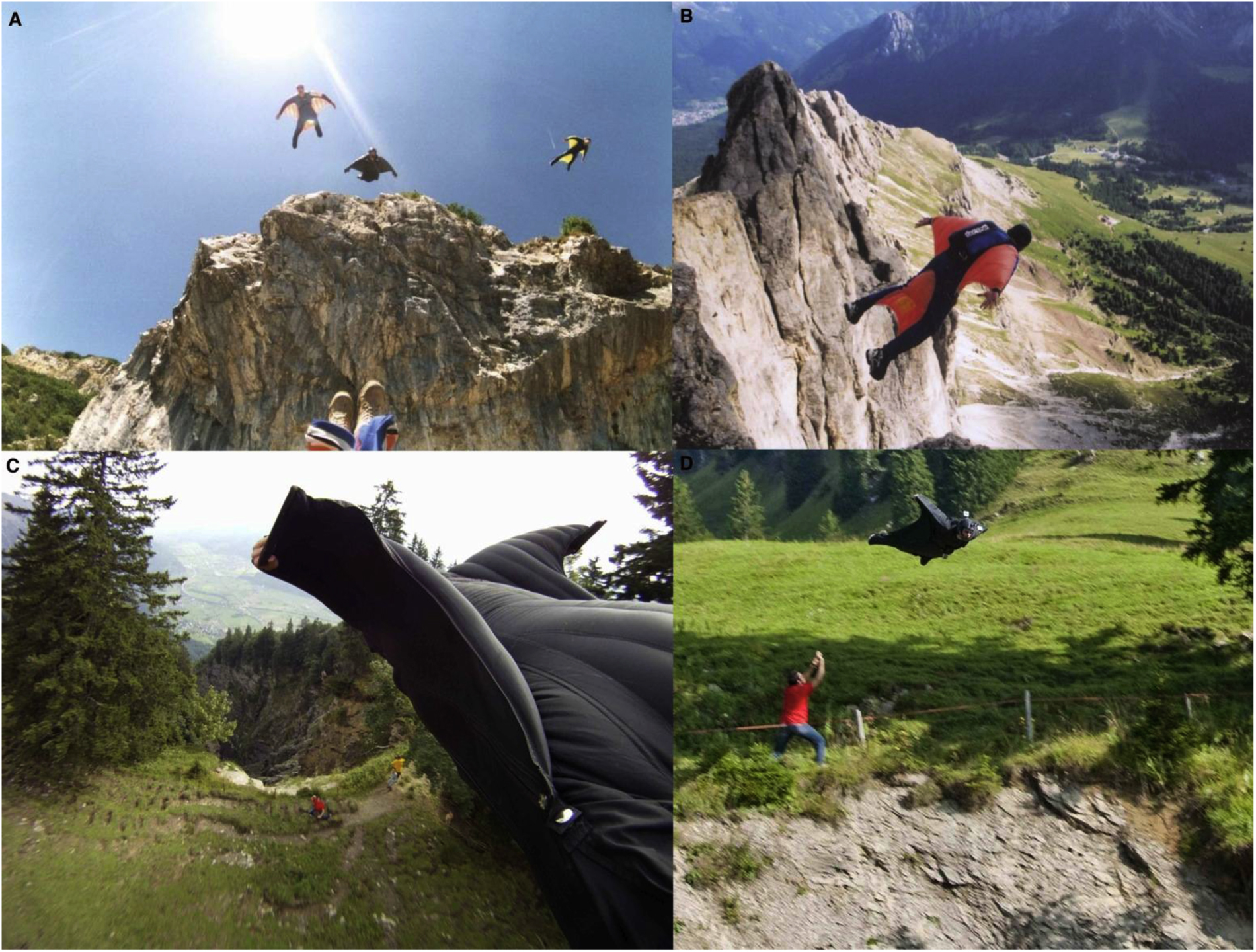
Wingsuit BASE jumping. (A, B). In early days, wingsuits had a relatively small wingspan and were used to fly away from the cliffs being jumped from. (C, D). Current wingsuits have a much larger wingspan, are harder to control, and require much more flying experience. They are used for proximity flying in cliff cracks and next to treetops.
In addition, the process of takeoff is crucial to all flying sports. This is particularly the case in wingsuit BASE jumping because the jumper has limited speed and ability to maneuver the body into the appropriate position during takeoff. If the jumper fails to exit takeoff in an optimal position and trajectory or fails to establish an immediately efficient flight, he or she is likely to fall next to the cliff for a few seconds before gaining sufficient speed to provide an opportunity to regain flight control and to avoid a cliff impact.
An analysis of fatality cases documented by the BASE Fatality List (BFL) 4 between 1981 and 2006 identified several cliff strikes during wingsuit flight and called for future investigations of wingsuit fatalities in BASE jumping. 3 The BFL was created by the BASE jumper Nick Di Giovanni in 1985. He maintained the database until 2007, when fellow BASE jumpers Mick Knutson and Brad Patfield assumed administrative responsibility. In 2011, the BFL database was moved to BLiNC Magazine, where it is still administered by the same team. According to Knutson’s assessment, no data were lost or missed during administrator transitions. Most cases in the BFL database are documented by eyewitness reports, generally from fellow jumpers, because very few BASE jumps are conducted solo.
The aim of this study is to review accidents involving the use of wingsuits in an international case series of BASE jumping fatalities and to analyze etiological factors, with the aim of identifying incident and injury mechanisms, to form a basis for potential prevention measures and future safety recommendations.
Methods
After obtaining University of Colorado-Denver ethics approval, fatal injury events in wingsuit BASE jumping were sequentially analyzed assessing human, equipment, and environment factors from 1981 to 2011. Data were retrieved from the BFL. 4 Fatal injuries sustained directly after and in relation to the landing were included. We excluded fatalities that occurred during the approach to the jump area and associated with jumps with glide ratio-enhancing garments that did not use ram-air technology (eg, “tracking pants”), verified suicides, jumps without any kind of parachute equipment, and nonspecific jumps using parachute equipment or glide ratio-enhancing garments not deemed to be BASE jumps. Fatal injury mechanisms were categorized as object impact (cliff or building strike) or ground or landing impact from the information provided under the BFL heading “cause of death” (COD). The BFL COD category “impact” was renamed “ground impact” for clarity. A limited number of COD events categorized as impacts involved striking ledges in free fall, and were reclassified as “cliff strikes.”
As there is no current standardized tool available to categorize and describe incident mechanisms leading to fatality in wingsuit BASE jumping, the authors propose the following taxonomy, which is based on the authors’ practical experience of BASE jumping: Wingsuit glide path miscalculation (such as unsuccessful attempt to fly a wingsuit over a ledge or a ridgeline); this class includes both physically impossible flight plans and poor wingsuit pilot performance during a theoretically achievable flight plan. Wingsuit equipment failure (such as torn fabric in flight leading to stability problems). Pilot chute complication (such as pilot chute bridle entanglement inhibiting parachute deployment). The pilot chute is a small round parachute that pulls the main canopy out of its container. Exit complication (such as launching with a suboptimal body position to begin immediate and efficient flight, or slipping on exit leading to initial unstable flight pattern).
In general, available data on the experience level of the parachutist were incomplete, and in several cases limited to only a subjective opinion. Also there was insufficient information to reliably determine the number of previous skydives (sport jumps from aircraft) or number of previous BASE jumps in the study subjects.
Results
Number of Cases, objecT types, sex, and experience level
A total of 180 fatal events in BASE jumping from 1981 to December 31, 2011, were included. Of those, 39 (22%) were related to the use of wingsuits. Thirty-eight (97%) were male (Table 1). The majority (n = 38; 97%) were from cliffs (BASE category E), and 1 (3%) was from a building (BASE category B). Of the total of 130 fatalities sustained jumping from cliffs, 38 (29%) involved the use of wingsuits. Only 8 cases reported data on the number of previous BASE jumps with a wingsuit; in these the mean was 26 (range, 0–92). An analysis of the reported narratives of the cases suggests that some of the cases may have had a higher number of previous wingsuit BASE jumps. Two (5%) of the fatal cases were parachutists doing their first wingsuit BASE jumps.
Sex of parachutist suffering fatalities, related and unrelated to the use of wingsuits 4
Year, Time of Year, Country of Incident, and Jump Site
The first reported fatal event in wingsuit BASE jumping occurred in 2002. Of a total of 12 fatal events in BASE jumping that year, 3 (25%) were related to the use of wingsuits. In 2008, of a total of 8 fatal events in BASE jumping, 6 (75%) were related to the use of wingsuits (Figure 2). Of a total of 59 fatal events in BASE jumping from 2008 to 2011, 29 (49%) were related to the use of wingsuits, whereas of a total of 61 fatal events in BASE jumping from 2002 to 2007, 10 (16%) were related to the use of wingsuits. Distribution by month and by country are shown in Figures 3 and 4, respectively. Of the total of 39 fatalities in wingsuit BASE jumping, most (n = 9; 23%) occurred in the Lauterbrunnen Valley in Switzerland.
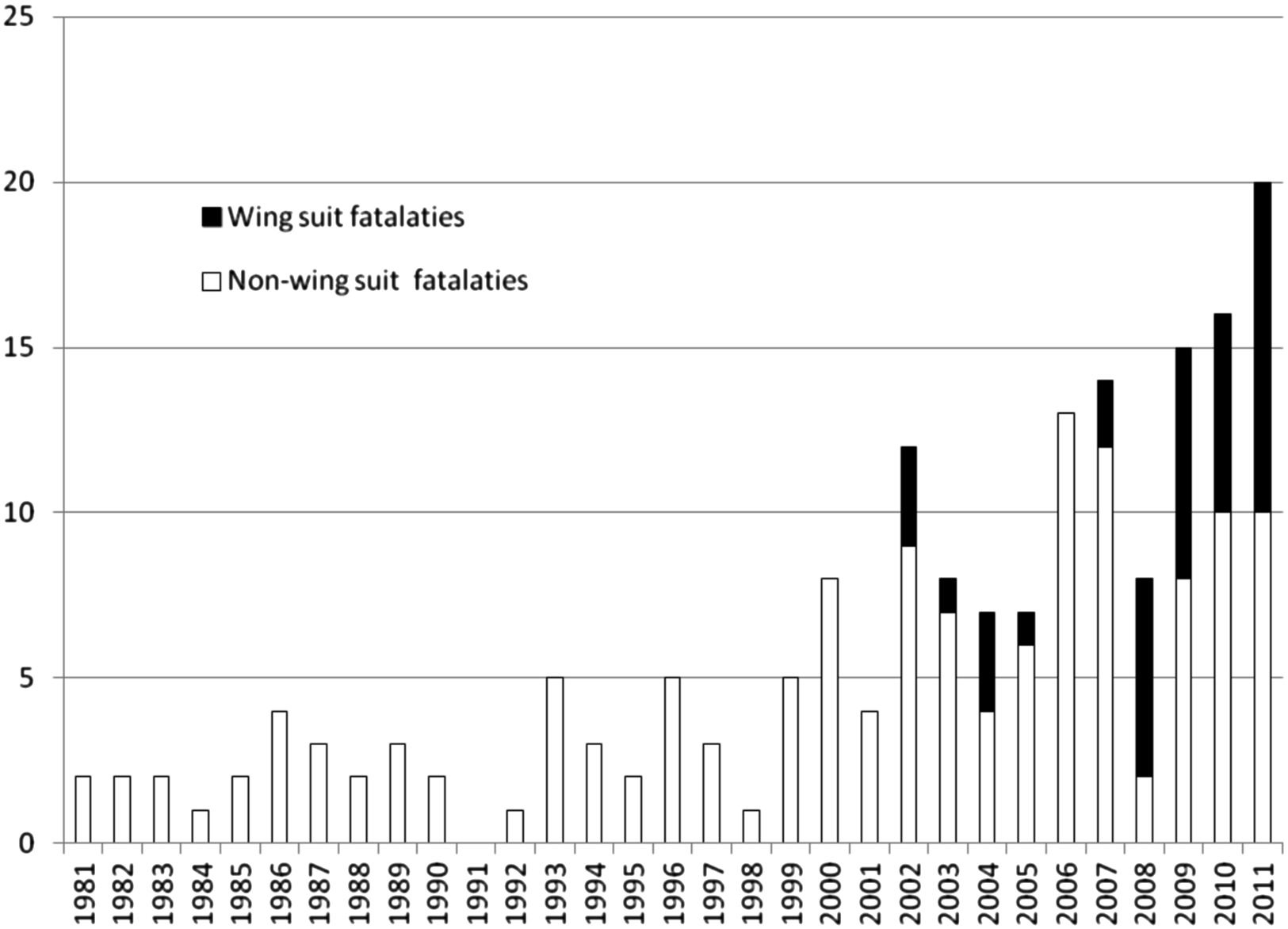
Worldwide fatalities in sport parachuting from fixed objects (BASE jumping) documented by the BASE Fatality List 1981–2011 (n = 180) by year, categorized as related to the use of wingsuits (n = 39) or not related to the use of wingsuits (n = 141). Cases involving the use of glide ratio-enhancing garments that do not use ram-air technology (eg, “tracking pants”) were categorized as not related to the use of wingsuits.
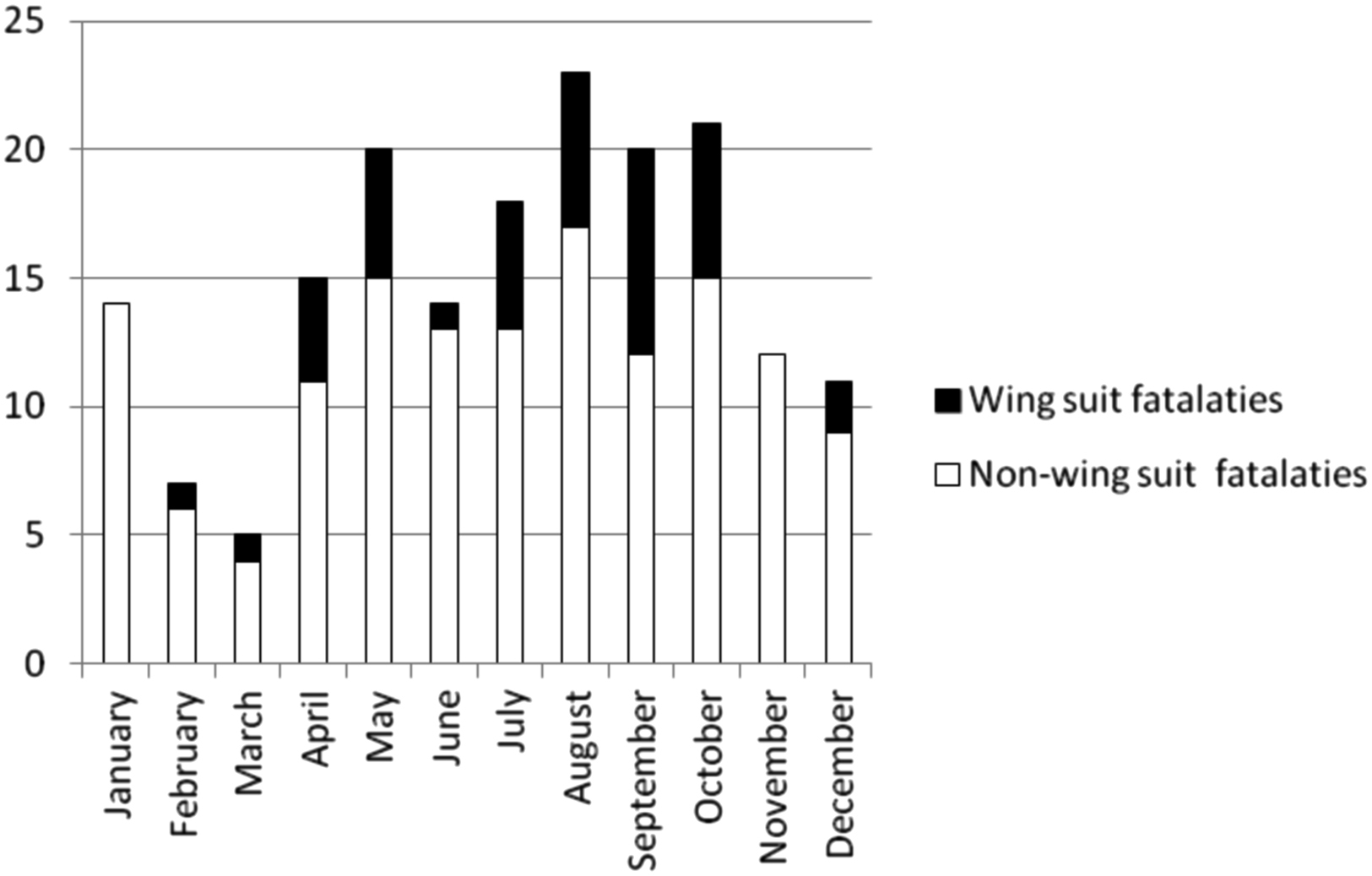
Worldwide fatalities in sport parachuting from fixed objects (BASE jumping) documented by the BASE Fatality List 1981–2011 (n = 180) by month, categorized as related to the use of wingsuits (n = 39) or not related to the use of wingsuits (n = 141). Distribution by month shows an increase of wingsuit-related cases between April and October, possibly reflecting a seasonal increase of activity in the northern hemisphere during its summer.
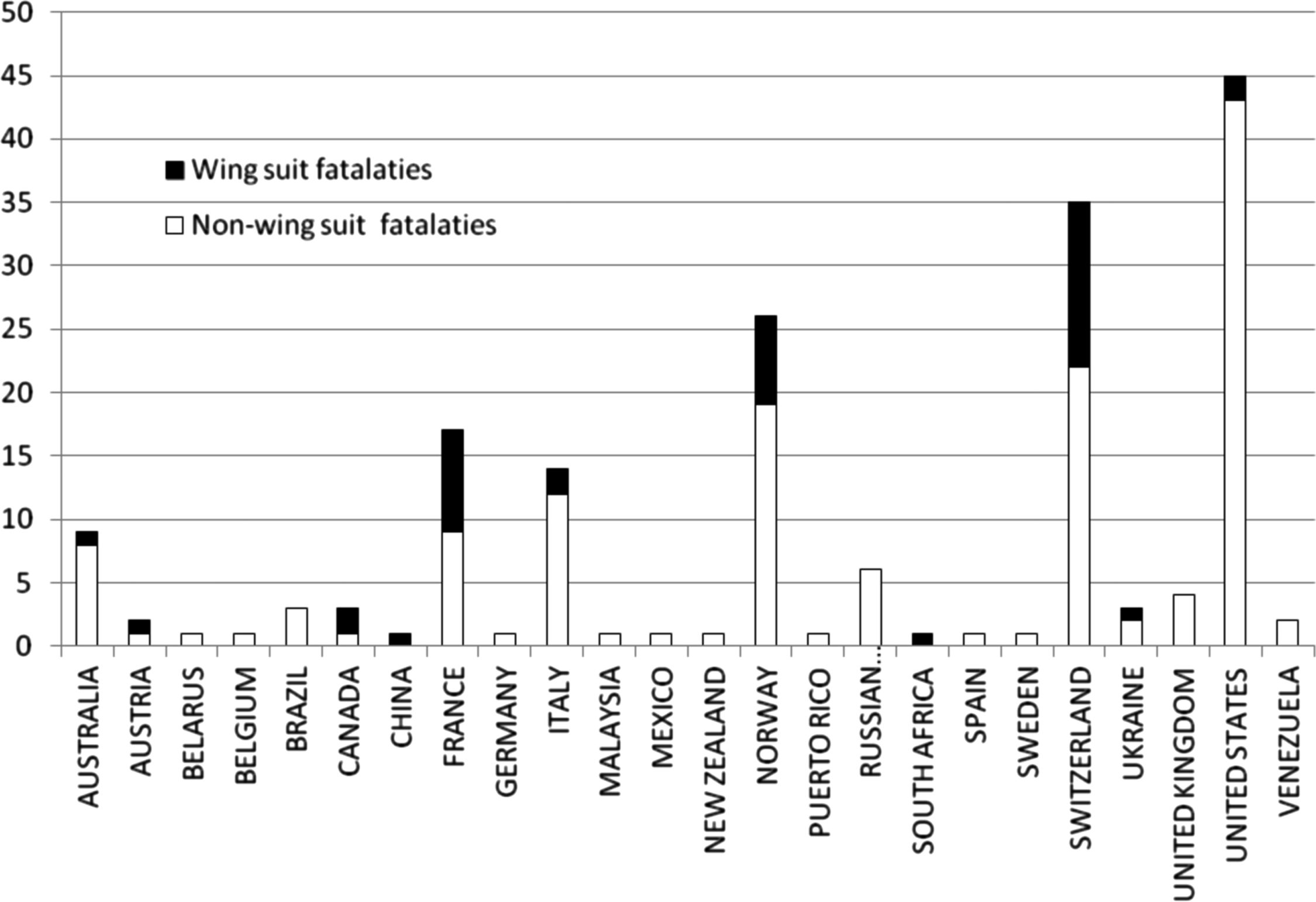
Worldwide fatalities in sport parachuting from fixed objects (BASE jumping) documented by the BASE Fatality List 1981–2011 (n = 180) by country of incident, categorized as related to the use of wingsuits (n = 39) or not related to the use of wingsuits (n = 141). The countries from which most wingsuit BASE jumping fatalities were reported were Switzerland (n = 13), Norway (n = 7), and France (n = 8). Thus, combined these 3 countries accounted for 28 (72%) of all reported wingsuit BASE jumping fatalities. Adding Italy (n = 2), Austria (n = 1), and Ukraine (n = 1) yields the finding that Europe accounted for 32 (82%) of all reported wingsuit BASE jumping fatalities.
Injury and Incident Mechanisms
Of the total of 39 fatalities in wingsuit BASE jumping, 19 (49%) were caused by cliff strikes, 18 (46%) were caused by ground impact, and 1 (3%) was caused by a building strike. In 1 case (3%), the data were insufficient to establish the cause of death. Reported incident mechanisms contributing to fatalities are given in Table 2.
Incident mechanisms contributing to fatality 4
Discussion
Fatality patterns in BASE jumping, one of the world’s most dangerous sports, appear to be changing with an increased proportion of fatal events related to wingsuit flights. The first reported fatal event in wingsuit BASE jumping occurred in 2002, less than 2 years after the introduction of the first commercial wingsuit; at that time sales of these were restricted to experienced skydivers. In approximately half of all fatality cases documented by the BFL from 2008 to 2011, 4 the BASE jumper used a wingsuit compared with only 16% of fatalities between 2002 and 2007.
The rise in wingsuit fatalities and its ratio within the base jumping overall fatalities have reached a new peak during 2013. These have occurred between January and September, with three months still remaining in 2013. There were 19 base jumping fatalities in the first 8 months of 2013. Of these, 17 (90%) were wingsuit related and only two were of jumpers jumping with plain cloth. Eleven of these wingsuit fatalities took place in two consecutive summer months in Europe.
There are no reliable data on the proportion of BASE jumpers who engage in wingsuit flying; however, in our experience (the first author has been an active member of this community since 1999 and was part of the initial wingsuit development team), they constitute a very small proportion of this population. We therefore believe that the current findings indicate that wingsuit BASE jumping is a particularly dangerous category of fixed-object sport parachuting.
Presently there are also no reliable data on the worldwide total number of BASE jumpers, but crude estimates can be made from the number of specialized BASE jumping canopies sold by manufacturers. The leading BASE equipment manufacturer, Jimmy Pouchert of Apex Moab (who also offers instruction and training in BASE jumping), reports a marked increase in the sales of equipment and the number of first BASE jump course participants during the past 3 to 5 years. Pouchert estimates that the number of active (>1 jump per month) BASE jumpers worldwide is approximately 3000, and that there has been a marked increase in the popularity of wingsuit BASE jumping in the past 5 years (personal communication). Stane Krajnc (Atair Aerodynamics) reports a 54% increase of BASE parachute sales in the last 5 years, from 241 BASE canopies in 2006 to 371 BASE canopies in 2011 (personal communication).
There is a sex difference in the wingsuit-related fatality pattern, as one-third of reported male cases were wingsuit-related, but only 7% of reported female cases were wingsuit-related. Thirty-eight of 39 (97%) wingsuit fatalities involved men, and only 1 (3%) involved a woman. BASE jumping appears to be a male-dominated sport. Data from the largest annual BASE jumping gathering event in the world (Bridge Day, West Virginia) indicates that women make up 10 to 12% of the population. The BFL noted a 10% (14 of 141) female nonwingsuit fatality rate. Overall this suggests that women are either less active wingsuit flyers or less likely to participate in this form of the sport than their male counterparts.
Distribution of fatality events by month shows an increase of wingsuit-related fatalities between April and October, most likely reflecting a seasonal increase of activity in the northern hemisphere summer. Seventy-two percent of fatal wingsuit BASE jumps were reported from the 3 mountainous European countries of Switzerland, Norway, and France. Of a total of 39 fatalities in wingsuit BASE jumping, 9 (23%) occurred in the Lauterbrunnen Valley in Switzerland. This area is a very popular jumping site because of its height, spectacular scenery, and relative ease year-round of access to cliff tops.
One of the main reasons for the increase in wingsuit fatalities is likely to be because of the evolution of the wingsuit flying style known as “proximity flying.” When wingsuits were first introduced, jumpers used them to glide as far away as possible from the wall after launching from high cliffs. The essence of proximity flying is exactly the opposite. With developments in suit design and flying experience, better flight-glide ratio suits have been introduced, allowing for greater forward movement as the jumper falls. This has enabled forward flights in close proximity to natural structures, leading to greater appreciation of speed and excitement during the flight. Skilled jumpers can fly within a few meters of rock formations and ledges. As a result of the wing effect of the suit, the actual flight path is determined far above the feature—a mistake in this flight path leads to accidents via a mechanism described herein as wingsuit glide path miscalculation. The rapid development in wingsuit design, combined with the jumper’s motivation to push the boundaries, may in essence have led some jumpers to act as test pilots of new wingsuit concepts.
In the present case series 49% of fatalities were the result of a cliff strike. Cliff strike is typically attributable to a wingsuit glide path miscalculation leading to deployment of the parachute in a confined area. Forty-six percent of cases were a result of ground impact with or without a partial or fully inflated canopy. Ground impact is typically a result of “low pull” caused by the jumper having insufficient altitude for the canopy to fully inflate. Unstable or asymmetric wingsuit flying position on canopy deployment can result in uneven canopy inflation, leading to cliff or ground strike. To date only 1 jumper has survived a wingsuit glide path miscalculation leading to a cliff strike during wingsuit flight; in that case the impact led to multiple lower limb fractures and soft tissue damage, although the jumper returned to the sport within 6 months. 5 To our knowledge, only 1 jumper has deliberately attempted and survived an intentional crash landing with a wingsuit without deploying a parachute, and using cardboard boxes for impact energy absorption. 6 These 2 events suggest that it is possible to land a wingsuit without a parachute; however, for this to occur there would have to be highly favorable biomechanical conditions such as those found in Nordic skiing high jump events, which provide the right friction and type of terrain at the optimal inclination to lessen the effects of impact.
Pilot chute complications were also an important fatal incident mechanism in the present case series. In wingsuit BASE jumping, a particular risk for the pilot chute can be caused by air turbulence created above the jumper by the wingsuit; a burble of air follows the jumper’s flight path and can catch the pilot chute after deployment, delaying or preventing the canopy from being pulled out of the container. If the jumper is aware of this problem at an early enough stage to react by collapsing the wings or changing body position, this can free the pilot chute and initiate the parachute deployment process. However, in at least 1 of the present cases, the pilot chute spun around in the burble so violently that the pilot chute bridle entangled with the pilot chute, preventing its inflation, even though the jumper collapsed his wings and rolled sideways to try and clear the pilot chute.
The process of takeoff is crucial to all flying sports. This is particularly the case in wingsuit BASE jumping, in which the launch presents a very delicate and dangerous stage of the jump, given that the jumper has limited speed and ability to maneuver the body into the appropriate position. If the jumper fails to exit the takeoff in an optimal position and trajectory, or fails to establish an immediately efficient flight, for instance because of slipping on exit, the jumper is likely to fall next to the cliff for a few seconds before gaining sufficient speed to provide an opportunity to regain flight control and to avoid a cliff impact.
Limited experience with wingsuit BASE jumping may contribute to the risk of accidents. In this case series, 8 cases had data on previous wingsuit BASE experience (mean, 26; range, 0–92); 2 of the fatalities involved jumpers undertaking their first wingsuit BASE jump. Wingsuit BASE jumping is technically demanding, and jumpers who decide to pursue this activity should accumulate numerous (hundreds) wingsuit skydives to master flight position and control techniques. In contrast to skydiving, there is no relative wind or fast-flowing air on the wing of a BASE jumper’s wingsuit to make it easier to control during the first stages of the jump or flight. Inability to fly and control the wingsuit during the first few seconds means that even small malpositions may prove fatal. Jumpers who decide to take up wingsuit BASE jumping are therefore urged to practice taking off from a hot air balloon. The calm air around the balloon contrasts with the fast-flowing air from a skydive airplane and has the same lack of relative wind characteristics associated with BASE jumping.
Limitations
Study limitations include those related to data acquisition from an informal database, particularly with varying data entry and the possibility of unreported cases. However, given that BASE jumpers are part of a very tight and small community, every injury and fatality tends to be documented promptly. Future areas of research may include assessment of different training techniques, equipment factors such as flight characteristics of various types of wingsuits, testing and airworthiness of new types of wingsuits, and biomechanical variables. Data on wingsuit trajectories in relation to topography of terrain may be obtained using video recordings and global navigation satellite systems such as the NAVSTAR Global Positioning System (GPS).
Conclusions
Wingsuit-related BASE jump fatalities appear to be increasing as this version of base jumping becomes more popular. Most fatalities are attributed to cliff or ground impact, and most are the result of flight path miscalculation. As with many other extreme sports, limited experience also seems to be a contributing factor to wingsuit fatalities.
Footnotes
Acknowledgments
The authors would like to thank Lori A. Nacius, PA-C, for her assistance in the preparation of the manuscript. We would also like to thank Mick Knutson, Jimmy Pouchert, Stane Krajnc, and Jeb Corliss for their assistance in data collection.
Disclaimer: Authors have nothing to disclose.
Source(s) of support in the form of grants, equipment, and/or drugs: None.