






Abstract
Objective
We describe the epidemiology and clinical features of scorpion stings presenting to an emergency department in Singapore, including that of the venomous species Isometrus maculatus. A management approach to scorpion stings is proposed.
Methods
A retrospective study was done for patients from 2004 to 2009. Cases were identified by searching through emergency department records with ICD code E905, inpatient records, and the hospital toxicology service records. Identification of species was assisted by the Venom and Toxin research program at the National University of Singapore.
Results
A total of 13 cases of scorpion stings were identified. Eleven stings occurred locally, and the remaining 2 stings occurred in neighboring countries. The most common presenting symptoms were pain (92%), numbness (31%), and weakness (23%) confined to the region of the sting. The most common clinical signs recorded were redness (77%), tenderness (77%), and swelling (46%). Only 2 patients had significant alterations of vital signs: 1 had hypertension and the other had hypotension from anaphylaxis. Three patients experienced complications (abscess formation, anaphylaxis, cellulitis) requiring inpatient management. There were no fatalities, and all patients made a good recovery. Three cases were identified to be stings from I maculatus. These cases occurred locally, and mainly had clinical features of pain, redness, and mild regional numbness.
Conclusions
Scorpion stings are uncommon presentations to the emergency department. Most stings cause local reactions that can be managed with supportive treatment. Stings by I maculatus were observed to cause mild, self-limiting effects.
Introduction
Scorpion envenoming is a serious public health problem in some regions. Occasional fatalities are well documented, and these most often occur in children. It is estimated that there are 1.2 million stings annually with a case fatality rate of 0.27%. 1 There are at least 25 to 30 species of dangerously venomous scorpion species worldwide, but these are mainly found in Africa, the Middle East, Mexico, South America, and Central Asia, particularly India. 1 Scorpion venom can cause anaphylactic reaction, neurotoxicity, cardiotoxicity, and autonomic storm, and patients have died of cardiovascular collapse.
Although Singapore is a small industrialized island state, bites and stings constitute 16% of the toxic exposures that presented to the emergency department. 2 There are 2 main species of scorpions in Singapore, and these belong to the families Buthidae (which contains most of the world's medically important species) and Scorpionidae. 3 Locally, there are sporadic cases of scorpion stings, but to our knowledge, there are no documented reports describing the epidemiology of scorpion stings in Singapore. Physicians may be unfamiliar with the acute management of scorpion stings because they occur infrequently.
The purpose of this paper is to describe the epidemiology and clinical features of scorpion stings that present to a local emergency department located in the east of Singapore. Our hospital is 1 of the 6 public general hospitals in this country with about 5 million people. In addition, 3 cases of stings that were identified as being from 1 of the species with potential medical importance, Isometrus maculatus from the Buthidae family, are described in greater detail. A management approach to scorpion stings in the emergency setting is suggested.
Methods
This is a retrospective study of patients with scorpion stings presenting to a local emergency department (ED) from January 2004 to December 2009. Cases were identified by a search of the ICD code E905 from the ED electronic records as well as inpatient case records. In addition, cases were also identified from referrals made to the hospital toxicology service, which was started in May 2008.
Cases were included if the patient sustained injury from a scorpion sting or suspected sting. The case is classified as a definite scorpion sting if the scorpion that stung the patient was brought to the hospital and identified. Cases in which the patients self-reported a scorpion sting were considered probable cases. Cases in which the patient and the clinician highly suspected it was caused by a scorpion sting although a scorpion could not be positively identified were classified as a possible or suspected scorpion sting case.
Cases were identified from the databases, and the case records were traced. A list of parameters that included the epidemiology and the clinical features of the sting were captured on Excel (Microsoft Corp, Redmond, WA) spreadsheets with dropdown lists. The epidemiologic data collected included the age, gender, time of sting, time of presentation to the ED, and the treatment and disposition of the patients. The clinical effects collected included the symptoms and signs accompanying the sting and the development of complications associated with the sting. The 2 authors independently abstracted the cases, and differences were resolved by consensus. Identification of the species of scorpion was assisted by the Venom and Toxin research program from the National University of Singapore. No statistical analysis was performed. The results were expressed as percentages and averages. The study was approved by the institutional review board.
Results
Thirteen cases of scorpion sting were identified during the 6-year period. Nine cases were identified under ICD code E905 from a total of 1078 cases of ED and inpatient records. The remaining 4 cases were identified because they were referred to the toxicology service. There were altogether 3 definite, 8 probable, and 2 suspected cases. The cases are listed in the Table.
Epidemiology, symptoms, and signs of scorpion stings that presented to an emergency department in Singapore, 2004–2009
BP, blood pressure; HR, heart rate.
Verified I maculatus cases.
Possible I maculatus case.
Symptoms with documented physical signs.
Seventy-seven percent of the patients were male, and the mean age was 39 years. Two of the patients were stung overseas: in Johor Bahru, Malaysia, and Bintan Island, Indonesia (both in close proximity to Singapore). Forty-six percent of the cases presented within 1 hour of the sting, and 23% presented between 1 and 4 hours after the sting. Six cases occurred in the day (0600 to 1800 hours), and 7 cases occurred at night (1800 to 0600 hours). Stings occurred most frequently in July (4 cases) and June (3 cases). Three of the patients sustained stings on the lower limbs, 9 patients sustained stings on the upper limb, and 1 patient was stung on his trunk (chest).
The size and color of most of the scorpions were not identified. None of the scorpions were kept as pets or were from captivity. Only 3 cases had photo identification. Cases 9 and 11 featured scorpions that were caught and brought to the ED. Photographs of the scorpions were taken and sent to the Venom and Toxin Research Centre at the National University of Singapore, which identified them as I maculatus (Figure). In case 10, the scorpion was brought to the ED but no photographs were taken. A standard photograph of I maculatus was later shown to the patient and the 2 clinicians who treated the patient, and they concurred that the scorpion looked similar to the one in the picture. Only 3 patients were admitted; the remainder were observed and discharged. A follow-up record was not available for most of the discharged patients except for 1 patient who was seen at the toxicology clinic. The patients received mainly supportive treatment like analgesia and antitetanus toxoid. Antibiotics were prescribed for 6 of 13 patients: 1 who had cellulitis, 1 who had an abscess, and 4 for prophylaxis against infection.
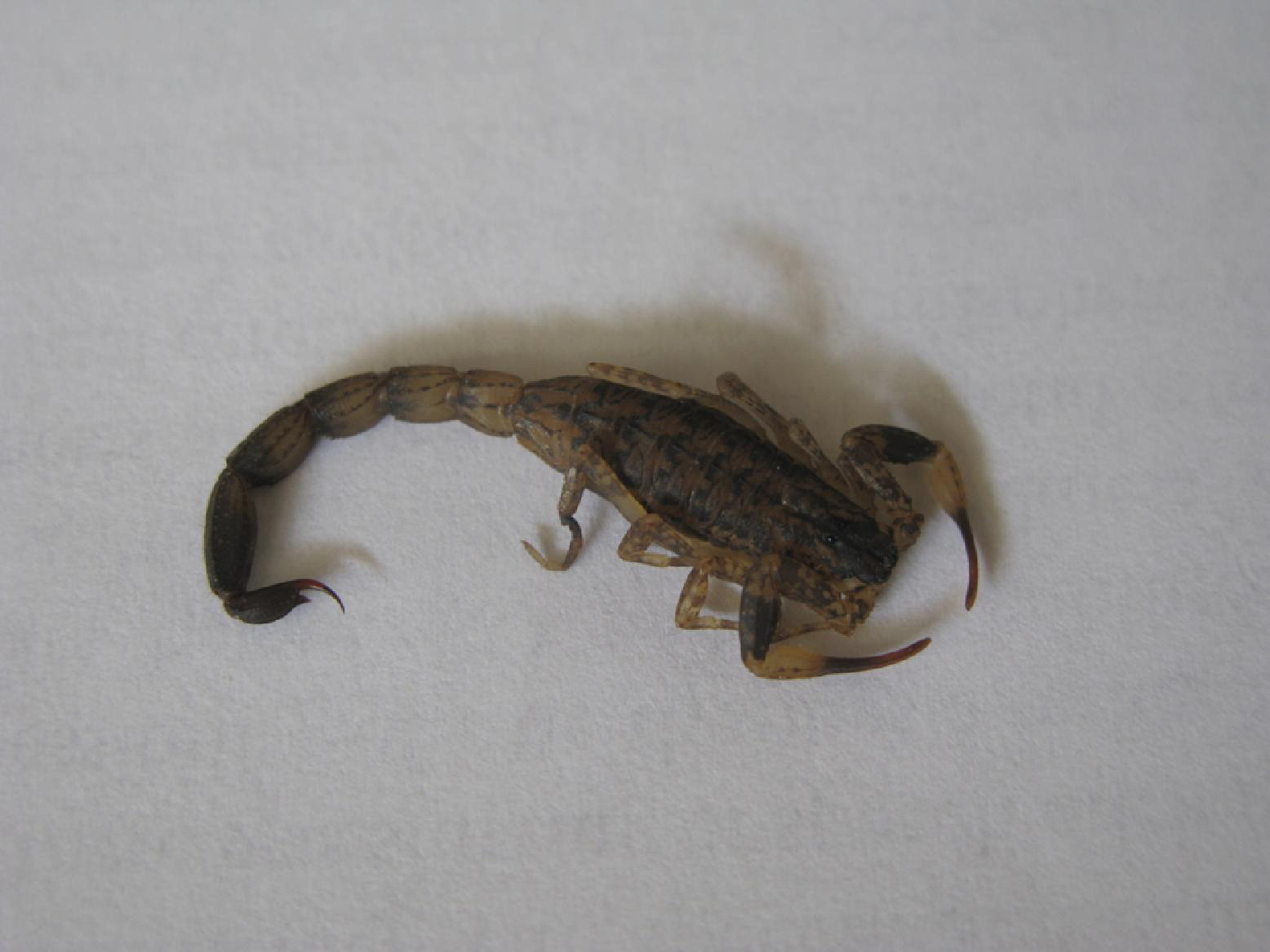
Isometrus maculatus in Case 11.
For the patients who were admitted, the first 2 patients were stung overseas outside of Singapore and they were both admitted for a day. The first patient (Case 1) who was stung in Johor Bahru felt feverish and had chills and mild diarrhea 2 days after the sting. He presented 50 hours after the sting and was treated for cellulitis owing to the scorpion sting as the sting site was red and tender. There was no documented fever, and the laboratory tests were normal. The diagnosis of cellulitis was also not confirmed by any blood or wound culture results. The second patient (Case 5) had anaphylaxis after he stepped on a scorpion in Bintan Island. Thirty minutes after being stung, he experienced shortness of breath, generalized body aches, and erythema, and was found to be hypotensive (blood pressure, 80/50 mm Hg) and tachycardic (heart rate, 110 beats/min). He was treated by a physician at Bintan with epinephrine and dexamethasone, with subsequent resolution of symptoms. However, 16 hours after the sting, he complained of generalized body aches, chest discomfort, giddiness, and nausea. He was later transferred to our ED 20 hours after the sting where he was admitted for 1 day. He did not have any abnormal vital signs when he was seen at the ED, and his symptoms had improved with no signs of anaphylaxis. The last patient (Case 4) had an abscess at the sting site and came to the ED the next day. He was admitted for 6 days and had surgical drainage of the abscess. Culture of the pus grew Staphylococcus aureus. All 3 patients recovered well.
The symptoms and signs experienced by the patients are described in the Table. The most common symptoms were pain (92%), numbness (31%), and weakness (23%). The numbness and weakness were localized to the region where the sting occurred and were confirmed by physical examination for cases 3, 9, 10, and 12. The numbness is defined as decreased sensation or altered sensation, like the presence of paresthesia. In case 3, the patient was stung on his left middle finger and there was mild numbness detected up to the mid forearm. He complained of weakness, but there was no power loss on physical examination. In case 12, the weakness was mild and was attributed to pain as the patient regained normal function after analgesia. The other cases with these symptoms are described below. The most common signs were redness (77%), tenderness (77%), swelling (46%), and puncture wounds (38%). Sixty-two percent (8 patients) of patients had abnormal vital signs (see Table), but they were mostly mild and self-limited and resolved after a period of observation. Only 1 patient (Case 7) had significant hypertension of 201/115 mm Hg. However, he had a history of hypertension, ischemic heart disease, and diabetes mellitus, and his blood pressure improved after analgesia and observation.
Cases With Photo Identification of I Maculatus
Case 9 was a 20-year-old man who was stung by a 5-cm-long brown scorpion on the left chest wall while he was sleeping. He had initial pain at the sting site and 3 hours later developed weakness and numbness of his left upper limb. There was a 1-cm-diameter redness over his left parasternal area at the level of the third intercostal space, but no puncture wound was identified. There was moderate tenderness over his entire left chest wall, anteriorly and laterally. There was no swelling seen. There was decreased sensation to light touch in the whole of his left upper limb from his deltoid downward. Power in his elbow and wrist (both flexion and extension) were decreased 4+/5. Power in his left shoulder was preserved, and no abnormal reflexes were reported. He was treated with analgesia, and his deficits resolved completely 8 hours after its onset. The scorpion was caught and brought to the ED.
Case 10 was a 37-year-old man who was stung on his right thumb by a 5-cm-long brown scorpion while he was sleeping. He felt the scorpion crawling at his neck area and tried to sweep it away with his hand but sustained a sting on his right thumb. He developed pain, swelling, and numbness on his thumb. The numbness, which was described as paresthesia, radiated and spread to his right forearm and elbow. There was erythema and swelling over the pulp of the right thumb with decreased range of movement of the interphalangeal joint of the right thumb. He was treated with analgesia, and his pain improved. The numbness resolved after 3 days. He brought the scorpion to the ED but no photographs were taken. The scorpion was later identified as I maculatus after a picture of the scorpion was shown to the patient and clinicians. He was followed up in the toxicology clinic 4 days later, but his symptoms and signs had resolved. This case can only be considered a possible I maculatus case because the identification was not verified.
Case 11 was a 51-year-old man who was stung by a small 2-cm-long brown scorpion on the right palm over the thenar eminence. He had bought some fruits (langsat) from Malaysia and was washing the fruits when he was stung. He complained of pain and numbness over the right palm. The initial pain score was 5 of 10. His vital signs were normal, and the pain was bearable. There was a small puncture wound with surrounding 1-cm-diameter erythema over the right palm. There was no swelling or ascending redness. However, no objective sensory loss was documented. He was discharged with analgesics and antibiotics (cloxacillin). His pain resolved 12 hours after being stung, and his numbness was resolving by the third day. A telephone follow-up call was made 2 days after the sting, and he reported developing diarrhea and fever the day after the sting, which lasted for a day. He also brought the scorpion to the ED (Figure).
Discussion
Venomous Scorpions
There are approximately 25 to 30 of 1500 species of scorpions that are potentially dangerous to humans, and these primarily belong to the families Buthidae and Scorpionidae. 1 The venom gland of a scorpion is located in the telson or stinging apparatus (last segment of the tail), where the stinger is situated. 3 Some medically important scorpion venoms are composed of neurotoxic peptides that cause neuroexcitation. They act mainly on sodium channels but also act on potassium, chloride, and calcium channels and may cause changes in depolarization of neuroexcitatory cells and modulation of neurotransmission.1,4 Systemic effects may include neurotoxicity, autonomic dysfunction, and cardiotoxicity with resulting cardiovascular collapse. 1 Neurotoxicity can manifest with paresthesia, fasciculation, slurred speech, hyperexcitability, restlessness, coma, convulsion, repetitive eye movement, and nystagmus. Cardiac effects include arrhythmia, heart failure, pulmonary edema, tachycardia, bradycardia, hypertension, and hypotension. 5 Generally most stings inflicted on adults result only in pain and paresthesia, but severe systemic effects occur more commonly in children. 5 For example, Hottentotta tamulus (formerly, Mesobuthus tamulus, Indian red scorpion) is a medically important buthid species. 6 Its venom acts on sodium channels and can cause an autonomic storm manifested by cardiovascular instability, hypertension, acute pulmonary edema, and cardiogenic shock.
Our study suggests that scorpion sting is an uncommon ED presentation in eastern Singapore, considering that there are approximately 150,000 patients attending our ED in a year. The most common presentation is pain. Some of the patients had abnormal vital signs, but they were mostly mild and self-limiting. These effects may not constitute systemic effects of scorpion sting as they could be attributed to pain and anxiety. The most serious effect occurred in the patient with anaphylactic shock. Two patients reported having diarrhea. However, its relation to the scorpion sting could not be verified as there may have been other causes for diarrhea. For example, 1 patient had antibiotics treatment before the symptom onset (Case 11). Two of our patients had wound infections (1 confirmed, Case 4; 1 possible, Case 1) occurring from the sting, but the need for prophylactic antibiotics could not be determined based on just these 2 cases. The redness and tenderness reported in Case 1 could also be attributable to local effects of the venom.
There are 2 mildly venomous species locally: common house spotted scorpion, I maculatus from the Buthidae family, and Asian forest scorpion or black scorpion (Heterometrus longimanus) from the Scorpionidae family. 3
Isometrus Maculatus
I maculatus belongs to the Buthidae family and has been reported in South Pacific countries like Australia,7,8 Japan, 4 Malaysia, Indonesia, and Singapore. 3 It is described as having a pale yellowish brown body with brown spotting on the legs. This scorpion can be found under loose rocks and fallen trees, but can also be found in houses in the attics, basements, and closets as well as under furniture.
Its sting has been reported to produce mainly local symptoms and signs such as severe pain and tenderness, but neurotoxicity features like numbness and paresthesia could also occur.7,8 The venom from this species has been studied, and it resembles that of other buthid scorpions but with less mammalian toxicity. 4 The mechanism of neurotoxicity is by modulation of ion channels in excitable membranes as mentioned above. 4
From our 3 identified cases, the most common presentation from a sting by this scorpion is pain. However, numbness, paresthesia, and weakness can occur. The numbness in Cases 9 and 10 radiated to the surrounding region. Numbness can sometimes be attributed to transient ischemia from local swelling, but in our cases the swelling was not significant. The weakness detected in Case 9 was mild and nonspecific. Weakness can sometimes be attributed to pain or somatosensory amplification because of anxiety. These symptoms can be quite alarming if one is not aware of its range of clinical effects. However, the effects are self-limiting and could be treated with supportive management. The numbness reported in these cases resolved between 8 hours and 2 to 3 days after the sting. The presence of numbness and weakness in these cases can only suggest the possibility of neurotoxicity from this species as the clinical features were quite mild and nonspecific.
For the other 10 cases, the species of scorpion could not be positively identified. Although the scorpion was not seen in Case 3, the presence of symptoms of numbness and weakness makes the diagnosis of scorpion sting by I maculatus likely. Conclusions about the toxic effects from the other venomous species, the Asian forest scorpion, cannot be drawn as the species was not identified. This species is described as glossy bluish black in color and is mainly found in parks and nature reserves. 3
Management
Management of scorpion stings in the ED should include pain relief (with analgesia and cold compress), wound management, and administration of tetanus toxoid. Antibiotics should not be prescribed routinely but only if indicated. Most of the symptoms are self-limiting, and the patients can be reassured that they will recover. The numbness and weakness should be observed and if it is improving, the patient can be safely discharged. There is no need for antivenom administration for scorpion stings causing only local effects. Patients who experience anaphylaxis from a scorpion sting should receive standard treatment with epinephrine, antihistamine, and steroids. Identification of the scorpion is important in locations where life-threatening species may be present as it would involve decisions regarding the use of antivenom. However, care should be exercised to prevent further injury while trying to catch the scorpion. In our local context, identification of the scorpion is less important as the management of the sting is mainly supportive. If the scorpion is caught, identification can be sought from an arachnologist, subspecialized invertebrate zoologist, or an experienced toxinologist. A sting by an unidentified nonlocal scorpion should warrant a longer period of observation if the patient is symptomatic. 9 The neurotoxic and autonomic effects from imported venomous scorpions can manifest with cardiovascular instability.
Limitations
This study is a retrospective study from a single center, and not all the data are available for all the cases. The identity of the scorpion in Case 10 cannot be concluded confidently because the picture of the actual scorpion was not available. The actual incidence of scorpion sting could be higher as there is a high chance of underreporting as the ICD coding may not be accurately used. Also, patients who have mild symptoms do not present to the ED or are attended to by general practitioners. Most of the cases are not identified, and hence it is difficult to attribute the symptoms to particular species. However, this study is an accurate reflection of cases that could present to the ED.
Conclusions
Scorpion sting is an uncommon presentation to our ED in Singapore and can be managed with standard supportive treatment for pain and wound care. Evidence for systemic toxicity from envenomation is lacking. Stings by I maculatus produce local symptoms of pain and redness, as well as mild regional numbness, which are self-limiting.
Footnotes
Acknowledgments
The authors would like to thank Professor Gopalakrishnakone from the venom and toxin research program in the National University of Singapore for his help in writing this paper. We would also like to thank the clinicians from the ED who contributed the cases by referrals to the toxicology service.
Disclaimer: Neither of the authors have any disclaimer to make.
Presented as a poster at the Asia Pacific Association of Medical Toxicologist 10th Congress meeting in Penang, Malaysia, Nov 12–14, 2011.