






Abstract
Objective
Hydration is an important logistical consideration for persons performing in austere environments because water demands must be balanced with the burden of carrying water.
Methods
Seven novice climbers participated in a study to determine the hydration kinetics and core temperatures associated with a successful summit of Mount Rainier. Ingestible radio-equipped thermometer capsules were swallowed to monitor core temperature, and an oral dose of deuterium (0.12 ± 0.02 g · kg−1 body weight) was administered to determine hydration kinetics.
Results
Mean core temperature throughout the 5.5-hour climb to Camp Muir (3000 m) was 37.6 ± 0.3°C. Water turnover was 95.0 ± 17.5 mL · kg−1 · 24 h−1 over the duration of the 43-hour study. There was a trend for reduced body mass from before (75.9 ± 13.0 kg) to after (74.8 ± 12.5 kg) the climb (P = .06), and urine specific gravity increased from before (1.013 ± 0.002) to after (1.022 ± 0.006) the climb (P = .004).
Conclusions
Hydration demands of climbing Mount Rainier are highly elevated despite modest fluctuations in core temperature. Participants experienced hypohydration but were able to maintain sufficient hydration to successfully summit Mount Rainier and return home safely.
Introduction
Maintaining sufficient hydration is challenging but necessary during many extended sport and work scenarios.1,2 The performance decrements associated with pronounced dehydration during mountaineering, wildland fire suppression, and military operations can have high consequences such as injury or death. Whereas most sports have a sideline with unlimited quantities of fluids, the athletes who choose to participate in more austere endurance activities such as mountaineering and wildland firefighting are limited to the amount of fluid they can carry. Unfortunately, the additional weight of carrying fluids can increase the required work, thus hastening fatigue and increasing the likelihood of injury. 3
To reach the summit of Mount Rainier by the most popular route requires ascending approximately 2700 m (9000 feet) in 14.4 km (9 miles) and then descending the exact same distance, which for most people requires 2 days. During this climb, climbers carry 15 kg to 25 kg of the necessities for life including food, water, climbing safety equipment, and shelter. This pack weight is in the range of the Army‘s current doctrine for recommended pack weight (22 kg for fighting and 33 kg for approach loads). The weight of climbing equipment, food, and shelter is relatively static, but the amount (and thus weight) of water can vary considerably. Water is one of the denser items in a climber's backpack, and it is important to understand the balance between enough water for safety but not so much that it impedes performance. Professional guides have determined, through years of experience, that this balance is most often met by carrying 2 L water on Mount Rainier.
High altitude environments are typically cold and dry compared to sea level. That can lead to increased respiratory water loss accentuated by the increased ventilation caused by both the increased activity of climbing and the reduction in atmospheric pressure. Sweat loss, the primary source for water loss during physical activity, can be minimized in the low ambient temperatures if core temperature remains low while climbing.
The purpose of this research study was to monitor core temperature during the warmest part of the climb and determine the fluid kinetics and resultant total body water of climbers ascending Mount Rainier by the standard route, using the most typical climbing schedule with the assistance of professional guides. We hypothesized that, while ambient temperature would remain cool and core temperature would increase mildly in response to exercise, hydration demands would be highly elevated for participants during the course of the climb compared with that of active adults in a low altitude environment.
Methods
Climbing Mount Rainier
Nine male participants gave informed consent to participate in a research protocol approved by the University of Montana's Internal Review Board. All participants were attempting to summit Mount Rainier 4939 m (14,410 feet) with the assistance of professional mountain guides. No participant had been above an altitude of 1500 m for at least 3 weeks before the study. Participants were recruited by word of mouth during an orientation session 2 days before the climb began. Seven participants (body mass 75.9 ± 13.0 kg; age range, 18 to 40 years) completed the whole trip and were included in the analysis. Two participants did not summit Mount Rainier owing to factors unrelated to this data collection. Two participants were taking acetazolamide to reduce the incidence of acute mountain sickness.
Data collection occurred over the course of 4 days. The ascent schedule was very similar for all participants and was based on the 40-year experience of the guiding company. The climb lasts approximately 30 hours, with 5 hours of movement and 1 hour of rest ascending from 1600 m to 3000 m, 9 hours of rest at 3000 m, 5 hours of movement and 1.5 hours of rest ascending to 4393 m, and 6 hours of movement and 2 hours of rest descending back down to 1600 m. At the start and finish of this expedition, climbers take a shuttle from 500 m to 1600 m. The ascent schedule can be seen in Figure 1. All climbers were within 30 minutes of this expedition schedule. The guide service uses a rather strict climbing regime between 1600 m and 3000 m that has proved to minimize the physical strain and maximize the number of climbers who reach the summit. This climbing regime consists of 60 minutes of continuous, constant pace climbing and 15 minutes of rest. Climbers' primary responsibility during the rest period is to eat and drink. This ascent regime requires 5 stages (namely, 60 minutes of climbing and 15 minutes of rest) to reach intermediate Camp Muir (3000 m). Above 3000 m, work and rest intervals vary and are determined by the topography but are consistent from climb to climb.
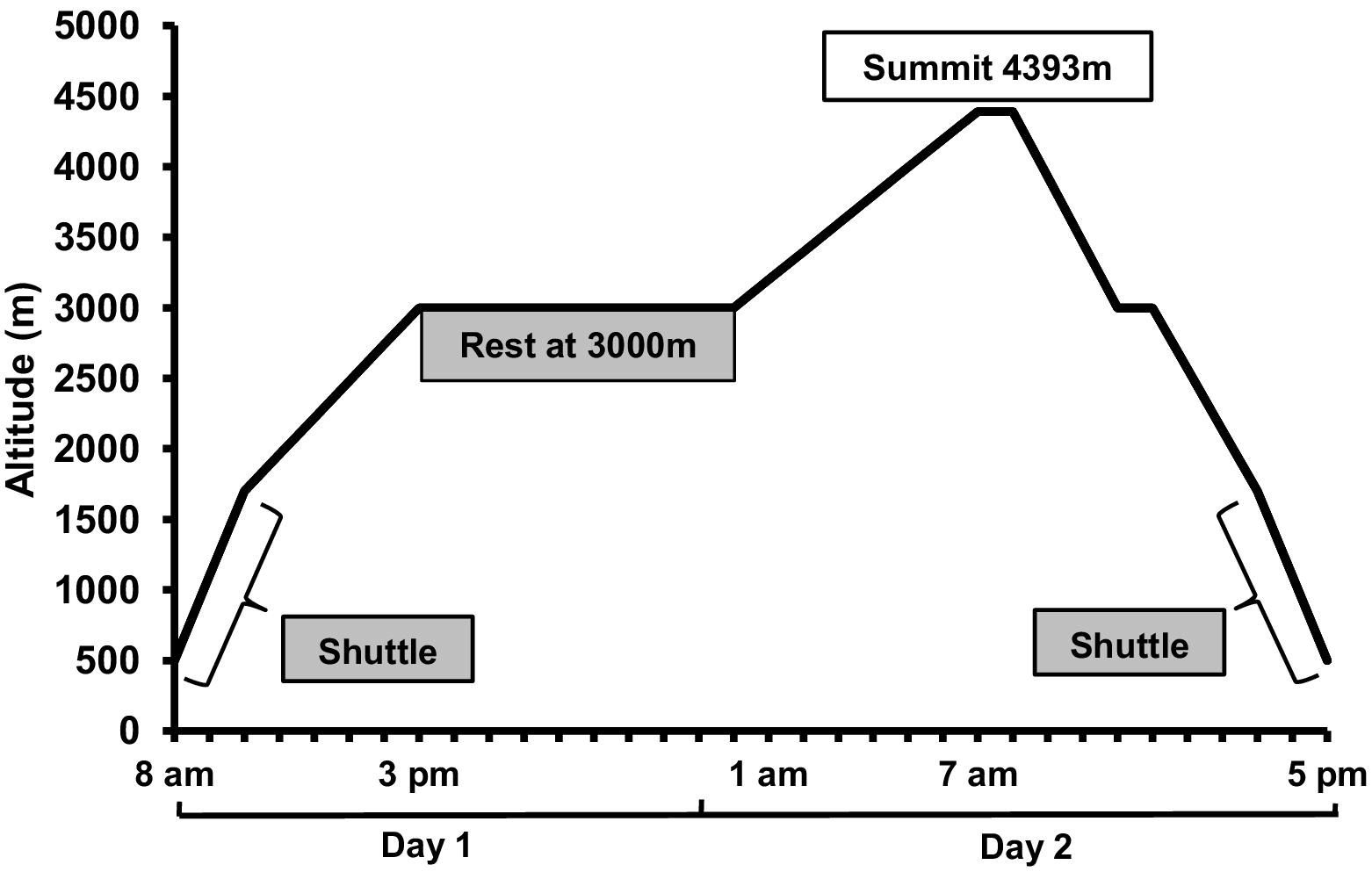
Ascent schedule and altitude profile during a typical summit climb of Mount Rainier with professional guides.
Body mass was collected the evening before beginning the climb (at 2200 hours) and upon return from the mountain (ranging from 1650 to 1842 hours) using an electronic scale (Befour Inc, Cedarburg, WI). These 2 measurements mark the beginning and end of data collection for each participant. Core temperature was continuously measured using an ingestible radio-equipped thermometer capsule and Vital Sense monitor (Mini-Mitter Co, Bend, OR) during the initial ascent to Camp Muir (1600 m to 3000 m). Core temperature capsules were ingested the evening before the climb began to ensure the capsules were past the stomach for the duration of the climb.
Weather Data
Ambient temperature, relative humidity, and wind speed were recorded every 3 s by a remote weather station (maintained by the Northwest Avalanche Center) located at the intermediate camp (Camp Muir), at an altitude of approximately 3000 m on the south side of Mount Rainier.
Water Turnover
At 2200 hours the evening before the climb began, each climber consumed a measured oral dose of 0.12 ± 0.02 g 2H2O (deuterium) per kilogram of body mass. The dosing procedures and analysis were similar to previous work completed by this laboratory. 4 Urine samples were collected immediately before ingesting the dose, at second void (between 0545 and 0710 hours) the morning of the climb to Camp Muir, and at first void after returning from the climb (between 1650 and 1842 hours) the following day. Urine samples were collected in 5-mL cryogenic vials and stored on ice for the duration of the experimental period. During the first night after dosing, overnight and first void urine volumes were collected and measured.
Isotopic Analyses
The Nutritional Sciences Laboratory at the University of Wisconsin, Madison, Wisconsin, conducted isotopic analyses of all urine samples. Each urine sample was mixed with approximately 200 mg of dry carbon black and filtered through a 0.22-μm filter to remove particulate materials and much of the organic material. Two 1-mL aliquots of each specimen were placed in 2-mL septum sealed, glass vials. Deuterium analysis was performed by reducing 0.8 μL of cleaned fluid over chromium at 850°C, which produces pure H2 gas that is introduced to a Finnigan MAT Delta Plus isotope ratio mass spectrometer (Thermo Scientific, Waltham, MA). 5 Deuterium abundance was measured against a working standard using a standard dual-inlet, Faraday cup, differential gas isotope ratio procedure. Enriched and depleted controls were analyzed at the start and end of each batch, and these secondary standards used to calculate the “per mille” abundance versus standard mean ocean water for each urine sample. All analyses were performed in duplicate, and all specimens from the same participant analyzed during the same batch. Results were corrected for any memory from the previous chromium reduction process. If duplicates differed by more than 5/mL, duplicate analyses were repeated. Isotope dilution space was calculated as described by Cole and Coward. 6 Total body water was calculated by averaging the deuterium dilution space divided by 1.041.
Statistics
Body mass and urine specific gravity were compared over time using paired t tests (Microsoft Excel 2007, Seattle, WA). Significance was set at the P ≤ .05 level. All data are represented as mean ±SD.
Results
The data collection lasted 44 ± 1 hours. There was a trend toward reduced body mass from before the climb (75.9 ± 13.0 kg) to after the climb (74.8 ± 12.5 kg; P = .06). Participants (n = 7) had a mean total body water of 45.5 ± 4.9 L before the climb, and had a loss of 1.1 ± 1.3 L total body water during the data collection period. The participants had a mean water turnover of 10.5 ± 1.7 L over the course of the data collection. That is equal to 7.1 ± 1.1 L · 24h−1 or 95.0 ± 17.5 mL · kg−1 · 24h−1. The urine specific gravity increased (P = .004) over the course of data collection (1.013 ± 0.002 and 1.022 ± 0.006 for pre- and post-climb values, respectively).
The 2 participants (“A” and “B”) taking acetazolamide had water turnovers of 6.2 L · 24 h−1 (A) and 7.1 L · 24 h−1 (B); or 105.4 mL · kg−1 · 24 h−1 (A) and 109.4 mL · kg−1 · 24 h−1 (B). These 2 participants had body masses of 58.6 kg (A) and 64.7 kg (B) at the beginning of data collection. From before to after the climb, urine specific gravity increased for both A (1.014 to 1.016) and B (1.015 to 1.024).
Core temperature increased in response to physical activity and then quickly decreased during rest periods (Figure 2). Mean core temperature during the first 8 hours of ascent was 37.6 ± 0.3°C, maximum core temperature was 38.2°C, and minimum core temperature was 37.0°C. Mean ambient temperature during this initial 8 hours of ascent was 4.4 ± 0.7°C, maximum ambient temperature was 10.5°C, and minimum core temperature was −1.0°C. Mean, maximum, and minimum relative humidities were 61.9% ± 8.5%, 98.2%, and 19.2%, respectively. Mean, maximum, and minimum wind speeds were 4.4 ± 1.4 km · h−1, 18.7 km · h−1, and 0.6 km · h−1, respectively.
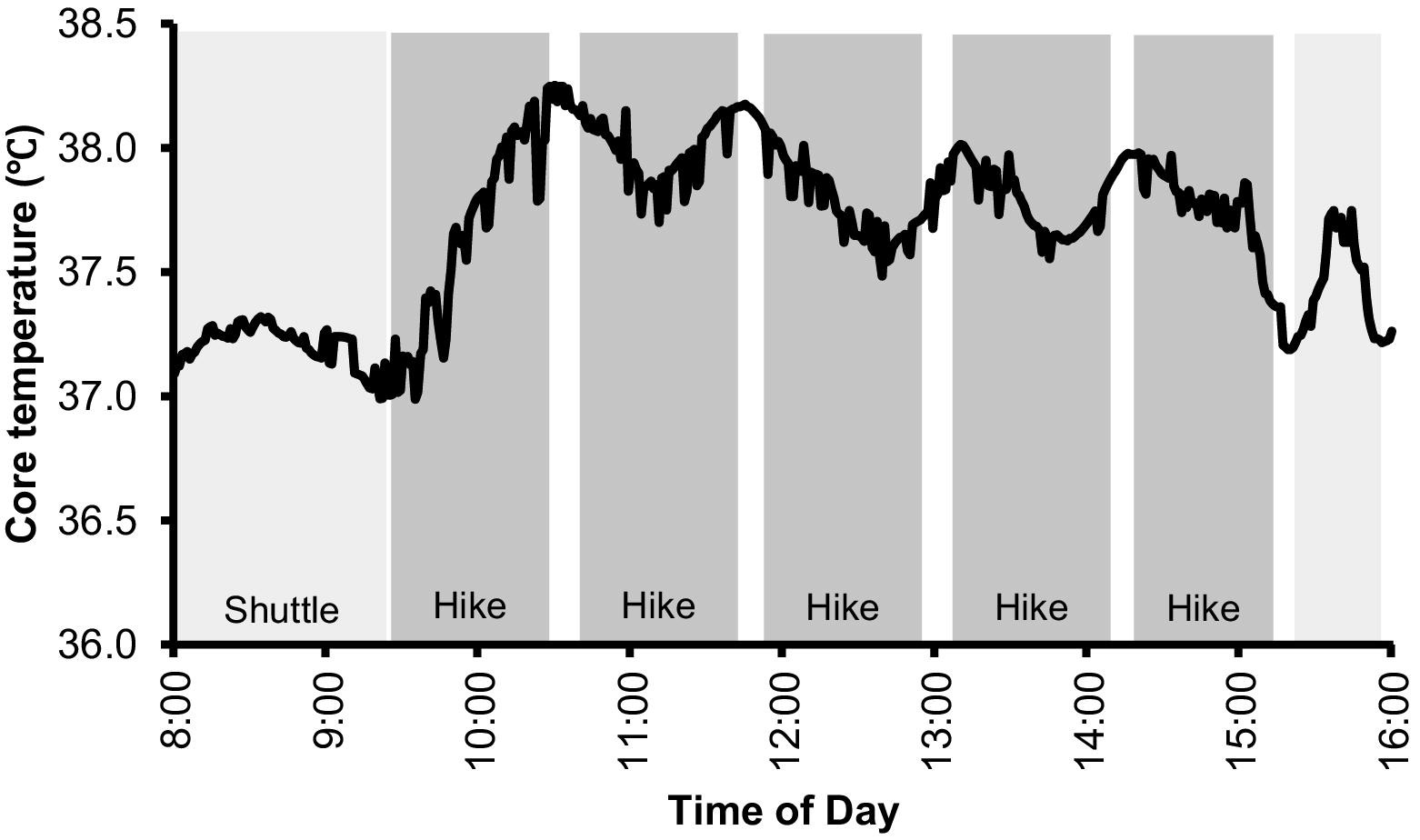
Mean core temperature of climbers (n = 7) ascending from 500 m to 3000 m. The ascent includes a 90-minute shuttle ride, 5 hours of hiking at approximately 300 m vertical per hour, and 30 minutes making camp at 3000 m.
Discussion
The climbers in this study who reached the summit had a water turnover rate similar to that of wildland firefighters (94.8 ± 20.1 mL · kg−1 · 24 h−1) drinking ad libitum while working on the fire line in high temperatures ranging from 32.0 to 38.9°C and lows from 6.9 to 23.4°C with 25 to 72% relative humidity. 4 The current rate was higher than the water turnover measured during extended moderate altitude trekking (79 ± 17 mL · kg−1 · 24 h−1) and high altitude mountaineering expeditions (73 ± 20 mL · kg−1 · 24 h−1), 7 and for sedentary males (36 mL · kg−1 · 24 h−1). 8 The increased water turnover rate in the current study may be explained in part by the relatively short (2-day) nature of climbing Mount Rainier compared with extended trekking and high altitude expeditions.
Climbers ascending with the assistance of professional guides are encouraged to carry 2 L fluid for the first 5 to 5.5 hours of climbing to intermediate Camp Muir, 2 L for the 12-hour summit attempt, and 0.5 L for the 2.5-hour descent from camp Muir (Walter Hailes' personal communication with professional guide company). A typical climbing schedule can be seen in Figure 1. This equates to approximately 0.36 L · h−1 for the approach climbing, 0.2 L · h−1 for the summit attempt, and 0.2 L · h−1 for the descent from Camp Muir. For a comparison, the lower end of suggested fluid consumption rates for marathon runners amounts to approximately 0.4 L · h−1. 1 Persons climbing with guides on Mount Rainier do have access to unlimited quantities of water while at intermediate Camp Muir and are encouraged to purposefully consume water and food so that they are adequately nourished for the summit attempt the next morning.
Many novice climbers believe that carrying 2 L water is inadequate for a summit attempt that will last approximately 12 hours. However, by carrying 2 L water when climbing and taking advantage of the adequate supply of water at intermediate Camp Muir, the climbers in this study effectively managed dehydration during the course of the 43-hour study. The climbers who reached the summit only lost approximately 1.4% ± 1.6% body mass over the duration of the data collection period. Assuming that all mass loss was from total body water, the climbers lost less than the accepted hypohydration equivalent to 2% body mass reported to impair athletic performance. 2 However, this hydration response is supported by previous research demonstrating that persons with unlimited supplies of fluids are reluctant to fully replace water loss ad libitum during activity. 9 Cheuvront et al 10 have also demonstrated that hypohydration does not always affect performance in cool environments. The minor hypohydration and the cool environment lead to the conclusion that the fluid intake of these climbers is adequate for the task and probably does not result in decreased performance that could lead to a reduction in safety. Additional research into the impact of ambient temperature and hypohydration on performance would improve the understanding of safety for persons who work and play in austere environments.
Study Limitations
As with all scientific data collected in the field, there are limitations to the precision and scope of the present data. The small sample size limits statistical power, as seen in the trend for decreased body mass during this collection period. The weather station was measuring the environment at 3000 m, not the exact environment of the ascent. Therefore, the ambient environment of the climbers was probably warmer than the reported mean. The diuretic effects of acetazolamide can influence hydration, which is an important factor to consider when taking this medication. The absolute water turnover of these participants fell within the normal range of this sample population, but their water turnover per kilogram of body mass was high due to their low body mass. This research was limited by the duration needed for isotope dilution to determine accurate water kinetics. Future research using different methods could determine the hydration status of climbers during each stage of ascent and descent. This would clarify the hydration demands of each portion of the climb. Data were collected on Mount Rainier only and does not include information about other ascent schedules, routes of ascent or mountain environments.
Conclusions
The typical Mount Rainier ascent schedule imposes substantial physical stress on climbers; fit, novice climbers are able to manage this stress and reach the summit. The fluid demands during this activity are substantially elevated compared with those of sedentary and active persons at low altitude. In spite of the limiting effects of climbing at altitude on hydration maintenance, these climbers were able to maintain sufficient hydration while summiting Mount Rainier.
Footnotes
Funding
This work was completed in association with the Center for Work Physiology and Exercise Metabolism at the University of Montana; and was sponsored by Air Force Surgeon General #FA7014-09-C-0010-P00001.
Acknowledgments
We would like to thank Rainier Mountaineering, Inc, for their support during data collection.