






Abstract
Objective
Halogen-based water disinfection tablets may render an unpleasant taste to treated water. Proposed safe additives such as ascorbic acid may reduce this objectionable taste. We compared the palatability of 2 field water disinfectants: iodine-based tetraglycine hydroperiodide (TGHP) and chlorine-based chlorine dioxide (CD) both with and without the concomitant use of an ascorbic acid taste neutralizer.
Methods
Blinded participants randomly sampled 5 different distilled water samples containing combinations of disinfectant tablets and ascorbic acid: 1) water; 2) water with TGHP; 3) water with CD; 4) water with TGHP plus ascorbic acid; and 5) water with CD plus ascorbic acid. Participants rated beverage taste via a 100 mm visual analogue scale (VAS) and ranked the samples from “most pleasant” to “least pleasant.”
Results
Sixty participants evaluated the samples. On the VAS, water with TGHP tasted worst and water with CD tasted second worst. Water with TGHP plus ascorbic acid, water alone, and water with CD plus ascorbic acid measured similarly as significantly best tasting. Water with TGHP was ranked by 58% as “least pleasant” tasting, while water with TGHP and ascorbic acid was ranked by 40% as “most pleasant” tasting.
Conclusions
Participants found halogen-based disinfected water significantly less palatable prior to the addition of ascorbic acid. Addition of ascorbic acid to treated water created a beverage of similar preference to distilled water. These results may increase compliance with the use of disinfecting tablets by increasing the palatability of drinking water made potable via addition of ascorbic acid to halogen-based chemical disinfection.
Background
Due to a variety of microbial pathogens, almost no untreated surface water should be considered safe to drink. 1 –3 There are many ways of disinfecting water on both large and small scales, including (but not limited to) filtration, heat, ultraviolet light, and chemical. Worldwide, chemical disinfection by halogen-based iodine and chlorine-containing compounds are the most commonly used methods of disinfection. 4 They offer convenience for both individual and group use because of the minimal equipment required and their technical ease.
When used appropriately, popular commercially available field water disinfection tablets relying on the action of halogens have been proven effective at rendering most water sources safe for human consumption.4,5 Halogens and related halogen-based disinfectants act as strong oxidants that destroy essential cellular structures and enzymes of water-borne pathogens.
4
–6 Of the halogens, iodine is the least reactive with organic compounds and tends to form relatively stable residual concentrations in treated water.
4
Chlorine-based chlorine dioxide, which is frequently used in municipal water treatment facilities, is the disinfectant shown to be most effective against
Chemical additives such as ascorbic acid are commonly used to reduce the unpleasant taste of halogen-treated water. 4 ,6,7 One Vietnam era study found that Marines commonly added drink mixes to canteen water to conceal the taste of water treated by TGHP. 7 Later studies found that the ascorbic acid contained in some of these drink mixes reduced the active disinfectant elemental iodine to relatively tasteless and odorless iodide, which contains little residual germicidal activity. 4 ,7,8 If used before the completion of disinfection, ascorbic acid may improve palatability but would be expected to reduce the disinfection effectiveness of iodine. We were unable to locate recent relevant studies in the available literature that address the effectiveness of improving the taste of halogen-treated water through the addition of ascorbic acid. We sought to compare the palatability of distilled water with water disinfected by 2 popular halogen-based chemical water disinfectants (TGHP and chlorine dioxide) with and without the addition of ascorbic acid.
Methods
This study was granted exemption from continuing review by our study site Institutional Review Board, and the need for formal informed consent was waived. Volunteer participants were enrolled as blinded “taste testers” at Madigan Army Medical Center at Fort Lewis, WA. All participants were healthy, nonpregnant adults with no known drug or food allergies, including known adverse reactions to iodine or iodine-containing compounds.
Five different water-based samples were tested by the study participants: 1) distilled water; 2) distilled water with tetraglycine hydroperiodide (TGHP); 3) distilled water with chlorine dioxide (CD); 4) distilled water with TGHP plus ascorbic acid; and 5) distilled water with CD plus ascorbic acid. The TGHP (Potable Aqua Drinking Water Germicidal Tablets: Wisconsin Pharmacal Company, Jackson, WI), CD (Potable Aqua Chlorine Dioxide Water Purification Tablets: Wisconsin Pharmacal Company, Jackson, WI), and ascorbic acid (PA Plus Tablets: Wisconsin Pharmacal Company, Jackson, WI) additives are all readily available to the lay consumer. The water disinfectants and ascorbic acid additives were mixed according to the manufacturer's instructions located on the package. When prepared as directed, solutions containing approximately 16 ppm of titratable iodine, 4 ppm of chlorine dioxide, and 45 mg of ascorbic acid per L of water are produced. 8 By design, the quantity of ascorbic acid in solution is sufficient to reduce all 16 ppm of titratable iodine when used in combination with TGHP. 8 Samples were kept at room temperature and were used on the day that they were made. Approximately 10 mL of each sample was placed in opaque cups with a lid and straw to inhibit the sight and smell of the sample. Participants were blinded as to the identity of each beverage.
Taste testers were instructed not to eat, drink, or chew gum 30 minutes prior to participation. They were given 5 numbered cups containing one of each different beverage sample. The order in which the different beverages were sampled was randomized in a predetermined, rotating fashion to reduce potential order effect. Participants sampled beverages during individual sessions without interaction with other study participants and were instructed to withhold discussing details regarding their tasting experience until after completion of the study period that day. After each sample, the participant immediately rated the taste of the beverage via a 100 mm visual analogue scale (VAS) by placing a vertical dash on the horizontal VAS line. The VAS is a well described means of assessing the palatability of a variety of beverages and foods.9,10 The left margin (0 mm) represented a “very bad taste” and the right margin (100 mm) a “very good taste.” Between beverage samples, the participants were instructed to cleanse their palate by eating a small soda cracker. After sampling all 5 beverages, the participants were instructed to rank the samples from the “most pleasant” to the “least pleasant.”
For each sample, the 100 mm VAS result was described by its mean value with 95% CI with testing for significance via a 2-tailed
Results
Sixty participants evaluated the samples. On the VAS, distilled water with TGHP measured as significantly worst tasting (mean VAS: 23.7 mm;
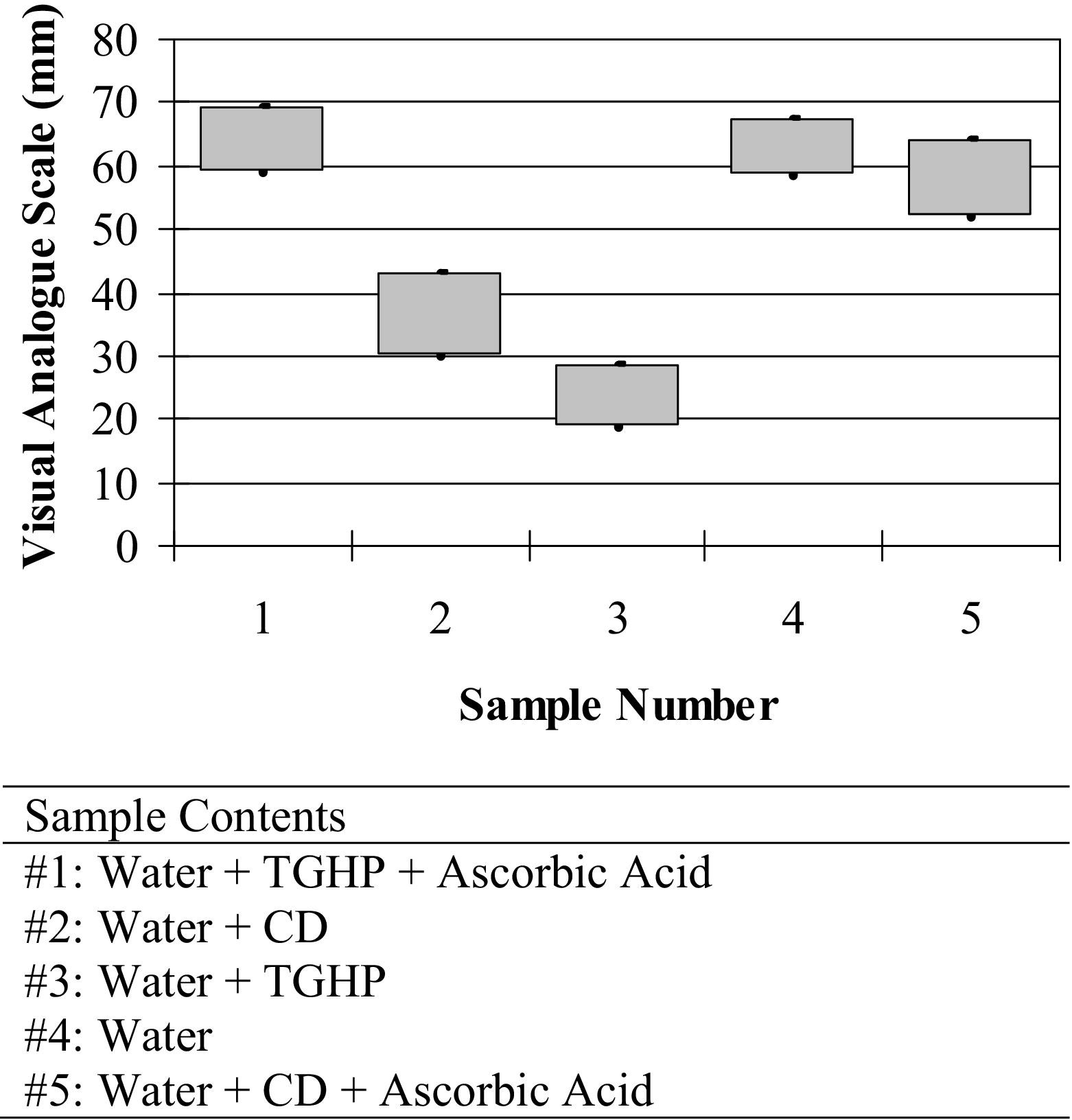
Mean palatability visual analogue scale measurements by 60 participants of the 5 water samples shown with 95% confidence intervals (Water = distilled water, TGHP = tetraglycine hydroperiodide, CD = chlorine dioxide).
Overall ranking of the 5 water samples (
TGHP, tetraglycine hydroperiodide; CD, chlorine dioxide; water, distilled water.
Discussion
This study sought to characterize the relative palatability of halogen-based chemically treated water samples with and without a common “taste neutralizer” when rated by study participants. While iodinated water is a globally effective and available water disinfectant, our participants rated its taste “least pleasant.” Similarly, the water treated with chlorine dioxide lacked relative palatability. Proper and safe hydration can be an obstacle in austere environments when the choices of beverages may be limited to water only. The relatively displeasing taste of chemically disinfected water, although creating more potable water, may also create a barrier to proper hydration.
In our study, we observed that the addition of ascorbic acid truly did eliminate the unpleasant taste of water treated with halogen-based chemical disinfectants. The addition of the ascorbic acid rendered the 2 treated water samples statistically indistinguishable from water alone. The implication of this finding is that, with use of a taste neutralizer, halogen-disinfected water can be as palatable as water without disinfectants, and the taste neutralizer removes any taste barriers to hydration. Interestingly, when selecting the most and least pleasant sample, the majority of participants in our study ranked the iodinated water to be the “least pleasant” tasting sample and ranked the iodinated water with the addition of the ascorbic acid taste neutralizer “most pleasant.” Regardless of bench-top efficacy, a truly effective disinfectant in the real world setting is one that is likely to be used properly and consistently. Thus, if taste is a barrier to the use of chemical water treatments, this study demonstrates that the addition of ascorbic acid may be able to eliminate or reduce this barrier. However, when using ascorbic acid as a taste neutralizer in iodinated water, it is critical to add the neutralizer after treatment time is completed because it will eliminate germicidal activity if applied prior to completion of treatment.
Some potential limitations to this study should be acknowledged. While distilled water was used in all samples, different water sources and the presence of minerals may create differing intrinsic palatability, possibly resulting in different overall palatability results. Also, we examined the taste using room temperature water. The differences observed may not be seen with water at colder or warmer temperatures. The magnitude of our findings was likely influenced by the relatively high concentrations of chemical disinfectants when prepared using the manufacturer's instructions. Such differences may not exist when lower concentrations of TGHP or CD are used. It is also uncertain if the palatability observations of TGHP or CD can be assumed to be the same in other iodinated and chlorinated forms of water. It can be debated whether or not the VAS or sample ranking findings between beverages indicate a field difference in addition to a statistical difference. Finally, each participant consumed only a small amount of each water sample. In more realistic conditions, a much larger volume of disinfected water would be consumed. We have assumed that the differences in palatability that we observed would also apply to these larger volumes.
More research is needed to demonstrate the true effect of this finding on usage patterns of chemical water disinfection. Clinically relevant future studies could focus on whether adding the ascorbic acid or other taste neutralizers lead to more proper or consistent use of halogen-based disinfectants. Additionally, hydration status could be monitored as a marker for willingness to consume adequate amounts of the plain treated or taste-neutralized water sources. Whether these results will have an impact on public health and rates of disease remains to be seen; at a minimum, it provides scientific and statistical background to support the use of ascorbic acid taste neutralizers to improve the palatability of water treated with commercially available halogen-based chemical purification agents.
Footnotes
Disclaimer: The views expressed herein are solely those of the authors and do not represent the official views of the Department of Defense or Army Medical Department.