





Abstract
To the Editor:
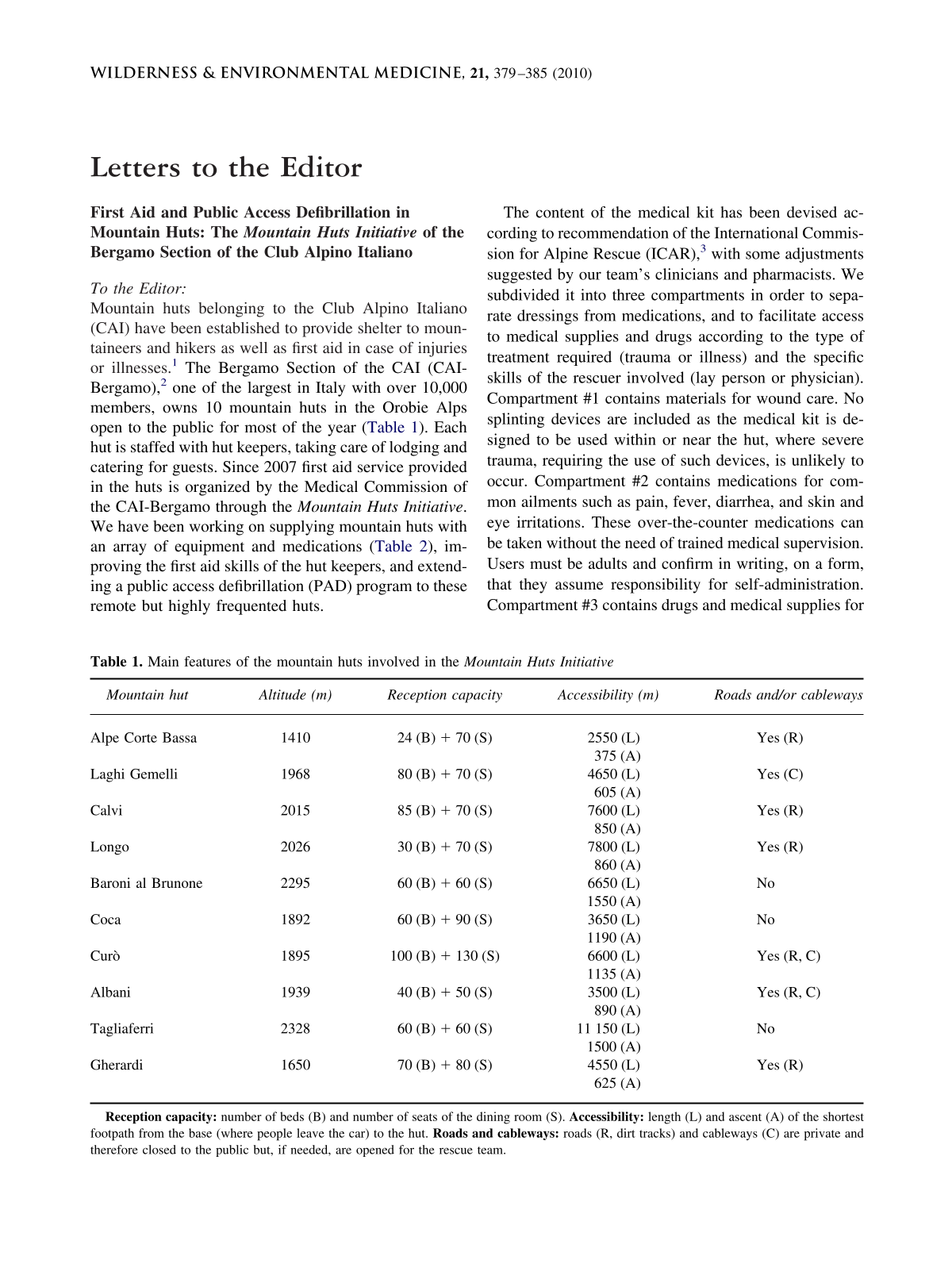
Mountain huts belonging to the Club Alpino Italiano (CAI) have been established to provide shelter to mountaineers and hikers as well as first aid in case of injuries or illnesses. 1 The Bergamo Section of the CAI (CAI-Bergamo), 2 one of the largest in Italy with over 10,000 members, owns 10 mountain huts in the Orobie Alps open to the public for most of the year (Table 1). Each hut is staffed with hut keepers, taking care of lodging and catering for guests. Since 2007 first aid service provided in the huts is organized by the Medical Commission of the CAI-Bergamo through the Mountain Huts Initiative. We have been working on supplying mountain huts with an array of equipment and medications (Table 2), improving the first aid skills of the hut keepers, and extending a public access defibrillation (PAD) program to these remote but highly frequented huts.
Main features of the mountain huts involved in the Mountain Huts Initiative
First aid equipment provided to mountain huts
The content of the medical kit has been devised according to recommendation of the International Commission for Alpine Rescue (ICAR), 3 with some adjustments suggested by our team's clinicians and pharmacists. We subdivided it into three compartments in order to separate dressings from medications, and to facilitate access to medical supplies and drugs according to the type of treatment required (trauma or illness) and the specific skills of the rescuer involved (lay person or physician). Compartment #1 contains materials for wound care. No splinting devices are included as the medical kit is designed to be used within or near the hut, where severe trauma, requiring the use of such devices, is unlikely to occur. Compartment #2 contains medications for common ailments such as pain, fever, diarrhea, and skin and eye irritations. These over-the-counter medications can be taken without the need of trained medical supervision. Users must be adults and confirm in writing, on a form, that they assume responsibility for self-administration. Compartment #3 contains drugs and medical supplies for dealing with more serious problems pending arrival of a professional rescue team. As clearly stated on the compartment box, its content is intended to be used exclusively by a physician or by a nonphysician after telephone agreement with a physician of the local emergency medical service (EMS). In the latter case the recording of the telephone call, testifying to the agreement, acts as a waiver of responsibility towards the lay rescuer. The medical kit does not contain antibiotics, antacids, or medications to treat upper respiratory infections or to facilitate sleep, as we consider these treatments to be more properly prescribed once back home. Neither colloid nor Ringer's lactate infusions have been included as we consider that these can be more correctly administered by a professional rescue team. Normal saline is in compartment #1 to be also used for emergency eye wash. The kit does not contain drugs to treat acute mountain sickness as the huts involved in the project are below an altitude of 2500 m.
The provision of resuscitation devices, an automated external defibrillator (AED) and advanced ventilation equipment (AVE), has been justified on the basis of sound epidemiological considerations. Sudden cardiac death (SCD) is the second most common cause of death in a mountain environment.4,5 Additionally, there are increasing numbers of people engaged in mountain sports and attending mass events in the mountains who may be at risk of SCD. 6 Several reports have shown that PAD programs significantly increase survival from out-of-hospital cardiac arrest if incorporated in a functional emergency medical response plan. 7 –9 On the basis of these considerations, major scientific associations involved in resuscitation medicine have recommended the implementation of PAD programs10,11 to be extended, according to the ICAR, to busy mountain huts. 12 AVEs were provided considering the possible presence of well-trained rescuers able to use these devices correctly. To our knowledge, the Mountain Huts Initiative is the first PAD program that covers mountain huts not integrated in ski resort areas.
Every 12 months, during the period of closure of the mountain huts, first aid equipment is checked, and medical supplies and medications are replaced as needed. The CAI-Bergamo is in charge of the maintenance of the medical kits, while the EMS is responsible for the maintenance of the AEDs and AVEs.
Hut keepers are annually invited and encouraged to attend formal education courses covering theoretical and practical training on first aid (including how to use the equipment properly) and basic life support and defibrillation (BLSD). The former training is conducted by physicians belonging to the Medical Commission and to the local branch of the Italian Alpine and Caving Rescue Service, while BLSD training is conducted by qualified instructors belonging to the EMS and to the Akja association (a local volunteer association devoted to rescue on ski slopes). In order to maintain hut keepers trained and updated, annual refresher courses are also arranged in addition to the above-mentioned ones. These training courses have been very popular with hut keepers since they first started in 2007. So far 3 full courses and 2 refreshers were given, with a total of 62 attendances. Twenty hut keepers attended the first full course in 2007, 9 attended in 2008, and 3 in 2009. Out of the 29 attendees of years 2007 and 2008, 5 quit their job and 21 (87.5%) came back for at least one refresher course.
Members of the local EMS participated in planning and carrying out the initiative. In the EMS operational headquarters is the list of mountain huts involved and details on the first aid equipment supplied, as well as the names of the hut keepers who attended training and their telephone numbers. When assistance is needed, the staff of the EMS is thus aware of the resources in the mountain huts and in a position to advise the responders accordingly.
The use of medical kits and resuscitation devices is documented in ad hoc registers. In each hut there is one register which gathers essential information related to the type of problem requiring the use of the kit. Another register is compiled during the annual check, and gathers data relative to the equipment used. Through ongoing data collection our next goal is to provide information for a better understanding of the medical issues of amateur mountaineers and hikers.
Footnotes
Acknowledgments
This initiative was not supported financially or materially by any producer of the described equipment. The authors do not have any financial interest and did not receive any grants. The authors wish to thank Herman Brugger, MD, Francesco Cantamessa, MD, Cinzia Andreotti, Manuela Abbate, and Gabriele Baldassini for their helpful review of the manuscript; Alessandro Benigna, PharmD and Maria Pinetti, PharmD for their valuable contribution; the local charity ONLUS Bergamo Vita for providing the AEDs; and all the hut keepers for the enthusiasm with which they participated in this initiative.