






Abstract
Empathy is important in our digitized and polarized world and an important aspect of education. What contribution can history teachers make to develop this in their students? In this study we investigated whether a lesson unit making use of eyewitnesses and designed from six pedagogical principles, resulted in more confidence in the ability to empathize, attributed importance to empathy and understanding of empathy by 10th grade students. In addition, we investigated the differences between two conditions: the use of a guest speaker versus eyewitnesses in a documentary. In this quasi-experimental intervention study, we used a pretest-posttest-follow-up design. The data were collected via questionnaires containing closed and open questions. The results showed that students (N = 97) in both conditions gained confidence in their ability to empathize and improved their ability to explain what empathy means and why it is important. After two months, progress on these items was still significant. In the condition with the guest speaker students scored significantly higher on understanding empathy than students who participated in the lesson unit with the documentary. This study contributes to the understanding of developing empathy through the use of eyewitnesses in history classes and the measurement of students’ understanding of empathy.
1. Introduction
Regarding empathy, Barack Obama mentioned in one of his speeches: ‘The biggest deficit that we have in our society and in the world right now is an empathy deficit. We are in great need of people being able to stand in somebody else’s shoes and see the world through their eyes.’ (2017). Empathy is an important and complex construct. The term empathy is derived from Titchener’s (1909) translation of the German word Einfühlung, meaning “feeling into” (Wispé, 1986). Empathy can be described as the ability to feel or imagine another person’s emotional experience and thoughts. Developing the ability to empathize is an important part of social and emotional development, affecting an individual’s behaviour towards others and the quality of social relationships (McDonald & Daniel, 2011). However, how do we promote empathy in daily teaching practice? Empathizing is often a difficult process that requires not only knowledge of the other person’ s context and experiences but also a certain degree of awareness of your own positionality and the will to recognize another person’s perspective. In this respect, history education can play an important role because students practice these things when trying to understand a past world.
The promotion of empathy is discussed in several fields of research. In our research, we focus on the teaching of empathy in the context of history education. Scholars in the field of history education research have focused on the process of students’ engagement with historical actors to better understand and contextualize their experiences, decisions, or actions (Endacott & Brooks, 2018) and discussed several issues related to the teaching of it, such as presentism, reliability of perspectives, moral judgement, and the role of cognition and affection (Barton & Levstik, 2004; Endacott & Brooks, 2018; Lee & Ashby, 2001). One of the proposed approaches to promote historical empathy is oral history, and even more specifically, the use of eyewitnesses (Bertram et al., 2017; Llewellyn & Ng-A-Fook, 2016). Previous research has shown that students and teachers consider the use of eyewitnesses an effective and promising way to work on historical empathy (Bartelds et al., 2020; Huijgen & Holthuis, 2016). Eyewitnesses can be brought into the history classroom in various ways, such as in the form of a primary source (eyewitness account), embedded in a documentary on a historical topic, or as a guest speaker in the classroom. Research has shown that an eyewitness approach can increase involvement in and motivation for history lessons, which in some, but not all, cases led to a better understanding of the past (Bertram et al., 2017; Lanman, 1987). However, what is not yet clear is the effect of an eyewitness approach on students’ understanding and valuing of empathy. Research into explicit teaching of second-order concepts and complex skills in history, such as causality (Stoel et al., 2017), has shown how important it is that students understand the skill that they are mastering.
Empathy is necessary, but difficult to develop. Insight into and appreciation of historical empathy may contribute to insight into and appreciation of generic empathy. Although such citizenship aims are often implicitly pursued in history education (Bartelds et al., 2020) it remains unclear to what extent promoting historical empathy in the history classroom can contribute to empathy as a generic competency.
This quasi-experimental intervention study investigates whether history education can indeed contribute to an understanding and appreciation of empathy. We examine the effects on students’ understanding of empathy, the confidence they have in their ability to empathize, and the value they place on empathy. We investigate and compare this development in two conditions in which historical empathy is explicitly practised with two pedagogic approaches that are recommended for teaching historical empathy, namely eyewitnesses in a documentary and live eye witnessing in the form of guest speakers.
2. Theoretical framework
2.1. The concept of historical empathy and empathy
This theoretical framework will first discuss how the literature considers the constructs of empathy and historical empathy and what the discussions are in this regard, and second, what is known about promoting (historical) empathy. Despite the prominence of the empathy construct in developmental research (Sagi & Hoffman, 1976; Ungerer, 1990; Zahn-Waxler et al., 1983), a clear, consensual definition of empathy remains elusive. Empathy refers to the tendency to understand or to feel the experiences of others. Empathy has a central role in ethical thinking and plays an important role in several religions (Coplan & Goldie, 2011). Furthermore, psychological and cognitive neuroscientists are increasingly focusing on empathy. A distinction can be made between cognitive empathy and affective empathy (Coplan & Goldie, 2011).
In this study, empathy is practised within the context of history classes. Similar to general empathy, historical empathy has increasingly been recognized as a multidimensional construct that involves both cognitive and affective dimensions (Bartelds et al., 2020; Boltz, 2019; Endacott & Brooks, 2018). Historical empathy has been a topic of debate for several decennia. Whereas initially attention was mainly paid to cognitive elements such as contextualizing, studying multiple perspectives and examining positionality (Ashby & Lee, 1987; Stoel et al., 2017; Colby, 2008; Seixas, 2012), in more recent publications the affective side of historical empathy is also more often highlighted (Barton & Levstik, 2004; Endacott & Brooks, 2018). Attention is paid to personal connection, showing interest in historical actors, caring for them, sympathizing or identifying with them, recognizing their human emotions, encouraging humility, and feeling involved. However, despite this increasing attention, it is not yet really clear exactly how this element is taught and learned. In this study, we follow the definition of Endacott and Brooks (2018), who described historical empathy as the process of students’ cognitive and affective engagement with historical figures to better understand and contextualize their experiences, decisions, or actions.
Previous studies have discussed similarities between empathy and historical empathy (Bartelds et al., 2020; Perrotta, 2018). These similarities relate, for example, to the similar steps that must be taken in the process of empathy and historical empathy: having enough context information, being aware of your positionality, of multiperspectivity, and that certain emotions affect your empathy. There are many claims that historical empathy contributes to historical understanding (Barton & Levstik, 2004; Endacott & Brooks, 2018; Seixas, 2012). Another objective of historical empathy that is mentioned in the educational literature is to develop insight into multiperspectivity (Colby, 2008) or to support historical imagination (De Leur et al., 2017). A last objective may be to foster citizenship competences, such as to understand the complexity of idea formation, decision making, and acting in both the past and the present. The difficult task of discussion and participation in a democracy is to agree on actions that can be taken despite differing values (Barton & Levstik, 2004; Endacott & Brooks, 2018).
A starting point of this study is that students can develop the ability to engage in (historical) empathy. The ability to empathize is difficult to measure (Froman & Peloquin, 2001), but students’ understanding of empathy may be examined, as is done with other metahistorical concepts underlying historical skills, such as causation or change (e.g., Stoel et al., 2017). The more insight a student has into a skill, the better the learner can practise and master that skill. In addition, it is important to gain insight into the extent to which students have confidence in their ability to empathize and attach importance to empathy. Students’ self-efficacy and valuing of a skill are important factors in their development of it (Kiuru et al., 2020; Velayutham & Aldridge, 2013).
2.2. Teaching historical empathy: six principles
Regarding teaching historical empathy, various pedagogic approaches have been investigated. From the literature, we derived six principles that can be considered design principles for promoting empathy in the context of a history class. We used these principles to design the lesson units.
First, offering historical context. Contextualization is considered important for historical empathy (Huijgen et al., 2014; Endacott & Brooks, 2018). Contextualization is the ability to situate historical phenomena or the actions of historical actors in a temporal, spatial, and social context to describe, explain, compare, or evaluate them (van Boxtel & van Drie, 2012). The more contextual knowledge a student has, the easier it is to empathize.
Second, developing students’ awareness of their own positionality. Students need to understand that their perspective is influenced by the time, place and culture in which they live. This requires awareness of their affective reactions (Endacott & Brooks, 2018). Particularly, when studying the history of interethnic relations in an ethnically diverse setting, in line with social identity theory (Tajfel & Turner, 1986), students engage in the cognitive process of social categorization (e.g. Arab versus Jew, Black versus White). This arouses the emotional process of social identification, which can either hinder or stimulate empathy (Goldberg, 2013).
Third, paying attention to multiperspectivity refers to the idea that history is interpretational and subjective with multiple coexisting narratives about historical events rather than being objectively represented by one closed narrative (Colby, 2008). Goldberg (2016) concluded that conventional single-narrative teaching reduced interest in the other’s perspective, while empathetic dual-narrative teaching increased it.
Fourth, attention should be given to a personal connection (recognizing yourself and connecting with someone) between students and historical actors (Barton & Levstik, 2004; Endacott & Brooks, 2018). There can be a personal connection when a student feels personally involved in an assignment or a specific subject because the task or subject appeals to the student’s interest or because the task seems like a real-world situation (Immordino-Yang & Damasio, 2007). With eyewitnesses most students feel some urgency to make a personal connection. This may involve showing interest in historical actors, caring for them, sympathizing or identifying with them, recognizing their human emotions, and feeling involved (Barr, 2015; Barton & Levstik, 2004).
Fifth, appealing both cognitively and affectively to the students. This involves whether teachers are appealing to both aspects (cognitive and affective), whether both aspects are present in the lesson. Cognitively, lessons or tasks should stimulate students to acquire contextual knowledge, study multiple perspectives, and examine their positionality. Affectively, lessons can evoke feelings and imagination (De Leur et al., 2017; Levesque, 2008). Portelli (2009) emphasized that while more conventional history is primarily interested in what happened, oral history asks another question: what does it mean? So it is not only about what and why something happened, but also about the meaning it has for the people who were there, and sometimes for the people who were indirectly involved or for people with whom a student can identify.
Finally, explicit instruction should be given on what it means to empathize historically (Huijgen et al., 2014; De Leur et al., 2021; Endacott & Brooks, 2018; Levesque, 2008). Comparable with approaches focusing on other historical thinking and reasoning skills, for example, causal historical reasoning (e.g., Stoel et al., 2017) or contextualization (e.g., van Boxtel & van Drie, 2012), instruction can be provided on what is meant by the skill of historical empathy, what you do and why it is important. Previous research has revealed that teachers hardly teach historical empathy in explicit ways (Bartelds et al., 2020).
2.3. Eyewitnesses embedded in documentaries and guest speakers
The six design principles can be implemented in the classroom in various ways, for example by using eyewitnesses. The use of eyewitnesses appears to be a good way to promote historical empathy (Bertram et al., 2017; Llewellyn & Ng-A-Fook, 2016).
In promoting empathy in history classes, the use of an eyewitness in a documentary has several advantages. First, it is practically easier to organize than a guest speaker (people do not have to be present live at that moment), and second, teachers generally have more experience with it than with a guest speaker in the classroom. Marcus and Stoddard (2007), for example, showed that 82% of the investigated teachers used documentaries at least once a week. The third advantage is that it gives more possibilities for showing multiperspectivity. Marcus et al. (2010) argued that history documentaries could be particularly powerful to develop empathy for groups of people who have been marginalized historically, since nonmainstream perspectives and controversial issues are often avoided in textbooks and other curricular materials (e.g., Barton & Levstik, 2004; Marcus & Stoddard, 2009; Wineburg, 2001). In addition, documentaries can make a strong appeal to both the affective side of historical empathy through the combination of images and sound and music and the cognitive side of perspective recognition because they clearly highlight the decision-making process, motivations, relationships and inner thoughts of the protagonists. Another interesting approach is the qualitative interview study by Haas (2020), who examined the development of empathy of students who participated in classes that used testimonial statements of Holocaust survivors through IWitness, a web resource of the USC Shoah Foundation. Findings from this study suggest that the personal nature of engaging with testimonies promoted the development of empathy among students. Specifically, teacher perceptions suggested that testimonies humanised Holocaust content and students developed emotional connections with survivors. These connections suggest that a deeper understanding of the content and students’ sense of empathy was evident in later activities, both inside and outside the classroom (Haas, 2020).
Researchers (Allport, 1954; Llewellyn & Ng-A-Fook, 2016) have claimed that the interaction and the urgency of the guest speaker increases (the importance of) empathy. It is not a silent or passive process but creates openings for different affective relations, such as empathy, humility, and compassion (Llewellyn & Ng-A-Fook, 2016). Zachrich et al. (2020) showed that an eyewitness as a historical source comprises different levels of interaction and engenders an interplay of cognitive, affective and physical engagement in learners. In their framework, they distinguished, first, cognitive engagement: attentional focus, imagination, perspective recognition, contex-tualization and a sense of insight. Second, affective engagement included being moved, personal attachment, awe and reverence, historical proximity and irritation. Third, physical engagement included physiological response, physical interaction and sensory interaction. Specifically, this physical engagement might be stronger with a guest speaker than with an eyewitness in a documentary. This last element is confirmed in an interview study on (historical) empathy (Bartelds et al., 2020), where students and teachers mentioned that compared to a documentary, guest speakers stimulate empathy more because you see the person live, you can interact and experience someone’ s reactions and non-verbal communication. Although there are some indications that there are differences between live eyewitnesses and eyewitnesses in a documentary, empirical research is scarce. Bertram et al. (2017) concluded in their study that students find guest speaker lessons “more fun” than lessons with a video documentary. However, the effects on understanding and valuing empathy are not yet clear. This exploratory study aims to gain insight in the effects of using guest speakers or documentary to increase students’ understanding and valuing of empathy.
2.4. Aims and research questions
The aim of this study was to gain more insight into promoting general empathy by teaching historical empathy using eyewitnesses in the history classroom. The pedagogic approach used is primarily aligned with the principles of historical empathy. In these history lessons with eyewitnesses, the students are engaged in historical empathy, with the aim of enhancing empathy. Therefore, the measurements are more generic and focus on insight in and value attribution of general empathy and not specifically on historical empathy. The research question is: What are the effects of eyewitnesses (guest speakers and eyewitnesses in documentaries) in history class on students’: 1. confidence in the ability to empathize, 2. understanding of empathy, 3. attributed importance to empathy and 4. explaining this importance? Our hypothesis is that students will improve in these four areas.
In addition, we investigated if there are differences between the use of a guest speaker versus an eyewitness in documentaries. Previous research (Bartelds et al., 2020) has shown that history teachers consider it more burdensome to invite guest speakers in the classroom than to show a documentary with eyewitnesses. Therefore, it is also important from a practical point of view to compare the learning outcomes of both approaches. Based on the literature on eyewitnesses (Allport, 1954; Haas, 2020; Llewellyn & Ng-A-Fook, 2016; Zachrich et al., 2020), there are some indications that students who received guest speaker lessons may score higher on confidence and importance than students who received documentary lessons because of the interaction and urgency of the live guest speaker. By also comparing two approaches, we hope to gain insight into the differences between eyewitnesses from a documentary and live guest speakers.
3. Method
3.1. Research design
In this quasi-experimental intervention study, we used a pretest-posttest-follow-up design. The data were collected via questionnaires containing closed and open questions.
3.2. Participants
Participants were 10th-grade students (pre-university level, 15/16 years of age) from five classes and two teachers from one urban school in the Netherlands. From the original 121 students in these classes, we could use the complete datasets of 97 students, as some students missed lessons or tests or (parents) did not give consent for participation. There were 57 students in the documentary condition and 40 students in the guest speaker condition. The mean age of the students was 15.1 years (SD 0.535), and 52.9% were female. Most students considered themselves nonreligious (71.1%) or did not know (10.7%), 12.4% considered themselves Protestant Christian, 2.5% Catholic, 2.5% Muslim and one student (0.8%) Buddhist. History is a compulsory subject for all students, and students receive two history lessons (45 min) per week. The topic of the intervention, “Life in Israel/Palestine”, was part of the compulsory curriculum on the (de)colonization of Israel/Palestine. The students had the same history education at the same school in the previous three years, and the history of the conflict had been dealt with in the first lesson via a power point and an assignment from the history textbook.
The teachers came from the professional network of the first author. Teacher 1 is male, 38 years of age and has 13 years of teaching experience. Teacher 2 is female, 34 years old and has 11 years of teaching experience. Both teachers hold a master’s degree, are white and have Christian backgrounds. Teacher 1 participated in two classes, one in each condition. Teacher 2 had three classes: two classes in the documentary condition and one in the guest speaker condition.
3.3. The lesson unit
Regarding the topic of the lessons, a theme was chosen for which both eyewitnesses and documentaries were available and where there is also a controversial history, where multiperspectivity is evident.c
The following procedure was used to design the lesson unit. First, the first author designed the first draft of four lessons according to the previously mentioned six pedagogic principles. Second, a focus group with five experts in history education gave feedback on the lesson unit and checked whether the principles had been properly incorporated. Third, there was a walkthrough with the two teachers, after which the feedback was processed. In addition, the two guest speakers were interviewed and prepared for the lessons. The documentary was watched by different teachers to check the usefulness. During the walkthrough of the lesson unit with the teachers, the teachers indicated the assignment would be appropriate for the students. Also the guest speakers had taught before and seemed suitable for the group of 10th grade students according to the teacher.
The final lesson unit consisted of a preparation lesson, two guest speaker/documentary lessons and a discussion lesson (see Table 1). How the six design principles were included in the lesson unit is shown in Appendix 1.
12Overview of the lesson unit.
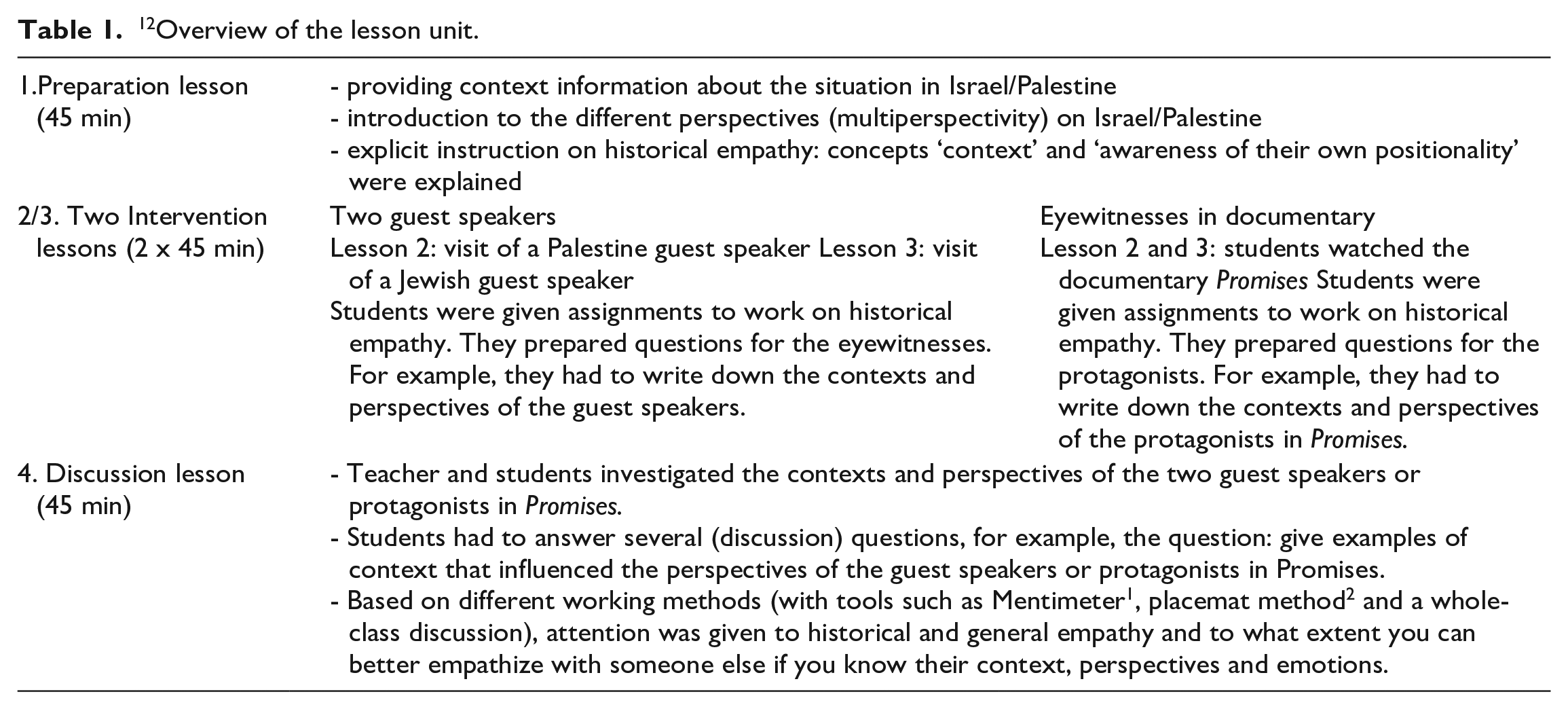
of the guest speakers. For this condition, an eyewitness of Palestinian background (second lesson) and an eyewitness of Jewish background (third lesson), who both had lived in Israel/Palestine, were invited. Both in the preparation lesson and in their homework assignment, students were occupied with questions about the historical context and perspectives of the guest speakers. They received information about the background of the guest speakers. In addition, they had to formulate questions to learn more about the context and perspective of the guest speakers, which they could ask during the visits. During their visits, attention was given to interaction. The guest speakers were asked to clearly tell their life story (context) and give their view of the current situation in Israel/Palestine.
of the eyewitnesses in a documentary. The students watched the documentary ‘Promises’ during two lessons. Promises (Goldberg & Shapiro, 2001) is a documentary film that examines the Israeli-Palestinian conflict from the perspectives of seven children living in Palestinian communities in the West Bank and Israeli neighbourhoods of Jerusalem. Three filmmakers followed and interviewed the children for three years. They also arranged a meeting between the children. The target audience for the film is precisely those who are still unfamiliar with the details and history of the conflict. The filmmakers promote the documentary as a learning tool for young people. Marcus et al. (2010) emphasized that documentaries that seem to work best provided first-person accounts from a compelling and, if possible, youth character. Here, too, the context of the seven main characters (four Jewish and three Palestinian teenagers) was told to the students and distributed in writing beforehand. Information about the seven protagonists concerned their age, cultural and religious background and experience of the conflict. In this way, the students already heard part of their context. The documentary provides insight into their lives and clarifies their perspectives on the conflict. The documentary also shows that there are different perspectives and opinions between the different Jewish and Palestinian children about the conflict in their country. For example, students see that secular Jewish twins have little understanding of Jewish orthodox customs.
3.4. Measures and instruments
To gain insight into potential differences between conditions in students’ tendency to empathize in the pretest, we measured cognitive and affective empathy and sympathy using the Adolescent Measurement of Empathy and Sympathy (Vossen et al., 2015). Students were asked twelve questions about empathy and sympathy, such as “I know when someone is cheerful, when he is not.” The answer options on a five-point Likert scale were (1) never, (2) almost never, (3) sometimes, (4) often, and (5) always”. This questionnaire was only used in the pre-measurement.
Confidence in the ability to empathize: We used the questionnaire developed by Gehlbach et al. (2012). The researchers reported an acceptable Cronbach’s alpha (a = 0.90, 95% CI = 0.80 - 0.94). The original scales measure confidence in social perspective taking (SPT) and fit the way empathy is interpreted in this study. In this questionnaire, we chose the term empathy, which refers to both the cognitive and affective parts of empathy (Coplan & Goldie, 2011; Endacott & Brooks, 2018). We translated the scales into Dutch, trying to stay as close to the original meaning as possible. Students were asked eight questions: “If you have a disagreement with someone, how sure are you that you can determine what that person is thinking?”. A five-point Likert scale was used ((1) not sure at all to (5) very sure).
Understanding empathy: We measured students’ understanding of what it means to empathize and why it is important to empathize by open questions. For the format of the questions, we used the format used by Stoel et al., 2017, that measured students’ understanding of historical causation. The questions were based on a previous study investigating students’ thinking about empathy (Bartelds et al., 2020) and a questionnaire from Bertram et al. (2017) on oral history in classrooms. Two questions were asked: “If you want to understand why someone does something, it helps if. . .” and: “If you want to understand why someone does something, it does not help if . . .”
Importance of engaging in empathy: We measured importance with a questionnaire and an open-ended question. We used the questionnaire developed by Gehlbach et al. (2012). The scale (7 items) in Gehlbach et al. ‘s study had a Cronbach’s alpha of.73 (95% CI = 0.48 - 0.84). Students were asked seven questions, such as “When talking to someone from another culture, do you think it is important to understand his/her point of view?”. The answer options on a five-point Likert scale varied from (1) not important at all to (5) very important.
Explaining Importance of empathy: Furthermore, we measured students’ ability to explain the importance of empathy by an open question: “Being able to empathize well with someone else is important, because. . . ”.
Confidence in the ability to empathize, Understanding empathy and the Importance of engaging in empathy were measured in the pre-, post- and follow-up measurement. Pre-measurement was conducted before the first lesson, and post-measurement after the last lesson. The follow-up test was conducted two months after the lesson unit.
3.5. Data analysis
We used repeated measures to examine possible differences between the conditions. The independent variable (between subjects) was the type of eyewitness: documentary versus live guest speaker. The dependent variables were confidence, understanding, importance and explaining the importance of empathy. In addition, there was the factor Time at three levels: pre-measurement, post-measurement and follow-up measurement. Cronbach’s alphas for the Confidence in the ability to empathize questionnaire were.71 (pretest), 0.73 (posttest), and 0.80 (follow-up test). Cronbach’s alphas for the questionnaire Importance of engaging in empathy were.64 (pretest), 0.71 (posttest) and 0.66 (follow-up test).
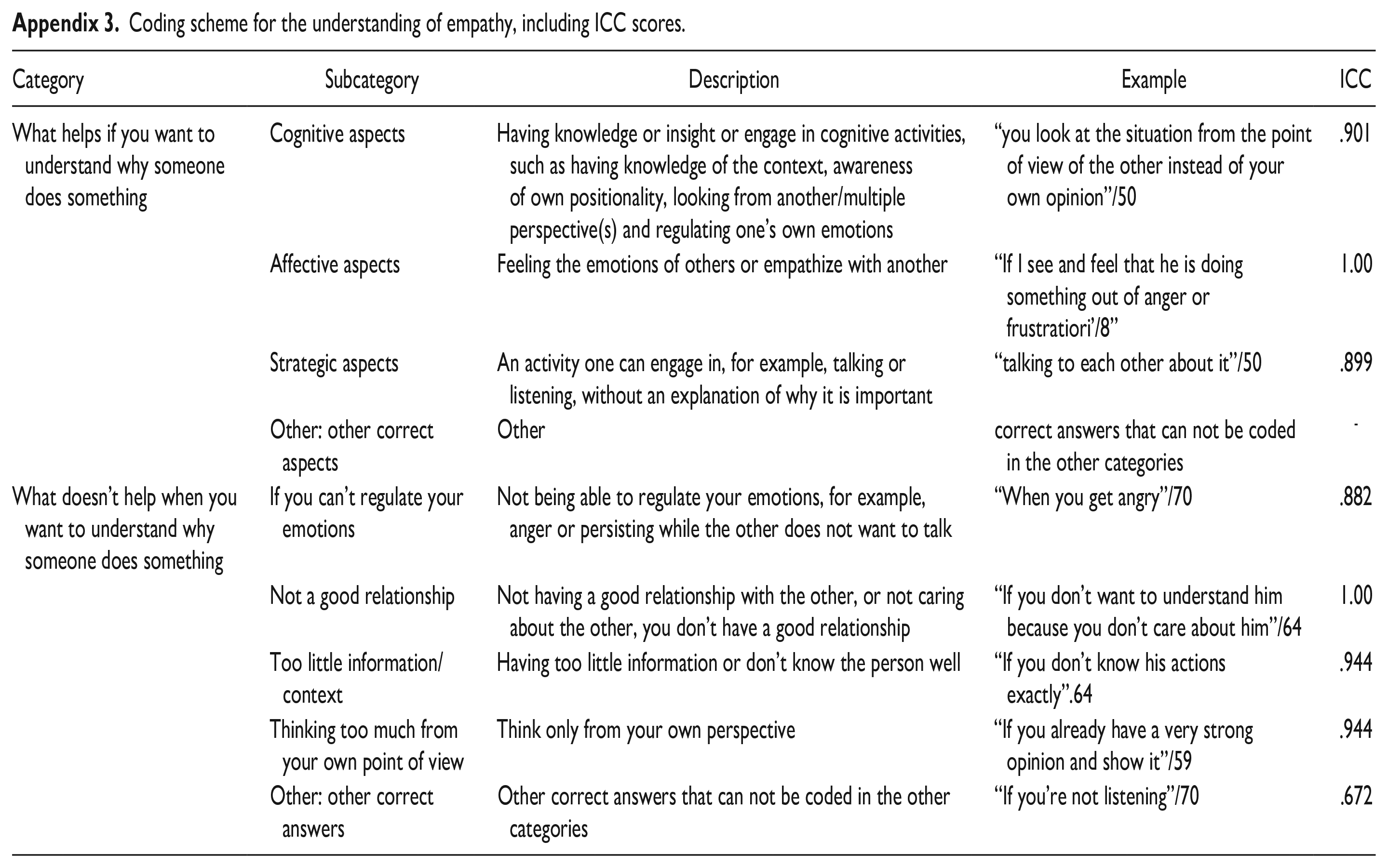
The answers to the first open question about understanding empathy were coded on how many correct aspects students mentioned in regard to what helps them empathize. In several rounds, based upon students’ answers and the literature (Endacott & Brooks, 2018; Gehlbach et al., 2012), two evaluators identified different categories and, after consultation, arrived at the following four categories: cognitive, affective, strategic or other correct aspects (see Appendix 3 for a description and examples). It sometimes happened that a student gave the same answer twice with different wording, then this was noted as one correct answer. In the second open question, the students were asked, “It does not help if. . . .?” where the answers were initially coded in six categories: if you could not regulate your emotions, not a good relationship, too little information/context, thinking too much from your own point of view, no direct physical contact, and other correct aspects. A second researcher and teacher trainer independently coded the answers of 60 randomly chosen students from both conditions. We calculated interrater reliability using ICCs for each category (see Appendix 3). Because the category ‘No direct physical contact’ (for example, “Only superficial contact via social media”) had an ICC that was too low (0.386), those remarks were included in the category ‘Other’. Except for the category ‘Other’, for which we reached moderate interrater reliability, the interrater reliability was good to excellent. In the repeated measures analysis, we used the total number of correct aspects students mentioned when answering the two open questions. In addition, we report percentages for each subcategory.
To analyse the open question about explaining the importance of empathy, we developed a coding scheme. In several rounds, using the data and literature (Endacott & Brooks, 2018; Gehlbach et al., 2012), the coders identified different categories and, after consultation, arrived at the following five categories: better understand the other/a context, prosocial behaviour between individuals and in groups, gaining insight into yourself, learn new perspectives/points of view and other aspects (see Appendix 2). For each subcategory, we counted how many aspects students mentioned that fit into this category. A second researcher and teacher trainer independently coded answers of 60 randomly chosen students from both conditions. We calculated interrater reliability using ICCs (intraclass correlation coefficient) for each subcategory (see Appendix 2). The inter-rater reliability was good to excellent. In the repeated measures analysis, we used the total number of aspects that fitted into the categories of the coding scheme for students’ ability to explain the importance of empathy. In addition, we report percentages for each category.
A Shapiro Wilk test revealed that in both groups, the dependent variables Understanding empathy and Explaining Importance (the open questions) were not normally distributed. Inspection of the plots revealed that the variable Understanding (pretest, posttest and follow-up posttest) was especially skewed right, and kurtosis of the posttest Understanding was rather high (5.7). A large portion of the students scored 6 points, and only a few scored higher. This might be the result of the format of the question, in which there were three fill-in-the-blank lines for each question. Based upon the inspection of the plots and because of the sample size (>30 in each condition), we conducted a parametric repeated-measures ANOVA.
4. Results
4.1. Comparability of the two conditions
Because of the quasi-experimental design, we first checked with the pretest whether the two groups (documentary versus guest speaker) were comparable at baseline using three scales from the Adolescent Measurement of Empathy and Sympathy. An independent t-test showed that students’ scores on the Affective Empathy Scale in the Documentary condition (M = 2.84, SD = 0.71) and in the Guest speaker condition (M = 2.77, SD = 0.75) did not significantly differ, t(109) = 0.47, p >.05. Furthermore, students’ scores on the Cognitive Empathy Scale in the Documentary condition (M = 3.70, SD = 0.54) did not significantly differ from students’ scores in the Eyewitness condition (M = 3.73, SD = 0.60), t(109) = —0.23, p >.05. Finally, we found that students’ scores on the Sympathy Scale in the Documentary condition (M = 3.92, SD = 0.47) and in the Guest speaker condition (M = 4.01, SD = 0.60) did not significantly differ, t(109) = —0.89, p >.05. There were no students who had a mean score below 2 for all three scales. We can therefore presuppose a similar initial situation of the students in the two different conditions.
4.2. Effects of the lesson unit
We investigated whether the students who followed the lesson unit on historical empathy showed progress on the three dependent variables. In Table 2, the results are presented. The table first shows the results of the closed questions (Confidence in the ability to empathize and attributed importance to empathy) and then of the open questions (Explaining Importance and Understanding).
Means, Standard Deviations for Confidence in the ability to empathize, Importance, Understanding and Explaining importance for pre-, post- and follow-up tests.
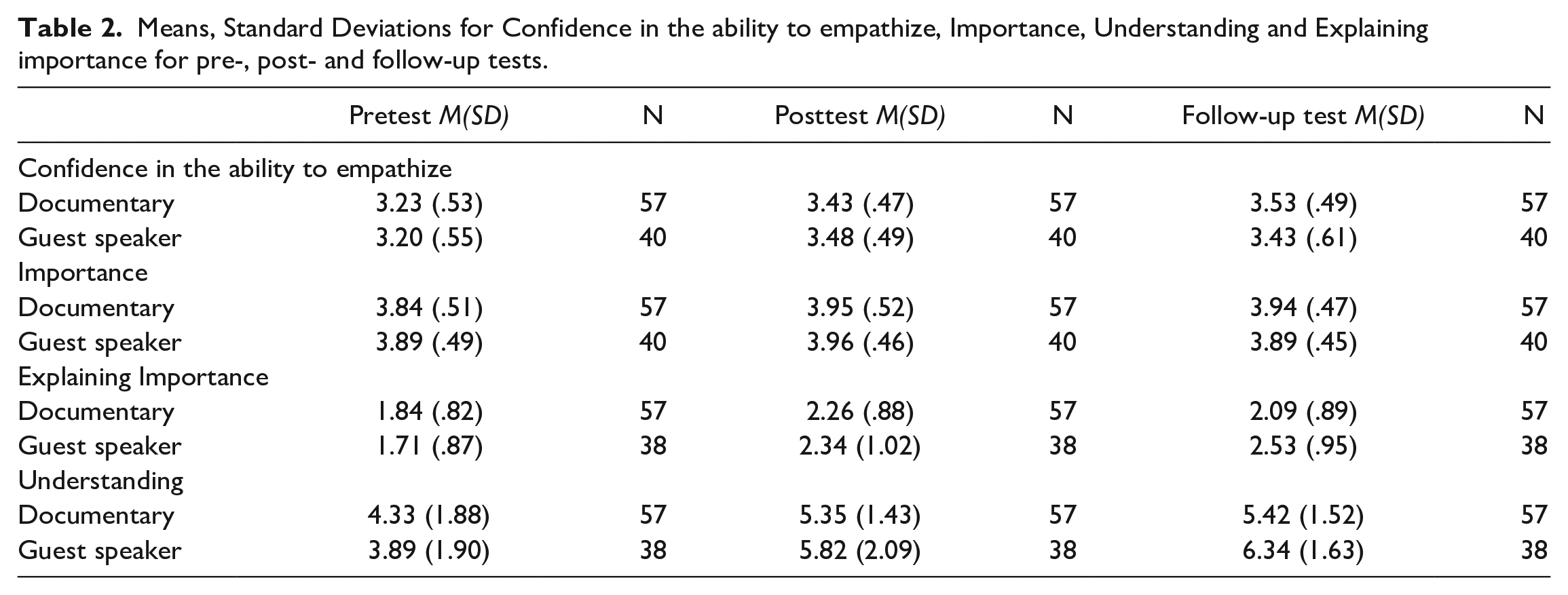
Confidence in the ability to emphatize Mauchly’s test indicated that the assumption of sphericity had been violated for the main effect of Time /2(2) = 7.19, p <.05. Therefore, degrees of freedom were corrected using Greenhouse-Geisser estimates of sphericity (e = 0.93 for the main effect of Time). There was a significant main effect of Time on students’ confidence in their ability to empathize, F(1.86, 176.97) = 25.69, p =.00. Contrasts revealed that students’ confidence at the posttest was significantly higher than that at the pretest, F (1,95) = 32.55, p =.00, r = 0.51. Furthermore, scores at the follow-up posttest were still significantly higher than those at the pretest, F (1,95) = 35.19, p =.00, r = 0.52. These are both large effect sizes. There was no effect of the type of eyewitness that was used in the lesson unit (documentary versus guest speaker) on students’ confidence scores (F(1,95) = 0.08, p =.77). There was no interaction effect between time and type of eyewitness (F(1.86, 176.97) = 1.61, p =.20).
Importance of engaging in empathy Mauchly’s test indicated that the assumption of sphericity was not violated for the main effect of time (x2(2) = 2.21, p =.33. There was no significant main effect of time on students’ rating of importance, F (2, 190) = 1.72, p =.83. At the posttest and follow-up tests, students did not attribute greater importance to engaging in empathy. There was also no significant effect of type of eyewitness, F(1,95) = 0.00, p =.96, and no significant interaction effect between time and type of eyewitness, F (2,190) = 0.62, p =.54.
4.2.1. Explaining the importance of empathy
Regarding the open question on explaining the importance of empathy, Mauchly’s test indicated that the assumption of sphericity had been violated for the main effect of time x2(2) = 9.08, p <.05. Therefore, degrees of freedom were corrected using Greenhouse-Geisser estimates of sphericity (e = 0.91 for the main effect of Time). There was a significant main effect of time on students’ ability to explain the importance of empathy, F(1.83, 170.02) = 11.82, p =.00. Contrasts revealed that at the posttest, students could significantly better explain the importance of empathy than at the pretest, F(1,93) = 16.23, p =.00, r = 0.39. Furthermore, scores at the follow-up posttest were still significantly higher than those at the pretest, F(1,93) = 14.72, p =.00, r = 0.37. These are both medium effect sizes. There was no effect of the type of eyewitness on students’ explanation of the importance of empathy, F(1, 93) = 1.15, p =.29. There was also no significant interaction effect between time and type of eyewitness, F(1.83, 170.02) = 2.64, p =.08.
We categorized the answers into five categories (see Appendix 2). As can be seen in Table 3, it appeared that for most students, empathy was especially important to better understand the other person or the other context. Within this category, answers such as “Because the two groups do not understand each other” or “Because then you will understand history better” were especially prevalent. Second, students mentioned the importance of empathy for prosocial behaviour, both between individuals and for society as a whole. Within the second category, this answer was common: “Because then you can help that person”. In the analysis, the third most frequently mentioned by students was: obtaining new perspectives (multiperspectivity), which sometimes gave them new insights. Category four ‘Gaining more insight into yourself’ was rarely mentioned. For example, in this category, it was mentioned that “Because then you can better form your own opinion”. The distribution over the different types of categories did not change from pre-to postmeasurement and follow-up measurements. Table 3 shows there were not many differences between the two conditions.
Percentages a for categories in students’ answers to the question why it is important to empathize for the Documentary and Guest speaker condition.
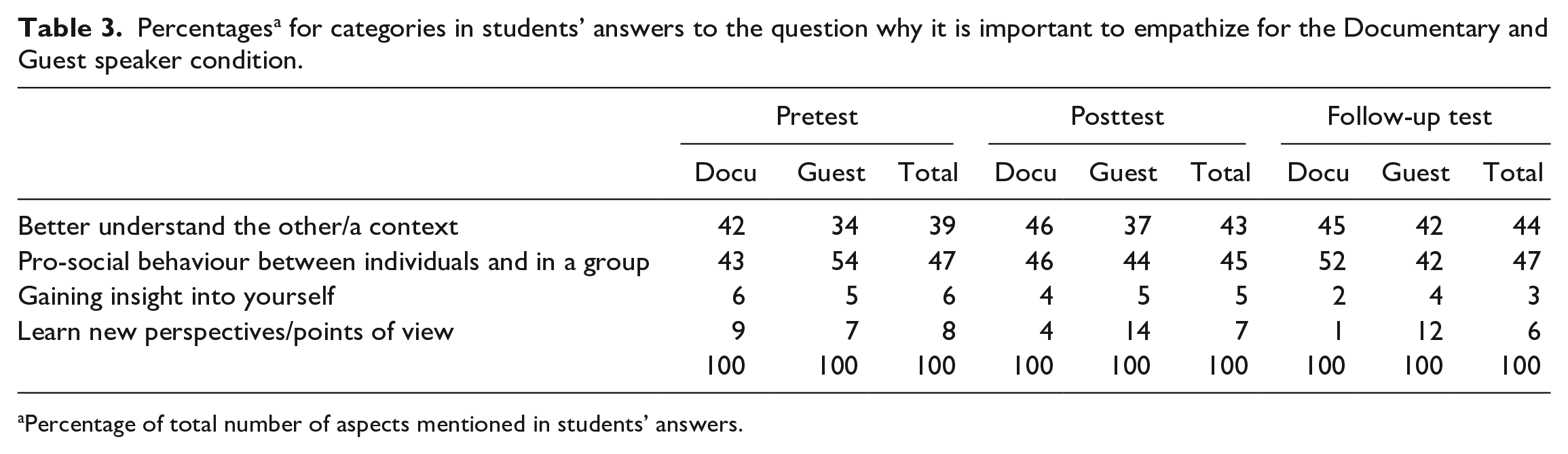
Percentage of total number of aspects mentioned in students’ answers.
Understanding of empathy Mauchly’s test indicated that the assumption of sphericity had been violated for the main effect of Time X2(2) = 19.42, p <.01. Therefore, degrees of freedom were corrected using Greenhouse-Geisser estimates of sphericity (e = 0.84 for the main effect of Time). There was a significant main effect of time on students’ understanding of empathy, F(1.68, 156.27) = 34.44, p =.00. Contrasts revealed that students’ scores at the posttest measuring their understanding of what it means to empathize were significantly higher than their scores at the pretest, F(1,93) = 33.31, p =.00, r = 0.52. Furthermore, scores at the follow-up posttest were still significantly higher than those at the pretest, F(1,93) = 50.57, p =.00, r = 0.59. These are both large effect sizes. There was no main effect of the type of eyewitness on students’ understanding of empathy, F(1, 93) = 1.60, p =.21. We found a significant interaction effect between time and type of eyewitness, F(1.68, 156.27) = 4.64, p =.02. Contrasts revealed that students who participated in the lesson unit with the guest speaker made significantly more progress between the pretest and the follow-up test than students who participated in the lesson unit with the documentary, F(1,93) = 7.48, p =.01, r = 0.27. This is a small to medium effect size.
We categorized students’ answers to the two open questions. The first question was: if you want to empathize with someone, it helps when. . . ? As seen in Table 4 in the pretest, most of the answers of the students were in the strategy category (“it helps if you ask questions”) and in the cognitive category (“it helps if you are open to a different opinion”, “it helps when you have enough information of that person”.) Some students also mentioned an affective element: “If I see and feel that he is doing something out of anger or frustration”. At all three measurement points, students mentioned mostly cognitive and strategic aspects and, to a lesser extent, affective aspects. Particularly in the Guest speaker condition, students mentioned relatively more affective elements. Where in the pre-measurement many short answers were given in the category ‘strategy’, in the post- and follow-up measurements appeared more elaborate answers, for example, “If you pay attention to his body language, to maybe connect an emotion to it, you are able to better understand someone” In the second open question on understanding empathy the students were asked: “it does not help if. . . .?” In the pre-, post- and follow-up tests, approximately one-third of students’ responses were coded in the category ‘if you cannot regulate your emotions’. The students indicated, for example, that it mainly works against you “When you get angry”. Approximately one-fourth of students’ responses were coded in the category “thinking too much from your own point of view”. Students answered that empathy is hindered “If you already have a very strong opinion and show it”. Third, if you have too little information/context, “If you do not know his actions exactly”. In the analysis, the following answers were the least frequent: “getting out of touch” and place five “not a good relationship”. The distribution over the different types of categories did not change much from pre-to post-measurement and follow-up measurements. Furthermore, there were few differences between the conditions. In the Guest speakers condition, the percentage of responses that was coded in the category “Thinking too much from your own point of view” increased, whereas in the Documentary condition, it decreased.
Percentages a for categories in students’ answers to the questions about what helps and what doesn’t help if you want to understand why someone did something, for the condition Documentary and Guest speaker.
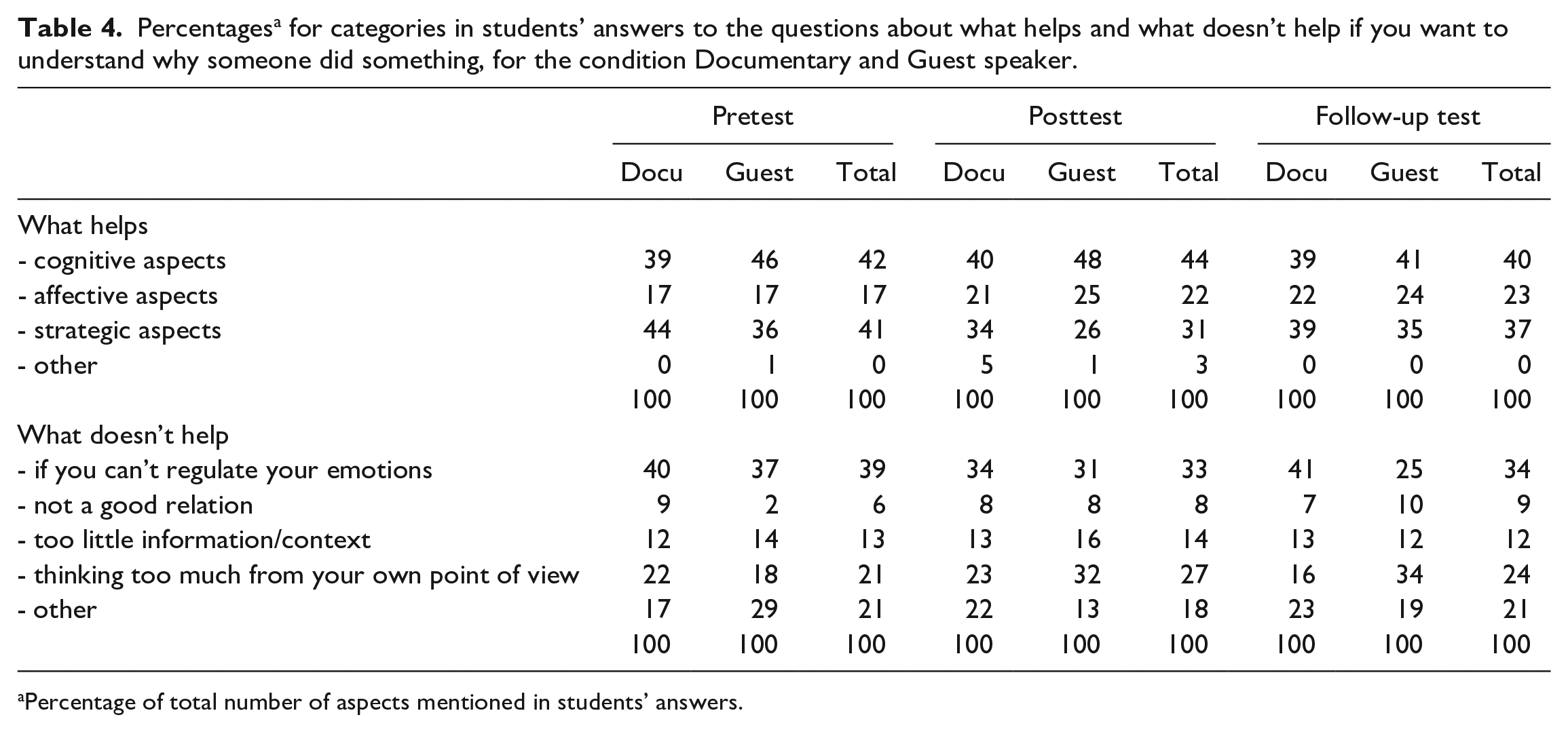
Percentage of total number of aspects mentioned in students’ answers.
5. Discussion and conclusions
Empathy is an important skill for students to develop in our current society. We investigated whether teaching historical empathy using eyewitnesses in the history classroom can contribute to students’ confidence in the ability to empathize, their understanding of what empathy entails, the importance they attributed to empathy and their ability to explain the importance of empathy. We compared whether the use of a guest speaker and a documentary resulted in differences.
With regard to our first research question, the results showed that after the lesson unit, students in both conditions were more confident in their ability to empathize, and they were better able to explain what empathy means and why it is important. After two months, progress on these items was still significant. These findings are in line with our expectations. We found no significant progress in the importance students assigned to empathy. This might be related to the already high scores on the pretest.
Regarding the open question concerning explaining the importance of empathy, students mentioned a better understanding of the other person/context, prosocial behaviour and new perspectives (multiperspectivity). These results are consistent with the literature on empathy, in which it is argued that empathy also allows us to be more tolerant and accept others (Bartal et al., 2011; Seller & Craig, 2016).
Previous research (Bartelds et al., 2020) has shown that history teachers also have citizenship goals with their lessons, including the promotion of empathy. A goal such as promoting empathy is difficult to measure, but what this study contributes to the literature is that understanding of empathy can be measured and that, after instruction, this understanding has also improved.
With respect to the understanding of empathy, at all three measurement points, students mentioned mostly cognitive and strategic aspects and, to a lesser extent, affective aspects. Students mentioned different cognitive elements, such as contextualization, awareness of their own positionality and multiperspectivity. However, particularly in the guest speaker condition, students mentioned relatively more affective elements. It was apparently difficult for students to see affective aspects such as emotions as part of the skill. One explanation may be that the explicit instruction on historical empathy emphasized cognitive aspects such as contextualization and positionality (e.g. background, culture, of the eyewitnesses), while the affective aspects were covered more during the lessons with the eyewitnesses and were therefore more implicit. Here we also see that, although in recent years the affective side of historical empathy has been increasingly recognized as an element of historical empathy (e.g., Barton & Levstik, 2004; Endacott & Brooks, 2018), it can be challenging for teachers to provide explicit instruction on the affective elements of historical empathy. In the lessons with the guest speakers, there was perhaps more implicit instruction on the affective aspects as the guest speakers modelled empathy.
Students participating in the guest speaker condition made significantly more progress in understanding empathy between pre-measurement and the post-measurement after two months than students in the documentary condition. The confidence and importance of empathy appeared to be fostered to the same extent by the documentary as by the guest speaker. However, there are aspects that may have influenced the outcomes. Perhaps the positive effects of the interaction with the guest speakers were partially offset by the fact that the guest speakers were a lot older (age 65) than the eyewitnesses in the documentary, who were teenagers (age approximately 12) like the students. This may have affected the personal connection and identification of the students with these persons. When students interact with their peers, identification and personal connection, and ease of empathy could increase (Wagenaar, 2017). A second difference was that the documentary also featured girls, while the guest speakers were both men. On the other hand, the documentary was already twenty years old. It could be that because of this the students felt less relevance and urgency when watching the documentary than when listening to the guest speakers who could also talk about the present. However, both the documentary and the guest speakers did not elaborate much on current affairs, but the emphasis was more on the different perspectives and histories. Although the teachers had more experience guiding the learning from a documentary than with a guest speaker, we managed to circumvent some of the pitfalls of having an eyewitness in the classroom, such as the lack of multiperspectivity by inviting two guest speakers with two different perspectives.
5.1. Limitations and suggestions for further research
This study has several limitations. We conducted this exploratory study with two teachers from one school and 97 students. Future research could expand to more schools, teachers and students, as well as to different grades. The lesson unit was designed on the six principles to promote historical empathy by using eyewitnesses, which were derived from the literature. Although the outcomes showed positive effects of the intervention, our data do not allow us to accurately identify which of these principles have promoted the increase in understanding, confidence and importance of empathy (the most). Future research could address this issue. Another aspect that needs to be considered is the high score on importance of empathy at pre-measurement. It is possible that the social desirability of students influenced the responses in terms of importance slightly more than in the measurements of confidence and understanding. Additionally, we must consider the low Cronbach’s alphas (0.64-0.71) of the importance-scale when interpreting these data. This might have been a reason for not finding a significant difference in importance between pre-measurement and post- and follow-up measurements. Additionally, the study does not provide insight into students’ actual ability to empathize. Nevertheless, it can be concluded that students are more confident in being able to apply the skill of empathy and that they understand it better.
The history teacher’ s instruction and exercises for the students focused on historical empathy, but the measurements focused on empathy in general. It is also a relevant question whether the ability for historical empathy has increased as a result of the lesson unit and to what extent performance on that kind of assignment is related to a more general understanding of what is needed to empathize. Although the measurements on general empathy did take place in the context of the history lesson, students’ historical empathy was not measured in this study. More research is needed to gain a better understanding of how and to what extent students’ understand and value (generic) empathy and their ability for historical empathy. There is also the question of the extent to which the choice of the theme of Israel/Palestine and that of the documentary and guest speakers influenced the results of this study. In addition, we did not test students’ prior knowledge of the content of the conflict. Future research could investigate the role of content knowledge on students’ understanding of empathy.
5.2. Implications for practice
Based on this study, it can be concluded that the six principles provide guidance for designing lessons to promote empathy. When students empathize with respect to a historical topic and the teacher promotes this according to the design principles, students gain a better understanding of empathy and become more confident in their ability to empathize.
This study shows that empathy is teachable and offers teachers an opportunity to monitor their students’ development in it. History teachers often consider empathy as a citizenship skill as an objective of their lessons. We can conclude that paying attention to empathy in history class contributes to understanding what empathy is and being able to explain why it is important. By paying attention to enough context information, awareness of positionality, the influence of emotions, and multiperspectivity, history teachers can contribute to the understanding of empathy.
The advantages of a documentary in the eyes of teachers are multiperspectivity, practical use and greater availability (Bartelds et al., 2020). Together, this offers teachers many possibilities. They can use both the advantages of a guest speaker and those of a documentary side by side. The lesson units can provide inspiration and direction for others who want to create lessons with empathy.
Footnotes
Appendix
Coding scheme for the understanding of empathy, including ICC scores.
| Category | Subcategory | Description | Example | ICC |
|---|---|---|---|---|
| What helps if you want to understand why someone does something | Cognitive aspects | Having knowledge or insight or engage in cognitive activities, such as having knowledge of the context, awareness of own positionality, looking from another/multiple perspective(s) and regulating one’s own emotions | “you look at the situation from the point of view of the other instead of your own opinion”/50 | .901 |
| Affective aspects | Feeling the emotions of others or empathize with another | “If I see and feel that he is doing something out of anger or frustratiori’/8” | 1.00 | |
| Strategic aspects | An activity one can engage in, for example, talking or listening, without an explanation of why it is important | “talking to each other about it”/50 | .899 | |
| Other: other correct aspects | Other | correct answers that can not be coded in the other categories | - | |
| What doesn’t help when you want to understand why |
If you can’t regulate your emotions | Not being able to regulate your emotions, for example, anger or persisting while the other does not want to talk | “When you get angry”/70 | .882 |
| Not a good relationship | Not having a good relationship with the other, or not caring about the other, you don’t have a good relationship | “If you don’t want to understand him because you don’t care about him”/64 | 1.00 | |
| Too little information/context | Having too little information or don’t know the person well | “If you don’t know his actions exactly”.64 | .944 | |
| Thinking too much from your own point of view | Think only from your own perspective | “If you already have a very strong opinion and show it”/59 | .944 | |
| Other: other correct answers | Other correct answers that can not be coded in the other categories | “If you’re not listening”/70 | .672 |
Acknowledgements
This research was funded by The Netherlands Organization for Scientific Research (NWO, project nr 023.011.002) and supported by Willem Lodewijk Gymnasium.