






Abstract
Obtaining suitable crystals for X-ray diffraction experiments is one of the rate-limiting steps in macromolecular crystallography. Robotic platforms that can increase throughput are highly desirable for crystal screening operations. The Thermo Scientific Matrix Hydra II eDrop is a liquid handling robot capable of dispensing sub-microliter and microliter volumes of solutions. Equipped with single-channel noncontact microdispenser, 96-channel syringe-based contact microdispenser and user-friendly ControlMate software, the Thermo Scientific Matrix Hydra II eDrop is appropriately designed for crystal screening experiments. The microdispensers are used in a single operational process to rapidly dispense sub-microliter volumes of liquids for automated crystallization plate setup. In this report, we discuss the design of the Thermo Scientific Matrix Hydra II eDrop. We also discuss an automated protocol for macromolecular crystallization trials that has successfully been used to produce crystals of a membrane protein, the rhomboid family intramembrane protease, GlpG. (JALA 2007;12:213–8)
Keywords
Introduction
Three-dimensional macromolecular structure determination plays a key role in the armory of today's biological scientist and has increasing importance in drug discovery.1–4 One of the rate-limiting steps for macromolecular X-ray crystallography is the discovery of growth conditions for crystals that diffract to high-resolution. These conditions cannot be predicted and it is possible to spend months, or even years, obtaining crystals of desirable quality. In most cases, crystallization trials of multiple constructs or macromolecular variants need to be attempted to obtain the desired crystal quality, thereby proportionately increasing the amount of time needed for the screening process. The traditional approach to this screening is to manually setup crystallization drops with a macromolecular sample volume between 1 μL and 5 μL. Incorporation of an automated liquid handler to the crystallization screening trials can increase throughput, reduce labor, and hasten the production of diffraction quality crystals.5–9 Several organizations have introduced automation into their macromolecular crystallization screening process.7,10–14 Many also use a mix of low- and high-throughput strategies, involving both manual and automated screening trials.15–17 These organizations have grasped the advantages of automated crystallization trial setups and the associated reductions in protein volume requirements, wastage, cost, and time. Furthermore, these techniques provide a dramatic increase in the number of conditions sampled. The relative expense of many crystallization robots has, however, meant that not all crystallography laboratories can adopt these automated systems. Thus, there is a need for a modular approach to automating the macromolecular crystallization process that is accessible to small and growing laboratories.
There are multiple bottlenecks that slow the determination of macromolecular crystal structures. For any particular project, these can include cloning, protein expression and purification, crystal screening, optimization and freezing, X-ray diffraction experiments, structure determination, and model refinement. In recent years, dramatic steps have been taken towards automation of the structure determination process in most of these areas.8,13,18–22 Such automation will become more important in the coming years as scientists try to direct increasing efforts to conducting structure–function analyses. Although high-throughput and structural genomics operations mandate highly integrated automation, most biological research laboratories do not require sophisticated automation for their experiments. Stand-alone modular automation can, therefore, be a viable and economical approach for these small-scale crystallography operations. The availability of validated platforms will enable users to easily adopt this automated technology. Here we discuss the use of the Thermo Scientific Matrix Hydra II eDrop to conduct sub-microliter volume protein crystallization screens. The Thermo Scientific Matrix Hydra II eDrop robot is an economical benchtop, stand-alone instrument whose instrumentation and programming interface has been validated for crystallographic screening, but that also has utility for liquid handling tasks in processes such as enzymatic assays, PCR, and inhibitor screening.
Materials and Methods
Construction of the Thermo Scientific Matrix Hydra II eDrop
The initial design of the Hydra II instrument platform consisted of a manually operated 96-channel syringe head with one-stage position, introduced in the early 1990s. This platform further evolved to incorporate two additional stage positions. The Hydra II with the three-position stage platform was later combined with a single-channel noncontact microsolenoid valve-based dispense module to develop a suitable platform for crystallization screening in the late 1990s. The instrument popularly known as Hydra-II-plus-one, however, lacked user-friendly software. Additionally, lack of appropriate controls to tune the instrument parameters for various liquids resulted in inaccurate dispense volumes for some solutions. Furthermore, the microsolenoid valve-based mechanism could lead to obstruction of valves with minute particulate material, thus requiring periodic valve replacements.
A viable alternative to the microsolenoid valve-based dispense mechanism is the use of the electromagnetic bellow (EMB) system. The current design of the instrument described here includes a dispense mechanism that uses EMBs whose contraction and expansion drive the dispense of liquid in a noncontact manner. The friction-free operation of the EMBs requires less maintenance compared to the microsolenoid valves. To improve the user interface of the instrument, the ControlMate software was developed and has an improved environment for the user to control the movements of the instrument. Features such as the ability to edit overshoot parameters (and thus change the force of liquid ejection from the single-channel nozzle) were introduced into the ControlMate software. This feature is particularly useful for crystallization screening of membrane proteins where the inclusion of detergents can affect protein dispense from the single-channel nozzle and manual refinement of the optimal overshoot can be required. Aside from these features, the tubing length and design of the nozzle also play an important role in protein dispense and were appropriately adjusted for this system. This new system, Thermo Scientific Matrix Hydra II eDrop with a combination of the 96-channel syringe head, an EMB-based dispense mechanism, new software, and improved tubing and protein dispense nozzle provided an optimal platform for crystallization screening of the intramembrane protease, GlpG, presented below.
The current version of Thermo Scientific Matrix Hydra II eDrop is thus a compact benchtop instrument designed to perform sub-microliter liquid-handling operations. Equipped with 96-channel syringe-based contact dispenser and single-channel noncontact microdispenser, the Thermo Scientific Matrix Hydra II eDrop is engineered to accurately aspirate and dispense sub-microliter volumes of liquids. The syringe-based 96-channel microdispenser functions by positive displacement. In contrast, single-channel noncontact liquid dispense is facilitated by an EMB system. Combined use of these contact and noncontact microdispensers enables users to perform both single- and multiwell dispenses with an integrated protocol. Fine control of the noncontact dispense mechanism via the EMBs is achieved by tuning the overshoot values in the ControlMate software which regulates the volume and time needed to eject the liquid droplet. The Thermo Scientific Matrix Hydra II eDrop has three-stage positions for deep well blocks, crystallization trays, or other labware and a one- or three-position tube rack for protein solutions with optional chilling accessory. The instrument is also equipped with two built-in wash stations for the single- and 96-channel microdispensers. Lateral movements of the stage and vertical movements of the single-channel microdispenser are programmed into the ControlMate software by select and drop features that allow easy protocol creation and editing. The ControlMate software interface facilitates introduction of major or minor variations that may be necessary for a specific process. The Thermo Scientific Matrix Hydra II eDrop can automate multiple crystallization screens in short periods of time.
Priming the Thermo Scientific Matrix Hydra II eDrop Before Crystallization Trials
The Thermo Scientific Matrix Hydra II eDrop requires a priming process before crystallization experiments that establishes a continuous liquid medium in the eDrop microdispense tubing, essential to perform noncontact protein dispenses. The priming procedure involves 50 cycles of aspiration of 80% ethyl alcohol and 50 cycles of degassed distilled water from a beaker followed by ejection via the eDrop single-channel microdispenser nozzle. The priming procedure is usually performed once daily using a preprogrammed procedure in the ControlMate software.
Crystallization Plate Setup
Crystallization trials for the rhomboid family intramembrane protease, GlpG, were conducted using the Thermo Scientific Matrix Hydra II eDrop under optimized conditions (Table 1). Automated crystallization trials were setup using Corning 3840 sitting drop plates (purchased from Hampton Research cat. # HR3-129 and HR3-131) and the SaltRX HT protein crystallization kit (Hampton Research cat. # HR2-136). For the trials, 50 μL of precipitant buffer was dispensed into the precipitant reservoir and 0.5 μL of precipitant buffer was dispensed into the sitting drop wells by using the Hydra-II 96-channel microdispenser. Purified GlpG, at a concentration of 5 mg/mL in 10 mM Tris–HCl (pH 7.6) and 0.6% n-nonyl-β-
Optimized parameters used in the crystallization plate setup
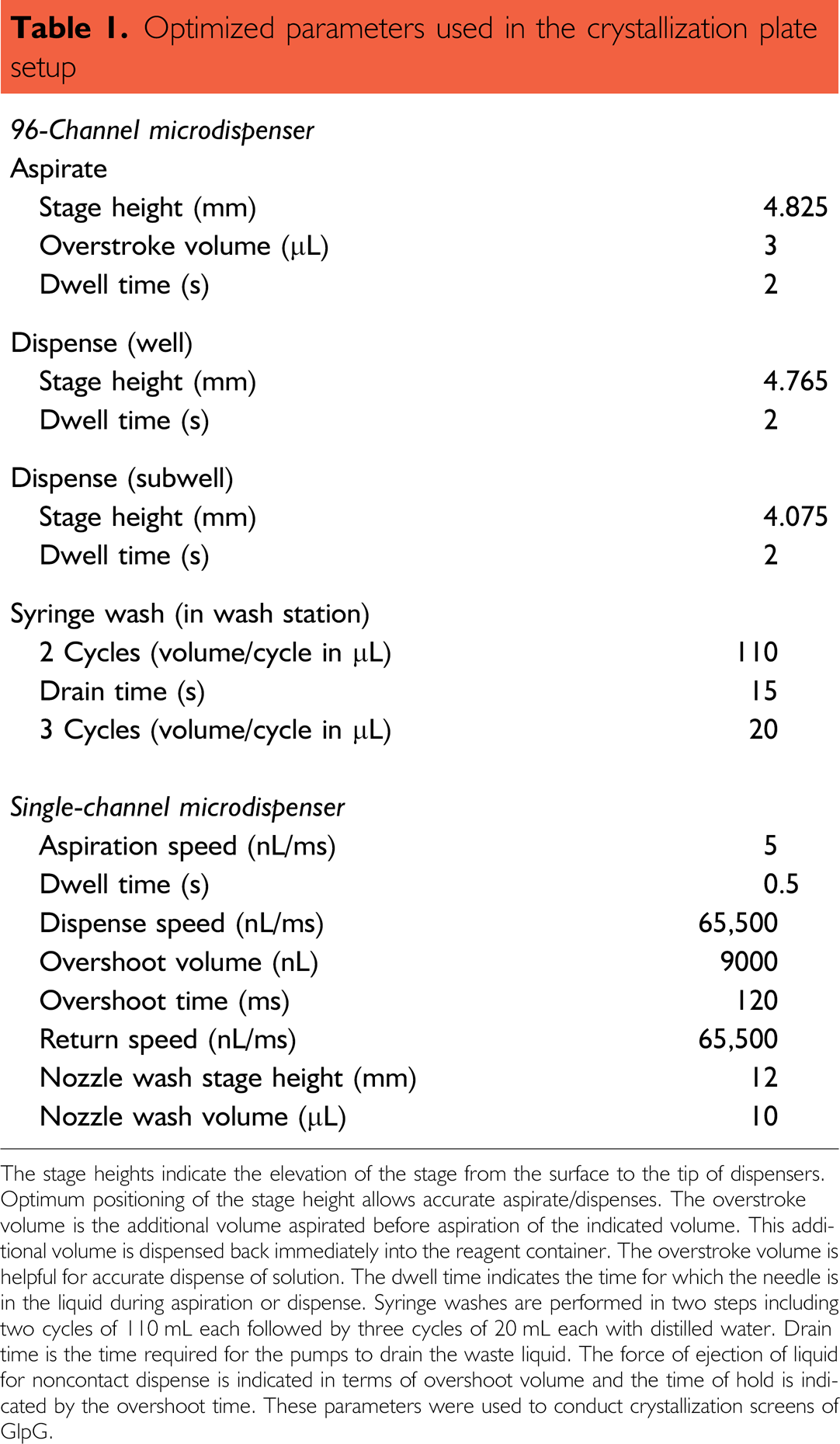
The stage heights indicate the elevation of the stage from the surface to the tip of dispensers. Optimum positioning of the stage height allows accurate aspirate/dispenses. The overstroke volume is the additional volume aspirated before aspiration of the indicated volume. This additional volume is dispensed back immediately into the reagent container. The overstroke volume is helpful for accurate dispense of solution. The dwell time indicates the time for which the needle is in the liquid during aspiration or dispense. Syringe washes are performed in two steps including two cycles of 110 mL each followed by three cycles of 20 mL each with distilled water. Drain time is the time required for the pumps to drain the waste liquid. The force of ejection of liquid for noncontact dispense is indicated in terms of overshoot volume and the time of hold is indicated by the overshoot time. These parameters were used to conduct crystallization screens of GlpG.
Results and Discussion
The protein crystallization screening process can be a laborious task involving significant amount of a researcher's time.24, 25 In this study, we addressed an important bottleneck, the setup of crystallization trials using an automated liquid handler. We systematically developed the Thermo Scientific Matrix Hydra II eDrop and ControlMate software to conduct these trials (Fig. 1). An iterative process of robot and software improvement, followed by performance testing was conducted. We validated the use of the Thermo Scientific Matrix Hydra II eDrop for crystallization trials using GlpG, a rhomboid family intramembrane protease. Several features of the Thermo Scientific Matrix Hydra II eDrop robot are appropriate for crystallization trials. These include the 96-well dispenses of precipitant reagents into the crystallization plate by a positive displacement method and the noncontact mode of protein dispense by the single-channel microdispenser. The combination of high actuator speed and friction-free operation of the EMBs aids in the dispense of small uniform droplets into the subwells of the crystallization plate. Development of the EMBs for the Thermo Scientific Matrix Hydra II eDrop allows higher-velocity liquid dispensing than conventional piston based systems. The EMBs also allow easy control of the reproducible droplet size that facilitates a wide sub-microliter volume range. During development, we discovered that the orifice size and adherence properties of the single-channel microdispenser play an important role in achieving uniform droplet ejection and have incorporated this knowledge into the instrument design.
Description of the Thermo Scientific Matrix Hydra II eDrop robot. Panel A shows a photograph of the Thermo Scientific Matrix Hydra II eDrop robot. For the protocol discussed, precipitant reagents were loaded into stage position 1 in a deep well block, the crystallization tray into stage position 3, and the protein solution into the protein solution tube rack. Panel B shows a three-subwell 96-well Corning crystallization plate and a schematic cross section of a sitting drop crystallization well. The dispense pattern can be adapted for different types of crystallization plates.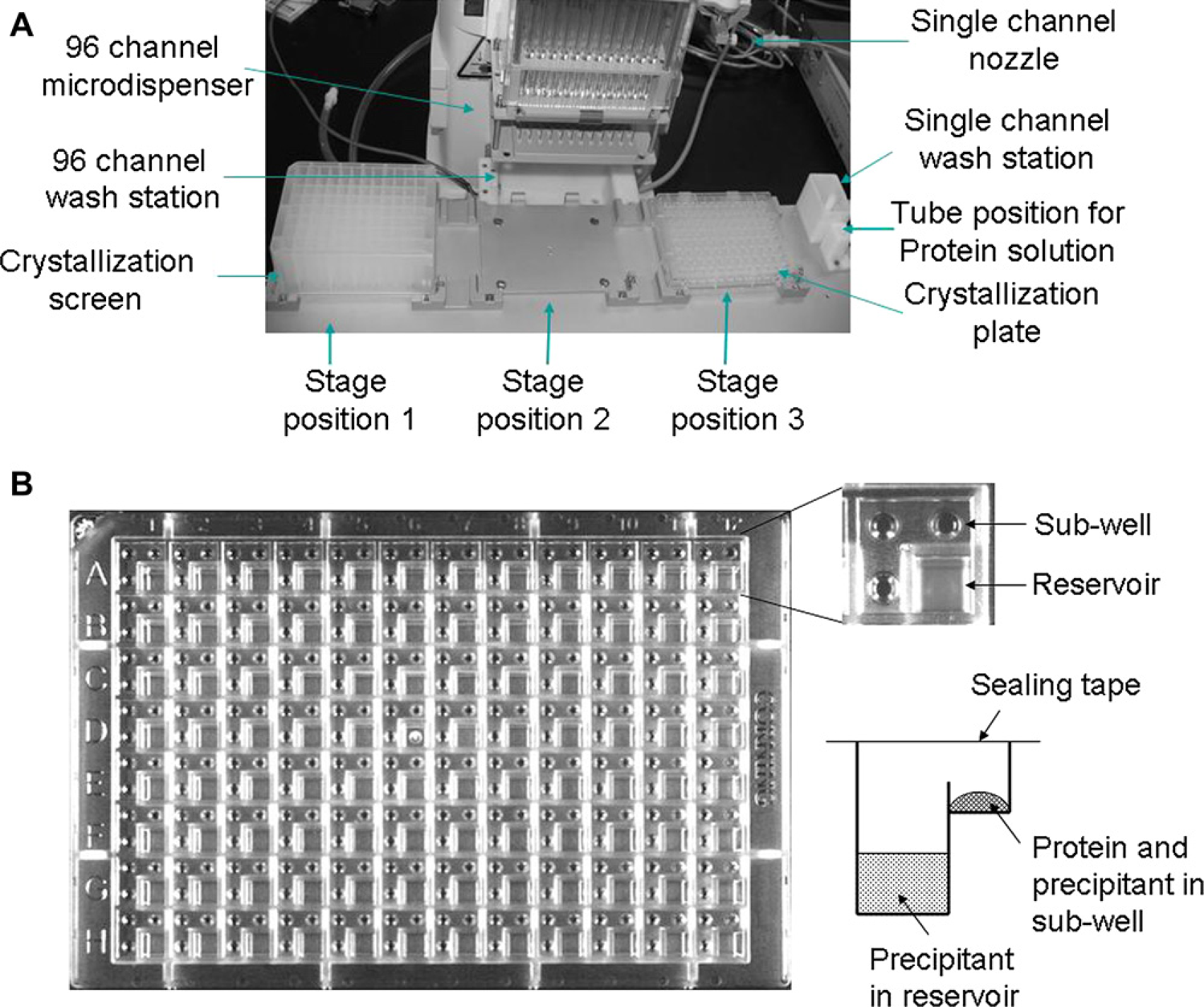
A protocol was developed for automated setup of crystallization trays using the Thermo Scientific Matrix Hydra II eDrop. This protocol required an initial setup of stage positions and height for the Corning 3840 sitting drop plates (Fig. 1B) that was saved to the software and reused for each crystallization run. Our protocol required positioning of the deep well block of precipitant reagents on stage position 1. The protocol also required the Corning crystallization plate to be positioned in stage position 3 and the protein solution to be placed in the one position tube rack (Fig. 1A). The automated process started with the aspiration of precipitant from the crystallization screen deep well block using the 96-channel microdispenser. These reagents were dispensed into the reservoir and subwells of the crystallization plate. After addition of the precipitant reagents, protein solution was aspirated from the one-position tube rack by the single-channel microdispenser. The protein solution was then dispensed into the Corning 3-subwell crystallization plate subwells. Our protocol allowed the utilization of one, two, or all three subwells of the Corning sitting drop plate to conduct 96, 192, or 288 crystallization trials per tray. One, two, or three different protein samples can be used. The noncontact dispense of protein sample from the single-channel microdispenser prevents cross contamination between precipitant and protein solution. After protein dispense into the sitting drop subwells, the crystallization tray was removed from the Thermo Scientific Matrix Hydra II eDrop platform and sealed with sealing tape by hand. According to the protocol, the microdispensers were then washed with distilled water to prepare the Thermo Scientific Matrix Hydra II eDrop for the next run. Use of washable 96-channel microdispenser significantly reduced the expense incurred in usage of disposable tips for the crystal screening operations. This automated crystallization tray setup protocol takes a total of 4, 7, and 10 min per plate to setup 96, 192, and 288 crystallization drops, respectively. Several thousand crystallization trials can, therefore, be conducted per day. A cleaning time of 6 min is required between tray setups to prevent cross contamination between precipitant deep well blocks. Initial setup time for plates and protein sample positioning on the stage is approximately 1 min per run. The instrument requires both the single- and 96-channel microdispensers to be cleaned daily using preset maintenance programs, before crystallization tray setup. In our laboratory, this one-time daily cleaning and maintenance protocol takes approximately 40 min. The flexible ControlMate software package allows most 96-well sitting drop crystallization plates to be accommodated by the Thermo Scientific Matrix Hydra II eDrop system. ControlMate software programs developed during the course of this study are available to researchers upon request.
Preliminary crystallization trials for the rhomboid family intramembrane protease, GlpG, were setup using the Thermo Scientific Matrix Hydra II eDrop. These trials, using crystallization screening reagents purchased from Hampton Research, rapidly resulted in initial crystal hits for this membrane protein. The hits were then optimized by hand using the hanging drop vapor diffusion method in 24-well VDX plates to obtain diffracting crystals with dimensions of approximately 100 × 100 × 100 μm (Fig. 2). The crystal structure was solved to 2.1-Å resolution. 23 The method of initial robotic screening using the Thermo Scientific Matrix Hydra II eDrop followed by manual optimization proved to be an effective and efficient way to obtain the first diffraction quality crystals of the rhomboid family intramembrane protease, GlpG.
Crystallization of a rhomboid family intramembrane protease, GlpG, using the Thermo Scientific Matrix Hydra II eDrop: initial crystallization trials discovered five crystal hits using the Hampton Research SaltRX HT kit (Hampton Research cat. # HR2-136). Panels A–E show the crystal hits. The crystallization screen conditions for each panel were (A) 1.5 M ammonium chloride, 0.1 M Bis–Tris propane, pH 7.0; (B) 3.5 M ammonium chloride, 0.1 M Bis–Tris propane, pH 7.0; (C) 3.5 M ammonium chloride, 0.1 M Tris, pH 8.5; (D) 3.2 M sodium chloride, 0.1 M Bis–Tris propane, pH 7.0; and (E) 4.0 M sodium nitrate, 0.1 M Bis–Tris propane pH 7.0. Panel F shows crystals resulting from optimization of initial crystal conditions shown in Panel D. The optimized precipitant conditions, 3.0 M NaCl, 100 mM Bis–Tris propane, pH 7.0, resulted in diffraction quality three-dimensional crystals with dimensions of approximately 100 × 100 × 100 μm.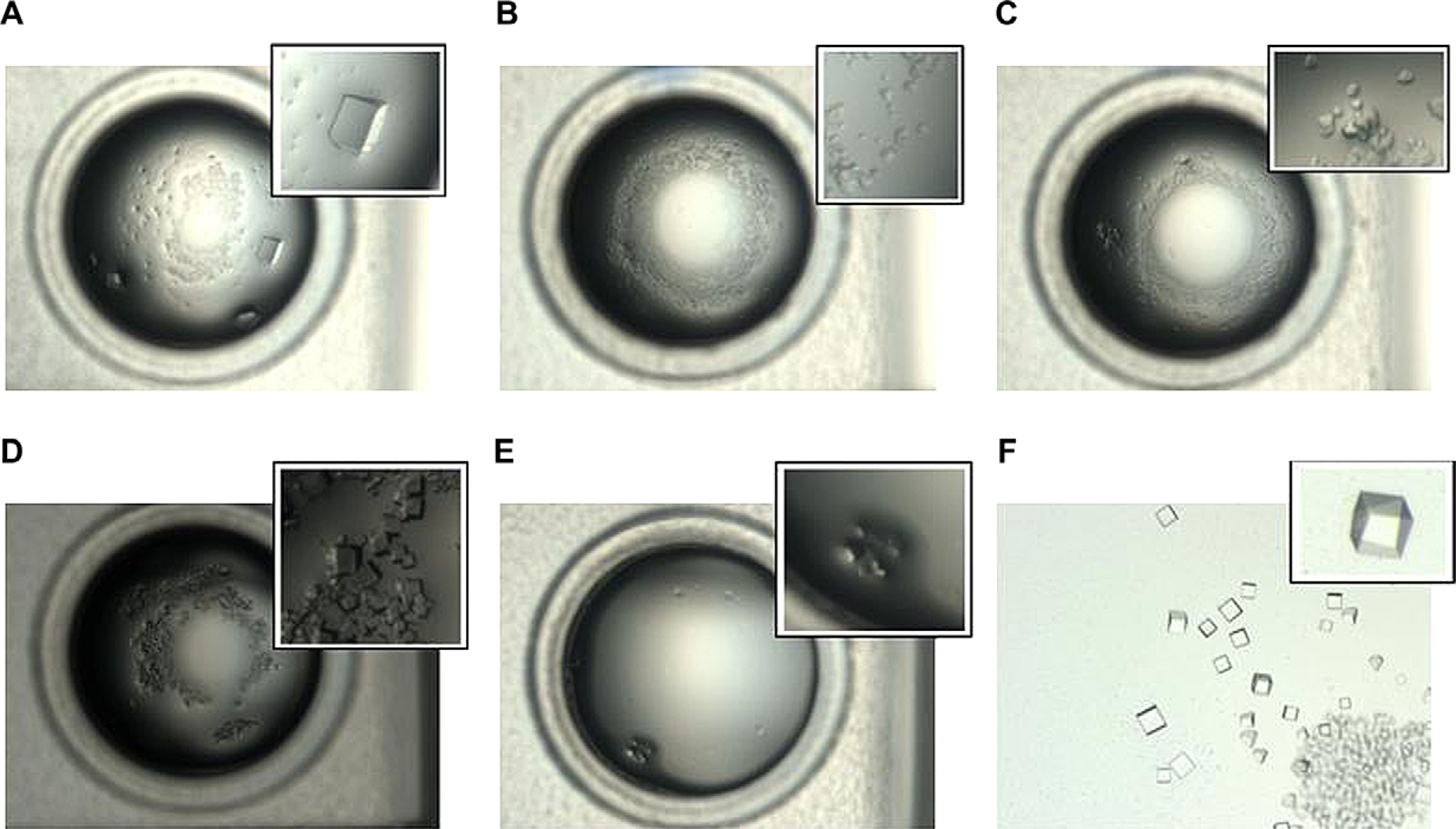
Footnotes
Acknowledgments
The Thermo Scientific Matrix Hydra II eDrop and ControlMate software are products of Thermo Fisher Scientific. Crystals of GlpG were produced at Yale University School of Medicine. We thank Joseph Schlessinger and the Department of Pharmacology for shared ownership of the Thermo Scientific Matrix Hydra II eDrop. YW is funded through an Ellison Medical Foundation grant to Ya Ha. TJB is an American Society of Hematology Junior Faculty Scholar. Ya Ha, Amit Kumar, and Edward Petri are thanked for helpful comments. The eDrop EMBs noncontact dispense mechanism is a patented technology from Fluilogic. We also thank Jeff Hall and other members of Thermo Fisher Scientific in Hudson, NH for their input on design of the procedures and robotics.