






Abstract
In Germany, all slaughtered cattle and fallen stock above the age of 24 months are required to be tested for bovine spongiform encephalopathy (BSE). Due to short turnaround times and urgent economic demand for fast results in the slaughterhouses, a highly reliable and fast-running system is needed. Using the Prionics (Prionics AG, Schlieren, Switzerland) CheckLIA Rapidtest, a modular system was installed that has processed over 245,000 samples since February 2004. Test runs averaged 340 min per batch of 240 samples. The rate of initial reactive results was 1.95 in 1000 samples.
Keywords
Introduction
Since the first reported case of bovine spongiform encephalopathy (BSE) in Germany in late 2000, laws have been installed to guarantee that every slaughtered cattle above 24 months of age is tested for BSE using tissue from the Obex region of the Medulla Oblongata. The Landeslabor (LSH) is responsible for the test of all cattle that are slaughtered in the state of Schleswig-Holstein, as well as fallen stock (animals that died prematurely on the farm, e.g. of diseases, accidents). In addition to cattle, sheep and goats older than 18 months are also tested for scrapie. The LSH uses the Prioncs CheckLIA 1 for the detection of PrPsc2 in these samples.
Our Lab accepts same-day samples until 2000 h, and has until 0600 h the following morning to report results (including retests), leaving a time frame of around 10 h. The majority of the samples arrive from 1700 h to 2000 h. The staff works in three shifts, with four technicians in every shift. Shift times are 0700 h to 1500 h, 1500 h to 2300 h, and 1900 h to 0400 h. During the time from 1900 h to 2300 h, two shifts are present to cope with the high number of samples that arrive during this time. In addition, two technicians carry out registration of the arriving samples, and one supervisor is present.
Due to the processing time of the CheckLIA of about 4 h, and the large number of samples per day (800-1500), automation is needed. However, in case of a breakdown, the system needs to be easily replaced by manual power or backup machinery. In such an event, our experiences with other systems have shown that it is easier to have a modular setup that does not rely entirely on one robot.
We developed a modular chain of automation named MoSES (Modular Semi-automatic ELISA System), which uses modules instead of a single machine to accomplish these goals, and which also only automates the justified and necessary steps when and where automation assists and supports the lab personnel.
Test Principle and Time Management
The Prionics CheckLIA Rapidtest is EU-validated for use on cattle to test for BSE, and on sheep and goats to test for scrapie. 3,4 Each plate has four high-positive controls, four low-positive controls, eight negative controls, and a maximum capacity of 80 samples.
Step b (Table 1) is performed by one technician, who cuts a 500 mg piece of tissue from the sample using a scalpel and adds the dilution buffer with a Dilumat IV (AES, Combourg, France; Fig. 1). Step d (Table 1) is done using a 0.5-mmdiameter blunt needle (Transcoject, Neumünster, Germany), which further assists homogenization (Fig. 2). To limit the processing time, plates are combined to a batch of three (number of samples per batch = 240). Technicians are needed to transports plates from one module to the next, which limits hands-on time and results in fewer manual manipulations.
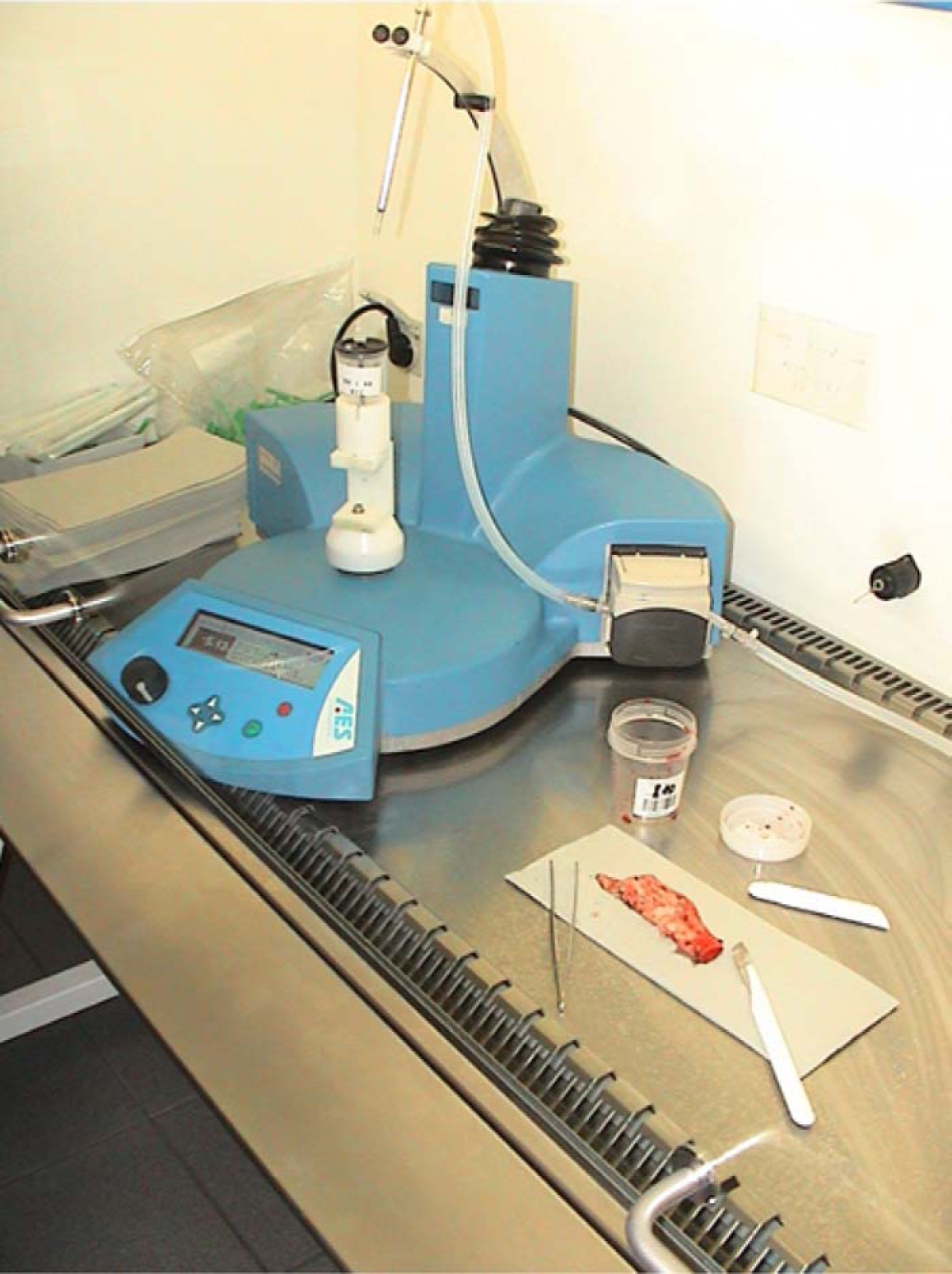
Sample cutting and Dilumat IV. Steps a-f are all performed manually, making up for almost the entire hands-on time needed in the process.
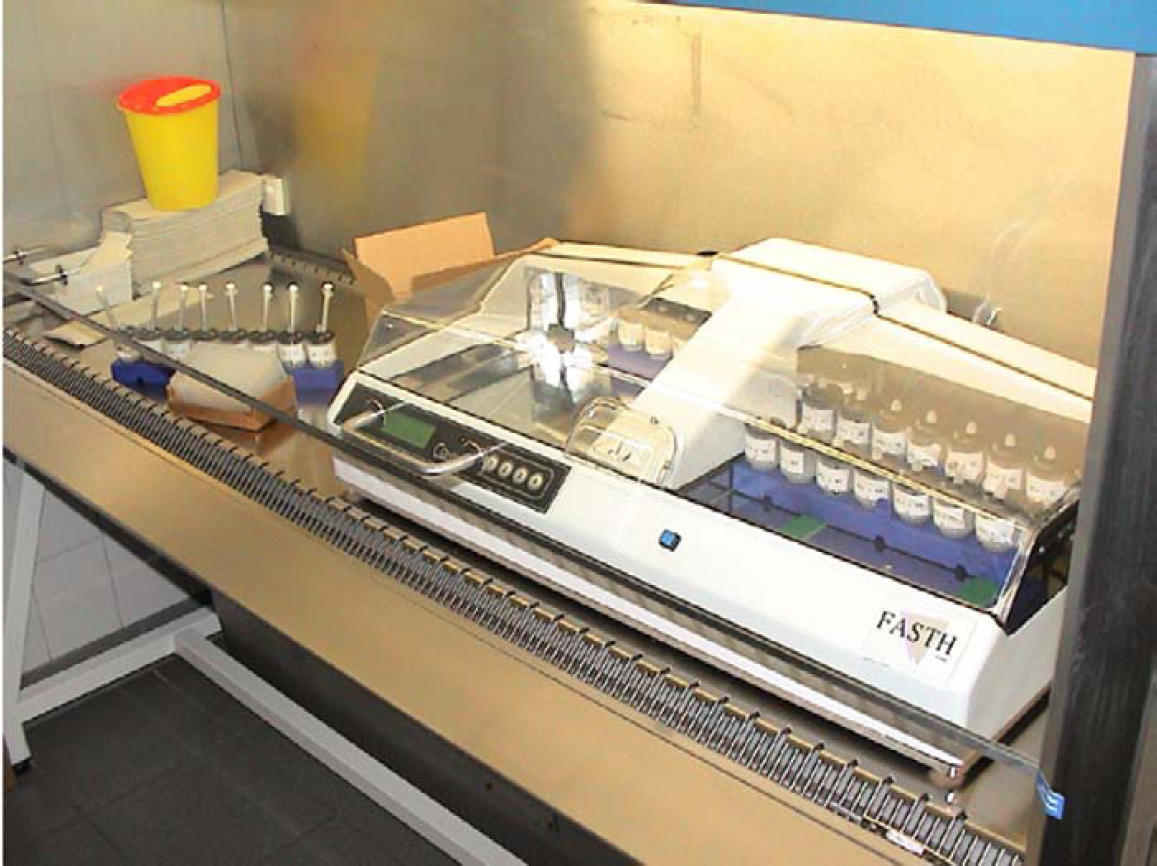
FASTH homogenization and transfer to master plate.
Test routine for one batch (3 Plates = 240 samples)

Including registration and cutting the samples, a processing time of around 340 min is needed for one batch, using a total of five technicians (four in the lab, one for registration). Under favorable circumstances (e.g., large numbers of samples arriving at the same time, limiting the time needed to have 240 samples for one batch ready), the time can be reduced to around 310 min. During times of high sample flow (e.g., winter, when more cattle are slaughtered), two “lanes” are formed, with each lane processing one batch; a total of 10 technicians for needed for steps a-f (Table 1). Once digestion has started, only one technician is needed to finish a single batch. If samples have to be retested, an aliquot of the original sample can be used, reducing the time by around 100 min, for a test run of 240 min.
Modular Automation
Steps h-m (Table 1) are the most critical and error-prone in the process. Therefore, it was decided to implement robots to minimize the risk of pipetting errors and to accomplish the best possible reproduction result. The LSH was supplied with two Beckman-Coulter (Fullerton, CA) Biomek FX robots to perform these steps (Fig. 3). In our case, these robots are only equipped with 96 channel heads; it was therefore necessary to have controls prepared by hand and filled into a plate, from which the robot can use them, or have them added to the preincubation plate manually. To enable us to use the 96 channel pod, even when only rows 3-12 were needed, special 12-row trays were used in which only the according rows were filled with the desired reagent. These trays also helped to accommodate the low volumes of reagents supplied by the manufacturer.
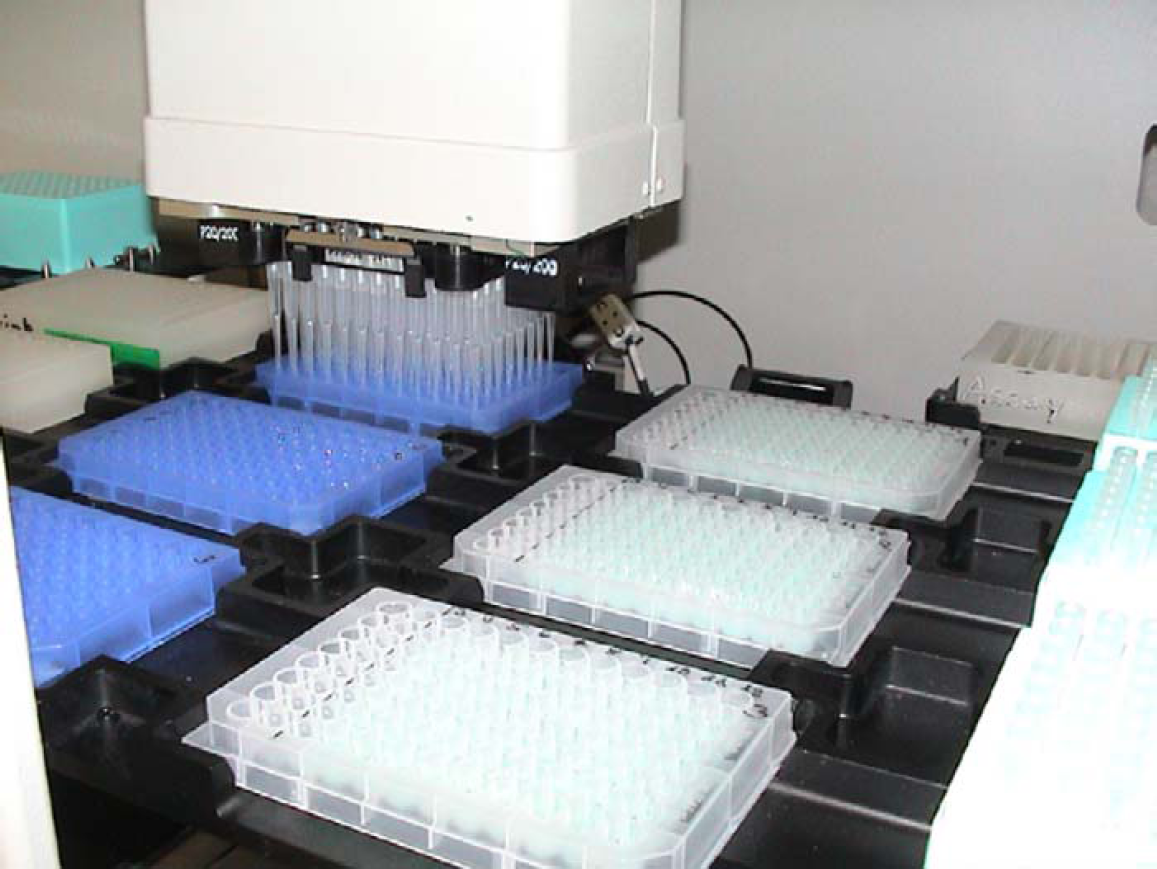
Critical steps are performed using a Biomek FX.
A special problem arose with steps l and m (Table 1). The time the robot needed to perform step l for three plates (one batch) was originally longer than desired (2 min ± 15 s allowed, 2 min 32 s were needed). To solve this problem, the setup of the Biomek FX workspace had to be optimized (Fig. 4), which brought down the time to 2 min 12 s, fitting the allowed time frame. Dispensers could not be used for any of these steps due to the very limited amounts of reagents in the kit, which were not designed to be used in a robotic setup. Step o (Table 1) is performed by the second Biomek FX, reusing the tips needed for step l (Table 1). The wash cycle is performed by a Bio-Tek (Winooski, VT) ELx405 VR 96- channel washer, which shortens the time of this step to 45 s for one plate. Two Berthold (Bad Wildbad, Germany) MPL2 Readers are used for measuring the luminescence (RLUs), with the third plate of the batch being processed around 5 min after the first two. The results are then calculated and stored in an Excel file and imported into the LIMS (HMLIMS, Adelheidsdorf, Germany), which also automatically prepares and sends faxes.
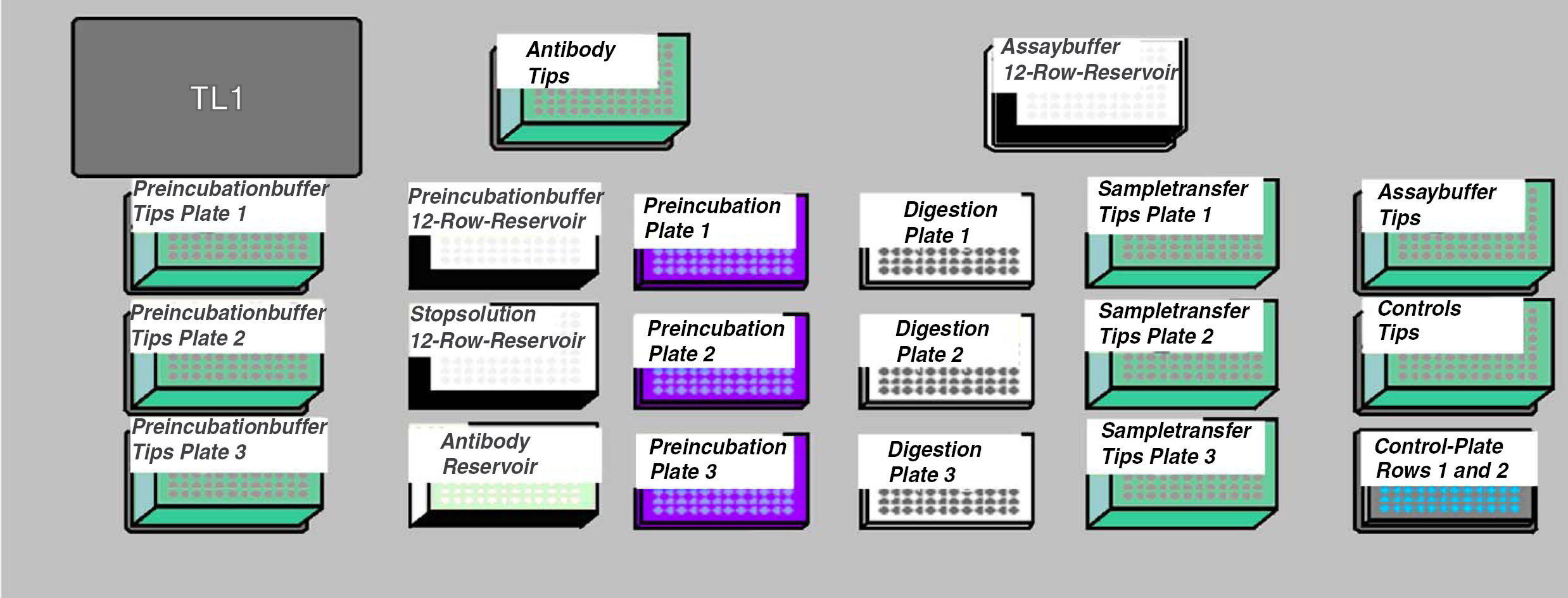
Optimized workspace setup of Biomek FX.
Backup Systems
The original design of the Prionics CheckLIA was a fully manual approach; therefore, all steps can be completely backed up by technicians and simple machinery. If a Dilumat IV fails, it can be replaced by a scale and a dispenser. The FASTH (Consul, Turino, Italy) is essential for the entire process and the only machine that cannot be backed up by something else. If a failure occurs, the LSH always has one replacement machine ready. All incubators, shakers, and washers are available in a large number, reducing the risk of any delay in the process if one of them quits.
Since two Biomek FX robots are installed, redundancy for each robot is available. In the unlikely case of a failure of both machines, the backup system for the critical steps is a Bio-Tek Precision 2000 robot. It can handle steps i-m (Table 1) for one plate at a time in less than 11 min, which lengthens the process for one batch by around 20 min. The LSH also uses two Berthold MPL2 Readers to ensure that one backup is always available. Of course, all pipetting steps can be performed manually if needed, which should be practiced by the lab staff from time to time.
Validation of the Modular System
To validate MoSES, we ran three sets of ring-trial samples on the system. All three sets were correctly identified. After passing these tests, the LSH was cleared by the German National Reference Laboratory (NRL) and the State Department for Consumer Protection (which oversees the LSH) to run this system. In addition, we used positive material in a dilution of up to 1:20 to test the sensitivity of the system. All samples were correctly identified, with the 1:20 dilution still yielding a result clearly above the cutoff that separates negative from positive samples (cutoff = 712 RLUs; sample 1:20 = 7935 RLUs). Since the installation of the modular setup, two annual ring-trials by the NRL have been passed by the LSH.
Discussion
The LSH processed 245,779 samples in 278 days with this modular system; from February 16th 2004 to March 24 2005, 220,060 slaughtered (sl) samples and 25,719 fallen stock (fs) samples were processed (avg: 970, min: 425, max: 1527). A total of 485 (sl = 355; fs = 125) samples had to be retested as the first run yielded a reactive result. Of these retests, 27 (sl = 7; fs = 20) had to be sent to the NRL for confirmation, as a reactive result was replicated. Four (sl = 1; fs = 3) were confirmed positive.
Because 17 out of 125 fallen stock retests had to be checked by the NRL without producing a true positive result (false-positive), a high sensitivity of the test in this high-risk group might be indicated. However, at the same time, the high rate of false-positives, when compared to the group of slaughtered cattle, can express the absent robustness of the test when decomposed, autolytic samples are to be analyzed.
In 14 of 246 days, the deadline of 0600 h could not be met; however, all results were ready by 0730 h. Fifty-two of 3072 processed plates became invalid, forcing a repeat of these plates from the digestion on. Problems with small amounts of reagents have to be taken into consideration when installing a system, especially when processing large numbers of samples, where automation is indicated.
In summary, our MoSES has proved to be stable and reliable, although three-plate batches always pose the risk of losing large numbers of samples if a machine fails. Therefore, it is necessary to have adequate backup systems at hand, as any delay in the process will cause many problems for the slaughterhouses.
Acknowledgements
The authors thank Dietmar Janke (Beckman-Coulter, Germany) and Christoph Hundt (Roche, Penzberg, Germany) for their work installing the system. We also appreciate the hard work of our nighttime BSE staff.