






Abstract
The advancement of technology in life science has created a need for improved accuracy and precision in pipetting small volumes1 from 50 nL up to and above 10 μL. Tomtec has adapted ink-jet technology2−6 to meet this need in their Nano pipettor heads. A coefficient of variation (CV) of 5% is achievable at 50-nL volumes, improving to 1-2% at 1 μL and above. A pipettor must aspirate from a source and dispense to a destination, then repeat the process without detectable carryover. The Nano head 8 and Nano head 16 achieve this utilizing a novel standpipe design that permits a fast wash through of the liquid handling channels. Each pipettor may be individually controlled, creating another dimension in pipetting flexibility.
Quadra Nano Overview
The Nano pipetting operation is based on ink-jet technology 2,6 that, in turn, is the refinement of the most commonly used method of liquid dispensing in the world: time-pressure. A liquid delivery orifice is held open for a precise length of time. The pressure applied to the liquid determines quantity of flow. The gates of a dam are held open for hours. This parameter, combined with the head pressure in the dam, determines how much flow moves downstream. An ink-jet system uses a fast acting microminiature valve that is held open electronically for microseconds or milliseconds. The pressure, or vacuum applied to the valve, determines the flow in that time period.
Tomtec's Nano heads are 8 or 16 individually controlled pipettors (Fig. 1). When combined with the automation of the Quadra 3 7 workstation, they can provide program control of the volume delivered to each well in the receiving plate. As an example: on a 384-well application, rows A and H could have 24 individual dilutions of a standard curve for compound A. Rows I and P could have similar standard curves for compound B. The remaining wells could have unknowns to compare to the standards at varying dilutions. The individually controlled pipettors permit a wide range of plate-preparation options. The ease of use and flexibility of the Quadra 3 Windows programming allows this level of automation for one microplate at a time, or fifty at a time.
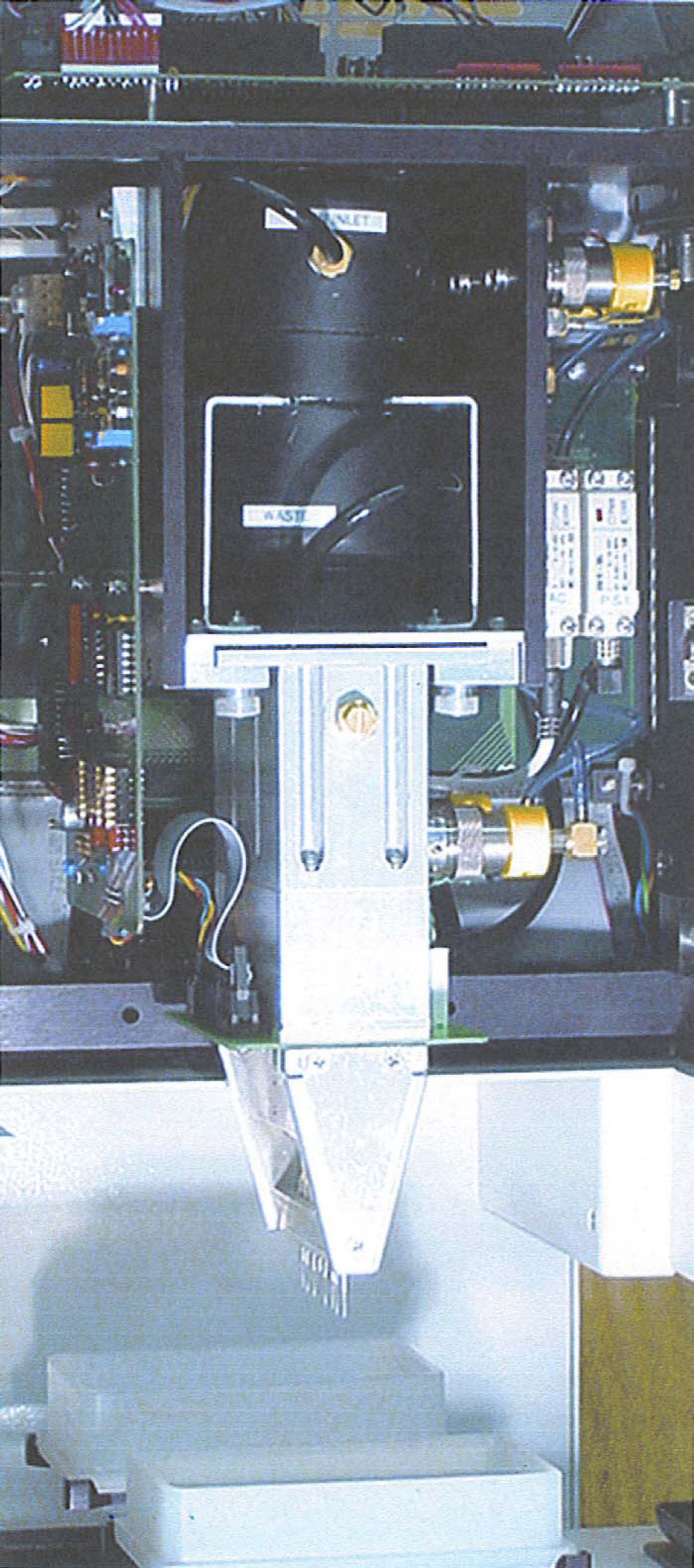
The Tomtec Quadra Nano 8 pipettor head.
The volume range of the Nano heads is extremely wide. The limiting factors are precision and accuracy at the sub-microliter volumes. For the higher volumes, it is simply a matter of how long the valve is held open for flow to occur (Fig. 2). The nanoliter volumes are determined by several factors: how fast can the microvalve open and close repeatedly, what head pressure is applied, and the characteristics of the liquid being delivered, that is, viscosity.
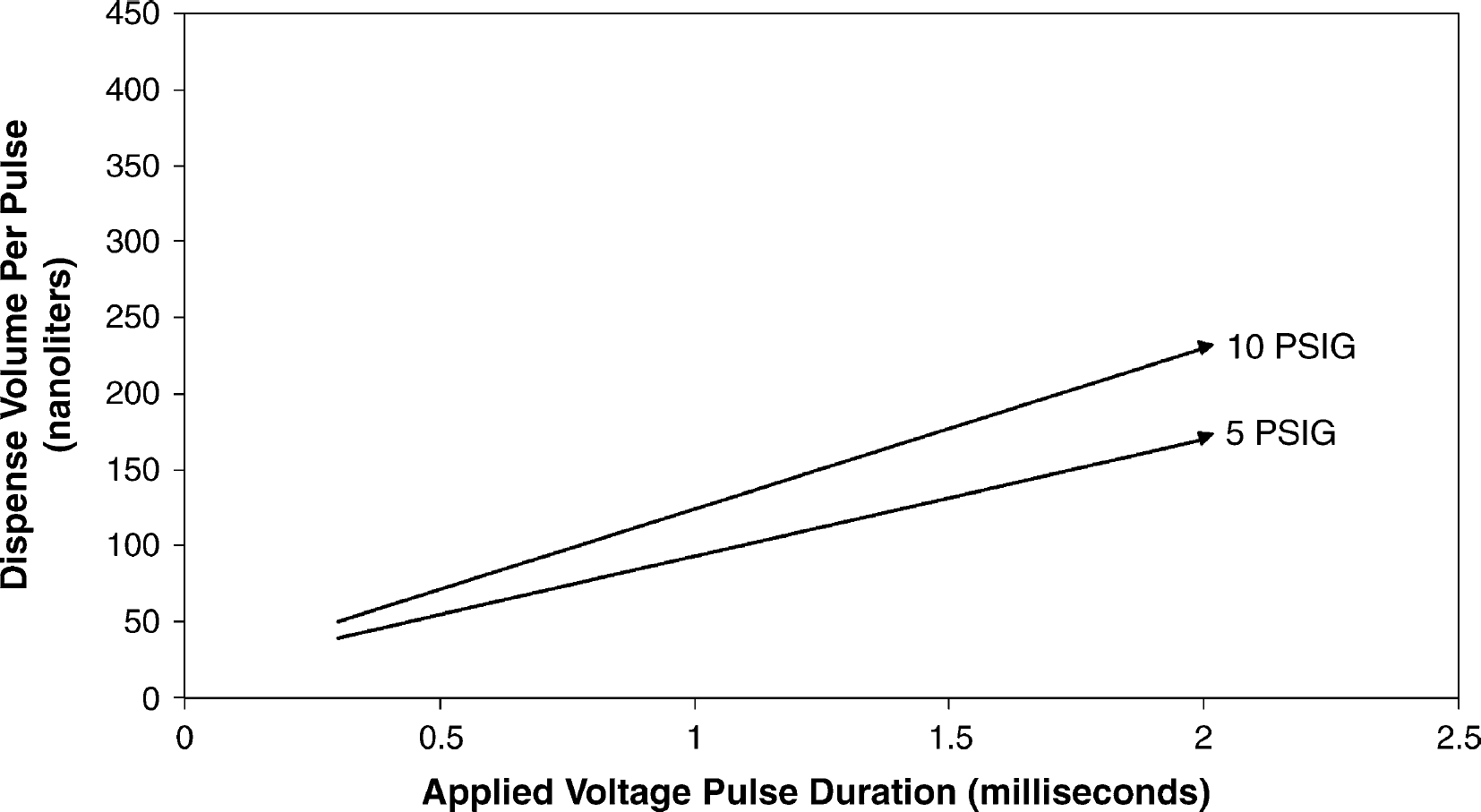
Total volume dispensed per pulse as a function of pulse duration and pressure.
The lower limit of volumes is also determined by the parameters for accuracy and imprecision acceptable for the specific application. At 1 μL, the Nano heads can provide a coefficient of variation (CV) of 1-2% using water as the pipetting medium (Fig. 3). At 50 nL, this application would have a CV of approximately 5%.
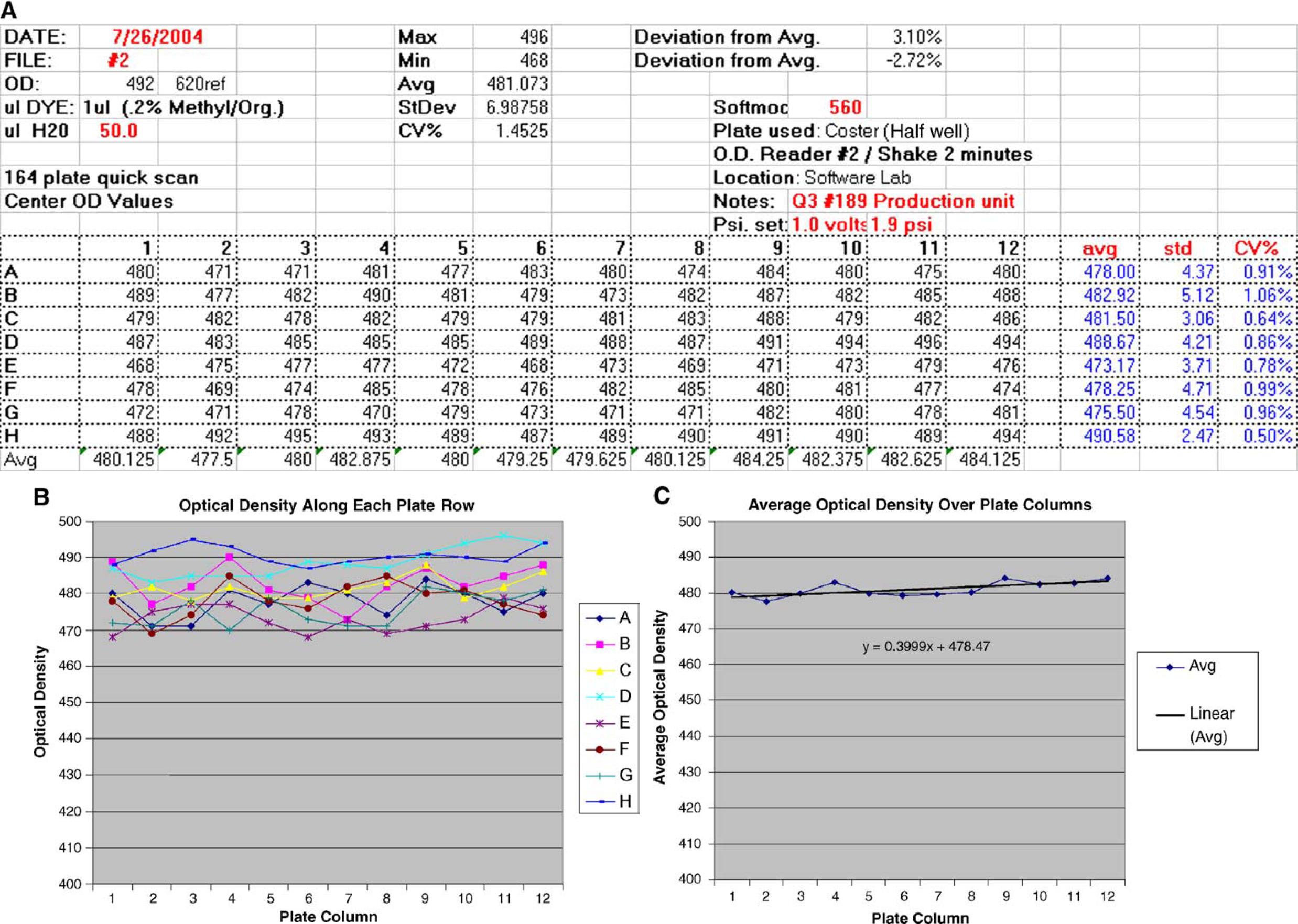
Twelve shots of 0.2% Methyl Orange in water (1 μL by weight) were dispensed to each well of a 96-well plate. The results were read bichromatically. The worksheet (a) presents all measurements, calculated results, and summary data. The center figure (b) charts optical density for each well in all rows over the columns of the plate. The bottom chart (c) charts the average optical density along with the fitted trend line. The CV for all wells was 1.45.
With typical ink-jet applications, a reservoir is filled with liquid (ink); it is pressurized with a positive pressure, and the ink-jet valve aliquots small dots of liquid to the destination. The difference in pipetting applications is the requirement to handle different liquids, not one common liquid. The requirement for a pipetting system is to aspirate from a source, dispense precise amounts to a destination, then wash or clean the flow paths to repeat the process with another liquid without detectable carryover.
The Nano heads can easily switch, under program control, from vacuum to positive pressure (Fig. 4). Vacuum is applied to the reservoir, the microvalve opens filling the reservoir. With the microvalve closed, the reservoir is switched from vacuum to positive pressure. As the microvalve opens again, it will dispense liquid from the said reservoir.
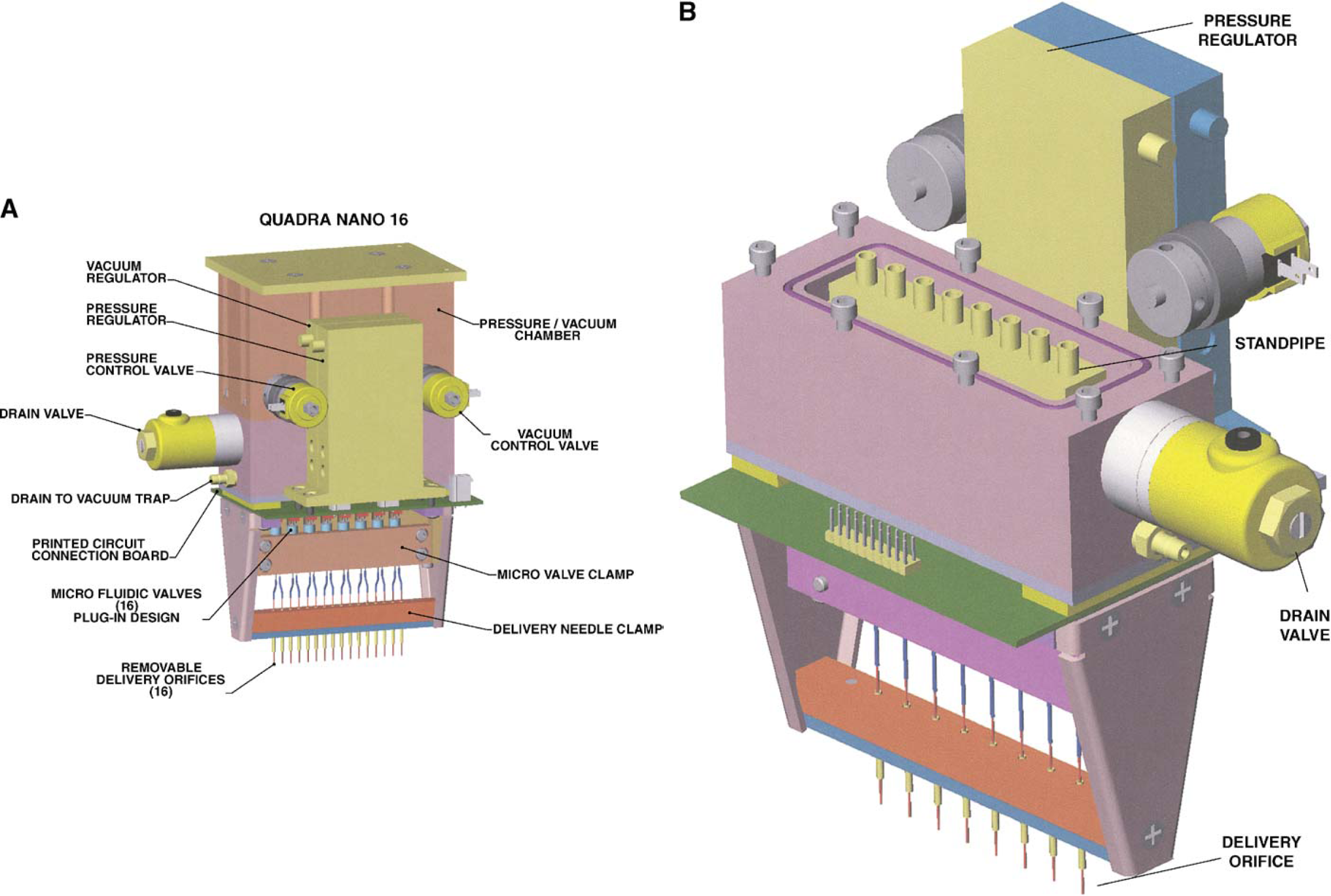
Components: (a) Components of the Quadra Nano 16 pipettor head. (b) Cut away view of the Quadra Nano 8 pipettor head.
The key design element (patent pending) of the Nano design is the use of individual standpipes as the reservoir for each valve. Thus, each microvalve has its own isolated flow path from delivery orifice up through the microvalve to its own standpipe. The 8 or 16 standpipes are open at the top to the enclosed pressure chamber.
For dispensing, a common precisely controlled pressure is applied to the chamber. Thus, all microvalves see this common parameter. The time each valve is opened is software controlled. This enables each microvalve flow path to deliver any volume within its range, regardless of the setting on the adjacent flow path, that is, individual volume dispensing for each valve.
For aspiration, a precisely controlled vacuum is applied to the standpipe chamber. The length of time each valve is held open determines the fill volume of the standpipe. Again, this can be a unique volume for each individual pipettor. In many small volume applications, precious reagents are used. Therefore, it is desirable to have a minimum fill volume. This fill volume consists of the actual dispensing volume that is required for the application plus the so-called dead volume. The dead volume is the minimum amount of liquid that is required before the pipettor can achieve the desired accuracy and precision. The dead volume of the Nano design is the volume of the liquid pathway between the orifice and the microvalve seat. This is 3.2 μL, and this dead volume can be recovered.
An area of concern when using ink-jet technology is the use of small orifices, and keeping them open. There are basically two small orifices involved: the delivery orifice and the valve seat in the ink-jet valve. The Nano heads use a sapphire jewel with a 0.004-in. (100 microns) diameter orifice. This is located at the entrance to the system, and in effect, is a filter on incoming particle size. However, if the system is washed in the opposite flow direction, that is, towards the orifice, it now becomes an outlet restriction. The wash system for the Nano heads washes the orifice in the same direction as the aspirating motion. Thus, the wash flow in is away from the. 004-in. orifice and not towards it. The orifice remains as an inlet restriction and not an outlet restriction. This wash action is described later.
Still, with small orifices, there is the risk of becoming clogged with particulate matter from the reagents being used. The ink-jet microvalves on the Nano heads electronically plug in to a printed circuit board and via an “O” ring seal into the standpipe. They can be easily and quickly changed. The needles containing the delivery orifices can be changed easily by unbolting the retaining clamp. The tip wash station for the Nano heads has an electronic test fixture included. Following the final rinse cycle, a dispense is made to the test fixture from all of the dispensing orifices (8 or 16). If any needle orifice is not dispensing, an error signal is produced for operator correction prior to the next delivery cycle.
As stated earlier, the Nano head design washes the system away from the small orifices, not to them. To wash the flow path of each pipettor, a vacuum is applied to the standpipe chamber. For washing, a fast flow rate is desired. Thus, the vacuum applied is full vacuum (20-in. Hg) for washing, as opposed to the electronically regulated vacuum of 12-in. Hg for aspiration. This high vacuum provides a wash rate of 70 μL per second. The wash fluid flows up through the delivery orifice, through the valve seat, and overflows the top of the standpipe, washing the entire liquid pathway. The waste overflows the individual standpipes into the surrounding chamber to the self-contained vacuum trap. After the wash cycle is complete, the vacuum trap is closed and pressurized to automatically drain out of the back of the Quadra 3.
The removable Teflon standpipes provide another easily changed design parameter. Assume the application requires 10 μL per well in a 384-well plate. The total volume required for each pipettor is 240 μL, so a standpipe with a maximum volume of 250 μL is required. A 10x wash, at the rate of 70 μL per s, requires 35 s. However for an application, such as adding 1 μL of master mix for a PCR reaction, the maximum standpipe volume is only 25 μL. Thus, the 10x wash rate only requires 3.5 s. The use of easily interchangeable standpipes permits optimizing the Nano head design for the specific applications throughput.
The Nano 8 or Nano 16 is supplied as the pipetting head in the Quadra 3 pipetting workstation. It utilizes the onboard pneumatic control system of the Quadra 3 to provide a self-contained system requiring only a power connection. The indexing stage traverses the microplate under the dispensing needles for noncontact, on the fly, dispensing. The Quadra 3 indexing stage allows the Nano 8 to be used for 384 applications. The individual control of each pipettor permits 96-well dispensing with the Nano 16. The Quadra 3 stackers provide infeed and outfeed of reservoirs and microplates to the pipettor head for full walk-away automation.
Conclusion
The Nano 8 and Nano 16 pipetting head design moves proven ink-jet technology from dispensing to pipetting. The Nano heads provide a simple reliable design to both aspirate and dispense various reagents used in life science. This is combined with the means of a fast rinse of the fluid pathways between reagents. The end result is an instrument that can dispense the small microliter, nanoliter volumes required for current applications.