






Abstract
This article describes the application of high-resolution ultrasonic spectroscopy (HR-US) for the analysis of industrial emulsions and suspensions. The benefits of HR-US are discussed, including the ability to perform a direct analysis of emulsions and suspensions, which would otherwise be impossible, require significantly more effort in the laboratory, or produce erroneous results. The HR-US 102 spectrometer is also introduced. Manufacture of this laboratory-scale instrument is now possible due to recent technological advances in HR-US. The article outlines the principles of the HR-US technique and illustrates the application of the HR-US 102 spectrometer for analysis of absorption of ligands on the surface of particles, thermal stability, and effects of thermal history on microstructure of emulsions, crystallization, and particle sizing in diluted and concentrated emulsions.
This article describes the application of high-resolution ultrasonic spectroscopy (HR-US) for the analysis of industrial emulsions and suspensions. The benefits of HR-US are discussed, including the ability to perform a direct analysis of emulsions and suspensions, which would otherwise be impossible, require significantly more effort in the laboratory, or produce erroneous results. The HR-US 102 spectrometer is also introduced. Manufacture of this laboratory-scale instrument is now possible due to recent technological advances in HR-US. The article outlines the principles of the HR-US technique and illustrates the application of the HR-US 102 spectrometer for analysis of absorption of ligands on the surface of particles, thermal stability, and effects of thermal history on microstructure of emulsions, crystallization, and particle sizing in diluted and concentrated emulsions. (JALA 2004;9:87-90)
Introduction
High-resolution ultrasonic spectroscopy (HR-US) is a new technique for material analysis. This technique is based on the measurements of velocity and attenuation of “sound” waves at high, ultrasonic frequencies propagating through materials. Optical transparency is not required, as ultrasonic waves propagate through opaque systems, thereby making the technique relevant for non-transparent as well as transparent samples. In all cases, the technique provides a fast and non-destructive analysis of micro-structural and molecular characteristics and processes in analyzed samples.
HR-US is a powerful technique that enables outstanding resolution (down to 10-5 %) and fast, highresolution analysis for small sample volumes. This technique eliminates degradation, contamination, and misalignment of sensors, enabling analysis of aggressive (and sticky/problematic) samples. In addition, HR-US eliminates evaporation of the samples, allows extensive data analysis, and reduces laboratory effort as a result of fast, digitally controlled analysis.
Emulsions and suspensions
Colloids, such as emulsions and suspensions, play an important role in various fields of the pharmaceutical, cosmetic, food processing, biotech, and other chemical industries. Stability of colloids is a key factor determining the quality of food dressings, milk products, cosmetic creams, shampoo and liquid soaps, pharmaceutical formulations, paints, and other materials. It is natural, therefore, that there is a growing interest in methods for quality control and characterization of these materials. Design and manufacture of these products require analytical tools able to characterize the microstructural behaviour of these systems and the effects of various factors. These include composition, temperature, and hydrodynamic treatment (stirring, shaking, etc.) on the microstructure and interactions between the different microscopic parts of the colloids. An ideal analytical tool must reveal a microstructural fingerprint of the colloid, thus allowing prediction of its desired qualities. Most colloids have limited transparency for light and other kinds of electromagnetic radiation, and, therefore, traditional techniques for microstructural analysis of materials (which are mostly based on the measurements of parameters of electromagnetic waves propagating through the sample) are hardly applicable. Novel technology utilizing a wave of another nature (the ultrasonic wave) propagating through materials has the potential to fill this analytical gap.
Use of ultrasound in analysis of emulsions and suspensions
The analytical power of ultrasound is well known through its application in medicine, where it is used to visualise internal parts of the body. However, the advent of ultrasound in methods to analyze the microscopic details of emulsions and suspensions can be explained by the arrival of breakthroughs in ultrasonic techniques, electronics, new theoretical approaches, and fast computers. Previously, advances were prevented by the technological challenge in generating monochromatic sound beams within a wide frequency range and measurements of parameters of these waves with high resolution. These barriers have now been overcome to permit the development of versatile laboratory instruments, i.e., highresolution ultrasonic spectrometers.
High-resolution ultrasonic spectroscopy is a novel technique for material analysis based on precision measurements of the variables of high-frequency sound waves, which propagate through the sample. Oscillating pressure in an ultrasonic wave causes oscillation of compressions, and, therefore, by its nature, this is a high-frequency rheological wave. This provides for one of the great advantages of the technology, including the characterization of concentrated dispersions without the need for dilution. The preparation of serial dilutions is one of the limitations of optical techniques, as optical transparency is required to avoid multiple scattering effects.
Ultrasonic analysis is well known through its successful application in medicine and a number of fields of material analysis. However, in the past, the limited resolution of the measurements and complicated cleaning and sample-handling procedures prevented a broad spread of ultrasonic spectros-copy in research and analytical laboratories. Ultrasonic Scientific Ltd. has employed modern technologies to overcome these limitations, thus making commercial ultrasonic instruments available in practical, laboratory-scale instruments, namely, high-resolution ultrasonic spectrometers.
An advantage of the technology employed in ultrasonic spectrometers is the absence of large actuators as in dynamic rheology or bulky light sources and other optical parts or expensive consumables, thus representing a robust and multipurpose instrument, which performs a broad range of analytical functions of fast, non-destructive and non-expensive analysis.
HR-US spectrometers measure the attenuation of ultrasound and the propagation velocity of this sound. Attenuation is mainly determined by the scattering of ultrasonic waves in non-homogenous samples, such as emulsions and suspensions, and fast chemical relaxation (in homogenous mixtures). The elasticity of the material is the main contributor to ultrasonic velocity, which as a measure of molecular forces contains information about the concentration of components, chemical transformations, state and conformation of polymers, molecular binding, and other molecular properties. Compression in the ultrasound wave changes the distances between the molecules in the sample (that respond with intermolecular repulsions and attractions), which is reflected in ultrasonic parameters. Thus, ultrasonic spectroscopy allows researchers to probe intermolecular forces within the sample, thereby providing new information about its interior.
A researcher can extract from ultrasonic parameters a broad range of structural and molecular characteristics of samples. Most spectroscopists are familiar with electromagnetic waves in analysis (ultra-violet, visible, infra-red, and NMR), which have so far dominated in the field of materials analysis. In a sense, ultrasonic spectroscopy can be considered as a powerful extension of these techniques using sound waves (instead of electromagnetic waves), which brings new information on molecular processes as well as allows analysis in the areas where other techniques fail. The analysis of materials using this non-destructive technique has given researchers a broad range of new analytical capabilities.
The following examples illustrate the application of the HRUS 102 spectrometer for analysis of absorption of ligands on the surface of particles, thermal stability and effects of thermal history on microstructure of emulsions, crystallization and particle sizing in diluted and concentrated emulsions.
Binding of ligands to the surface of colloid particles
Figure 1 shows the change in ultrasonic velocity measured in a suspension of 200-nm polystyrene particles during a course of titration with a concentrated solution of calcium at 25 °C. Only data for 11 MHz are shown. The absorption of ligands (metal ions) on the surface of particles is an important phenomenon with regards to colloidal stability of suspensions. The added cations accumulate on the surface of the polystyrene particles. This binding is accompanied by the dehydration of the ions and the surface of the particles and results in a decrease of the ultrasonic velocity.
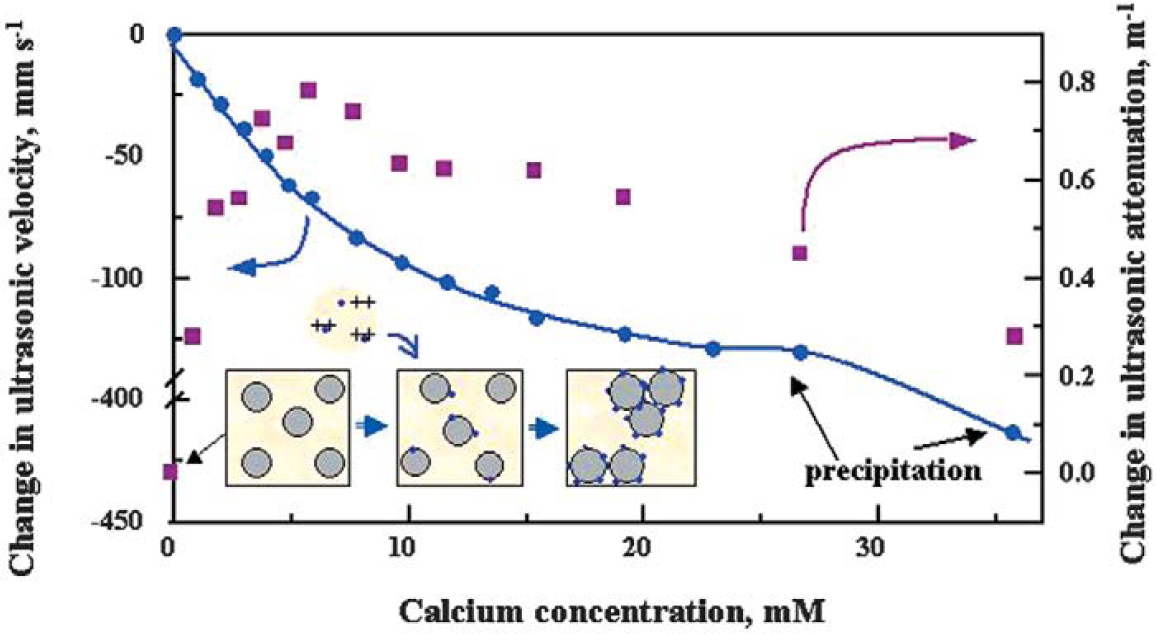
Ultrasonic monitoring of binding of calcium ions with polystyrene particles (0.5%). Concentrated solution of ligand (CaCl2) was added stepwise into the 1-mL suspension in the ultrasonic cell and into 1 mL of water in the reference cell.
When the concentration of cations on the particle surface increases, it results in the electrostatic neutralisation of particle charge followed by their aggregation and precipitation as indicated by an additional decrease in ultrasonic attenuation and velocity at high concentrations of calcium. These measurements allow calculation of the amount of ions bound to the particle surface and the binding affinity.
Thermal stability of emulsions and dispersions
In the second example, ultrasonic measurements were used for evaluation of thermal stability of two products, coating emulsions and effects of thermal history. This analysis was done with the temperature ramp regime, which allows measurement when temperature is changing with a programmed speed. Several consequent ramps 0 to 50 °C and 50 to 0 °C were performed. Three are shown in Figure 2.
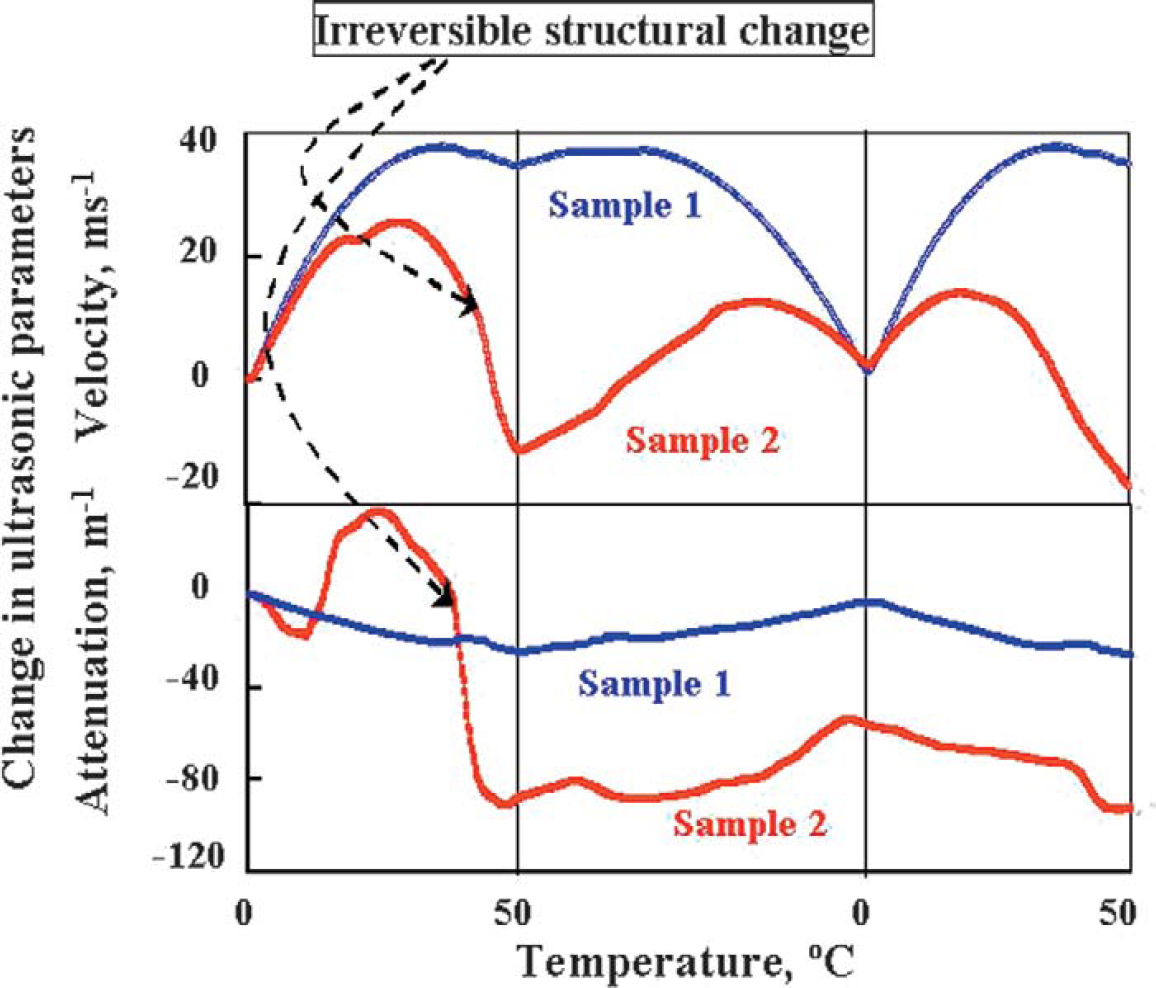
Ultrasonic analysis of thermal stability of coating emulsions and effects of thermal history on their structure. Change in ultrasonic velocity and attenuation in two emulsions during several consequent ramps: 0 to 50 °C and 50 to 0 °C. Frequency: 5.2 MH.
Reversible changes of ultrasonic parameters were observed in one of the emulsions (sample 1) during several cycles of heating and cooling. The regular profile indicates that the structure of this emulsion changes with temperature, but all the changes are recoverable, and the structure is not affected by the thermal history. In contrast, a sharp drop in ultrasonic velocity and attenuation in the second sample was observed at the first heating circle at around 40 °C, which did not recover during the next ramps. This indicates the irreversible changes in the emulsion. The decrease in ultrasonic parameters can be explained by the temperature-induced coagulation of the oil particles and the aggregation of the original particles into larger particles following the phase separation between oil and water phases.
Crystallization of lysozyme
Lysozyme protects us from bacterial infection by attacking bacterial cell walls, causing them to rupture. Therefore, the crystalline form of this protein is widely used in pharmaceutical applications. By varying the experimental conditions, various amounts and sizes of protein crystals can be produced. The amount of crystals, as well as an assessment of the size of crystals and interaction between crystals, is an important part of routine analysis in the pharmaceutical industry. The HR-US series of spectrometers allow measurements as the crystal grows with time and temperature as well as assessments of the amount of crystals in a sample. The monitoring of the crystal formation and, in particular, the kinetics of the reaction is essential for the optimisation of process control in the batch crystallization of pharmaceutical compounds.
Crystallization of lysozyme measured by high-resolution ultrasonic spectrometry is shown in Figure 3. In this measurement, 1 mL of a solution of lysozyme (40 mg/mL) in 0.1 M Sodium Acetate at pH 4.8 was placed into the ultrasonic cell. A crystallization agent was added to the sample, and kinetics of crystallization was followed. The data show three stages in the crystallization process. Over the first 3.4 h of the reaction, no significant change is detected. At the end of Stage (I), the ultrasonic velocity and attenuation start to increase due to the formation of crystals. This increase continues through Stage (II), as the concentration and size of the crystals grow. The rise in the ultrasonic velocity is caused by the increase in rigidity (decrease in compressibility) of the sample as a result of the formation of crystals. The rise of the ultrasonic attenuation can be attributed to the scattering of the ultrasonic wave on the solid crystals formed. The scattering contribution is dependent on the ratio of crystal size and frequency (e.g., the attenuation at the higher frequencies is more sensitive to the formation of small particles). Therefore, multifrequency ultrasonic attenuation measurements allow analysis of the crystal structure and size. During Stage (II), the ultrasonic velocity starts to decrease. In Stage (III), the ultrasonic attenuation nearly levels off, indicating the end of crystal formation in the micron-range size; however, the velocity continues to decrease as a consequence of the sediment of a small percentage of large crystals from the system.
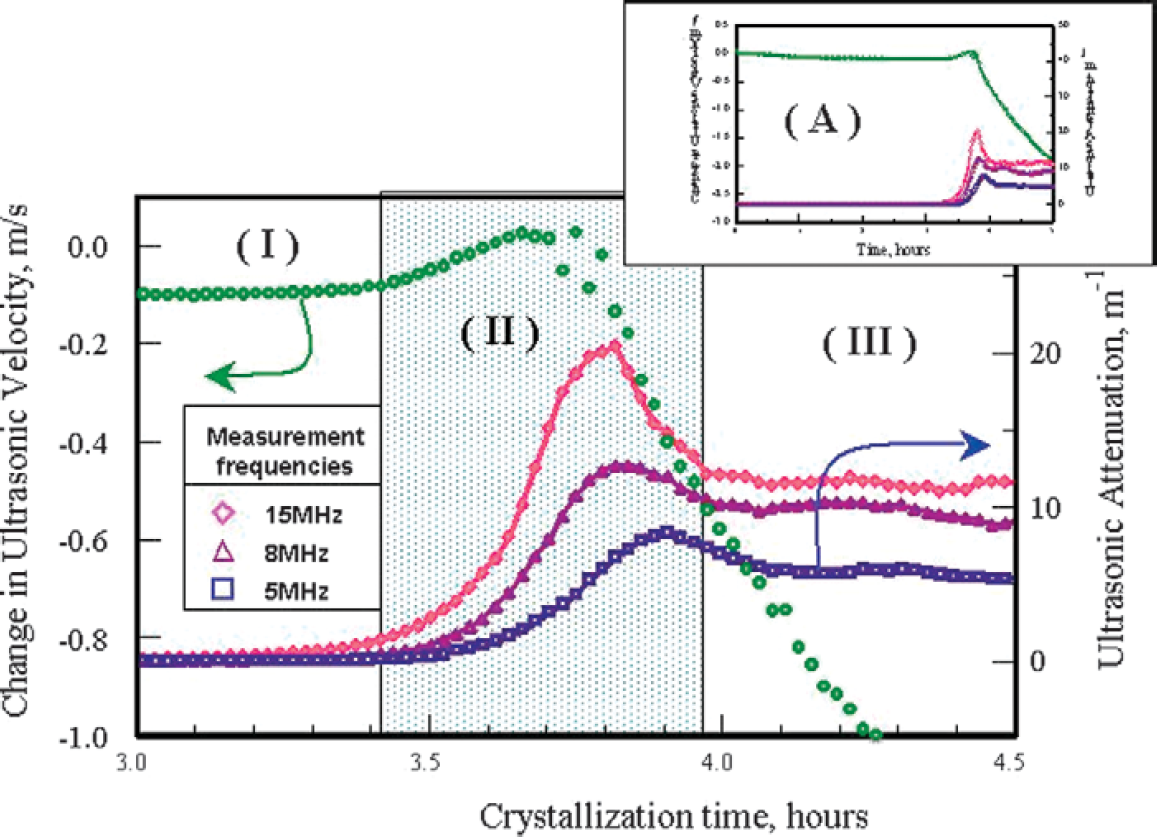
Monitoring crystallization of Lysozyme by ultrasonic spectrometry. The inset (A) shows the measurements over the first 5 h of crystallization process.
Determination of particle size in dilute and concentrated emulsions
One of the key elements of emulsion quality and stability is the particle size of the dispersed phase. Batch-to-batch variation in particle size can lead to unpredictable variations in the lifespan and stability (shelf life/heat stability) of the product. Traditionally, measurements of the droplet size in an emulsion are made using optical methods. This means that the sample must be diluted to reach optical transparency and avoid multiple scattering effects. Figure 4 shows the application of the HR-US 102 spectrometer to measure the particle size in a concentrated (undiluted) water-in-oil emulsion and its change in the course of dilution. Using the HR-US 102, the size of the water droplets in the original products was measured as 0.9 μm. As the product is diluted stepwise to a lower concentration where optical measurements can be performed (1% v/v water-in-oil), the droplet size decreases in accordance with the ultrasonic measurements. This example shows that measurements of particle size using traditional techniques, which require dilution of original and concentrated emulsion, would not provide correct information.
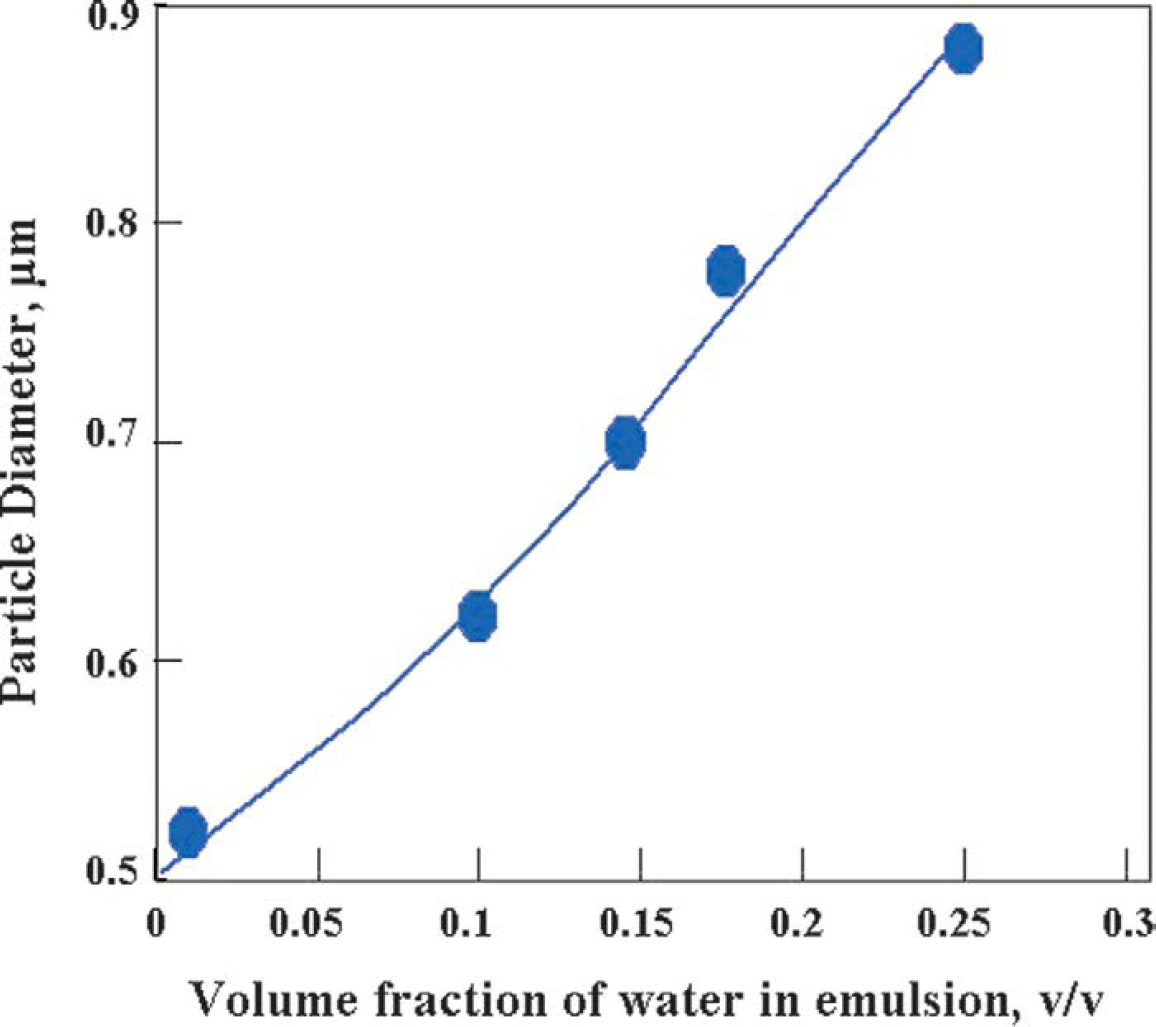
Ultrasonic analysis of particle size in 25% water-in-oil emulsion and its change with dilution at 25 °C.
Conclusion
HR-US spectroscopy is a powerful technique for characterization of emulsions and dispersions. The measurements can be performed in small samples (typically 1 mL; lower and higher volume of sample compartments also available) and are done under well-controlled temperature conditions (down to 0.01 °C). Overall, high-resolution ultrasonic spectroscopy provides a broad range of new tools for analysis of chemical and micro-structural characteristics of emulsions and suspensions.