






Abstract
Objective/Background
The aim of this study was to assess the leisure-time physical activity of Polish white-collar workers in relation to various health recommendations.
Methods
The study used a cross-sectional design with a convenience sample of 482 white-collar workers from Poland. Researchers recorded the leisure-time physical activity logs for 7 consecutive days of the week. Physical activity level was interpreted in relation to the World Health Organization and the American College of Sports Medicine recommendations.
Results
Among the workers, 42% of women and 53% of men declared moderate physical activity for at least 150 minutes per week, but only 23% of women and 18% men undertook activity in at least 5 days.
Conclusion
The results of the physical activity identified were significantly different from the American College of Sports Medicine and World Health Organization recommendations. The lower percentage of workers who met American College of Sports Medicine recommendations was caused by insufficient frequency of physical efforts.
Introduction
The health benefits of regular physical activity have been recognised and documented in numerous studies and scientific meta-analyses (
The knowledge about health-related physical activity parameters (type, frequency, duration, and intensity) is disseminated in various physical activity recommendations. Currently, the recommendations disseminated by the World Health Organization (WHO) and the American College of Sports Medicine (ACSM) are the most popular in the world. In both recommendations mentioned above, a similar duration of weekly physical activity is promoted; however, the ACSM recommendations additionally contain the frequency criterion. One of the key differences between the discussed recommendations and the previously promoted recommendations (e.g., Instruction of International Physical Activity Questionnaire [IPAQ]) is to consider only moderate and vigorous physical activity. This is the result of numerous studies in which the health benefits of the activity of at least moderate intensity, especially vigorous physical activity, have been confirmed (
It should be noted that the ACSM and WHO recommendations are related to the total physical activity. However, there is a need to separate the leisure-time physical activity from occupational physical activity. Many publications have shown that physical activity during work time might not be beneficial to health and may even be harmful. For example,
Therefore, assessment of physical activity that is beneficial for health should include primarily leisure time activity. It refers especially to white-collar workers who, due to dominant sedentary work style, can undertake regular physical activity mostly in their nonoccupational time.
Furthermore, some studies indicated that low occupational physical activity significantly translates into a lower level of leisure time physical activity (
The aim of this study was to assess the level of leisure-time physical activity among Polish white-collar workers in relation to health recommendations disseminated by the WHO and ACSM. The second aim was to compare the differences between the percentage of workers meeting the ACSM recommendations and that of workers meeting the WHO recommendations, and identify which particular criteria of recommendations were not complied with.
Materials and methods
This study has been assessed by the Bioethical Commission of the Jerzy Kukuczka Academy of Physical Education in Katowice, Poland. It used a cross-sectional design with a convenience sample of 482 white-collar workers, including 256 women and 226 men (mean [M]
age
= 36.15 years, standard deviation [SD]
age
= 12; Mbody mass index = 24.5, SD
body mass index
= 4.31). Detailed characteristics of respondents are shown in
Characteristic of the Participants.
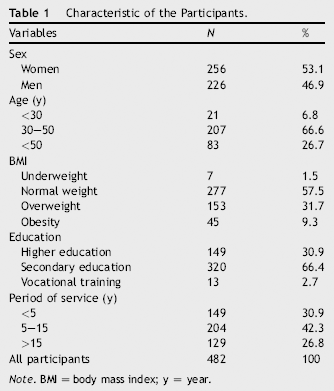
Note. BMI = body mass index; y = year.
Participants were recruited from purposely selected corporations in South Poland. The inclusion criteria for the study were: consent to participate in research and understand the full research programme, professional activity as a white-collar worker, work experience of at least 2 years, and full-time employment. Initially, 506 workers from selected corporations agreed to participate in the research; however, participants who did not meet all inclusion criteria and those with missing data were excluded from analysis. As a result, 482 male and female workers who met the inclusion criteria with completed data were analysed. Owing to a lack of time and reluctance to participate in time-consuming research among white-collar workers, physical activity logs were used as a research tool (B.
In this study, the leisure-time physical activity for 7 consecutive days of the week was recorded. Participants determined and recorded everyday the log duration (time) and intensity (low, moderate, and vigorous) of all physical activities lasting continuously for at least 10 minutes. The level of moderate and vigorous physical activity was calculated separately. Prior to the study, participants received a detailed instruction on the proper completion the logs. In order to facilitate the identification of the level of intensity of physical activity efforts, short definitions of physical activity and some typical activities with different levels of intensity based on the Compendium of Physical Activities were given to participants (
Physical activity level was interpreted in relation to the ACSM and WHO recommendations. Assessment of partial and overall recommendations classifies respondents as those who “meet” versus those who did “not meet” recommendations. The overall recommendations were met by the respondents who met at least one of the recommendation's criteria. The following recommendations were adopted:
ACSM: criteria of moderate physical activity (at least 5 days/week, and at least 30 min/day) and vigorous physical activity (at least 3 days/week and at least 20 min/day)
WHO: criteria of moderate physical activity (at least 150 min/week) and vigorous physical activity (at least 75 min/week)
Statistical analysis
For the quantitative variables, the basic parameters of descriptive statistics were calculated: M and SD. To assess the differences of physical activity level between men and women, univariate analysis of variance was used for quantitative variables and chi-square tests for qualitative variables. Multivariate logistic regression was used to verify which particular physical activity parameters (time and frequency) determined that recommendations of ACSM were met. Analyses were performed using IBM SPSS 20 software (IBM SPSS Statistics for Windows, Version 20.0. Armonk, NY: IBM Corp). A p value of <.05 was set at a significance level of 5%.
Results
Female white-collar workers significantly more declared physical activity of moderate intensity in their leisure time as compared with male workers (p < .05); however, its duration was significantly shorter (p < .005;
In total, 42% of women and 53% of men declared moderate physical efforts for at least 150 minutes per week, but only 23% of women and 18% men accumulated them in at least 5 days (
Parameters of Leisure-time Physical Activity.
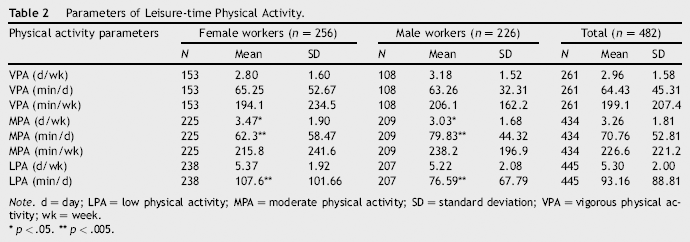
Note. d = day; LPA = low physical activity; MPA = moderate physical activity; SD = standard deviation; VPA = vigorous physical activity; wk = week.
p < .05.
p < .005.
In relation to both partial and total criteria of ACSM recommendations, there were no significant differences in physical activity between male and female workers. In the case of the WHO recommendations, it was found that men significantly more often met the criterion of moderate intensity (OR = 1.590; 95% confidence interval [CI] 1.109–2.279; p < .05) and overall recommendations (OR = 1.596; 95% CI 1.081–2.355; p < .05; (
Sex Differences of Meeting Partial and Total Criteria of Physical Activity Recommended by the ACSM and WHO.
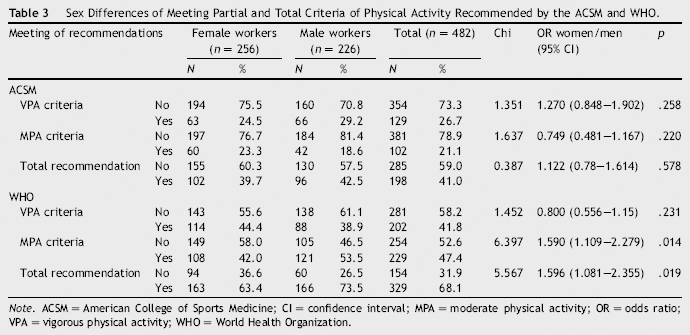
Note. ACSM = American College of Sports Medicine; CI = confidence interval; MPA = moderate physical activity; OR = odds ratio; VPA = vigorous physical activity; WHO = World Health Organization.
Significant differences were noticed in the percentage of workers meeting the ACSM and WHO recommendations in both female and male workers (
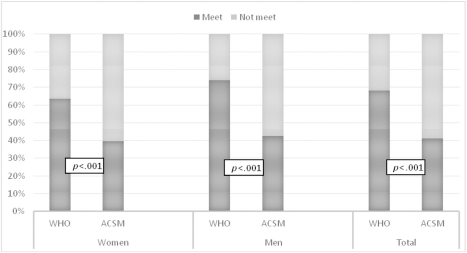
Differences between white-collar workers meeting the ACSM recommendations and those meeting the WHO recommendations.
Multivariate logistic regression analysis confirmed that the most significant parameter in meeting the ACSM recommendations was frequency of moderate (OR = 2.330, 95% CI 1.681–3.231) and vigorous (OR = 11.863; 95% CI 5.889–23.899) physical activity (
Multivariate Logistic Regression of Variables Associated with Meeting ACSM Recommendations.
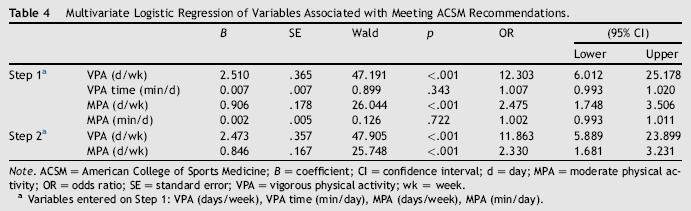
Note. ACSM = American College of Sports Medicine; 6 = coefficient; CI = confidence interval; d = day; MPA = moderate physical activity; OR = odds ratio; SE = standard error; VPA = vigorous physical activity; wk = week.
Variables entered on Step 1: VPA (days/week), VPA time (min/day), MPA (days/week), MPA (min/day).
Discussion
Leisure-time physical activity is an important occupation in the prevention and treatment of noncommunicable diseases, especially among white-collar workers whose level of occupational activity is low. In this study, we assessed leisure-time physical activity of white-collar workers in relation to the ACSM and WHO health recommendations, and identified the differences between the type of recommendation and the percentage of respondents undertaking health-related physical activity.
The results indicated that the percentage of white-collar workers meeting the criteria of the ACSM (41%) was significantly different from that meeting the criteria of the WHO (68%). Such a large variation may be surprising due to the similarities of the compared recommendations, especially the recommended duration (time) of weekly moderate and vigorous physical activity. However, in the ACSM recommendations, there is also a criterion of frequency for both moderate activity (>5 days/week) and vigorous activity (>3 days/week). The decrease in frequency was significantly in white-collar workers who met the ACSM recommendations.
Similar results were obtained by
It may be noticed from our results that the frequency is an important parameter of physical activity. A lot of studies indicated the relationship between the frequency of physical effort and the health condition (
Study limitations
The main limitation of this study was using the subjective methods of physical activity assessment (self-assessment), which might result in overestimation of physical activity level. The second limitation was a small sample of convenience and a lack of precise information about occupations, work tasks, and sociodemographic situations.
Conclusions and implication for further research
Assessment of physical activity level and verification of meeting global recommendations for health helps to monitor insufficient physical activity which is one of the main noncommunicable disease risk factors. Owing to the occupational sitting, white-collar workers belong to the study group are at high risk of insufficient physical activity. Although recommendations disseminated by the WHO and ACSM promote the minimal dose of physical activity beneficial for health, the level of health-related physical activity in the study group of white-collar workers was low. The lower percentage of workers who met the ACSM recommendations was due to insufficient frequency of physical efforts.
Further studies should focus more on assessing the impact of individual parameters of physical activity on health, and above all, on frequency and various intensity of physical activity, rather than the total weekly volume of moderate and vigorous physical activity.
In this study, we identified the criteria of physical activity recommendations that are mostly not complied with by white-collar workers in the study population in Poland. This can be a guideline for employers and occupational therapists to design and implement health programmes for promoting physical activity for white-collar workers. In these programmes, frequency of physical activity (regular activity in the week), in particular, should be promoted.