






Abstract
Objective/Background
This study aimed to examine the relationships of theory of mind (ToM) to both pretend play and playfulness in children with autism spectrum disorder (ASD).
Methods
Twenty children with ASD aged between 3 years and 7.11 years were assessed with the ToM test, and then placed in a free play condition and a pretend play condition to assess pretend play and playfulness with the Child-Initiated Pretend Play Assessment and Test of Playfulness, respectively. In addition, the children's symptom severities of ASD and verbal abilities were also assessed with the Childhood Autism Rating Scale (CARS) and Receptive and Expressive Vocabulary Test—second edition, respectively.
Results
The results of the regression analysis confirmed that ToM significantly predicted pretend play variables, namely, Number of Object Substitutions (R2 = .158, p = .002) and Number of Imitated Actions (R2 = .175, p = .001), but not playfulness. The CARS score was a significant predictor of the Percentage of Elaborate Pretend Play Actions of pretend play (R2 = .075, p = .034), as well as the internal control (R2 = .125, p = .006) and framing (R2 = .071, p = .039) variables of playfulness.
Conclusion
The findings support the idea that children with ASD who have better ToM might be able to develop better pretend play, but not better playfulness, which might be more strongly related to their autistic severity.
Introduction
Autism spectrum disorder (ASD) is a lifelong neuro-developmental disorder. Children with ASD have the core symptoms of impaired socialisation and communication, and they exhibit restricted, repetitive, and stereotyped behaviours or interests (
Play, the main occupation of children (
Pretend play is a form of external performance and is defined as play composed of both conventional imaginative play and symbolic play (
Pretend play deficit appears to be a clinical feature of children with ASD (
In addition to the external performance of play, playfulness is the internal experience and the quality of play (
Researchers have indicated that children with ASD are less likely to have positive play experiences or gain pleasure from play (
Researchers have suggested that impairment in theory of mind (ToM) may be associated with pretend play deficits (
Previous studies that examined the relationships of ToM, pretend play, and playfulness in children with ASD had several issues that necessitate further examination. ToM measurements used did not cover most of the ToM components. Only joint attention or false belief tasks were used to represent the whole construct of ToM. However, ToM is a broad construct that involves many component skills (
Methods
Participants
A convenience sample of children with ASD was recruited from hospitals and paediatric clinics in south-central Taiwan. Children were included in the ASD group if they (a) had a chronological age (CA) of 3—7.11 years, and (b) had received formal diagnosis, by a trained psychiatrist or paediatrician, of autistic disorder or Asperger's disorder according to the diagnostic criteria in the Diagnostic and Statistical Manual of Mental Disorders, Fourth Edition, Text Revision. Children were excluded if they (a) had symptoms associated with organic brain dysfunction (e.g., seizures, cerebral palsy), chromosomal abnormality (e.g., Down syndrome), or rare disorders; (b) were unable to follow orders or complete the procedure; (c) had uncorrected hearing or visual impairment, (d) failed to demonstrate verbal ability for basic communication; or (e) had Childhood Autism Rating Scale (CARS) scores lower than 30.
This study was approved by the institutional review boards of National Cheng Kung University Hospital, College of Medicine, National Cheng Kung University (A-ER-102-201) and Chi Mei Medical Center, Tainan (10307-010), Taiwan. Parents and guardians were fully informed and signed consent forms prior to the assessment.
Measures
ToM test
Children's ToM was measured with the ToM test. The ToM test used in this study combined the original version developed by
All items are presented on a computer in the form of pictures, written descriptions, verbal descriptions, or audio descriptions. Each subtest has identification questions (scored 0—2), confirmation questions (scored 0—3), and control questions (scored pass or fail). The control questions are used to exclude the effects of attention, memory, and verbal understanding. The test is stopped when the child fails to answer the control question or the identification question of an item. The pass rate of each level is calculated as the percentage of the highest score relative to the total score. A pass rate higher than 70% represents that the child has mastered the ToM of that level. If the child cannot pass the first level of Basic Mental Development, his or her stage is classified as “Before Basic Mental Development.” The reliability and validity of the ToM test have been examined (
Child-Initiated Pretend Play Assessment
The Child-Initiated Pretend Play Assessment (ChlPPA;
The scoring of the ChlPPA includes three items: (a) Percentage of Elaborate Pretend Play Actions (PEPA), which reflects the elaborateness, complexity, and organisation of play actions; (b) Number of Object Substitutions (NOS), which represents the number of objects the child uses as something else, indicating flexibility and problem solving abilities when using objects; and (c) Number of Imitated Actions (NIA), which represents the number of imitations appearing soon after the modelled actions, indicating the child's ability to self-initiate play ideas. The NIA is a reverse-scored item—that is, a higher score represents poorer performance. Raw scores can be transformed to standard scores or compared with the range and the mode of the normative sample (
Test of Playfulness
Children's playfulness was measured with the fourth version of the ToP. The ToP is an observational assessment designed to objectively assess the playfulness of any individual aged from 6 months to 18 years (
The ToP consists of 30 items, each of which is rated on a 4-point (0—3) scale. Scores indicate extent (i.e., proportion of time), intensity (i.e., degree of presence), or skillfulness (i.e., ease of performance). A score of “not applicable” is recorded if there is no opportunity to observe a particular item (
Childhood Autism Rating Scale
The CARS (
Receptive and Expressive Vocabulary Test—second edition
The Receptive and Expressive Vocabulary Test, second edition (REVT2;
The REVT2, which is assessed in a one-on-one setting without distractions, can be completed within 20—40 minutes. The measurement covers the receptive scale and the expressive scale, each of which has four subscales: naming, category, definition, and reasoning. The REVT2 has been found to have good reliability and validity (
Procedures
Measurement preparations
Prior to data collection, two administrators, who were occupational therapists, were specially trained on the measurement manuals to ensure that the administrators met the qualifications and fully understood the measurements. One administrator (the tester) was responsible for the assessment session, in which the REVT2, the ToM test, the CARS, the ToP (free play condition), and the ChlPPA (pretend play condition) were administered. Before formal recruitment began, the tester needed to be familiar with all the measurements, practice with an experienced therapist several times, and finish a pilot study under supervision. The tester was allowed to begin formal recruitment when the experienced therapist approved her assessment skills.
Another administrator (the coder), who was blind to the group status of the participants, was responsible for the coding session. The coder coded the videos of the two play conditions based on the scoring criteria of the ToP and the ChlPPA. Prior to scoring, the manual and the scoring criteria were translated into Chinese for easier scoring. The Chinese manual and scoring criteria were confirmed by experienced therapists and clinicians to ensure that the scoring criteria were applied based on the original version and were relevant to Taiwanese culture. The interrater reliabilities between the coder and a therapist experienced with the ToP and the ChlPPA were examined with 10 videos. The interrater agreement of the ToP ranged from 85% to 90%, and that of the ChlPPA ranged from 81% to 90%.
Study procedures
The data were collected in two visits. The procedure of this study is depicted in Figure 1. Each visit lasted about an hour, and the two visits were completed within 2 weeks. In the first visit, the child was assessed with the REVT2 and then entered the free play condition. The caregiver of children finished a basic information sheet and was interviewed with the CARS. Children who met the criteria continued to participate in the second visit. In the second visit, the child was measured with the ToM test and then entered the pretend play condition. The entire measurement session was completed by a trained tester. All play, including the free play condition and the pretend play condition, was videotaped and later rated with the criteria of the ToP and the ChlPPA, respectively, by the trained coder.
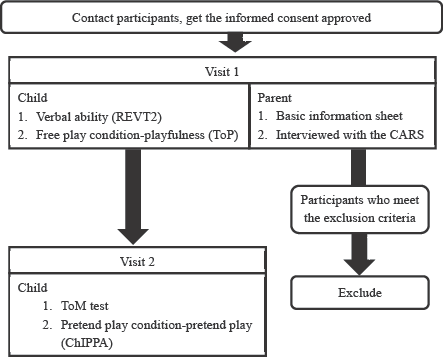
Study procedure. Note. CARS = Childhood Autism Rating Score; ChlPPA = Child-Initiated Pretend Play Assessment; REVT2 = Receptive and Expressive Vocabulary Test—second edition; ToM test = Theory of Mind test; ToP = Test of Playfulness.
Data analysis
The data obtained from each measurement were analysed in SPSS version 17.0 (SPSS Inc., Chicago, IL, USA). Descriptive statistics were used to describe the demographic characteristics, ToM, pretend play, and playfulness of the participants. Pearson's correlation coefficients were used to investigate the correlations among the variables of ToM, autism severity, pretend play, and playfulness. As regards the regression analysis, seven regression models were examined. The pretend play variables (PEPA, NOS, NIA) and the playfulness variables were the dependent variables (intrinsic motivation, internal control, freedom to suspend reality, framing). The independent variables, including the ToM, autism severity, and the interaction term of CARS and ToM test total scores, were entered and removed in a stepwise manner using the default criteria of probability of F-to-enter = p < .05 and probability of F-to-remove criteria = p > .10. The procedure was stopped when adding an additional predictor did not yield a t test p value of <.15. In addition, the F test of overall significance and coefficient of determination (R2) of the final model were also provided. The significance level was set at alpha < .05.
Results
Twenty children with ASD and their caregivers participated in this study. Table 1 summarises the demographic characteristics of the children and shows the children's performance of assessments of ToM, pretend play, and playfulness. The results of the REVT2 showed that the children with ASD in this study were verbal and relatively high-functioning. Based on their performance on the ToM test, most of the children were found to be in the “Basic Mental Development” stage of ToM (16/80%), which means the children had the prerequisite skills of ToM with desire-based emotions but not adequate ToM for their ages.
Sample Characteristics of the Children (N = 20).
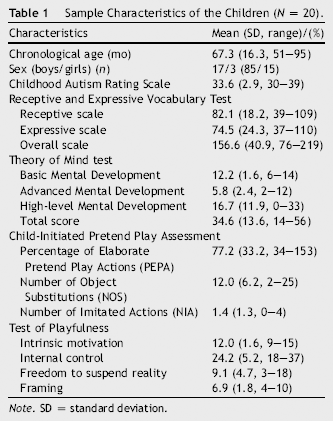
Note. SD = standard deviation.
Table 2 shows the correlations among the independent and dependent variables, and the results of the stepwise regression analysis are summarised in Table 3. The interaction effects of ToM and CARS were insignificant for all dependent variables, and only five of the dependent variables showed significant relationships with one of the main effects. For the PEPA model, the results showed that only the CARS was a significant predictor, accounting for 7.5% of the variance (F1, 18 = 4.698, p = .034). In the NOS and NIA models, the ToM was significant, explaining 15.8% of the variance (F1, 18 = 10.871, p = .002) and 17.5% of the variance (F1, 18 = 12.287, p = .001), respectively. For the internal control and framing models, only the CARS was left. It accounted for 12.5% of the variance of the Internal control (F1, 18 = 8.296, p = .006) and 7.1% of the variance of the Framing (F1, 18 = 4.442, p = .039). No significant variable was entered into the final models for Internal motivation and Freedom to suspend reality.
Correlations on Measurements of Interest in Children with ASD (N = 20).
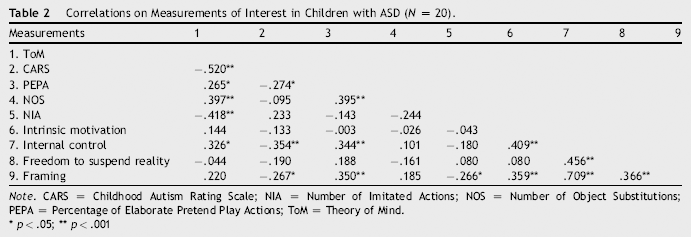
Note. CARS = Childhood Autism Rating Scale; NIA = Number of Imitated Actions; NOS = Number of Object Substitutions; PEPA = Percentage of Elaborate Pretend Play Actions; ToM = Theory of Mind.
p < .05;
p < .001
The Stepwise Regression Models of Pretend Play and Playfulness (N = 20).
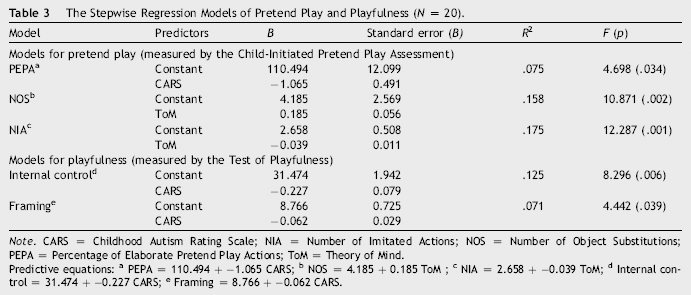
Note. CARS = Childhood Autism Rating Scale; NIA = Number of Imitated Actions; NOS = Number of Object Substitutions; PEPA = Percentage of Elaborate Pretend Play Actions; ToM = Theory of Mind.
Predictive equations:
PEPA = 110.494 + −1.065 CARS;
NOS = 4.185 + 0.185 ToM;
NIA = 2.658 + −0.039 ToM;
Internal control = 31.474 + −0.227 CARS;
Framing = 8.766 + −0.062 CARS.
Discussion
The present study examined the relationships of ToM with pretend play and playfulness in children with ASD. The results showed that children's ToM was significantly associated with their pretend play in initiating play actions, object substitutions, property attribution, and pretending an imaginary object were present. However, the correlation coefficients failed to show a significant relationship between children's ToM and their playfulness. From the regression results, autism severity appears to be a relatively important factor that influences children's playfulness, especially their internal control and framing. This study provides better understanding of the relationships of ToM with pretend play and playfulness in two ways: (a) by covering the ToM from prerequisite to sophisticated skills, rather than only targeting a single component skill; and (b) by investigating the relationships of ToM with pretend play and playfulness simultaneously to consider both the external performance and the internal experience as parts of play and thereby to view play more comprehensively.
The results of the regression analysis showed that ToM and autistic severity were important predictors of pretend play. The ToM could predict a child's behaviours of object substitutions, property attribution, and pretending an imaginary object was present, as well as the numbers of times a child would imitate the modelled play actions. The results were consistent with previous research indicating that impairments in ToM may cause difficulty for children with ASD in developing the ability of pretense and thereby limit their engagement in pretend play (
Interestingly, the results of the regression model of play elaborateness (the PEPA model) showed that autistic behaviour, not ToM, can better predict the elaborateness, complexity, and organisation of a child's play. In this study, it was observed that children with ASD who had poor adaptation to change and more unique use of objects would exhibit play behaviours that were less changeable and lacked narrative. For example, the children might keep rolling the toy truck to watch the rotation of the wheels without any play purpose, and the children would also show resistance when asked to play with other objects or when the tester modelled the play actions.
However, the results showed that ToM was not a significant predictor of children's playfulness, possibly because of the small sample size. In addition, the results showed that autistic behaviour was the most significant predictor of children's playfulness. It suggested that children with more autistic behaviours would look less joyful during play. As autistic behaviour encompasses the characteristics of ASD, the results are congruent with those of previous studies demonstrating that children's playfulness is related to individual characteristics, such as age, sex, and other personality attributes (
This study had three limitations. The small sample size may limit the statistical power of the results. Further study is warranted to recruit more children with ASD. Second, because this study recruited only children with relatively high-functioning and verbal ASD, the findings cannot be generalised to lower-functioning and nonverbal children with ASD. Third, the ToM test used in this study required children to speak aloud or explain their decisions. It is difficult to separate children's expressive verbal ability from the measurement of ToM, which is also the reason why the association was high between ToM and expressive verbal ability. Therefore, expressive verbal ability was not entered into the regression models to avoid multicollinearity. Further studies should include more participants, apply a measurement of ToM that is less verbally demanding, and recruit lower-functioning and nonverbal children with ASD to illustrate the relationships among ToM, pretend play, and playfulness.
The results of this study provide a better understanding of the relationships of ToM with pretend play and playfulness in children with ASD. The results showed that the ToM of children with ASD is significantly associated with both the number of objects a child uses as something else and self-initiated pretend play actions, respectively indicating children's flexibility and problem-solving abilities when using objects and the ability to self-initiate play ideas. However, the results did not show a significant relationship between ToM and playfulness.
The present study suggests that it is necessary to target interventions at ToM, pretend play, and playfulness in children with ASD, because the results indicated that children with ASD who have better ToM may have better performance in pretend play, particularly in the initiation of pretend play actions and the behaviours of object substitution, and that children's playfulness might be more strongly related to their autistic severity. For clinical practice, we suggest that clinicians help children with ASD to develop their ability of ToM in order to enhance their performance in pretend play rather than their playfulness.
Conclusion
Based on the results, children with better ToM have better performance in pretend play, and autistic severity influences both pretend play performance and playfulness, especially the latter. ToM deficit is associated with pretend play performance in children with ASD, but not with their playfulness. Children's playfulness might be more strongly related to their autistic severity. We suggest that occupational therapists, clinicians, and parents help children with ASD to develop their ability of ToM in order to enhance their performance in pretend play rather than their playfulness.
Footnotes
Acknowledgments
This study was supported by a grant awarded to the corresponding author from the National Science Council of Taiwan (100-2410-H-006-103-MY3) and the Ministry of Science and Technology (103-2410-H-006-060, 104-2410-H-006-065, and NCKUH-10506022).