






Abstract
Objective/Background
The aim of this article was to analyze the needs of hospitalized adolescents with cancer in relation to the performance of meaningful activities as well as to explore the possible scenarios of occupational deprivation in hospital paediatric wards.
Methods
The study follows an ethnographical research approach using two techniques: participant observation and in-depth interviews, with constant comparison by data triangulation. Eight adolescents diagnosed with cancer aged between 15 years and 19 years (5 males and 3 females) were recruited from Toledo and Madrid in Spain.
Results
Five themes revealing the needs of adolescents with cancer in hospital environments were identified: (a) educational needs, (b) leisure needs, (c) physical space of the rooms, (d) interaction with medical personnel, and (e) lack of specific wards for adolescents.
Conclusion
The lack of variety and availability of educational activities and leisure, and the subsequent changes of the individual physical, social, and cultural environments could cause situations of occupational deprivation, and also affect the health and quality of life of the individuals.
Introduction
Currently, cancer is one of the most significant diseases worldwide, not only for its incidence and prevalence but also for its mortality rates, as it is the leading cause of death by disease in children and adolescents (
There are difficulties in creating an appropriate framework for the treatment of children and adolescents with cancer (
This article follows those research studies that have analyzed sociological and physical aspects of specific situations to promote changes needed in the environment (
The objectives of this research were as follows: (a) to analyze the needs of hospitalized adolescents with cancer and their relation with the performance of meaningful activities based on the subjective perception of the study participants (adolescents); (b) and to analyze possible scenarios of occupational deprivation in adolescents hospitalized with cancer based on the identified needs.
Methods
This study was qualitative and descriptive in nature. It was based on an ethnographical research approach (
Participants
The selection of participants in the field study was conducted in the offices of the Paediatric Oncology and Paediatrics ward of the Virgen de Toledo Hospital, Toledo, Spain.
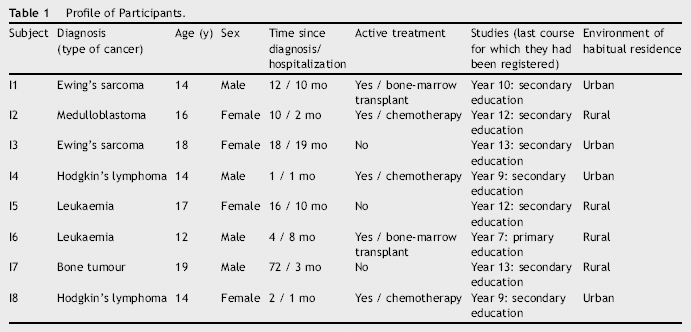
The study sample was selected following a purposive theoretical sampling and by applying the following inclusion criteria: adolescents diagnosed with cancer aged between 15 to 19 years who were admitted at least to the hospital and who had signed a consent form. Exclusion criteria were as follows: adolescents suffering from other added or associated pathology. A total of eight adolescents (5 male and 3 female participants) were finally included in the study, and they were from either Toledo or Madrid in Spain (
Profile of Participants.
Fieldwork
The first study contact was established with the members of staff responsible for the paediatric oncology ward of the Virgen de la Salud Hospital, to locate and involve the possible participants in the study. Following this, the researchers met the chosen adolescents and their families with whom no previous relationship existed before the study. For the final selection of participants, medical and psychological reports of patients receiving treatment in the Virgen de la Salud Hospital were consulted. In addition, the researchers also met with the oncologists responsible for each individual participant. A total number of eight adolescents met the study's conditions and later signed the informed consent. Four declined participation in the study due to their parents’ refusal who alleged time-related problems to participate. Finally, the fieldwork was conducted. The informants’ subjective perspective on their experiences and life situations, expressed in their narratives, was obtained by observing the patients and spending time with them.
Data collection
Recording equipment was used during interviews with the consent of parents or legal guardians and the informants’ narratives were later transcribed word for word for analysis. To collect the participants’ data and the information regarding direct observation, a fieldwork diary was used with notes that were processed afterwards in ATLAS.ti software (Version 6.2.28, Thomas Muhr, Berlin, Germany). Field notes were also taken after the interviews.
Data analysis
After the verbatim transcription of the interviews, each researcher carried out an independent analysis of the data using the ATLAS.ti software (Version 6.0). The three researchers organized data coders to compare the notes and interpretations of individual analyses, while discussing how to reach consensus (peer debriefing).
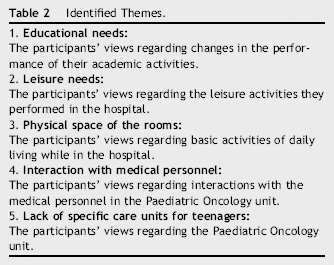
Following the interviews with the study participants, 20 different data coders were identified and a series of semantic connectors, subcategories, and top-level categories were defined. These categories were then organized by themes, with each theme corresponding to a specific need of adolescents with cancer. The themes were all extracted from the analysis of the participants’ discourses. Finally, five themes were extracted from the analysis of the participants’ discourses (
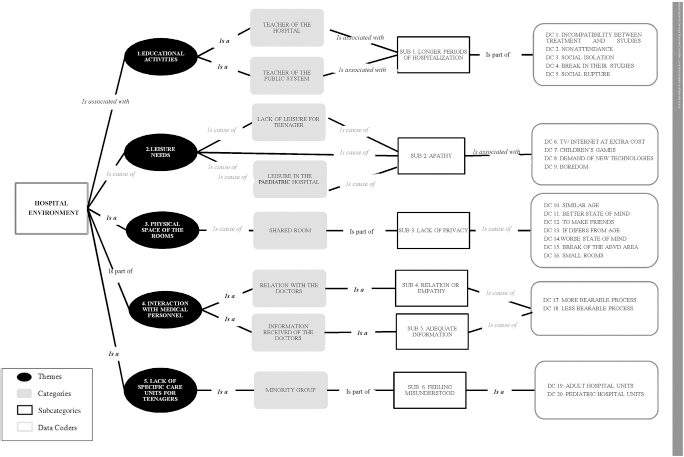
Thematic tree.
Identified Themes.
Results
The authors identified five themes in relation to the needs of adolescents with cancer within a hospital environment: (a) educational needs, (b) leisure needs, (c) physical space of the rooms, (d) interaction with medical personnel, and (e) lack of specific wards for adolescents. These themes were later used to analyze their influence on the participants’ occupational performance. Interviewees’ quotes, originally in Spanish, have been translated into English. Each informant was labelled in a fieldwork diary with the letter “I” (which stands for informant) and a number.
Educational needs
This theme describes the participants’ views regarding the changes in the performance of their academic activities, highlighting some of the most significant difficulties encountered. One participant remarked:
During that time I did not go to class, I had help in the hospital and did not do bad. There were few hours, but I got on with it and then when I rejoined high school I did notice a change, because you feel it … the … you're at home, they go to your house when you want so you feel more comfortable. But, having to go to school at a certain time already forces you to catch the bus … you notice the difference, but it wasn't bad. [15]
All the participants’ narratives agreed in this matter. Educational activities available in the adult oncology wards only partially met the needs of adolescents. Most participants stressed the artificiality of educational activities and the absence of standardized routines and study habits (meeting schedules, travel to school, and relationships with peers). The data obtained corroborated the narratives; detachment from school and the difficulties associated with teacher support were the patients’ most common complaints.
Leisure needs
All participants indicated that the lack of interesting leisure activities was one of the main reasons for not keeping themselves active. Two categories within this theme were especially significant in their narratives: one was the lack of leisure activities for adolescents and the other one was the existence of recreational activities only directed towards young children inside the paediatric hospital. These points are evidenced by the following narratives:
You watch TV, which is all you can do. [11]
No, well …we also have Internet, that's what we do the most, because then … there are board games, but the problems are that, or you play with your parents … because the others are little children and nothing else … you help in some activity, but, games for us, no. [13]
Physical space of the rooms
Shared rooms and the consequent lack of privacy were common categories in all interviews. These factors seemed to interrupt or alter the performance of the basic activities of daily life. One of the informants mentioned:
Yes, I have had companions forever. Very bad, it's a bit annoying. [12]
Another one noted,
If you are alone you have enough privacy, but if you are with someone there are many things you have to restrain yourself a bit from doing. [17]
This situation was obvious when the age difference was greater. Most adolescents suggested that the problem lies not only in sharing a room, but also in sharing it with people of very different ages. If the age of the partner was similar, then their mood was improved. This was clearly evident in some narrations:
I've been with girls who were 8, 10, and even 3! There is a huge difference huge. [12]
Interaction with medical staff
This was one of the most recurring themes in the narratives of the adolescents studied. For those patients who were treated in paediatrics wards, this was identified as a factor that facilitates the adaptation process during hospitalization and the recovery periods. It was no doubt that interaction with the medical staff in paediatric wards improved patients’ experience during hospitalization. All participants in this study verbalized that:
The treatment provided by doctors is perfect, no doubt. [16]
Yes, everything you ask, they explain, they clarify. [14]
Yes, yes, the treatment is very good. [12]
However, such experiences were different for those adolescents treated in adult wards.
Lack of specific care units for adolescents
Finally, the theme concerning the lack of specific wards for adolescents was identified. Participants perceived themselves as a minority group, a feeling that was accentuated when the participants shared their room with children whose age was drastically different from their own. The following narratives illustrate this point:
Unfortunately, most hospitalized people are children … [18]
Because everyone else is a young child, nothing else … [13]
You're surrounded by many children, there should be two sections, for the babies and for older kids, because, you know, there should … be a ward in between, between young and old, and either they move you from a room with a baby or they put you with an 80 year old man, and … that shouldn't happen. [15]
Discussion
The overall results of this study reveal specific characteristics about paediatric oncology wards and hospital settings. The study results also reveal the characteristics and settings that make it difficult for adolescents to carry out meaningful activities and those that not only affect the patients’ quality of life during hospitalization but also their recovery. Since the mid-1990s, occupational therapy literature has shown a growing interest in investigating the influence of cultural, political, economic, and social features about human health in a population, and in particular the restrictions imposed by educational systems and social and health services when it comes to disease and disability. This interest has given way to a school of concepts—including occupational deprivation—proposed to serve as a theoretical foundation on which practical occupational therapy should be based (
As previously stated, the concept of occupational deprivation describes situations that limit occupational performance, concerning the individual's immediate context. In particular, the lack of available opportunities in the environment may affect the time-use patterns and routines associated with the performance of meaningful activities. Such restrictions on the performance can have serious consequences for patient's health such as resulting in disorientation, loss of the sense of efficacy, high suicide rates, sleeping disorders, and difficulty acquiring adaptive skills to integrate themselves into the community (
In conclusion, this study has identified five basic needs related to the performance of meaningful activities among adolescents with cancer within a hospital environment. The findings of this research highlight that situations of occupational deprivation cannot only limit the performance of activities but also affect the health and quality of life of the individuals.
Footnotes
Observation Protocol.
INTERACTIONS WITH MEDICAL PERSONNEL
I1
I2
I3
I4
I5
I6
I7
I8
Does he/she greet the medical personnel?
Does he/she talk to the medical personnel about his/her disease?
Does he/she talk to the medical personnel about other different matters?
Is he/she co-operative with the different phases of treatment?
Does the medical staff greet the patient?
Others
LEISURE ACTIVITIES AND FREE TIME
The kinds of leisure activities and fee time the hospital offers and type of play materials
Does he/she watch TV by him/herself or with others? For how long?
Does he/she use the computers of the hospital or his/her own compute? For how long?
Does he/she take part in the group activities offered? Or Does he/she observe group activities? How often??
Does he/she use the school library? Or Does he/she read? For how long?
Do he/she talk to his/her friends and acquaintances by phone?
Does he/she have hospital visits of friends?
Does he/she have hospital visits of relatives?
Others
ACADEMIC ACTIVITIES
Does he/she use the educational classroom at the hospital? And the educational classroom meets the appropriate conditions (climate, space, etc.)
Does he/she take part in the classroom?
Does he/she ask questions about the subjects taught by the teachers?
Does he/she do his/her homework in the classroom at the hospital or in his/her hospital rooomsl?
Is there adequate space for academic activities?
He/She does not take part in any academic activity while in hospital
His/her school performance is not good since being admitted in hospital or before being admitted in hospital?
Others
RELATIONS WITH OTHER PATIENTS
Does he/she interact with other patients? Does he/she interact with patients of similar age?
Does he/she try to spend time with other patients? Does he/she try to spend time with other patients of similar age?
Does he/she share activities with patients of similar age? Does he/she smile? Does he/she enjoy joint activities?
Does he/she take part in joint activities or Does he/she observe the joint activities?
Others
Does he/she remain in his/her room alone for the majority of the time?
Does he/she engage in any leisure activity in his/her room?
Does he/she use other available spaces?
Does he/she use the games room?
Does he/she walk around the hospital?
Others
Script of the Interview.
Annotations:
Annotations: