Objective/Background
Consequent to the introduction of occupational therapy (OT) training programmes in Nigeria in the past decade, this study sought to assess the awareness and knowledge of Nigerian medical and other health career undergraduates about OT.
Methods
Three hundred and eighty-one undergraduates and students of other health disciplines from the College of Health Sciences, Obafemi Awolowo University (OAU), Ile-Ife, Nigeria responded to a validated three section questionnaire assessing their awareness and knowledge about OT. The collected data were analysed using descriptive statistics of mean and percentages and inferential statistics of chi-square test of association.
Results
The mean age of the respondents was 20.96 ±2.88 years. Over 80% of the respondents were aware of the OT profession, with higher rates among male respondents (83.7%), students in the 2nd year of study (94.7%), and those in the medical rehabilitation programme (99.1%). Amongst the respondents, < 40% had good knowledge of OT while a majority had knowledge ranging from poor to moderate (62.7%). Respondents’ course of study and level of study were significantly associated with awareness and knowledge about OT.
Conclusion
Nigerian medical and health sciences undergraduates had high awareness, but poor to moderate knowledge about the OT profession, roles, and work settings. Level of awareness and knowledge about OT were significantly influenced by the rehabilitation-related course of study and lower level of study. Replication of similar studies in countries with different cultural backgrounds is suggested.
Introduction
Occupational therapy (OT) is an important component of the multidisciplinary and interdisciplinary healthcare service team (Johansson, Eklund, & Gosman-Hedström, 2010; Paul & Peterson, 2002). The OT approach is based on the knowledge that purposeful activity can promote health and well-being in all aspects of daily living (Creek, 2008; Reed & Sanderson, 1999). The enablement of every individual to participate in activities of everyday life forms the primary goal of OT. This goal is achieved by occupational therapists “working with people and communities to enhance their ability to engage in the occupations they want to, need to, or are expected to do, or by modifying the occupation or the environment to better support their occupational engagement” (World Federation of Occupational Therapy, 2012 p. 1). Despite, the importance of OT in the healthcare team, there appears to be limited knowledge of the role and function of the occupational therapists amongst other healthcare professionals (AlHeresh & Nikopoulos, 2011; Jamnadas, Burns, & Paul, 2002; Tariah, Abulfeilat, & Khawaldeh, 2012) and also in the general population (Jackman & Stagnitti, 2007). Inadequate knowledge or misconception about OT in previous studies have been implicated on factors not limited to lack of availability of occupational therapists in most settings, but also on limited numbers of OT training institutions, lack of exposure of other health professionals to the role of OT during their academic training (Brogan, 1981; Diffendal, 1998; Tariah et al., 2012), as well as limited or lack of advocacy and sensitisation of the general public on the role of OT by the professional bodies regulating the practice of OT (Deitch, Gutman, & Factor, 1994; Jackman & Stagnitti, 2007).
In the Nigerian milieu, there is an apparent dearth of studies on knowledge of OT among health professionals and in the general population. OT was introduced into the Nigerian healthcare service by two British chartered occupational therapists in the early 1950s at the University College Hospital, Ibadan, Nigeria and the Nigerian Association of Occupational Therapists (NAOT) in 1965. Subsequently, the Nigerian civil war in 1967–1970 brought about an increase in OT practice and inflow of occupational therapists from around the world into Nigeria to render services domiciled in mostly military and a few civilian hospitals in the country (Emechete, 1974). Unlike their physiotherapy counterparts, the British occupational therapists did not start a training programme in OT, thereby resulting in a dearth of trained and certified practitioners in OT. Consequently, there was a wide gap in the advances and milestones in OT practice attained in the developed countries compared to Nigeria. Before the advent of training institutions for occupational therapists in Nigeria, few Nigerians who studied OT abroad began to practice in Nigeria and uplift the professional image of the NAOT. They also ensured membership of the NAOT with the World Federation of Occupational Therapy and Occupational Therapy African Regional Group in 1992 and 2001 respectively (Coker, 2003).
Consequent to the abovementioned, there has been keen effort and advocacy by NAOT towards clearly defining professional image and role, and autonomy of practice, and to ascend to a higher level of professionalism. OT in Nigeria in the past decade witnessed landmark educational milestones with the establishment of the Bachelor of Medical Rehabilitation (BMR) Degree Programme in OT and the Diploma Training Programme in OT at the Obafemi Awolowo University (OAU), lle-lfe in 2002 and the Federal School of Occupational Therapy, Oshodi, Lagos in 2003, respectively. Within 12 years of commencement of the OT education in Nigeria, 20 occupational therapist registrars and 109 OT assistants have graduated. There has also been an upsurge in the number of occupational therapist registrars and OT assistants registered with the Medical Rehabilitation Therapy Board of Nigeria reflecting an increase in number of practitioners trained locally and abroad (Medical Rehabilitation Therapist Board, 2014). Presently, the OAU BMR OT programme remains the only degree programme in sub-Sahara Africa (excluding South Africa). With the recent emergence of OT training programmes in the Nigerian education system, the objective of this study was to assess the knowledge and awareness of Nigerian medical undergraduates about OT.
Methods
Participants
Undergraduate students from the departments of medicine, nursing science, dentistry, and/or medical rehabilitation in the College of Health Sciences were invited to participate in this cross sectional survey using a convenient sampling technique. OT students were excluded from participating in this study. All of the participants were studying full-time.
Instrument
A questionnaire on knowledge and awareness of physiotherapy by Akinlade (2001) was modified and used as the survey instrument for this study. The questionnaire was validated in a pilot study among 20 medical undergraduates who were not part of the actual study. Consequently, redundant and ambiguous items were removed or reframed appropriately. The questionnaire was observed to be internally consistent with Cronbach's alpha value of .72 and reliable with test—retest reliability score of .66. The three section questionnaire comprised open and close ended questions which were designed to obtain information from the respondents regarding their awareness and knowledge of OT. The first section sought information on demographic characteristics of the respondents. The second section comprised questions on awareness of OT as a course of study and as a profession, as well as a question regarding the source of information about OT. The third section sought information on the precision of the respondents’ knowledge. Four OT tasks were enumerated and these were: treatment of bone, joint diseases and injuries, planning of a patient's treatment programmes, use of activities as means of treatment, and relevance in treatment of psychiatric disorders. Two distracters were also listed: “OT synonymous to recreational therapy”, and “occupational therapists perform surgical operations”. Furthermore, five places where occupational therapists work were listed and included: “sport centres”, “research centres”, and “industrial settings” which are uncommon working places for occupational therapists in Nigeria; and “schools/special schools” and “rehabilitation centres/convalescent homes” which are common places where occupational therapists work. Response options were “Yes” and “No”. The knowledge score was determined by the summation of correct responses to all of the questions.
Procedure
The Ethics and Research Committee of the OAU Teaching Hospitals Complex, Ile-Ife, Osun State, Nigeria gave approval for the study. The purpose of the study was explained verbally and in writing through a subject information sheet to the respondents in their respective lecture classrooms. Eligible volunteers gave signed consent to participate in the study. Four hundred copies of the questionnaire were administered by hand by the researchers to purposive undergraduates in medicine, nursing, dentistry, and physiotherapy degree programmes of the College of Health Sciences, OAU, Ile-Ife, Nigeria. In total, 381 eligible volunteers responded, thereby yielding a response rate of 95.25%. On completion, the questionnaires were collected on site by the researchers or returned through participant's class representative. Twelve copies of the returned questionnaire were invalid because major portions of it were inappropriately filled or omitted, while seven copies of the questionnaires were not returned.
Data analysis
Descriptive statistics of mean and percentages were used to summarize data. Inferential statistic of chi-square was used to determine the association of awareness of OT and respondents’ sociodemographic characteristics as well as the association of knowledge about OT and sociodemographic characteristics. Based on a total knowledge score, knowledge was categorized as poor (for a raw score of 0–4), moderate (for a score of 5–6) and good (for a score of 7–11). Data were analysed using SPSS version 20.0 (SPSS Inc., Chicago, IL, USA).
Results
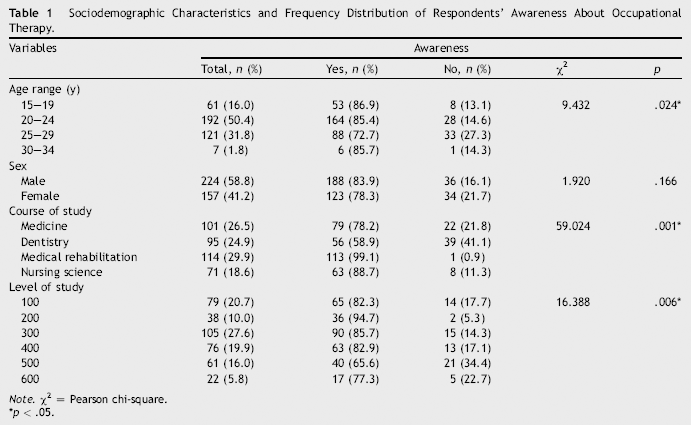
The mean age of the respondents was 20.96 ± 2.88 years with a range of 15–34 years. The sociodemographic characteristics of the respondents and frequency distribution of respondents’ awareness about OT are presented in
Table 1
. Most of the respondents were male students (58.8%) and were from the Department of Medical Rehabilitation (29.9%) (
Table 1
). Information about OT was mostly obtained from friends and colleagues (25.4%) and through personal contact with an occupational therapist (24.4%). The results showed that > 80% were aware of the OT profession. There were higher rates of awareness about OT among male respondents (83.7%), students in the 2nd year of study (94.7%), and those in the Medical Rehabilitation programme (99.1%).
Note. χ2 = Pearson chi-square.
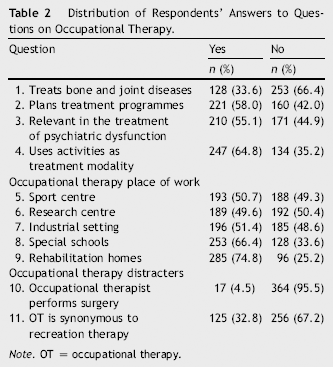
Distribution of respondents’ answers to questions on OT tasks is presented in
Table 2
. A majority of the respondents answered the question on the OT use of activities as treatment modality correctly (64.8%). Above 70% of the respondents believed that occupational therapists work in rehabilitation homes compared with research centres (49.6%). The respondents correctly asserted that occupational therapists do not perform surgeries (95.6%) and that OT is not synonymous with recreation therapy (67.2%).
Note. OT = occupational therapy.
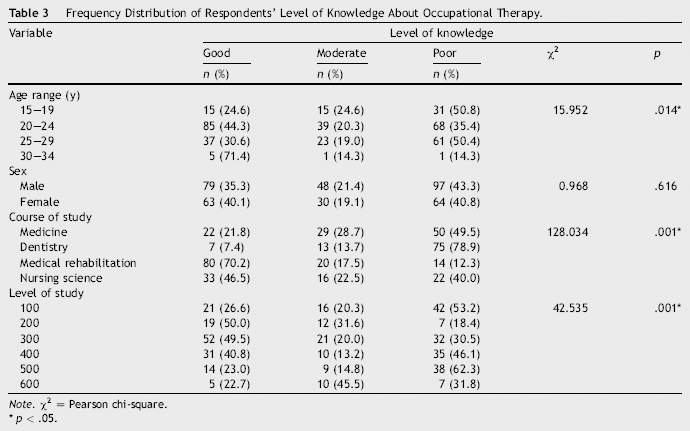
The distribution of respondents’ level of knowledge about OT is presented in
Table 3
. Less than 40% of the respondents had a good knowledge of OT while a majority had knowledge ranging from poor to moderate (62.7%). There was a higher level of knowledge of OT among male respondents (40.1%), students in the 3rd year of study (49.5%), and those in the Medical Rehabilitation programme (70.2%).
Note. χ2 = Pearson chi-square.
This study also showed that respondents’ awareness about OT was significantly associated with the respondents’ age (x2 = 9.432; p = .024), course of study (x2 = 59.024; p = .001), and level of study (x2 = 16.388; p = .006). Similarly, respondents’ level of knowledge about OT was significantly associated with the respondents’ age (x2 = 15.952; p = .014), course of study (x2 = 128.034; p = .001), and level of study (x2 = 42.535; p = .001).
Discussion
Compared to most professions in the Nigerian health sector, OT is somewhat less well known among the professionals and populace despite its long history. This study investigated the awareness and knowledge about OT among medical and other healthcare career students in the only university offering a baccalaureate degree in OT in West Africa. The findings of the study showed that most of the undergraduates were aware of OT. However, a majority of the undergraduates had poor to moderate knowledge about OT which consisted largely of misconceptions about roles of the occupational therapists. This result is consistent with previous findings on poor knowledge and misapprehension of OT roles among nurses, physician assistants, and nursing students (Jamnadas et al., 2002; Patel & Shriber, 2001). The majority of the students in the study knew at least one of the four questionnaire items on the attributes of OT, however, some still ascribed tasks that are not within the scope of OT to the profession. As a larger number of the undergraduates in this study will later become health practitioners, having a poor to moderate knowledge about OT roles could hamper referral of potential clients for OT; this invariably could negatively affect a holistic treatment approach to healthcare delivery in Nigeria. This suggests that the students need to be educated about OT roles. In order to improve the quality and safety of healthcare practice, several discussions and advocacies that focus on the establishment of practice mechanisms are being held around the world regarding the intricacies of human health. Interprofessional education and interprofessional collaborative practice are approaches that have been offered as a solution to the disjointed state of healthcare delivery systems observed in several developing countries, such as Nigeria. The need for the use of such approaches in educating medical and other health professional undergraduates, as well as in collaborative management of patients, is further corroborated in the present study.
The findings of this study indicated that students were most familiar with the occupational therapists using activities as treatment modalities but were less familiar with occupational therapists’ treatment roles in musculoskeletal dysfunctions. The imprecise knowledge of OT in this study can be attributed to the source of information about OT in this study environment. This misinformation is corroborated by the greater percentage of students who obtained information about OT from media and friends rather than direct contact with an occupational therapist. It is believed that the information obtained from media and friends may not be accurate to facilitate correct knowledge about OT. Patel and Shriber (2001) suggested that direct contact with an occupational therapist is the most beneficial and effectual source for acquiring information regarding OT. Furthermore, this study showed that most of the students had limited knowledge about the diverse settings an occupational therapist could work besides the rehabilitation homes and special schools. Shared knowledge through rotational clinical postings that reach students across all health disciplines could help in providing correct information about OT to the students. Rotational clinical postings; a period in which medical, dental, and other health professional students in their clinical years of education passes through different health specialities, departments, and/or units in 1–4 month blocks; accentuates the holistic approach to patients’ care by providing students with a broad perspective of the healthcare environment. These postings afford the students first hand contact with occupational therapists and other health professionals, as well as the various conditions they treat and handle. The students’ awareness about OT and level of knowledge were associated with the respondents’ course of study and level of study with students in rehabilitation-related programmes showing a higher level of knowledge about OT. Rehabilitation-related programmes, such as physiotherapy and nursing science, allowed for an extended interdisciplinary interaction amongst students with their OT counterpart. Students in the rehabilitation-related programmes offer similar courses with their OT counterpart at their preclinical (from 1st year to 3rd year) and clinical (4th year and 5th year), thereby enabling interaction throughout their undergraduate training, unlike medicine and dentistry. Similarly, students at the lower level of study showed a higher rate of awareness of OT and better level of knowledge about OT. The lower level of study, which serves as the preclinical level, provides an avenue for academic interaction among medical and other health career undergraduates, as students offer the same courses coupled with their discipline-specific courses at this level thereby allowing opportunities for shared knowledge. It could be argued that students in their clinical level of study had little or minimal interaction with other medical career students during their preclinical training, as OT had yet to commence as a course of study during this period.
Shared learning among different health professions enrolled in the same medical college is important towards advancing professional image and status of OT in Nigeria. Rotational clinical postings which cut across all health disciplines for medical and other health career undergraduates will enhance shared learning among the students in the present study. This will enable the students to have direct contact with practitioners from other health discipline such as OT. Similarly, occupational therapists and the NAOT should intensify their effort towards correcting the misrepresentation of OT and enlightening other healthcare professions about the role of OT in healthcare delivery.
Conclusion
Nigerian medical and health sciences undergraduates had high awareness, but poor to moderate knowledge about OT profession, roles, and work settings. Level of awareness and knowledge about OT were significantly influenced by rehabilitation-related course of study and lower level of study. Replication of similar studies in countries with different cultural background is suggested.