






Abstract
The Soviet canonisation of Abai, the nineteenth-century Kazakh poet and enlightener became a problematic theme for local intellectuals in the 2010s after the Occupy Abai movement in Moscow raised concerns over the heritage of Abai as a Sovietised canon and as an independent non-Soviet thinker. In 2012 oppositional leaders in Russia occupied Abai monument in Moscow and the leader of the opposition Alexey Navalny, called for his supporters to gather around the monument to unknown strange Kazakh guy using the Russian slang word –
Introduction
In 2012 Russian opposition informal leader and popular blogger Alexey Navalny called for his supporters to gather around the monument to “
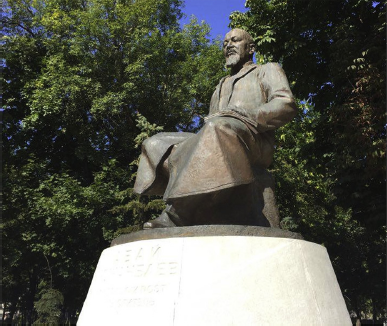
Abai monument in Moscow. Photo courtesy: Olga Zeveleva.
The opposition movement around Abai monument in Moscow drew more and more attention in 2012 and the internet hashtag #occupyabai became the third most popular in the world and the first most popular in Russian mediascape
1
. These changes in Russian society led to the unprecedented discussions in Kazakhstan – young urban intelligentsia started rethinking and re-reading Abai's Soviet canon. There were numerous attempts to make Abai contemporary, less Soviet and more understandable (
McGuire, G. 2018. “Aqyn Agha? Abai Zholy as Socialist Realism and as Literary History,”
In this article I analyse the uses of the image of Abai, the nineteenth century canonical Kazakh writer and philosopher and the role of his image in the formation of new cultural and political discourse in post-Soviet Kazakhstan. Many of these discourses critically evaluate the use of Abai's image and his canonisation and criticize the fact that Abai is used for the face value while his literary and philosophical heritage is less popularized, read or understood. In other words, the image of Abai is more popular than his works. Occupy Abai movement that started with Alexey Navalny's rather impolite comment about unknown Kazakh, for which he later apologised and promised to study Abai's texts, raised concerns over whether people actually were familiar with Abai's own oeuvre rather than just
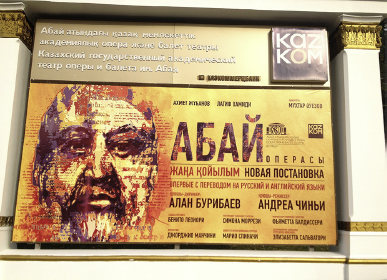
Abai opera premiere poster in 2014. Courtesy: author's photo.
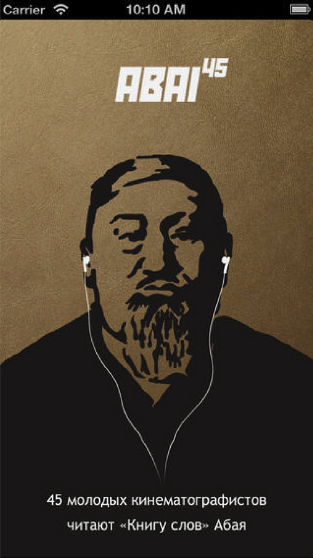
Abai 45 mobile application (iTunes download).
The questions that were raised during these debates crystallized the necessity for re-reading Abai. In this article I address the possibility of deconstructing Abai's canon in contemporary Kazakhstan. With the complexity of the discussions after Occupy Abai demonstrate the greater problem with accepting the Soviet past and its legacy in cultural field. It also calls for re-thinking and re-reading canonical texts and figures such as Abai, perhaps unpacking them as Soviet and nationalist post-Soviet canons and the return to “pure Abai” – Abai and his oeuvre before he was read through Socialist Realist lenses or canonised into the national hero. This is what the analysis of the many responses and cultural texts reveal. Abai remains misunderstood and his works alienated from many contemporary Kazakhstanis.
Kazakh writer and philosopher Abai is a canonical figure in Kazakhstani culture and society. The father of the Kazakh written literature, Abai, like Pushkin in Russia is considered an indisputable symbol of Kazakhness and even Kazakh statehood of contemporary Kazakhstan. In the past he was also canonised into the great revolutionary and the fighter for the Soviet values even if he died before the advent of the Soviet power in the Kazakh steppes. Many local Soviet writers considered Abai a “truly Soviet writer” and thinker owing to Mukhtar Auezov's seminal text
See McGuire (2018) in this issue and Kudaibergenova, D.T. 2017
The canonical construction of heroes such as Abai and historical writing in novels remained in the heart of Kazakh modern literature of the twentieth century. During this time, in the context of Soviet propaganda and censorship writers used the historical novel genre to recount the stories and histories of their people by the way of writing and re-writing their nation in novels, plays, operas, and other literary genres. Abai became the canonised symbol and one of the first historical protagonists of the semi-biographical, semi-historical and realistic novel. Prior to the publication of the
After Kazakhstan gained independence in December 1991 Abai remained state's main canonical figure in nation-building and cultural understanding of Kazakhs. “The nation's salvation is in its spiritual [and cultural] rebirth. The path to this rebirth, as Abai fairly considered, would be long and difficult but it is necessary,” said President Nursultan A. Nazarbayev at the 1995 Abai's 150th anniversary in Semey (Nazarbayev, 2011), Eastern Kazakhstan, the native land of Abai
4
. The anniversary celebration in Semey in 1995 became one of the first spectacular events in post-independent Kazakhstan and attracted a lot of effort and attention from the local intelligentsia, including Rollan Sarsembayev who wrote a personal letter to the President Nazarbayev and organised the celebration
5
. The Abai monument in Moscow emerged in 1996 following these celebrations and as a part of the continued project of spectacular nationalism that engaged Abai as one of its symbols. There is even a street in the new capital of Kazakhstan – Astana – dedicated to the 150th anniversary of Abai. A major avenue of Almaty, the biggest city of Kazakhstan, also bears Abai's name with the grand monument to the writer right at the beginning of the avenue that urban dwellers sometimes call
Quoted in Nazarbayev,
From the Presidential Archive, 1995 Administration of the President archives.
But how Abai canon, that was formed historically, changes under contemporary conditions of the growing gap between urban cosmopolitan Kazakh intellectuals, Kazakh speaking national-patriot groups and active Internet users? What happens to this canon or Abai under the pressures of the so-called creative class? There are still very few studies done on the impact of creative class – a concept defined by Richard Florida (2014:8) as a wide range of professionals whose prime ethos evokes around the necessity “to create new ideas, new technology and new creative content.” They are united by the “values of creativity, individuality, difference, and merit” and unlike the dominant frameworks of the working or middle class, the members of creative class are mainly concerned with the symbolic and cultural capital and the production of knowledge. The focus here is on post-independent generation of local intellectuals among writers, artists, directors, actors, young academics who gather around new open spaces, engage in critical discussions and work in alternative theatres and who in general defy the official ideological mechanisms of commemorations and further canonisations that to them is largely done in the “same Soviet framework.” This top-down approach requires for a tedious mechanisms of control to be in place such as the institutionalization (through the Ministry of Culture) and routinization of the “official” discourse of what Kazakh culture means. These include the canonised symbols such as ornaments, canonised figures such as Abai and a repetition of state-appropriated symbols of Kazakh literary narratives. The new creative class formed in major cities of Kazakhstan rarely engages with such “dull” and least innovative approaches to culture that they view as a lot more complicated and vivid. In this elite-dominated space and the prevailing “official” discourse, the alternative internet discussions allow for multiple negotiations and discussions, even scrutinisation of these themes and canons outside or away from the official and state-sponsored cultural propaganda. Not all of the views that the creative class are producing remain elitist. Both Russian and Kazakh language commentators, opinion leaders, public intellectuals, young and old writers and popular Internet bloggers are able to address larger audiences but mainly through the use of online resources. These new members of the creative class or creative intelligentsia rarely publish books of their own and instead remain short in their remarks and notes on social media, popular blog platforms, websites dedicated to nationalist and cultural discussions (in Kazakh) and popular media web sites.
Abai canon discussions that spurred after the Occupy Abai movement in Moscow offer particularly original contribution to this understanding of the virtual “civil society in the making.” Abai's oeuvre and legacy was claimed by the state but then re-claimed by the individuals and groups within the forming creative class. These people also choose different, alternative cultural leaders in these discussions, - late Gerold Belger was of a great influence, and allow themselves to form new discourses. Some of them are able to criticize the “sacred” image of the Father of Kazakh literature and culture while others call for the re-evaluation of his heritage. Erzhan Rashev goes even further than that in his 2014 piece for Esquire Kazakhstan where he comes back to the idea of the “depressing Abai.” Abai was a prolific philosopher but “it doesn't matter,” writes the popular blogger, the same person will remain as Prime Minister, devaluation of
Mankurt is the synonym for the Russified Kazakh who forgot his or her cultural roots, and lost connection with the indigenous understanding of social and cultural ways to live, with lifestyles and most importantly, with cultural norms and values. In this context Yerzhan Rashev and his opponents from the dispersed Kazakh national patriots (
Yerzhan Rashev, “It doesn't matter,” available in Russian at http://esquire.kz/2130-it_doesnt_matter.
Although Rashev's opponents were never able to identify directly what it means to be a mankurt apart from forgetting one's native language and becoming less traditionalised (also a term national patriots failed to explain 8 ), the attacks on Yerzhan Rashev consistently followed criticism of his “cosmopolitan” rather than nationalist views. This division is superficial outside nationalist discussions where they guard imagined traditions of Kazakh nation – a term they themselves find hard to define, and do not allow any discussion about Kazakh heritage, including Abai's oeuvre. Every category that falls into the understanding of “sacred” Kazakh national discourse is thus not open for any consequent analysis of debate. Yerzhan Rashev's position as a Russian-speaking Kazakh and scandalous blogger 9 who decided to deconstruct Abai, was rather unfortunate because it attracted more criticism than valuable comments.
See Kudaibergenova, D. 2017. “Contemporary Public Art and Nation: Contesting ‘Tradition’ in Post-Socialist Cultures and Societies,”
Yerzhan Rashev was accused of plagiarism in his publications on many occasions. He also became scandalously famous due to his radical publications of objectifying women in 2009–2010 on his first dokugusfra.kz blog platform, but he has since changed his agenda and positions himself as a mild feminist. Rashev, for example, condemned the assault on female journalist and criticised local sexist advertising. However, his plagiarism continues.
The discussions about the role and image of Abai in contemporary Kazakhstan, its politics, culture and society demonstrate divisions that exist on the societal level in terms of national and cultural identification. But the situation is rather more complex than the mere division into Russian speaking and Kazakh speaking communities or the divide of generations. The problematic and uneasy discussion on who is Abai in contemporary Kazakh society and what is the real value of his heritage really demonstrates the uneasy dialogue with the Soviet legacy of sovietised canonisations. Many young intellectuals see the problem in the fact that Abai's image is too literal, too Sovietised but his heritage is still not deconstructed and not analysed fully again due to the Soviet legacy of reading Abai simply as a canonical Socialist Realist figure, a master plot. Everybody knows who Abai is but not everyone is particularly familiar or is capable of interpreting what Abai wrote about and thus he remains misunderstood. There is a growing necessity of re-thinking and re-reading Abai in contemporary context.
Those Kazakh speakers who claim Abai's sacredness and do not allow even the mere deconstruction of his heritage never question the problems of translation of his work from Kazakh (the original language) into Russian, for example. The Russian translation of Abai's works remain a larger issue for those Russian speaking Kazakhs who continue to use the out-dated and “not so perfect” Russian translation of
These discussions remain open and popular – groups of creative class youth create mobile phone applications to popularize Abai's 45 philosophical essays
One of the most scandalous perhaps was the note from then popular blog platform dokugusfra.kz that featured an entry on misunderstanding Abai trend. Abai's texts and his canon was outdated, boring and unnecessary argued the blog's anonymous author hiding behind the nickname Alejandro. This blog post caused so much debates and polemics that it was later deleted and the dokugusfra.kz website does not exist anymore. The author of the blog post claimed that Abai was overused ever since the school but the real meaning of his “words” and his oeuvre was not adequately analyzed and understood yet.
Ever since then the Abai discussions occupied young Kazakh community in Kazakhstan's cultural capital – Almaty. I follow these discussions, events and opinions and evaluate the ways some groups of contemporary cultural elites in Kazakhstan in many ways oppose the traditional canonical views and attempt to provide their new “re-reading” of Abai. The people whose opinions I present here are alternative groups and individuals who choose internet (blogs, social media and Twitter) as their main platform for action. Among them is Erzhan Rashev, a popular blogger and former editor-in-chief of the dokugusfra.kz website, who at different times was accused for plagiarism, snobbism and being a prime mankurt still represents one of the popular alternative media content. Other bloggers and media opinion leaders and writers also include groups around the former Kult.kz 10 website (the site stopped working in 2014), former journalists and active public figures, Madi Mambetov (former editor-in-chief of Time Out Almaty), young writer Timur Nusimbekov, Daria Khamitzhanova (the project manager behind the Kurmangazy-Pushkin dubbed by controversial lawsuit as the “LGBT propaganda” poster), political analyst and journalist Adil Nurmakov, popular DJs Nariman Issenov and Nourbergen Makhambetov, and others.
Kult.kz positioned itself as a “journal for the new people.” Organised by the group of vibrant cultural activists in Almaty – writers, journalists, bloggers, musicians, photographers and copy writers, it represented a fresh and much needed resource for the local creative class. Kult.kz columnists – locally famous members of the same creative class wrote knowledgeable and critical pieces about current affairs – politics, society and most importantly – culture. The journal editorial team decided to close the website in 2014 following first scandal with Yerzhan Rashev's plagiarism but also citing editors’ busy schedules and engagement in multiple projects. Since then Daria Khamitzhanova and her team were involved in the lawsuit for “dishonoring” the image of Kurmangazy (famous Kazakh nineteenth century bard) and Russian canonical poet Pushkin in the poster where the two canonical figures were kissing. Khamitzhanova and her team prepared the poster for the advertising of the local gay club on the intersection of Kurmangazy and Pushkin streets in Almaty but the image was leaked online causing a number of discussions and controversies. Khamitzhanova left Kazakhstan a few months after the court hearing where her advertising agency lost the law suit.
“Tomorrow is Abai's birthday… people are constantly talking about him in here [in Kazakhstan] but are not thinking about what he wrote about… [they] turned him [Abai] into a wrapping paper of Rakhat candy [local confectionary factory], primitive painting –
Timur Nusimbekov, “#abay(
In his 2014 piece Nusimbekov claimed that Abai became “strange” and “misunderstood” because he was caged into the official discourse of the canon of Kazakh nation and culture (Nusimbekov, 2012). There are thousands of printed books and Abai's works are translated into many foreign languages, there are numerous monuments and posters dedicated to his oeuvre and his face in different towns in Kazakhstan, writes Nusimbekov, but was this something that led to Abai's misunderstanding, something that perhaps turned him into an object of admiration but not a subject of its own? The study of Abai, his life and his work has even formed into a separate scientific field of
The 150th anniversary of Abai and further celebrations that only canonised him into a figure of political propaganda of Kazakhness took Abai away from the public who continue to question who is Abai and what is his place in contemporary Kazakh culture? This is the question many scholars, public figures and writers continue to ask till today. In fact, a year after the pompous celebrations in style of Soviet dekada, in November 1996, Gerold Belger wrote an essay dedicated to Abai who famously questioned “How to live? What to do next?” (Abai Qunanbaiuly, 1993,
In his series of diaries and dialogues with long gone thinkers and writers, Gerold Belger combined contemporaneity with heritage, he brought old writers, Abai among them, back to life to question the great thinker about life and problems of contemporary Kazakhstan. Belger used philosophical discussions (
In one of these essays, Gerold Belger comes to visit Abai monument in central Almaty to silently address the grandeur poet and share his thoughts with him. After a short introductory talk about the Time and Abai's path – “my path was difficult. I am a man with mystery, remember that! I fought with the darkness as much as I could…” 12 , Belger continues.
Belger, Gerold. 2011.
I thought that Abai-ata got tired. [He got tired] of the recent grandiose anniversary that his grateful descendants and admirers around the world organized, and [that Abai was tired] from the poetic evenings at his feet [of the numerous Abai monuments] when all sorts of poets and speakers broke their voices in all sorts of dialects, from the longest to the out of place speeches, idle speech constructions uttered by all rang of bureaucrats and chatterboxes that represent [political] power. But maybe the reason for his tiredness is in something else? What does he, poet-philosopher has to do with all of this bustling and vanity when he is residing at the inaccessible and peaceful height? 13
Belger, ‘U geniia net vibora,’ p. 263.
Gerold Belger analysed the alarming tendency that would later follow a number of great artists and writers – the division into “official” and “independent” cultural producers in post-independent Kazakhstan. In the essay he continues with his imagined Abai's discussion on the issue. “Artistic talent is a Godsend,” says Abai, “[Artistic] oeuvre is a responsibility and an obligation, not a play.” Then Abai asks:
Poet is a prophet, he is a connecting point between people and the real power so this is why any earthy power means nothing for the poet! If you are a poet, if you are called upon by your people, then why would you need any sort of tinsel, unnecessary things?!
14
Belger, ‘U geniia net vibora,’ p. 265.
With this rhetorical questioning the imaginary Abai in Belger's narrative addresses the complex issue of “celebrated” and official writers in post-independent Kazakhstan, who like the Soviet intelligentsia, continued to serve the political elites in power instead of their own people. What can be achieved from such relationship, asks Abai – “I never received any awards and never suffered from that,” he concludes in Belger's narration. What is the point to serve the political means if these means do not deal “with eternity” as much as poets deal with something that would last and politicians – with something immediate, contemporary?, questions Belger alluding to the great debate in Kazakhstani society and its evolving civil society that is able to criticize this short-term approach only online. This short-term vision also leads to the souvenirisation of Abai and his continuous misunderstandings in contemporary Kazakhstan – the paradox when Abai's works and image are constantly popularised but there is very little done in order to re-interpret these works and image.
In order to understand the shifts and misunderstandings of Abai's oeuvre it is important to analyse the different discourses Abai's figure represents – those are the political, Kazakh authentic, and discourses on Lost Abai.
Although Auezov aimed to provide both the literary and cultural influence of Abai and understand his oeuvre, it was also important for him to describe the context in which Abai was growing up and in which he formed into the Father of the Kazakh modern literature. The framework of cultural production at the time of the heightened political control and repressions positioned Auezov in such conditions where he “had to write the novel as realistically as possible” to demonstrate the backwardness of the colonial and pre-Soviet Kazakh society
15
. As I write in the wider study about Kazakh modern literature, many Soviet critics tended to focus on “the class struggle shown in the novel” that many critics understood “as the master plot of the novel as a whole although Auezov was able to bring across significant findings about the history of Kazakhs by sowing such aspects as steppe nomadic law, tribal land ownership and customs and traditions”
16
I also argued that in
Abetov, Stenogramma of the
Kudaibergenova, D.T. 2017
Abai became one of the most ubiquitous and undisputable images of Kazakh modernity that the post-independent political elites widely used in their political projects. Even the famous Abai monument in Moscow (Fig. 1) that became the space for Occupy Abai movement in 2012 for the Russian, not Kazakh opposition, was constructed as a way for independent Kazakhstani elites to demonstrate their historical heritage and statehood set in stone and in the history.
On the crossroad between formerly Kalinina and Shevchenko and currently Kabanbay and Karasai batry streets, across from the famous Almaty Opera and Ballet House named after a pictorial graffiti of his image appeared in late 2000s (Figs. 4–5). In one night the graffiti of an old symbol of Kazakh and Kazakh-Soviet culture and heritage appeared on the wall of the old Soviet-built apartment house. The graffiti displayed a the classical, and perhaps the most well-known image of Abai in his late years – a wise old man who looks into the eyes of those passing by wide streets of post-Soviet Almaty.
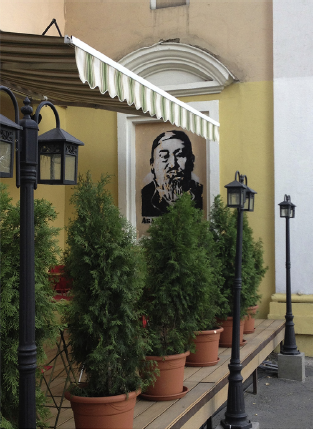
Abai graffiti in Almaty. Courtesy: author's photo.
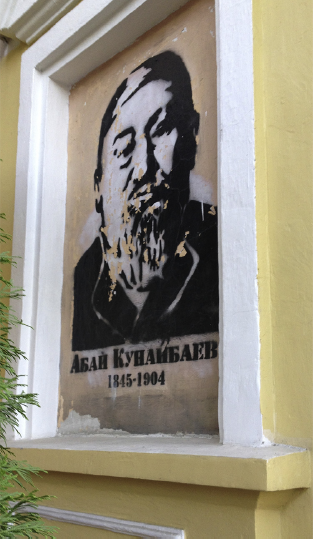
Abai graffiti in Almaty. Courtesy: author's photo.
After Occupy Abai movement in Moscow abai.kz writers and commentators also shared their opinions about the rising popularity of the Kazakh poet and philosopher that came up so unexpectedly and from Russia's capital. Their opinions were mainly positive but also self-reflexive. Many questioned whether the sudden interest in Abai's oeuvre and his life outside Kazakhstan also reflected on the “adequate” level of Abai's popularization in Kazakhstan. Aidos Sarym, one of the known Kazakh national-patriots also stressed that ideas Abai talked about in his context were still important as well as ideas of Alash – the nationalist movement that followed Abai's ideas and enlightenment and in words of Sarym who were the following the “eternal Alash idea” for independence. So “if democrats of the post-imperial [Russia] are not ashamed to chant “Occupy Abai!” what stops us from chanting “Occupy Abai! Occupy Alash!”? asked Sarym (2012) in his essay about the future of Kazakh national idea that could unite all of the Kazakhs 17 . In a separate piece on manifestations abai.kz also called Occupy Abai as one of the most “creative” rallies in the post-Soviet space 18 . There were indeed attempts of Kazakh opposition to also occupy Abai monument in Almaty in 2013 and 2014 but these were failed attempts although those manifestations also remained as very memorable – it is almost impossible to organize a rally right in the centre of Almaty where the main Abai monument is located.
Aidos Sarym, “Occupy Abai! Occupy Alash!” available in Kazakh at http://old.abai.kz/content/aidos-sarym-occupy-abai-occupy-alash.
Available in Kazakh at http://old.abai.kz/node/41457.
Other pieces featured at abai.kz and other web sites in Kazakh also questioned why Abai and not other “famous monuments” in Moscow dedicated to Pushkin, Tolstoy, Ghandi and Lermontov were not targeted by the opposition? One way to explain it claimed the commentators, was Abai's close location to the Kremlin. On the other hand, said the commentators, Abai's symbol and his heritage, ideas of freedom, enlightenment, fairness, his ideas about active civil society were close to many protestors who came to Occupy Abai 19 . Qalyakbar Usemqan-uly, one of the commentators claimed that Abai's oeuvre and thoughts represented very important and timely questions about social and civic activism and unity. In the same piece other commentators also questioned whether Abai's popularity in Moscow resulted in his popularization in Kazakhstan too.
“Abai orys kogamyna oi saldy,” available in Kazakh at http://old.abai.kz/node/13703.
Aidos Sarym claimed that Occupy Abai influenced the Kazakh youth differently. While some people were proud that Abai became the popular symbol abroad, he analysed, other groups said “So what is the point of that?”. The latter group of people then saw an opportunity to re-discover Abai again in the light of Abai's popularity abroad. Many shared the opinion that Abai's thoughts and ideas were as important to Kazakhstan as these were important in Russia. Abai's
In 2014, shortly after Occupy Abai movement in Moscow a group of young urban Kazakh celebrities united under the organization “Luch” (Ray of Light) issued a mobile application
Because the application was available for free for any mobile devices and because the idea was promoted by the young celebrities,
Finally, in all of these discussions there was also a space for the
Timur Nusimbekov, “#abay(
Could it be that Abai was able to get to the heights that no one was able to reach yet. Maybe in those spaces he was able to see something eternal and unbreakable and he [Abai] was able to see the real eyes of the Eternity. Perhaps he concluded his lessons for us from there – about the beauty, about the Understanding of the limit and peace, lessons about love, wisdom and freedom. We are ignorant, lazy students [of his], sixteen million of souls and potential followers. But perhaps there is still a possibility that some of us would be able to take the lead and deal with Abai's heritage in the most deserving way. And that would be the time when Abai would have his real birth day. And we will see something comprehensible, local, and lively there where right now we only see the monument to the misunderstood and strange Kazakh 21 .
Timur Nusimbekov, “#abay(
These discussions pose an important question about the possibility to divide or appropriate a cultural heritage, if there is perhaps a way to politicize culture and whether monuments can actually become virtual and real spaces of anti-political contestations. The Occupy Abai movement in Moscow shook Kazakhstani society allowing a lot of ideas to come on the surface. These were ideas and debates that question the “solid” and undisputable symbols and images, ideas and doctrines and challenge the political status quo in its cultural and ideological agenda. Kazakhstan was one of the countries where the cultural elites were divided into the “official” intelligentsia that Abai-ata and Gerold Belger discussed in their imaginary dialogue; and into independent intellectuals. The former group was actively engaged in supporting ruling political regime's ideas but rarely questioned or criticised its approaches. The latter group was never able to form into a unifying and strong political group to provide their critical approach but they were nevertheless able to inspire a new generation of writers and cultural activists who slowly occupy their space. In the absence of viable channels of communications and free and accessible media these young people turn to internet, social media, and blogs where they are able to translate their ideas into slogans, manifestos and blog texts. Occasionally these discussions become vocal but most importantly the new creative class is able to facilitate open and independent discussions and thus facilitate an online civil society in the making.
Conflict of interest
The authors declare that there are no conflicts of interest.
Acknowledgements
I want to thank Naomi Caffee and Gabriel McGuire for putting all of our papers together in a manner that questions Abay's legacy from a historic and also contemporary perspective. Parts of ideas for this paper came from the discussions at the CASI workshops on Intersections of Literature and History in Central Asia kindly organised by Central Asian Studies Institute at the American University of Central Asia in Bishkek and run by Christopher Baker and Svetlana Jacquesson in August 2014 and December 2017. Many members of the Central Asian literary and cultural studies group, including Naomi, Gabe, Joshua Freeman, Chris Baker, Chris Fort, Boram Shin, and Sam Hodgkins contributed to the development of my literary arguments. I also want to thank Boram Shin and the anonymous reviewers of the Journal of Eurasian Studies for stimulating comments and discussions. In Kazakhstan I owe it to a number of friends and colleagues, writers and activists who have inspired my work over all of these years. I want to thank Timur Nusimbekov, Murat Auezov, late Gerold Belger, Svetlana Ananyeva and other respondents.