






Abstract
The Eurasian Economic Union is an institution formalized in January 2015 for the purpose of regional economic integration; it includes five countries: Russia, Kazakhstan, Belarus, Armenia, and Kyrgyzstan, and may include Mongolia and Tajikistan in the future. With a GDP of $1.59 trillion in 2015, an industrial production of $1.3 trillion in 2014, and population of almost 200 million as of 2016, the EEAU could represent a geopolitical success that supports both Putin's ambitious political agenda and the Union's economic prospects. Although the efforts of this Union are ongoing and long-term success is not certain, the Russia-led Eurasian Economic Union can be considered a hybrid half-economics and half-political “Janus Bifrons” that serves as a powerful illustration of what Putin envisions for the post-Soviet space. Despite promising steps so far, more should be done toward the achievement of economic development and balanced opportunity for all Eurasian countries. Russia's longstanding role within the Union, as well as its power and political motivations, are all considerations that must be accounted for.
Introduction
Since the fall of the Soviet Union, the new Russian ruling class has endeavored to design a novel framework for the Eurasian region with a view that ensures stability and political autonomy in both domestic and foreign policy in to compete economically in the international economy. In 1991, the Commonwealth of Independent States (CIS) – a regional organization that coordinates trade, finance, lawmaking, and security in the post-Soviet space – served mainly to fill the political vacuum caused by the collapse of the Soviet Union (Sergi, 2011). During the 1990s, the Eurasian integration process was slow, and numerous treaties were signed by CIS member states (mostly on bilateral bases) to settle on a regional-type trading bloc. Although many ambitious efforts existed to this point, a feasible plan did not exist until the ideation of a Eurasian Economic Union.
To promote further cooperation, the Eurasian Economic Community (EurAsEC) was founded in 2000 to shore up a common market and the Eurasian Customs Union subsequently came into existence on January 1, 2010. In October 2011, the Russian President Vladimir Putin announced his plan to create a Eurasian Union – a hybrid half-economics and half-political “Janus Bifrons” (An ancient Roman deity, guardian of doorways and gates and protector of the state in time of war. Janus was usually represented as having two faces, since he looks both to the future and to the past.) I say – a reference to the President of Kazakhstan, Nursultan Nazarbayev, who first mentioned the idea of creating a union in central Asia during a speech given at Moscow State University in May 1994. Irrespective of the plan's origins, on November 18, 2011, the Presidents of Belarus, Kazakhstan, and Russia signed an agreement setting a landmark goal of establishing the Eurasian Union by 2015. A single market with established on January 1, 2012, and the Eurasian Economic Union (EEAU) was eventually established on January 1, 2015.
On the net, all EEAU member states project that their benefits outweigh the risks in terms of improvements to their living conditions. Although the establishment of the EEAU is ongoing, the EEAU theoretically provides an economic space in which movement of goods, services, capital, and labor are free, positive-sum benefits are distributed to all members, economic and monetary policies are harmonized, and single currency area may result in the long-term. A Customs Union is now viewed as a springboard for the subsequent transition to more intensive forms of regional integration. Once the agreements have been adopted, the resulting platform creates new opportunities for companies of the member countries to choose where to register their business, where to pass customs clearance, and which market to serve with their goods and services. The factors that will propel this region into success include common technological targets, common infrastructure, and common development systems. For example, structural homogeneity will drive integration because the countries share similar objectives. Consider the fact that the nuclear energy sectors of Kazakhstan and Russia are linked through the mining and enriching process and are also linked through engineering projects and pharmaceuticals (Kirkham, 2016). Similarly, Russia and Belarus are linked through military equipment development and railway car engineering while Belarus and Kazakhstan are linked through real-tank construction. Factors that may prevent regional success include discrepancies in the size of the economies, discrepancies in political regimes, and major divergences in monetary and fiscal policy approaches. For example, Russia accounts for the vast majority of the Union's GDP and therefore might pressure other countries in the Union to integrate in ways that are beneficial to it. Although regional economic integration is the endorsed long-term objective, the sustainability of such plans is uncertain given that the EEAU's strength as a geopolitical actor remains to be seen. Importantly, there are also negotiations between the EEAU and non-members; for example, Iran and the EEAU are now in the midst of discussions related to free trade zones.
After this introduction, Section 2 will summarize and explore existing research on the Union, Section 3 will discuss geopolitical considerations that drive and complicate the Union's existence, Section 4 will expand upon the geo-economics of member states and how conditions have changed as a result of the Union's establishment, and Section 5 will discuss post-Union patterns of economic integration. These sections are followed by thoughts on the uncertain future of the Union.
Literature review
Existing research has pointed to the discrepancy between the EEAU's publicly stated economic objectives versus its unstated power-driven objectives. For example, although the economic benefits of a single market is an incentive for all members, Russian leadership seems to also have unstated political objectives. For example, Russia's invasion of Ukraine is reflective of the fact that that enlargement might be a significant driving force for the country. The power dynamics will undoubtedly have been, and will continue to be, driven at least in part by the relative size of each country. The differences in economic size are rather stark, as shown in Figure 1 below (Kirkham, 2016):
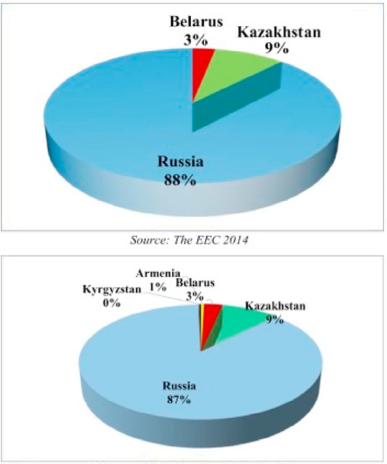
(1) CU GDP in 2013, % of total of $2.39 trillion (2) EEAU GDP in 2014, % of the total of $2.41 trillion.
Outside of the Union, Russian leadership has felt directly threatened by the Western world's hegemonic status, and it also seems concerned about China's position as a “rising power whose economic capabilities far exceed those of a weaker Russia” (Wilson, 2016). Despite the fact that Russia has been strengthening its relation with China and has been mostly cordial with the Western world, its desire to regain and expand its power is unmistakable. To begin with, Russia has reason to be concerned about the regional influence of other countries. For example, China has paid billions of dollars for Kazakhstan's oil fields and has additionally lent the country just as much. Similarly, China has transferred some of its military equipment to Kyrgyzstan while Russia reneged on promises to assisted Kyrgyzstan's energy sector. The fact that countries such as China may gain control over Eurasian economies is undoubtedly alarming to Russia, and serves as a major reason the country hopes to salvage its power in the region. In the past, Vladimir Putin has denied that he is aiming to effectively rebuild the USSR, but his statement that fall of the USSR was one of the “greatest geopolitical tragedies of the 20th century” makes it seem otherwise (Spechler, 2013, 130). In connection with these political aims, Russia also hopes to maintain “near exclusivity in trade with the near abroad, on terms favorable to Moscow” (Spechler, 2013, 130). There has been debate about the distribution of the region's economic activity; close to 90 percent of the import custom duties were allocated to Russia as of 2013. While some argue that this distribution is warranted, others argue that Russia is allowing itself a disproportional share of the gains (Mostafa, 2013).
A second condition which has been noted in existing literature is the fact that this Union is being established during a very interesting period. On one hand, there is a global trend of fragmentation – for example, the recent divisions within the Eurozone as well as diminished macroeconomic coordination might indicate that the success of such a Union is ultimately precarious. At the same time, however, there is also the promising trend of regionalism. As Hartwell states, “with the failure of broader–based and multilateral economic initiatives over the past decade… countries have begun to look closer to home for trade agreements and drivers of competitiveness” (Hartwell, 2016, 50). It is critical that actors within the EEAU take into account both the condition of regional integration coupled with global fragmentation.
Finally, existing literature explores the Union's strengths and weaknesses. Strengths of the Union include the large size of the Eurasian territory, the competitive advantage this region maintains due to natural resources, and the educated human capital. Some of the weaknesses of this region include the isolated geography, the lack of intellectual property protections, instability along borders, and lack of export diversity (Hartwell, 2016). Other concerns include the fact that the countries in the Union maintain disparate economic and legal systems, and that the Union could potentially violate the WTO's ‘trade nondiscrimination’ provision (Khussainova, 2016). There were previously many attempts at regional integration that have been alluded to by this paper – including the Commonwealth of Independent States (CIS), the Economic Cooperation Organization (ECO); the Eurasian Economic Community (EurAsEC or EEC); the Single Economic Space (SES); the Central Asia Regional Economic Cooperation Initiative (CAREC); the Central Asian Cooperation Organization (CACO), etc. (Obydenkova, 2015). While some of these attempts such as CIS were long-lasting and successful by numerous measures, other attempts were transient and did not come to fruition (Obydenkova, 2015). As an important caveat, we cannot equate analysis of the Eurasian Economic Union with analysis of the European Union. These two Unions are associated with very different historical legacies, institutional choices, structural-development contexts, and on-going state- and regime-building problems (Obydenkova, 2015). One would be misguided in their attempt to draw clear parallels between the two Unions. Nonetheless, if the Eurasian Economic Union can capitalize on its strengths while remaining cognizant of its weaknesses, it is quite possible that the EEAU will continue in the direction of success.
While Russia's greatest aim in establishing the EEAU was to restore Russia's economic influence on the post-Soviet space, Moscow has struggled to fulfill its ambitious goal of building a more unified version of Eurasia. An interesting dynamic is introduced by the fact that many of the states participating in this project are closely linked to Russia, yet appear to be simultaneously hedging against Russia. Thus, while Russia recognizes the need to consolidate its influence in a gradual and consensual way within the EEAU, many political realities of the region are working against these efforts.
Although any smaller member of the Union might be forced to give up some of its independence to Russia, it simultaneously could use the Union to aggrandize its own soft power for interactions with countries outside of the Union. Russia might help other member states break into new markets, modernize, and build up its soft power through economic development (Nurgaliyeva, 2016).
One of the stated rationales behind the Union was to maintain peace in the region through a “Schuman Declaration” approach; in essence, to integrate, merge interests, and link economies in order to promote economic development and prevent war (Nurgaliyeva, 2016). Although regional peace would no doubt be a tremendous benefit, Eurasia also builds its own power through its innovative initiatives. More recently, the Union members are arranging a draft an inter-governmental agreement to integrate its space and orbital resources such as satellites. If the EEAU were to succeed in all its economic and political goals, it would represent the EU's geopolitical contemporary in the East, attracting those European countries with non-Western historical and cultural roots seeking an alternative to the EU in order to support development, independence and political autonomy. Yet, almost every EEAU sub-region seems to have its own set of problems. Since the start of a rebellion in eastern Ukraine, the relations between Russia and the Baltic States have been strained, compromising almost any possibility for a Baltic presence in the project in the near term. In addition, relevant countries such as Moldova and Turkey have shown no interest in joining the initiative – Moldova has publically rejected the EEAU and instead is aiming to join the EU, while Turkey similarly benefits from a customs union with the EU.
After the demise of the Soviet Union, the United States, the EU, and China became increasingly important players in the post-Soviet space. The result has been tangible obstruction of Russian projects from not only these, but also other powers. Even Belarus, the post-Soviet state most economically dependent on Russia, is engaged in a tough bargaining game with Russia over subsidies, gas prices, and economic rents. Similarly, Central Asian countries, such as Tajikistan, have thus far expressed a mixed interest in joining the EEAU. Turkmenistan officials seem reticent to join the EEAU as it continues to maintain political neutrality and economic self-sustainability, while diversified foreign economic relations push Uzbekistan not to join. The “broader-EEAU alliance” would represent the most up-to-date “Janus Bifrons” attempts President Putin has been pioneering to recreate a superpower in the region under more modern political outlook and economic strengths (Sergi, 2011).
From an economic perspective, the EEAU comes with important unknowns. The EEAU introduced free movement of goods, capital, services, and people, and provided for common transport, agriculture and energy policies with provisions for a single currency and greater integration in the future. Despite having excess reserves of raw materials (minerals, energy, agriculture, and livestock), however, the EEAU lacks a fully developed financial sector and technological capabilities that could facilitate regional innovation. Evidence is increasing that Russia's economic troubles are rippling across the wider region, as seen with the Western sanctions. This, as well as the continuing drop in oil prices, has caused trade turbulence during the EEAU's first few months of existence.
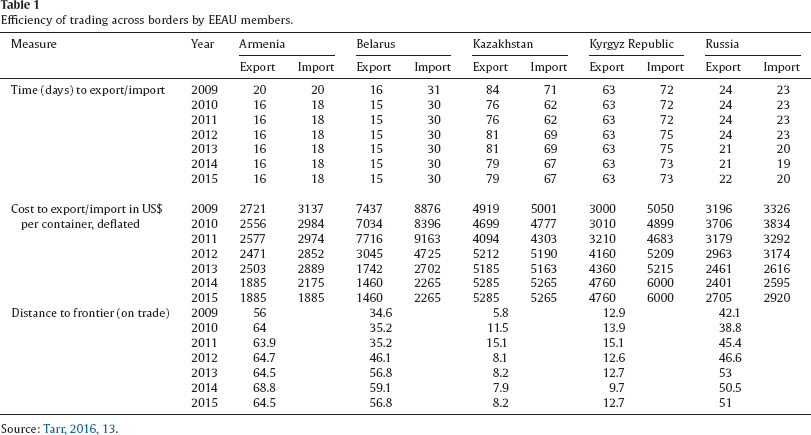
In order to measure the changes in trade as a result of the EEAU so far, Table 1 below demonstrates the efficiency of trading across borders between 2009 (pre-EEAU) to now (Tarr, 2016).
Efficiency of trading across borders by EEAU members.
Source: Tarr, 2016, 13.
Efficiency of trading across borders by EEAU members.
Source: Tarr, 2016, 13.
2010, the year that the preliminary customs union was formed (included Russia, Belarus, Kazakhstan), is also shown on the table. This table indicates the possible benefits of the Union's members (Tarr, 2016). Naturally, an effective Union makes exchange quicker by decreasing the export/import time in days as well as reducing the cost to export/import. Countries that saw the greatest decreases from the pre-EEAU timeframe to the post-EEAU timeframe presumably benefited the greatest from the Union's establishment. For example, the Kyrgyz Republic experienced no trade benefits as it relates to time it takes to exchange; its export time remained consistent at 63 days, its import time actually increased by one year, and its cost to export increased from 2009 to 2015. In contrast, Armenia seems to have experienced significant benefits – its export time decreased from 20 days to 16 days, import time decreased from 20 days to 18, and cost to export/increase decreased significantly from 2009 to 2015. Although we see much of the aforementioned changes being demonstrated before the formal establishment of the Union, it is important to remember that the Union was preceded by a number of agreements that were formative and influential to the establishment of the Union itself. Number of days required to import and export decreased in Belarus in 2010, Belarus cost of importing/exporting significantly decreased between 2011 and 2014, and time to import/export in Russia fell 10 percent between 2012 and 2015 (Tarr, 2016). Although the improvement in Russia's indicators could be attributed to its accession to the World Trade Organization, it seems that the formation of EEAU was nonetheless a factor in its efficiency (Tarr, 2016). Unfortunately, Kazakhstan's trade indicators initially improved but later worsened. More time will be required before one can conduct a deeper analysis into trade outcomes.
Similarly, the distance to frontier component of the table above measures the level of regulatory performance over time. Although the methodology behind this evaluation is nuanced, the most important thing to realize is that it is ranked on a scale from 0 to 100 where 0 represents the lowest performance and 100 represents the highest performance. Interestingly, each of the five countries aside from Kyrgyz Republic experienced a net improvement in this measure of the regulatory regime between 2009 and 2015. Improving the regulatory environment for these countries is definitely one aspect of efficiency that the Union is responsible for.
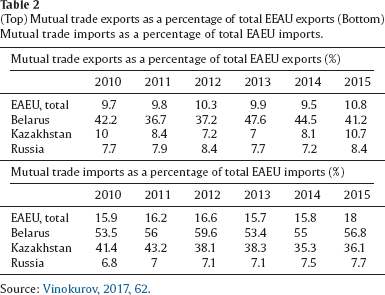
In terms of the effects this policy had on mutual trade exports (between countries within the Union), the evidence is clear – the total percent of mutual trade exports and imports as a percentage of total EEAU exports increased despite year-to-year variations (Vinokurov, 2017) (Table 2):
(Top) Mutual trade exports as a percentage of total EEAU exports (Bottom) Mutual trade imports as a percentage of total EAEU imports.
Source: Vinokurov, 2017, 62.
Although the increase in mutual trade is not consistent, the trend shows a clear increase. Another enlightening trend is the movement of mutual FDI stocks as “despite the overall instability of the global economy and capital flight from emerging markets, Eurasian Union member states maintain a relatively stable level of investment interactions” (Vinokurov, 2017). The movement of mutual FDI stock in CIS countries and EAEU member states is depicted in Figure 2 below:
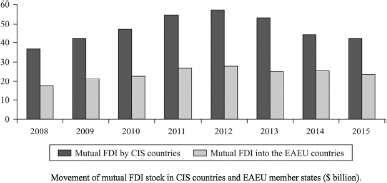
Movement of FDI stock in CIS countries and EEAU member states.
Russia is engaged in constant diplomatic efforts to attract new members, but aside from Ukraine, few states have considered this prospect. The EEAU cannot afford to rely on the success of just one partner, so creating a network of free trade areas, as evidenced by the May 2015 agreement with Vietnam, along with similar deals with Egypt, India, and Israel, should be a possible solution amidst the current crisis in relations with the West. Other potential partners could include South Korea and Iran. However, talks with the EEAU's major trade and economic partners, the EU, and China, are perhaps most important. Recently, the EEAU and China have started talks on a trade and economic cooperation agreement. The EEAU's participation in China's new strategic project, the Silk Road Economic Belt, has been an ongoing discussion since 2013 with plans of the project stretching across Eurasia, Oceania, and West Africa. There is no doubt that mutually beneficial cooperation between EEAU's member states and China would add momentum to regional development, as well as facilitate transport, energy, and financial cooperation in Central Asia. In addition, although further cooperation between the EU and EEAU are not currently in consideration, there may be many reasons for these two blocs to improve cooperation in the future. The EU is both Russia and Kazakhstan's major trading partner, accounting for over one-half of Russia's trade, while Russia is the EU's third largest trade partner.
It is also important to spotlight what countries such as Kazakhstan are doing in terms of spurring individual relationships with the West and China. Central Asian republics are traversed by roads and pipelines connecting Western Europe and China. Although Kazakhstan does not yet possess transit pipelines, its efforts to construct the Kazakhstan-Caspian Transport system highlights Kazakhstan's stride toward developing a stronger relationship with China. Under the EEAU system, however, it is understandable that deals which favor the EEAU as a whole are much preferred over deals that favor countries within the Union on a selective basis.
To make the Eurasian system work effectively, individual countries need to adopt policies, especially in the economic and social areas that can strengthen the EEAU structure. In particular, the data shows a high level of unemployment in Armenia and Kyrgyzstan, as well as in Turkmenistan and Uzbekistan who have yet to join. Belarus could also benefit from this project given its inflation rate of 9.5 percent as of January 2017, higher than the other countries in the region, while Armenia and Uzbekistan recorded lower levels of negative .2 percent and 5.7 percent as of February 2017, according to Trading Economics.
Ideally, any new economic policy will promote the region's service industry (an area in which all member states would noticeably benefit) but will not disproportionately favor one any of the other industries. As explained in one analysis, the region is more or less structurally homogeneous which means common targets will serve as a positive factor towards integration (Kirkham, 2016). To understand each country's role within the future of the EEAU trading system, let us assess the level of bilateral remittances between Eurasian countries. According to data, Russia is undoubtedly the most advanced country involved, with higher figures compared to other countries, including the three major Eurasian countries not members of the EEAU (Tajikistan, Turkmenistan, and Uzbekistan).
Russia plays an important role in the foreign trade of Eurasian countries to varying degrees. These differences concern both volumes of bilateral trade and relative significance of trade with Russia. Despite a reduction in commodity turnover between Russia and several Eurasian countries, Russia remains an important trading partner for all of the Eurasian countries due to its dominant role as the leading sales market for goods produced by Eurasian extracting and manufacturing industries, as well as their agricultural sectors, which are all significant employers. This implies a substantial interest in retaining and continuing cooperation with Russia on the part of Eurasian businesses and entrepreneurs.
After some deliberation, Kyrgyzstan is finally the most recent full-fledged member of the EEAU. Prior to accession, it maintained one of the weakest and most depressed economies in the Central Asia as it depends heavily on foreign aid and on remittances from its own migrant workers in Russia and Kazakhstan. The Kyrgyz Republic is one of the largest recipients of remittances which amount to 25 percent of the country's GDP (World Bank). Similarly, reports indicate that anywhere from half a million to one million Kyrgyz nationals, out of its population of 5.7 million, travel to Russia to find work. The World Bank data indicates that one third of the Kyrgyz citizens were below the poverty line as of 2015. The weakness of the economic fundamentals coupled with questions of whether the Kyrgyz Republic's laws are compatible with those of the EEAU has caused hesitance in the broader community. For example, one initial worry was that EEAU regulation could void some of Kyrgyzstan's current and promised infrastructure projects funded by China which amounted to billions. Although Chinese representatives have previously stated that the funding would be “free of additional conditions,” it is still to be seen whether this commitment will be realized. If the EEAU barriers do indeed impede upon these projects, severed access to Chinese financing and Chinese materials would be at jeopardy.
Aside from this concern, Kyrgyzstan has not felt the immediate positive impacts of accession as it was promised. While the EEAU guaranteed free movement of capital and labor in addition to being the voice of macroeconomic stability, financial competition, and energy policies, Kyrgyzstan has undoubtedly stagnated after joining the Union. Measures by the National Statistical Committee indicate that in the year after accession, imports decreased by 8 percent, exports decreased by 30 percent, and even trade with other EEAU members reduced by 22 percent (The Diplomat, 2016). With an overall decrease in GDP of 2.3 percent, joining the Union seemed to have been a major mistake which some predict will lead to a “Kyrexit.” The analysts believe that the high tariffs being imposed on trades with non-EEAU countries – especially China – is perhaps the biggest burden that Kyrgyzstan has faced. Although a “Kyrexit” may seem as though it is a no-brainer, however, the Kyrgyzstan citizens maintain a feeling of dependency on other EEAU states such as Russia (The Diplomat, 2016). For this reason, they may not leave. Especially surprising is the International Republican Institute's finding that as of March 2016, over half of Kyrgyzstan's public believed that the country is “headed in the right direction” (The Diplomat, 2016).
In terms of other news for the region, the Ukrainian crisis has altered both the perspective and the nature of the project, undermining its international credibility and knocking down the forecasts of domestic economic growth. In fact, Ukraine has always been politically and geographically essential for the project. Indeed, Russia could not accept that Ukraine was in the EU orbit, and even attempted to counter the Association Agreement between Ukraine and EU by offering Ukraine economic aids and low-cost gas. However, after the annexation of Crimea by Russia, President Putin lost – for the moment – Ukraine as EEAU potential member, and in the process compromised relations with other post-Soviet countries. In addition, if in the past the perception of affinity with the culture has made Russian influence in the region hegemonic, the gradual integration of part of East-central Europe with the EU and the Western values has opened a rift between the “center” (Russia) and “periphery” (other Eurasian member states). Ukraine's new wave of nationalism, pro-Western reasons of expediency, has caused a rejection of the Russian hegemony, and the muscular and assertive policy pursued by the Government of Moscow has radicalized many Eastern European countries, which are afraid of a new “tsarist expansionism.”
In Central Asia, Kazakhstan has the largest volume of commodity trade with Russia, due to the production, transport, and processing of hydrocarbons, and the electric power industry. Russia is not only one of the top export destinations of Kazakhstan, but is also one of the top import origins of Russia. Uzbekistan is second in terms of volume of trade, due to its growing natural gas exports. While Kazakhstan is a founding member of the EEAU and Uzbekistan is not a member, the possibility of Uzbekistan joining the EEAU would spark likely trade advantages (and disadvantages) with other Eurasian countries. Following the Ukrainian crisis, the only other post-Soviet state with a comparable population and economic potential is Uzbekistan. With a population of just over 30 million, Uzbekistan would provide a significant addition to the EEAU's internal market. Russia was and remains Uzbekistan's main trading partner, and Russia's labor markets remain the preferred destination of millions of Uzbek migrants whose remittances constitute 4.7 percent of Uzbekistan's GDP as of 2015, according to the World Bank.
The second most important member of the EEAU, Kazakhstan, is another significant trading partner for Uzbekistan. The risk of being excluded from such markets would be a reason to seriously consider EEAU membership, especially since Uzbekistan's prosperous automotive industry sells one third of its production to Kazakhstan and Russia. On the other hand, if Uzbekistan and other countries do not join the EEAU and offer the benefit of synergistic regional growth opportunities, the EEAU could remain a “paper tiger,” meaning that it could be ineffective and unable to withstand challenge (Sergi, 2014). The synergistic commitment within the EEAU, especially if cohesive and successful, would move away from a simple factor-driven stage toward full compliance with innovation-driven stages, requiring both the advances services and industrial markets to undergo radical change in order to cope with intensifying international competitiveness. To this end, trade openness would be significantly associated with income gross income and income per capita and better quality institutions and governance would complement the benefits from trade openness.
The patterns of economic relations
A Customs Union is deemed to be one of the most important stages of increasing Russia's influence in the former Soviet region. However, instead of recreating the old centralized state system that proved to be unviable, Putin's administration is aspiring to build a new system, which will influence the former Soviet republics without assuming responsibility for the official logistical functions of each state. While some of the former Soviet republics have shown resistance to Moscow's influence, Kyrgyzstan's recent filing for an entry into the EEAU is a sign of the strategy's success in its concept and execution.
The advent of the Customs Union and the Common Economic Space has found some positive response in China, which considers integration with Russia as an integral part of a global trend to accelerate economic convergence. In fact, China is the top export destination of Russia ($39 billion) and also the top import origin of Russia ($50 billion) (MIT Observatory of Economic Complexity, 2017). At the same time, customs brokers say that the volume of the Chinese counterfeiters in Russia is miniscule, and that the majority of imports comprise the essential modern equipment and various high-tech products. What the focus should be, economists say, is the production of import-substituting products. Another crucial component is production standards and product expectations, common to the current of potential EEAU members. Thus, for Russian producers, the commodities markets in Kazakhstan and Belarus are the most promising. Ironically, however, Russia exports of finished goods spiked when the EEAU was first formed but the level of exports have now returned to pre-EEAU levels. This indicates that Russia's export market has not benefited as much as once hoped.
The business sector has no clear picture of how its activity will be affected, which changes in the legislation should be expected, what prerogatives they have in the foreign turf, how they are protected, and so forth. Above all, how will these intra-institutional changes affect the trade and economic relations with other countries, for example (and often, especially with) China.
The Russian Chamber of Commerce has developed a clear algorithm outreach program, not only for Russian businesspersons, but also for business transactions with Belarus and Kazakhstan. Already a number of seminars for business in Kazakhstan, Belarus, and Russia have addressed the possible areas of concern connected to the internal operations of the Customs Union, the Common Economic Space, as well as Russia's accession to the World Trade Organization. In the case that China demonstrates similar concerns, Russia is ready to unfold a similar campaign via distance by means of internet-driven forums. According to Russian entrepreneurs, the establishment of the Customs Union has significantly simplified some of the logistical and bureaucratic procedures. However, when it comes to freight by rail or trucks originating from China, there are still significant gaps in the code. There is no centralized system of custom duties and taxes, as well as no unified code for exemptions or privileges. The transfer of customs controls to the external borders resulted in complications in regulation of the import and export processes. This, in turn, affects the local businesses. The situation evokes the major consideration that an economy will survive and prosper only if it develops a system of support for the local producers, by fostering the establishment of innovative technological sectors oriented towards the production of goods for local consumption and export. Logistical questions play a detrimental part in the development of trade and serving as a gauge to the overall success of the EEAU. For example, consolidating the port for all incoming and outgoing goods between China, Europe, and EEAU in Kazakhstan would reflect in a significant drop in transportation costs, therefore, making the final goods much more affordable to the final consumer. However, to-date the routes for cargo transport are dispersed throughout the external border of the EEAU. Scholars and experts propose that positioning the Chinese and European MNC's on the territory of the EEAU should be recognized as a full-scale economic integration of the two economic giants with the post-Soviet region. This development will irrevocably change the domestic, economic, and political landscape of the EEAU members. However, the ramifications of this development will not be known until after several years of continued operations.
The volatility of Russia's political and economic climate and the majority of the former Soviet space, underlines the acute importance of integration initiatives within the region. The institutional agenda originally promoted these projects as regional stabilizers in the areas of political, social, and economic development, as well as intrastate relations and regional security. Another important factor is synchronization of macroeconomic and customs policies, which could afford a certain level of predictability and stability among the members. This arrangement once more highlights the fact that former Soviet states are somewhat limited in their domestic and foreign policy choices. Since the former Soviet states are in a closed network, where the centrality is unmistakably pronounced by Russia, they are dependent on Russia's internal and external choices. While the former Soviet states are closely tied to Russia's policies and are inclined to participate in the regional integration initiatives, they have been fiercely and continuously fighting to consolidate their independence. One such strategy became apparent in the former Republics’ inclination towards forging alliances with the Western partners, or their neighbors beyond the CIS. Azerbaijan and Kazakhstan have developed a successful partnership with Turkey over the last twenty years. Kyrgyzstan carried out a series of agreements with the United States to host their military bases, by which it deeply upset the Kremlin. Iran is seen as a strategic partner for Kazakhstan, particularly in the field of uranium trade. These endeavors have often served as aggravating factors to Russia, but also have become an important source of foreign direct investments, providing lines of Western credits, exchange of knowledge and technologies, and a bargaining chip in the great game with Kremlin.
The patterns of economic relations described above carries profound implications for theory and practice in the implementation of the EEAU. An increasing number of public institutional investors in the region are called to adopt sustainable investment policies, although an increasing complexity within the region's competition faces up against diverging interests. Firms unavoidably exert influence over politics through the power that is generated by both structure and process. Considering further research into this mechanism of influence, Abdelal (2013, 2015) offers a significant view that patterns of international economic relations recast domestic coalitions in specific, rather than general, directions. The energy interdependence of France, Germany, and Italy with Russia has drawn selected European nations closer to the East, occasionally at the expense of their multilateral relations in the West. Their Russian interdependence is, however, more politically and strategically meaningful when it comes to their energy policies. The scholarly literature on the power of business in politics has demonstrated how influence derives from instrumental agency as well as structural influence, but it has taken an unnecessarily restrictive view of politics and an overly materialist theory of power.
In particular, Gazprom (the agent of Russian energy policy which has the Russian state as its majority owner) has produced patterns of regional and international politics that seemed almost inconceivable few years ago. France, Germany, and Italy have cultivated bilateral energy relations with Russia at the expense of a common stance on the continent's dependence on Russian gas, and much to the dismay of other EU members. Giant European energy firms conducted this realpolitik for all of Europe. For the past ten years, Gazprom has been tasked with maximizing profits and provide huge tax revenues: Gazprom needs its Western European revenues to be profitable, and Russia needs Gazprom's profits and taxes to prop up the country's budget.
Conclusions
Since the Eurasian Economic Union was formalized on January 1, 2015, it has been considered as a historical economic and political achievement for the region and for Putin's political agenda. In the context of geo-politics and geo-economics, this Union serves as a powerful illustration of what Putin has envisioned for the post-Soviet space as the Union has been partially motivated by Russia's goal of self-aggrandizement. With many benefits and an equal number of costs, however, it is still unclear as to whether this institution was accumulate success or simply diminish in importance.
The newly established Union has to economically and politically deal with European and Asian economies, most notably China. The exact geographical boundaries of the EEAU are unknown, however. While Kazakhstan may potentially leave the EEAU because its trade turnover diminished after joining the Union and its currency has lost considerable value against the dollar, other countries such as Tajikistan may potentially join the Union. As Russia is engaged in constant diplomatic efforts to attract new member states, the European Economic Union is an ongoing concern and the political and definitive patterns of trade with non-Union members carry profound implications for implementation of the Union. If all the countries were called to adopt sustainable economic policies, increasing economic complexities due to their economic interdependencies as well as the growing competition the region faces up, a better integration would be envisaged. In fact, on Monday, September 28, 2015 President Vladimir Putin in his address to the UN general assembly talked about regional economic projects, specifically referring to the “integration of integrations of universal and transparent rules of international trade. As an example I would like to cite our plans to interconnect the Eurasian Economic Union with China's initiative of the Silk Road Economic Belt.” Similarly, the President of Kazakhstan also mentioned an “integration of integrations” during June of 2016 which might link the EU and the EEAU. Moreover, he went on to say that the integration of the EEAU with the European Union would be highly promising. More should be done toward achieving economic development and balanced opportunity for all Eurasian countries, but Russia's historic and recent role is a source of wonder that would be hard-pressed to avoid.
Conflict of interest
There are no conflicts of interest. No financial support received for this article would count as a conflict of interest.