






Abstract
Russian political–economic development since the early 1990s has been described as one of initial liberalization and subsequent re-etatization a decade later. Our paper critically builds upon this view, systematically adding patrimonialism as third dimension and conceptualizing Russia's trajectory as varying with respect to ideal–typical liberalism, statism and patrimonialism. We argue that Russian patrimonialism hindered the rise of the economically facilitating state capacity and undermined both liberalization in the 1990s and re-etatization in the 2000s.
Furthermore, we add a comparative BRICs perspective that clarifies the peculiarity of Russia's development based on statistical data from the World Bank, the OECD and Heritage Foundation. The data confirm the de-liberalization of Russia and show an increase of patrimonialism. Another finding is that Russia was the only BRIC country that de-liberalized and increased its level of patrimonialism in the period under consideration.
Introduction
It is widely acknowledged that Russia's political economy 1 underwent a liberalization in the 1990s, followed by re-etatization in the 2000s (cf. Aslund, 2007; Goldman, 2010; Hanson, 2007; Rutland, 2008; Yakovlev, 2006). However, further differentiation is required for a more exhaustive and systematic analysis of change in Russia's political economy during the past two decades. Such differentiation is the objective of this study. It makes a case for supplementing the better known statist and liberal dimensions of Russia's trajectory with systematic incorporation of a third dimension: patrimonialism, understood as a distinct structural mode of political–economic organization based on clientelism and patronage. Many scholars acknowledge patrimonialism as one of the defining features of the Russian political economy but have difficulties assessing its interaction with the formal, legal–rational aspects of the system (e.g. King, 2007; Robinson, 2011; Sakwa, 2013). We build upon this scholarship and assess empirically the impact of patrimonialism on Russia's politico-economic development. We show how patrimonialism undermined both the liberalization of the 1990s and the etatization of the 2000s and offer a quantification of the process.
In this study, the terms ‘political economy’ denotes the ensemble of state–economy and capital–labour relations (cf. Becker, 2013, p. 34).
In this paper we develop an analytical framework and quantitative tools for comparatively exploring the specificity of Russia's political–economic development over the past two decades. First, we systematically address change by conceptualizing the trajectory of the Russian political economy as a case that changed location in the field between the liberal, statist and patrimonial ideal types. This approach differs both from static classifications (i.e. Russia having, for example, ‘state-led capitalism’ (Lane, 2008) or ‘patrimonial capitalism’ (King, 2007)) and from analyses cited above which focus on the shift from liberalization to etatization but do not grant enough attention to the impact of patrimonialism. Second, we quantify such developments in Russian political economy, placing it in a comparative BRIC context and illuminating the particularities of Russia's development.
In doing so, the paper builds on the literature on comparative capitalisms. We depart from predominant accounts in the field in two important respects. First, our approach differs from static classification of national political economies where large numbers of cases, including Russia and other post-communist countries (e.g. Lane, 2005; Myant & Drahokoupil, 2011), are crowded-together under the label of one or another ‘type’, calling cases in plural, for example LME
The paper clarifies Russia's political–economic development in these ways, through two distinct but interrelated steps. The first, historical–analytical step provides insight into changes that occurred in the political economy of post-communist Russia in the conceptual framework of three ideal types of capitalism. The assessment is based on a critical reading of secondary literature supported by newspaper articles and interviews with entrepreneurs conducted in Russia in the spring of 2014. We make the case that Russia experienced an attempt at liberalism in the 1990s, which was followed by an attempt at statism in the 2000s. Both processes were accompanied, and indeed undermined, by patrimonialism. The study of the impact of patrimonialism on the processes of liberalization and etatization is central to the analysis. Notably, the attempted move toward greater statism hardly implied a general strengthening of the state, although it became more centralized and the extent of state ownership and state activities increased. State capacity, understood broadly as the capacity to formulate and implement policy, rose only in coercive terms, not in terms of facilitating economic development which involves creating incentives for private entrepreneurialism, providing legal certainty and improving education, R&D and the infrastructure (we dub it ‘facilitating state capacity’). The rise of the facilitating state capacity has been hindered by patrimonialism, notably the widespread patron–client ties and private appropriation of the public realm by political and bureaucratic agents.
The second step in the paper aims to ‘individualize’ (Tilly, 1984) Russian political economy in comparative BRICs perspective and to examine whether the direction of change as identified in the first step can be quantitatively revealed. The BRIC countries are selected as comparison cases since they are all large emerging and internationally significant political economies. No doubt there are notable differences between the BRICs as regards size, historic legacies and factor endowment, to name a few, which are interesting for the purpose of comparison. For the purpose of this research, however, we want to point out some similarities between the BRICs. Figures of economic performance, competitiveness and investment indicate growing importance of these countries and imply a shift in global economic power beyond the “hype initiated by the Goldman Sachs BRICs … studies” (Nölke, ten Brink, Claar, & May, 2014, p. 539). For instance, the share of the BRICs in global production increased from 15% in 1995 to 25% in 2010 (International Monetary Fund, 2012). Politically, since 2009 the leaders of the BRICs 2 have been meeting at annual summits, aspiring to give emerging countries a stronger voice in international governance and to advance an alternative agenda on economic development, in particular through a more pronounced role of the state.
The club was extended by South Africa in 2010, which is not included in the study due to the lack of necessary data for the time period considered.
The focus of the comparison will be on Russia: we do not attempt a detailed treatment of other BRICs nor aim to compare or explain in depth their trajectories. A general statistical comparison, however, is possible and appropriate, using data provided from the Index of Economic Freedom, the World Governance Indicators and the OECD on product market regulation and employment protection legislation. The main finding is that the data confirm the de-liberalization of Russia and show an increase of patrimonialism. Another finding is that both processes ran counter to the developments in other BRIC countries. In terms of its trajectory of change Russia is revealed to be an outlier: Russia was the only BRIC country that de-liberalized in the 2000s compared to the 1990s, while India, China and, to a lesser extent, Brazil liberalized in this time period. Russia was also notably the only country that experienced a growth of patrimonialism, which decreased in other BRICs.
In taking these two steps, the paper makes both theoretical and empirical contributions. In theoretical terms, the paper contributes to efforts to incorporate patrimonialism into the comparative capitalism framework. While the concept of patrimonialism is widely deployed in studies of political systems or governance regimes (e.g. Adams & Charrad, 2011), it is seldom applied to the economic domain (Robinson, 2011, and Schlumberger, 2008, being among the notable exceptions), although it shapes to a considerable degree the organization of the political economies of emerging markets.
In empirical terms, the paper provides a systematic analysis of change in the Russian political economy within an original conceptual framework and offers a tool for the quantitative assessment of that change. The incorporation of patrimonialism in the framework allows to become more precise than the existing analyses on the scope of patrimonialism and its impact on other dimensions of Russia's trajectory. In particular, scholars recognize that Russia combines both legal–rational and patrimonial features (e.g. Sakwa, 2013; Whitmore, 2010) but have difficulty assessing “this complex interaction” (Whitmore, 2010, p. 1003). 3 We want to contribute to this research agenda by offering qualitative and quantitative assessments of how patrimonialism interacts with other, legal–rational elements (liberalism and statism), and how this affects the development of the political economy as a whole. The conceptual framework is applicable to other political economies given the data are available.
For instance, in her study of parliamentary oversight in Russia, Whitmore merely finds that “the equilibrium between legal–rational and patrimonial spheres of the state shifted toward the prevalence of the patrimonial during Putin's presidency” (Whitmore, 2010, p. 1022).
The empirical contribution offers an attempt to establish with the best available data and with some precision the character and development of political economies as conceptualized with respect to patrimonialism, liberalism and etatism. Social scientific texts often talk of ‘more or less’; we try to be somewhat more precise, even if the available data are not perfect and we generally should not confuse social sciences with physics. Interpretation and estimation are the main ingredients of social–scientific research, they express the complex, interdependent character of social reality and should not be ‘analyzed away’ (Hall, 2003, p. 386) by reducing the latter to independent and dependent variables. Of course, our empirical contribution must come with more-than-the-usual caveats regarding data availability and limited precision (see the discussion in Section 3.1). Nevertheless, the measures presented in this article are to date the only suitable available data for a comparative politico-economic analysis of the BRICs, and Russian political economy in particular.
The next section will set forth the conceptual framework. It will present the criteria for creating the typology and explain the construction of ideal types, granting particular attention to patrimonialism. The section that follows discusses the sources of the persistence of Russia's patrimonialism, providing a background for the subsequent historical analysis of Russia in terms of ideal–typical liberalism, statism and patrimonialism. The following section quantifies Russia's development in the comparative BRICs context. Finally, in the conclusion we summarize the argument and reflect on the broader impact of the study.
We suggest a typology of capitalist varieties as a tool to comparatively individualize political economies. Typology is a means to ease comparative analysis: it reduces the differences between the empirical cases to a few fundamental ones. In the Weberian tradition we distinguish ideal types and empirical cases. Ideal types are theoretical models based on comparative empirical knowledge which represent a tool to ease comparative analysis. Empirical cases, by contrast, are hybrids that only approximate ideal types to a certain degree and contain elements of more than one type; over time cases may change location in the field between the ideal types. Therefore the distinction between ideal types and empirical cases is a requirement for making gradual change in a given political economy intelligible, as well as gradual differences between the countries (Becker, 2009, p. 44ff; Crouch, 2005).
We construct our typology based on two criteria that point to fundamental features of a political economy and its working – primarily, state–economy relationship and, secondarily, capital–labor relationship, which cover most of the institutional components in the comparative capitalism literature. The state–economy relationship is at the heart of every political economy and includes the character of economic policy, employment protection and the welfare dimension, product-market regulation, privatization/nationalization of firms and the (non-)regulation of wages, supply and demand (Becker, 2013, p. 34). The capital–labor relationship is the most fundamental cleavage in capitalism and includes the union–employer and management–employee relations and, connected to this, corporate governance and stakeholder–shareholder relations (Becker, 2013; cf. Schmidt, 2002, p. 107f). Our typology is conceived for the analysis of the entire range of capitalist variety and contains five ideal types. Relevant for the analysis of Russia are three of them: liberal, statist and patrimonial types of capitalism. 4 The liberal type has never been disputed since capitalism is basically a market economy and therefore to a substantial degree liberal. Two other non-liberal ideal types – statist and patrimonial – emerge from our decision to abandon the predominant dichotomous construction of liberal versus coordinated type (we prefer to call the latter type, in the tradition of Polanyi, 1957, ‘embedded’). We argue that the embedded ideal type of capitalism is a catch-all concept that conceals fundamental distinctions and needs differentiation. Therefore we split the embedded type – where the market is embedded in politically or culturally induced non-market configurations – into the statist and patrimonial types. Both statism (Schmidt, 2002, p. 108f, also uses this concept) and patrimonialism are plausible choices since they play a role in a large number of political economies, notably emerging ones.
The typology furthermore contains the corporatist type (relevant for instance in Brazil), where capital and labour cooperate on macro-economic policy, and the meso-communitarian type (relevant for example in South Korea or Japan), where management and labour in huge business conglomerations form a community (cf. Becker, 2013).
Based on this conceptualization, we define the proposed three ideal types of capitalism as follows. In the liberal ideal type the market is conceived as governing every aspect of the economy, and politics unrestrictedly facilitates private property and the market – apart from basic legal and social regulations. State interventionism is limited, industrial relations tend to be individualized and workers as well as companies are commodified. The USA and other Anglo-Saxon political economies approximate the liberal idea type. Any move to strengthen private property and the market in any given country is also a move in the liberal direction.
In the statist ideal type the market is restricted by political regulation which intends to determine the course of the economy. By implication, the state capacity to facilitate economic development must be high. Importantly, like in the liberal type, the state acts on the basis of universalistic norms. The state assumes to know best what the common interest is and state-owned firms might have a prominent place in the economy. The preponderant conception of organization and decision-making is hierarchical and the rights of labor are limited. Emerging political economies that have chosen a state-directed course of development feature a considerable degree of statism.
The patrimonial ideal type deserves a longer treatment. While not part of the conventional comparative capitalism framework, it is central to the understanding of political economies of non-OECD countries. The notion of patrimonialism goes back to Max Weber (1972). Weber looked at pre-modern societies like Imperial China, late Roman Empire and Tsarist Russia and constructed ideal–typical patrimonialism as a state–society nexus consisting of personal hierarchical relationships based on loyalty and mutual services between rulers and ruled and without a strict distinction between public and private (Weber, 1972, pp. 580–653). The patrimonial set-up derives from a household administration of a chief who grants clients tax-farming opportunities in the form of prebends, fiefs or the like. According to Weber, the main feature of patrimonialism is private appropriation of resources by those who hold political power and enjoy corresponding economic rights. Weber described patrimonial state administration as based on interpersonal rather than impersonal relations of authority and thus sharply demarcated it from the universalist rational bureaucratic state (Weber, 1972, pp. 586, 598).
The concept of patrimonial rule gained prominence in social sciences since the 1960s in the study of Latin America, Asia and later also Africa (Bach, 2011). The ambivalence related to the application of a concept associated with traditional rule to modern states was resolved by Eisenstadt (1973), who coined the concept of neo-patrimonialism. The prefix ‘neo-’ came to define the co-existence of legal–rational and patrimonial elements within a political system (we do not opt for the term because in our conception it is empirical cases that are mixed while ideal types are pure). At the same time, (neo-)patrimonialism attained a negative connotation as it came to be associated with predatory, ‘anti-developmental’ forms of politics (Bach, 2011, p. 279ff).
We provide a slightly different perspective on patrimonialism, deploying the concept to denote not a state administration or governance type but an ideal type of political economy. We argue that patrimonialism qualifies as a separate ideal type for two reasons. First, rather than being an incidental feature of certain social arrangements, patrimonialism is a distinct structural principle of the politico-economic organization of a society as a whole, affecting both criteria for the construction of an ideal type, as detailed below (Becker, 2013, p. 36). Second, patrimonialism qualifies as an ideal type of its own because of its salience in most political economies outside North-Western Europe and its former American and Oceanian settler colonies (cf. Adams & Charrad, 2011; on patrimonialism in post-communist states, see Bach, 2011, p. 286f).
In our definition, the core organizing principle of ideal–typical patrimonial capitalism is patron–client relations between political and economic elites, which deeply penetrate the social fabric. The ruling groups regard society as their own private domain; the lack of distinction between office and office-holder allows private appropriation of public resources for personal gain (Kohli, 2004). The state intervenes in the economy on the basis of political considerations and particularistic gains (unlike in the statist type where the state regulates the economy based on universalistic rules). By the same token, managers regard the fulfillment of corporate functions as a legitimate means to their own personal enrichment. Capital–labor relations are based on clientelistic arrangements between managers and employees rather than on institutionalized interaction. The economy is typically reliant on rents (e.g. from natural resources) which are central for the survival of patrimonial capitalism, sustaining the rent-seeking ruling elite and cronies in business and at the same time enabling patronage of the society.
Patrimonialism may undermine the common good and economic development: proprietorial office holding can be associated with corruption, while the state may become a ‘vehicle through which rapacious elite groups commandeer the resources and property of others’ (Robinson, 2013b, p. 193). Patrimonial exchanges above a certain level are said to weaken the facilitating state capacity (see, for example, Kohli, 2004, p. 9) as well as competition and meritocratic principles, and therefore may undermine the efficacy of the market and the economy as a whole. However, one should be careful with this argument because China, despite its strong patrimonialism (cf. further Table 5 and McNally, 2012), demonstrates the ability to trigger technological progress. Chinese patrimonialism could have facilitated economic development in periods of reform when space for entrepreneurial initiative was bought by business people bribing state officials (cf. Gregory & Zhou, 2009, p. 5). Examples of Indonesia and the Asian Tigers also indicate a co-existence of patrimonialism and successful economic development (Bach, 2011, p. 284f).
How do we account for the process of politico-economic change in our conceptual framework? To recapitulate, we conceive of empirical cases as hybrids that contain elements of different ideal types; liberal ideal type of capitalism is conceptualized as opposite to the two embedded types, namely, statism and patrimonialism. Therefore, in our conception change is a shift in the proportion of elements of ideal types in an empirical case: liberalization implies a decrease of statist and/or patrimonial elements in a political economy; conversely, de-liberalization implies a movement into the direction of either increasing statism or, alternatively, patrimonialism (or an increase of both).
To sum up, our conceptual approach seems well-suited to comparatively analyze change in the political economies of the BRICs. First, it allows capture of gradual change through the distinction between empirical cases and ideal types of capitalism. Second, it systematically integrates patrimonialism, characteristic of politico-economic organization in most emerging economies, and accounts for its impact on the process of politico-economic change.
In the following section we will analyze Russia's political–economic development since the break-up of the Soviet Union in 1991 in the framework of the suggested three ideal types of capitalism. Our focus will lie on the implications of patrimonialism for the processes of liberalization and subsequent etatization. The section will serve as a basis for the second part of the paper, which provides a quantitative assessment of the identified developments in Russian capitalism in a comparative BRIC context.
The legacy of patrimonialism
The legacy of patrimonialism extends back to the origins of Russian statehood. The sources of the persistence of patrimonialism can be roughly divided into two categories – ‘top down’ and ‘bottom up’, associated with politico-economical and socio-cultural factors, respectively.
‘Top down’ explanations of the endurance of Russian patrimonialism revolve around factors associated with the state and the legacy of politico-economic organization such as the tradition of authoritarian rule, the lack of private property (Pipes, 1999) and the historical continuity of social structure based on clientelistic relations and particularistic exchange (Robinson, 2013a). For instance, the social structure of Muscovite and later Tsarist Russia developed the system of kormlenie, or ‘feeding’: the monarch, who was literally the possessor of all Russia, granted land (pomestye, or prebend) to the nobility in exchange for their service and loyalty (Pipes, 1999, p. 160). This clientelistic system became further entrenched under socialism: the communist state and the party controlled all significant property and delegated its administration to the nomenklatura – holders of key administrative positions, whose appointment had to be approved by the Communist Party and thus embodied the principle of patronage. In this hierarchical and highly personalized system, the executives of state-owned enterprises took advantage of the opportunities for enrichment under the auspices of their party patrons (Solomon, 2008, p. 81ff). More generally, the specificities of the Soviet economic system encouraged transactions that were not monetized, like in a market economy, but rather represented particularistic exchanges based on acquaintance and trust, which allowed members of elite networks to convert power resources into other goods and services (Robinson, 2013a, p. 20ff).
In light of the politico-economic explanations, patrimonialism outlived the collapse of the Soviet Union due to the continuity of the system of particularistic exchange: barter and the factual preservation of soft budget constraints allowed enterprises to stay afloat in the 1990s (Robinson, 2013a). In this way economic elites preserved their political power and used their connections for appropriating state assets during Soviet unraveling, hindering the liberalization, as will be addressed in the next section. Moreover, due to the high level of elite continuity – as of 2001 nearly 60% of federal officials were hired during communism (Brym & Gimpelson, 2004, p. 109ff) – modern Russia inherited the patrimonial character of the Soviet public administration and the proprietorial office holding resembling the system of kormlenie (Fisun, 2012, p. 91). The system of particularistic exchange endured in the 2000s despite the consolidation of the political power: access to wealth and economic resources followed from connections and proximity to power, rather than possession of money (Robinson, 2013a). Under president Putin, patron–client relations in Russia's political economy flourished and became further entrenched due to the favorable economic situation, which implied an increase of assets that could be distributed. Given Russia's dependence on hydrocarbons and other primary exports, factors associated with the ‘resource curse’ (e.g. Ellman, 2006) as well as rent-distribution from the hydrocarbon sector to the industry (Gaddy & Ickes, 2013) may have further contributed to the entrenchment of patrimonialism.
‘Bottom up’ accounts of the endurance of Russian patrimonialism explore its socio-cultural sources, for instance deep-seated societal attitudes such as paternalism and social passivity (Dubin, Gudkov, & Levinson, 2008), the Soviet legacy of ‘doublethink’ and ‘doubledeed’ (Ledeneva, 2013) and, crucially, the traditional prevalence of informal practices (Ledeneva, 2006) and the existence of a vast shadow sphere in public life. The engrained preference for informal arrangements and ways to circumvent the law historically evolved as an adaptation strategy to the overregulating and often arbitrary Russian state in line with the popular wisdom that reads ‘rigidity of our laws is compensated by their non-observance’. Thereby the traditional response to illicit activities has been promulgation of ever more rigid laws, which has exacerbated the vicious circle by promoting further circumvention. For instance, in Soviet times, unwritten rules and informal practices proliferated as people struggled to adapt to the perennial shortage and an oppressive legal system in which legality (zakon) and justice (spravedlivost) were often far apart. Similarly, in the 1990s informal practices thrived given the deteriorating living standard, poor law enforcement and proliferation of crime (Ledeneva, 2006).
The policies of the Putin administration and the increased living standard in the 2000s, however, have not undermined informality and patron–client relations due to the predominant socio-cultural attitude, or normality of informality. Many of the informal practices are still regarded normal in large parts of the Russian society, laws are routinely circumvented and most formal institutions are utterly mistrusted (Shlapentokh, 2006, p. 155f). Personal informal relations with local officials are perceived as vital because they guarantee special treatment and help to ‘resolve issues’. One Moscow businessman refers to it as ‘administrative resource’: ‘When you become big [business], you have friends in the procuracy, the investigation committee, the ministry of the interior … No need to pay bribes to anyone.’ (interview with B23). However, corruption is entrenched, along the motto ‘I never bribe traffic police. Only if they want to take away my driving license!’ (interview with B16). Corrupt practices such as tax evasion (B8, B20, B22), kickbacks (B7, B12) or bribery and the use of black cash (B3, B14) are lamented yet sometimes considered inevitable given the widespread notion that ‘everybody else does it’. This bolsters the acceptance of informal practices, turning them into the social norms of everyday life and business operations. Normality is a crucial aspect since it renders society inert and helps sustain the continuity of patrimonialism.
Patrimonialism subverts liberalization
In the 1990s Russia moved toward liberalism by privatizing large swaths of the formerly state-owned economy and liberalizing the labor relations. However, patrimonialism arguably subverted the liberalization process, having turned the privatization of state assets from a classical liberal policy into a particularistic appropriation of formerly state-owned assets by politically-connected insiders, thus perpetuating the traditional close link between power and property.
The major beneficiaries of Russia's privatization were the Soviet-time enterprise managers (‘red directors’) and the Russian bankers who later became known as the oligarchs. Both groups were able to appropriate lucrative assets, thanks to their political connections back in Soviet times: the red directors per se belonged to the former Soviet nomenklatura, while the future oligarchs had links to it or to the communist youth organization Komsomol and hence had access to insider information and the financial resources of the Communist Party (Kryshtanovskaya & White, 2005).
The appropriation of state assets by the insiders started during Gorbachev's perestroika, favored by the waning state control and partial economic liberalization. This ‘spontaneous privatization’ allowed the oligarchs to make their first fortunes and the incumbent managers to reap profits and tap resources from state-owned enterprises without legally owning them (Aslund, 2007, p. 57ff, 160). This paved the way for further asset appropriation after the fall of the Soviet Union in the course of privatization. Its first round, the voucher privatization of 1992, benefitted primarily the former enterprise managers, who had a vested interest in protecting their de-facto ownership from re-allocation and were ultimately able to seize control and effective ownership of the companies they were managing (McFaul, 1995).
The second round of privatization, the ‘loans-for-shares’ auctions (1995–1997), was captured by the oligarchs, who, thanks to the direct access to president Yeltsin, were able to rig the auctions and obtain stakes of the country's leading enterprises at a fraction of their potential market value. In order to secure their ill-gotten wealth, in 1996 the oligarchs ensured the re-election of the increasingly unpopular Yeltsin through massive financial and media support (Goldman, 2010, p. 63ff). We conclude that the infamous scheme was not only an instance of state capture by big business, as the predominant assessment suggests (e.g. Yakovlev, 2006), but also a manifestation of patrimonialism because it demonstrated the entrenchment of patron–client relations: the oligarchs, historically connected with the political establishment, financed the latter and in return exerted influence on political decision-making and received privileged access to the most profitable forms of entrepreneurship. Overall, contrary to the intentions of the reformers, Russia's privatization program did not create a full-fledged liberal market economy but rather implied two waves of patrimonial asset appropriation by well-connected insiders in the context of a weak state.
Patrimonialism limited also the liberalization of the capital–labor relations. Despite privatization and a dire financial situation many enterprises kept redundant workers on the payroll since managers, who nurtured relationships with government officials, were keen to secure their own jobs and thus private access to resources (noteworthy, many troubled enterprises continued employing excess workers only nominally, pushing them into the informal economy). Rather than adapting to competitive market, enterprises pursued the system of particularistic exchange, which implied rent seeking, spread of barter as well as mounting payment arrears and proliferation of unpaid leaves. Liberal reforms, especially minimum wage provisions and regulations authorizing dismissals, were subverted this way. Moreover, many firms routinely circumvented legal provisions governing labor relations given the low enforcement capacity of the state, leading to informalization of employer–employee relations (e.g. employment without formal contract, ‘envelope’ salaries etc.) (Kapelyushnikov, 2009, p. 20f).
Despite the deteriorating situation of the workers and the legal recognition of the right to strike the level of industrial conflict remained low: instead of going on strike workers preferred to rely on clientelistic arrangements with the management, which gave them access to non-wage supplements and covert earning schemes (Kapelyushnikov, Kuznetsov, & Kuznetsova, 2012, p. 181ff). This perpetuated the paternalistic ties between workers and managers that used to be at the heart of the Soviet labor model and hampered the transformation of trade unions into viable workers’ organizations (Cook, 2012, p. 320). The holdover communist-era union federation FNPR continued the old practice of cooperation with the management and the state rather than on defending workers’ rights, and concentrated on protection of union prerogatives as well as on management of vast property inherited from Soviet times, including prestigious premises, sporting facilities and holiday resorts (Ashwin & Clarke, 2002, p. 90ff).
Patrimonialism undermines etatization
Patrimonialism not only had an impact on the process of liberalization in the course of the 1990s, it also subverted Russia's turn to statism in the 2000s. Two major statist policies of Putin's administration – strengthening of the state and nationalization in ‘strategic’ economic sectors (Goldman, 2010, p. 99ff) – were undermined by entrenched patron–client ties between the state and business, even though the terms of those relations were changed to the fiscal advantage of the state (Robinson, 2013a, p. 194), and enabled further appropriation of productive assets, notably by the bureaucratic elites.
The policy of the strengthening of the state was ambiguous: on the one hand, the windfall from hydrocarbons indeed allowed the president to bolster his political power, to receive a larger basis for elite mobilization and to centralize the state (albeit at the expense of some democratic freedoms); on the other hand, these moves concerned primarily the coercive state capacity as illustrated by the increased powers of the security agencies. At the same time, the facilitating state capacity was undermined by patrimonialism: clientelistic connections allowed Putin's friends or aides to advance into key positions in politics and economy (Albats & Ermolin, 2011 5 ), while the implementation of ambitious socio-economic programs suffered from administrative weakness and corruption. Proliferation of kickbacks in public procurement is an illustration (Arkhipov & Meyer, 2013; Makarov, 2011; Nemtsov, 2013), leading to large-scale embezzlement and considerable financial pressure notably on small- and medium-sized companies. For example, an owner of a small Moscow-based construction firm laments: “If we win [a tender] with the known contractors…, sometimes we come to an arrangement to reduce their share [of the kickback]. … But bargaining does not always work.” (interview with B7). Moreover, the state's ability to set strategic priorities, implement policies and act innovatively and flexibly was declining throughout the 2000s, from 6 out of 10 points in 2003 to 4.7 points in 2014 (Bertelsmann Transformation Index, various years, indicator ‘steering capability’; in comparison, in 2014 the steering capability was 5 points in China, 8.3 in Brazil and 7 in India). Instead of routinely addressing arising problems, the state often resorted to ‘manual steering’ which required the involvement of the top political authority (Petrov, 2011).
For the workings of Putin's paternalism and system of governance, see an excellent account by Ledeneva (2013).
The weakness of the facilitating state capacity can be further illustrated by Russia's ‘innovation gap’ to the advanced economies, which has increased in the decade up to 2010 (Pro Inno, 2011; those of China and Brazil have narrowed, and that of India has remained stable). Diversification of the economy away from hydrocarbons was not achieved: Russia's non-oil and non-gas exports have sharply declined, as the negative trade balance figures reveal (Fig. 1), and attempts to develop a vivid high-tech sector have not been successful.
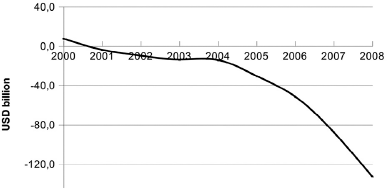
The Russian non-oil and -gas trade balance, 2000–2008.
Patrimonialism further subverted another major statist policy of Putin's administration – nationalization in the pivotal industries and concentration of strategic economic assets in state corporations. These moves do not appear as genuine statist policies deemed to be in the public interest for the sake of economic development. Rather they appear as clientelistic re-distribution of property in favor of the incumbent bureaucratic elites akin to Weber's granting of prebends and tax-farming opportunities: loyal incumbent members of the executive branch – foremost the siloviki (officials of law-enforcement agencies) – were placed on corporate boards of state companies, providing the officials with access to budget funds and hence vast rent seeking opportunities (Sakwa, 2013, p. 87).
The appropriation of assets by the bureaucratic elites was facilitated by the legal environment marked by excessive and often ambiguous business regulations. This encouraged circumvention and made the breach of some formal rules inevitable (Yakovlev, 2006, p. 1048), thus making business vulnerable: the Damoclean sword of sanctions was hanging over virtually every entrepreneur. Moreover, business was exposed to pressure by state officials who used formal rules as a pretext for achieving personal goals. For instance, bureaucratic extortion became commonplace, typically during tax inspections. In the words of a furniture manufacturer from the provincial town of Kaluga, who faces regular tax extortion, ‘[tax inspectors] come with an obvious “plan”: penalty strictly depends on your turnover. … The tax collection plan definitely exists. I know for sure because I talked to the folks from the tax authority.’ (interview with B17). Doing business in many regions became contingent on ‘cooperating’ with designated ‘affiliated firms’, owned by local politicians’ relatives. Another businessman recalls negotiating to build a factory in a provincial region: ‘The mayor came and said: “We need a fountain. Costs – 10,000 Euro. You build a fountain at the city square and everything will be good.” He gave us a company that builds fountains, we paid to that company. As a result a small puddle was built on the square and a huge fountain at the mayor's summer residence.’ (interview with B14).
Against the backdrop of patrimonialism, the strengthening of the coercive state capacity exacerbated the situation, empowering state officials to subvert formal institutions, such as courts and tax authorities, and to turn them into a tool for legal harassment, expropriation and, ultimately, private enrichment. The proliferation of illicit corporate raiding – hostile takeovers of assets by means of physical and administrative coercion – is a case in point (Rochlitz, 2013). The apparent increased involvement of the siloviki in raiding in the course of the 2000s marks an informal re-distribution of productive assets in favor of this group (Ledeneva, 2013, p. 189ff).
Patrimonialism undermined also the development of the capital–labor relations further on through the 2000s. Formal policy was aimed at de-regulation: the new Labor Code, adopted in 2002, on paper liberalized the labor relations and introduced greater flexibility in, among others, hiring and firing (Cook, 2012, p. 323). Also the enforcement of the labor legislation improved compared to the 1990s. Nonetheless, clientelistic arrangements continued to flourish, demonstrating the persisting gap between formal rules and the actual practice. For instance, the ‘black-and-white salaries’ proliferated both in private companies and in the public sector where the black cash typically originated from kickbacks in public procurement. Not fixed in any contract, the underhand ‘envelope payments’, which are estimated at about 50% to the official average wage, kept the labor costs flexible, at the same time enhancing the personal dependence of the workers on the employer (Kapelyushnikov et al., 2012, p. 185). Similar to the 1990s, oftentimes workers preferred to rely on paternalist relations with the management and individual arrangements instead of collective bargaining. Conspicuous labor quiescence in the 2000s was also due to the fact that strikes became almost impossible given the numerous restrictions in the new Labour Code, while collective rights of unions eroded and the leading trade union federation FNPR became incorporated into an alliance with the ruling party, United Russia (Cook, 2012, p. 322ff).
On balance, the development of Russia's political economy in the 2000s implied a very specific turn toward coercive statism blended with patrimonialism. The latter hindered the rise of the economically facilitating state capacity and subverted the policy of nationalization as well as the institutionalization of capital–labor relations. Bureaucratic elites (including trade union functionaries) advanced as the primary beneficiaries of this process, who were able to use public property for personal aims and to tap the cash flow from private firms.
The goal of this section is to become more precise on identified political–economic changes in Russia. How much did Russian capitalism de-liberalize under Putin as compared to the Yeltsin years, and which scope and impact did patrimonialism have? To tentatively answer these questions we will make use of statistical data on Russia. To determine the specificity of the Russian development, we will also consider data of other three BRIC countries and the USA as highly liberal contrast. To recapitulate, we work with a two-stage typology: stage one is dichotomous and consists of liberal and embedded capitalism, which is sufficient to identify levels of (de-)liberalism; stage two differentiates embedded capitalism into its statist and patrimonial components.
Indicators, data and limited precision
The localization of empirical capitalist varieties and their trajectories in the field between the ideal types at time T1 and at T2 has to be based on data and features that indicate the locations, such as for instance level of private company ownership, political market regulation, tax progression, public expenditures, employment protection and corruption. It has to be stressed that only some precision of measurement is possible here since the indicators are often ‘soft’ survey-based data, while qualitative data need to be quantified. Regarding certain indicators or years data are lacking and those available only crudely approximate the relevant reality. Sometimes data are to some degree ‘subjective’ and comparisons lopsided. If not all indicators should have the same weight, what is the logic of differentiation? Any quantification of quality and any weighting of indicators involve some degree of arbitrariness and therefore inevitably violate the principle of precision (cf. Becker, 2013).
The available data are based on surveys and law texts and are collected by the Heritage Foundation (Index of Economic Freedom; IEF), the OECD (indices of Product Market Regulation [PMR] and Employment Protection Legislation [EPL]) and the World Bank (Worldwide Governance Indicators [WGI]). These organizations have a liberal bias (the IEF, for example, attributes extremely low scores for high levels of public spending), but this does not distort every use of the data. The PMR, EPL and IEF indices reveal a dichotomous structure of market versus political regulation with the IEF, adding corruption as third dimension. They are suitable for the differentiation between liberal and embedded capitalism. Each of the IEF and the OECD data will count for one half of the total liberal score. The score for embeddedness is the residual one. This method is justified by the fact that the indices run from totally liberal to totally non-liberal. Therefore, the non-liberal score can be specified into the score of embeddedness. The WGI data measure effective political and judicial regulations and can help to differentiate the residual score of embeddedness into statism and patrimonialism. Here, where low statism corresponds with high corruption levels, patrimonialism is the residual category. 6
In the WGI the continuum runs from effective statism to non-effective statism. In parallel the WGI includes a continuum from high to low corruption. This continuum is only indirectly related to the former one, but we understand it as opposite to effective statism and therefore use it as a residual category of patrimonialism (of which corruption is the main ingredient).
Let us start with the Index of Economic Freedom. It is the broadest index and works with a scale of 0 to 100 of ‘freedom’/liberalism. The IEF is composed of ten single indicators, each of them with the same weight: (1) business freedom, (2) trade freedom, (3) fiscal freedom (taxation level), (4) government spending, (5) monetary freedom (how much inflation and political price distortion?), (6) investment freedom, (7) financial freedom, (8) property rights (legal protection of private property), (9) freedom from corruption and, since 2008, (10) labor freedom. So we have nine indicators for 1998 and 2008 of which we will neither include monetary freedom because it is strongly bound to a certain idea of the causes of inflation and price distortion nor property rights, which are an aspect of the rule of law and accounted for in the WGI.
Attempting to soften the liberal bias of the IEF, we have put together freedom of trade and freedom of investment, because separately they would count too much as compared to, for example, business or labor freedom. We also merged the related fiscal freedom and government spending because taxation and public spending are highly related. Moreover, the IEF gives very high scores to low spending. The reasoning is the less a polity spends, the more liberal it is. However, taxes and public spending are generally relatively low in the BRICs. Given their stage of economic development and social individualization this is quite normal, particularly in China and even more in India, and is hardly a result of liberal policy.
Thus, the selected indicators of the IEF are business freedom (level of regulation of business operations); trade freedom (level of trade restrictions) put together with investment freedom (easiness to invest; level of equality of opportunity to invest); fiscal freedom (the taxation level) put together with government spending; financial freedom (the business freedom of the financial sector) and freedom from corruption. Table 1 shows the scores. 7
Index of Economic Freedom, 1998 and 2008; selected indicators (range 0–100). Source: Heritage Foundation, 2012.
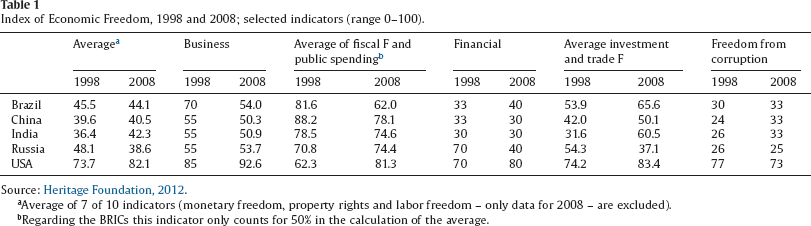
Index of Economic Freedom, 1998 and 2008; selected indicators (range 0–100). Source: Heritage Foundation, 2012.
Average of 7 of 10 indicators (monetary freedom, property rights and labor freedom – only data for 2008 – are excluded).
Regarding the BRICs this indicator only counts for 50% in the calculation of the average.
A general feature of the IEF is that the average country scores are relatively close to each other. This is due to the systematics of the IEF. It implies that the differences between the countries mentioned would become larger when the range from 30 to 100 would be set 0–100. From 0 to 30 there are no overall scores. Something similar can be said about the PMR and EPL scores with their scale from 0 to 6. There are nearly no scores higher than 4.
The table shows that the BRICs experienced a differentiated development. The data show Russia having de-liberalized, particularly in the sectors of finance, trade and investment. Although not reflecting the nationalization of some key industries, this development is roughly in line with the account of the previous part of this paper that emphasized Russia having de-liberalized under Putin. It also shows that the corruption level in Russia has remained stable and is higher than that of the other BRICs. 8 Overall, China appears to have hardly changed, Brazil appears relatively stable (though year-by-year data show it liberalizing until 2003 and then de-liberalizing – particularly due to the social policies of the Lula government; cf. Boschi & Gaitán, 2009) and India is the only BRIC country that has considerably liberalized. Taxes and public spending also rose in China and India, but more than in the richer Brazil this has probably been the result of the fast modernization related to industrialization and urbanization.
The scores of the Corruption Perception Index of Transparency International (2011) in many cases deviate from those of the IEF. In Russia, for example, corruption has increased more in the CPI than in the IEF. Its score moved from 2.4 in 1998 to 2.1 in 2008 (the lower the score, the higher the corruption), while Brazil moved from 4.0 to 3.5, China remained stable at 3.5 and India improved from 2.9 to 3.4.
To see whether the OECD's scores for Product Market Regulation and Employment Protection Legislation confirm or correct the IEF data we have to refer to Table 2. EPL informs about the commodification of labor, and in this text it is the main indicator of the capital–labor relation. PRM is more complex and consists of many sub-indicators. The first layer contains ‘state control’, ‘barriers to entrepreneurship’ and ‘barriers to trade and investment’, which all count for one third in the overall PMR index. While the last two sub-indicators are also part of the IEF and might balance the IEF data, state control is specific to the PMR index. Sub-indicators of state control are ‘public ownership’ and ‘involvement in business operations’, which at a lower level are sub-divided in ‘scope of public enterprise’, ‘price control’ and a few other indicators (Wölfl, Wanner, Röhn, & Nicoletti, 2010, p. 8).
Product market regulation and employment protection legislation. Sources: Employment protection: OECD Library (n.d.); OECD, 2010, p. 171 (BRICs 2003); product market regulation: OECD Statistics Portal (n.d.).
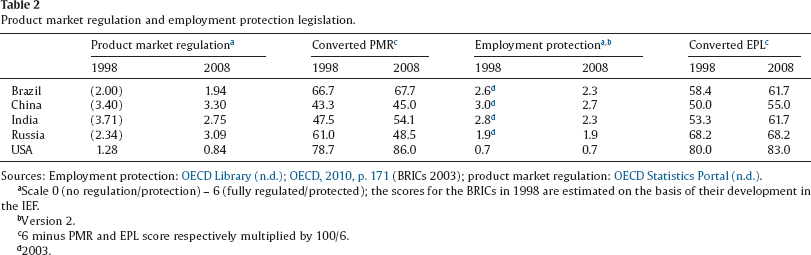
Scale 0 (no regulation/protection) – 6 (fully regulated/protected); the scores for the BRICs in 1998 are estimated on the basis of their development in the IEF.
Version 2.
6 minus PMR and EPL score respectively multiplied by 100/6.
2003.
In the realm of PMR the results are very similar to that in Table 1: Brazil was rather stable, China liberalized a bit, India's liberalization is worth mentioning, and Russia de-liberalized considerably, although – contrasting the IEF statistics – the country appears still more liberal than China. We should not forget, however, that the BRICs’ scores are derived from the data for 2003 and then have been estimated for 1998 on the basis of their development in the IEF (in the table indicated by brackets). Keeping in mind that re-etatization by the Putin administration commenced around 2003, the Russian estimate should be roughly correct. In India, China and Russia PMR is still much more rigid than in the USA, and Brazil is in-between. A look at the sub-domain of state control (the extent to which governments influence firm decisions; this indicator determines the PMR index for one third) reveals a similar picture. In 2008 the USA scored 1.1, while China (4.63), Russia (4.39) and India (3.58) still had a high level of state control and Brazil (2.69) was again located in-between. The development of the EPL level reveals a similar picture. China and Brazil liberalized more than in PMR, but the most significant exception is Russia, where, according to the data in the table, the level of employment protection did not change at all. This may be due to the fact that no data are available before Putin's reform of the labor market in 2003. However, in part one we have seen that on paper capital–labor relations were liberalized under Putin, even though formal rules have been undermined by patrimonial practices.
Now we can average the IEF, PMR and EPL scores to calculate overall values of economic liberalism and, by subtracting these scores from 100, overall scores of embeddedness. However, depending on the level of corruption reality might differ from the intentions of law texts and other codified regulations that the PMR and EPL indices are based upon. For this reason it makes sense to adjust the PMR and EPL figures for corruption. It will be done by using the corruption data of the Index of Economic Freedom. In Table 1 corruption determined the average scores for 20%. Giving corruption with respect to PMR and the EPL the same weight as in Table 1 the formula to be applied in Table 3 is ([2 × PMR] + [2 × EPL] + IEF-corruption)/5.
Overall liberal scores in 1998 and 2008 (scaled 0–100).
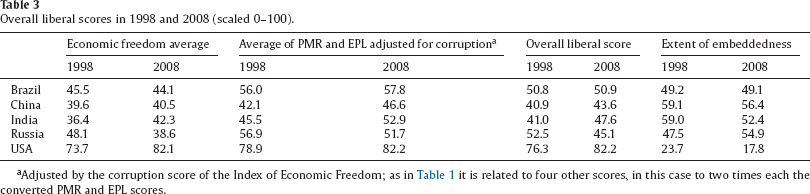
Adjusted by the corruption score of the Index of Economic Freedom; as in Table 1 it is related to four other scores, in this case to two times each the converted PMR and EPL scores.
Table 3 confirms that Russia was the only BRIC country that de-liberalized between 1998 and 2008. This finding is in line with the case made in part one of the paper: Russia underwent a de-liberalization in the 2000s. China and India liberalized (for different views see Huang, 2008, on China and Kohli, 2006, on India), while Brazil hardly changed. Based on Table 3 we can draw a figure localizing the BRICs’ political economies on the axis between ideal–typical liberal capitalism and ideal–typical embedded capitalism (Fig. 2). Fractional digits are not relevant here. Since there are no scores below 40, the axis starts at level 25.

Location of select political economies on the axis between the liberal and embedded ideal types in 1998 (beginning of arrow) and 2008 (end of arrow).
The next step is to divide the scores of embeddedness into those of statism and patrimonialism. This will be tentatively done on the basis of the values of the Worldwide Governance Indicators – tentatively because the WGI data are not exhaustive. Rather pointing to state capacity, WGI data only indirectly indicate statism. Put into this perspective, we cautiously assume that the higher the WGI scores for ‘government effectiveness’, ‘regulatory quality’ and ‘rule of law’, the higher the level of statism within the residual category of embeddedness. Table 4 shows the scores of the WGI. In the WGI scale the highest score is 2.5 and the lowest −2.5. Again, at first sight it seems that the differences between the BRICs and the USA are large. Yet the differences shrink when the WGI scores are converted in a scale from 0 to 100 (column 4 of Table 4). With statist embeddedness to be quantified in this table, patrimonial embeddedness will be left in the basket as residual category.
Worldwide Governance Indicators 1998, 2008, scaled −2.5–2.5 and converted. Source: World Bank, 2012.
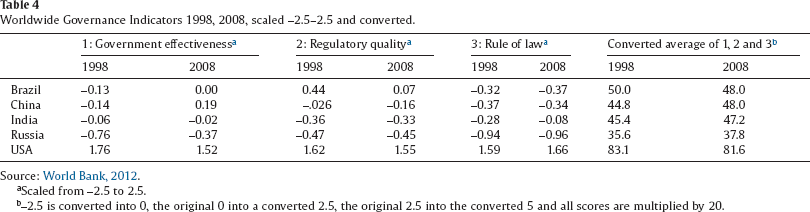
Worldwide Governance Indicators 1998, 2008, scaled −2.5–2.5 and converted. Source: World Bank, 2012.
Scaled from −2.5 to 2.5.
−2.5 is converted into 0, the original 0 into a converted 2.5, the original 2.5 into the converted 5 and all scores are multiplied by 20.
The most striking feature is that the Russian scores of indicators 1–3 in both 1998 and 2008 are clearly below the level of those of the other BRICs. The average value of the Russian scores has slightly increased, although ‘regulatory quality’ and ‘rule of law’ have not. This is roughly consistent with the description in part one of this paper, which noted a poor steering capability, a low facilitating state capacity as well as the weakness of the judicial system, which is often misused by rent seeking officials to harass entrepreneurs or extort bribes. Notably, the level of statist embeddedness in Russia is still low, as suggested by the average scores of the three WGI indicators in the last column of the table. This indicates that state involvement, which should not be confused with statism, is more patrimonial (i.e. based on particularistic gains) than statist (i.e. based on universalist principles).
With the mentioned precision limits in mind, the level of statism (S) can be determined on the basis of the preceding tables. It will be done by calculating the average converted score of ‘government effectiveness’ (WGI1), ‘regulatory quality’ (WGI2) and ‘rule of law’ (WGI3) as percentage of the extent of (statist/patrimonial) embeddedness (E) as fixed in Table 3. The formula is S = (WGI1+2+3) × E/100. Subsequently, the residual level of patrimonialism (P) can be established by subtracting statism (S) from the extent of embeddedness (E): P = E − S. Table 5 shows the results.
Establishment of rough levels of statism and patrimonialism (%).
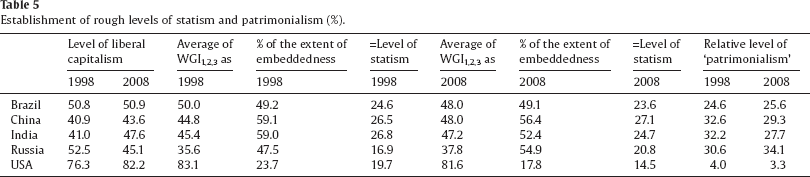
The conclusion based on Table 5 is that at both points in time, in 1998 and 2008, the BRICs represent a rather homogenous group of countries: all of them are much less liberal than the USA and feature high levels of statism and similarly high levels of patrimonialism. However, if we focus not on points in time but on the process of change – the core interest of this paper – we find a different development in Russia as compared to other BRICs. The main finding is that, based on our indicators, Russia moved into the opposite direction than the BRICs: it was the only country that de-liberalized. India liberalized considerably, China liberalized somewhat, while Brazil hardly changed. 9 While Russia was the most liberal BRIC country in 1998, it de-liberalized so much that it became the second (after China) least liberal BRIC country in 2008. Brazil was the most liberal country in 2008, followed by India.
For a detailed treatment of the trajectories of the BRICs, see Becker (2013, p. 47ff) and the respective country chapters in the same volume.
At the same time, Russia is revealed to be an outlier in terms of patrimonialism: it was the country with the highest level of patrimonialism and the only BRIC country where patrimonialism considerably increased between 1998 and 2008. Based on our indicators, in 1998 the Russian level of patrimonialism resembled that of China and India (in fact, it was even lower), but in 2008 it clearly exceeded it. While China and in particular India diminished their levels of patrimonialism between 1998 and 2008, Russia's patrimonialism increased. As for Brazil, patrimonialism hardly changed, but was significantly lower than the Russian value for both years. Moreover, Russian patrimonialism is revealed to be much higher than the country's level of statism, which in both years was lower than in other BRICs. This supports the analysis of part one of this paper where we stressed that patrimonialism undermined both the liberalization of the 1990s and the turn to statism in the 2000s.
One might twist whether the WGI 1, 2 and 3 data are appropriate indicators of statism and whether the residual value, the only identifiable indicator of which is corruption, truly reflects the level of patrimonialism. At this moment, however, the IEF, PRM, EPL and WGI data are the sole coherent basis for determining with some precision the respective levels of liberalism, statism and patrimonialism in emerging economies. Bearing these caveats in mind, we can comparatively map the development of Russian capitalism. This exercise has to give an impression of the trajectory of change at a glance. Fractional digits and even single percentage points will be ignored, and very small differences like those between Brazil in 1998 and 2008 cannot be shown (on a ray of 10 cm, one index/percentage point would be one millimeter). For the sake of clarity the Chinese and Indian values, which are often very close to the Russian ones, are not included. The comparative perspective is therefore limited to the highly liberal contrast case of the USA and Brazil. The latter is somewhat similar to Russia in terms of size and dependence on basic materials (Fig. 3).
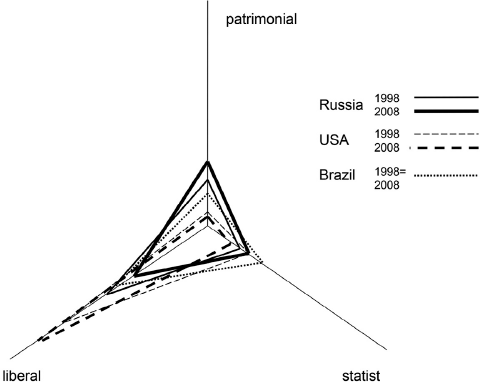
Russia, Brazil and contrast country USA mapped in the field between three ideal types.* (*Each ray starts at zero in the center of the figure and has a value of 100. 100 is also the true value of each spider wire over the three dimensions.).
According to a widely shared interpretation, Russia's political economy was liberalized since the early 1990s and started a process of re-etatization a decade later. We have amended this interpretation by a systematic incorporation of patrimonialism – political–economic organization characterized by clientelistic state–business and capital–labor relations as well as patronage. Thereby we built on the work of scholars concerned with the interaction of the patrimonial and the legal–rational sphere and proposed a framework for assessing the scope of patrimonialism in Russia's political economy and its impact on the country's trajectory of change.
We integrated patrimonialism into the analysis by conceptualizing Russian political economy as a dynamic hybrid of three ideal types of capitalism: liberalism, statism and patrimonialism. This hybrid changed from a fairly liberal and, to a considerable degree, patrimonial economic form in the 1990s to a less liberal, more statist and, notably, even more patrimonial form in the course of the 2000s. Thus the main direction of change was decreased liberalism and increased patrimonialism. We showed that the latter decisively affected Russia's trajectory: in the 1990s patrimonialism undermined the liberalization, turning it into a sell-off to rent-seeking insiders; in the 2000s patrimonialism hindered the rise of statism in the sense of higher facilitating state capacity. It was the coercive state capacity that rose – a capacity in the context of which private enrichment of elite groups, notably the siloviki, could flourish. Similarly, patrimonialism hindered the institutionalization of capital–labor relations by sustaining patron–client networks, perpetuating paternalistic arrangements between managers and workers, and by allowing some managers and trade union functionaries to use the power of their respective positions for private appropriation of economic advantages. We also conclude that Russian patrimonialism changed its form between Yeltsin- and Putin-periods, from predominantly society-initiated to predominantly state-initiated. In the 1990s patrimonialism had a largely bottom-up character with a central role of the oligarchs, while in the 2000s it had a more top-down character with a central role of the siloviki.
In comparative perspective the main finding is that Russia was the only BRIC economy that de-liberalized in the decade after the late 1990s, while Russian patrimonialism increased to the highest level among the BRICs by 2008. Thus in terms of trajectories of change, Russia is an outlier, even though generally all BRICs share, relative to for instance advanced industrial economies, similar levels of relatively low liberalism and relatively high statism and patrimonialism. Generally, the statistics corroborate the paper's conceptual assessment and quantitatively reveal the direction of change. The data also underscore that Russia's re-etatization in the 2000s signals merely a rise of state involvement, not a move to more statist political interventionism on the basis of general rules. Government effectiveness, including the effectiveness of its coercive tasks, slightly increased, but regulatory quality and the presence of the rule of lawremained at their very low levels. In other words, the Russian state increased its political–economic involvement not in universalistic terms, but in particularistic, patrimonial terms.
The empirical contribution of the above study is the quantitative assessment and comparative mapping of the trajectories of change in emerging economies offered here with reference to the BRICs. The suggested tool operationalizes and combines measures of liberalism, statism and patrimonialism in ways that can be applied to other comparative studies and time periods, and should enhance our understanding of other emerging economies.
In theoretical terms, the main contribution is our conception of ‘varieties of capitalism’ that take explicit account of patrimonialism. We have argued that patrimonialism is more than an incidental feature like corruption or blemish on a particular type of capitalism. Instead, it is a competing logic of economic and social organization that systematically obstructs and undermines ideal–typical liberalism and statism. More generally, political economies beyond the OECD world feature high levels of patrimonialism and cannot be adequately understood without the systematic attention to this clientelistic, particularistic dimension of politico-economic organization.
In this context, our study may have established some useful theoretical and empirical ground rules for understanding the role of patrimonialism in comparative political economy, but it has only touched upon questions pertaining to the origins of patrimonialism and its impact on economic development. The study has been able to say little about where a given country's or period's combination of liberalism, etatism and patrimonialism might come from. What role do external factors, ideological conditions, and technological or political conflict play in shaping the persistence of patrimonialism in Russian political economy relative to its BRICs counterparts, and in recent decades compared to the early post-Cold War period? An in-depth analysis of the origins and workings of Russian patrimonialism is yet to be done. Just as important, the present study has been able to say little about the implications of patrimonialism for development goals. Which levels of patrimonialism are detrimental for economic development? Might patrimonialism in some ways ‘facilitate’ and compensate for the shortcomings of the formal system? All such questions we must leave for further study, but the present portrayal of patrimonialism as central descriptor of Russian and BRIC political economies underscores their urgency.
Conflict of interest
The authors confirm that there are no known conflicts of interest associated with this publication and there has been no significant financial support for this work that could have influenced its outcome.
Footnotes
List of interviews
Entrepreneur = owner of small- (/S) or medium-sized (/M) business. CEO.
Position
Date
Code
Business association executive, Moscow
3.04.2014
A1
Entrepreneur/M, sewing factory, Moscow Oblast
4.04.2014
B1
Entrepreneur/S, publishing house, Moscow
4.04.2014
B2
Entrepreneur/S, retail, Moscow
6.04.2014
B3
Business association executive, Moscow
7.04.2014
A2
Lawyer, Moscow
7.04.2014
L1
Lawyer, Moscow
7.04.2014
L2
Journalist, Moscow
8.04.2014
J1
Business association executive, Moscow
8.04.2014
A3
Entrepreneur/S, PR agency, Moscow
8.04.2014
B4
Entrepreneur/S, street food, Moscow
8.04.2014
B5
Academic, Moscow
9.04.2014
E1
Entrepreneur/S, medical clinic, Moscow
9.04.2014
B6
Entrepreneur/S, construction company, Moscow
10.04.2014
B7
Entrepreneur/S, private kindergarten, Moscow
10.04.2014
B8
Entrepreneur/S, legal services, Moscow
10.04.2014
B9
Entrepreneur/M
*
, manufacturing (chemicals), Moscow
11.04.2014
B10
Journalist, Moscow
11.04.2014
J2
Entrepreneur/S, translation agency, Moscow
11.04.2014
B11
Academic, Moscow
14.04.2014
E2
Entrepreneur/S, construction company, Moscow
14.04.2014
B12
Entrepreneur/S, retail, Moscow
15.04.2014
B13
Entrepreneur/M, manufacturing (metal), Vishniy Volochek (Tver Oblast)
15.04.2014
B14
Entrepreneur/M, IT services, Moscow
15.04.2014
B15
Entrepreneur/M, manufacturing (furniture), Kaluga (Kaluga Oblast)
16.04.2014
B16
Entrepreneur/M
*
, manufacturing (plastic), St. Petersburg
17.04.2014
B17
Entrepreneur/M*, manufacturing (metal), St. Petersburg
17.04.2014
B18
Entrepreneur/S, retail, Moscow
18.04.2014
B19
Entrepreneur/M, retail, Moscow
21.04.2014
B20
Academic, Moscow
21.04.2014
E3
Entrepreneur/M, confectionary production, Moscow
21.04.2014
B21
Academic, Moscow
22.04.2014
E4
Entrepreneur/S, manufacturing (industrial fans), Zelenograd (Moscow Oblast)
22.04.2014
B22
Entrepreneur/S, car retail, Moscow
23.04.2014
B23