






Abstract
During the 17 years that Vladimir Putin has ruled Russia, the country has become increasingly authoritarian. However, I argue that this rollback of democracy has not been motivated by Putin's blind desire to maximize his political power, as many have assumed. Rather, his anti-democratic policies have responded to perceived specific threats to his control. In applying theories originally developed in the field of international relations to individual leaders, we can understand Putin as a “defensive realist” who balances against threats in order to maintain security rather than maximize power. This is an essential distinction that produces important conclusions about what motives lie behind the increasingly authoritarian character of the Russian state and gives insights into the possible future trajectory of the regime.
Introduction
The anti-democratic policies and reforms of Vladimir Putin during the years he served as Russia's president (2000–2008, 2012–present) and as Prime Minister (2008–2012) are well known. Efforts aimed at silencing independent media, jailing and legal harassment of outspoken oligarchs, elimination of gubernatorial elections, and raising barriers to opposition political parties characterized the early years of Putin's rule. The mid- to late-2000s witnessed increasing manipulation of electoral processes in order to produce favorable outcomes for Putin and the party of power, United Russia. Not until the mass protests that spread through Russian cities following the questionable Duma and presidential elections of 2011–2012 did Putin initiate a significant crackdown on ordinary citizen political activism.
To many observers and scholars of Russian politics, Putin's efforts have been a constant and deliberate process of deepening authoritarian rule in Russia, concentrating ever more political power in the Kremlin. Such a narrative is often paired with the assumption – explicit or otherwise – that Putin's goal (whether for personal or institutional reasons) is to maximize his political power as head of the Russian state. Thus, the gradual attack on democratic institutions and individual liberties in Russia has come at the hands of a power-hungry dictator who always seeks more for himself. This line of reasoning resonates at the domestic level with theories developed in International Relations to describe the behavior of states: “offensive realism” argues that great powers seek to acquire as much power in the international system as possible in order to promote their security. A domestic “offensive realist” explanation of Putin's authoritarianism would argue the same.
However, in international relations theory there is another school of thought, that of the “defensive realists” who argue that states seek not to maximize power but rather to maximize their security. The goal of states in the international system, according to defensive realists, is to ensure their security and survival, an objective that may actually be undermined if they seek too much power and provoke a backlash. “Balance of threat theory,” first developed by Stephen Walt, is an example of the defensive realist school of thought. Walt argues that states take action to counter threats to their security, with threat level determined by four characteristics of a possible rival state: 1) Aggregate power; 2) Offensive power; 3) Proximate power; and 4) Offensive intentions. To the defensive realist operating according to balance of threat logic, the threat to state security comes first and is followed by a counterbalancing reaction. This contrasts with the offensive realist assertion that great powers are primarily assertive – not reactive – in efforts to expand their power.
I argue the application of insights from these IR theories to the domestic political power calculations of Vladimir Putin's regime can produce important insights into the logic and trajectory of Russia's authoritarian development. By properly understanding Putin as a “domestic defensive realist” who seeks first and foremost to maintain and secure his domestic power, we can understand his anti-democratic policies in a new light. A careful analysis of several episodes throughout Putin's rule will reveal that his policies – while undoubtedly authoritarian – are not examples of a power-hungry dictator expanding his control as widely and deeply as possible. Rather, they are more accurately seen as reactions to threats that have arisen to his political control and security.
This conclusion – that Putin “balances” in reaction to domestic threats – leads to some troubling and surprising conclusions: Vladimir Putin's actions suggest a deep sense insecurity which has led to a nearly obsessive counterrevolutionary focus on ever-emerging threats to his political survival. These threats have often been concentrated around electoral cycles in Russia and – importantly – in Russia's neighbors as well. This leads to a prediction that Russia will continue its authoritarian ratcheting under Putin and that the next rounds of elections in Russia are likely to be the most oppressed in Rusisa's post-Soviet history.
Putin's authoritarian march
There can be no question that since coming to power in 2000, Vladimir Putin has overseen the transformation of Russia from a semi-democracy to an exemplar of “competitive authoritarianism” (Levitsky & Way, 2010). The causes of that transition are multiple and they are complex; the present endeavor does not afford the opportunity to explore the full spectrum of causes of Russia's authoritarian trajectory. However, there is no doubt that Putin himself has been a key driving force behind Russia's increasingly autocratic regime. The general outlines of Russia's political development under Putin is readily apparent in Figures 1 and 2, which display Russia's compiled scores from Freedom House's Nations in Transit (NIT) reports (Orttung, 2009, 2014). The Nations in Transit reports evaluate, rate, and discuss a country's progress toward or away from democracy along several dimensions of liberal democracy, as well as a composite “democracy score” (Fig. 1) that combines the ratings in each subcategory. The Freedom House scale ranges from 1 (consolidated democracy) to 7 (consolidated authoritarian). 1 These figures show what Russia watchers have long known – that Russia has become increasingly autocratic over the duration of Putin's rule. This transformation has taken place in all realms of political life as the state has centralized and strengthened its power at the expense of any possible independent loci of political power. To use the terminology of Tsebelis (2002), the Kremlin under Vladimir Putin has eliminated or severely weakened both formal and informal veto players who might have been in a position to challenge its policies.
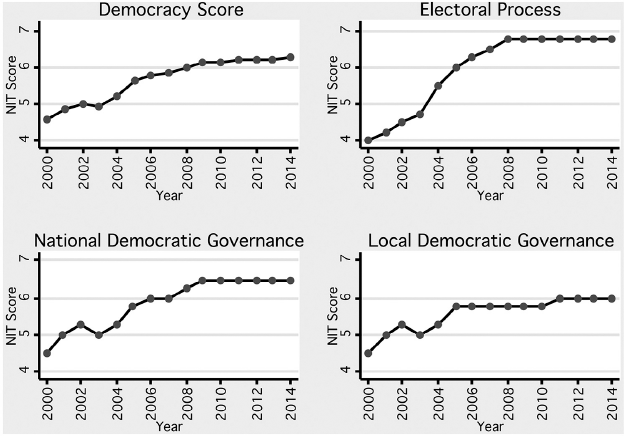
Freedom House “Nations in Transit” Scores – Russia.
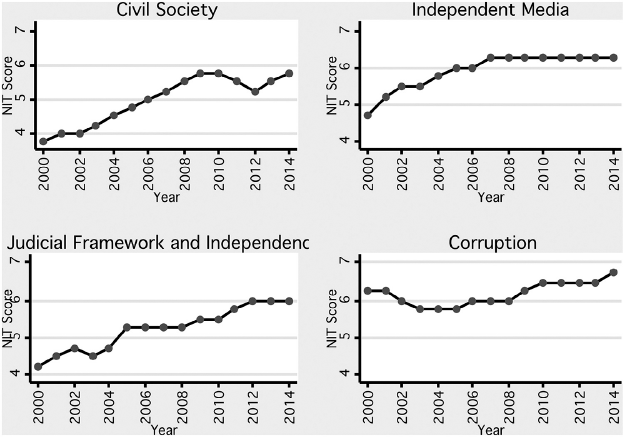
Freedom House “Nations in Transit” Scores – Russia.
See the NIT methodology article for a detailed description of the methodologies used to generate country ratings and reports. Subcategory ratings consider the following: “
Experts in the academic, policy, and media spheres have rightly placed a hefty share of the blame for Russia's reversion to authoritarianism on Putin himself as he has transformed the institutional attributes of the Russian regime. The dominant narrative among western Russia analysts has been that Putin's reauthoritarianization of Russia has been part of a deliberate effort to extend his control over Russian political, economic, and social life. In this narrative, Putin is the power-hungry autocrat with a ever-expanding appetite for political power. In other words, he is a power maximizer – the more, the better.
Such interpretations of Putin's underlying motivations appear in a variety of scholarly analyses from his first presidency (2000–2008) as well as his current term as president (2012–present). In an influential 2008 Foreign Affairs article by (one day U.S. Ambassador to Russia) Michael McFaul and Kathryn Stoner-Weiss, the authors narrate Russia's authoritarian slide throughout the 2000s (McFaul & Stoner-Weiss, 2008). Tellingly, the article's subtitle is “How Putin's Crackdown Holds Russia Back.” Throughout the piece the authors describe the various assaults on the independent media, the judiciary, regional governments, the parliament, and NGOs. At various points this is described as “Putin's autocratic turn” (69); “Putin's rollback of democracy” (70); “the Kremlin['s extension of] its reach” to media (70); Putin's “emascula[tion of] the Federation Council” (71); and other similar descriptors. In the 2007 Seymour Martin Lipset Lecture on Democracy in the World, international relations scholar Pierre Hassner declared that “Putin is the most sinister figure in contemporary Russian history… He has led Russia into a harsh brand of authoritarianism with some fascist features, and he remains under strong suspicion of having inspired a number of criminal acts” (Hassner, 2008, 7). Graeme Gill writes of the “hegemonic presidency” in Russia, a phenomenon born of Yeltsin but greatly expanded by Putin as the latter “continu[ed] to close off avenues of popular control and to bring under his purview those aspects of the power structure that had escaped the control of Yeltsin” (Gill, 2006, 70). He then describes the means by which Putin sought greater control over aspects of Russian political life and methodically extended his power over areas that had remained outside the president's control prior to his presidency.
The impression given by these and similar analyses of Russia's authoritarianization under Putin is one of a deliberate and calculated expansion of authoritarian power at Putin's behest. Under this paradigm, Putin has been proactively expansionary in his autocratic tendencies: where the opportunity has arisen (or where the opportunity already existed) for an assault on democracy, he has taken it. Though rarely stated, the underlying assumption is that Putin has sought since coming to office in 2000 to maximize his power over Russia. This assumption often lies at the core of early (and later) analyses that looked to Putin's KGB past as a signpost to his rule. The assumption of the power-maximizing imperialist autocrat is pervasive throughout media treatments of Putin's reign as well, especially since his return to the presidency in 2012. A 2012 analysis of Putin's “path to tyranny” states that “Vladimir Putin is rapidly transforming Russia in to a repressive state reminiscent of the Soviet Union.” It goes on, noting that “there had always been signs that Putin was convinced that he could only perform his duties with severity and ruthlessness” (Diez, Mayr, & Schepp, 2012). Longtime Russia watcher David Remnick writes of “power for power's sake” as a core tenet of “Putinism” (Remnick, 2011).
Not surprisingly, the narrative of Putin as the power maximizer appears in the political realm as well among those in the West (and to a much lesser degree in Russia) who have reason to oppose his rule. Former British Foreign Secretary David Miliband calls him “ruthless” in the performance of his “script for continued power” (Miliband, 2012). Former opposition Russian Duma Deputy – turned political analyst Vladimir Ryzhkov wrote in 2012, “if left uncontrolled, Putin will turn into a Russian version of Belarusian President Alexander Lukashenko,” a man who is reported to relish his branding as the “last dictator of Europe.”
More recently, in an op-ed titled, “Beware the rise of Putin the Terrible,” the American Enterprise Institute's Leon Aron argues that Putin's involvement in the Ukrainian crisis has been intended to serve as “a political arrangement that could secure his rule in Russia for life” by riding the wave of “nationalist hysteria and paranoia” that the Kremlin's propagandists have engineered alongside the crisis. By stoking the fires of nationalism and raising the specter of a hostile West, Aron asserts, Putin has struck upon a “convenient justification for greater repression” in his construction of a “personality-driven dictatorship.” (Aron, 2014). While Aron's assertions and provocative language might be best taken with a grain of salt, it is worth pointing out the underlying premise that Putin has manipulated events in order to justify and support his preexisting condition of lust for ever more power. Former chess champion and well-known Russian opposition activist Garry Kasparov goes even further, comparing Putin's Ukrainian gambit to Hitler's 1938 invasion of Austria. On the domestic front, Kasparov writes of Russia gripped by a long-running “campaign to destroy democracy and civil liberties in Russia,” orchestrated by a “bad guy who was supporting rogue states abroad while in Russia he was persecuting dissidents, locking down the media under state control and subordinating the Rusian economy to the Kremlin and his small circle of cronies” (Kasparov, 2014).
Further examples of the “power-hungry autocrat” narrative abound in the scholarly, media, and political spheres of the West. The purpose in highlighting the above examples is neither to lend them credence nor call them into question (despite the occasional rhetorical over-embellishments). Rather, the purpose is to illustrate the dominant discourse surrounding Putin's authoritarianization of Russia since 2000: that of an individual who has sought to maximize his political control and who has taken nearly every available opportunity to do so, particularly since returning to the presidency in 2012. If we accept the constructivist premise that discourse has the power to create its own reality and motivate policy, then it is worth illuminating that discourse and putting its assumptions on the table.
There is hardly a clear-eyed observer of Russian politics that would deny Russia's descent into dictatorship and who would question the singular role that Vladimir Putin has played in leading Russia into the depths of autocracy. While the evidence of Russia's authoritarian slide presented in Figures 1 and 2 is consistent with the narrative elucidated above, I will argue that they are consistent with another narrative. Rather than casting Vladimir Putin's authoritarian policies as part of a constant effort to maximize his power, I argue that they have rather been “defensive” in nature as reactions to perceived threats. Drawing insights from a similar distinction in the literature on international relations, I argue that Putin's authoritarianization of Russia – real though it is – has been motivated by Putin's drive to maximize his security, not his power. Though the distinction might seem a minor one at the moment, the implications of this distinction are anything but insignificant, as they go to the very core of Putin's control of his vast country.
The field of international relations is defined and organized by a handful of theoretical traditions, of which (neo)realism, (neo)liberalism, and constructivism are the best known and most influential. While each tradition encompasses a wide variety of theories explaining state behavior, each tradition is unified by a more or less common set of fundamental principles and assumptions about what states seek and why they seek it. In other words, theories within a particular IR tradition tend to share a common worldview regarding why states do what they do. By examining state behavior through the lenses of these theoretical traditions, one can often bring those events into sharper focus in order to advance toward a better understanding of the “why?” question that sits at the heart of social scientific inquiry.
While theory also occupies a central role in the subfield of comparative politics, the latter subfield is less defined (and some would say constrained) by comprehensive “traditions” like those that dominate IR. In many respects this offers comparativists greater flexibility and creativity when it comes to theory generation, but there is an increasing appreciation of the fact that insights developed in one subfield might shed useful light on the theoretical and empirical questions that are the realm of another subfield. The purpose of this article is to do just that – to take some key insights from IR theory, retool them to apply to the domestic context, and then use them to explain the policies and actions of domestic actors, in this case Vladimir Putin.
In many respects, this is the reverse of the process that characterized the genesis of the modern field of international relations. Drawing their inspiration from the “original” realists like Hobbes and Machiavelli, early post-WWII theorists of international relations such as Hans Morgenthau began with a set of (somewhat unflattering) assumptions about human nature. Of man's real nature, Hobbes wrote, “I put for a generall inclination of all mankind, a perpetuall and restlesse desire for Power after power, that ceaseth only in Death” (Hobbes, 1996, 70). Morgenthau and others in what has become known as the “classical realist” school of internationals relations then projected these human traits (particularly the lust and will to power) onto states, explaining states’ perpetual drive for greater power in similar terms for similar motivations. Thus, his self-titled “realist” theory of international politics asserted that “politics, like society in general, is governed by objective laws that have their roots in human nature” (Morgenthau, 2006, 4). Indeed, it is the “aspiration for power” that was, according to Morgenthau, “the distinguishing element of international politics,” for “the tendency to dominate…is an element of all human associations, from the family, through fraternal and professional associations and local political organizations, to the state (35, 37). Given the inherent uncertainty regarding the true capabilities of potential adversaries, Morgenthau argued that “all nations must seek the maximum of power obtainable under the circumstances,” resulting in a “limitless aspiration for power” (219).
A similar conclusion – that states in the international system aspire to accumulate the maximum amount of power possible – is shared by a more modern school of IR theory, that of offensive realism. In the defining text on offensive realism, John Mearsheimer notes that like Morgenthau's “human nature” realism, the theory portrays great powers as “relentlessly seeking power” (Mearsheimer, 2014, 21). However, as a member of the neorealist or structural realist school of IR theory that arose a generation after Morgenthau, Mearsheimer reaches this conclusion about a state's drive to maximize its power without reference to human nature or any innate lust for power. Rather, the anarchic nature of the international system requires great powers to seek the maximum power possible. Echoing elements of Morgenthau's argument 50 years prior, Mearsheimer writes, “given the difficulty of determining how much power is enough for today and tomorrow, great powers recognize that the best way to ensure their security is to achieve hegemony now, thus eliminating any possibility of a challenge by another great power.” Thus, powerful states will “act offensively to amass as much power as it can, because states are almost better off with more rather than less power” (35).
However, a third branch of IR theory – that of defensive realism – starts with different assumptions about power and thus comes to divergent conclusions. Considered the father of structural realism and its defensive realist variant, Kenneth Waltz argued that security was the highest end that states could pursue. Power, on the other hand, was of value not as an end in itself (as assumed by classical realists) but rather a means to achieve security and, ultimately, survival (Waltz, 2010, 126). Thus, “neorealism sees power as a possibly useful means, with states running risks if they have either too little or too much of it…Excessive strength may prompt other states to increase their arms and pool their efforts against the dominant state…[so] sensible statesmen try to have an appropriate amount” (Waltz, 1989, 40). These crucial assumptions – that states seek to maximize their security and that efforts to pursue maximum power might ultimately reduce a state's security – lead to the “defensive” modifier attached to this sub-school of realist thought: security-seeking states will generally behave defensively in order to maintain their position in the international system rather than upset the balance of power (Mearsheimer, 2014, 19–20).
Integral to the defensive realist school is the concept of power balancing: states in an anarchic system, when met with an adversary whose power is rising, will seek to balance against that rising power in order to constrain the other's rise and ensure its own security. In the classic formulation, “balancing” consists of forming defensive alliances with other states whose security is also threatened by the rising power. But Waltz distinguishes between this type of balancing, which he terms “external balancing” and what he refers to as “internal balancing.” The latter consists of states taking internal measures such as increasing domestic economic capacity, increasing military strength, and developing superior strategies to counter the rising power (Waltz, 2010, 118). Because internal balancing means relying on a state's own capabilities rather than those of an external ally, Waltz deems internal balancing to be “more reliable and precise than external balancing” (168).
Yet history shows that it is not entirely accurate to say that states will balance – whether internally or externally – against superior or rising powers. If this were the case, then Europe should have joined the Soviet Union in balancing against the United States during the Cold War (and afterwards, for that matter), for America's military and economic capabilities far exceeded those of the Soviet Union. Stephen Walt noted this discrepancy in his seminal work on alliance formation. In it, Walt argues that states do not simply balance against powerful states; rather, they balance against threatening states (Walt, 1990, 5). The distinction is a crucial one, as Walt makes the case that it is not raw material power alone that determines whether one state is threatening to another. Rather, he identifies four factors that determine the threat posed by a potential adversary:
The first is aggregate power: “All else being equal, the greater a state's total resources (e.g., population, industrial and military capability, and technological prowess), the greater a potential threat it can pose to others” (22). This is essentially what traditional balance of power theorists argued. However, there is more than simply aggregate power that must be considered. The second factor affecting threat that Walt identifies is geographic proximity: “Because the ability to project power declines with distance, states that are nearby pose a greater threat than those that are far away” (23). The third threatening factor is offensive power: “All else being equal, states with large offensive capabilities are more likely to provoke an alliance than those that are incapable of attacking…Offensive power is also closely related but not identical to aggregate power. Specifically, offensive power is the ability to threaten the sovereignty or territorial integrity of another state at an acceptable cost” (24). Finally, Walt recognizes the crucial importance of aggressive intentions: “states that are viewed as aggressive are likely to provoke others to balance against them” (25). On this final element of threat Walt recognizes the fact that “perceptions of intent” – and conversely, misperceptions – “are likely to play an especially crucial role” in balancing decisions (Walt, 1990, 25). This fourth factor of (perceived) aggressive intentions solves the riddle posed above: Europe balanced against the Soviet Union rather than the United States because the former was perceived to have aggressive intentions along with the offensive power and geographical proximity to achieve them.
Domesticating the argument
Let us now turn to the matter of “domesticating” these insights from the defensive realist school of IR theory and constructing a similar lens through which to view the authoritarianizing policies of Vladimir Putin. To be sure, there are some important areas in which the analogy will need to be relaxed just a bit. First and foremost, there is the matter of what Waltz referred to as the ordering principle of the system: most of the key insights drawn by structural realists derived from the anarchic nature of the international system, wherein there is no overarching political–military authority above sovereign states. 2 Domestic political systems, of course, are hierarchical: there is such an authority known as the state which claims (according to Weber's classic formulation) “the monopoly of the legitimate use of physical force within a given territory” (Weber, 1946, 78). But just because the system is hierarchical and the state lays claim to the legitimate use of violence does not mean that power is not contested – sometimes even violently – within that polity. Indeed, Weber recognized this fact, noting it in the very same lecture as his more famous declaration quoted above: “ ‘politics’ for us means striving to share power or striving to influence the distribution of power, either among states or among groups within a state” (78). Morgenthau, writing in the first edition of his Politics Among Nations echoed Weber's sentiment: “Domestic and international politics are but two different manifestations of the same phenomenon: the struggle for power” (Morgenthau, 1948, 21).
For more on the central role that anarchy plays in conditioning state behavior in the international system, see chapter 6 of Waltz (2010) and chapter 2 of Mearsheimer (2014).
That domestic politics is in its most essential form a struggle over power and its distribution is hardly controversial. Nonetheless, we still might expect domestic political actors engaged in the struggle for power to mirror the behaviors and motives of states as the latter seek power in the international system. Though domestic actors in a hierarchical domestic political system face greater institutional constraints in their pursuit of power than do states in anarchy, the basic principles of competition, power, security, and threat still come into play to differing degrees. To be sure, it is important to acknowledge that domestic institutional constraints may matter a great deal. Unlike the anarchic international system, which forces all states to behave in a similar fashion as security seekers, robust domestic institutions that effectively constrain and divide political power may mitigate the more intense and potentially violent power competition that a domestic realist theory of politics would predict. When considering domestic political systems, therefore, it is useful to view them along a spectrum that runs from anarchy (lack of any regulative institutions) to a highly ordered and institutionalized system that regulates and divides political power. The closer a state falls toward the anarchic end of the spectrum, the more we should expect its politics to mirror the contentious zero-sum competition that characterizes international politics.
I argue that Russia under Putin falls on this contentious end of the spectrum when it comes to the institutions that constrain and regulate the acquisition, division, constraints, and succession of power. Though formal institutions exist to delineate such things, the experience of the last 16 years in Russia has shown that such institutions are often malleable, weak, and subject to revision. This, combined with the fact that the stakes of gaining or losing power in Russia are quite high, leads me to argue that domestic politics in Russia more closely resemble Waltz's security dilemma than to the politics of well-institutionalized democracies. For Waltz's international system and Putin's Russia share two crucial characteristics: competition is a zero-sum game in Putin's eyes, putting survival at stake for all actors in the political arena.
Recalling the key distinction between the classical and offensive realists on the one hand and defensive realists on the other, I argue that Putin's ultimate objective is to maximize his security, not his power. While the slow creep of authoritarianism in Russia over the last 15 years has, of course, been characterized in a steady increase in the Kremlin's power, I argue that the underlying motivation has not been the insatiable drive for maximum power that appears in the “power-hungry autocrat” narrative that dominates much discourse on Putin. Rather, the underlying motivation is that which has been found in autocrats for most of history: the desire to survive in power. According to the domestic defensive realist argument, Putin's authoritarian march has not been the result of a proactive drive to expand power but has instead been a defensive reaction to perceived threats to his political security and survival. It is also worth noting that Putin very likely sees his political security as synonymous with Russia's security and survival: in 2014, Kremlin deputy chief of staff Vyacheslav Volodin famously declared to an audience of western analysts that “any attack on Putin is an attack on Russia…There is no Russia today if there is no Putin,” a sentiment that Volodin's boss no doubt shares (The Moscow Times, 2014).
To say that these policies have been defensive reactions is not to seek to justify them or excuse them in any way, as the result is still the same: they have resulted in the drastic erosion of democracy and political liberties in Russia. But the defensive realist argument produces an important set of implications distinct from those based on the assumption of offensive power maximization. I will return to this topic in the concluding section of the article.
At this point it is useful to integrate Walt's balance of threat theory and its four elements of threat into the theoretical framework. Doing so leads me to the assertion that Putin has not reacted simply to the power held by other actors in the Russian domestic sphere; rather, he has reacted against those actors that pose a perceived threat to his control. The two are not synonymous, and there are instances described below where Putin has tolerated the former while acting against the latter. To sum up this part of the argument, it is not political or economic power alone that makes a potential rival threatening to Putin. What is determined to be a threat depends on the amount of power an actor possesses, what kind of power he possesses, where that power resides, and – crucially – what the actor's intentions are.
It is also worth noting that there is a special place in Putin's pantheon of threats for those who have or are perceived to have the financial support of foreign actors. Domestic political actors, parties, or NGOs that receive financial support from western NGOs or western governments (especially the United States) are seen as especially threatening because they potentially combine offensive capabilities with perceived aggressive intentions. That some of these foreign actors and governments are thought to support regime change in Russia makes them an intolerable – and highly dangerous – threat in Putin's eyes.
Political competition in Russia today is perceived by Putin as a zero-sum struggle for security. In this environment, Putin's policies are motivated by an imperative to maximize security of his rule and survival in office. Putin's authoritarianizing policies have been defensive responses to perceived threats to his security, not an offensive will to maximum power. Aggregate power: All else equal, powerful actors in the Russian political, economic, and social spheres are more threatening than those without significant power. Offensive power: All else equal, actors with the ability to deploy domestic “offensive” power are more threatening. Geographic proximity: All else equal, powerful actors located in the centers of power (both literally and figuratively) are more threatening. Aggressive intentions: The greatest source of threat arises from oppositional actors with the desire to see Putin's exit from power or a significant weakening of his control.
I argue that the key events and policies that have characterized Vladimir Putin's re-authoritarianization of Russia since 2000 follow the patterns and principles laid out in the domestic defensive realist framework. That is to say, they have largely been defensive reactions to perceived threats to his authority and security rather than elements of a premeditated strategy to maximize his political power. Each of these episodes and policies can be understood in terms of at least one of the four threat factors discussed above, a task to which I turn in the present section. Before doing so, it is worth noting that the available data and case study method can, at best, provide a strong plausibility test of the argument by showing that events are consistent with a defensive realist interpretation. Without access to Putin's innermost thoughts, it is hard to definitively rule out the “power maximizer” thesis, though careful examination of the sequencing and nature of the key events will help bolster the credibility of the defensive realist argument.
This section will do so by examining Russia's authoritarian descent thematically within the realms of institutional reforms; electoral manipulation; media and business; and civil society. 3
For “a chronological sampling of the suppression of political opposition, independent media, and civil society,” see Puddington et al. (2012, 14–20). For more detailed discussions of these elements of authoritarianization in Russia, see the series of “Nations in Transit” and “Freedom in the World” reports by Freedom House, listed in the bibliography.
When Vladimir Putin assumed the presidency of Russia in 2000, the office had been weakened by nearly a decade of Yeltsin's tumultuous leadership and its attendant crises in the political, economic, and social spheres. Shortly after taking office, Putin began implementing institutional changes to Russia's political structure in order to consolidate presidential authority and weaken alternative centers of power that might threaten central political control. One of the earliest reactions to potential threats took place in opposition to Russia's governors who, during Yeltsin's tenure, took to heart the latter's 1990 exhortation to “take all the autonomy you can swallow” (Breslauer, 2002, 125). In doing so, Russia's regional leaders cultivated independent bases of support and managed to accumulate significant power that was autonomous of the Kremlin. Perhaps most famous was the case of Mintimer Shaimiev, head of Russia's Republic of Tatarstan whose efforts to carve out the region's (and his own) political autonomy were once thought to be second only to Chechnya as a threat to Russia's territorial sovereignty (The Economist, 2007). Other regional leaders pursued such efforts to a lesser degree and could rightly be considered during Yeltsin's presidency as formidable centers of power residing outside the total embrace of the Kremlin.
This regionally-based power, to include in some cases control or influence over highly valuable natural resources located within regions, plausibly fits with the domestic versions of aggregate power and offensive power outlined above. Their control over significant political and economic resources (including in many cases strong public support), along with the autonomy to use that power to their own ends, made powerful regional leaders a potential threat to the Kremlin's central control of the country. The threat was especially salient in the early years of Putin's presidency as Moscow fought the bloody war against Chechen separatists.
Starting in 2000, Putin sought to “balance” against that threat by taking aim at the sources of their power and autonomy. In that year, regional governors were removed from their seats on the Federation Council, the upper house of the Russian parliament. 4 This reform had the effect of separating the governors from the power of the legislative branch while also physically removing them from Moscow where many maintained residences and spent a significant portion of their time. This calls to mind the principle of proximate power, discussed above, and its contribution to the threat matrix faced by the domestic defensive realist.
Prior to 2000, each region held two seats on the Federation Council: one was filled by the regional governor and one was filled by the head of the regional parliament. Following the 2000 reforms, one seat was filled by nomination from the governor; the second seat was filled by election of the regional parliament.
It was also in 2000 that Putin established seven federal “super districts” to further solidify central control over the regions and rein in renegade governors. Each federal district was overseen by a presidential appointee tasked with ensuring the enforcement of federal laws and policies. Furthermore, the reform was designed to reassert central control over the federal agencies based in the regions, the heads of which had in many cases developed stronger loyalties to governors than to the central government (McFaul, 2007a).
But the greatest assault on the power and autonomy of potentially threatening regional leaders came in 2004 withthe elimination of gubernatorial elections. 5 The measure was passed swiftly in the wake of the 2004 Beslan hostage crisis in North Ossetia, cited as a necessary means to prevent such threats in the future. To be sure, it is hard to see how such a measure could have prevented the crisis, but when viewed in the larger effort to circumscribe the power of regional elites it stands out as the ultimate means of reducing any possible regional threat to Putin's power. Under these reforms, the president obtained the power to appoint and dismiss regional governors with the rubber-stamped approval of pliant regional parliaments. Thus, within a few years of the reforms all of Russia's governors had gone from being potential threats to Putin's power to Kremlin loyalists dependent on the good will of the president for their political survival. This fact, combined with the reforms to the Federation Council described above, ensured that both institutions would no longer pose a threat to the Kremlin's security. In the wake of mass protests following the manipulated 2011 Duma elections, it was announced that direct election of governors would be restored in Russia. This move was seen as a concession to the public's vocal reaction against Russia's overly-managed political theater that suggests a careful balancing act for the sake of maintaining the security of the Putin–Medvedev tandem system. While power maximizers would be expected to cling to such authority, I would suggest that Putin the security maximizer recognized the risk of doing so.
See Person (2015) for extended discussion and analysis of the elimination of gubernatorial elections in Russia.
The lower house of Russia's parliament, the Duma, and the political parties populating it were not spared Putin's attentions either. Recall that for the entirety of the 1990s the Duma was populated by an often-changing collection of diverse parties, none of which ever gained a majority in the mixed PR-SMD system. While some of these parties were explicitly or implicitly recognized as pro-Kremlin parties, no pro-government coalition was able to form a majority in the Duma during the 1990s. In fact, it was the Communist Party of the Russian Federation that won the largest share of seats in the 1995 and 1999 elections, a reality that would stymie Yeltsin's efforts to pass legislation and continue economic and political reforms in the later half of the decade. There was little question that the Duma marched to its own drum during this period and existed as a significant center of power outside the control of the Kremlin.
The tide began to shift in the 1999 Duma elections when the recently-formed Unity party came in close second to the Communist Party with 23.3 percent of the vote. Though created only three months prior to the elections, this pro-government predecessor to the United Russia party was able to capitalize on the popular Prime Minister Putin's support in achieving a surprisingly strong electoral showing. Nonetheless, once in the president's office, Putin begin to actively modify the playing field to ensure that the Duma would be dominated by a loyal – and non-threatening – pro-Kremlin majority. The 2003 Duma election was marked by reports of widespread electoral fraud and manipulation, which was successful in delivering 223 out of 450 seats to the recognized party of power, United Russia. 6 Though this result, combined with additional seats from smaller pro-Putin parties, ensured that the Kremlin's legislation could be passed, the representation of vocal opposition parties in the Duma continued to make the institution a potential locus for independent political power.
For an exhaustive study of electoral fraud in Russia, see Myagkov et al. (2009).
I argue that the residual power and independence of Russia's opposition parties residing in the Duma were sufficient threats to Putin's political control to prompt additional institutional reforms to neutralize the threat. In 2006, a law was passed that stripped Duma deputies of their seats if they changed political parties while also prohibiting the formation of electoral alliances wherein multiple parties could throw their support behind a single candidate. The move was intended to cement the dominant position of United Russia and make it nearly impossible for opposition parties and candidates to win significant power.
The reaction to the threat of parliamentary opposition continued in the lead up to the 2007 Duma elections as the Kremlin (through its now-pliant Duma) took measures to ensure United Russia's security as the unchallenged dominant party. Under the 2007 reforms, single member districts were eliminated, with the entire Duma to be elected according to a PR system based on party lists. This made it impossible for independent candidates to win seats as they had once done in districts, since nobody could take a Duma seat without being on a party list. Furthermore, the reforms made it much harder for opposition to gain representation in the upcoming Duma, as the threshold for electoral support was raised from 5% to 7%. Furthermore, in order to be registered as political parties and eligible to contest the election, parties were required to have at least 50,000 total members, with a minimum of 500 members in at least half of Russia's 83 regions. This ensured that only well-funded and well-organized national parties would be effectively allowed to compete, further tilting the playing field toward those parties loyal to the Kremlin. The electoral reforms had their intended effect, with any possibility of threat emanating from the Duma virtually eliminated after the 2007 elections. Four parties passed the 7% threshold: United Russia (64.3%), the Communist Party of the Russian Federation (11.6%), the Liberal Democratic Party of Russia (8.1%), and A Just Russia (7.7%). Of these four, only the communists served as a real opposition party to United Russia and the Kremlin.
This supermajority raises the important case of the institutional “dog that didn't bark,” to borrow the episode from the famous Sherlock Holmes story. Even prior to the achievement of the constitutional super majority in 2007, there was speculation across the Russian political class that Putin would easily have the political and popular support to amend the constitution and eliminate the presidential term limits that would prevent him from running for a third consecutive term in office. Indeed, this period coincides with one of the highest points of Putin's popularity: in 2007 Putin's approval rating never dropped below 79 percent and reached a high of 87 percent in December of that year (CSPP, 2014). Instead of doing so and ensuring uninterrupted control of Russia's political system, Putin opted to arrange the now-famous swap with then-Prime Minister Dmitri Medvedev, who would run for president with Putin to serve as the former's prime minister. Many suspected that the intention had always been for Putin to return to the presidency in 2012, making the 2008 decision a bit puzzling. 7 The strategy came with risks – that Medvedev would renege on the arrangement, that unforeseen events and public opinion might complicate a return to the presidency, and others. Why take such risks when it would have been possible to settle the issue with greater certainty with an elimination of term limits before the 2008 election?
At the September 2011 United Russia party convention where Putin and Medvedev announced that the latter would not stand for reelection, Putin told listeners “I want to say directly: An agreement over what to do in the future was reached between us several years ago.” Medvedev concurred: “we really discussed this possible turn of events at the time when we formed our comradely union.” (Barry, 2011).
This article cannot offer a definitive answer except to note that the episode is consistent with the domestic defensive realist perspective. One would have expected a power-hungry maximizer to jump on the opportunity to cement his political control in a highly permissive environment. And yet Putin did not do so. I suggest that he felt secure enough in his position at the time that he did not see it as necessary to amend the constitution. By understanding Putin as a security seeker responding to threats rather than a power maximizer seizing opportunities, this puzzling episode comes into sharper focus as a key moment when Putin clearly did not act in the interest of maximum power. While the presidential term was extended from 4 years to 6 by constitutional amendment in 2008, it is notable that the term limits were maintained at that time as well, again suggesting an opportunity for power maximization that was deliberately declined.
Another well-known element of Russia's authoritarianization under Putin has been the manipulation of electoral processes with a regime best characterized as “competitive authoritarian,” defined by Levitsky and Way (2010) as “civilian regimes in which formal democratic institutions exist and are widely viewed as the primary means of gaining power, but in which incumbents’ abuse of the state places them at a significant advantage vis-a-vis their opponents. Such regimes are competitive in that opposition parties use democratic institutions to contest seriously for power, but they are not democratic because the playing field is heavily skewed in favor of incumbents. Competition is thus real but unfair” (5). This uneven playing field, marked by the use of state resources and other advantages of incumbency was present in the 2003–2004 electoral cycle but was taken to new extremes during the 2007–2008 electoral cycle (Myagkov, Ordeshook, & Shakin, 2009, 116–118).
A domestic offensive realist explanation would see this intensification of electoral fraud as part of the inexorable drive to expand Putin's power over the Russia political system. A set of key intervening events between the 2003–2004 cycle and the 2007–2008 challenges this interpretation. These events are the “colored revolutions” that swept aside semi-authoritarian incumbents in several post-communist states, including Georgia (2003), Ukraine (2004), and Kyrgyzstan (2005). Importantly, these regime changes were each centered around fraudulent elections, leading scholars to identify the “electoral model” of regime transitions across the region (Bunce & Wolchik, 2006). There is little question that Putin and his retinue similarly identified the pattern of like-minded incumbents falling to mass protest movements centered around electoral events. In an effort to counter the potential threat to his political survival, Putin kept the tightest of reins on the electoral contest. While the fraud itself is instructive, more telling is the unabashed use of state resources, harassment of opposition parties and figures, and heavy use of state media to control the playing field and send a clear message that no colored revolution would be allowed in Russia. With the electoral competition perceived as a potential threat to his survival, especially following the lessons learned in the colored revolutions in the “near abroad,” Putin reacted preventively and decisively to head off this threat before it materialized.
If the tight control over the 2007–2008 cycle was seen by the Kremlin as a successful preventive measure against a potential threat, the same cannot be said for the 2011–2012 cycle that brought Putin back into the presidency. Marked by widespread protests in Moscow and other large cities, the latest electoral cycle revealed to Putin new existential threats to the security of his rule, prompting new unprecedented reactions to those threats. That reaction will be treated in a subsequent section of the article.
Media and business
Thus far we have seen evidence of the way in which Putin has reacted in the institutional and electoral realms to counter domestic variants of aggregate, offensive, and proximate power that potentially threaten his security as Russia's vozhd, or supreme leader. In this section, we will see how the combination of domestic offensive power and aggressive intentions among certain members of the business and media classes provoked strong reactive responses.
Recall from above that offensive power in the domestic understanding is political power that can be utilized and projected against the power, control, and security of the central government. Its ability to be used offensively to threaten the regime's security derives from the degree to which it is independent of Kremlin control, the degree to which it is tied to specific assets, and its ability to mobilize elite and mass option and action. With this understanding, we see that some of Russia's wealthy oligarchs, particularly those with powerful media empires, potentially posed significant threats to Putin under certain circumstances.
Putin made clear early on what was expected of those oligarchs whose wealth, power, and influence – actively wielded for their own benefit throughout the Yeltsin era – made a potential threat to the Kremlin's new master. In a July 2000 meeting with oligarchs, Putin was reported as having set down the rules in no uncertain terms: the Kremlin would not interfere in their business activities or revisit the questionable privatizations of the 1990s as long as the oligarchs stayed out of politics and refrained from criticizing Putin (Goldman, 2004, 34).
Particularly noteworthy are the two individuals who violated Putin's conditions early on and drew the swift wrath of the Kremlin. The first was media magnate Vladimir Gusinsky, whose empire of television, radio, and newspapers was openly critical of Putin and his policies, particularly those related to the war in Chechnya. Particularly threatening to Putin's position was Gusinsky's NTV television network, one of few Russian television networks with nationwide reach. Following months of harassment by tax police and other legal authorities, Gusinsky eventually fled abroad and a controlling stake in NTV was acquired by Gazprom, effectively putting control of the network in the Kremlin's hands.
The ability to pose an offensive threat through critical use of media assets also brought the Kremlin into conflict with Boris Berezovsky, ironically one of Yeltsin's inner circle who had advocated Putin's selection as Yeltsin's heir. Though Berezovsky and his ORT nationwide television network were vocal supporters of Putin's 2000 presidential campaign, by the end of the year the magnate had fallen out with the Kremlin and had launched a series of highly critical attacks on Putin, including the latter's handling of the Kursk submarine disaster (36–37). Putin's reaction to this threat was swift and unambiguous: responding to an interviewer's question about Berezovsky's criticisms, Putin replied, “The state has a cudgel in its hands that you use to hit just once, but on the head… We haven't used this cudgel yet. We've just brandished it, which is enough to keep someone's attention. The day we get really angry, we won't hesitate to use it… It is inadmissible to blackmail the state. If necessary, we will destroy those instruments that allow this blackmail” (The Moscow Times, 2000). The unsubtle hint was not lost on Berezovsky, who declined to return to Russia from international traveling, beginning his self-imposed exile in London. Divested of his share of ORT under pressure from the Kremlin in 2001, Berezovsky would also lose control of his TV-6 network, another national network that was liquidated in legal proceedings in early 2002. The simultaneous termination of the independent TVS network, also critical of the Kremlin, ensured that all major television outlets, from which a majority of Russians get their news, were under the direct or indirect control of the Kremlin.
Here it is important to note the importance of aggressive intentions, one of the four threat factors in our domestic defensive realist theory. While powerful oligarchs with extensive media holdings are potentially threatening to the Kremlin, it is only those that used those “weapons” in an offensive manner – by criticizing Putin and his policies – who were acted against. Other oligarchs, such as Roman Abramovich who owns a majority stake in Russia's Channel One (successor to Berezovsky's ORT), have been left in peace. What distinguishes Abramovich (and others) from men like Berezovsky and Gusinsky is the willingness to toe the party line and refrain from threatening Putin's control. They have lived up to their end of the July 2000 agreement, and Putin has thus had little inclination to take action against them, consistent with the balance-of-threat theory.
When considering the matter of the media as a domestic offensive weapon in the political sphere, it is also worthwhile to note that capabilities matter greatly in determining how and whether the Kremlin will react to counter a threat. Small pockets of criticism have been tolerated in some print and radio outlets such as Ekho Moskvy, Nezavisimaya Gazeta, Novaya Gazeta, The Moscow Times (English) and other smaller outlets critical of the Kremlin, largely because of their limited circulation outside the capitol and limited readership beyond the intelligentsia. Consistent with the predictions of the domestic defensive realist theory, these outlets have, for much of Putin's rule, posed little practical threat to Putin's power as their limited circulation minimizes their mobilizational power. This fact highlights the Kremlin's sensitivity to both capabilities and intentions when assessing political threats. However, in reaction to the political upheaval in Ukraine in 2014 and the fears that it could spread to Moscow, the Kremlin has recently even moved against some of this more minor outlets, including Ekho Moskvy (radio) and the small independent television TV Dozhd, which had covered the 2011–2012 protests extensively. In the case of the former, Kremlin pressure forced a change in station management, installing a Putin ally in the position of CEO in 2014. In the case of Dozhd, pressure from the Kremlin compelled major Russian television service providers to drop the network in the same year.
Though not a media magnate, one cannot discuss Putin's reaction against threats posed by powerful oligarchs without considering the case of Mikhail Khodorkovsky, once Russia's richest man and head of Yukos, once one of Russia's largest and most successful oil and gas companies. Though Khodorkovsky had long funded a variety of political parties, in 2003 his direct involvement in politics accelerated, with the oligarch reportedly offering $100 million to the liberal opposition parties Yabloko and SPS to join forces in opposition to Putin and the United Russia Party (Goldman, 2004). This, along with Khodorkovsky's increasingly vocal public criticism of Putin and his policies, along with insinuations of a 2008 presidential run, were a clear violation of the “bargain” made with the oligarchs in 2000. Indeed, Khodorkovsky posed a direct threat to Putin's security that the latter could not ignore. Goldman writes,
More and more, it appeared that, with his immense wealth, control over what was about to become the world's fourth-largest oil company, and considerable influence in the Duma, Khodorkovsky saw himself as beyond the control of the Kremlin. No businessman had ever reached that point before, neither under the tsar nor under Yeltsin, and Putin was determined not to let it happen on his watch either.
In Khodorkovsky Putin faced an opponent with immense aggregate power, offensive power underwritten by independence from Kremlin control, control over natural resources directly proximate to the Russian state's core interests, and aggressive intentions against Putin. In many respects, Mikhail Khodorkovsky was the most fully-formed threat to emerge during Putin's rule, a fact that accounts for the particular ferocity with which he was arrested, tried, and jailed for tax-related charges in 2003. Putin faced this existential threat exactly as we would expect a domestic defensive realist to do.
This balance-of-threat perspective also helps clarify trends in Russia's internet policies over the duration of Putin's rule as well. In 2013, the Levada Center, an independent polling firm, reported that 59% of Russians were internet users. That number was up from only 5% in 2001 (Two Thirds of Russians are Internet Users – Survey, 2013). As internet usage has expanded during the Putin era and as it is become a key means for publishing opposition viewpoints and organizing anti-regime activities, so too has the Kremlin's restriction of internet freedom increased in response. Freedom House's inaugural Freedom on the Net report, first issued in 2009, noted the following in the Russia country report:
After the elimination of independent television channels in 2000–01 and the tightening of press regulations, the internet became the last relatively uncensored platform for public debate and the expression of political opinions. There have not been any significant cases of technical blocking or filtering, but the authorities have increasingly engaged in intentional content removal. Internet freedom has corroded significantly in recent years, and this trend is borne out by the statistics: one internet activist killed, seven criminal cases launched against bloggers, one blogger badly beaten, and ten oppositional blogs attacked by hackers (Karlekar & Cook, 2009, 85).
Perhaps not surprisingly, this trend accelerated in the lead up to and aftermath of the 2011–2012 elections, in which opposition figures and movements were able to successfully mobilize major protests in Moscow through the use of the internet. Putin's government has targeted such figures and their internet outlets through a variety of measures, including utilization of the many vague “anti-extremism” laws passed throughout Putin's tenure (first passed in 2002 and expanded in 2006, 2007, and 2008). While these measures were widely used to target critical traditional news outlets during much of this period, the growing threat from internet sources prompted a revision of the law in 2014 that explicitly targeted online communications, seen by many as a reaction to the political upheaval in Ukraine. According to the Kremlin's English-language mouthpiece, RT (formerly Russia Today), “The [2014] laws are in line with the Russia's anti-extremism strategy, prepared by the Interior Ministry and presented to public in mid-June. According to the document, the authorities see the internet as the main channel for spreading dangerous information, and want to counter the threat through intensive monitoring of the web and imposing traditional values on the young” (RT (Russia Today), 2014).
Targeting vocal opposition figures and online news outlets that give voice to the Kremlin's critics by labeling them extremists has been paired with direct targeting of access to certain sites as well because of their content. In 2012 the Duma passed a law authorizing the creation of a federal blacklist of websites that can be blocked without court oversight. According to the 2013 report of internet freedom in Russia, between January 2012 and February 2013, the number of websites blocked by the Ministry of Justice due to “extremist content” increased 60% (Kelly et al., 2013). In 2014 this power was used to block Russian access to the websites of opposition figures Garry Kasparov and Alexei Navalny, the anti-Kremlin blogger who gained notoriety (as well as arrest) during the 2011–2012 election protests.
And so, as internet usage has spread across Russia and become a key source for subversive content, the Kremlin has come to recognize the impressive mobilizational offensive power that the medium offers. This power was utilized to great effect in 2011–2012 in bringing out thousands into Moscow's streets to protest the flawed elections. Fearful of the threat that this poses to his security and survival, Putin in reacting against this threat has behaved exactly as would be predicted by the domestic defensive realist theory.
Civil society
In what is emerging as a familiar pattern, the gradual tightening of control over civil society and individual political liberties has followed a similar pattern of reaction in response to evolving and growing threats to the regime's security and survival. Freedom House's assessment of the climate faced by NGOs in Russia in 2002 is instructive: “President Putin's approach to NGOs has largely been one of establishing dialogue with groups and then attempting to coopt them. Groups critical of Putin's policies are simply marginalized” (Orttung, 2003). This relatively benign attitude toward NGOs would not last long, however. Inklings of what lay ahead could be seen in the 2002 law passed giving the government authority to suspend the activities of organizations whose members are accused of “extremism” (Puddington, Roylance, Machalek, & Huston, 2012, 15). Though initially justified as a response to separatist extremism in the North Caucasus as well as domestic hate crimes, the law was considered by many to be sufficiently vague as to potentially serve as a weapon against any group engaged in political activity.
Indifference and suspicion of NGOs developed into outright hostility as a result of the prominent role that western-funded NGOs played in supporting Ukraine's Orange Revolution of 2004–2005. Indeed, many Russians (and reportedly Putin himself) consider the Orange Revolution to have been orchestrated by the United States through NGO proxies as a deliberate move against Russian interests in its sphere of influence (Poolos, 2007). 8 Witnessing the potential “offensive threat” that well-organized and well-funded NGOs could pose to his authority through mass mobilization, Putin took action to neutralize this threat before it fully formed in Russia. NGOs dependent on domestic sources of funding could be pressured easily enough, but foreign-funded organizations were another matter. In July 2005, Putin called for restrictions on foreign financing of NGOs engaged in “political activities.” By the end of the year, the Duma fulfilled Putin's wishes and passed a law requiring Russian NGOs that receive foreign funds to register that fact with the Justice Ministry, along with a statement of the finding's purpose and reports on how the money is actually spent. NGOs not adhering to these reporting requirements would be forced to close their doors. Additionally, foreign NGOs operating in Russia would be required to re-register with the government, a burdensome and costly process requiring extensive documentation. Finally, NGOs would be required to submit to the government lists of planned activities for the upcoming year, presumably enabling the Kremlin to better monitor – and counteract – any potentially threatening activities (Orttung, 2007). As the Kremlin grew increasingly threatened by criticisms from the NGO community, particularly those with strong links to western organization, Putin's government continued to seek increasingly assertive ways to restrict their influence and activities in Russia. A 2008 presidential degree revoked the tax-exempt status of foreign NGOs, particularly those operating in the realms of human rights and environmental issues.
See also Wilson (2006) and McFaul (2007b) for perspectives on this aspect of the Orange Revolution.
As with other examples of Putin's domestic “balance of threat” authoritarianization, a substantial reaction against the threat posed by civil society organizations occurred in the wake of the 2011–2012 elections. In the face of protests that shook Moscow following the elections, the Duma in 2012 passed a law requiring NGOs receiving foreign funding to take the label of “foreign agent” while giving the government unprecedented authority to unannounced inspections. Since passage, cases have been filed against a large number of NGOs deemed noncompliant (Human Rights Watch, 2014). Hundreds of NGOs have been subjected to inspections by law enforcement, and 115 groups have been classified as foreign agents by the Ministry of Justice since June 2014 including a wide range of political and civic organizations. While the ministry has removed the label from seven groups upon their elimination of foreign funding, at least 14 groups have been forced to shut down (Human Rights Watch, 2016).
In identifying the direct threat posed by foreign-funded nongovernmental organizations and taking deliberate reactive measures against such a threat, particularly when that threat manifests itself around electoral events, Putin's government has behaved in a manner consistent with predictions of the domestic defensive realist theory as he faces the offensive power and potentially aggressive intentions of those organizations who criticize his policies and oppose his rule.
But foreign funding is just one channel through which NGOs and civil society more broadly threaten the Kremlin. Even more threatening is their ability to potentially mobilize significant public action, at least within the major cities of Moscow and St. Petersburg. This threat – of discontented citizens fed up with Putin's rule taking to the streets – has been slower to materialize than the others discussed in the article, a fact which explains the particular evolution of Putin's policies on individual political action.
In fact, the mass protest by ordinary citizens was not a significant threat to Putin during his first presidency (Fish, 2005). This is thanks to the high levels of what appears to be genuine public support for his policies and leadership during most of that period. 9 Early examples of political demonstration and other citizen activism were tolerated, with opposition parties and groups often granted permits to hold rallies in public spaces. As Koesel and Bunce (2012) note, “[prior to 2011], large anti-regime protests [were] extremely rare. Post-Soviet civil society has been largely assumed to be inactive, and when protests have taken place, they have tended to be quite contained with respect to their geography and their issue focus” (412).
See CSPP (2014) for monthly time-series data on Putin's approval ratings for the entirety of his time in power.
This is not to say that protest was completely absent in Russia during this period, however. In 2005 citizens took to the streets in several Russian cities to oppose cuts in social welfare programs implemented by Putin (Myers, 2005). Protests such as these were followed by more explicitly political opposition protests throughout 2006–2007, with a series of protests known as “Dissenters’ Marches” organized by the “Other Russia” opposition movement headed by former prime minister Mikhail Kasyanov, chess champion turned opposition figure Garry Kasparov, and the nationalist writer Eduard Limonov (Shevtsova, 2007, 275–277). Nonetheless, these protests only attracted a fairly narrow slice of the population and the 2007–2008 electoral cycle was not characterized by major mass protests even though electoral fraud was rampant (Koesel & Bunce, 2012; Myagkov et al., 2009). Thus, mass protest never posed a serious threat to Putin's handover of power to Medvedev in 2008 and Russia did not witness a significant reactive crackdown against the threat of mass mobilization following the 2008 transition. Such a dynamic is consistent with the balance-of-threat prediction of our theory: absent a major threat, there was not a balancing reaction in response.
The same cannot be said for the 2011–2012 transition that brought Putin back into the presidency. Signs of brewing dissent emerged following the September 2011 announcement that Putin and Medvedev would be switching places once again, and that this arrangement had been agreed to prior to the 2008 elections. This poorly-handled announcement confirmed what many Russians already suspected: that the regime's rhetoric regarding Russia's “sovereign democracy” was simply veneer for a tightly-controlled authoritarian process that rested entirely in Putin's hands.
Reports of widespread electoral fraud during the Duma elections of December 4, 2011 sparked a series of protests in Moscow, St. Petersburg, and other Russian cities such as Novosibirsk, Ekaterinburg, Nizhny Novgorod, and Vladivostok. 10 However, by far the largest protests took place in Moscow throughout the winter and into the spring as the presidential election approached. Estimates of the size of protests vary, with some opposition figures claiming that at their height the protests attracted 150,000 participants. Police estimates put the number closer to 25,000 (Koesel & Bunce, 2012, 412). Many protests, organized by opposition figures and organizations, were granted permits to demonstrate in public. Others were unsanctioned spontaneous demonstrations. Nonetheless, many protests witnessed harassment and arrest of opposition figures, culminating in a major protest in Moscow that turned violent the day before Putin was to be inaugurated in May 2008. Though some protests continued throughout 2012 and into 2013, the movement eventually lost its momentum and the risk of mass protest subsided.
See Volkov (2012) for an analysis of the demographic characteristics of the protesters who tended to be middle-aged, well educated, predominantly male, regular internet users, and fairly well-off economically.
It is worth noting that the protests took on an explicit anti-Putin nature, with many participants openly calling for the ouster of Putin and his United Russia party. It is not a stretch to say that these protests presented Putin with the most serious threat to his political survival since coming to power in 2000. In terms of our threat factors, the demonstrations of 2011–2012 can be said to display elements of aggregate power in their potential, were they to reach a critical size, to force Putin to make significant concessions that he otherwise would not make. They also can be understood as proximate threats, as the largest demonstrations took place at the heart of the Russian political universe in Moscow. Recalling the principle that power is more threatening the closer it is, this fact made the 2011–2012 events especially dangerous. Finally, we cannot help but notice the aggressive intentions of the protest movement which sought the removal from power of the Putin–Medvedev tandem and their United Russia power.
Given the elements of threat present in the protest movement, our domestic defensive realist theory would predict a formidable reaction to counter the threat. Putin did not fail to deliver on this count, as Kramer (2014) noted:
The main thing Putin has feared since returning to the presidency in 2012 is a mass protest movement that could bring down his regime. The protests in Russia in December 2011 provoked a brief scare in the Kremlin, but Putin moved aggressively after early 2012 to ensure he would never again face such a challenge. Through a combination of selective prosecutions, vigorous crackdowns on attempted protests, and draconian laws and regulations, the Russian authorities ensured that would-be protesters would be stymied at every stage.
After passing measures in 2012 that sharply increased the penalties for violating public order during protests, the Kremlin aggressively targeted opposition figures at the head of the 2011–2012 demonstrations and those who dared incite protests thereafter. Most famous were the cases of opposition blogger and Moscow mayoral candidate, Alexei Navalny, who was subject to repeated arrest, as well as the members of the protest punk band “Pussy Riot” whose arrest and trial gained international notoriety. Not surprisingly, the political tremors set off by the Euromaidan movement and ouster of Ukrainian president Viktor Yanukovych in 2014 eventually reached Moscow and provoked a reaction in response. Under a law passed in July 2014, repeat violators of Russia's laws on public order would be subject to fines of up to $30,000 USD (up from approximately $8500). Such offenders would also be subject to up to 5 years in prison. Tellingly, the bill's author dubbed the measure the “anti-Maidan” law, a clear signal that the kinds of protests that toppled Yanukovych would not be tolerated in Russia. Additionally, new laws – passed after Russia's annexation of Crimea – increased the penalty for advocating a violation of Russia's territorial integrity (such as calls to return Crimea to Ukraine) to four years in prison (Nechepurenko, 2014).
Though this article has only been able to trace the broad outlines of Putin's authoritarianization of Russian as it has taken place through institutional reforms, electoral manipulation, policies toward media and business, and policies toward NGOs and civil society, certain distinct patters have emerged. The timing and patterns of these authoritarian reforms and policies call into question the dominant narrative of Vladimir Putin as an autocrat seeking to maximize his political power and control of Russia's political system. Such a narrative would have predicted a much more rapid authoritarianization of the country earlier in his rule. Were he driven to accumulate as much political power as possible, one would have expected him to do it at the height of his popularity in 2007, if not even earlier. In many respects, Russia under a power-maximizing Putin should have looked like Belarus under Alexander Lukashenko, who quickly consolidated dictatorial control in Belarus within two years of being elected president of that country. The evidence shows that this was not the case – Russia's descent into authoritarianism has taken place gradually and has been primarily reactive. It has taken place in response to those actors, organizations, and forces that have presented a threat to Putin's political security. The overall threat posed by such entities has depended on the degree to which they posses domestic variants of aggregate power, offensive power, proximate power, and aggressive intentions. These threats have emerged and evolved over 14 years of Putin's rule, and Putin has responded accordingly to “balance” against such threats. Rather than acting as a power maximizer, he has revealed himself time and again to be a domestic security maximizer intent on maintaining just enough power to ensure his survival at the top of Russia's political pyramid.
If the observable outcome is the same – Russia under Putin the security maximizer is still a firmly authoritarian regime, as it would be if he were a power maximizer – does it really matter how Russia arrived at that point? I argue that it does matter, as the implications of the domestic balance of threat perspective on authoritarianization in Russia give important insights into both Russia's past and its future.
While Putin has reacted to threats throughout his time as leader of Russia, those threats – and the authoritarianizing reaction to them – have been concentrated around power transitions and electoral events in Russia and in neighboring countries. This includes Putin's initial efforts to reassert Kremlin authority in Russia following Yeltsin's resignation (2000), which was largely characterized by actions taken against the threats posed by strong and independent regional leaders, media magnates, and business figures. These actions, particularly those against independent media and opposition parties, continued through the 2003–2004 electoral cycle and beyond. Putin's domestic reaction to Ukraine's Orange Revolution (2004–2005) was characterized by measures meant to limit the threat from NGOs – particularly those with foreign funding – on whom Putin blamed the Orange Revolution. The fact that the Orange Revolution began with election protests further accounts for the Kremlin's tight control and manipulation of the electoral process heading into the 2007–2008 electoral cycle, measures meant to ensure that no similar uprising would take place in Russia. However, Russia was beset by protests during the 2011–2012, promoting a strong response to the threat of mass political action in the form of increased penalties and prosecution of leaders of opposition social movements. These trends only intensified following the collapse of Viktor Yanukovych's authority in Ukraine in 2014, with familiar reactions in Russia against opposition media, civil society, and political liberties.
This suggests that Russia has developed its own “electoral model” of regime transition. However, unlike the electoral moments that brought about the collapse of authoritarian rule during the 2000s in colored revolutions, Russia's “electoral model” is a fundamentally conservative, counterrevolutionary force. Kramer (2014) writes,
Under Putin, Russia has been a deeply counterrevolutionary power since at least 2004 (after the so-called Orange Revolution in Ukraine) and particularly since December 2011, when mass protests erupted in Moscow and some other Russian cities after fraud marred the parliamentary elections. Having initially been caught off guard, Putin successfully countered the protests in Russia, but the mere fact that unrest broke out at all – and that it quickly took on distinctly anti-Putin overtones – instilled in him a counterrevolutionary obsession
The most recent electoral cycle in Russia (and previous cycles in its neighbors) has revealed threats to Putin's political security and has triggered a counterbalancing reaction. These reactions have comprised the ratcheting action of Russia's march toward authoritarianism with a distinct threat-based action–reaction dynamic. There can be little doubt that Putin has come to a similar conclusion as ours – that threats to his security and survival are at their peak in the lead up to elections. Especially given the fact that the Kremlin was caught off guard by the depth of dissent revealed in Russia in 2011–2012, this analysis suggests that Russia's next round of elections (Duma elections in 2016 and presidential elections in 2018) will be the most tightly controlled in Russia's post-Soviet history. Nothing will be left to chance, and the lead up to these elections will likely witness repression of opposition parties, NGOs, independent media, and individual liberties on a scale not seen since the Soviet era. To borrow another theoretical construct from the IR field, Putin is likely to resort to preventative and preemptive measures to forestall any significant threat before it emerges. Even more troubling is the likelihood of increasingly nationalistic and militaristic rhetoric to motivate Russians to once again cast a vote in favor of Putin.
The authoritarianization of Russia according to a balance-of-threat dynamic also leads to a somewhat unexpected conclusion about the driver of that process: Vladimir Putin possesses a deep and enduring sense of insecurity in his rule over Russia. As reality has become blurred with perception, the tendency to see threats emerges across all realms of politics and society suggests, as Kramer noted above, a man obsessed with the possibility of revolutionary upheaval against himself and his position as defender and embodiment of the Russian states.
This situation suggests in a lack of stable equilibrium in the state–society relationship in Russia. For much of the 2000s, there was assumed to be an implicit bargain between Putin and Russian society: Putin would deliver the order, stability, and economic prosperity that Russians had longed for throughout the turbulent Yeltsin years, and in return they would consent to the reduction in political freedom that was supposedly necessary to facilitate that prosperity. 11 The conventional wisdom of the 2000s was that the relationship between the Kremlin and society built on this bargain was relatively stable and static, but this analysis suggests otherwise. The relationship has always been in flux on both sides: revisionist actors, whether from the political, social, and economic spheres have continued to emerge, and Putin has repeatedly reacted with an ever-greater rollback of any democratic trappings that Russia once had.
See McFaul and Stoner-Weiss (2008) for a rejection of the underlying assumptions of this democracy-for-growth sacrificial bargain.
And so we are left with an uncomfortable reality: as long as there are actors who will be perceived as a threat to Putin's political security, the Master of the Kremlin will continue to respond to those threats by turning the authoritarian ratchet even further. All that remains under question is how Russian society will react to this incremental but ever-increasing pressure: will it passively allow itself to be compressed infinitely, or will it eventually shatter like a spring that has been compressed too tightly for too long? Putin's fate, whether in 2018 or beyond, may rest on the answer to that question.
Conflict of interest
None.