






Abstract
We analyse the profession of criminal defence lawyers (“advocates”) in Russia to understand their potential for collective action in an imperfect institutional environment. In 2013, we conducted a survey of 372 advocates in 9 regions of Russia. The following two main hypotheses are tested: (1) lawyers with strong ethical values have a higher demand for collective action; and (2) the negative experience of clients’ rights violations by law enforcement officers can motivate advocates to support the foundation of a strong professional association. We suggest that an advocate's profession with bona fide members at the core could be an instrument to evaluate and to improve the quality of law enforcement in Russia.
Keywords
Introduction
After perestroika and the collapse of the Soviet Union, two opposing processes could be observed in Russia. On the one hand, the market transition implied the development of legal regulation and the formation of legal institutions to accompany growing demand for legal services. On signal of this demand was manifested in the dramatic increase in the number of law students. On the other hand, because of the weak state and the general degradation of the law enforcement system, which was unprepared to address the new realities, most economic entities either ignored legal requirements – engaging in large-scale tax evasion, barter and non-payments, etc. – or tried to manipulate legal norms, such as the legislation concerning bankruptcy and joint-stock companies, in unintended ways. The consequence of these two processes was an increase in the size of the profession of advocates (licensed private criminal defence lawyers) and a simultaneous obvious decline in professional standards. After Vladimir Putin came to power in the 2000s, the restoration of the state led to the strengthening of the law enforcement system and increased risk for those engaging in legal noncompliance. However, the combination of non-homogeneous staff and a distorted pattern of incentives stemming from the closed nature of the law enforcement system and a lack of public control over it resulted in a systematic tendency towards accusatory bias in court decisions (the probability of not-guilty verdict is less than 1%), violent pressure on businesses, corruption, large-scale violations of human rights, and a lack of progress in the fight against crime.
Attempts to reform the existing system through on-going general legal reform, reforms of the Interior Ministry, the separation of the Investigation Committee and the Prosecution Office, etc. have thus far produced no tangible results. The key problems linking law enforcement and judicial system reforms are their objective evaluation in an absence of independent courts and genuine political competition, as well as the extremely limited influence of free mass media. Public opinion polls concerning the performance of law enforcement do not provide a reliable picture of the situation, because the majority of the population is rarely involved with the courts and the prosecution authorities. Any real encounters often have dramatic implications, however. In the absence of reliable information this situation entails, advocates can step in to fill the information gap: providing both the state and society with an external evaluation of the quality of law enforcement and an examination of potential reforms. In this study we try to answer two key questions: what factors increase the demand of advocates for collective action in the context of an imperfect institutional environment and what groups of advocates can become the drivers for social changes in Russia?
In this study we try to show that a corporation of advocates could be subjected to changes in the legal profession under current conditions. Advocate (“advokat”) is a formal status that allows Russian lawyers to work on criminal cases. Since 2002 lawyers must have higher legal education and at least two years of legal practice to take the special exam to become an advocate. Every advocate in Russia is a member of a regional chamber of advocates and must pay an annual fee and conform to a formal code of legal ethics. Because of this, advocates are the most organised part of the legal community in contemporary Russia. This professional group has clear membership and strict rules of professional control that private lawyers (so called “chastnopraktikuyushchie yuristy”, attorneys who did not pass the bar exam) lack. Therefore, in our study we will focus on advocates as the most organised part of the legal profession in Russia. Advocates as a special professional group are by law part of civil society. Although they regularly interact with various representatives of law enforcement bodies they are formally independent from them. The question is to what extent this professional group is ready to become a platform for creating an external evaluation of the law enforcement system and its practices. We argue that now there are no other professional or social groups in Russia with the relevant skills and knowledge of the law enforcement system and organisational capacity for to provide systemic information. An important advantage of advocates compared to other sources is that their evaluations of the quality of law enforcement have a higher probability of being politically neutral. Therefore under the current political regime, they can be accepted by ruling elites in ways that assessments by human rights activists or the political opposition cannot and can help to improve the law enforcement system. However this important task can only be realised by a large, inclusive professional corporation of advocates.
In our survey of 372 advocates conducted from November to December 2013 in nine regions of Russia, we proposed a mechanism for a type of “external evaluation”. The possibility to create such external evaluation is not yet widely understood by the majority in the profession, but the idea receives support from advocates with whom we have discussed it. The survey also allows us to assess the main incentives for collective action in the community of lawyers, because this mechanism can only be launched in a professional group through the efforts of its members.
To evaluate the potential incentives of advocates for collective action, we formed and tested several hypotheses. First,
Hypothesis 1 The demand for collective action (exercised through professional associations) will primarily be expressed by advocates with high ethical standards.
By ethical standards, we mean an orientation of advocates on the interests of their clients and the reputation of the legal profession, rather than a focus on personal benefit or the interests of state. Generally, this means that advocates will follow the formal rules in Russia's Code of Ethics. We note that the risk of a decline in the reputation of the profession is quite tangible to advocates, as it may manifest in an overall drop in prices for legal services because of a lack of quality signals (cf. Akerlof, 1970 for a similar situation in “lemon” car markets).
Hypothesis 2 A personal encounter in which the rights of defendants are violated by law enforcement will create an incentive for advocates’ collective action.
This circumstance may be indirectly registered through advocate assessments of existing law enforcement practices and the reasons for the “accusatory bias” in legal decisions.
By suggesting these hypotheses, we try to determine both the internal motivation (professional ethics) and external stimuli (violations of the rights of defendants) for collective action among advocates. Thus we can take into account the most important factors of collective action discussed in the literature within our study.
This paper is divided into 8 sections. In Section 2 we discuss several theoretical approaches to research on the profession of advocates and the factors that can stimulate collective action among professionals. In Section 3 we provide a short history of Russian advocacy and describe the characteristics of this corporation in modern Russia. After the description of sample and methodology (Section 4) we present a brief portrait of an advocate in Russia (Section 5) and then discuss both internal and external incentives for collective action (Section 6). Finally, we test our hypotheses using the regression analysis (Section 7) and then conclude.
Theoretical approaches to the research of the profession of attorneys
Research on the legal profession traditionally proceeds in the framework of professionalism (Evetts, 2003). Professionalism emphasises the privileged status of lawyers equipped with special formal knowledge, ethical standards, and a developed professional community (Brante, 1988). Some researchers note that professional groups follow a “third logic” (Freidson, 2001) distinctive from the logic of the market and the logic of bureaucracy. Interestingly, business associations occupy a similar marginal place between the state and the market (Schneider, 2004); their mission is to seek a balance between the tasks of the authorities and the interests of entrepreneurs. Professional groups, such as attorneys and physicians, also create this type of association to protect their interests (Parsons, 1939; Halliday, 1987), but professionalism does not necessarily imply collective action.
Researchers distinguish two different types of mobilisation related to the legal profession: “legal mobilisation” and the “mobilisation of lawyers” (Marshall & Hale, 2014). In “legal mobilisation”, lawyers act as intermediaries between the government and certain groups of citizens. In particular, studies on legal mobilisation as a strategy used by various marginalised groups, such as immigrants (Kawar, 2011), leprosy patients (Arrington, 2014), prisoners (Prabhat, 2011; Ratner, 2007), etc., have recently gained popularity. Researchers have concluded that this type of mobilisation is the result of growth in the accessibility and transparency of justice (Arrington, 2014; Lawrence, 1991). In “legal mobilisation”, lawyers are often considered “gatekeepers” (Marshall & Hale, 2014; Silbey, 2005) of change to social institutions. The legal profession in this framework is viewed as having unique skills that provide the necessary tools for social change (Teles, 2010).
The second type of collective action, “mobilisation of lawyers”, comprises mobilisation of lawyers that is intended to improve the legal profession and protect their professional status. A good example of this type of collective action occurred in Pakistan since Pervez Musharraf's rise to power (Ghias, 2010), where particularly in 2007, lawyers opposed the politically motivated dismissal of judges (Faqir, Islam, & Rizvi, 2013).
In both types of mobilisation, lawyers with different statuses, competencies, expertise, and professional backgrounds can be involved in collective action (Prabhat, 2011). In this context, however, it is important to understand the motives for these activities.
In the literature regarding lawyers’ collective action, we distinguish two main theoretical frames that explain the motives of lawyers for mobilisation: “cause lawyering”, developed by Sarat and Scheingold (1998), and “political lawyering”, suggested by Halliday, Karpik, and Feeley (2007). The “cause lawyering” approach suggests that lawyers are first and foremost the defenders of ordinary people. Their main function is to protect the “weak side” in a dispute, with the state typically considered to be the strong side. Therefore, cause lawyering is often associated with human rights protection (Hajjar, 1997; Moley, 2014; Ratner, 2007) and “pro bono” work (Granfield, 2007; Sandefur, 2007). Political lawyering is instead focused on the relations between the legal profession and the state. Lawyers trying to change the system in order to get some privileges is one example. Political lawyering has many similarities with professional lobbying (Paik, Heinz, & Southworth, 2011), which is usually well organised and based on a high level of economic and social capital. In this regard, a discussion of political lawyering is similar to the literature concerning the concept of “professional projects” and attempts by professionals to “monopolise” the market (Evetts, 2003; Freidson, 1984; Gobe, 2013).
From the body of the literature about cause lawyering and political lawyering we can conclude that lawyers can act both on the side of the ordinary people and on the side of the government. But what determines the choice of which to pursue?
For cause lawyering, such as pro bono work or human rights protection, the internal motives of lawyers are very important (Boukalas, 2013), because economic goals cannot explain provision of legal services free of charge. Therefore, this approach is more closely associated with the vast literature devoted to legal ethics (Abbott, 1983; Beggs & Dean, 2007; Overman & Foss, 1991) and principle agent problems between lawyers and their clients (Kritzer, 1998; Marshall & Hale, 2014; Moorhead, Paterson, & Sherr, 2003; Pepper, 1986; Sarat & Felstiner, 1988). Sociologists usually consider the nature of attorneys’ work in terms of a “contract” between society and professionals; according to this contract, society provides high status and privileges, while professionals obey professional ethics (Evetts, 2003, 400). This tacit contract is necessary because neither society nor professional groups are capable of completely controlling the quality of the professionals’ work. This partial control is also why professional ethics and oversight are key to any profession, including advocates (see Abbott, 1983).
Conversely external causes play a decisive role for “political lawyering”. According to this approach, the weak institutional position of Russian advocacy – manifested in frequent violations of defendant rights by law enforcement – can be as serious a motive for collective action as ethical values. Recently, research regarding lawyers’ collective action has focused primarily on the United States and countries that share the Anglo-American legal tradition (Kawar, 2011). The experiences of these countries cannot always be used in the analyses of post-communist countries with continental legal systems, however. In Russia, judges and other representatives of the law enforcement system often feel that they are part of the state rather than independent agents (Solomon, 2005).
A “logic of professionals” (in terms of Freidson) is characteristic of different representatives of the legal profession to different degrees. The prosecution and the courts in Russia are particularly exposed to bureaucratic logic and influenced by it. (Volkov, 2012) provides numerous examples of hierarchical practices in court decisions. The heavy-handed system of reporting that persists among law enforcement officers and judges (Paneyakh, 2014) is another manifestation of the fact that the formal level of professional control in these groups prevails over informal peer control or self-control through the adherence to ethical standards. Formal regulations in these segments overrule all other considerations, and therefore bureaucratic logic is thriving.
The profession of advocates is relevant in this context because it lies exactly between the logic of the market and the logic of bureaucracy. On the one hand, attorneys are not appointed by higher-ranking officials, and, on the other hand, their work prohibits the possibility of selling their expertise as services (Bear, 1951, 976).
The special status of attorneys in society and the law enforcement system makes their opinions crucial for understanding the problems and development prospects of the entire legal profession. There is an opinion that advocates in Russia have traditionally been on the fringes in a type of isolation (Solomon, 2005), whereas prosecutors and judges occupied a central position. The accusatory tendency in the administration of justice makes full acquittal of clients practically impossible – the proportion of acquittals in Russian courts has not exceeded 1% for over 20 years (Volkov, 2012). Interestingly, however, a similar situation is observed throughout the entire post-Soviet region in Latvia, Poland, Ukraine, Georgia, and Bulgaria (Volkov, 2012).
These problems could and should be addressed by a strong professional association that includes the majority of members of the profession of attorneys (Bonelli, 2003) and is capable of efficiently lobbying their collective interests at the level of the state, similar to the American Bar Association (see Kawar, 2011). Russian advocates can be members of different lawyer associations (like Association of Lawyers of Russia), but it appears that thus far, these associations have not been fulfilling these functions.
In this context, the approaches used by many researchers for analysing the formation of business associations in developing countries are useful to study the development of the legal profession in Russia (cf. Pyle, 2006). Specifically, using a case of Brazil and Southern Italy, Locke (2001) shows that business associations can ensure community coordination, contribute to the strengthening of trust among key actors, and help establish a dialogue with the state even if the market and state institutions are weak. With this end in view, business associations, according to Locke (2001, 12), should undergo the following three steps: the creation of demand in the community, support from the stat, and an increase in the association's authority and independence in response to the support received. Professional associations of lawyers in Russia are currently close to the second phase of this process. The development of a truly authoritative professional association is possible only with collective action intended to strengthen trust towards the professional community, however.
Advocates in the Soviet Union and Russia
The professional association of advocates in Russia has a long history. The status of advocates at law, who performed the functions of defence counsel in court trials, was introduced as part of the judicial reform in 1864. After the October revolution in 1917, the Bolsheviks decided that the new communist society had no place for the legal profession. Therefore, a 1917 decree of the Council of People's Commissars “on the Court” abolished the institution of the bar in Russia. However, in 1922, the “Provision on the Bar Council” returned the defence advocates to the judicial process. Moreover, advocates were granted the right to create professional associations.
In the Soviet Union, advocates could provide their services only to private individuals, which explained their specialisation primarily in criminal and family law. Advocates were largely independent of the party bureaucracy system, which gave them the unique status of a “free profession” (Mrowczynski, 2012). Autonomy is crucial to professionalism because professionals can obtain high social status and efficiently pursue their interests (Larson, 1977). Advocates in the Soviet Union enjoyed this high status. In addition, advocates had opportunities for informal income (Mrowczynski, 2012, 106), which strengthened their position in Soviet society even more. According to the “Provision on the Bar” adopted in 1939, advocates had a right to establish associations organised in regions. Consistent with the Provision, a person with a higher legal education, a graduate of a law school, or a person with three years’ experience working at a court or the prosecutor's office was eligible to practise law as an advocate. These requirements are very important in the framework of professionalism and for the formation of a strong profession enjoying a privileged status. During the pre-war period, the requirement of obligatory higher legal education was not established even for judges, however. In 1946, 14.6% of judges in the Soviet Union had higher legal education (Volkov, 2012), and the proportion of advocates with a university degree in 1947 was 41.7% (Razi, 1960), which indicates the significant professional superiority of advocates. Therefore, advocates were the elite among the legal community until the collapse of the Soviet Union.
With the beginning of perestroika, bar associations began losing their positions because entry barriers to the profession radically declined. This decline had several complementary causes. On the one hand, development of a market economy and the introduction of market-oriented regulation led to strong demand for lawyers from the business community. Universities started to respond on this demand with multifold increase in the number of law students. On the other hand, in Soviet times all quality requirements for new advocates were based mostly on informal agreements between members of the bar. Even higher education was not formally required for the provision of legal services. Therefore, many new players without relevant experience tried to gain from this lack of formal regulation of profession in the post-Soviet period. Almost all universities introduced programmes of legal education – very often without a full staff of teachers of the law. Former employees of law enforcement agencies (sometimes even those fired for misconduct) started to create new organisations of advocates in parallel with the old Soviet collegiums. The lack of regulation, absence of strong professional associations, and requirements for a bar exam all led to the dilution of professional standards and the decline in the average quality of legal services after the collapse of the Soviet Union.
Russian advocates did not become formally organised into a single association until 2002, contrasting with other formerly Communist countries like Poland, where attorneys were organised much earlier (Mrowczynski, 2012). The Soviet Lawyers’ Union was created in 1989 but only lasted until 1991. The collapse of the Soviet Union was followed by a considerable dilution of the profession of advocates, because it was joined by many lawyers from prosecutors’ offices, courts, and other government agencies. The rapid growth of the legal profession began in the final Soviet years; in 1965, universities were annually preparing only 6900 graduates in law, whereas in 1980, 40 legal departments and 4 legal universities prepared 16,700 graduates (Feldbrugge, Van den Berg, & Simons, 1985, 473). During these 15 years, the total size of the legal community in the Soviet Union doubled (from 100,000 to 200,000 lawyers with higher education).
In 1970, the Soviet Union had 15,000 advocates (i.e., one advocate for almost 16,000 residents) and 40,000 legal advisers. In 1980, 20,000 advocates were practising law in the Soviet Union (13,000 residents per advocate) in addition to 70,000 legal advisers (Feldbrugge et al., 1985, 473). The growth of the number of advocates in the 1970s and 1980s proceeded at a much slower pace than the growth in other segments of the legal profession, which indicates the relatively closed nature of the professional group of advocates in these years.
According to different estimates, the ratio of advocates in the Russian Federation in the 1990s (considering the population decrease compared with the Soviet period) grew 4- to 5-fold (Mrowczynski, 2012). An important change in lawyers’ activity after the collapse of the Soviet Union was the opportunity to work in the commercial sphere. An increase in the number of private companies created a need for qualified lawyers who actually did not have to be advocates. The emergence of the market has become a driving force for increasing financial incentives to join the profession, which produced an even more rapid growth in the number of lawyers and legal departments at universities.
According to the Association of Lawyers of Russia, 166,000 students were annually receiving legal education in Russia as of 2009, which is 10 times more than in the Soviet Union in the 1980s. Although many graduates do not work in legal fields, this excess of new specialists resulted in a devaluation of diplomas and a gradual dilution of the boundaries of the legal profession. This dilution of the boundaries had several consequences. First, many graduates started to work as lawyers without becoming advocates. They provided the same services for all types of clients – both citizens and businesses – as advocates, except for working on criminal proceedings. Second, no bar exam existed in Russia since the collapse of Soviet Union and before 2002. Therefore, many people with poor qualifications and a lack of experience were able to acquire the status of advocate during this period.
The reform of the legal practice market by the adoption of the Federal Law “On Legal Practice and Advocacy in the Russian Federation”, which went into force on 31 May 2002, led to the formation in 2003 of the Federal Chamber of Attorneys (FCA). Membership in this association became compulsory for all advocates in its regional branches. In addition, the merger of the Russian Law Society and the Law Society of Russia in 2005 resulted in the creation of the Association of Lawyers of Russia (ALR) – one of the biggest associations with voluntary membership in Russia. ALR unites not only advocates but also private and corporate lawyers, law enforcement officials, judges and even some state officials with legal education.
Despite the membership of many high-ranking officials in the ALR (including Russian President Vladimir Putin and Premier Dmitry Medvedev), as of 28 October 2013 there were only 2030 advocates among its members. This was about 3% of the total number of advocates in Russia. At the same time, there was 2.5% annual growth in the number of advocates registered in Russia in the past five years and growth in the number of lawyers who are members of the ALR, although this does not account for the number of advocates (Figs. 1 and 2).
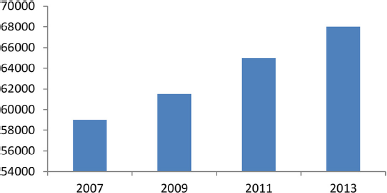
Dynamics of the number of advocates in Russia (according to data from the Federal Chamber of Advocates).
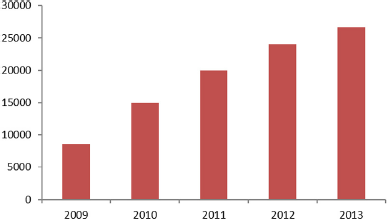
Dynamics of the number of members of the Association of Lawyers of Russia.
Although the absolute number of advocates in Russia is growing, the proportion of the number of advocates to the size of the population is slightly below the figures for other European countries. A comparative evaluation of the number of advocates is complicated by the fact that not all countries make a distinction between advocates and lawyers, and not all countries have data on the number of attorneys in the legal profession. Considering there are approximately 300,000 private lawyers in Russia (no one knows the exact number because private lawyers are not registered), there are 390 residents per lawyer in Russia. This exceeds the figures for Germany, Ukraine and Poland but is lower than the level of the United States and Italy (Table 1).
Number of lawyers in different countries around the world.
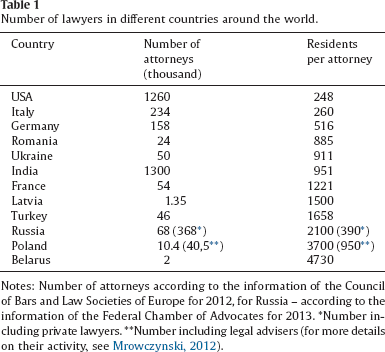
Notes: Number of attorneys according to the information of the Council of Bars and Law Societies of Europe for 2012, for Russia – according to the information of the Federal Chamber of Advocates for 2013. *Number including private lawyers. **Number including legal advisers(for more details on their activity, see Mrowczynski, 2012).
Many legal services in Russia are being provided by persons who have not taken a bar exam. This fact indicates there is a lack of control over the quality of professional training and legal ethics of most market participants, who are not members of either lawyers’ chambers or professional associations. This situation was negatively assessed by advocates who agreed to give us an interview, and they also expressed full support (91%) of the “monopoly of advocates”, an idea that only advocates should have access to court proceedings is all cases.
After the collapse of the Soviet Union, the number of advocates in Russia radically increased (Mrowczynski, 2012), whereas there was no bar exam at that time. The lack of a bar exam could eventually lead to a decline in the quality of work of advocates and the dilution of professional values. This situation is why it was important for us to register the differences in the views of advocates representing different generations as part of our study (see Table 8).
Research on the legal profession encounters the problem of opposition to normativism (Halliday, 1985). Lawyers often have a ready answer to many questions referring to regulations. This is why we held six in-depth, informal interviews with advocates and many meetings with representatives of the legal profession to determine whether our questions were properly formulated and do not allow dual interpretations.
The final version of the questionnaire generally reflects the aspects of the research on the legal profession described above. In the context of questions regarding different levels of professional control, we paid considerable attention to the problem of ethics and the professional paths of advocates. We tried to explain the isolation of the advocates and the role of this isolation in the conditions of the existing accusatory judicial tendency. We asked questions concerning interactions with representatives of the law enforcement and judicial systems and the reasons behind the relatively small number of acquittals.
Finally, we devoted one block of questions to the formation of the profession and the role of legal associations in the activities of advocates.
The study, conducted by the Institute for Industrial and Market Studies (IIMS) at the National Research University – Higher School of Economics (HSE), involved a survey of 372 advocates from nine Russian regions representing all of Russia's federal districts. The survey was conducted on the basis of the formalised questionnaire discussed above. The response rate was about 20–25% for all regions, which is relatively large for a subject group such as professional advocates (taking into account their busy schedules). The list of regions and the number of respondents in each of them are presented in Table 1. The survey was conducted through regional branches of the ALR. Because one of the purposes of the survey was to establish the differences between ALR members and non-members, minimal quotas of respondents in each group were established for each region, which provided an opportunity to conduct a comparative analysis. As a result, as shown in Table 3, the proportion of advocates who are ALR members in our sample considerably exceeds the proportion of ALR members in the overall population of advocates in the relevant regions (40% compared with 3%) (Tables 2 and 3).
Total number of respondent advocates and advocates registered in the regions of the survey.
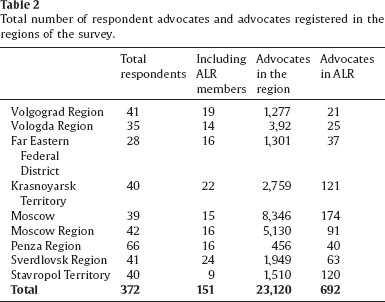
Total number of respondent advocates and advocates registered in the regions of the survey.
Form of legal practice.

In the next section we provide a portrait of a typical Russian advocate in order to show some basic information about the profession before discussing possible incentives for collective action.
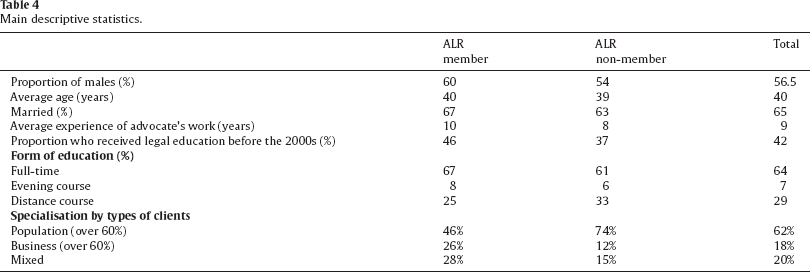
According to the data presented in Table 4, the average age of our respondents is 40, and their average professional experience is 9 years. Approximately 42% of the advocates sampled received their legal education before the 2000s (46% of ALR members), and approximately 30% of respondents took a distance course in jurisprudence. Approximately 28% of respondents became advocates immediately after graduation, and 20% joined the bar after working at commercial companies. Approximately 19% of advocates who were ALR members were previously employed in the law enforcement and judicial systems, compared to 27.6% of ALR non-members. Generally, in the opinion of most advocates (57% of ALR members and 73% of ALR non-members), new advocates often join the profession having experience at law enforcement agencies (Table 4).
Main descriptive statistics.
Main descriptive statistics.
Approximately 25% of ALR members and 33% of ALR non-members received degrees from correspondence programmes. The proportion of respondents with distance education is considerably higher among those who were admitted to the bar from law enforcement agencies and the judiciary system (35% and 45%, respectively), however. We also asked our respondents whether they share the opinion that some advocates act as intermediaries between their clients and law enforcement, helping them achieve a certain outcome in their cases. In all, 22% of respondents consider this a widespread practice, and 60% said this occasionally occurs.
Conducting a survey of the profession of attorneys, we expected to measure the dynamics of ethical values, their dependence on the biographical and professional characteristics of advocates, and how this relates to preferences for a strong professional association.
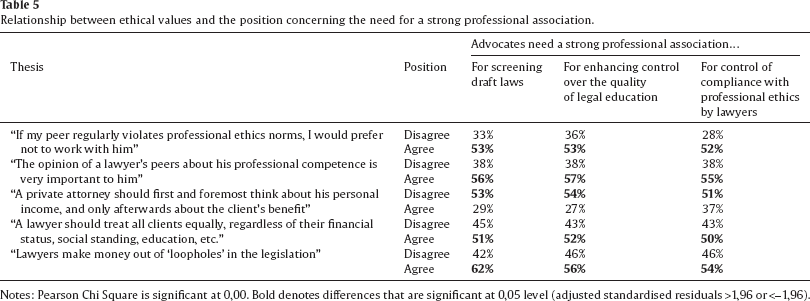
Our findings show that advocates with a higher level of ethical standards are more enthusiastic about the need for a strong professional association (see Table 5).
Relationship between ethical values and the position concerning the need for a strong professional association.
Relationship between ethical values and the position concerning the need for a strong professional association.
Notes: Pearson Chi Square is significant at 0,00. Bold denotes differences that are significant at 0,05 level (adjusted standardised residuals >1,96 or <−1,96).
For an advocate oriented towards personal benefit, a strong professional association could become an obstacle. A strong professional association may produce additional signals concerning the quality of services by developing professional standards, creating blacklists of unscrupulous entities and inadequate universities, controlling adherence to ethical standards, etc.
Surveys in Europe and the USA emphasise the following types of lawyers: those concerned with the public benefit, those oriented towards corporate values, and those concentrating on personal benefit (Mindes & Acock, 1982; Overman & Foss, 1991; Tapp & Levine, 1974). These motivations can be characteristic of both law enforcement officers and attorneys. The crucial issue is the interrelation of these ethical views inside each professional group.
The non-homogeneity of profession of advocates is substantiated by our findings. Our cluster analysis enables the classification of advocates into three groups based on several factors conventionally identified in the literature (see Table 6): “reputation-oriented,” “holders of a cynical view of the profession,” and “benefit-oriented.” The “benefit oriented” category is the least complete, which meets our initial assumptions that advocates oriented towards personal benefit should agree to take our survey less frequently.
Factor analysis (based on questions about professional ethics).
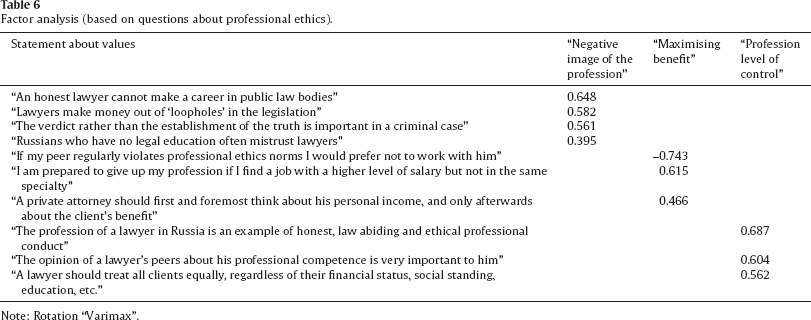
Note: Rotation “Varimax”.
The remaining part of the sample of advocates is divided into two approximately equal groups depending on the “image of the profession” formed by the individual advocate (see a detailed description of the groups in Table 7). A large part of the legal community is certain that the population does not trust lawyers (70%) and that the verdict in a criminal case is more important than the truth (50%). They also believe than an honest lawyer cannot make a career in public law (47%). Only 13% of advocates in this group regard lawyers as examples of honest, law-abiding, and ethical professionals. At the same time, nearly all “reputation-oriented” advocates agree with this opinion (94%), and all of them are convinced (99%) that a lawyer must treat his clients equally regardless of their financial status. This category of advocates particularly favours the idea of the creation of a strong professional association.
Description of clusters.
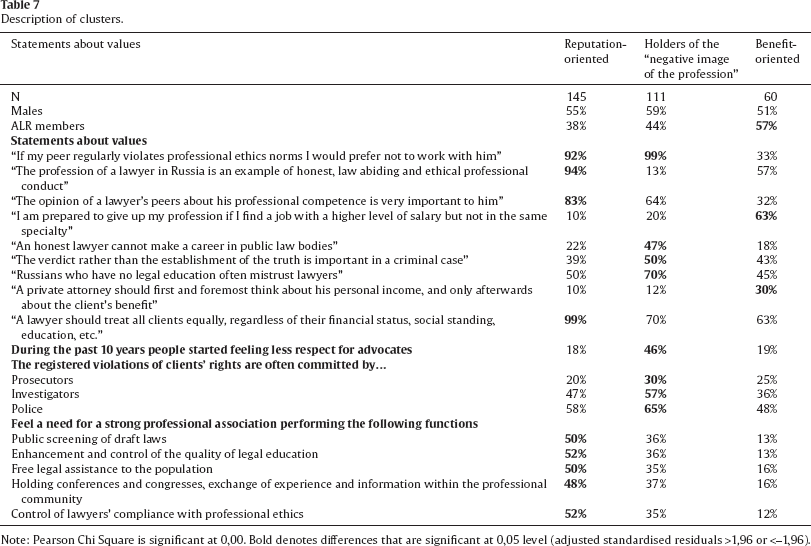
Note: Pearson Chi Square is significant at 0,00. Bold denotes differences that are significant at 0,05 level (adjusted standardised residuals >1,96 or <−1,96).
However, advocates with a cynical view of the profession also demand collective action much more often than those who are oriented towards personal benefit. For them, an association may also be a means of rectifying the current situation and returning prestige to the profession.
Therefore, the legal profession has a certain nucleus that shares ethical values and expresses a demand for collective action and a group of advocates who would potentially join this association. In this case, both positive orientations (“development of the community”) and negative motivations (“rectify the situation”) may become an incentive for development of the professional group and collective action. Advocates oriented towards personal benefit and ready to leave the profession for more favourable opportunities are much less inclined towards collective action. These advocates may be interested in association membership only from the perspective of obtaining additional status.
Recent years have witnessed a certain dilution of professional values among advocates: lawyers have become increasingly oriented towards personal benefit rather than professional reputation (see Table 8).
Difference in ethical values of different generations of advocates.
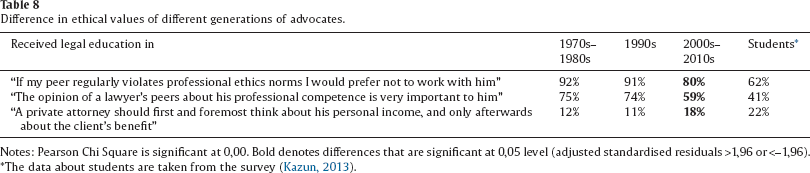
Notes: Pearson Chi Square is significant at 0,00. Bold denotes differences that are significant at 0,05 level (adjusted standardised residuals >1,96 or <−1,96). *The data about students are taken from the survey (Kazun, 2013).
Two-thirds of benefit-oriented advocates and advocates in our survey with a cynical view of the profession (65% and 64%, respectively) received their higher education after the 2000s. Thus, the dilution of professional values could be the consequence of the marketisation of legal profession in 1990s (both in terms of education and the labour market) combined with a weak level of professional control as described by Abbott (1983). The Legal departments of universities play a prominent role in this phenomenon (Erlanger & Klegon, 1978; Mertz, 2007) because they form certain normative patterns among future professionals. Poor quality legal faculties in Russia award diplomas of higher education but that does not necessarily form professional values in graduates. At the same time, current professional associations (even FCA) are not strong enough to exclude dishonest lawyers from the profession. Such impunity definitely reduces the ability of associations to build a professional reputation. The degradation of professional values may therefore eventually become a serious obstacle to the development of a professional group.
Questions concerning the violations of client rights by representatives of various law enforcement bodies (police, investigators, prosecutors) were included in the questionnaire to test the possible evaluation of the performance of the entire law enforcement system by advocates. These questions allow for the identification of regions where a government agency violates client rights more frequently (Table 9).
Violation of clients’ rights by law enforcement bodies by region (% of advocates admitting that violations are frequent).
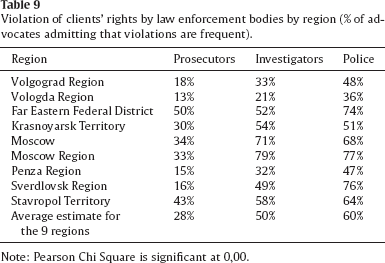
Note: Pearson Chi Square is significant at 0,00.
Table 9 shows statistically significant strong regional variation in the number of violations of client rights by various agencies. The worst assessments were given to Moscow, the Moscow Region, the Far Eastern Federal District, and – regarding the police – the Sverdlovsk Region. In our opinion, the quality of the law enforcement systems in different regions should be evaluated compared with other regions and average indicators for the country. The quality of law enforcement should not be evaluated on the basis of absolute numbers, which may be slightly higher than expected because advocates and law enforcement officers are often ex officio in opposition to one another. We plan to conduct a survey across all of Russia, which will allow for a better comparison of the performance of law enforcement agencies and the situation in different regions of Russia on the basis of advocate assessments.
There are differences in the evaluation of the scope of violations of client rights inside the profession of advocates (Table 10).
Distinguishing features of advocates frequently encountering violations of clients’ rights.
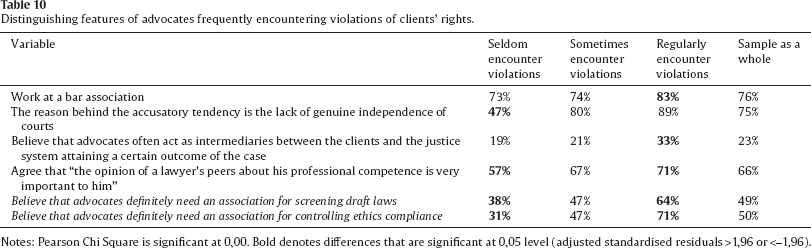
Notes: Pearson Chi Square is significant at 0,00. Bold denotes differences that are significant at 0,05 level (adjusted standardised residuals >1,96 or <−1,96).
Violations of client rights are most often registered by bar advocates. Advocates regularly encountering violations of client rights more frequently cite the reason as a lack of independent courts (89% compared with 47% who rarely encounter these violations). Moreover, one-third believes that advocates frequently act as intermediaries between the client and law enforcement to obtain a certain outcome in the case. Indeed, respondents granting in-depth interviews referred to these advocates as “deciders” – ‘reshalshchiki’. The cluster of advocates oriented towards personal benefit is closest to these “deciders” in terms of values and also close to the cluster called “pragmatic brokers” (Liu & Halliday, 2011). This group less frequently registers violations by investigators and police officers. Advocates who often register violations frequently have a negative image of the profession.
We are particularly interested in the fact that the advocates who see frequent abuses by law enforcement agencies are more active in their support of a strong professional association (Table 10), which could perform controlling and representative functions. These advocates see in this association the possibility of influencing the authorities to overcome the problems of the law enforcement system that they encounter in their practice.
The review of the problem of violent pressure on business in Russia based on the case of the Centre of Public Procedures “Business against Corruption” (CPP BAC) shows that confronting injustice can actually be a catalyst for collective action (Yakovlev, Sobolev, & Kazun, 2014). CPP BAC already has several examples of the protection of businessmen against unscrupulous representatives of the law enforcement system. These examples would hardly be possible without dozens of experts from the legal profession ready to work on pro bono terms.
However, we cannot assert that this pattern is not a coincidence or a derivative of some other cause (e.g., value orientations) before conducting a system analysis of all the factors influencing the demand for collective action. We therefore proceed to the regression analysis of the data.
To test the patterns linking collective action and advocate characteristics, we use ordinal logistic regression. We constructed our dependent variable based on 5 questions. These questions concerned whether advocates need a professional association to fulfil one of the following functions: screening draft laws, control over the quality of legal education, control over professional ethics, holding congresses and conferences, and representing the interests of the advocates at the state level. All respondents were categorised into 6 groups depending on the number of times they answered that this association is “definitely needed” (from 0 to 5 times). We used the factors based on variables of ethical values and the question of the frequency of encountering violations of client rights as the main regressors. We added control variables for education, work experience, specialisation, their membership in the ALR, and also a dummy variable for the region and the sphere of previous work (Table 11).
Regression models 1 and 2 (ordinal logistic regression).
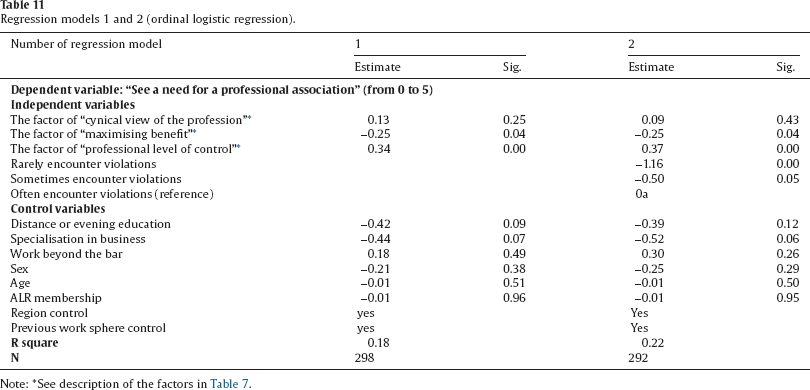
Regression models 1 and 2 (ordinal logistic regression).
Note: *See description of the factors in Table 7.
Regression model 1 substantiates our hypothesis that reputation-oriented advocates (Abbott, 1983) express greater demand for collective action. Moreover, advocates striving to maximise their personal benefit are less interested in the activity of a professional association (the factor of “benefit maximising” is significant with a negative sign). In addition, a “negative image of the profession” does not impact advocate support for collective action.
We added to the regression a variable characterising the frequency of violations of the rights of advocates’ clients by police, investigators and prosecutors. After adding this variable, factors connected with the value orientations maintain their significance while the explanatory power of the model increases. This outcome confirms our hypothesis that experiencing violations by law enforcement provides additional motivation for advocate participation in “collective action.”
The findings indicate a strong qualitative heterogeneity in the profession of advocates, with differences in ethical values and readiness to participate in professional associations. There is an alarming tendency for negative selection in the legal profession caused by the dilution of professional boundaries and the growth in the number of “deciders.” Most advocates note the deteriorating quality of legal education and the overproduction of lawyers with university degrees. These circumstances led to a decline of ethical values and the forming of a negative image of the profession characteristic of legal students and the advocates.
These findings suggest that the reforms in 2002 had only a limited positive effect. They have not solved the problem of the unification of all lawyers (including human rights defenders and private lawyers) into a single association with mandatory membership, as it happened in the USA at the beginning of the twentieth century (Halliday, Powell, & Granfors, 1993). Such integration would help to expand the “healthy core” of the profession and improve the legal profession's ability to be a key actor in social change.
Since 2015 FCA and Russian government have actively discussed the idea of introducing a so-called “monopoly of advocates”. The idea is to force all lawyers working in the court to take the exam and enter the FCA. In fact, it means the union of most Russian lawyers in one organisation. However, this step has serious risk that people with low professional qualifications and low ethical standards could come into profession, which in turn will increase the heterogeneity of the professional community. Current social and political uncertainty could be a serious barrier to such integration because it does not allow professionals to plan their individual and collective action over a long-term time horizon. Without long-term planning it is impossible to develop ethical values associated with a reputation. An orientation on reputation is not contradictory to an orientation on personal benefits. The two are compatible if lawyers are sure that other members of the legal community share the same values and that customers are guided by professional reputation as a signal of quality of legal services. While uncertainties remain, the bona fide core of the legal profession will remain relatively small.
Despite the risks and limitations, we believe that legal community can benefit from the consolidation on the basis of advocacy as this would help to resolve issues related to the decline in the quality of legal services and frequent violations of defendant rights by the law enforcers.
We know from the studies of business associations that the development of standards through professional associations relies on the sector's healthy nucleus. The collective action of advocates could be intended to create these quality signals for consumers of legal services. The question is: to what extent are advocate in Russia ready for this type of action?
Our survey results demonstrate that advocates in Russia still have a healthy core that could initiate collective action to develop and support professional standards and enhance the social status of advocates. This initiation would come from advocates oriented towards professional reputations rather than personal benefit, especially those who regularly encounter violations of client rights by law enforcement officers. This result is why one of the possible incentives for initiating collective action might be the creation of a public mechanism for the assessment of the law enforcement and judiciary systems.
Acknowledgements
The article was prepared within the framework of the Basic Research Program at the National Research University Higher School of Economics (HSE) and supported within the framework of a subsidy granted to the HSE by the Government of the Russian Federation for the implementation of the Global Competitiveness Program. The authors express their acknowledgements to Deputy Board Chairman of the Association of Lawyers of Russia Igor Redkin for support and assistance in organising and conducting the survey, and also to Veniamin Yakovlev, Igor Manylov, Gasan Mirzoev, Robert Zinovyev, and other participants in the roundtable held at the Association of Lawyers of Russia in April 2014 as well as to Katharina Pistor, William Pyle and other participants of ICSID seminars in Pushkin (May 2014) and New York (September 2014) for their remarks and comments. Also we express special gratitude to all advocates who took part in the survey.
Conflict of Interest: Anton Kazun and Andrei Yakovlev have received research grants from form National Research University Higher School of Economics (Russia).