






Abstract
Relying on a large quantitative data set from the United Nations General Assembly voting records in the years 1992–2013, this study analyses developments in the foreign policy preferences of the member states of the Commonwealth of Independent States [CIS]. It finds that the general level of disagreement between the member states as a whole has increased significantly and that policies have become more radicalised, causing member states to hold directly opposing views still more often. It also finds that a majority of member states, led by Russia, have converged on the foreign policy mean, causing the core of the organisation to become still denser. This suggests that the CIS will undergo a future development where member states will travel along increasingly different trajectories. This research has important implications for our understanding of the CIS and of the policies of the individual member states.
Introduction
Established in December 1991, the Commonwealth of Independent States [CIS] has provided a forum for a majority of the former Soviet republics to advance both their individual and collective interests, be these of a political, economic, military, cultural or different nature. Whereas for some member states (mainly Georgia, Moldova, Turkmenistan and Ukraine) the CIS has been little more than a necessary and not least temporary evil designed to manage the complex interdependencies created by the shared existence within the former unitary Soviet state, for others it has provided the foundation on which something much more ambitious eventually would be built. 1 These latter have since worked to bring the CIS member states closer together and to both widen and deepen their integration in all policy spheres (Kosov & Toropygin, 2009; Kubicek, 2009: 241).
Former Russian President Boris Yeltsin “thought of the CIS as a new type of union, formed to rescue Soviet integration as the Soviet state was falling apart, leading in a few years to a confederal arrangement, similar to the European Union” (Brzezinski & Sullivan 1997: 41).
Much of the Western scholarly literature on the record of the CIS is negative. Writing in the late 1990s, Richard Sakwa and Mark Webber (1999: 379) noted that the organisation “has failed to integrate the Soviet successor states in any meaningful sense”, and a majority of writers seem to have reached similar conclusions, if not always expressed so directly, since then. These writers will usually point to the continued existence of serious conflict, military even, within the membership circle, the frequent policy opt-outs, the low of the lowest common denominator, the lack of supranational decision-making bodies and enforcement mechanisms as well as withdrawals – or a combination of it all (for instance Åslund, Olcott, & Garnett 1999; Hansen, 2013; Kramer, 2008; Kubicek, 1999, 2009).
There is an alternative and more positive interpretation, however. Taking a “glass half full” perspective, these scholars emphasise what has been achieved rather than what may be lacking. One recent such study, by Willerton, Slobodchikoff, and Goertz (2012), analyses the dense security treaty network within the CIS, arguing that it is a sign of a mature organisational culture, where member states willingly let their future actions be restricted and defined by a shared legal framework. Willerton et al. (2012: 60) insist that their findings from the CIS security domain are relevant to other policy fields as well, and they remain optimistic about the future of the CIS, guided as they are by assumptions about the positive effect of the treaty lock-ins for learning, socialisation and incremental change among the signatory states.
Other scholars (for instance Costa-Buranelli, 2014; Pourchot & Stivachtis, 2014) share these positive conclusions. Relying on English School insights they argue that a regional shared understanding – a society – has emerged according to which common rules should be observed and common institutions respected. They see the gradual strengthening of a shared normative structure within the CIS which points to a continued positive development; as Willerton, Slobodchikoff and Goertz they focus on those elements which have moved relations beyond the mini anarchy which we could otherwise expect to find in a regional setting such as that covered by the CIS.
Some of these assumptions are drawn from social constructivist integration theory according to which we should expect to see still greater policy co-operation, co-ordination and eventually integration among member states across a wide range of issues. It is argued that a high level of interaction, for instance within an organisational setting such as the CIS, may gradually reduce differences between the actors involved, eventually making them much more similar by giving them a more or less full set of shared norms, identities and preferences (Checkel 2007; Herrmann, Risse, & Brewer, 2004; Risse-Kappen, 1996; Tonra, 2003). This is due to the cognitive capacity of actors; as they interact, they tend to learn from each other, developing and internalising new world views and standards of behaviour in the process, and in general begin to think and act in increasingly similar ways (Checkel, 1999, 2005; Checkel & Moravcsik, 2001).
Social constructivists further insist that state interests are not defined and fixed a priori but instead develop during interaction with others; put differently, preferences are endogenous to interaction. And they will point, for instance, to studies of the European Union [EU] member states or other groups of states with frequent interaction to show that this preference harmonisation – or socialisation – does indeed take place. Thus, it has been suggested, for instance, that the EU member states have developed a still higher degree of foreign policy harmony – and that this has been achieved despite even the intake over time of a relatively large number of new member states (Johansson-Nogués, 2004; Luif, 2003; Marchesi, 2010).
This study builds on and tests these assumptions as it seeks to increase our understanding of the CIS, the closest we get to an organisational embodiment of the Soviet superpower that was once was. It does so by analysing the actual foreign policy behaviour of the member states – as seen in their individual voting records in the United Nations [UN] General Assembly – in order to observe and assess possible developments within the group as a whole. The integration theory just sketched gives us reason to expect, all things being equal, that the CIS member states have converged still more on a foreign policy mean, gradually causing differences in preferences to have been ironed out. The available data will show if this is so.
It should be noted that Article 4 of the CIS Charter, signed on 22 January 1993, declares that member states should strive for “foreign policy co-ordination”, which in itself alone would seem to suggest policies ranging from mere advance consultation to a full harmonisation of foreign policy behaviour. However, as Article 1 of the same Charter lists among the fundamental aims of the organisation “the future development and strengthening of … mutual understanding and mutually beneficial co-operation between the member states”, the original ambition indeed seems to have been that policies should show still greater convergence and that member states would gradually move towards the deeper end of the integration pool (Ustav, 1993). While the Charter is rather vague on foreign policy – quite obviously a reflection of what little could be achieved when it was being negotiated – there is little doubt that growing divergence would go against the hopes and aspirations of the CIS “founding fathers”.
I perform four main tasks in this study. Firstly, I give a short background to the CIS and to the UN membership of the member states. Following this, I go over the methodology of using the UN voting records to measure the foreign policy cohesion between two or more states. I then present and discuss the findings for the whole CIS before looking at specific dyads of states, focussing on both core and outlier states as well as on key issues of agreement and disagreement. Finally, based on these different findings of the study, I offer a few perspectives on the future development of the CIS and on individual relationships between the member states.
The 8 December 1991 announcement by the then leaders of Russia, Belarus and Ukraine that the Soviet Union would cease to exist by the end of that year suddenly threw into real sovereign existence all the 15 former Union republics. Whereas by this time a majority of the republics had already declared their sovereignty, although not always strictly as understood by international law, they now all had to seek international recognition and to develop the full machinery of a sovereign state. General international recognition of Estonia, Latvia and Lithuania had started pouring in already in early September 1991, but the other republics had to wait longer; the United States of America [USA], for instance, waited until 25 December 1991 before recognising en bloc the sovereignty of the remaining 12 Soviet republics.
With universally recognised sovereignty came membership of the UN. As the official successor state of the Soviet Union, Russia did not have to apply for membership but simply took over all former Soviet rights and obligations in the UN system, including the prestigious permanent seat in the Security Council; and since the Soviet regime under Josef Stalin had decided to give both Belarus and Ukraine the façade of semi-statehood which made it possible for them to enter the UN as founding members in 1945 and thus to secure two extra votes for the Soviet Union, they merely continued their presence in the organisation (Bühler, 2001: 171–172). 2
In the words of a legal expert, “[the membership of Belarus and Ukraine] made little sense prior to 1991 from the legal point of view” explaining that “since the [Soviet Union] itself (…) was considered a legal subject of international law and was a member of the [UN], there was no legal justification for the membership of the UN of any of its constituent republics, just as none of the states of the Unites States ever sought or acquired membership”; Blum, 1992: 354–355, n. 2.
The remaining nine republics, however, had to apply for membership and then join separately and as new entities. 3 While eight of them (Armenia, Azerbaijan, Kazakhstan, Kyrgyzstan, Moldova, Tajikistan, Turkmenistan and Uzbekistan) were all admitted to the UN on 2 March 1992, the last (Georgia) was admitted only on 31 July 1992 (UN General Assembly Resolutions A/RES/46/223–230). This delay was caused by the lack of effective government in the republic; the political chaos and instability that had broken out in Georgia as the former Soviet Union was collapsing had brought a large number of states to hold back their recognition of the sovereignty of the republic and it was only following the appointment on 11 March 1992 of then former Soviet foreign minister Eduard Shevardnadze to the position of acting head of state that this changed and the way was cleared for Georgia to obtain membership of the UN (A/RES/46/241).
Estonia, Latvia and Lithuania had all been admitted to the UN already on 17 September 1991; see UN General Assembly Resolutions A/RES/46/4–6.
In the UN system, the CIS member states are split between two regional groups or voting blocs, making co-operation and co-ordination between the various national delegations slightly more difficult (Gruenberg, 2009: 477–482; Peterson, 2007: 106–110). Armenia, Azerbaijan, Belarus, Georgia, Moldova, Russia and Ukraine – together with for instance Estonia, Latvia, Lithuania and the states of the former Yugoslavia – all belong to the Eastern European Group; with only 23 members, this is the smallest of the five regional groups. Kazakhstan, Kyrgyzstan, Tajikistan, Turkmenistan and Uzbekistan on the other hand are all in the Asia–Pacific Group together with states such as China, India, Iran, Afghanistan and Pakistan; this group has 54 members (UN Department for General Assembly and Conference Management, 2012).
The use of quantitative data from the UN General Assembly as a proxy for foreign policy “interests” or “preferences” (Voeten, 2013: 62) is a favourite approach among many students of international politics. The first such studies appeared already in the 1950s, and it is therefore a well-tried methodology with a strong pedigree (for instance Ball, 1951; Holloway, 1990; Holloway & Tomlinson, 1995; Kim & Russett, 1996; Lijphart, 1963; Newcombe, Ross, & Newcombe, 1970; Voeten, 2000). It is particularly useful for those interested in the big pictures – drawn over time and/or across a group of states. As used here, the data may provide us with a central piece of the jigsaw that is the foreign policy harmony between the CIS member states: Their level of cohesion, associated trends and issues of (dis)agreement.
As Erik Voeten (2013: 62) notes about the UN General Assembly voting records, “there is no obvious other source of data where so many states over such a long time period have revealed policy positions on such a wide set of issues”. The richness of the source does not mean, however, that it is unproblematic to rely on. Critics often point out that a vote in the General Assembly merely shows whether a state is willing to support a resolution – it may not entail more than that and so is not necessarily reflected in subsequent policies (Voeten, 2013: 62). Also, the methodology is fraught with dangers and may easily produce biased findings; the coding of the votes is challenging and different approaches will easily lead to vastly different conclusions (Bailey, Strezhnev, & Voeten, 2013; Boockmann & Dreher, 2011; Voeten, 2013: 62–64). Having noted this, it is a standard tool and studies relying on the UN General Assembly voting records are being prepared in ever greater numbers and across a wide range of issue areas (Voeten, 2013: 54–55).
The overall data set for this study then is the voting record of the CIS member states in the UN General Assembly. For the purposes of this study I define the CIS as the 12 former Soviet republics and now sovereign states which have – for different durations and with different statuses – been members of the CIS in the years 1991–2013. I do this despite the following important exceptions to the general membership rule: Georgia joined the CIS in March 1994 only and left again in August 2009; Azerbaijan joined in December 1991, then left in October 1992, only to return again in September 1993; Ukraine has never ratified the CIS treaty and so technically has remained an associated member only, a status which Turkmenistan has also been claiming for itself since August 2005. 4 While the precise meaning of the term “CIS” thus remains unclear and even contested, it is still our best shorthand reference to these 12 states, the post-Soviet development of which has been markedly different from that of Estonia, Latvia and Lithuania.
Following the March 2014 annexation by Russia of the Ukrainian peninsula of Crimea (including the city of Sevastopol), it was announced that Ukraine intended to withdraw completely from the CIS.
I employ data from sessions 47–67, beginning in September 1992 and ending in September 2013; within this time span, I use data from every second session, giving me data from eleven different sessions. 5 All the data is openly available at the UN website (http://www.un.org/documents/resga.htm). The data collection has been based on the following three principles.
Since Georgia was only admitted to the UN as the 46th session was coming to a close, data from this session will not be included.
Firstly, in order to make the study more manageable, I use only entire resolutions passed which is in line with previous literature. In other words, I exclude for instance votes on resolutions which have been rejected by a majority as well as votes on parts of resolutions such as operative paragraphs (see Luif, 2003: 22–23). Studies suggest that the effect of omitting rejected resolutions is marginal (Boockmann & Dreher, 2011: 447).
Secondly, from this data set I include only roll call (recorded) votes; usually, some 75–80 per cent of all resolutions are passed without a vote (this is done by consensus), and if added to the picture of foreign policy congruence between two or more states, these resolutions would inflate the figures, leading to an often dramatically exaggerated image of the foreign policy harmony of the states in question (Luif, 2003: 20). 6
For an example of the differences between the two data set (that is, between all votes and roll call votes only), see United States State Department (various years).
When combined these two first principles leave us with a pool of typically some 65–85 resolutions per session. Thus, a total population of 826 recorded votes is included in this study. On each of these resolutions, the member states had the choice of voting “yes” or “no” or abstaining, or they could simply choose to be absent, that is, not take part in the voting altogether. 7
Member states may also be non-eligible to participate in the voting, for instance because of arrears in their contributions to the UN; most significantly, Kyrgyzstan, Tajikistan and Uzbekistan were all prevented under Article 19 of the UN Charter from voting in the 56th session as their financial contributions were in arrears.
Absenteeism may be caused by a number of different reasons, the most simple of which are a lack of either commitment to the UN or financial or human resources, in general or at specific times only. It may also, however, be caused by the controversial nature of a specific resolution, bringing states to “hide” behind a non-vote and thus reducing the risk of conflict with other states. To illustrate, in sessions 60–66 Mongolia was absent from every single vote on the human rights situation in North Korea, thereby avoiding the painful choice between doing damage to its relations with China, the most important ally of North Korea, or to its reputation as a liberal state (see for instance A/RES/66/174). 8
No vote was recorded on the human rights situation in North Korea in the 67th session.
Absenteeism is a general problem for anyone studying the UN voting record as there is no immediate or easy way of determining how the member state would have voted had it taken part in the voting. The problem is accentuated when there is a relatively high degree of absenteeism as is indeed the case with a number of CIS member states; Uzbekistan, Georgia and Turkmenistan have all been absent for more than 90 per cent of all recorded votes during a single session, but Kyrgyzstan (+70 per cent), Tajikistan (+60 per cent) and Armenia (+50 per cent) also have records of comparatively high levels of absenteeism during one or more sessions. All in all, in the eleven sessions analysed in this study, one or more CIS member states have been absent from more than half of all recorded votes.
Faced with the challenge of absenteeism some researchers simply throw out all cases with less than full participation of all objects of analysis (Johansson-Nogués, 2004: 4–5). This, however, clearly would not work in this study as it would leave a pool of less than half of all votes only; these remaining votes, moreover, would be unevenly scattered across various sessions, making the final result a highly skewed set of findings without much validity.
What I do instead, and this is the third principle, is to follow a common practice by regarding absenteeism as abstention and to assign a middle position to the state. The basic assumption behind this principle, so explains Paul Luif (2003: 25), who also relies on it, is that “the country is regarded as not knowing how to vote, it is ‘in-between’ a pro and a contra vote” (Luif, 2003: 25; also Holloway & Tomlinson, 1995: 243, Kim & Russett, 1996: 632; Voeten, 2000: 193).
However, if a member state is absent for more than one-third of all recorded votes during a single session, data for this particular state will not be included in the cohesion index for the year in question; its entire voting record will simply be disregarded (Luif, 2003: 25). 9 This rule is relevant to six different member states and to five different sessions; of all the CIS member states Turkmenistan and Tajikistan have shown the poorest voting discipline in the General Assembly and data for both is excluded from sessions 47 and 51–57, while data for Uzbekistan is excluded from sessions 47 and 55–57, for Kyrgyzstan from sessions 47 and 57, and for Armenia and Georgia from session 47.
Lowering the threshold of absent votes accepted from one-third to e.g. one-fourth may reduce the number of uncertain votes in the calculations made, but it may also reduce accuracy and validity as recorded votes are thrown out. To illustrate, Turkmenistan in the 61st session was absent from approximately 30 per cent of all recorded votes, and a threshold of one-fourth would then have meant that its voting record would have had to be excluded; while this may have added slightly to the accuracy of the calculations by possibly excluding a few “false” abstaining votes, it would also have left out the four important votes on which Turkmenistan voted in complete isolation from the other CIS member states.
I start by looking at the overall voting pattern of the entire group of CIS member states. This is done by classifying the data into three categories according to the distance between the states on the range “yes-abstention-no”. Firstly, a unanimous vote on which there is full agreement; secondly, a two-way split (or partial disagreement) where at least one state abstains while the others vote either “yes” or “no” (but not both); and a three-way split (or full disagreement) where at least one state votes “yes” while at least one other state votes “no” (Johansson-Nogués, 2004: 4). Fig. 1 shows the result (x-axis = session; y-axis = percentage of total number of recorded votes).
The overall pattern of cohesion. What is immediately noticeable in Fig. 1 is the relatively low level of agreement between the member states; the share of unanimous votes has never been higher than 44 per cent (in the 57th session) and in general it has remained within the 25–35 per cent band. This means that the CIS member states in general have only agreed on every third or even fourth vote passed by the General Assembly (in the 67th session the share was 34.7 per cent). This is significantly below the cohesion levels of for instance the EU and even more so the Association of South East Asian Nations, both of which routinely record unanimity levels of +75 per cent (Ferdinand, 2013). What is left then is a relatively high level of disagreement; whereas the overall share has remained quite constant (with a 0.4 per cent increase only in two decades), two-way splits have steadily given way to three-way splits (the latter reaching a high of 26.3 per cent in the 67th session). The member states hold directly opposing views still more often, and this clearly indicates that policies have become radicalised and that disagreement has hardened. As will be demonstrated below, a few member states (most notably Moldova, Ukraine, Georgia and Russia) have caused this development, expressing strong dissent on a few isolated issues; these have mainly been human rights and security and disarmament matters, and in the 67th session the general picture was such that whereas Moldova, Ukraine and Georgia tended to vote together against the rest, Russia found itself in complete isolation on several occasions.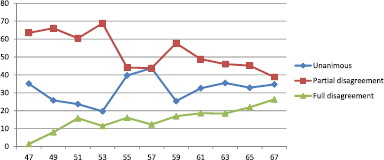
A note should be offered on the 55th and 57th sessions, which have produced a sudden increase in the share of unanimous votes on the one side and a decrease in the share of partial disagreements on the other side (see Fig. 1). The explanation is simply methodological; as will be shown below, Uzbekistan has been a relatively strong outlier and in the 53rd session it was in fact further removed from the CIS mean than any other member state. The country, however, has been excluded from the data set for the following 55th and 57th sessions because of a high degree of absenteeism (57 and 45 per cent, respectively). If instead included in the data set for these two sessions, the voting record of Uzbekistan would cause the share of unanimous votes to be reduced to 18 and 16 per cent, respectively (instead of 40 and 44 per cent), and the share of partial disagreements to be increased to 66 and 71 per cent, respectively (instead of 43 and 44 per cent).
It should be made clear that these last figures are surrounded by a very high degree of uncertainty as a large part of the Uzbek votes now included were absentee votes (treated here as abstentions). However, given the earlier record of Uzbek voting, there is good reason to speculate that the country would in fact have continued – albeit possibly with a certain moderation – the strong independence which so characterised its foreign policy line in the second half of the 1990s. If so, this would have caused the data for sessions 53–59 to change much less dramatically than shown in Fig. 1.
The voting patterns presented in Fig. 1 only inform us about the CIS as a whole; they do not tell us anything about individual member states. The first step in this direction instead is to look at the CIS mean or “average” voting record and calculate the distance of the individual member state from this. I do this by identifying all absolute majorities among the CIS member states included in the data set for the various sessions and then assign values to the member states based on their distance from this majority. The standard absolute majority will be 50 per cent plus one, that is, seven member states. However, since a number of states have been excluded from a number of sessions because of absenteeism, the absolute majority will vary; while in 47th session it is only four, in the 51st and 53rd sessions it is six, and in the 55th and 57th sessions it is five.
The distance of member states from the CIS mean.
The distance of member states from the CIS mean.
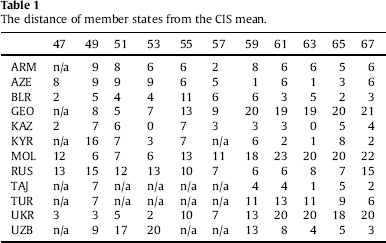
The first thing that should be noted is that Russia clearly has not been defining the “CIS foreign policy line”. In fact, throughout the 1990s Russia was a leading outlier, occasionally finding itself completely isolated on votes, and only later did it gravitate towards an average position. Some of the more notable outlier issues included the Arab-Israeli conflict (where Russia sided cautiously but also consistently with Israel in the first half of the decade (Nizameddin, 1999)) as well as human rights (where Russia often held a highly liberal position).
It is important to add that the move towards the mean in the 1990s was caused mainly by a change in the Russian policy rather than by a process by which the other member states gradually and increasingly voted with Russia (Chubaryan, 2003). Changes in the Russian policy included both the Arab-Israeli conflict (gradually increasing its support for especially Syria and the Palestinians) and human rights standards (gradually becoming less willing to support Western criticism of alleged human rights violators). As an illustration of this latter process, Russia in sessions 47–53 voted in favour of the annual resolution criticising the human rights standards in Iran (and on five of these seven votes was even the only CIS member state to do so (for instance A/RES/53/158)); in the 54th session it suddenly abstained; and from the 55th session and onwards it has then voted against all of these resolutions, closely associating itself with the Islamic regime in Tehran (for instance A/RES/65/226).
In the 2000s the picture became more unclear; Russia made minor changes to its foreign policy but some of the other member states also started to follow the Russian lead more closely than they had done before. With a distance score of 6–8 in sessions 57–65, Russia found itself within close reach of the mean, but in the 67th session it moved again to a relatively strong outlier position. The cause of this was found most immediately in its votes on nuclear disarmament and human rights in Syria, where it failed to bring the rest of the CIS over, even voting in complete isolation on six different occasions. Clearly, despite its progressively more assertive policy in the CIS, how Russia votes is not necessarily how even the weaker member states vote (Kramer, 2008; Kubicek, 2009; Nygren, 2008; Trenin, 2009).
The CIS foreign policy line instead has been epitomised most strongly by Kazakhstan. With an average distance score from the CIS mean of 3.6 only in the eleven sessions, the country is closer to the average position than any other member state. By contrast, Moldova has an average distance score of 14.3 in the eleven sessions, making the country the strongest outlier of all, closely followed by Georgia with an average distance score of 13.1 in ten sessions.
As already indicated, in the 21 years of General Assembly voting examined in this study, the controversial votes producing outlier positions have mainly been on issues of security and disarmament (including questions of nuclear disarmament and the legality of the use of nuclear weapons) and human rights (including the interpretation and universality of these as well as the alleged violation of agreed standards in specific countries). In the 1990s questions of colonialism (including the right to self-determination) was also a relatively frequent source of disagreement within the CIS membership circle.
In the 67th session the dyads with the smallest distance scores were Moldova–Ukraine, Moldova-Georgia and Tajikistan–Uzbekistan (all five per cent), Belarus–Uzbekistan, Tajikistan–Turkmenistan and Turkmenistan–Uzbekistan (all six per cent) and Belarus–Tajikistan (seven per cent). At the other end of the scale we find Moldova–Turkmenistan (31 per cent), Moldova–Russia and Moldova–Uzbekistan (30 per cent) as well as Moldova–Tajikistan, Georgia–Russia and Ukraine–Russia (all 29 per cent). This indicates that voting patterns are heavily influenced by domestic regime type – democratic versus authoritarian – as other studies of voting in the UN General Assembly have also found (Voeten, 2000: 205–207).
While Russia has not been defining the CIS foreign policy line, it still enjoys a position of overwhelming dominance within the organisation. Thus, its population of 142.5 million represents just over 50 per cent of the combined CIS-12 population; its Gross Domestic Product [GDP] of USD 2553 billion represents a full 70 per cent of the total CIS GDP; and its military budget of USD 90,464 million represents a staggering 86 per cent of the total CIS military expenditure (Central Intelligence Agency, 2014; Stockholm International Peace Research Institute, 2014). By comparison, Germany, the biggest and leading EU member state, only has a 16 per cent share of the combined population of the 28 EU member states and its economy represents also relatively modest 20 per cent of the combined EU GDP (Central Intelligence Agency, 2014).
Given this dominant position of Russia, the country is a natural focal point for the other member states. For this reason alone it is of interest to see how the latter relate to the centre or “engine”, which Russia is, and how they accept or resist its heavy gravitational pull. This data will complement the findings presented in Table 1, serving to produce a fuller picture of the position of the different member states in the CIS landscape.
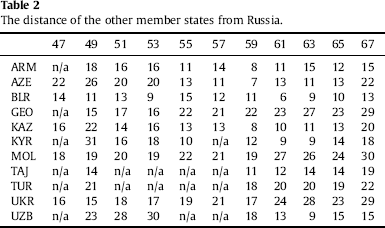
I calculate the distance of each member state from Russia by employing the same methodology which was used to calculate the distance from the CIS mean. Only now, when voting together with Russia, the country receives a score of 0; when voting against Russia in a two-way split (partial disagreement), it receives a score of 1/2; and when voting against Russia in a three-way split (full disagreement), it receives a score of 1. The combined total is then again presented as a share (in percentages) of the total number of recorded Russian votes in a given session. This means that if a member states always votes with Russia, it receives a distance score of 0; if it puts itself in maximum opposition to Russia (always voting against Russia in three-way splits) it receives a distance score of 100. Let us now consider some of the more noticeable trends.
Much talked about by observers (Lane & White, 2010; Ó Beacháin & Polese, 2010) in the 2000s, the anti-establishment “Colour Revolutions” in Georgia (2003), Ukraine (2004) and Kyrgyzstan (2005) were expected by many to weaken not only the CIS in general but also the ability of Russia to exercise its power over the other member states more specifically (Delyagin, 2005; Wallander, 2007). Whether based on hope or fear, such an interpretation should lead us to expect increasing divergence from Russia as the new regimes would redirect the foreign policy of their respective states to reflect their opposition to Russia and to the authoritarian rule of the Kremlin (Hagan, 1989; Morrow, 1991; Siverson & Starr, 1994). The general data in Table 2 present a mixed picture. Whereas there is a significant increase of seven percentage points in the distance between Ukraine and Russia in sessions 59–61 (2004–05 to 2006–07), suggesting that the Orange “turn to the West” did have a more or less immediate impact on the country's foreign policy behaviour, Georgia saw a much smaller increase of just one percentage point in sessions 57–59 (2002–03 to 2004–05) and Kyrgyzstan even recorded a fall of three percentage points in its distance from Russia in sessions 59–61. As noted earlier, however, the Russian foreign policy in the 2000s saw minor changes and it is of course possible that the effects of the Colour Revolutions were simply offset by these. A closer inspection of the voting records reveals that this is not the case. Contrary to our expectations, neither the Rose Revolution in Georgia nor the Tulip Revolution in Kyrgyzstan produced a noteworthy change in the voting alignment of these two states. Again an illustrative example is found in the annual resolution criticising the human rights standards in Iran, which even in the post-revolution years Georgia continued to abstain from and Kyrgyzstan continued to reject. By contrast, Ukraine shifted towards a policy of support for this specific critical resolution already in the 60th session (2005–06) and in general quickly became more critical of alleged human rights violators and of attempts, usually by members of what Erik Voeten (2000: 213) has called “the counterhegemonic group”, to introduce into the UN system alternative and broader understandings of human rights (Donnelly, 2013). More detailed future studies may profitably pursue these differences about which it may for instance be hypothesised that the collective cognitive effect of the transformation has been greater in Ukraine than in both Georgia and Kyrgyzstan; after all, even the “post-Orange” administration of former President Viktor Yanukovych largely resisted rolling back the human rights achievements recorded during the reign of his predecessor Viktor Yushchenko (Freedom House, 2014). It may also be speculated that the greater weight of Ukraine – with an economy 12 times bigger than that of Georgia and 24 times that of Kyrgyzstan (Central Intelligence Agency, 2014) – makes the country less vulnerable to external pressure and therefore gives it an amount of autonomy in decision-making not enjoyed by the two smaller states. With an average distance score of 22.2 in the eleven sessions and a score of 30 in the 67th session alone, Moldova has the most dissimilar voting pattern relative to that of Russia. The country in this latter session found itself in full disagreement with Russia on one in every six votes, covering mainly human rights and democratisation (where Moldova isolated itself from most other CIS members) as well as nuclear issues (where Russia isolated itself). The country – often described and contextualised by its high level of vulnerability vis-à-vis Russia (for instance Mungiu-Pippidi & Munteanu, 2009: 142) – has been the most consistent supporter among all CIS members of what may broadly be termed a pro-Western and liberal agenda and as a consequence of this has had more three-way splits with Russia than any other member state. This suggests a relatively high level of socialisation into the underlying norms and the existence of a domestic consensus which sees the country's external action space (Mouritzen & Wivel, 2012: 41–42) as comparatively clearly delimited by those same norms. Turning to the other end of the extreme, with a distance score in the 67th session of relatively modest 13 Belarus was closer to Russia than any of the other member states. Indeed, Belarus has held this position in eight of the 11 sessions, indicating that politically the country may be seen as Russia's closest ally. This political proximity is also illustrated by the fact that while Ukraine – the third original co-founder of the CIS – has never allowed its distance score to drop below 15, Belarus on its side has never allowed its score to go beyond 15. The two states have been entertaining ambitious ideas about a possible union since 1993 and even more so since 1994 when Alexander Lukashenko took over power in Belarus (Marples, 2008). Although leading policy-makers in both capitals have since effectively abandoned the union state project, its prominent position on the bilateral agenda and in the public mind for nearly two decades suggests that the high similarity in voting reflects more fundamental similarities in norms and identities and, following this, in interests (on this link, see Herman, 1996); the respective world views of the two states, in other words, seem to have become largely identical. It could also be speculated, however, that Belarus follows Russia's lead simply as a consequence of its heavy dependence on Russian support – be it, for instance, of an economic, political or normative nature. Thus, as Russia continues to shield the regime in Minsk – the most repressive in Europe – from the worst effects of the economic and social sanctions imposed by the West and from international shaming, Belarus may consider it wise to return the favour by supporting the Russian policy in the UN General Assembly (Ambrosio, 2006; Klinke, 2008). Finally, we see in Table 2 that Uzbekistan has narrowed the otherwise relatively large gap which separated it from Russia in the 1990s; from a position of strong dissent, the country has progressively realigned itself with Russia in the General Assembly voting. This process largely mirrors the level of Western pressure put on the country as well as its dramatic record of alliance choices, making it a somewhat unpredictable member of the CIS. Uzbekistan in 1999 left the Russian-led military co-operation of the Collective Security Treaty [CST], of which it had been a reluctant member for a few years already, and instead joined GUAM (consisting of Georgia, Ukraine, Azerbaijan and Moldova), in the process causing this grouping to be renamed “GUUAM” (Hansen, 2000; Kuzio, 2000). Six years later, in 2005, it left GUUAM again to re-join its former allies in what had by then become the Collective Security Treaty Organisation [CSTO], that is, a more heavily institutionalised version of the CST. To complicate matters further, Uzbekistan withdrew from the CSTO again in 2012. This latter development has yet to translate into any noteworthy foreign policy shift. The years immediately preceding the dramatic 2005 realignment had witnessed an increase in the amount of Western – and especially United States [US] – pressure on authoritarian regimes. The 2002 US National Security Strategy (White House, 2002: 6) had set the tone for what would follow by openly emphasising the need for democratisation and the introduction of more civil liberties in suppressive states, pointing to the “Muslim world” as an area of special concern. Critical voices soon started calling for reforms in Uzbekistan also, and president Islam Karimov apparently drew the conclusion that his regime would not survive under the then existing terms of co-operation with the West and that he could in fact be the next leader to suffer a Colour Revolution (Fumagalli, 2007). For Karimov the solution, as also practised by many other Third World leaders anxious to hold onto power, was to distance himself from the external supporters of his domestic opposition and instead move closer to those who would help preserve political status quo in Uzbekistan (David, 1991). The rationale is simply to pay the price for what is good for the regime – in this case quite clearly to converge with the Russian foreign policy line.
The distance of the other member states from Russia.
Two major findings stand out. The first of these is that in the years since 1992 the level of disagreement between the CIS member states has increased significantly. The disputed votes in the 67th session represented 65 per cent of all votes – the same as two decades earlier – but a full 40 per cent of those votes were three-way splits.
This makes it fully clear that a socialisation process, reflected in an increasing homogenisation, has not taken place within the group of member states as a whole. On the contrary, from this perspective it seems that different learning processes have taken member states in two different directions; as they have developed new and, for some at least, increasingly separate identities, their foreign policy outlooks have also become increasingly divergent. While some of the member states are gradually – albeit with some difficulties – approaching Western liberal democratic standards and have openly stated their aspirations to join the EU, others have rolled back even the democratisation of the late Soviet era and instead have set up authoritarian regimes rejecting the values and norms of the Western world.
Having noted this, it should be added that a relatively large core of member states have converged on the mean, suggesting that a socialisation process may have taken place within this group. Excluding the three big outliers Moldova, Georgia and Ukraine, we find an average distance score from the mean of 5.2 for the remaining nine members in the 67th session; by contrast, in the 49th session (from which data for all these nine states has been included) the average distance score was 9.3. Future research inspired by social constructivism may determine whether such a socialisation process has indeed taken place, perhaps even causing states to identity with the collective symbolised by the CIS (Smith, 2004: 25–35).
The second major finding is that Russia has not controlled the foreign policy behaviour of the other CIS member states – at least not the behaviour expressed through voting in the UN General Assembly. The country perhaps has never wanted to but if it has we may conclude that it has failed in this. With distance scores ranging from 13 (Belarus) to 30 (Moldova) in the 67th session, none of the other states follow the Russian lead blindly.
Again, however, we see that a smaller group of states are now quite consistently within the 10–20 point reach of Russia. As just suggested, such a growing convergence may be caused by a process of increasing homogenisation, in turn causing identities to become still more identical. This could serve to explain the lower distance scores; these states (including even Russia) may have learnt from each other, eventually sharing still more views and achieving the level of foreign policy harmony shown in the 67th session.
A rationalist interpretation instead would hold that this may simply have been caused by cost-benefit analyses. While Russia has not been attractive or powerful enough to bring especially Moldova, Georgia and Ukraine closer to its own foreign policy line, it has had more success with most of the other states. Closer studies may show just how useful a rationalist approach is in explaining the foreign policy behaviour of the CIS member states and, as part of this, exactly when and how Russia has used its power to reward or coerce the other member states to ensure their foreign policy compliance.
A particularly interesting aspect of a future rationalist-inspired study would be to assess the extent to which Western pressure in general – and its democracy and human rights promotion more specifically – has served as an engine of foreign policy convergence between members of what was described above as the relatively large CIS core. The hypothesis would be that the greater the Western pressure, the more closely the other authoritarian states follow Russia's foreign policy lead in order to qualify for protection and to receive compensation for losses as the West reduces economic support. Put differently, such a study could demonstrate the extent to which Western pressure (the independent variable) has caused the foreign policy convergence (the dependent variable) which can be observed between some of the member states.
If the past is a reliable guide for the future, the data presented here suggests a further radicalisation of the foreign policy of the different CIS member states, causing them to act – and to vote – in increasingly dissimilar ways. This process is likely to be led by Moldova, Georgia (already an ex-member since 2009) and Ukraine (which in May 2014 announced that it intended to withdraw from the CIS). These three states are main outliers and we should expect that they will continue to produce three-way splits, pitting themselves against various combinations of the other CIS members in full disagreements. Following the March 2014 annexation by Russia of Crimea and its alleged involvement in the subsequent civil war in Ukraine, the latter in particular may be expected to hold outlier positions, thereby further distancing itself from Russia and the CIS core.
The data also suggests that the rest of the CIS will continue to converge on the mean, eventually causing this core to become denser by reducing the distance between these states. It is likely that Russia will play a leading role in this by either serving as a source of learning for the others or by bribing or coercing them to bring their voting record more in line with the Russian behaviour. From this does not follow, however, that Russia will define the mean; even in some of the later sessions Russia has voted in complete isolation from the other member states and, absent any dramatic changes in Russia's ability to inspire or willingness to pay or force the others to fall into line, we should expect that this will continue in coming years also.
Footnotes
Appendix
It may be argued, as did indeed one anonymous reviewer, that a more correct picture would be offered if Georgia, Turkmenistan and Ukraine were excluded from the study; given the nature of their relations with the CIS, we should expect that they hold (or have held) outlier positions, thereby causing the level of foreign policy cohesion within the CIS to be lowered. This step, however, would also be problematic as all three states have been members, even if only associated, of the CIS. A study of the data without Georgia, Turkmenistan and Ukraine reveals that they have in fact a marginal impact only on general development. The overall level of cohesion among the remaining nine member states is given below and when compared to that of Fig. 1, we see that while the unanimity vote is slightly higher, it is not enough to offset the dramatic rise in three-way splits (in this case caused mainly by Moldova).