




Abstract
What determines small states’ behaviour in multi-lateral organisations? Mainstream theories of international relations expect small states to be conditioned by the power asymmetries in which they are immersed. Recent work has revisited this assumption, highlighting the need to understand the conditions in which small states can exert some agency. We use the case of Colombia to test our argument. Due to the close relationship that Colombia has with the United States, scholars describe Colombia’s behaviour as subordinated to US interests. We provide a more nuanced view of the reasons behind Colombia's foreign policy. We review Colombia's voting behaviour in the United Nations General Assembly (UNGA) and analyse the circumstances under which Colombia votes the same way as the United States. Our findings suggest that while some types of foreign aid and trade dependency increase the chances that Colombia and the US vote similarly in the UNGA, counternarcotics aid decreases the likelihood that Colombia votes as the United States does. Our findings suggest that factors not associated with United States influence predict Colombia's support of United States in the UNGA. For example, the voting behaviour of Latin American and Caribbean Nations.
Keywords
Introduction
December 2nd of 2008 was a good day for the Colombian delegation at United Nations General Assembly (UNGA). After months working with delegations from Japan, and South Africa, among other countries, the resolution of the illicit trade in small arms and light weapons in all its aspects (A/RES/63/72) was approved in the General Assembly of the United Nations by all the UN members, except the United States (United Nations, 2008, 2010). Securing global co-operation to address the traffic of small arms is important for Colombia as the issue poses a serious threat to its domestic security. Even though countries like the United States vehemently opposed efforts at regulating small arms, Colombia actively sought opportunities to solidify support for the resolution (Araújo, 2007, 2008; Barco, 2003, 2004, 2005, 2006; Bermúdez, 2009). As a result, Colombia not only obtained the approval of the resolution but also secured the sponsorship of 78 countries (including 19 nations from Latin America and the Caribbean). This case highlights the agency exerted by countries like Colombia and presents a puzzle. When does Colombia choose to pursue its own interests in global organisations, even despite the opposition of the United States?
This question is important as it stresses the need to explore concepts such as small states and agency. Conventional wisdom assumes that small states can only align with powerful countries to obtain resources and/or avoid costs. 1 Based on that logic, small countries’ foreign policy should be limited to following the political preferences of major powers, reflecting the hope that they will be rewarded in return. Recently, scholars have revisited this assumption, providing a more nuanced view of the determinants of small states’ foreign policy (Flemes and Wehner, 2015; Long, 2015; Long et al., 2020; Wehner, 2020; Zapata and Martínez-Hernández, 2020). This new body of proposes an asymmetrical approach to understand better both the constraints and opportunities faced by small states in their relationships with other states. Thus, small states can be defined by the different relationships they find themselves in. This literature argues that small states can take advantage of certain conditions to shape politics in their favour in the international arena (Long, 2015). Sometimes, small states make decisions unsupported by strong states because they are aware that the costs for retaliation from stronger states are minimal or absent. In other contexts, it is hard to disentangle if weak states make decisions in pursuit of their own interests or if they are forced into decisions by coercion from stronger states (Tickner and Morales, 2015). Sometimes states behave similarly as it is in the best interests of both states to support each other in attaining certain international goals (Russel and Tokatlián, 2003). In other instances, the behaviour is the product of a coercive relationship (Escudé, 1995). We must find the contingencies under which small states can exploit or relinquish their agency in multi-lateral spaces. This article aims to add to this growing literature by using the asymmetric relationships framework to assess the factors that determine Colombia's voting decisions in the UNGA.
Looking at small states’ behaviour in multi-lateral organisations is particularly useful for understanding to what extent small states are constrained by the strength of powerful countries’ influence. Because the UNGA is the only space where all countries can vote on various relevant issues, looking at voting decision in this forum helps assess countries’ alignments with powerful countries like the United States. (Zapata and Martínez-Hernández, 2020). Strong countries such as the United States have ample tools at their disposal to secure political support in such forums. Foreign aid is one of those tools. Existing research shows that the United States uses bilateral and multi-lateral aid to reward its supporters in the UNGA (Adhikari, 2019; Carter and Stone, 2015; Thacker, 1999; Woo and Chung, 2018).
Scholarly work that focuses on developing countries’ foreign policy suggests that this might not be the case: countries do not always follow the preferences of their powerful partners. Voeten (2000) points out that Latin American countries often change their voting preferences in the UNGA and do not always adhere to the Western bloc. Research provides some reasons for such variance. According to Wehner (2020), some Latin American countries choose to counter the United States to reduce the large asymmetry between themselves and the United States. Other studies review the factors that determine changes in foreign policy in Latin America: while in some countries, high-level politics and capabilities help explain voting similarity with the United States, in other cases, ideology and domestic politics are better predictors of voting decisions (Amorim and Malamud, 2015; Merke and Reynoso, 2016; Zapata and Martínez-Hernández, 2020).
What about small countries? Are they always following power politics and bending to United States interests? If not, what determines their foreign policy behaviour? This article aims to answer these questions by examining the factors determining Colombia's foreign behaviour in multi-lateral settings. Colombia is perceived as an unconditional US ally. Colombian President Marco Fidel Suarez (1918‒1921) coined the doctrine Respice Pollum, which states that Colombia's foreign policy should be aligned with the US's interests (Ardila, 2020). Some examples confirm that doctrine: Colombia is the only Latin American country that sent troops to the Korean War and the Suez Canal and is among a handful of Latin American countries that supported the 2003 US invasion of Iraq. This support provided Colombia with a steady revenue from US aid (Tickner, 2003). However, Colombia's voting record in the UNGA exhibits a different behaviour: Colombia's voting record does not align with the United States. Even when the United States granted Colombia large levels of aid to address security threats, Colombia voted against US preferences on salient issues such as Palestine, Cuba's embargo and nuclear disarmament, among others. 2 What accounts for such differences?
Scholarly work identifies various strategies small states use to offset their weaknesses in a world of power asymmetries. Strategic hedging allows small states to interact with regional and international powers on different issues without confronting them (Kuik, 2021). Colombia's voting decisions in the UNGA allow Colombia to co-operate with other regional powers without upsetting the United States. Other explanations highlight the relevance of coalitions, which allow small states to increase their influence, particularly in settings where decisions are made by majority rule and when the issues debated can be framed under moral arguments, like humanitarian law (Deitelhoff and Wallbott, 2012; Panke, 2012). In this article, we aim to contribute to a growing body of literature that questions the perception of Latin American countries as subordinated to major powers like the United States. Specifically, the assumption that small countries always align with the preferences of major powers. We suggest a more nuanced explanation: small states’ voting patterns are the result of strategic calculations on the nature of their asymmetrical relationships that include not only the repercussions of voting against US interests but also other factors derived from the dynamics of the asymmetric relationships small states create with powerful countries such as the United States. We argue that small states have three types of behaviour in the UNGA to respond to the power asymmetries in the international arena. First, they align with strong states because they are afraid of the drawbacks of opposing dominant actors. We claim that trade, economic aid and military aid produce such effects since those economic flows are substantial for the interests of the small states’ governments and their interest groups. Second, small states could oppose the interests of strong actors when they notice that hegemon states are incapable of enforcing sanctions. We assert that foreign aid that attempts to pursue the national interests of strong states incentivises small states to act more independently and, therefore, be more likely to disagree with major powers (e.g. counter-narcotic aid). Third, small and strong states vote similarly because there is a confluence of interests between both agents rather than an imposition of latter interests over the former's preferences. We defend that weak states work with their regional partners to pursue their agenda. Thus, small states are more likely to vote with dominant states because there is a regional consensus towards that end. To test these arguments, we explore the aspects that account for the alignment between Colombia and the United States in the UNGA. The results of this study provide a more nuanced view of Colombia's foreign policy behaviour. This article enhances our understanding of small states’ agency in the international system by looking at the behaviour of a small state such as Colombia.
The article is organised as follows: The next section reviews the existing literature on the determinants of states’ voting patterns in the UNGA. The third section presents the case of Colombia and introduces our theoretical expectations. The fourth and fifth sections describe the research design and introduce the results of our statistical analysis. Finally, in the last section, we discuss our findings and draw some conclusions.
Literature Review
Several studies have used the voting patterns in the UNGA to measure a country's foreign policy preferences. The various issues debated in the UNGA allow all Member States to discuss wide-ranging initiatives including security, human rights, economic development and the environment. In addition, unlike in other international forums, every member state of the United Nations can cast a vote. Because decisions taken by the UNGA are not binding, states can use this space to display their interests and even to project their political stand. In 2006, for instance, in a calculated effort to cast himself as a leader of the Global South, Venezuela's President Hugo Chávez used this space to criticise President George W. Bush's foreign policy (Albaret and Brun, 2022, Stout, 2006). Due to these characteristics, existing research has used voting behaviour in the UNGA to measure states’ foreign policy preferences and determine whether those states are influenced by powerful countries such as the United States (Bearce and Bondanella, 2007; Dreher and Jensen, 2013; Dreher and Sturm, 2012; Kim and Russet, 1996; Thacker, 1999; Voeten, 2000, 2004; Zapata and Martínez-Hernández, 2020).
Many scholars have used voting similarity in the UNGA to assess whether aid influences recipients’ decisions. Indeed, donors provide aid with the expectation of obtaining influence over the recipient's behaviour, and voting similarity provides material evidence of such influence. Numerous studies found that US aid is associated with voting similarity in the UNGA (Carter and Stone, 2015; Dreher et al. 2008; Rai, 1980; Wang, 1999). Studies disagree, however, on whether the aid is used as an incentive to vote according to US interests (De Mesquita and Smith, 2009; Woo and Chung, 2018) or a reward for recipients’ loyalty (Alesina and Dollar, 2000).
Studies have likewise explored whether the impact of aid on recipients’ behaviour is mediated by political regime type. Autocracies display higher levels of voting similarity with the United States than democracies do (Brazys and Panke, 2017, Lai and Morey, 2006). This can be explained by the fact that autocracies are less constrained by their constituencies and thus face fewer obstacles to meeting their donors’ demands. Democratic countries, on the other hand, tend to vote in line with the United States only on decisions that are salient for the major power. Doing this minimises both domestic backlash and the likelihood of being punished with US aid cuts (Carter and Stone, 2015). These findings suggest that policy inducement is only possible in specific cases.
Existing research provides different explanations for this behaviour. Particularly for the Latin America region, Voeten (2000) argues that it is a consequence of the change in the world order. During the Cold War, the East–West conflict helped predict Latin American countries’ voting decisions. However, with the end of the Cold War, the voting behaviour of countries in this region changed: they do adhere to the Western position at times, but not always. A new line of research has sought to enhance our understanding of foreign policy decisions from the point of view of small or less powerful countries. According to Wehner (2020), small states purposely adopt foreign policies that counter the United States. In a study of several countries in Latin America, he argues that choosing regional groups over the United States is beneficial to small countries as it reduces the asymmetry with the United States. While this argument revolves around power distribution, Wehner highlights how the expectations that traditional international relations theories impose on small states ignore these states’ agency and efforts at levelling existing asymmetries in pursuing their own interests. For example, Brazil and other rising powers who are dissatisfied with their lack of influence in the international system decided to work together and promote an agenda at the UNGA closer to their interests (Binder and Payton, 2022).
In a similar vein, studies have explored the complexity of variables connected to the foreign policy of Latin American countries. Amorim and Malamud (2015) focus on UNGA voting patterns of major countries in Latin America. After testing variables associated with the characteristics of the international system, domestic institutions and foreign trade, the authors conclude that global factors are more influential in predicting voting similarity with the United States only for Brazil and Mexico. According to the authors, the national capabilities of these two countries allow them to behave independently in the UNGA. In the case of Argentina, domestic institutions, specifically the ideology of the cabinet are better predictors of levels of convergence with the United States. Other studies review Venezuela's behaviour in the UNGA during the Bolivarian Revolution. They show that Venezuela strategically opposes the US interests in using foreign aid to influence the decision-making process in the United Nations (e.g. Petrocaribe) (Albaret and Brun, 2022, Carvalho and Lopes, 2022)
Merke and Reynoso (2016) explore other domestic factors that help explain states’ behaviour in the UNGA. According to the authors, executives who seek higher levels of alignment with the United States also advocate for co-operation and free trade with other countries in the North, while leaders who oppose the United States exhibit higher levels of autonomy, protectionism and co-operation with countries in the South.
While existing studies provide important lessons for studying foreign policy in Latin America, it is unclear whether the analyses apply to smaller countries. Whereas the capabilities of Mexico and Brazil grant them autonomy in their foreign policy, this can hardly be the case for other countries in Latin America. Their economic and military power would imply that these states are expected to follow powerful countries. As discussed before, the existing research suggests that structural variables such as US relevance in terms of both trade and foreign aid can determine the foreign policy of developing countries. However, the literature in Latin America discussed here also shows that ideology and pragmatism are important determinants of foreign policy. The mixed results suggest that something else can be at play. This paper focuses on Colombia to enhance the existing knowledge of the foreign policy of small states in multi-lateral settings.
Colombia in the United Nations General Assembly
Mainstream theories depict small countries as constrained by power politics. Their foreign policy, thus, is reduced to choosing between complying with powerful countries’ demands so they can maximise resources and avoid costs or challenging regional powers and searching for co-operation with smaller countries (Hey, 1993). However, recent studies that focus on smaller countries suggest that such states have more agency than commonly assumed. 3 Zapata and Martínez-Hernández (2020) study on voting behaviour in the UNGA demonstrates that the decline of US power in Latin America has allowed the region to increase its agency, aligning with China in certain issues. In addition, several studies pinpoint conditions under which small states can increase their agency levels: These studies show that while small states are immersed in asymmetrical relationships, they purposely develop coping strategies that compensate for their weaknesses and allow them to pursue their goals (Long, 2017, 2022; Wehner, 2020). Colombia's behaviour in the UNGA illustrates one of such copying strategies. We argue that looking at the voting behaviour of a small country in a multi-lateral forum can enhance our understanding of how small states achieve higher levels of autonomy without compromising vital resources. In trying to pursue their interests in asymmetrical relationships, small states work together to achieve their own agendas (Voeten, 2004).
A case study is valuable for understanding this process better. First, Colombia has a long tradition of supporting US foreign policy interests. Experts argue that the country implements this strategy to achieve modest gains without assuming risks in the international arena (Bergamaschi et al., 2017; Drekonja, 1983). The Colombian government repetitively makes public announcements regarding its support for the US foreign policy agenda, demonstrating its support to the regional power (e.g. anti-communism, the war on drugs and the war against terrorism) (Tickner and Pardo, 2003; Tokatlián, 2000). Scholars argue that Colombia makes those decisions based on the idea that US assistance could be helpful for its domestic interests regarding civil conflict and commercial interests (Borda, 2007; Garay, 2008; Rojas, 2006, Tickner, 2007).
An example of the way in which Colombia leverages US interests to advance its domestic interest is Plan Colombia. In 1999, the United States and Colombia negotiated an aid package initially aimed at bolstering Colombia's fight against illicit drugs. In time, Plan Colombia turned into a much larger initiative that included not only aid to fight drug trafficking but also substantial amounts of economic and military aid, as well as aid to support Colombia's government's fight against terrorism (Galeano et al. 2019; Rojas, 2006; Tickner and Pardo, 2003). As a result, Colombia became the third recipient of US foreign aid (Ramírez, 2004). While the dramatic increase in aid can be understood as the result of US’ interests in reducing narcotics production, Colombia's internationalisation of the domestic conflict, particularly the representation of domestic actors such as the guerrilla forces as terrorist organisations, denotes a strategic choice in which the Colombian government used the interests of the international community to secure key resources needed to advance its domestic agenda (Borda, 2007; Tickner, 2007). Moreover, and as argued by Long (2015), the use of the war on drugs language and rhetoric was a calculated strategy that allowed the Colombian government to secure aid from the United States while advancing Colombia's domestic security interests, specifically fighting the FARC guerrilla. Thus, this new interpretation of Colombia's actions illustrates how small states can strategically find spaces in which to behave autonomously within the asymmetric relations in which they are immersed.
One space where this strategic behaviour may be easily observed is the UNGA. Colombia's conduct in the UNGA does not resemble the expected pattern of loyalty toward the United States. For instance, in most of the resolutions that condemned Israel for the violation of human rights between 1990 and 2009, Colombia sided with China, not the United States (Borda, 2012; Borda and Berger, 2012). In the UNGA, Colombia often promotes issues that are relevant within the Global South, such as the importance of foreign assistance for the Third World, advocacy of regional trade agreements, the use of international law to solve disputes, shared responsibility in the administration of counternarcotics policy, and the necessity to reform UN institutions. Colombia also tends to make motions and draft resolutions with Latin American countries (Castillo, 2017; Hernández, 2017; Rivero, 2017; Tirado and Holguín, 1995). Colombia thus offers an opportunity to analyse a nation that claims to be loyal to the United States but uses the UNGA to advance interests connected to its own goals.
The Force of the Neighbors
Making decisions in collegial bodies is hard. If we assume that political actors pursue changes in the status quo in making such decisions, individuals first must solve any collective action problems (Aldrich, 1995). Legislatures use several types of institutions that catalyse decision-making processes (Cox and McCubbins, 2007, Shepsle and Weingast, 1981). The UN has many of the same institutions but lacks political parties. In the absence of such actors, one way that states can solve a collective action problem and approve resolutions is by aligning around geographic regions (Alker, 1964; Newcombe et al., 1970, 1999; Russett, 1966). Shaping international policies around national interests requires states to have the capacity and will to reach agreements with different governments. Otherwise, it will be impossible for them to achieve their goals individually (Russell and Tokatlián, 2003).
States will be inclined to reach agreements with those nations with which they frequently interact. However, collaboration and co-ordination between states in the same region do not necessarily emerge from geographic proximity. Two main factors can explain co-operation among neighbours. First, the UN's institutional design forces countries from the same region to reach agreements regarding their representation within the organisation (e.g. Security Council, Economic and Social Council and Trusteeship Council) as instruments for defending their interests in the UN (Ruda, 2010). Those groups also help to exchange information, discuss and define the position of the regions in different matters. For example, while Colombia was president of the Latin American and Caribbean Group (GRULAC), the government participated actively in the approval of the resolution named ‘Optional Protocol to the International Covenant on Economic, Social and Cultural Rights’ (A/Res/63/117) despite the opposition of powerful countries such as China, Japan, the UK and the United States (Bermúdez, 2009; Haldiz, 2017; Hoffmann, 2020). 4
Second, countries commonly belong to and participate in regional institutions as mechanisms to foster international co-operation; such institutions include the Organisation of American States (OAS), Latin American Integration Association (in Spanish Asociación Latinoamericana de Integración, ALADI), Andean Community of Nations (in Spanish Comunidad Andina de Naciones, CAN) and Common Market of the South (in Spanish, Mercado Comun del Sur, Mercosur). Being part of regional institutions helps nations define common interests and co-ordinate efforts to promote a regional international agenda around diverse topics (Holloway, 1990). During negotiations in the UNGA, members of regional organisations share information, co-ordinate meetings and talk to each other to set common positions (Panke, 2013). Commonly, Latin American countries set meetings of the economic and political integration mechanisms during the opening of the UNGA sessions. For example, Rio Group meets to discuss democracy, drugs and multi-lateralism (Araújo, 2007; Bermúdez, 2009). Sometimes, those organisations act as observers and intervene publicly to show the preferences of the group within the UNGA (Hoffmann, 2020; Panke et al., 2017). However, the level of cohesion highly depends on the strength of the institutions that embody international agreements (Binder and Payton, 2022; Haas and Rowe, 1973). If these explanations are correct, then the influence of the region's interests, reflected in the voting patterns of the region, should explain a given state's voting behaviour.
In certain instances, the regional interest can even influence powerful countries to change their initial preferences. For instance, in 2014, the UNGA approved the resolution ‘extrajudicial, summary or arbitrary executions’ (A/RES/69/182). This resolution was co-sponsored by eleven Latin American countries (including Colombia). While initially, the United States did not support the resolution, in the end, the country and most of the Latin American and Caribbean (LACA) states voted in favour of its approval (Guyana and Surinam abstained). This example shows that, first, Latin American and the Caribbean nations might promote their own interests in the international arena, and second, that those regional interests can resonate positively within the United States. Consequently, the coincidence between voting patterns between Colombia and the United States comes from the coincidence of interests between Colombia and the region, not from a coercive relationship with the United States.
Therefore,
H1: An increase in the similarity of voting behaviour of Latin America and the Caribbean (LACA) with Colombia increases the probability that Colombia votes in line with the United States in the UNGA.
What Aid Can Buy
The use of aid as a reward for political support in the UNGA is well documented. Existing research argues that powerful states such as the US grant aid in hopes of obtaining political support from their recipients, even in spaces such as the UNGA (Adhikari, 2019; Carter and Stone, 2015; De Mesquita and Smith, 2009; Dreher et al. 2008; Dreher and Sturm, 2012; Rai, 1980; Wang, 1999). Research on small states’ voting behaviour in the UNGA finds that aid-dependent countries change their voting positions more frequently than non-aid recipients, which evidences the influence of foreign aid (Brazys and Panke, 2017). Supporting the United States in the UNGA is also beneficial as it enhances the chances of obtaining aid from multi-lateral organisations such as the World Bank and the International Monetary Fund (Andersen et al. 2006; Alesina and Dollar, 2000; Barro and Lee, 2005; Dreher et al., 2008; Stone, 2004; Thacker, 1999). There is little question that powerful countries pay close attention to small states’ decisions in the UNGA. The US State Department, for instance, reports to the US Congress on voting practices in this forum. The United States is willingness to use its aid to buy political support means that recipients carefully consider when to oppose or support this country in securing its foreign aid.
However, not all types of aid create the same constraints. We argue that there are some conditions under which we expect aid to secure similar voting behaviour. First, aid must be indispensable to funding recipients’ domestic goals. In the two-level game between domestic constituents and foreign donors, leaders need to carefully calculate their behaviour so that they do not lose domestic support. If pleasing donors creates backlash at home, leaders will only please donors when aid can help them overcome domestic opposition and pursue their goals (de Mesquita and Smith, 2009). Economic aid, for instance, can be vital for small states as it can help fund programs that benefit large sectors of the population and, therefore, have a positive impact on the recipient government's domestic image. Second, donors’ threats to cut aid must be credible: donors should be willing to remove all aid to punish recipients who fail to support them. However, this is not always the case. If the recipient's co-operation is salient to US interests, leaders in recipient countries can take advantage of this leverage (Bell et al., 2017). Kiyani (2022) demonstrates that countries that receive US aid connected to US strategic interests exert increasing levels of agency due to their strategic salience to the United States. In such a scenario, leaders in recipient countries are no longer constrained by donors’ threats and, therefore, become more willing to vote against donors if doing so will please domestic constituencies. This allows small states to increase their agency in the UNGA.
The case of counternarcotics aid illustrates this point. Colombia is not only one of the top recipients of US foreign aid but also the largest recipient of US aid in Latin America and the Caribbean (Congressional Research Service, 2022; Congressional Research Service, 2021: 7). A considerable amount of this aid funds ‘counternarcotics and counterterrorism efforts’ (Congressional Research Service, 2021: 7). These efforts are part of a larger counterdrug program developed by the United States. The war on drugs, launched by President Richard Nixon in 1971, identified drug consumption as a national security threat. In trying to reduce drug production, the United States designed coercive strategies to ensure drug eradication and interdiction. The long-term goal of these efforts is to stop the flow of drugs into the United States while at the same time reducing the production of drugs overseas. The war on drugs turned into a key policy that frames US foreign policy towards Latin America (Crandall, 2002; Tate, 2013; Tickner and Cepeda, 2011). Indeed, because counterdrug policy is closely connected to US national security interests, it would be very costly to use this aid to influence Colombia's support in the UNGA. Thus, we argue that US aid might buy allegiance to the UNGA if assistance is more important for recipients than for donors. In cases where aid is connected with donors’ long-term policy goals, aid might increase recipients’ autonomy.
Therefore,
H2a: An increase in US economic and military aid to Colombia increases the chances that Colombia will vote in line with the United States in the UNGA.
H2b: An increase in US counternarcotics aid to Colombia decreases the chances that Colombia votes in line with the US in the UNGA.
The Influence of Trade
Governments’ willingness to please powerful countries in the UNGA can also be motivated by domestic actors. According to Gartzke (2007), trade relationships create shared interests across countries, an effect which, in turn, increases levels of co-operation among trade partners. Particularly in democracies, interest groups and local economic actors that benefit from international trade pressure governments to follow the preferences of big economies such as the United States (Baldwin, 1985; McKeown, 1984; O’Neal and Russet, 1999). In Colombia, for instance, the National Federation of Coffee Growers was long known as Colombia's unofficial Ministry of Foreign Affairs (Drekonja, 1983; Garay, 2008; Tickner, 2003). Recent studies provide a more nuanced picture of the way in which economic sectors impact Colombia's foreign policy, highlighting their strength and political influence (Arnson and Tickner, 2016; De Lombaerde, 2015; Garay, 2008; Vargas et al., 2012). For instance, Long, Bitar and Jiménez (2020) illustrate how a free trade agreement between China and Colombia failed to materialise due to the strong opposition from domestic economic groups like manufacturers, entrepreneurs and unions. We argue that these actors’ influence extends to multi-lateral organisations. Flores-Macías and Krepps (2013) demonstrate that increasing levels of trade with China changed the voting behaviour of Latin American and African countries in the UNGA. Domestic actors can influence in foreign policy behaviour and might pressure governments to acquiesce to trade partners’ demands. We argue that higher levels of trade with the United States will increase Colombia's domestic actors’ pressure on the executive to match US preferences in the UNGA.
Therefore,
H3: An increase in trade economic dependency to the United States increases the probability that Colombia will vote in line with it in the UNGA.
Research Design
Using a set of logit models with robust standard errors, we analyse the determinants that lead Colombia to vote as the United States does between 1946 and 2019. Our dependent variable is the Similarity of UN Voting behaviour of Colombia and the United States. The variable adopts the value one (1) when both Colombia and the United States vote similarly in the UNGA and zero (0) otherwise. We assume as missing values the resolution in which either Colombia or the United States is absent from the UNGA. Therefore, our unit of analysis is UNGA Resolution. We use Voeten's UNGA Voting Data (Voeten, 2013).
We use the similarity of voting behaviour of LACA nations with Colombia as our first independent variable. This variable describes the proportion of UN members from Latin America and the Caribbean that vote in line with Colombia. We estimate this variable with UNGA Voting Data (Voeten, 2013).
We address our second hypothesis with three independent variables, each for every line of foreign aid: Economic Aid, Counternarcotics Aid and Military Aid. Economic aid includes all assistance concerning projects related to agricultural development, support for education and health and institutional strengthening, among others. Counternarcotics aid includes funds that specifically mention the aim of fighting the illegal drug economy. Military aid refers to resources that fund all programs that provide training and equipment for the Colombian armed forces and do not mention their commitment to the struggle against drug trafficking. All three independent variables are logged due to their distribution. We use the information from US Overseas Loans and Grants (USAID, 2020).
To test whether trade influences Colombia's voting decisions, we use Colombia's trade dependence on the United States as our third independent variable. This variable captures the proportion of Colombian exports to the United States of total Colombian exports to the world. We calculate this variable using the International Monetary Fund's Trade Statistics Department.
We include in all our estimations a set of control variables related to both American and Colombian international and domestic politics. Regarding American politics, we added a variable named Divided Government. This variable assumes the value of one (1) when the control of the presidency and Congress is divided between the Democratic and Republican Parties, and zero (0) otherwise. We expect that Colombia is less likely to vote as the United States does America has a divided government. In those periods, the US government is more constrained to punish disloyalty in the international arena effectively (Guáqueta, 2001, Pastor, 1980). In trying to capture the impact of geopolitical distribution, we use the variable Cold War. During this period, Colombia always defined itself as an ally of the United States in its fight against communism (Tokatlián, 2000). Thus, we expect that Colombia will vote more like the United States during the Cold War. This variable assumes the value of one (1) during the Cold War, and zero (0) otherwise.
Concerning Colombian domestic politics, we expect Colombia to vote in line with the United States when the quality of its democracy decreases. Autocracies display higher levels of voting similarity with the United States than democracies (Brazys and Panke, 2017, Lai and Morey, 2006). We use the revised combined Polity Score from Polity V Project. We also include Colombia's score from the Index of National Capabilities (CINC). We expect that as this measure increases, Colombia will vote less like the United States, since it is reducing its power asymmetry and thus is able to act more autonomously (Amorim and Malamud, 2015). Furthermore, we include a variable named Conservative President. This variable assumes the value of one (1) when the Colombian president is a member of the Conservative Party, and zero (0) otherwise. We anticipate that Conservative Party presidents will generally deviate from US voting patterns, reflecting their nationalist perspective on foreign policy (Drekonja, 1983).
We also include as a control variable Colombia in the Security Council. This variable assumes the value of one (1) if Colombia is a member of the UN Security Council, and zero (0) otherwise. We expect that Colombia will tend to vote more like the United States while Colombia is a Security Council member because this position promotes more interaction and understanding with the United States (Hwang, Sandford and Lee, 2015). Finally, we add the UNGA Turnout. We calculate this variable as the proportion of the number of UN members that vote over the total number of UN members. The level of influence of states rises as the number of nations present in the UNGA decreases (Downs, 1957). Therefore, Colombia will be less likely to vote in line with the United States when the turnout in the UNGA increases. All models also include five dummy variables that describe the different topics discussed in the UNGA. We use Voeten's (2013) classification of the resolutions: Middle East Conflict, Nuclear Disarmament, Human Rights, Colonialism and Economic Development. Following this strategy, we consider how certain topics might induce both countries to agree in their voting behaviour.
Results
In our first hypothesis, we argue that an increase in the similarity of LACA voting behaviour to Colombia's voting increases the probability that Colombia votes in line with the United States in the UNGA. Our statistical analysis found that a standard deviation increases in the similarity in voting behaviour between LACA and Colombia, nearly .23, boosts the odds that Colombia and the United States vote similarly by 42.8 per cent, holding all other variables constant (see Figure 1). Colombia leans in favour of US interests if its neighbours support those interests. 5
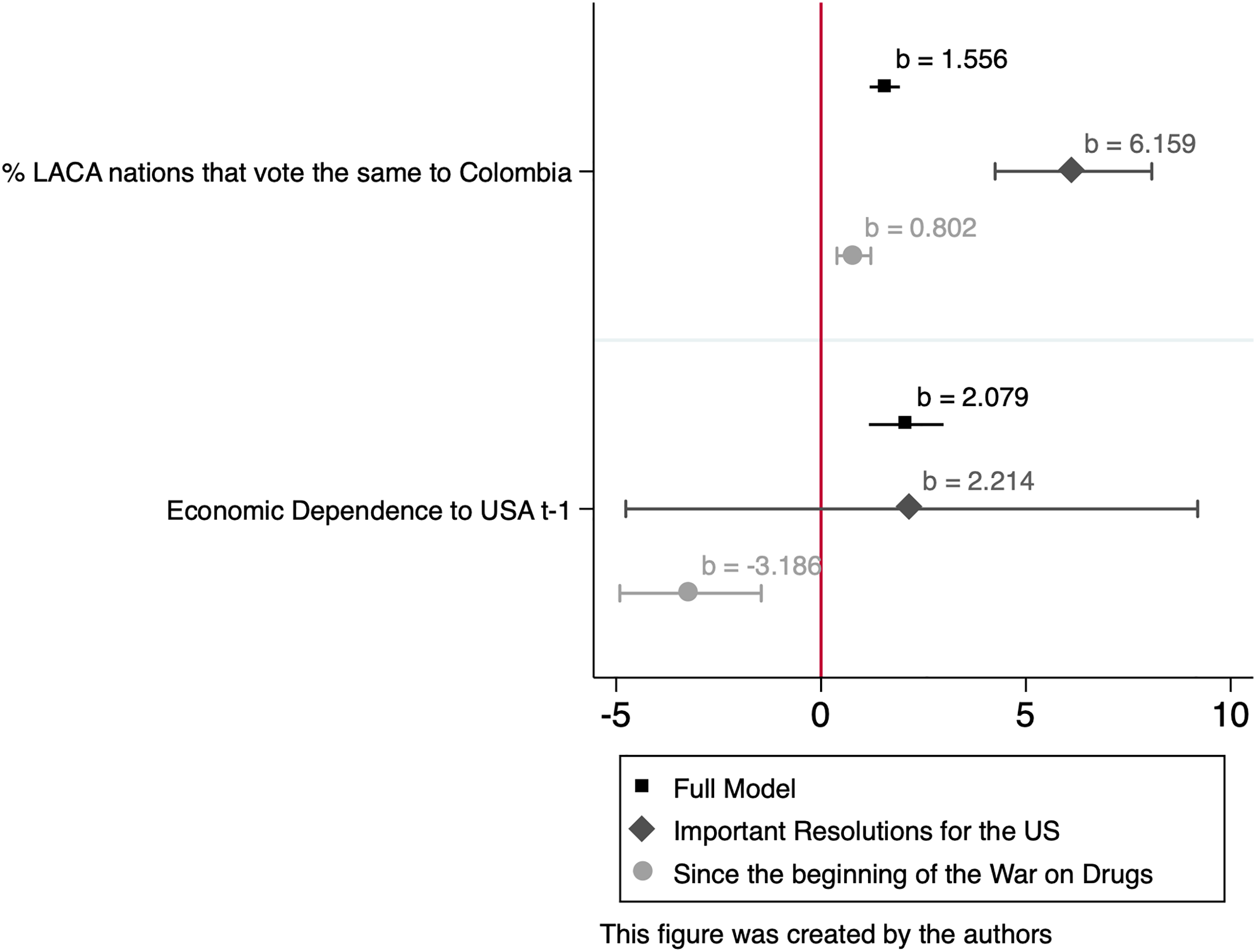
Linear Prediction of Latin American and Caribbean nations and Trade Dependence on the Similarity of UN Voting Behaviour of Colombia and the United States.
The results regarding our second hypothesis are very interesting. In the case of economic aid, we found that an increase in 10 per cent in US economic foreign aid to Colombia augments the odds that Colombia and the US vote similarly by 1.5 per cent, holding all other variables constant (see Figure 2). However, we cannot reject the null hypothesis with military aid. While economic aid has a positive effect on the probability that Colombia and the US vote similarly in the UNGA, counternarcotics aid has a negative effect on the probability that Colombia and the US vote similarly in the UNGA. An increase in 10 per cent in United States counternarcotics aid to Colombia decreases the odds that Colombia and the US vote similarly by 0.6 per cent, holding all other variables constant.
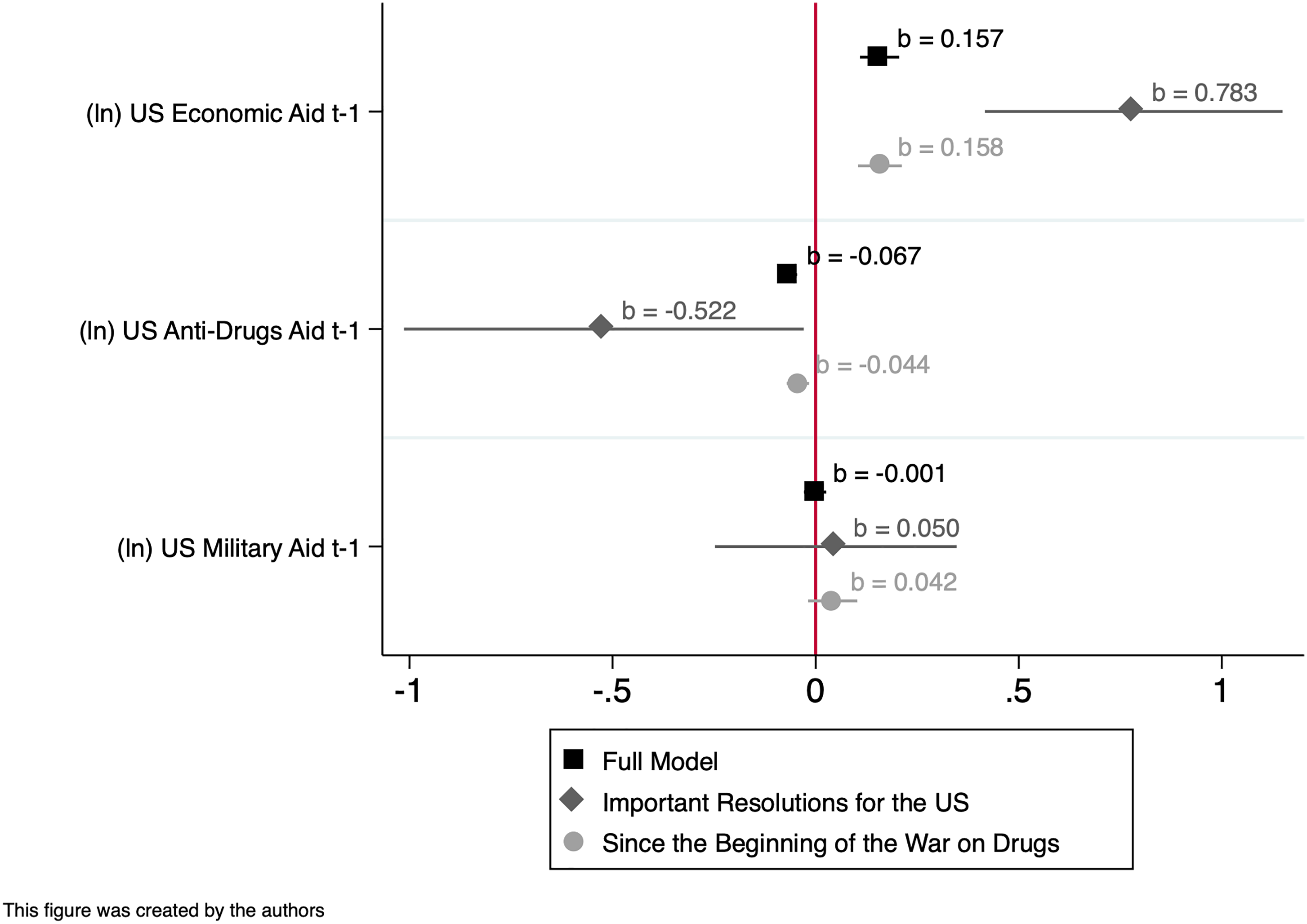
Linear Prediction of Foreign Aid on the Similarity of UN Voting Behaviour of Colombia and the United States.
As expected, our analysis suggests that aid is associated with Colombia's support of the US only when the aid is more important to the recipient than to the donor. When the allocation of aid is driven mainly by donors’ interests, recipients gain autonomy in their decisions since donors’ threats to cut aid are not credible. Aid that is connected to drug programs fails to secure Colombia's compliance. In such cases, Colombia acts more freely in the UNGA because the United States is strongly committed to the war against drugs.
Our third hypothesis argues that an increase in trade dependency raises the likelihood of Colombia voting in line with the United States. Our estimation supports that argument. We found that a standard deviation increase in trade dependency to the United States, nearly .15, augments the odds that Colombia and the United States vote similarly by 35.9 per cent, holding all other variables constant (see Figure 1). This outcome suggests that Colombia tries to behave according to US interests to protect its economy and export economic groups. 6
Robustness Checks
As existing research has suggested, not all resolutions are equally important, especially for the United States. Therefore, the analysis should focus on resolutions crucial for US international policy. 7 In this case, we estimate an additional model in which we only consider the resolutions that the US State Department considers essential (see Figure 1). The analysis shows similar results to those of our main models. Colombia votes in line with the United States when there is an increase in the number of LACA countries that agree with Colombia. However, we did not find empirical support for the effect of trade dependency on the voting behaviour of Colombia.
In the case of foreign aid, we found that foreign assistance from the United States to Colombia has dissimilar effects (see Figure 2). While economic aid increases the likelihood that Colombia and the United States will vote similarly in the UNGA, counternarcotics aid has the opposite effect: reducing the probability of the countries casting the same vote. As stated above, aid can buy support in the UNGA if the provision of aid is more important for recipients than for donors.
In contrast, interests among the LACA states are too diverse to consider that the alignment between Colombia and the United States is due to the confluence of interests of all LACA countries (see Figure 3). Therefore, we estimate different models in which the independent variable evaluates the similarity of voting behaviour between Colombia and Latin America, Colombia and South America, Colombia and Colombian Neighbors and Colombia and Andean Nations. All those estimations support the idea that Colombia leans in favour of US interests if their neighbours agree with Colombia.
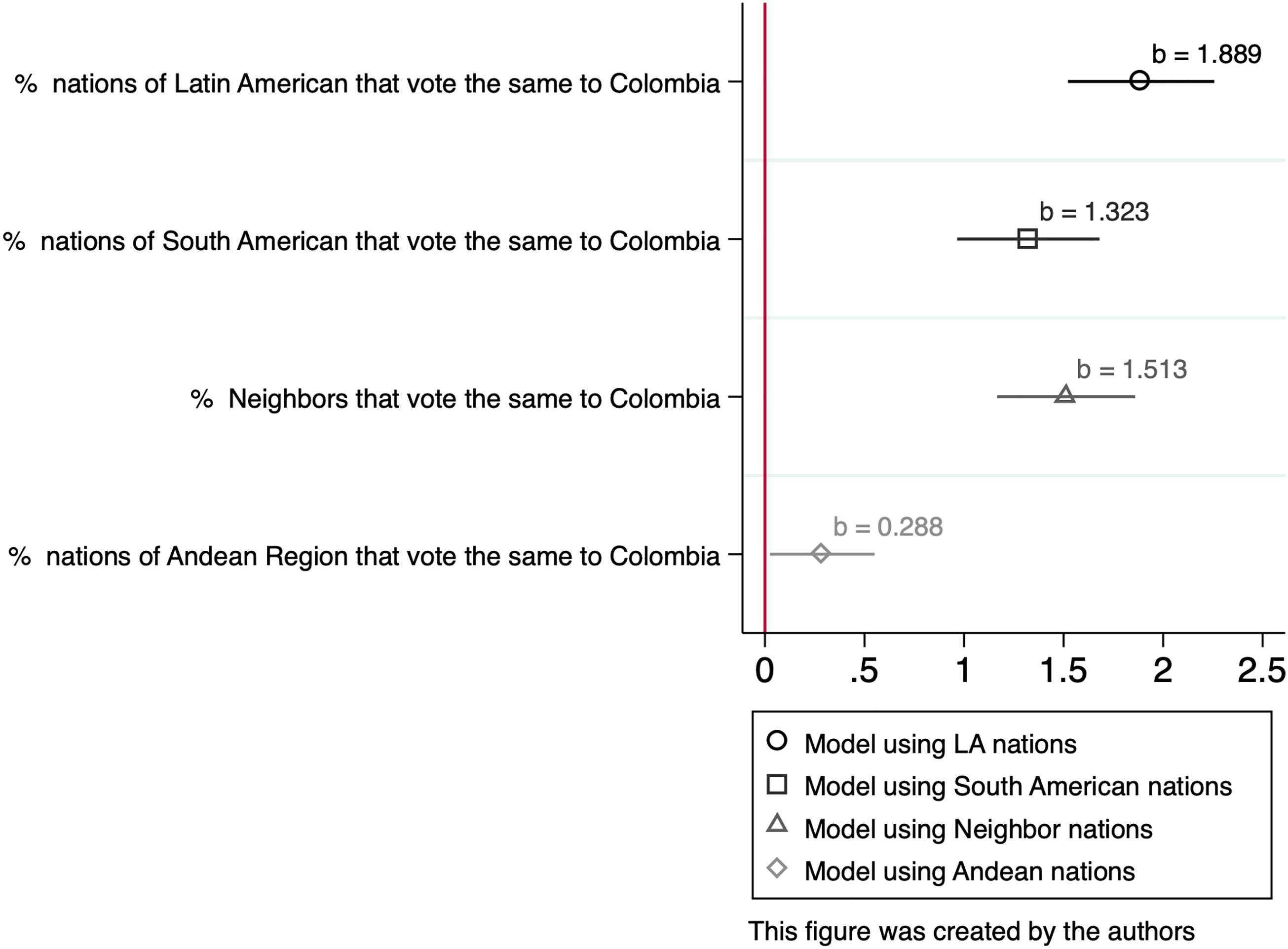
Linear Prediction of the Voting Behaviour of the Region on the Similarity of UN Voting Behaviour of Colombia and the United States.
On the other hand, the War on Drugs started during the Richard Nixon administration. Therefore, counternarcotics aid is absent in part of the period that we are studying. So, we estimate an additional model since the beginning of that policy (see Figure 2). While economic aid has a positive effect on the probability that Colombia and the US vote similarly in the UNGA, counternarcotics aid has a negative effect on the probability that Colombia and the US vote similarly in the UNGA. This model shows that trade dependence has a negative effect on the coincidence of the voting behaviour between Colombia and the US. Before 1971, trade dependence was considerable, but with a downward trend. Such a trend ends at the beginning of the 1980s. Therefore, we use the growth of trade dependence of Colombia to the United States to test our last hypothesis. This model shows that an increase in the growth of the trade dependence increases the probability that Colombia votes in line with the US after 1971. Colombia's votes often align with the United States when its trade dependence changes significantly.
Since several of our independent variables vary annually, we estimate a set of Tobit models. To perform these tests, we collapse our sample at the year level. We find that Colombia tends to vote in line with the United States when Colombia aligns more frequently with its neighbours. With respect to foreign aid, we encounter that while economic aid has a positive effect on the proportion of occasions in which Colombia and the US vote similarly in the UNGA, counternarcotics aid has the opposite effect. However, these models show that trade dependence is not statistically significant. There is something that we must consider: Using the proportion of the Similarity of UN Voting behaviour of Colombia and the United States as a dependent variable has limitations. Simplifying the analysis to the mean assumes that that variance is constant throughout the whole period, and that is not true. The effectiveness of tobit models in making predictions will be inconsistent.
Discussion
Mainstream theories of International Relations often deem smaller states to be actors that have little to no agency when designing their foreign policy. Frequently, analysts show that Latin American countries implement a series of strategies to gain autonomy from central powers, but they also describe Colombian behaviour as subordinated to American interests. Our analysis suggests that small states’ behaviour is more complex than previously assumed. Despite having a close relationship with the United States, Colombia behaves more autonomously than the literature traditionally depicts. This study provides a more nuanced view of the reasons for Colombia's behaviour in the multi-lateral forum, enhancing our current understanding of Colombia's foreign policy in such settings. We review Colombia's voting behaviour in the UNGA and analyse under which circumstances Colombia votes as the United States does. We argue that the behaviour of neighbouring nations, trade and foreign aid shape Colombian preferences in the UNGA. Future studies can explore to what extent the same calculations are applicable in bilateral relations.
Our results suggest that at least for small states’ behaviour in multi-lateral settings like the UNGA, regional interests are important for countries like Colombia, sometimes more influential than the power exerted by the United States. We argue that Colombia is willing to vote in line with the United States because of the preferences of LACA countries and not because of the coercion of the United States. This means that Colombia is not acting independently from the region. This illustrates how countries can strategically manage their actions in multi-lateral spaces and find ways to please powerful countries without compromising their relationship with their neighbours. The proximity between weak and strong states does not always come from constraints; it can arise from small states’ pursuit of their own interests. Therefore, these findings suggest that small countries engage in careful considerations and have more agency than previously assumed.
In addition, our study helps understand not only how aid conditions recipients’ behaviour and the circumstances that make it possible for recipients to overcome donors’ influence. While economic aid impacts Colombia's voting behaviour in the UNGA in favour of the United States, our analysis suggests that small countries such as Colombia strategically find opportunities to behave independently. Although Colombia benefits from counternarcotics aid, the United States cannot credibly threaten to reduce such funds. Therefore, when counternarcotics aid increases, Colombia leverages that opportunity and acts more freely in the UNGA. While these results overlap with the existing literature on small states’ autonomy, future studies can explore if small states use that independence to advocate for resolutions on issues relevant to their neighbours or relevant to their domestic constituencies.
Finally, our findings suggest that trade impacts voting decisions in the UNGA. Colombia tends to vote in line with the United States when the volume of its exports to that country is sizeable. When Colombia's economic dependency on the United States is high, Colombian vulnerability also increases. Before the 1970s, the size of trade dependency influenced Colombia's voting behaviour. However, since the 1970s, it's been the growth of trade dependency, rather than its size, that has shaped Colombia's voting behaviour. While this is in line with existing findings regarding the relevance of domestic economic actors, future comparative studies could help in understanding if some sectors are more influential than others, and whether drastic changes in trade patterns do impact countries voting behaviour in the UNGA.
We show that small states in multi-lateral scenarios can behave autonomously and that they display their agency in deciding when it is more convenient to align with or oppose powerful states. In this article, we have discussed how economic and institutional factors shape Colombian behaviour. We think it would be valuable for future analysis to review how domestic politics of global south nations influence voting behaviour in international organisations.
In this article, we focus on Colombia's case and its relationship with the United States. Additional research on small states in multi-lateral and regional forums should explore whether other countries in the global south deploy the same strategies. Also, we argued here that the nature of the asymmetrical relationship matters: Colombia and the United States have a particular relationship shaped by past interactions and specific interests. However, not all asymmetrical relationships are equal. As shown here, to better understand the foreign policy of small states, future research on the nature of those relationships in other regions in the global south is needed.
Lastly, our analysis focuses on voting similarity and it does not consider the issues in which countries tend to vote similarly: small states could display more significant levels of agency in multi-lateral settings by strategically selecting issues that do not counter the interests of major powers. Future studies can analyse the voting behaviour on specific issues to assess whether small states strategically enhance their agency by finding spaces where their voting behaviour will not be penalised because these issues are not perceived as relevant for major powers.
Supplemental Material
sj-docx-1-pla-10.1177_1866802X241302811 - Supplemental material for Respice Polum in Colombia's Voting Behaviour in the UN General Assembly: What the Evidence Shows
Supplemental material, sj-docx-1-pla-10.1177_1866802X241302811 for Respice Polum in Colombia's Voting Behaviour in the UN General Assembly: What the Evidence Shows by Carlos E. Moreno León and Paola Fajardo-Heyward in Journal of Politics in Latin America
Footnotes
Funding
The authors received no financial support for the research, authorship and/or publication of this article.

Supplemental Material
Supplemental material for this article is available online.
Notes
Author biographies
References
Supplementary Material
Please find the following supplemental material available below.
For Open Access articles published under a Creative Commons License, all supplemental material carries the same license as the article it is associated with.
For non-Open Access articles published, all supplemental material carries a non-exclusive license, and permission requests for re-use of supplemental material or any part of supplemental material shall be sent directly to the copyright owner as specified in the copyright notice associated with the article.
