






Abstract
Supplier firms are increasingly seeking new ways to personalize their offers and differentiate their products, especially in contested digital markets. One approach that shows promise involves encouraging customers to participate in pricing decisions using schemes such as “pay-what-you-want” where the customer has an input into determining the price. These approaches can benefit both the customer in terms of paying a reasonable price and reducing risk, and the supplier in terms of increasing sales and generating deep customer insights that can assist in relationship development. However, extant research shows limitations associated with these pricing approaches and, despite some qualified successes, there has not been widespread adoption in businesses. This study extends consideration of existing participative pricing schemes and proposes a new conceptual framework, termed FairPay. This framework overcomes many of the limitations of previous approaches, while addressing important challenges, especially those faced by many digital product suppliers. The framework offers an attractive pricing solution for both customers and suppliers, ensuring an equitable exchange that is based on value-in-use. We discuss the application of this framework in the context of digital products, where the approach has special promise.
Introduction
Suppliers create differentiation through their marketing strategy, with pricing decisions representing an important and highly visible part of this process (Kim et al., 2009). Recent years have seen a proliferation of digital products entering the market, which provide greater opportunities for innovative and participative pricing approaches, including involving customers in determining the price they wish to pay. Suppliers are now considering a broader range of pricing options in an attempt to further differentiate and customize their market offerings.
However, although advances in computer-mediated relationships combined with data mining permits more in-depth knowledge of key aspects of customer behavior, the opportunity for using such insights to develop personalized participative pricing has not been widely exploited and there is a lack of approaches that help guide digital marketing strategies (de Ruyter et al. 2018). Instead, customers have learned to expect price discounts when using digital channels. The visibility of digital prices across a market means that consumers can easily focus on searching for the lowest price. Digital products also introduce fundamental challenges in pricing, because their essentially free replication leads many consumers to feel digital content should be free―even though the creation of such products can have high costs. Similarly, while advances in computer-mediated relationships are shifting commerce to center on recurring revenue relationships (notably subscriptions), even there personalized participative pricing has not been widely exploited.
Experimentation with engaging customers in pricing decisions is reframing fundamental marketing decisions (Hu et al., 2015), with some innovative suppliers adopting a range of pricing approaches (and, as with crowdfunding, blurring of the lines between donations and purchases). These approaches include various forms of auctions, exchanges and a range of other pricing schemes. Many of these approaches are shortened to an acronym, e.g., ‘pay what you want’ (PWYW) and ‘name your own price (NYOP); or adopt a new term, e.g., ‘Freemium’. However, despite an increasing research interest in these pricing approaches, suppliers have attempted only limited adoption of such innovative mechanisms. In particular, there has been little attempt to develop a dynamic framework for participative pricing that integrates extant research in this important area. Instead, work has largely focused either on the economic benefits to the supplier (e.g., Kim et al., 2009), or on the behavioral responses of consumers (e.g., Gneezy et al., 2012) without providing an integrated, holistic perspective.
Attention is now needed on conceptual work that integrates existing research and provides a dynamic pricing framework for managing ongoing customer relationships in digital markets. It is here that this paper contributes by proposing a new conceptual framework for participative pricing. This framework identifies how suppliers and consumers can utilize pricing decisions to augment their understanding of the each other's perspective of value. Consumer digital products or services are an especially relevant context and participative pricing offers significant opportunity to address this challenge.
The paper proceeds as follows. First, we discuss contemporary pricing approaches, highlighting ‘pay what you want’ as a form of pricing with significant potential. Second, we consider the opportunities presented by adopting more flexible forms of participative pricing strategies. In particular, we address the opportunity to secure additional customer revenue resulting in more sales. Third, we review recent research on how consumers determine a fair price and their motives for pricing fairly. Next, drawing on research on participative pricing, we present a novel conceptual framework for dynamic pricing and consider the context for its application. Finally, we discuss our contribution and provide a detailed research agenda to extend work in this promising area.
Approaches to pricing
Changes in approaches to pricing
Today, in most business-to-consumer (B2C) relationships, suppliers set a price, and consumers can only take it or leave it. However, this has not always been the case. Historically price setting involved individual negotiations between customers and suppliers based on their needs, their relative bargaining power and their unique relationship. Social norms were largely defined by relational characteristics, with mutual consideration of empathy, fairness and generosity. Until the mid-19th century, bargaining and negotiation were unquestionably the dominant means of arriving at a price for most purchases (Phillips, 2012).
However, a dramatic change occurred with the advent of department stores. The “price tag” aimed at simplifying transactions by assisting in their scalability and operational efficiency. Although this pricing process was more efficient, the nature of commercial relationships changed significantly. A customer could now compare prices for a similar product and then choose the most attractive offer from alternative suppliers. However, the supplier no longer gained insights about the price a customer was willing to pay; instead, a customer might abstain from a purchase, or might be willing to pay more than the set price.
The digital age offers many innovative opportunities to suppliers, including the potential for them to provide their customers with personalized products, channels and messages. This has resulted in a shift from isolated transactions, to recurring transactions and subscription models. However, surprisingly, the opportunity for providing personalized prices (and framing of prices) has not been widely recognized or effectively exploited. In the limited contexts where dynamic pricing has been attempted, it has been in opaque forms that consumers often deem exploitive. Instead, the advent of digital marketing has often resulted in price slashing, with e-suppliers offering significant price discounts to consumers in distinct contrast to those offers provided through other channels. A key research question arising from these considerations is: How can pricing be made more participative and personalized in a way that enhances value to both customers and businesses, improves customer insight, and results in longer-term customer relationships?
Newer forms of pricing
Goods and services are now increasingly purchased online. In this context, pricing mechanisms such as different forms of auctions and exchanges (e.g., eBay) have become well-established. With these changes, other new forms of pricing have started to become more prominent with a growing number of innovative suppliers using and experimenting with them. Each of these requires involvement of the customer, but they differ in terms of how the supplier structures the offer and the extent of customer involvement in determining the price.
Participative pricing describes situations where customers are actively involved in determining the price paid, beyond either accepting or rejecting a fixed price. Table 1 provides a summary of illustrative examples of contemporary pricing mechanisms and variants of them drawing largely on academic studies. These approaches have been used in different industry contexts or explored in various field experiments.
Illustrative contemporary pricing mechanisms and variants.
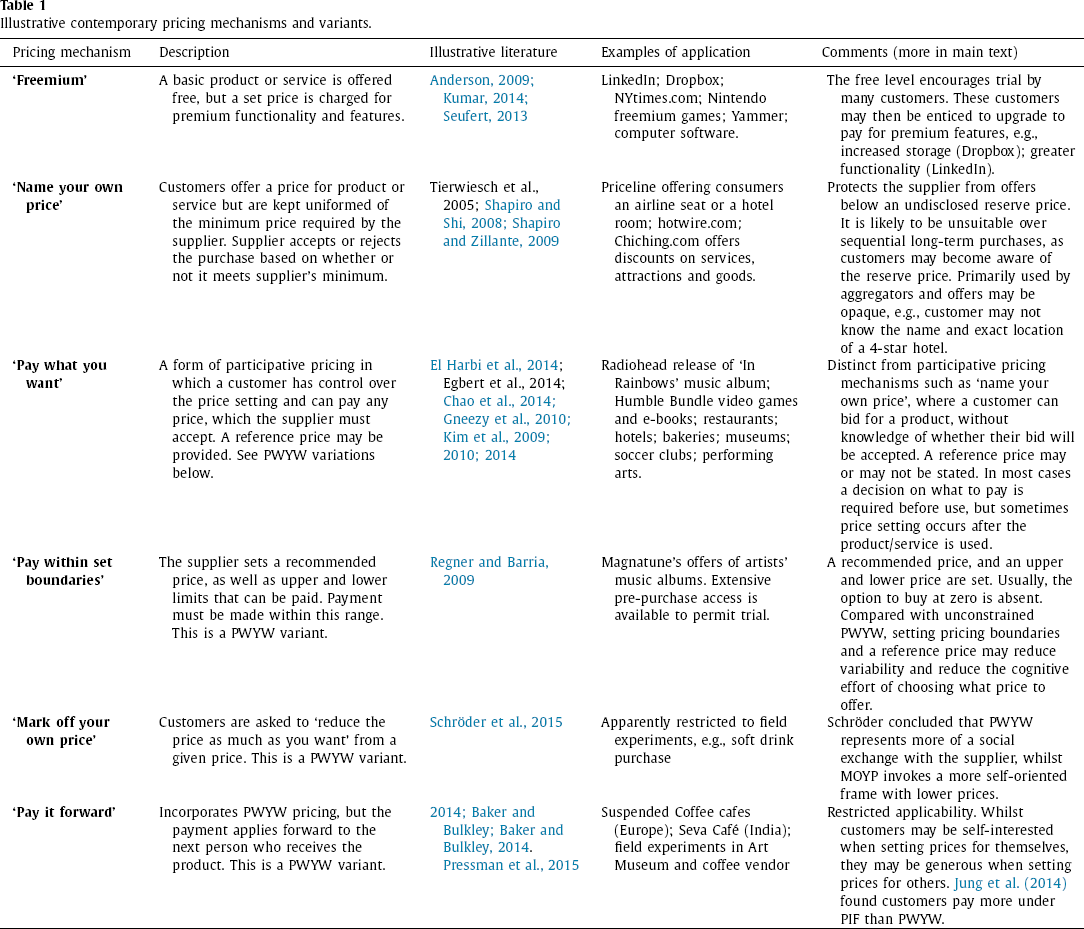
Illustrative contemporary pricing mechanisms and variants.
In this paper we consider more innovative forms of pricing, rather than those associated with general trials, free offers, bargaining, negotiations and auctions. In the review that follows our focus is on B2C markets where digital pricing approaches are especially relevant. However, we note that value/performance/outcomes pricing, or ‘contingent pricing’, increasingly becoming best practice in many business-to-business (B2B) markets, has important similarities to participative pricing in B2C markets. as well as to ‘post-pricing’.
The illustrative examples discussed below and summarized in Table 1 highlight that research is fragmented. Many pricing mechanisms are studied, often without much business design or analytical clarity on how the factors considered interact. Further, much of this practice and research is in small trials or with analytic models that may not be meaningfully realistic. The examples in Table 1 also vary in the scope of their application. Of these examples, the most prominent is Freemium, which has had fairly large-scale adoption and has become a dominant pricing strategy for digital. Also, ‘pay what you want’ is increasingly being trialed in a fairly wide range of contexts, with some of these examples representing variants of this general approach. Some of the pricing approaches in Table 1 have limited business potential (e.g., ‘pay it forward’ and ‘mark of your own price’), whilst others have larger-scale business potential. The discussion that follows considers features and limitations of each approach, providing context to the dynamic participative pricing framework we develop later in this paper.
Freemium is a pricing strategy whereby a basic product or service is offered free, but a premium is charged for greater functionality or proprietary features (e.g., Anderson, 2009; Kumar, 2014; Seufert, 2013). It is not participative; typically it incorporates a menu pricing schedule with one base tier at a set price of zero and one or more premium tiers with non-zero set price. Unlike limited-time free trials, freemium is usually a continuing limited-function option. A wide range of restrictions may apply to a free version of the product including limited features, or a lack of support. In the case of ‘free to play’ games, advancing to a more challenging version of the game may require purchasing premium credits. For the supplier, this approach can dramatically increase customer awareness and engagement with the product, while many customers benefit from free usage, hopefully leading to increased paid sales.
‘Name your own price’ (NYOP)
Name your own price is a mechanism where a buyer makes a bid for a product and if the bid is higher than an unknown reserve price then the bid is accepted. Priceline.com pioneered the NYOP approach in the online environment. Usually, but not always, NYOP offerings are ‘opaque’ as the consumer does not have full information about the products they are purchasing. For example, the supplier of an airline seat or a hotel room may not be specified prior to bidding. Generally studies suggest that this type of pricing results in an increase in profit (e.g., Shapiro & Zillante, 2009). This is participative, but is not equity/fairness based, and is often applied as a supplementary channel for price-sensitive buyers willing to put up with the opacity.
‘Pay what you want’ (PWYW)
Of all the forms of participative pricing, pay what you want, also known as ‘pay what you wish’, has received the most substantial research attention (e.g., El Harbi et al., 2014; Chao et al., 2014; Gneezy et al., 2010; Kim et al., 2009;2010; 2014; Schröder et al., 2015). Pure PWYW is a form of participative pricing in which a customer has control over the price setting and can pay any price above or equal to zero, and the supplier cannot reject it. PWYW applications have been used or trialed in an increasing number of contexts including digital content (e.g., Radiohead, Humble Bundle); restaurants (e.g. Lentil as Anything); soccer clubs (Isaac et al., 2010); golf (Machado & Sinha, 2013); and performing arts (Dallas Theatre Center, 2012). In most studies PWYW is economically viable, and some have proved more profitable in the short term than fixed price offers. In the case of Radiohead, the average price was less than the standard album price, but the offer was more profitable to the band, because no label was sharing revenues. We note that PWYW has an important relationship with other forms of voluntary payments (Natter & Kaufmann, 2015), such as recurring crowdfunding. Of special relevance to our research, the timing of PWYW is particularly important, with recent evidence that payment after consumption reduces the uncertainty of determining the value of a purchase (Viglia et al., 2019; Egbert et al., 2015). However, despite significant interest in PWYW, there is little work addressing the important question of how PWYW pricing operates in ongoing relationships (Greiff & Egbert, 2016a; 2016b).
‘Pay within set boundaries’ (PWSB)
This variation on PWYW provides a recommended price, and/or upper and/or lower price limits. For example, online music label Magnatune, might offer an album where the price range is $5-$18 with a recommended price of $8 (Regner & Barria, 2009). This framing can reduce the consumer's cognitive effort in making a judgment about price, and limits pricing extremes. Price “floors” can eliminate the supplier's risk of not covering marginal costs. The impact of providing a reference price and/or pricing bounds appears mixed and probably context dependent (Armstrong Soule et al., 2014). The downside for the supplier is the potential missed revenues from customers willing to pay more or less than the boundary prices. PWSB also precludes trial at low/zero cost, thus foregoing potential revenues for the current offer as well as future offers.
‘Mark off your own price’ (MOYOP)
This less common variation on PWYW asks customers to ‘reduce the price as much as you want’ from a given reference price. One recent field experiment for soft drink sales found that customers paid significantly less in MOYOP than PWYW, presumably perceiving this offer as an invitation to mark downward (Schröder et al., 2015). MOYOP has very limited application, primarily where suppliers wish to encourage trial or nudge customers to pay less because of competition.
‘Pay it forward’ (PIF)
This further uncommon variant incorporates PWYW pricing, but the payment relates to the next customer receiving the product. Here customers are informed that their product has been paid for as a gift by the previous customer and invited to donate a similar gift for the next customer. This pricing strategy focuses on the ethical behavior of each customer, resulting in possibly overestimating the kindness of others, with a corresponding increase in each customer's personal payment (Baker and Bulkley, 2014; Pressman et al., 2015). Examples include ‘Suspended Coffee’ cafes in Europe and the Seva Café in India. PIF is of narrow business interest, and appears most applicable where there is a simple sequence of customers, such as at a coffee shop or drive-through restaurant.
PWYW pricing considerations
From our review and recent summaries of participative pricing (e.g., Krzyżanowska & Tkaczyk, 2018; Spann et al., 2018, Viglia et al., 2019), we conclude there is high potential for a more advanced form of participative pricing in digital contexts. In particular, PWYW options can be considered as a generic structure, with tactical variations that can be parameterized and fine-tuned for testing in specific contexts and customer segments. PWYW options include: having a ‘bounded floor price’ to avoid free riders; a ‘bounded ceiling price’ to reduce consumers cognitive load in making a pricing decision; an ‘incentivized bonus’ where extra benefits are offered for prices above a given level; an ‘incentivized charitable contribution’ with benefits flowing to designated charitable organizations. Perhaps most promising is post-pricing, a surprisingly neglected variation of PWYW where the price paid is decided by the consumer after their use of the product/service and thus the price is based on their actual knowledge of the product's value. There are many contextual factors that need to be taken into account within digital markets. For example, suppliers selling individual items versus subscription sales (e.g., purchase of an album on iTunes versus taking out a monthly subscription to music on Spotify), and heavy use of ad-supported models in digital content (e.g., advertising revenues can suffer as a consequence of paywalls, as well as of consumer overload/inattention and ad-blocking in response).
The appropriateness and ultimate success of a given form of PWYW pricing depends not just on contextual considerations, but also on other important factors including: (1) the opportunity to secure incremental revenue, which, in the digital context is typically closely related to margin; (2) the fairness and ethical behavior of the customer base regarding their willingness to pay fairly, contrary to traditional economic theory that suggests customers seek to pay as little as possible; (3) behavioral responses to just how offers are framed to consumers; and (4) the ability to develop a dynamic participative pricing framework consistent with a personalized marketing approach. These factors are considered in our proposed new framework.
Participative Pricing: The opportunity to secure ‘lost’ revenue
From fixed to participative pricing
Despite the widespread practice of setting fixed prices, the potential inefficiencies of this approach are acknowledged increasingly. Price discrimination theory argues that a supplier “is always better off if it can discriminate between consumers with varying price sensitivities” (Dhar & Hoch, 1996, p. 6). Mendoza-Abarca and Mellema (2016) point out that participative pricing mechanisms bring the enterprise closer to individualized pricing. A participative pricing strategy allows suppliers to gain deeper consumer insights that can assist them in identifying consumers with differing price elasticities and potentially enable greater surplus extraction (Viswanathan et al., 2007). Participative pricing also has the potential for suppliers to gain a more precise understanding of consumers’ sense of value at any specific point of time and respond with attractive offerings. Adoption of more participative and flexible pricing approaches represents an opportunity for suppliers of not only capturing additional consumers who are unable or unwilling to pay a given fixed price, but also benefiting from those consumers who may be willing to pay more.
Participative pricing and digital markets
Participative pricing is especially applicable within digital markets. Anderson's (2006) ‘long tail of products’ represents a seminal idea explaining a substantial opportunity for revenue gain within online markets. Here e-retailers selling books and music (e.g., Amazon and Rhapsody) have significant advantages over bricks and mortar stores. While these latter retailers, faced with restricted shelf and storage space, are forced to focus on best-selling items, e-retailers operate without inventory constraints and can capitalize on generating additional sales revenue from less popular items. Anderson's long tail is a form of Pareto distribution, and the concept of a long tail can be applied to a different Pareto distribution in the context of flexible and participative pricing - what we term a long tail of customers. In Fig. 1 we illustrate the additional revenues that may be generated by adopting more flexible pricing strategies. This figure demonstrates the need for suppliers to consider not only the ‘long tail’ of potential lost consumers who cannot, or will not, pay the set price, but also those customers in the ‘tall head’ that are willing to pay more than the set price.
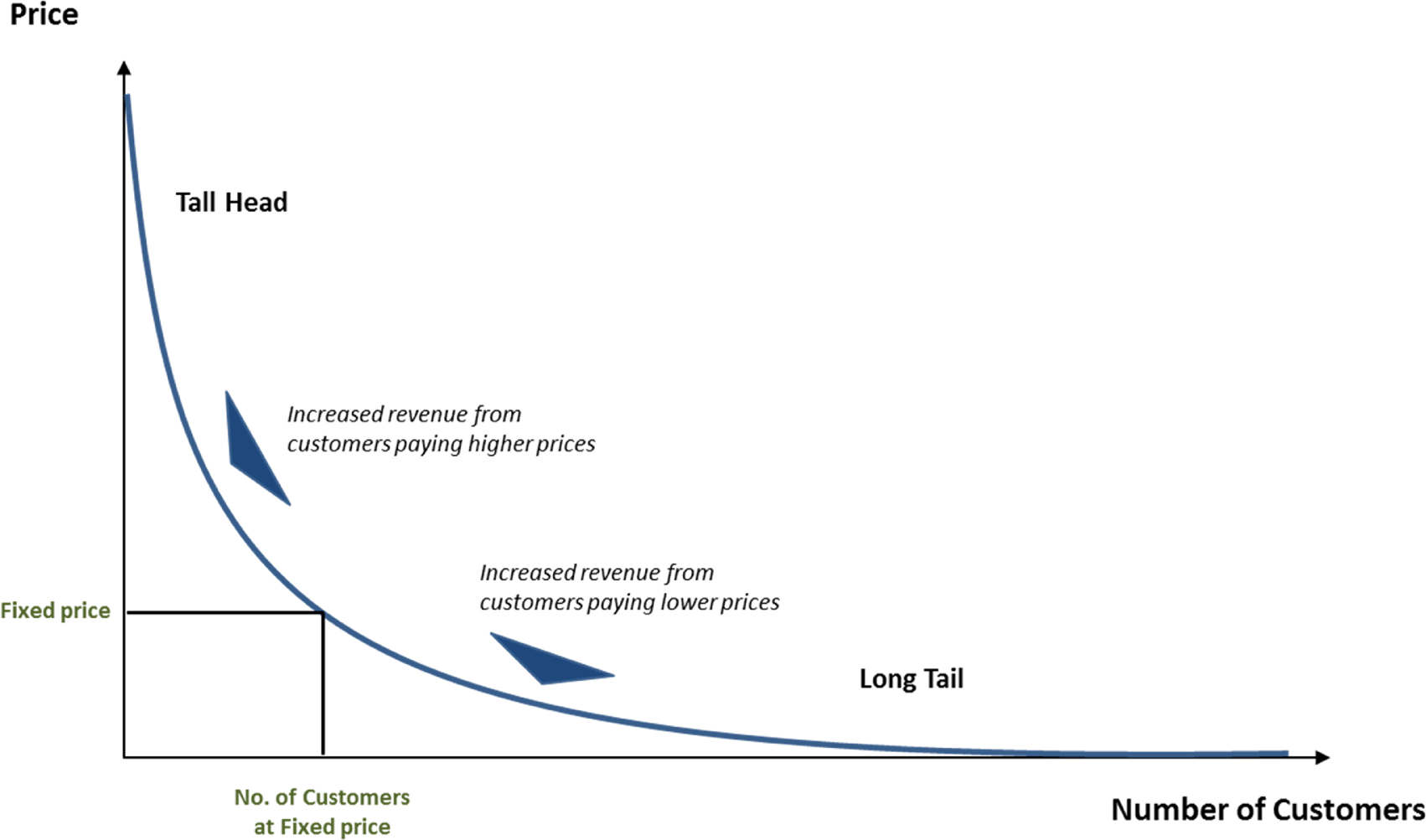
Tall head and long tail additional revenue from flexible pricing strategies.
For tall head consumers, who are willing to pay more yet are charged the fixed price, money is left on the table. The long tail of consumers depicts those who are not willing to pay the set price, but who would gain value from product usage and would pay above the marginal cost. This group of potential customers represents both lost sales and lost revenue, which for some products may represent a significant opportunity for generating revenue and increasing market share. Suppliers have typically sought to attract customers with different price elasticities through largely short-term incentives such as trial offers, coupons, special deals, bundling, volume discounts, and other methods of market segmentation. However, such efforts are usually not executed in a systematic and sustained manner. With digital products, substantial prospects exist to generate profits, even at relatively low price levels, given that there is typically a near zero marginal cost of selling additional items.
Further, there is an additional opportunity to capitalize on the ‘tall head’ of consumers who may be willing to pay more. In some cases these consumers will simply not be price sensitive and in other cases they may be motivated to pay more through features of functionality that add value to them. For certain products, such as content that carries advertising, there may be a further benefit from additional numbers of customers exposed to the advertising (Hungenberg et al., 2008). Having highlighted the potential benefits of more flexible and participative pricing, an important question is “Will consumers choose to pay fairly?”, an issue we now address.
Whilst neoclassical economic theory suggests rational consumers would pay zero under unconstrained conditions of participative pricing, recent studies show this is not the case and the total revenue (and profits) derived from using this approach can exceed expectations under a fixed pricing policy (e.g., Kim et al., 2010; Kunter, 2015, Viglia et al., 2019). We now briefly review theoretical perspectives that provide some explanation of consumer motivation for behaving fairly, and conditions that impact the success of participative pricing approaches. Recent reviews of participative pricing discuss theoretical and empirical evidence of the benefits of this approach (e.g., Greiff & Egbert, 2016a; Kunter, 2015; Christopher & Machado, 2019; Viglia et al., 2019).
Several psychological theories help explain consumer prosocial behavior. These help identify the conditions that predict when consumers will pay a fair price and suggest that consumers are motivated to behave fairly, with intrinsic goals within specific contexts (Schmidt et al., 2015). For example, some consumers are concerned for the supplier wellbeing and therefore are willing to pay fairly rather than inflict economic damage on a supplier. This preference is stronger the more valued the supplier relationship (Marett et al., 2012). Also, it seems that consumers may reciprocate fair behavior, suggesting that generous acts by the supplier, such as augmenting a product offered to a consumer, will be rewarded by higher payments in return (Kim et al., 2009). Rather than damage their own identity, consumers that are self-interested will pay fairly, seeking to keep a supplier in business for their future patronage (Gneezy et al., 2012).
Studies that consider extrinsic characteristics of equitable pricing include those relating to supplier activities and those relating to the context of a pricing decision. Consumers seek external cues to determine a fair price (Shampanier et al., 2007). A supplier has options on how to motivate and manage equitable consumer behavior. Setting a reference price can provide an uplift to the final price paid by a customer (Kim et al., 2009) and function “as normative anchors, influencing consumers to choose a price that is close to the external reference price” (Kim et al., 2014, p. 413).
Another device that suppliers can use to signal their expectations of a fair price includes using subtle (or even explicit) cues about their costs (Schons et al., 2014). Further, in monopolistic markets, consumers may fear that unfair payments may drive the supplier out of the market (Schmidt et al., 2015). The timing of pricing decision is also important, as payment after consumption eliminates a perceived consumer risk of unmet expectations (Egbert et al., 2015; Viglia et al., 2019).
A conceptual framework for participative pricing
FairPay
Digital technologies offer substantial opportunities for personalized pricing. One key opportunity is to move from the use of a fixed price to value-based pricing over the duration of the customer relationship. With such an approach the focus shifts from individual transactions to building long-term relationships, where price offers are individualized to each customer. The unique characteristics of digital provide the means of introducing a new interactive and equity-based approach to pricing consisting of a cycle of interactive and individualized pricing decisions and purchases over time, with ongoing dialog and feedback between the supplier and the customer facilitated throughout the purchase cycle. Drawing on the theoretical insights discussed above and work on a dynamic pricing framework (Reisman, 2016; Reisman & Bertini, 2018; Frow et al., 2015) we now pose a novel conceptual framework for value-based pricing in digital markets. The FairPay dynamic pricing framework in Fig. 2, outlines the key characteristics of a simple, intuitive, highly automated pricing framework that can be applied to mass consumer markets. Through implementation of this framework, the supplier and customer can engage in participative pricing at the individual customer level.
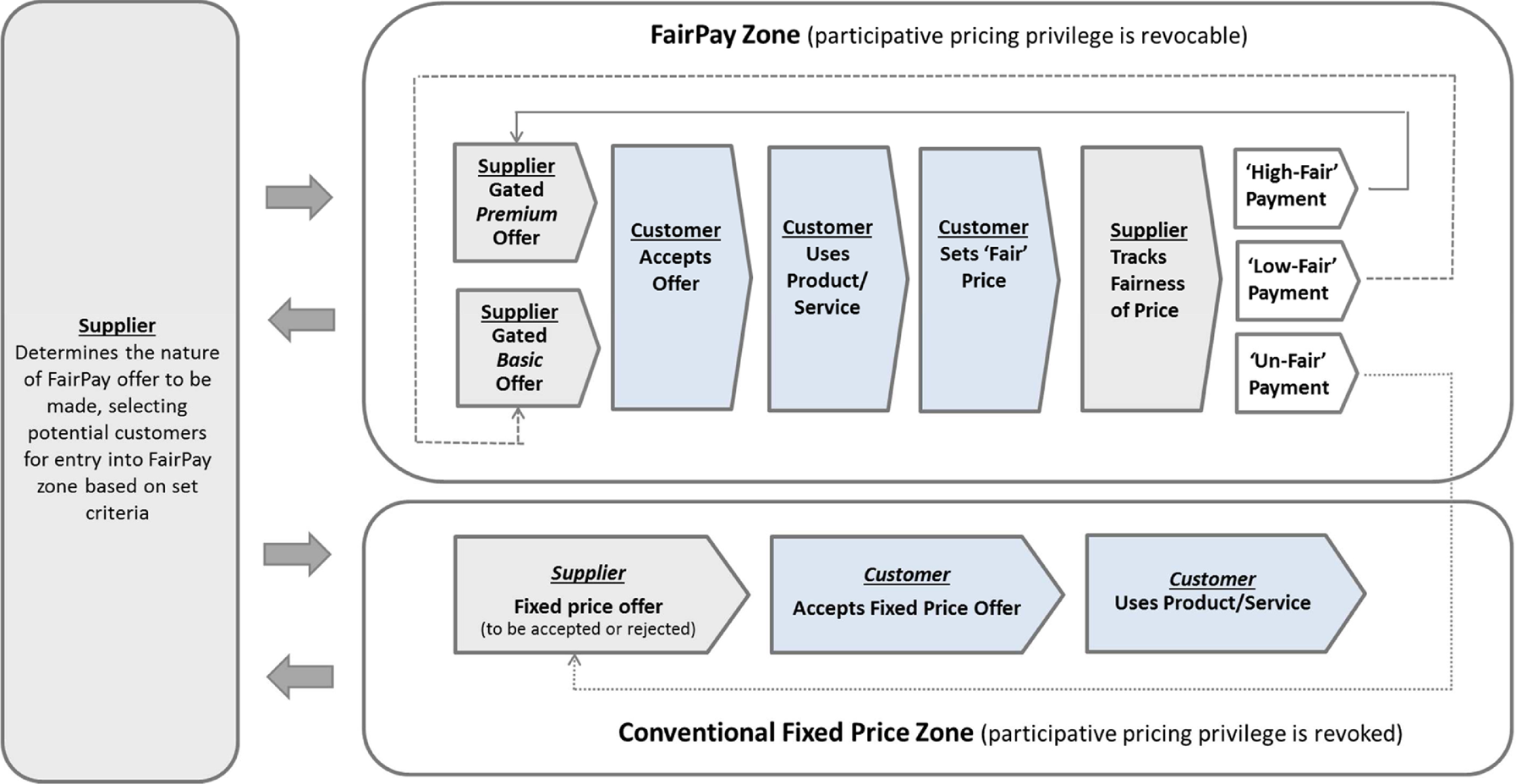
The FairPay conceptual framework.
The framework in Fig. 2 shows the customer's potential interaction with the supplier in two zones: an optional ‘FairPay zone’ that can be offered to selected customers on a privileged basis, but can be revoked by the supplier at any future time; and a conventional ‘Set-Price zone’. Within each of these zones there is a sequential process of supplier-customer interactions, the outcomes of which, over time, guide decisions regarding the zone in which future supplier-customer interactions will take place. A key aspect of the upper FairPay zone is ongoing interaction, dialog and feedback regarding the customer experience with respect to the price paid by the customer at every purchase occasion.
At the launch of this participative framework the supplier selects potential customers for entry into the FairPay zone, based on criteria such as the customer's expected fairness, sales potential, loyalty, or other factors, and generates for these customers a privileged offer to engage in participative pricing. This privileged offer may be made very broadly or quite narrowly across the customer base, depending on the context. Selected customers, if they prefer, can elect to pay a set price and operate within the conventional Set-Price zone.
As shown in Fig. 2, customers participating in the upper FairPay zone engage with the supplier in a series of sequential steps: (1) the supplier makes an offer of a product (premium or basic) to the customer; (2) the customer accepts (or rejects) the offer; (3) the customer uses the product, determining its value-in-use; (4) the customer then sets and pays a price after the use of the product, based on their usage experience; and, (5) the supplier tracks and monitors the price paid by the customer and determines if the customer has priced fairly, based on their customer usage data together with customer feedback collected through a very short set of online questions that are used to elicit customer experience and value. These questions may include factors impacting their pricing decision, their experience and satisfaction with the product and other relevant information. The nature of digital markets enables the supplier to construct an individual profile for each customer and continually update this data with information on the customer's ongoing reputation for fairness. Each transaction provides additional information about the customer including their evaluation of what is valued and what represents a fair price. Supplementary data from operations can signal and validate the value received. Optionally, ‘ability to pay’ information (e.g., income, employment status, student, pensioner, disabled) can be acquired from customers or third parties. Over a period of time and across a series of purchase transactions the supplier evaluates the behavior as ‘high-fair’, ‘low-fair’ or ‘un-fair (see Fig. 2).
These emerging fairness ratings are applied to ‘gate’, or control, customer access to future offers. Customers rated ‘high-fair’ may enjoy supplier-gated premium offers, while customers rated ‘low-fair’ may be limited to supplier-gated basic offers. Premium offers can be featured as incentives to nudge customers into the ‘high-fair’ category. For example, subscribers to a digital publication may be offered extended content that is supplementary to match shorter articles in the publication; they may also be offered invitation-only discussions or participation in live events. As a disincentive, preferably rarely applied, the supplier may warn ‘un-fair customers that such price behavior is not sustainable, and continuation of their privileged offers may soon be revoked. This would leave such customers restricted to the Set-Price zone.
The FairPay framework is based on seeking to build customer/supplier relationships characterized by cooperation, trust and mutual commitment. A supplier can design a choice architecture for a ‘repeated game’ (e.g., Greiff & Egbert, 2016b)―designing and reviewing individualized offers, testing each offer and optimizing to the customer's evaluation of value-in-use. Over time, the customer is motivated to gain a reputation for fairness, which the supplier rewards based on the value of the relationship. Relationship value can include revenue, contribution and customer lifetime value, but also factors such as advertising views, provision of data, and referrals to others.
The advantages of this dynamic participative pricing and value discovery approach include not only engaging the customers in dialogue about value, but also offering the supplier the opportunity of integrating real-time, real-life market research into their ongoing operations. In contrast to set-prices, this dynamic framework allows a supplier to continuously learn how consumers’ individual differences influence their responses to offers and focus on those consumers most likely to participate fairly in collaborative pricing (e.g., Weisstein et al., 2016). The supplier benefits through higher revenue, which is gained through accepting offers from any customer willing to pay a fair price. These customers include those who previously were unwilling to meet a fixed price, but are willing to pay something―the ‘long tail’, as well as others who might be motivated to pay even more than the fixed price―the ‘tall head’ (see Fig. 1). Even if average revenue per user may decrease, total profit (and sales) can increase. As a competitive strategy, the framework offers a personalized approach to fulfilling customer needs that deepens interactive relationships, engages customers and builds their loyalty. It shifts the game from competitively zero-sum price discrimination and bargain hunting to cooperatively win-win value discrimination. FairPay operationalizes an emergent, offer-driven pricing strategy, making the entire firm more adaptive to market-sensing from the bottom up (e.g., Smith, 2012).
The FairPay framework is especially relevant to long-term customer relationships in digital markets, where value-in-use may vary considerably between different customers, different usage patterns and times, and different abilities to pay. The framework allows the supplier to understand and capitalize on usage differences and adapt and learn from them. It is also suited to contexts when a customer perceives that a product is valuable, but the originator of the offer is not fairly rewarded as a result of a fixed price, or where an intermediary takes too much of the margin. For example, many musicians often receive relatively minimal rewards in comparison with the music label producers. Fans may decide to go out of their way to reward musicians they admire as the example of the band Radiohead demonstrates. Potential industry sectors that could especially benefit from adoption of this framework include suppliers of journalism, videos, podcasts, digital books, games, and software apps (and non-profits). It could be especially effective in a situation where a shared platform infrastructure could manage the supplier-customer dialogue, assimilate the reputation history of each customer and use the individualized information collectively. In such contexts, the data becomes useful longitudinally in much the same way as a credit rating database, by identifying the reputation of each customer for paying a fair price.
Other contexts are applicable for the framework, where instead of relying only on unit volume, the customer offers a price that also reflects value in-use. The customer may suggest a fair price that relates to their usage (such as the number of articles, books, songs, or video programs accessed in a subscription period) and incorporates a volume discount. The supplier thus encourages heavy usage, but can offer more affordable prices over the spectrum of usage. Although the customer has equitable control within the relationship, the supplier can explain, for example, peak pricing, guiding the customer in fair pricing decisions. A supplier can segment customers, designing offers that reflect the unique context of each customer or group of customers. For example, an offer could reflect the ability to pay of a particular customer segment (as often done for students or seniors), their usage, time of the usage, how many devices, and how many users are using this service.
The FairPay framework is particularly relevant to suppliers with low marginal cost and where there is a long tail of customers who do not purchase because of a fixed price, yet would pay at a level consistent with their own specific value-in-use (Raju & Zhang, 2010). News, information and magazines are industry sectors facing severe pricing pressures that threaten their sustainability and application of the framework in such sectors may be very valuable. With music and video content suppliers, there are opportunities to use the framework to build unique offers for purchasing downloads or subscription services that are linked to the value in-use for specific customers. The framework's adaptive value discrimination ability can be applied to achieve dynamic segmentation of customers―as they vary from one another, and over time―to better reflect variations in usage contexts, usage levels, value-in-use, and even ability to pay. This has the potential to simplify current methods of segmentation that are more rigid, difficult to design, and that can lead to customer resentment by appearing seemingly arbitrary.
Application of this framework is not restricted to digital offerings, or even to low marginal cost offerings, but is applicable to other categories where fixed prices do not fully capture potential revenue. For example, perishable goods are well suited to this framework, where a supplier can gain revenue from products that a customer may not purchase at a fixed price level. Offers that allow a customer to choose their own in-use value can be attractive to both customer and supplier, as a more win-win alternative to NYOP. Minimum price floors can be applied to ensure that participative prices will cover marginal costs, even for non-perishable goods and where marginal cost is not low, so that the FairPay component is restricted to the sharing of the value (a profit margin) above the cost-recovery floor. The FairPay nudging process can also be used with ‘carrots’ and no ‘sticks” to boost non-profit donation models.
Discussion
Our work responds to calls for additional research that investigates consumer decisions and choices in the context of new pricing models (Grewal et al., 2012) and “How should prices be set to properly reflect customer, competitive and consumer considerations” (Marketing Science Institute, 2014, p. 9). This paper reviews evidence of how participative pricing can benefit both suppliers and customers, discussing how a conceptual framework for participative pricing, FairPay, provides a novel and valuable approach to differentiating offers, engaging customers and building sustainable, long-term customer relationships.
There are several important aspects to this conceptual framework that distinguish it from other participative pricing models. First, consumers are empowered with the pricing decision, making a decision on the price after experiencing the product and therefore reflecting their in-use value. Empirical evidence highlights the benefits of paying after consumption, as consumer uncertainty is reduced (e.g., Viglia et al., 2019, Greiff & Egbert, 2016b). Reciprocity is encouraged, as customers learn that their generosity is rewarded with premium offers and perks from the supplier. Higher prices may occur after consumption as the consumer does not apply a risk margin for a possible unsatisfactory experience with the product (e.g., Machado & Sinha, 2013).
Second, FairPay promotes enhanced dialogue between the consumer and supplier, adopting a flexible, longitudinal approach to pricing decisions. A supplier can set reference prices that guide consumer price decisions and at any time can request consumers to explain their choice of price. This approach creates enhanced understanding between supplier and consumers, allowing suppliers to augment their offer in line with those aspects that are especially valued by the consumer. Extant studies of PWYW explore the net effect on revenues of PWYW pricing at the aggregated level. Use of the framework in the digital environment enables a more granular approach to understanding PWYW mechanisms longitudinally and with individual customers.
Finally, the framework adopts a long term, cyclical approach to customer relationships, rewarding and reinforcing fair customer behavior with favorable offers while ensuring that the supplier is satisfied through fair payments. This cycle creates a new balance of power supporting the equitable behavior of both customer and supplier―a ‘repeated game’ (e.g., Greiff and Egbert, 2016b). FairPay offers a dialogue about value between customer and supplier at each stage of repeating customer journeys, focusing on building trust to maximize long term value.
Contribution to theory
Our first contribution is to provide a conceptual framework for participative pricing that enables the continuous generation of new customer insights regarding price setting. Applying this approach is likely to yield significant understanding of how customers set prices and determine value and which particular aspects of an experience are the most salient within a specific context. These deep insights reflect valuable feedback on consumers’ value-in-use. They are dynamic and can assist in the ongoing design of personalized and unique offerings over the long term.
Second, participative pricing offers opportunities for enhancing long term, sustainable customer relationships, providing a new emergent approach to continuously identifying how best to compete. Previous approaches to understanding price as a relationship building strategy have largely focused on short term tactics such as premium offers, discounts and limited-time incentives. Each of these approaches focuses on appealing to consumers’ desire for getting more for less money, a strategy that is likely to provoke price cutting and competitor retaliation, and lead to consumer bargain-hunting and defection. The conceptual framework provides a means of developing―and measuring―deep customer relationships. The approach draws on previous research that investigates participative pricing in consumer markets, but extends this work to include relationship-building components, making the framework more broadly applicable, especially in digital. The framework permits supplier and customer to agree on a pricing approach, uniquely building the loyalty and profitability that maximizes customer lifetime value for those customers that can be supplied profitably. It offers a novel process for maximizing the advantages of participative pricing (and post-pricing), developing strong relationships that are built on trust and achieving a sustainable revenue stream. This can be thought of as a kind of social contract. Complementary to the invisible hand that works across a market, this agreement is an invisible handshake that works along each relationship.
Third, our conceptualization contributes to the literature on co-creation, in particular the motivation for moving customers from passive to active participation (e.g., Prahalad & Ramaswamy, 2004). Despite significant recent discussion on co-creation, there is little work on exploring different forms of co-creation and in particular collaboration regarding pricing decisions (Frow et al., 2015). FairPay provides a novel method for investigating co-pricing, exploring how value perceptions are dynamic and context specific. In particular, the framework explores the mechanics of engaging consumers, shifting them from ‘passive receivers’ of a price to ‘active co-pricers’.
Contribution to practice
Currently, many firms offer personalized products, channels and messages to their customers, yet the opportunity for providing personalized prices has largely been ignored. Instead, the advent of digital relationships has caused price slashing, with e-suppliers offering significant discounts compared to other channels.
Our first managerial contribution relates to the use of the FairPay participative pricing framework to increase the customer base. Participative pricing has the potential to expanding the group of customers that can be served profitably by serving the ‘long tail’ of customers who are interested in purchasing the product, but are unwilling or unable to pay the set price. In addition, this approach may result in increased revenue from those customers in the ‘tall head’ who are more willing to pay more than the set price. For low marginal cost products in digital markets increasing revenues can generate substantially improved profits. Value-based pricing has been mainly applied in the context of B2B markets. The framework we describe has the potential to extend value-based pricing in B2C markets.
Second, use of the participative pricing framework provides the opportunity to generate much deeper insights into customer attitudes regarding price, customer experience of the product and resulting customer satisfaction. Using this knowledge, suppliers can develop idiosyncratic offers that are highly personalized to a customer and that respond to their experience of value-in-use. The framework proposed in this study provides a new basis for segmenting customers, based on their perceptions of value, their fairness and their willingness to participate in pricing decisions. As a result customer insight is greatly enhanced.
Finally, our framework provides the means of building long-term relationships with customers helping ensure that profits and revenue will be sustained over time. Customer involvement in participative pricing offers opportunities for enhancing relationships and building trust, fairness, reputation and commitment between suppliers and customers. The customer insights generated through participative pricing and resulting information emerging from customers’ experience of the product and resulting customer satisfaction permit the building of trusted relationships. For both customer and supplier, the experience of equitable participative pricing in one product category provides the platform for building a relationship in other product categories.
Future research
A growing interest in participative pricing has resulted in both conceptual and empirical work that investigates this topic. However, to date, most of the scholarly participative pricing studies use online experiments or field experiments and in a limited range of contexts. Field experiments have largely been restricted to particular sectors (e.g., restaurants, Kim et al., 2014). Research investigating participative pricing has largely focused on its benefits as a shorter-term promotional tool, although noting the potential opportunity for long term advantages (Kim et al., 2010; Riener & Taxler, 2012). Surprisingly little work integrates extant findings and provides a more holistic perspective that can guide theory development and managerial practice. We argue that future research should especially focus on forms of participative pricing that have broad-based potential rather than restrictive studies with limited potential such as ‘pay it forward’ and ‘mark off your own price’.
Our conceptual work in this paper is aimed at making one contribution to this shortfall, with the FairPay conceptual framework incorporating insights from previous studies investigating participative pricing. However, much research remains to be undertaken including empirical work across a range of contexts that quantify the impact of firm adoption of our conceptual framework. In Table 2 we provide a research agenda for inquiry into participative pricing.
Participative pricing: a research agenda for scholarly inquiry.
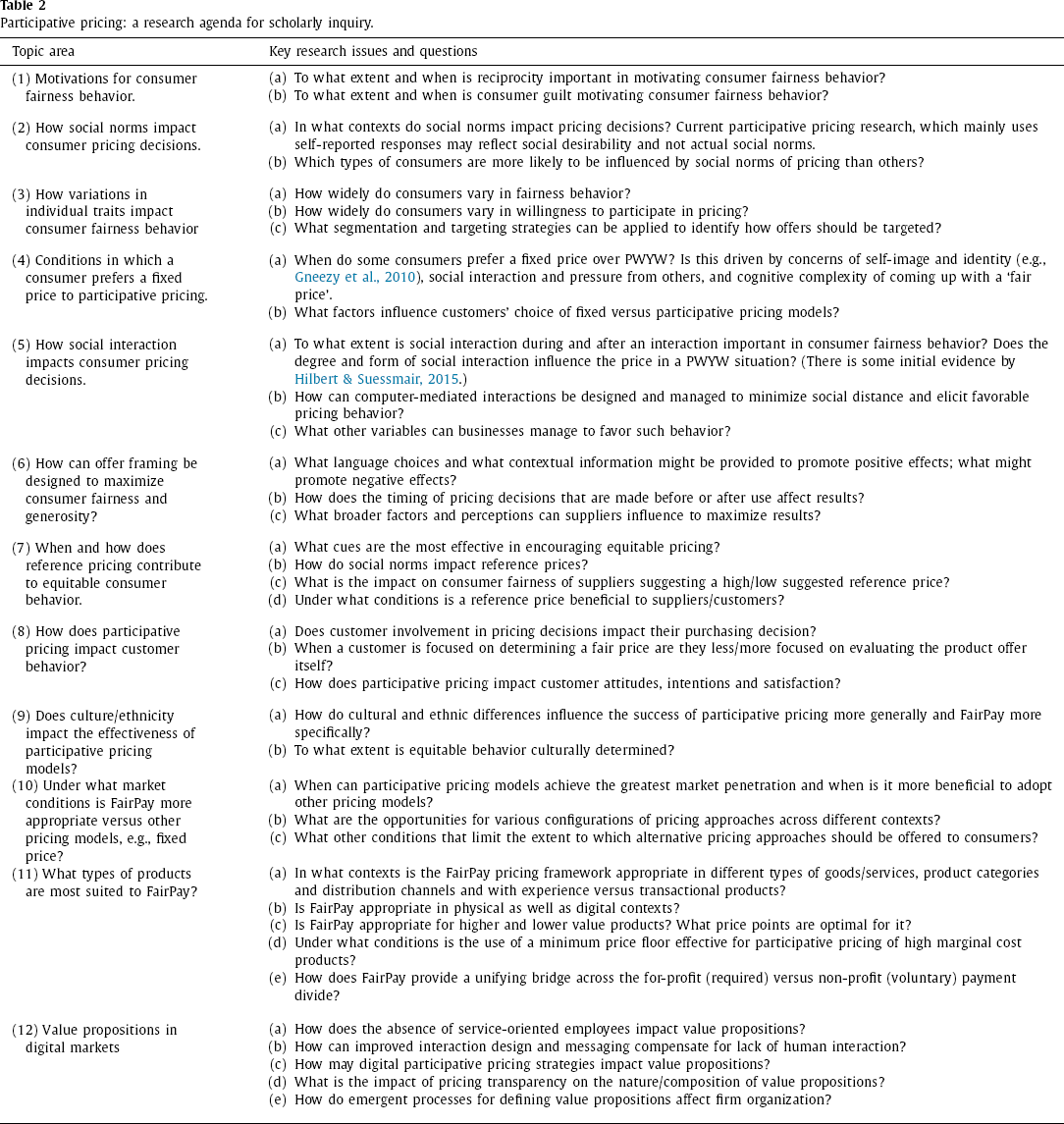
The first three topic areas in Table 2 propose further investigation into motivations for consumer pricing behavior, including the impact of social norms and individual traits related to consumer fairness.
Topics four to eleven call for work exploring the conditions that impact participative pricing. For example, we suggest comparative studies regarding the conditions when consumers prefer fixed price to participative pricing. Some key issues and questions here include how context, timing and prior experience impact the motivation for participative pricing and in particular consumers’ desire to price fairly. Recent work reveals some important insights about the timing of consumer price participation (e.g., Viglia et al., 2019). In addition, prior work mainly focuses on aggregated benefits of participative pricing, without exploring such effects at the individual consumer level, at different times and contexts. Our work draws upon these findings, but suggests detailed examination across conditions and time is now needed. Our framework provides personalized, idiosyncratic pricing offers for individual consumers that now need further testing―not just in isolation, but as a process for integration of emergent pricing into ongoing business operations (Smith, 2012). Further, FairPay may be a unifying framework that bridges the gulf between purchases for profit and non-profit donations; understanding current and emerging methods holistically across that spectrum could be especially fruitful (e.g., Hu et al., 2015).
Our final topic relates to further work exploring value propositions, especially those addressing digital markets. Digital markets are essential for a wide range of products and services, yet there is limited work that investigates how best to price in this highly competitive channel. We call for empirical work that explores this important topic.