



Abstract
Introduction
Besides higher efficiency and sensitivity, another advantage of capillary/nano LC is the volume compatibility with the μ-liter fraction requirements of MALDI targets. One of the challenges is the collection of nanoliter volumes without remixing the separated compounds and losing chromatographic separation. In this work, a high-precision X/Y/Z robotic system, Probot™, was used that allows for the collection of tiny nanoliter volumes with zero chromatographic dispersion.
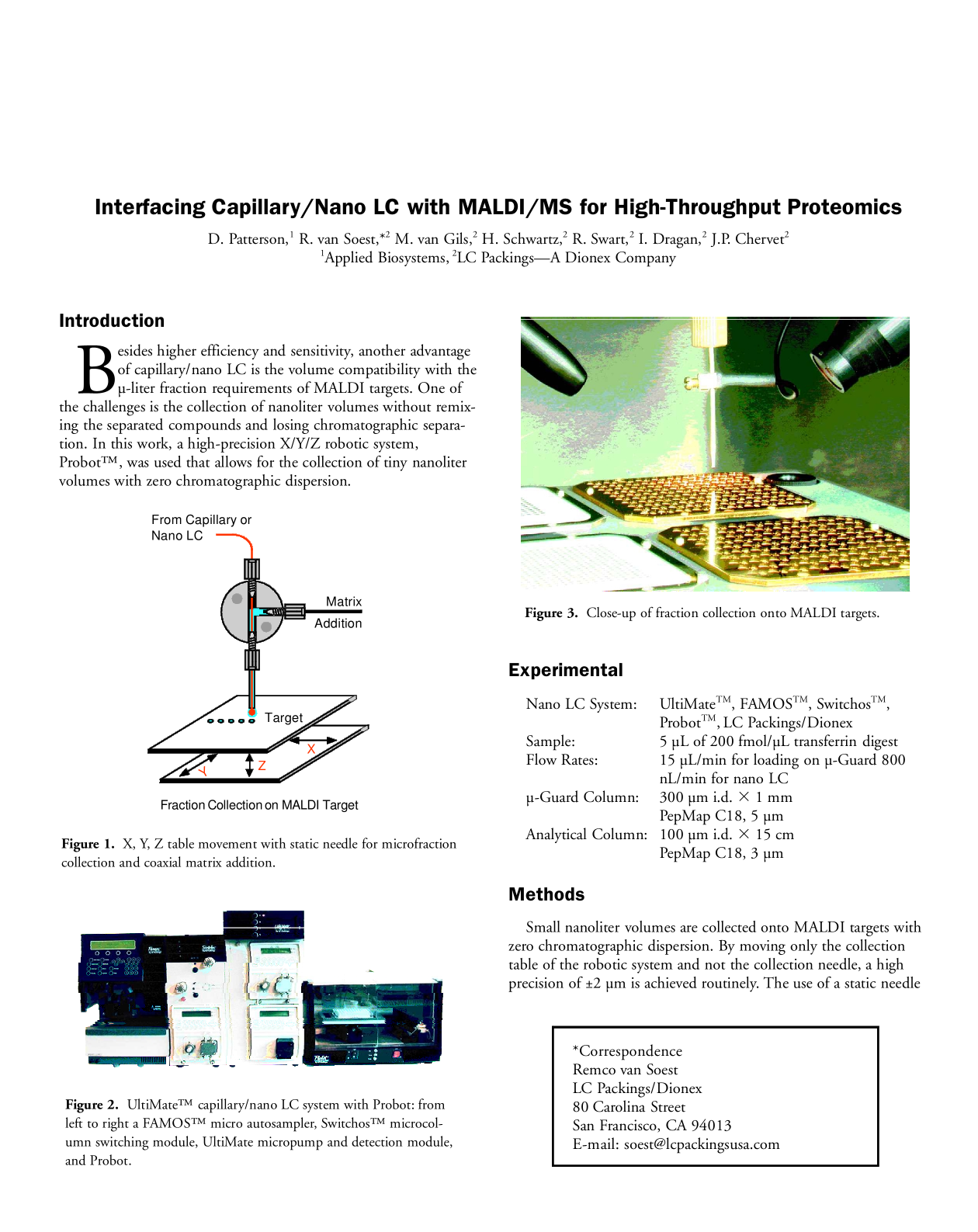
X, Y, Z table movement with static needle for microfraction collection and coaxial matrix addition.
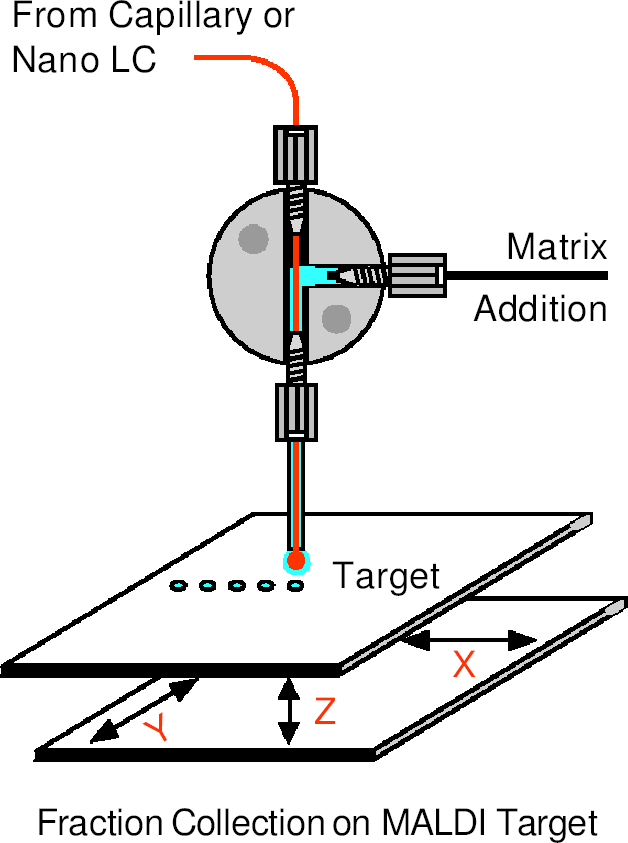
UltiMate™ capillary/nano LC system with Probot: from left to right a FAMOS™ micro autosampler, Switchos™ microcolumn switching module, UltiMate micropump and detection module, and Probot.
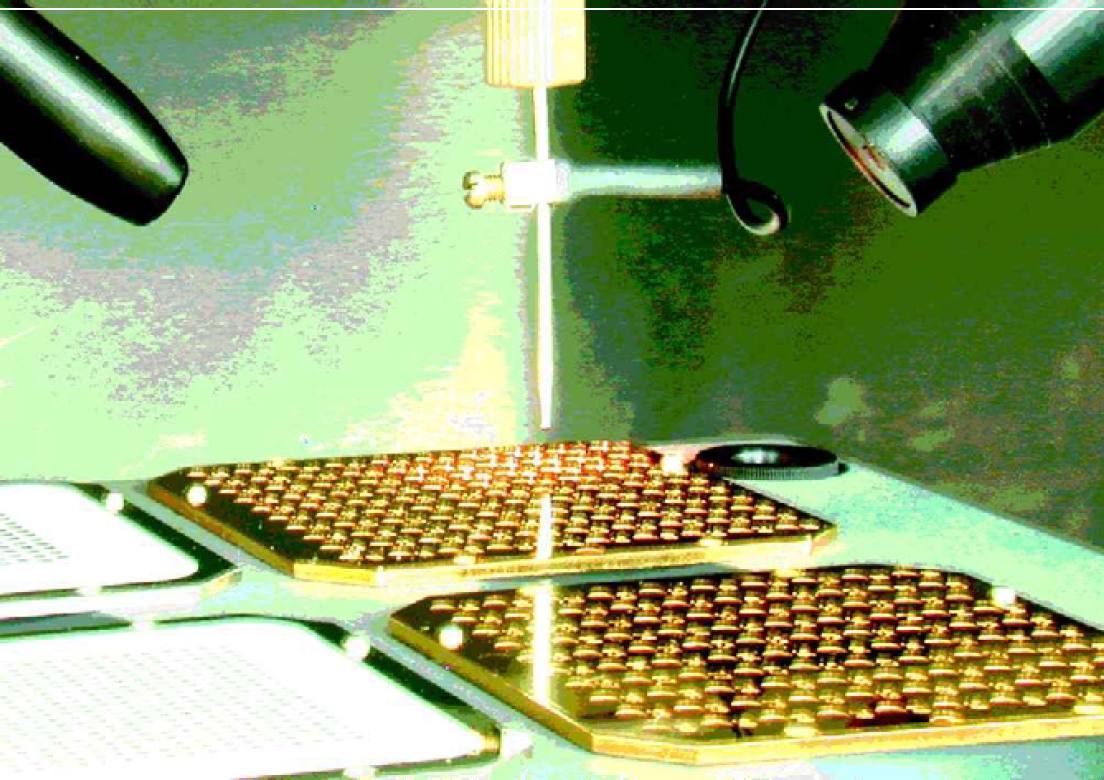
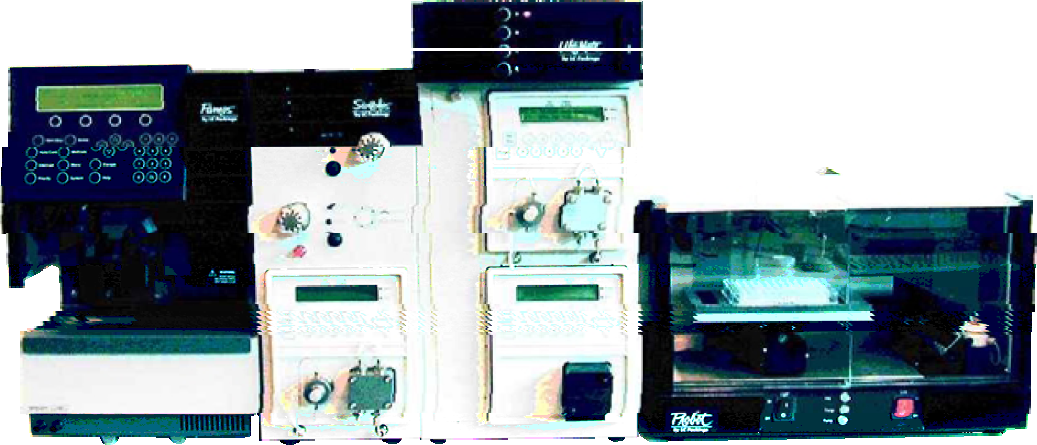
Close-up of fraction collection onto MALDI targets.
Experimental
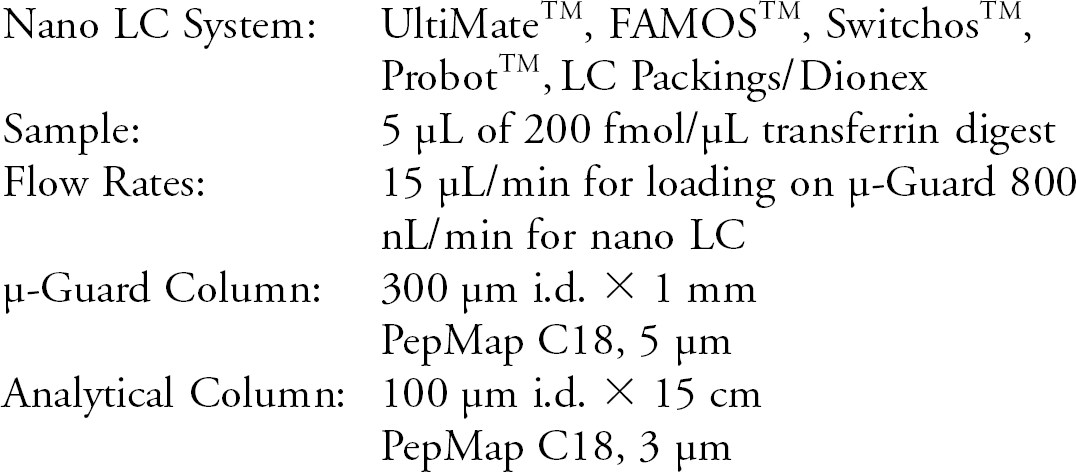
Methods
Small nanoliter volumes are collected onto MALDI targets with zero chromatographic dispersion. By moving only the collection table of the robotic system and not the collection needle, a high precision of ±2 μm is achieved routinely. The use of a static needle allows for the collection of small nanoliter volumes, which is impossible with a moving needle due to capillary forces. For optimal crystallization, the needle setup allows for coaxial and postcolumn addition of matrix solution, generating a perfect sweet spot. For high throughput using MALDI/TOF/TOF MS, up to six high-density targets can be placed on the table deck. Using nano LC with typical 200 nL/min flow rates, collection times as short as 2 s are possible that result in collection (spotting) volumes as low as 7 nL. Under these conditions, no chromatographic dispersion is observed (zero dead volume), and therefore highest MALDI/MS sensitivity is achieved. Another advantage of this approach includes the sample preservation, allowing for optimizing work flows and sample reanalysis.
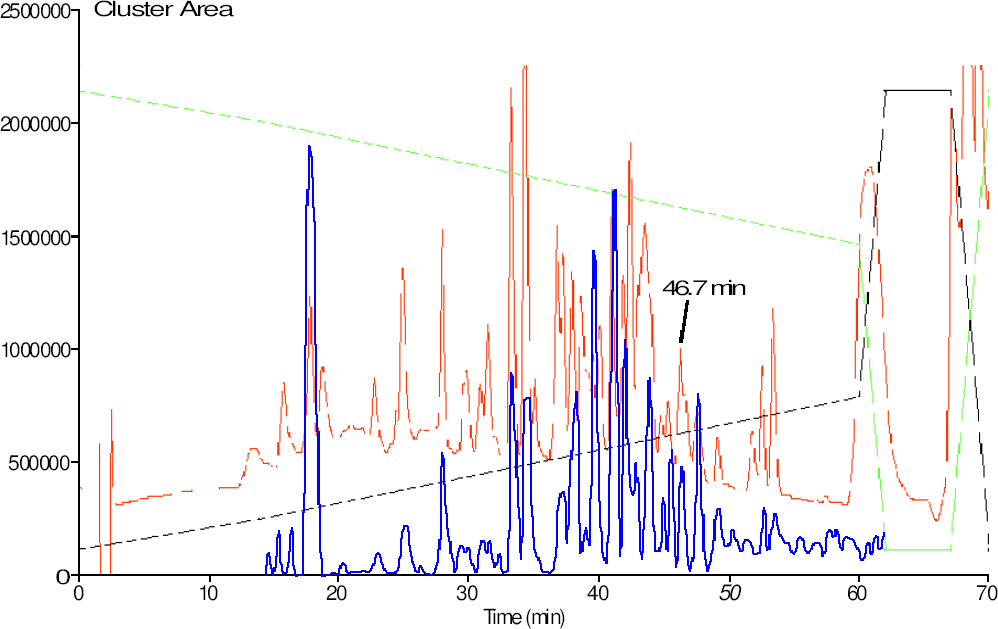
UV (214 nm) and MALDI (BPI) trace of 1 pmol transferrin digest, illustrating zero chromatographic dispersion (frequency: 28 s/spot). Peptide eluting at 46.7 min collected on well #100.
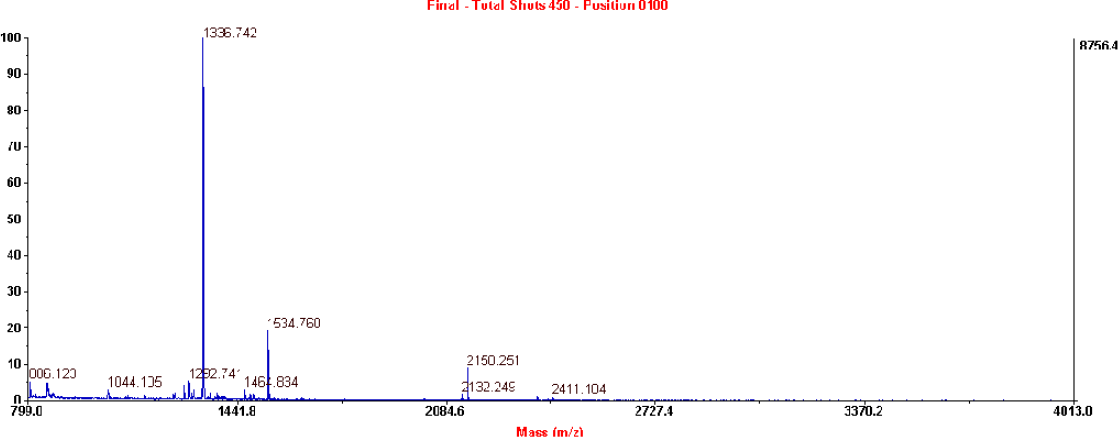
MADLI/MS spectrum of spot #100 eluting at 46.7 min (m/z 1336). MS data can be recorded from any spot.
Results
With the Probot microfraction collector, on-line collection of μL- and nL-fractions eluting from capillary/nano LC systems is possible with the highest reproducibility. Fractions can be collected on many different target types.
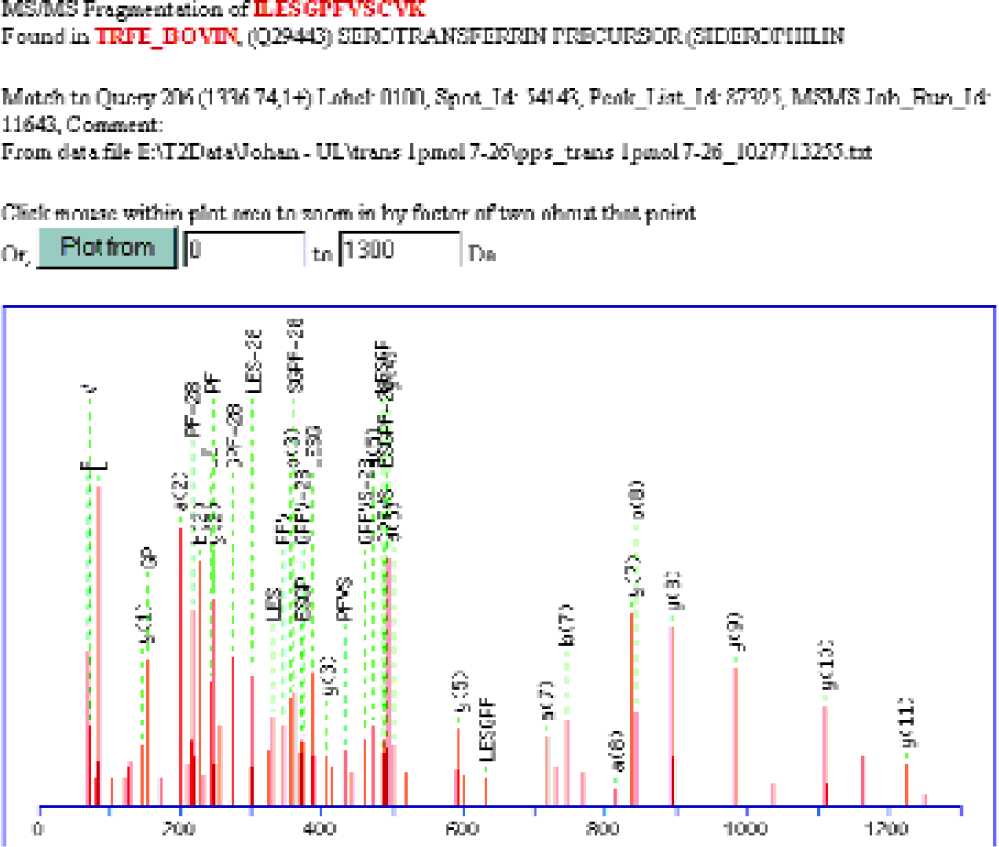
MS/MS spectrum from peak m/z 1336. Very strong and complete y-ion series with immonium ions and internal fragments for sequence verification are obtained, allowing for unambiguous identification by database search.
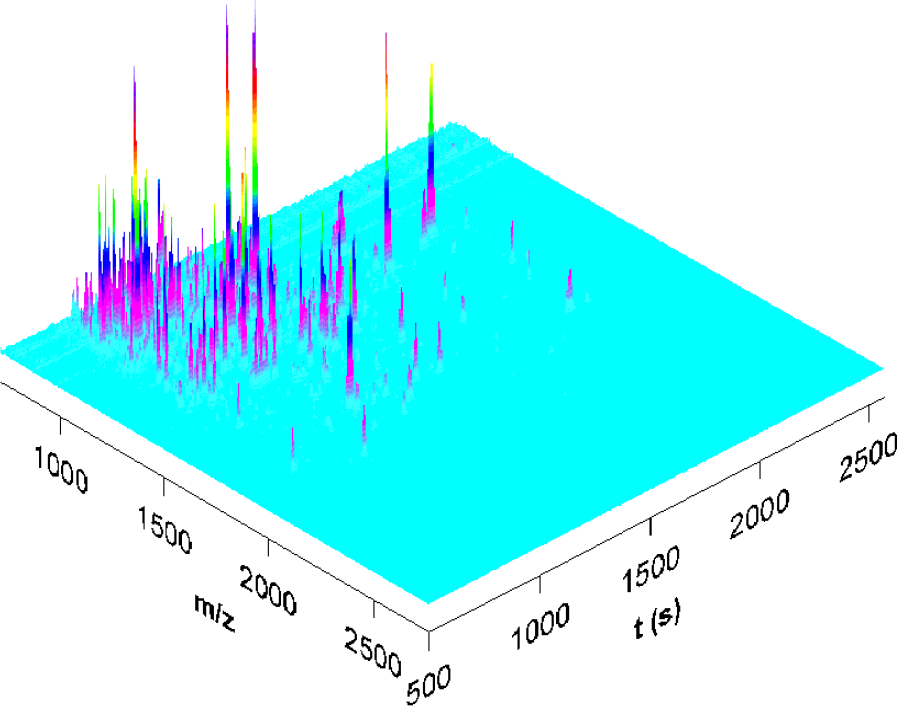
A 3-D mass map of Yeast digest fraction #8 after a 2-D separation on SAX and RP (5 s fractions).
Conclusions
A method has been developed to collect entire chromatograms onto MALDI targets. Transferrin has been successfully separated using a nano LC system, coupled to a Probot microfraction collector. The analytes eluting from the nano LC column are directly collected onto MALDI targets for subsequent MALDI/MS analysis. The use of Probot allows for a high degree of automation with zero chromatographic dispersion, and the transcription and storage of the entire chromatogram on MALDI targets.