



Abstract
Healthcare's shift in focus, demand and expectations presents medical practices with opportunities to effect change in office operations and patient services. Developing strategies to incorporate technology among staff and physicians is a high priority for practice administrators today. A computerized medical record is a significant change in the daily activities of physicians, clinical support staff, and patients. A multi-manufacturer, integrated information system that routes data from a patient's body through a point-of-care device and straight into a patient management system — all without keyboard entry — is the Office of the Future.
WHAT IS THE OFFICE OF THE FUTURE PROJECT?
The Office of the Future Consortium integrates design, technology and information to develop physicians' offices that:
increase cost-effectiveness and efficiency;
improve clinical outcomes; and
improve patient and provider satisfaction.
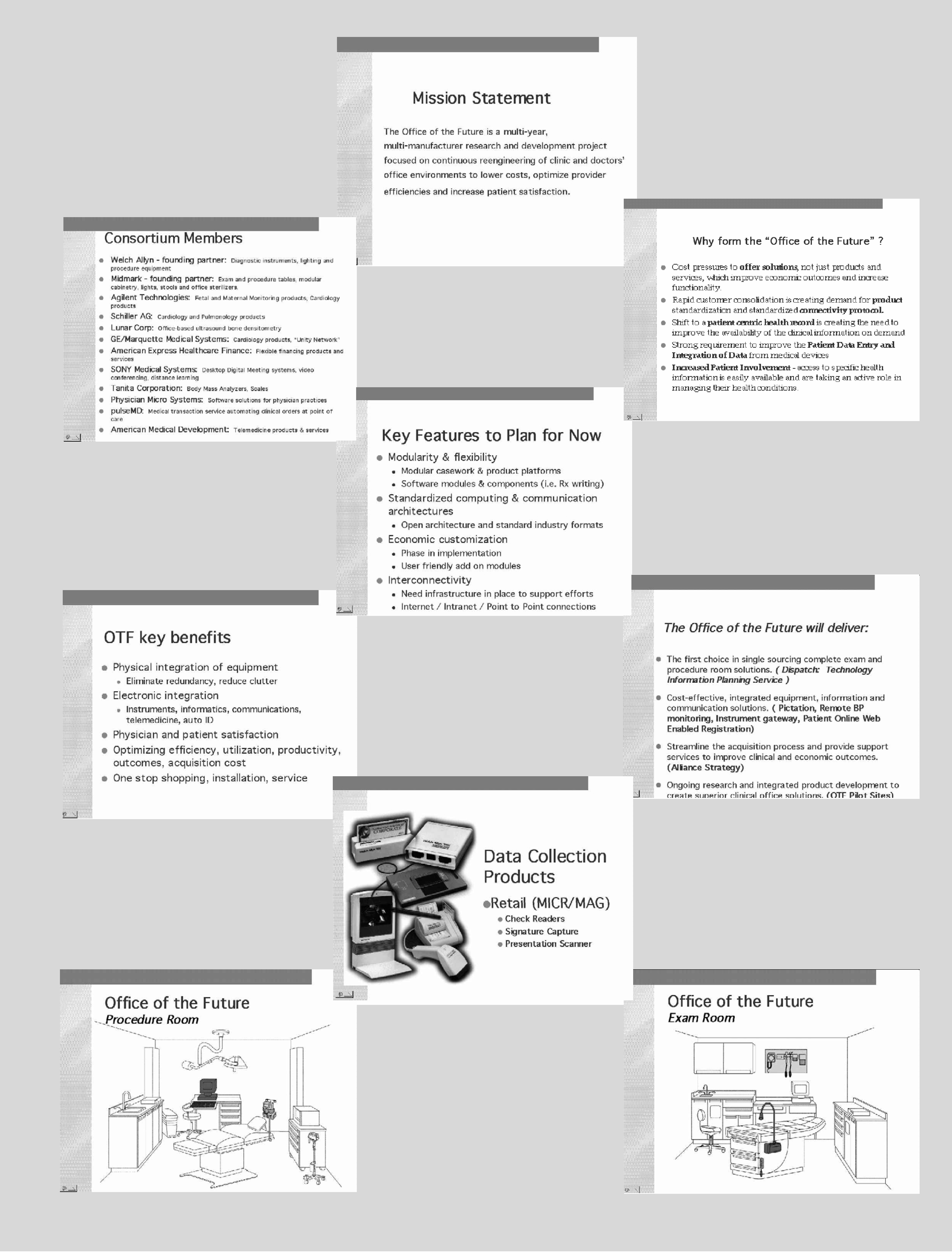
The Office of the Future Consortium was founded by Welch Allyn, a world leader in the design and manufacture of high-quality medical diagnostic instruments, and Midmark, makers of market-leading procedure and examination tables, sterilizers and modular cabinetry. Since the inception of the Office of the Future Version 1.0, Hewlett-Packard, now known as Agilent Technologies, joined the Consortium, working in concert with Welch Allyn and Midmark to develop Version 1.1 of the OB/GYN Office of the Future. Realizing that the next big leap in office efficiency will come from computer-based patient and practice management systems, Physician Micro Systems Inc. and pulse MD, developers of software and information systems for physician practices joined the Consortium. Other associate members in cardiology — Agilent Technologies, Marquette, Schiller, and Brentwood by Midmark — now allow for the true integration of ECG and other integral medical devices into the Office of the Future. The one-stop solution includes bone densitometry by Lunar, telemedicine integration by American Medical Development and SONY Electronics Medical Systems and financing by American Express Healthcare Finance.
The Consortium has launched a series of multiyear pilot studies to provide proof-of-concept information and assemble a national advisory board of physicians, health maintenance organizations, and integrated health systems to establish ergonomic and other operating and design standards.
OFFICE OF THE FUTURE: PROJECT OBJECTIVES
Enhance provider productivity through product integration, efficient layout, equipment access and usage.
Eliminate redundancy among various manufacturers' equipment, sharing technology platforms wherever possible.
Create an overall environment that promotes patient satisfaction with their clinical experience.
Take a leadership role in device compatibility related to telemed cine, medical information systems and other communication technologies.
Incorporate new tools and technologies previously available and affordable only in higher-cost settings.
Maximize cost effectiveness of initial acquisition and ongoing operating/support expenses.
In the Office of the Future, modularity and flexibility are paramount, so that components can be easily and economically customized to each site's unique requirements. Standardized computing and communication architectures lay the groundwork for several levels of interconnection: the ability to share images, patient records and even admissions and accounting information between locations. Universally applied design standards enable each provider to adopt “best practices”, utilizing examination or procedure rooms that optimize work-flow ergonomics for the provider, maximize space efficiency and coordinate equipment both functionally and aesthetically.
WHAT DOES THE MEDICAL PRACTICE GAIN IN THE OFFICE OF THE FUTURE?
Version 4.5 of the Office of the Future features a distinct lack of clutter and smooth, graceful integration of all major instruments, computers and furnishings. The integration of existing and new technologies to provide truly seamless implementation of diagnostic equipment and information systems to improve physicians' office operations, increase patient satisfaction, and provide outcomes data is a key benefit of the Office of the Future. Increased functionality and efficiency is gained through automated patient identification, a computerized patient record, and direct data input from medical devices. Emphasis on the integration of multiprocedure video platforms and telemedicine-ready diagnostic equipment allows remote physician consultation and increases access to appropriate care for patients.
Improved data gathering is accomplished with a patient check-in kiosk where the patient can privately and independently self-register and complete their medical, family, and social history. The kiosk serves to notify the medical staff of the patient's arrival and automatically generates specimen labels with patient identification tags for authentication. The right knowledge at the right time produces the right results, and patient identification and association with clinical data is integral to the Office of the Future solutions.
Practices gain future upgrade compatibility with emerging device and information architectures. An integrated PC/procedure monitor, combined to eliminate redundancy and reduce cost, provides optimal viewing of live images and can be used for image management, annotation and patient record access. Other examples of product integration and compatibility are Welch Allyn's Vital Signs Monitor and Exam Light II, which mount to the Midmark table eliminating clutter associated with stands while positioning light exactly where needed. The Vital Signs Monitor as well as the Tanita body composition analyzer pass patient vitals directly to the Physician Micro Systems Practice Partner computerized patient record, eliminating data entry by clinical staff and potential erroneous recordings. The procedure station with the Welch Allyn VideoPath system, sink, disinfection tray, and suction pump facilitates performing a wide variety of procedures in an office-based environment, including flexible sigmoidoscopy, colposcopy, and rhinolaryngoscopy while capturing and saving images in a computerized patient record management system.
ID tags worn by patients provide an automated tracking mechanism used to gather data and analyze wait times and patient flow within the practice. Implementation of new technologies such as the computerized patient record is eased with the integration to devices, collecting data electronically rather than requiring clinical staff to input information. Device connectivity to the patient record is a tremendous advantage in the practices' quest for an efficient and effective office operation. The computerized patient record improves access to patient information within as well as outside the facility, tracks patient compliance with treatment plans, monitors physician adherence to practice guidelines, and improves provider productivity with prescription writers, templates, and custom views of patient data.
The Consortium is providing cost effective integrated clinical equipment solutions now. The project will continue to explore the physical relationship of the office, patient and practitioners in much greater detail for future versions. Ongoing research and development components to provide timely solutions consistent with the need of the front line medical practice provider are being conducted at several provider sites.