



Abstract
A Thailand quality assessment program called ìThe External Quality Assessment in Clinical Chemistry, EQAC” was found in 1986. A blind lyophilized control serum is monthly-cycle distributed to the participants and the returned test-report values are evaluated by a computed program. Evaluated report Mean Variance Index Scores (MVIS) and mean score of all tests are posted back to the participants.
In 1999 the program was applied by 324 laboratory participants of which 59% of general hospital and community health hospital laboratory, 29% of private hospital laboratory including polyclinics, and 12% of the others. By now as many as 144 trials of 23 biochemistry tests at different methods were assessed from the EQAC program. Participant communication, knowledge update and enhanced quality encouragement have been managed by mean of participants' VIS from 120 to 93 during 1987–1998.
For the next millennium, the implementation of ISO/IEC Guide 25 for quality system in clinical laboratory will be a promising strategy of quality improvement in Thailand. The Ministry of Public Health is step forward to adopt this guide for certifying standard laboratories. These efforts will be a first step towards the next generation of quality improvement for clinical laboratory in Thailand.
Keywords
Chamras Promptmas

INTRODUCTION:
The clinical laboratory is responsible for the total quality of laboratory information services from the time patientís specimen is collected to the time completed analytical result is available to the physician. The major intent of quality assurance is to identify and eliminate laboratory errors through various activities in 3 major aspects: preventive activities, assessment procedures, and corrective actions(1–2).
The analytical errors both accuracy and precision were determined for assessment procedures. This activity consists of internal and external quality control programs. The external quality control programs have been conducted by many institute both national and international programs(3 –7). These offer a good assessment of the state of the art of clinical laboratory quality analysis including in clinical chemistry laboratory.
Thailand External Quality Assurance Scheme (TEQAS) for clinical chemistry has been established since 1978 by Professor Dr. T.P. Whitehead and Dr. D.M. Browning under the collaboration of WHO. This activity is sustained in both Department of Medical Science, Ministry of Health and Mahidol University. To date, “The External Quality Assessment in Clinical Chemistry: EQAC” is the most active program in Thailand(8). This program has been managed by Associate Professor A. Prijavudhi which supported by Department of Clinical Chemistry, Faculty of Medical Technology, Mahidol University.
The quality improvement of clinical laboratory must be generally considered in three major areas, pre-analytical, analytical, and post-analytical processes(9 –11). All processes require high standard of technical expertise, academic background, and also a quality of management system. In Thailand, it is comparatively small number to the entire Thai population, 60 millions, with more than 3,000 medical technologists and new graduates, approximate 400 each year, from 8 state and private universities. The laboratory assistants have been allowed to perform laboratory service under the supervision of medical technologist or pathologist. Therefore, continuing education will be an essential activity for all personnel improvement.
MATERIALS AND METHOD:
Regarding to EQAC program(8), the lyophilized control material (human or bovine serum) was in-house prepared and analyzed for 23 biochemical analytes, Albumin, Bilirubin, Calcium, Chloride, Cholesterol (Total), Cholesterol (HDL), Creatinine, Glucose, Phosphate, Potassium, Protein, Sodium, Triglyceride, Urea, Uric Acid, Alanine Transaminase, Alkaline Phosphatase, Aspartate Transaminase, Creatine Kinase, Creatine Kinase (MB), Glutamyltransferase, Lactate Dehydrogenase, and PSA, respectively. The package of lyophilized control serum is illustrated in

The Package of Control Serum Using in EQAC program.
The comprehensive program for EQAC consists of quality assurance training course for all new participant, a proficiency testing survey, and continuing education as summarized in

Activity Diagram of The External Quality Assessment in Clinical Chemistry.
All key personnel of participantís laboratories have been trained for understanding the concept of quality assurance before starting. A blind lyophilized control serum was monthly-cycle distributed to the participants by post together with appropriate report form. The test results were filled in the from and returned back to the organizer for evaluation within 2 weeks.
All returned test-report values were evaluated by a computer program. This computation of EQAC program was in-house development. The proficiency of each participantís laboratory was calculated using Variance Index Score (VIS), Bias Index Score (BIS), Mean Variance Index Score (MVIS), and Mean MVIS as following:

X = test results obtained from participantís laboratory
DV = designated value
(mean of individual test results from all participants)
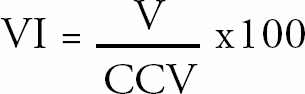
V = % Variation
CCV = chosen coefficient of variation which was recommended by WHO's International External Quality Assessment Scheme 1997.
The VIS was assigned as a value as calculated VI when VI lower than 400, while VIS was assigned to 400 in case of VI was 400 or higher. BIS was identical in value to the VIS, but retaining the sign of its difference from the DV. MVIS was the average of individual participant VIS. Mean MVIS was the average of all participants MVIS. The MVIS values between 0–50, 51–100, 101–150, 151–200 and higher than 200 were interpreted as very good, good, medium, low and unacceptable quality, respectively.
The proficiency testing report was enclosed in the next trial together with EQAC Newsletter.
RESULT OF QUALITY IMPROVEMENT
The number of participant in EQAC program was obviously increased from 45 laboratories in 1986 to 324 in 1999 as presented in
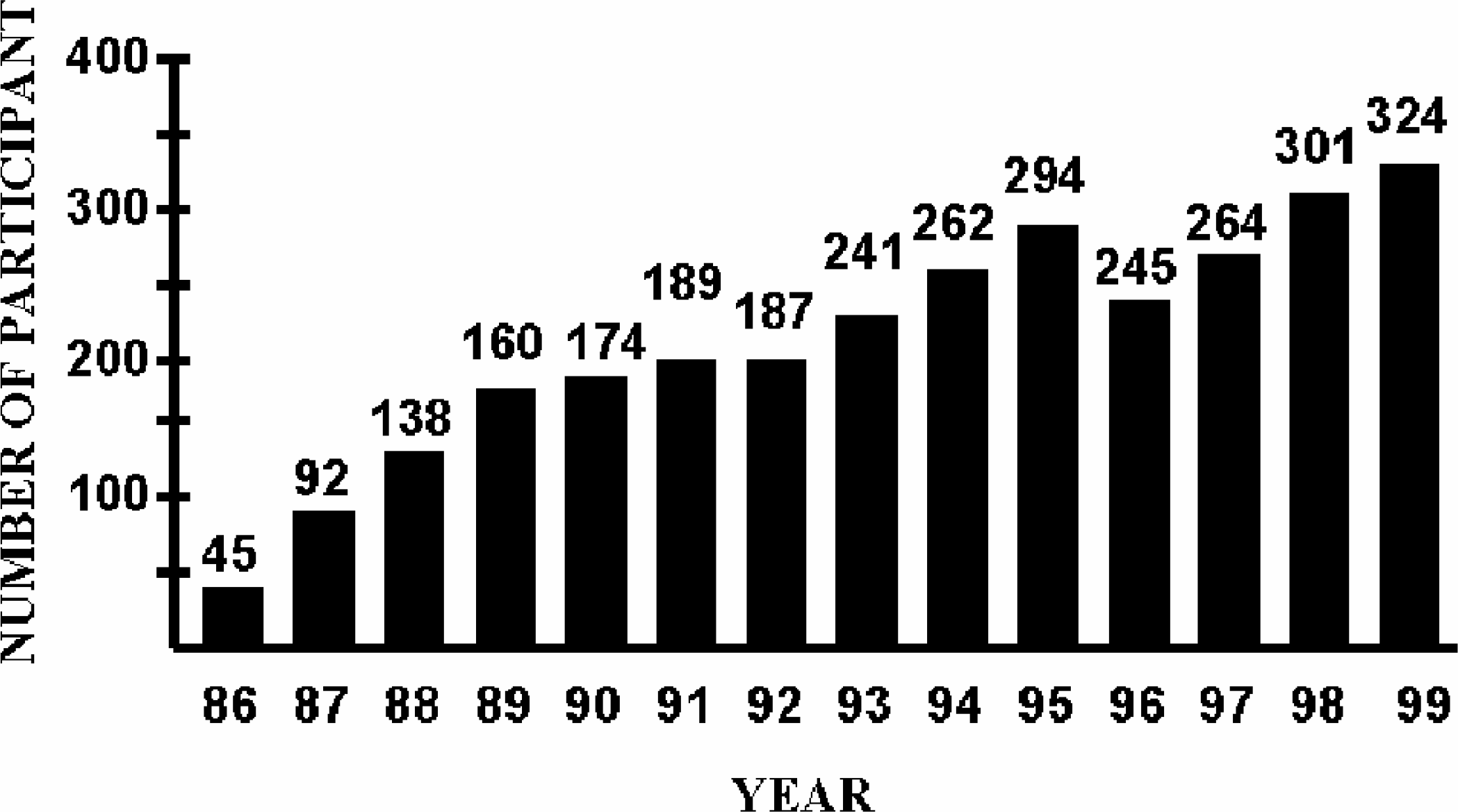
Number of Participant in EQAC Program During 1987–1999
The average MVIS of participant laboratory was dramatically decreased from the value of 120 to 82 in the first 2 years of EQAC program. The later was maintained at 90–93 as shown in Figure 4. About 60% of participants had good MVIS of 100 which denoted approved quality while 31% were at MVIS of 101–150 (medium quality) and 9% were unacceptable quality MVIS.
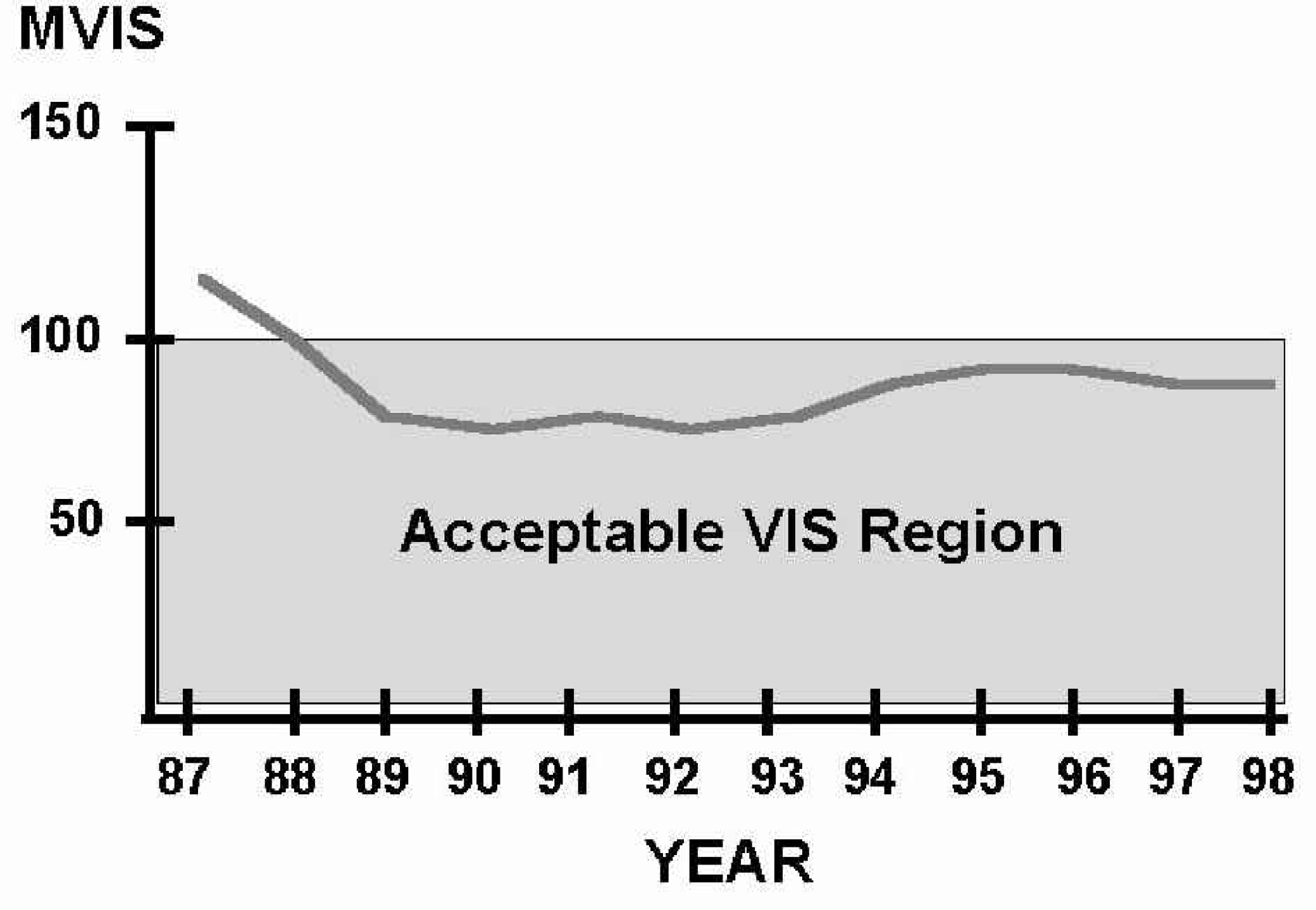
Mean VIS of Participants in EQAC Program During 1987–1998.
NEXT STEP OF QUALITY IMPROVEMENT:
Recently, the Office of Laboratory Standards was founded by Ministry of Public Health for the promotion of quality service in laboratory medicine. This office decided to use ISO/IEC Guide 25 for laboratory standardization. Officially, this guide has been managed by the Thailand Industrial Standard Institute (TISI) which is one of 16 member countries of the Asian-Pacific Laboratory Accreditation Co-operation (APLAC). The APLAC member consists of Australia, Brunei, Canada, China, Hong Kong, India, Indonesia, Japan, Korea, Malaysia, Nepal, New Zealand, Papua New Guinea, Philippines, Singapore, Taiwan, Thailand, USA and Vietnam.
The proficiency testing is one of the essential technical requirement in ISO/IEC Guide 25(12). With very high experience in management of proficiency testing program, the EQAC can step forward to be a certified body for this particular activity.
The academic institute in Thailand also internationally participated and operated for quality improvement promotion. the EQAC program was assigned to be WHO collaboration for the quality assurance training program. Two or more training requests from Asian countries such as Sri Lanka, Nepal, Phutan, Bangladesh, Burma and PDR Korea was submitted to EQAC each year. Recently, more than 20 participants from those countries had been trained for management of quality assessment for clinical chemistry laboratory. In early 1999, the First Colloquium on Standardization of Laboratory Medicine in Asia was held in University of Indonesia under the co-operation with The Japan Society for the Promotion of Science (JSPS) to initiate laboratory standardization between Asian countries including Thailand. This seminar was prepared for sharing the experience and addressing state of the art of quality assurance in clinical chemistry laboratory among the participants, developing a guideline for good laboratory practice, and planing a multi-lateral co-operation system of Asian regional body responsible for clinical laboratory quality standardization in the next millennium.
CONCLUSION:
This EQAC managed the proficiency testing for 12 years without interruption so that it has been recognized as a major institute for quality improvement of clinical chemistry laboratory in Thailand. Apart from first TEQAS supported by WHO, the EQAC program provided not only the proficiency testing but also education and consultation by mean of national and international training courses, and monthly published Newsletter. EQAC program can be classified as second generation of quality improvement in Thailand. However, several community hospital laboratories need to improve service quality by upgrading their knowledge and skill. To boost up the quality service, it needs to have the next generation quality improvement which has closed interaction with participant in quality problem solving. ISO/IEC Guide 25 is promising system for this activity. Due to the capability of university based EQAC, this program has been proven not only to be certified proficiency testing body in Thailand but also to be international training center for quality assurance.