



Abstract
Historically, access to large numbers of quality compounds in a parallel solution phase library synthesis environment has been hindered by the inability to rapidly purify, quantitate, and characterize solution phase libraries in an efficient and cost effective manner. At Neurogen Corporation, we overcome these barriers by employing a collection of novel workstations in the High Speed Synthesis (HSS) group that are tightly integrated into our informatics architecture. This approach supports rapid and reliable instrument operation, rapid interpretation of results, and decision analysis for further downstream tasks and processing. Our movement of library samples and data from workstation to workstation facilitates synthesis throughput and the utilization of equipment, creating a cost-effective library production environment.
Keywords
Introduction
In HSS, our goal is to support ongoing Neurogen discovery projects and long-term screening activities through the creation of chemical libraries. Our approach to chemical diversity is founded through the formation of numerous focused libraries containing a dense set of homologous analogs built around biologically privileged core structures. To this end, the Neurogen HSS strategy focuses on the continuing creation of libraries through the rapid synthesis of organic compounds using parallel solution phase techniques.
As a key element in our overall discovery approach, library synthesis is a component of our larger Accelerated Intelligent Drug Discovery (AIDDsm) effort. AIDD strives to facilitate drug discovery by tightly integrating high-capacity synthesis, screening, and automated molecular modeling within a two-week iterative discovery cycle. The following sections describe our approach to parallel solution phase library synthesis and our strategy to resolve common challenges during the synthesis process.
Synthesis Workflow
A fundamental element in all high throughput synthesis efforts is the identification and implementation of a formalized workflow and the impact it can have on the overall efficiency, utilization, and nature by which the discovery process functions. Figure 1 represents the current synthesis workflow employed at Neurogen within the High Speed Synthesis group.

High Speed Synthesis workflow diagram.
By design, our workflow represents the minimum set of activities necessary to effectively manage a successful solution phase library synthesis process with modest capital investment. Our process is predicated on our desire to (1) purify all library samples using solid phase extraction (SPE) procedures, (2) quantify each sample using an automated weigh station, (3) characterize all samples via liquid chromatography mass spectrometry (LC-MS) methods, while (4) providing a fallback, decision-based, purification pathway incorporating mass-activated preparative LC-MS techniques. Prior to engaging in the physical activities delineated in our HSS workflow, we place an emphasis on all administrative activities relating to the execution of automated library synthesis.
Library Administration and Management
Central to our approach is a formal protocol that drives all workstation activities during the library synthesis process as it relates to a particular synthetic route. In order for a non-validated synthetic method to be accurately captured for immediate and future synthetic purposes, a protocol must be created that embodies all of the variables required to perform each of the activities encountered during the synthesis workflow. Ideally, this includes a description of viable reagent classes in combination with concentrations, volumes, and addition sequences to afford the desired transformation via liquid handling. SPE purification processes are no different and demand the ability to store and retrieve all parameters necessary to perform the desired separation.
Additional demands are placed on the rapid quantitation, characterization, and secondary purification processes that require the ability to interpret data after these workstations have completed operation. In a structured environment, events of this type afford the ability to assign sample and fraction attributes (e.g., pass, suspect, fail) and formally summarize all workstation outcomes using underlying software logic and custom rules. To readily incorporate these concepts into our protocol model, we have created a process by which custom rules can be created and applied, along with thresholds, to interpret data from specific workstations.
To efficiently manage data, information, and the variables required during workflow activities, HSS has designed and implemented an Oracle relational database that is central to all activities associated with library administration and synthesis. This relatively complex schema consisting of over 45 tables and 500 attributes is the core repository for all data supporting the creation, tracking, and quality assurance of HSS libraries. Everything from control sequences for automated instruments to comprehensive chromatographic information is stored in this database whose design and implementation is beyond the focus of this paper.
Storing and retrieving information is the foundation by which all HSS processes are linked. The implementation of a centralized Oracle data structure has proven to be an essential element in the overall process to streamline Neurogen's discovery effort. The following sections overview HSS workstations and describe the value of combining in-house software development, workstations, and a centralized Oracle data structure.
Workstation Overview
Within the HSS group, we have integrated a collection of workstations necessary to efficiently pursue our synthesis workflow. One of the criteria we use in workstation selection is to incorporate the use of a single versatile vessel and standard format, post synthesis, which can easily migrate from workstation to workstation while possessing the characteristics each workstation demands. Equally important is that any given workstation should, at minimum, possess a capacity to process the output of our current synthesis station (i.e., 352 individual samples). Lastly, any given automated run at each individual workstation should be at a rate that does not create a constraint on our overall synthesis throughput. These factors, in tandem with our protocol-driven process, influence the progression of activities encountered when moving from workstation to workstation during the execution of syntheses while promoting high workstation utilization.
The subsequent workstations meet all of our essential criteria and represent the evolution of our approach toward library synthesis and process integration.
Library Purification
Integral to the development and implementation of our current Tecan Parallel SPE system 1 (Fig. 2) was the co-development and testing of a 48-position prototype filter plate by Neurogen and Mettler-Toledo AutoChem incorporating preexisting MiniBlock™ SPE consumables. 3 Tecan hardware modifications supporting our existing collection vessels and effluent streams, in combination with the novel SPE filter plate, result in a parallel purification workstation possessing significant throughput advantages over competing vendors' workstations.
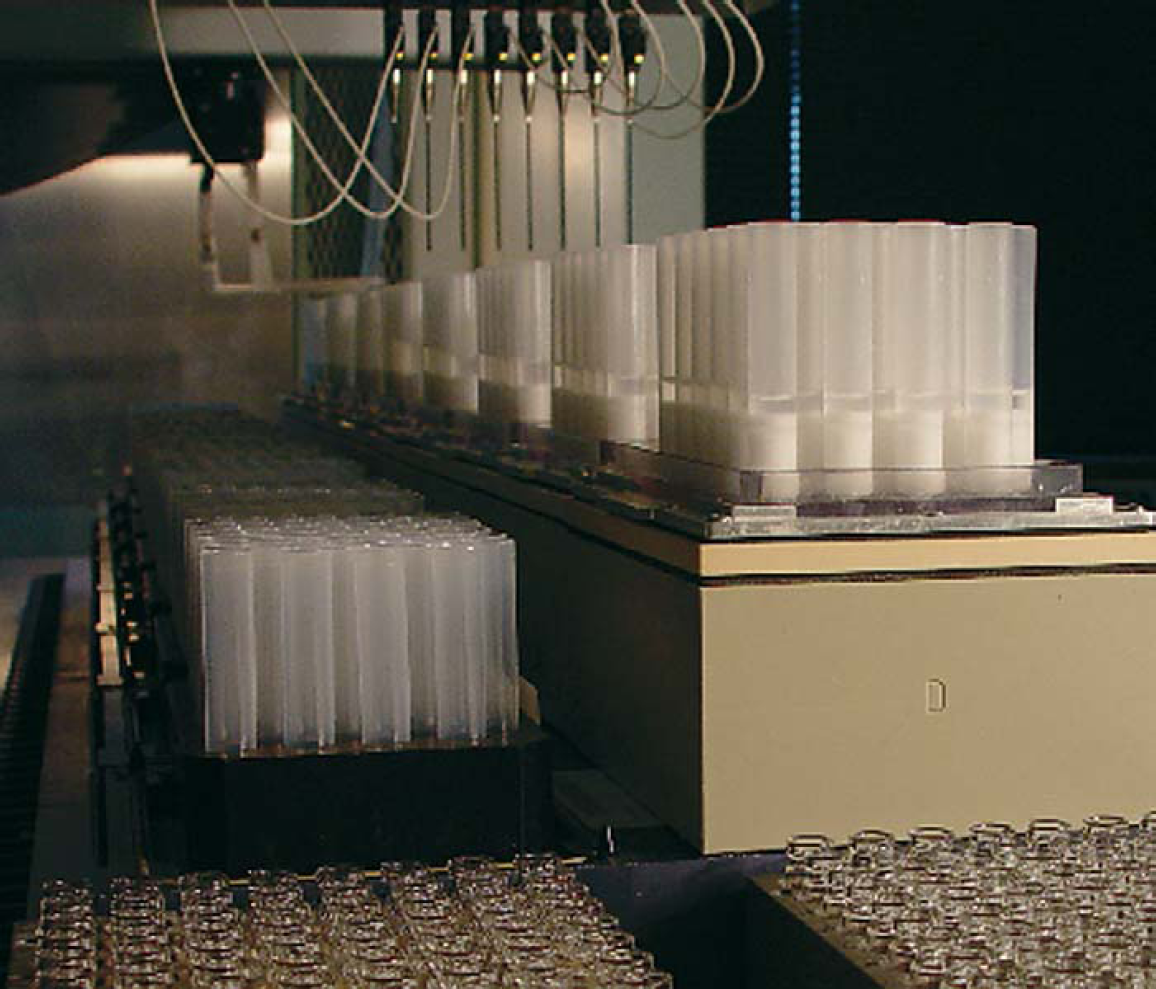
Automated Parallel Tecan SPE Purification Instrument 1 engaging in a multi SPE plate column conditioning sequence prior to a routine purification.
Our single SPE workstation incorporates eight independently configured vacuum bases and modified vacuum pumps. Liquid handling and vacuum base transport between waste and collection basins are achieved using standard Tecan LiHa and RoMa arms, respectively.
Currently, this workstation is capable of purifying 352 samples in one automated run, allowing multiple runs to be executed during a single day. A single cycle can be completed in less than 3 h incorporating any combination of basic processes, including liquid-liquid extraction, column washing, elute-to-waste, and elute-to-collect steps. During purification, all samples are collected into our standard disposable tubes that reside in a staggered 48-position bar-coded aluminum block to facilitate downstream processes, including tracking, evaporation, and weighing.
Instrument control and integration have been achieved by creating a custom in-house SPE software application written in Microsoft® Visual Basic® 2 (VB) that functions in conjunction with Gemini and our in-house protocol environment. Fundamental functionality supports the scanning and tracking of source and destination blocks that, via barcode, result in queries that return all SPE protocol variables required to influence aspiration volumes, elution volumes, solvent selection, and the conditions by which complementary purification sequences are differentiated.
The combination of activities described above has had significant impact on our SPE purification throughput. A single workstation supports the purification of >225,000 discrete samples per year.
Library Quantitation
Realizing that traditional automated weigh stations lacked both the deck capacity and throughput required to keep pace with our existing synthetic capabilities, sample quantitation is achieved using a recently developed Tecan Automated Weigh Station. 4 Our existing workstation (Fig. 3) incorporates dual balances (Mettler-Toledo SAG204) and dual Freedom arms that reside on a standard 2-m Tecan chassis. Collaborative hardware development of the custom instrument deck and tube grippers facilitates the reliable retrieval and weighing of our densely formatted tubes used to collect both samples and fractions from our SPE and preparative LC-MS purification systems, respectively.

Automated Tecan Weigh Station incorporating dual arms and balances.
The weigher deck contains 27 individually bar-coded locations that can be accessed by each of the two pick-and-place arms with the benefit of collision control functionality. At maximum capacity, the deck supports the loading and weighing of 1296 individual tubes in less than 4 h.
Workstation software integration is achieved by creating a custom Neurogen weigh station application that functions in harmony with our current Oracle data structure and the instrument software developed by Tecan. Key workstation functionality resulting from this relationship is as follows:
During weight acquisition, balances are polled and a weight is accepted only after consecutive weights meet a standard deviation threshold ensuring real-time balance stability.
Automatic balance maintenance procedures support periodic internal weight recalibration and balance tare activities.
Quantitation of preparative fractions is enabled by the ability to selectively weigh any or all tubes contained within a block.
The underlying Tecan workstation configuration incorporates a combination of Genesis software coupled with its novel Pegasus modular software package. Tecan's Pegasus software package supports various module controls using its own scripting language that enables Structured Query Language (SQL) to read and write data to the local weigher database. In total, this package manages all required weigher functionality, including flexible software, data storage and retrieval, and viewing.
To integrate this new instrument into our synthesis environment, a custom in-house weigher application was written in VB 2 (Fig. 4) based on a detailed list of predetermined design specifications. Ultimately, a modification to an existing Pegasus initialization script was required to support the capture and execution of our custom application within the Pegasus framework.

Custom Neurogen weighing application user interface contained within Tecan Pegasus software.
Although the incorporation of our custom application within Pegasus simplifies general application startup and shutdown procedures, each application runs independently of one another. Communication between the independent applications is achieved via file and Pegasus-named pipe interfaces. For example, when a block is scanned for removal from the weigher deck, our application opens a named pipe communication channel with Pegasus and initiates the execution of an internal script that writes the desired weighing output file to a predetermined directory. Existing data capture activities, working under our protocol structure, interpret the sample weight data, which is used throughout archive, characterization, and secondary purification processes automatically.
Library Characterization
Effective automation of the characterization of samples from various sources (e.g., synthesis libraries, sample archive, externally acquired samples) by LC-MS requires a cohesive strategy that addresses all interrelated factors. Figure 5 displays the basic hardware configuration and relationships incorporated within our current approach.

Analytical and preparative LC-MS integration scheme incorporates three fundamental processes that include (1) automatic retrieval of sample analysis/purification information, (2) comprehensive capture, processing, and storage of sample data, and (3) intranet-based tools supporting the mining and viewing of characterization and purification results.
Although not depicted, central to this approach is the preemptive management of instrument performance and routine maintenance. The former is achieved in automated fashion by continuously monitoring instrument performance using “Standards Validation” procedures within our overall informatics model. Specifically, these procedures incorporate the Web-based management of formal standard information and subsequent automatic injection of instrument standards during library characterization using our in-house-developed instrument software. This approach has provided a valuable measure of system performance when performing hundreds of thousands of analyses per year.
The HSS analytical characterization hardware includes two LC-MS systems with identical instrument configurations 5 ensuring around-the-clock operation during unexpected instrument downtime. As previously described, 6 we perform characterization using rapid reverse phase gradients on instruments configured with a single monolithic column supporting high flow rates and fast cycle times to obviate the risk associated with more complex instrument configurations. 7,8
Fundamental to our integration is our in-house Combinatorial Chemistry Quality Assurance application (CCQA™) displayed in Figure 6. In short, features contained within CCQA function in accord with our informatics model that supports the database retrieval of all pertinent sample and instrument standard validation information. Combined with barcode scanning activities at the instrument, this approach rapidly promotes the hands-free LC-MS characterization of library samples using AutoLynx™ 9,10 features available in Waters Corporation instrument software.

Existing data capture processes and subsequent data interpretation using our Rule Set-based model facilitates the immediate, comprehensive viewing of summarized characterization results (Fig. 7) using custom internal Web pages that include both chromatogram and spectral panes. The latter was achieved through our opportunity to test the OpenLynx Global Server™ 11 (OLGS) software package, originally available from Micromass®, during the infant stages of product development.

Sample LC-MS analysis summary page available for viewing, incorporating Waters Corporation OLGS™ 11 functionality.
Under our data-capture model, characterization data is automatically evaluated using a Neurogen Rule Set application that uses a predefined collection of functions and thresholds assigned to a library of samples through a synthesis protocol. As this process relates to LC-MS, our infrastructure and internal Web pages support the creation and assignment of detector types to instruments, as well as the creation of custom rules that can be assigned to any detector supporting data collection. Functions and thresholds contained within each rule can individually influence the status of a sample, which has the potential to impact subsequent processes. The greater utility of this process lies in the ability to organize rules in a larger Rule Set supporting broader deployment and the standardized interpretation of characterization results. Although the range of potential rules is limitless, our most heavily deployed LC-MS Rule Set incorporates 18 of 82 currently existing rules. LC-MS data functions contained within our paradigm include, but are not limited to; (1) various chromatographic purity determinations, (2) spectral evaluations, (3) isomer management, and (4) the identification of various starting materials and reagents.
The creation of this environment has significantly simplified notoriously complex characterization processes associated with library synthesis. Our current model depicted in Figure 5 has been rigorously tested and has supported the rapid characterization and evaluation of more than 250,000 samples by a single operator. Our characterization throughput expectation for the equipment we employ is > 125,000 samples per instrument over the course of 1 year.
Secondary Library Purification
Our decision-based purification approach incorporates the management of activities ranging from the selective preparative LC-MS purification of suspect samples to the recharacterization of quantified reformatted fractions when more cost-effective SPE techniques fail. This strategy is designed to minimize the negative impact on downstream processes and throughput that broader deployments carry in terms of instrument acquisition, operation, and maintenance. Upstream workstation activities, including quantitation and characterization, present options relating to data capture that can influence whether or not a sample falls within the boundaries that qualify a candidate for preparative LC-MS purification.
In combination with CCQA software, purification processes automatically ensue for only those samples that meet our predetermined Rule Set criteria defining viable sample candidates. Sample separation is achieved using a single preparative LC-MS system, operating under routine conditions, that affords an inject-to-inject cycle time of approximately 10 min. 12,13 Sample fractions are collected into our standardized format and proceed through a series of integrated steps managed by barcode tracking, in-house informatics, and custom applications. Figure 8 details the stepwise flow of the overall process, which incorporates most of our existing HSS workstations in a harmonious fashion.

HSS decision-based secondary purification sample workflow.
By design, our decision-based preparative LC-MS workflow is a hands-free approach to library purification supported by internal Web pages developed in JSP that provide convenience and functionality when tracking, viewing, and administering related activities (Fig. 9).

Supporting (i) purification and (ii) reanalysis intranet pages resulting from a secondary LC-MS purification process.
Our implementation of preparative LC-MS sample purification in an ancillary fashion is a cost-effective approach that provides complementary value when implemented in concert with our current SPE workstation.
Summary
Improvements cited in this article around purification, characterization, and quantitation of chemical libraries have provided Neurogen with a unique combination of speed, value, and quantity in advancing the pace of drug discovery. Current HSS protocols cover a broad range of solution phase transformations ranging from simple acylations and alkylations to complex multistep heterocyclic transformations.
Synthesis production of roughly 3000 compounds per week is achieved at Neurogen with a small team of scientists (six FTEs). Ongoing in the evolution of the synthetic process is decentralizing the workstations to the general medicinal chemistry community to create a larger impact on current and future projects.
Over the last 5 years, high-speed synthesis has become an integral part of the drug discovery process. The Neurogen paradigm continues to develop to provide balanced workflow with ever increasing throughput and quality. The ultimate goal of “industrialization” of early drug discovery, by creating a platform where the output of a single scientist is magnified a thousand-fold, is well on its way to realization.
Acknowledgment
The authors thank the following individuals for their valuable advice, technical assistance, and support: Russell Barnes (Barnes Technical Products), Jon Besson (Waters Corporation), Jim Conboy (Pfizer), Beat Coray (Tecan), David Deans (Waters Corporation), Roger Kurrat (Tecan), Brent Marinelli (North American Computing Solutions), Ben Moshiri (Mettler-Toledo AutoChem), Greg Paneitz (SymbioSystems), Jennifer Paturzo (Tecan), Dick Schroth (Schroth Systems Consulting), Steve Trudell (Pfizer), and David Varley (Waters Corporation).