




Abstract
In the Sahel weak government institutions, porous borders, and ethnic, religious and tribal tensions enable organised crime networks, militants and terrorist groups to operate with relative impunity. The region is now a transmission belt for instability across resource-rich northern Africa. Lucrative hostage deals and smuggling have created a close relationship between organised crime and terrorist networks. Turmoil in the Sahel influences, and is influenced by, the aftermath of the Arab revolutions. European citizens and interests are at risk. The EU has a strategy to promote security and development in the Sahel, and its military missions focus on capacity-building to stem the terrorist threat. However, the EU does not have an integrated approach to the broader Sahel.
Introduction
The Sahel stretches from West Africa's Atlantic shores to the Gulf of Aden, straddling the southern limits of the Sahara desert. It is the zone of limited rainfall that runs from Mauritania across the breadth of the continent to Eritrea and includes parts of countries as diverse as Senegal, Sudan and the Central African Republic. The region is characterised by arid and harsh climatic conditions. Its political environment is equally challenging: weak government institutions, porous borders, and ethnic, religious and tribal tensions give rise to endemic instability, enabling organised crime networks, militants and terrorist groups to operate with relative impunity. The collapse of state authority in northern Mali in 2012 and the subsequent French-led military campaign demonstrated that developments in the region may present acute security threats to Europe. The EU's Sahel strategy was published in 2011. It describes the kaleidoscope of issues the Sahel countries confront as follows: ‘The Sahel is one of the poorest regions of the world. It faces simultaneously the challenges of extreme poverty, the effects of climate change, frequent food crises, rapid population growth, fragile governance, corruption, unresolved internal tensions, the risk of violent extremism and radicalisation, illicit trafficking and terrorist-linked security threats’ (EEAS 2011a, 1). While European leaders are now focused on responding to the threat of the Islamic State in Syria and the Levant, known as ISIL, they should not ignore how ISIL may inspire Sahel-based terrorist groups. Instability in the Sahel, and the terrorist threat associated with it, requires a coordinated and long-term European response.
A kaleidoscope of threats
The Sahel envelops 13 countries, or parts thereof. In spite of their diversity, there are a number of traits that all Sahel countries share. Countries in the region are afflicted by a lethal cocktail of climate change, youth unemployment, poverty, chronic food insecurity and failing state institutions, creating fertile ground for organised crime and radicalism to flourish. This interlocking dynamic guarantees regional spillover that influences the Maghreb (such as Libya and Algeria) and parts of West and Central Africa (such as Cameroon and the Central African Republic). The Sahel is a transmission belt for instability across the northern tier of the African continent. As local governments have struggled to provide their citizens with basic social services and economic opportunities and failed to exert control over large swathes of territory, a permissive environment has been created for organised crime, militant groups and terrorist networks to recruit, seek refuge and operate.
An effective government presence in Sahel countries is often restricted to urban centres, leaving rural expanses vulnerable to insurgent groups, who enjoy the freedom to move across poorly policed borders to find sanctuary. As the EU strategy describes it: ‘State control of the desert regions in the North of Mali and Niger is fragile’ (EEAS 2011a, 3). But this observation holds for several other countries in the region as well, such as Libya, Algeria and Mauritania. In this vast expanse, geography, not manmade borders, is the defining feature.
The political turbulence in North Africa following the 2011 Arab uprisings, particularly in Libya, has acted as a catalyst for low-level conflicts in the Sahel. There is a seamless link between the instability in Libya and problems across the region. After the collapse of the regime of Muammar Qaddafi, arms caches opened up. In early 2013, strengthened by readily available weapons, Tuareg fighters returning from Libya joined elements of Al Qaeda to exploit the post-coup chaos in Mali. Subsequent French military action led militant groups to seek refuge in surrounding countries. Libyan arms are now finding their way to the Sinai, Gaza and Syria.
The availability of weapons has caused simmering ethnic and tribal tensions to boil over. The context in the Sahel is shaped by the unresolved issue of Tuareg self-determination. These nomadic people have long had a tense relationship with the elites in places like Bamako, Algiers and Niamey. Thus far, the uneasiness continues. Some Tuareg movements, struggling for greater autonomy, see their interests as converging with Salafist groups, who aspire to carve out a space in the Sahel for their ‘caliphate’. Alliances of convenience, where terrorist groups rely on Tuareg knowledge of the terrain, have become common.
The Sahel's problems radiate beyond the region, including beyond solid ground. Corruption and state failure in West Africa have contributed to the rise of piracy and organised crime. Latin American drug cartels have been able to get a foothold in a number of coastal West African countries, such as Guinea-Bissau (UNODC 2013). The drugs are transported to the Mediterranean coast, making use of local smuggling networks, trans-Sahelian and trans-Saharan trade routes, and the overall permissive environment that the Sahel offers. Adding to the region's problems is the Ebola epidemic, which has ensnared a number of these same West African countries since summer 2014. Making West Africa less attractive to drug trafficking–-by taking effective action against the Sahel's smuggling corridors–-would offer welcome relief for the overwhelmed authorities.
What the broader Sahel's instability means for trafficking, it also means for illegal immigration. The collapse of Libya has triggered a wave of immigration across the Mediterranean. Between January and September 2014, more than 135,000 refugees washed up in Italy. Many of them come from conflict-ridden Libya or Syria, but also from sub-Saharan Africa, including 32,000 Eritreans (UN Human Rights Council 2014). Traffickers use the Sahel and exploit Libya's fragility.
Moreover, Europe has genuine energy security interests in the region. Europe relies on North African regimes to maintain a stable flow of energy–-Libya holds the largest oil reserves in Africa and Algeria is the third-largest natural gas supplier to Europe (after Russia and Norway). The Sahel also has substantial deposits of uranium, gold and diamonds. Chaos in Libya in the aftermath of the collapse of Qaddafi's regime has led to a decline in oil exports at a time when Europe is already concerned about energy supply risks due to the Ukraine crisis and its desire to reduce dependence on Russian energy imports. From 2010 to 2013, European oil imports from Libya dropped by nearly half. In 2014, decreased Libyan production meant that one million barrels per day were removed from the global market. Attacks against the natural resource sector in the Sahel–-including against the In Amenas gas plant in Algeria (operated by BP and Statoil) in January 2013 and the French-operated uranium mines in Niger in May 2013–-show that European interests are at risk.
Alliances of convenience
Parts of the Sahel are sanctuaries for jihadist organisations. This threat is acute in countries like Mali, Niger, Algeria, Mauritania and Libya, areas where Al Qaeda in the Islamic Maghreb (AQIM) appears most active. There are three types of violent extremist organisations operating in the Sahel:
Local insurgent groups, such as the National Movement for the Liberation of Azawad and Ansar Dine, which have strong ties to Tuareg communities. These groups seek control of territory or transport routes, but lack a broader global, or jihadist, agenda.
Regional Salafist groups, such as Al Mourabitoon and Ansar al-Sharia (in Tunisia and Libya). These organisations may cooperate with other groups, but essentially have a regional agenda to secure a space where their version of Islamic law is enforced.
Groups which are affiliated with global jihadist movements, such as AQIM and Boko Haram, and want to build a ‘caliphate’ from which to target Westerners or Western interests.
The boundaries between these groups are fluid, with alliances of convenience emerging on a regular basis. For instance, in August 2013, the Belmokhtar network (also called the ‘Signers in Blood Battalion’ or ‘Masked Battalion’) and Movement for Oneness and Jihad in West Africa fused to create Al-Mourabitoon. This new group has claimed a number of attacks against French and international forces in Mali. Most recently, on 3 October 2014, the group ambushed and killed nine UN peacekeepers from Niger (The Guardian 2014). AQIM has also sought regional alliances with Ansar Dine; among other occasions, in the run-up to its occupation of northern Mali in early 2013. On 11 September 2012, according to a US congressional investigation, the US mission in Benghazi was attacked by individuals from four groups, including AQIM and Ansar al-Sharia (US Senate Select Committee on Intelligence 2014).
Further south, Boko Haram is waging a campaign of violence and hostage-taking in Nigeria's northern states and Cameroon's north. In the first half of 2014, according to the Nigerian government, Boko Haram killed more than 2,000 civilians (AllAfrica 2014). Links are also believed to exist between Boko Haram and its ideological peers–-or operational allies–-in Mali (such as AQIM), Tunisia, Libya (notably Ansar al-Sharia) and possibly Somalia (with Al Shabaab).
Most attention, however, falls to AQIM, which is responsible for attacks and kidnappings, and sports the Al Qaeda ‘brand’. However, it is not a unitary organisation. The network, led by Algerian Abdelmalek Droukdel, has been embroiled in infighting. Internal dissension has recently emerged over its relationship with ISIL, with some AQIM leaders advocating stronger allegiance to the group (Le Figaro 2014). When ISIL called for strikes against Western targets in September 2014, a previously unknown group in Algeria responded. The ‘Soldiers of the Caliphate in Algeria’ kidnapped and beheaded a French citizen in Kabylie, some 200 kilometres east of Algiers. The Algerian group had been created seven days earlier, when a fringe of fighters left AQIM. The attackers declared that they had acted in response to the call by ISIL leader Abu Bakr al-Baghdadi. This hints at the broad appeal of ISIL, but also at the degree to which events in the Sahel are influenced by dynamics elsewhere. For European security and intelligence services this means that ISIL could inspire more volatility, or even a second front, in the broader Sahel.
Analysts also highlight a nexus between criminal and terrorist networks, concluding that the two are hard to distinguish (Minoua 2014). A number of Salafist groups are bankrolled by smuggling (drugs, guns, cigarettes or counterfeits) and hostage-taking. Reports suggest that since 2008 AQIM has received $91.5 million in ransom payments (Callimachi 2014).
Europe's response
The EU must have the stamina to pursue a coordinated and long-term effort to contain the terrorist threat emanating from the region, and to contribute to stability and economic development in the Sahel. Success depends on partnering with other countries and institutions. The EU works with organisations like the UN, the African Union and West Africa's regional organisation, the Economic Community of West African States, to promote development, reduce food insecurity and strengthen local security authorities in the Sahel. In terms of development assistance, most is directed at the Western Sahel: the EU has committed €5 billion (2014–20) to joint international development projects, €1.5 billion (2014–20) to promoting agricultural reform and food security, and €150 million to emergency food relief (EEAS 2014).
There are five EU security missions in the region, involving approximately 1,500 troops (see also Table 1). At the time of writing, a sixth mission, Operation Triton, to provide coastguard support in the Mediterranean, was pending. Most of Europe's military efforts, however, are dedicated to supporting regional governments to respond to the terrorist threat by advising and training local armed forces and police, and to strengthening legal and law-enforcement institutions. Capacity-building to train and support partner countries in the region is crucial, but more should be done.
EU missions in the broader Sahel
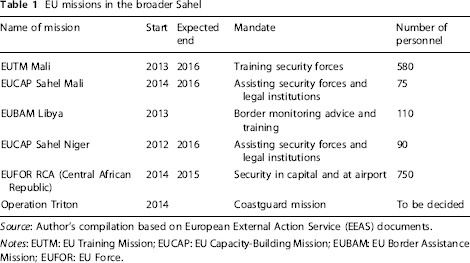
Source: Author's compilation based on European External Action Service (EEAS) documents.
Notes: EUTM: EU Training Mission; EUCAP: EU Capacity-Building Mission; EUBAM: EU Border Assistance Mission; EUFOR: EU Force.
In Libya, EUBAM is important, but inadequate. The EU's presence is restricted to the main border crossings in the north and Tripoli airport; there is no permanent presence in Libya's south. This means that the operation does little to stop militant groups from using southern Libya as a sanctuary. The EU should expand the operation and consider a permanent presence at Sabha. In a regional context, the EU should encourage better intelligence sharing and consider deploying surveillance assets to contribute to the counter-terrorism dimension of border monitoring.
The French intervention in Mali has also demonstrated that offensive military action, like the coalition many European countries have joined against ISIL, might be necessary to respond to the threat posed by Sahel-based groups. Despite Europe's best efforts to prop up local security institutions, it should also be willing to use military force if required. The former colonial power, France, plays a crucial military role in the Sahel. In light of the intervention in Mali, the French have reorganised their military presence across Africa to focus on the Sahel. Operation Barkhane is a French operation with a presence in five Sahel countries: Chad, Burkina Faso, Mali, Mauritania and Niger. It replaces the counter-terrorism mission in Mali. Although called an operation, it is in fact a reorganisation of the French permanent military presence in the region. It consists of 3,000 French troops, 6 fighter jets, 20 helicopters, 200 armoured vehicles, 10 transport aircraft, and associated intelligence and surveillance assets, including drones (RFI 2014; The Economist 2014). These forces will work with the Sahel countries and fight terrorist networks to prevent the creation of sanctuaries.
The EU should work closely with Chad and the Maghreb countries, but a common response is hampered by Moroccan-Algerian competition for regional political influence. European diplomats should put their weight behind bringing the two sides together. The EU should also coordinate with countries outside the region that have growing influence in the Sahel, including the Gulf countries and Egypt.
Moreover, Brussels should improve the coordination of its own policies and missions across the broader region. Besides the six missions mentioned above, the EU has two maritime security missions off the coast of the Horn of Africa–-the anti-piracy operation ‘EUNAVFOR’ and the capacity-building mission ‘EUCAP NESTOR’. Moreover, the EU trains military personnel in Somalia (‘EUTM’), which involves 125 EU personnel, in close cooperation with the African Union peacekeeping mission in Somalia (‘AMISOM‘–-the African Union Mission to Somalia). The EU says it will connect the Sahel to developments in the Maghreb, and even Nigeria, but not to those in the Horn of Africa. From a counter-terrorism perspective, these links should be made. If Al Shabaab and AQIM are learning from each other, so should we. Equally, the EU has a strategy to tackle piracy and instability in the Gulf of Guinea. Given the relationship between narcotics trafficking and Sahel-based groups, the dynamic in the Gulf of Guinea will also be affected by the EU's success in promoting security and development in the Sahel.
The EU's southern neighbourhood policy, which is based on development, cooperation and trade, is called ‘the partnership for democracy and shared prosperity with the Southern Mediterranean’ (EEAS 2011b). It targets the countries of the Maghreb, but not the Sahel. The EU should be strategic in its approach to the Maghreb-Sahel region; continuing instability in the Sahel harms the Maghreb's prospects for growth and prosperity, while turmoil in the Maghreb reinforces the Sahel's problems. The two zones cannot be conveniently considered separate. More coordination between the economic and security dimensions of the Maghreb and Sahel policies is needed; the EU needs an integrated strategy for the Maghreb-Sahel region.
Conclusion
The Sahel hosts a complex range of development and security challenges, including the presence of terrorist networks and militant groups that pose threats to European interests and citizens. The 2013 crisis in Mali demonstrated that the Sahel is part of Europe's neighbourhood. The EU should link its Sahel strategy to its southern neighbourhood policy and other strategies in the region. The EU needs an integrated, not a piecemeal, approach to the broader Sahel.
Ultimately, better coordination depends on Brussels. At the senior level, policy towards the broader Sahel is fragmented. The EU special representative for the Sahel focuses on Mali and its neighbours to the east and west, but the Maghreb falls under the EU special representative for the southern Mediterranean; while Somalia, Sudan and South Sudan are covered by a special representative for the Horn of Africa. (The Central African Republic has no EU special representative). This means that the EU's approach to the broader Sahel is compartmentalised, when a more strategic policy framework, that ties dynamics in different parts of the region together, would be beneficial. In addition, most of the resources the EU could use in the region are controlled by the Commissioner for Development, not the European External Action Service. The new EU High Representative, Federica Mogherini, has an affinity with the issues in Europe's southern neighbourhood. She, or a special coordinator she appoints, should review and make recommendations to change the existing policy structures–-particularly the system of EU special representatives–-to enable a streamlined European approach to the broader Sahel. Europe's interests and an effective response to the region's terrorist threat require it.
Footnotes