




Abstract
The Great Depression of the 1930s greatly affected political developments in Europe. Economic stagnation proved beneficial for far-right parties, which generally saw their influence increasing. Authoritarian regimes became established in most European countries at the time, the most important being the Nazi regime in Germany. In recent years, the global financial crisis has also increased the appeal of far-right extremists. All over Europe anti-system political parties that are anti-liberal, racist, anti-Semitic, xenophobic and Eurosceptic are gaining ground: the European Parliament elections held in May 2014 offer the latest example of this. Historical experience shows that when economic conditions remain bad for a significant period of time people tend to become more radical as far as their electoral behaviour is concerned. However, no matter how strong the linkage between economic crisis and the rise of political extremism might be, economic crisis is not the only factor to be taken into account when analysing the phenomenon of political extremism, as other parameters (historical, social and so on) are also important.
Introduction
You do not have to be an expert on explosives to know that a detonator is essential in order to trigger an explosion. You do not need to be a chemist to understand that a catalyst rapidly increases the rate of a chemical reaction. And it is most definitely not necessary to have a Ph.D. in history or political science to come to the conclusion that an economic crisis boosts political extremism. It is just common sense. But is this actually true? Does an economic crisis necessarily lead to political extremism or are there other things that need to be examined in order to understand the phenomenon of the rise of extreme-right parties? This article argues that the deterioration of economic conditions plays an important role in facilitating the success of parties with extreme political leanings, especially far-right ones. However, it also argues that attributing this success only to economic factors can sometimes lead to a rather one-sided analysis.
Past: the Great Depression and the rise of authoritarianism in the 1930s
Father used to joke a lot in those days. But after two years the picture changed. One day father came home looking downcast. Mother looked at him and knew what had happened. He had lost his job … Now my father has been unemployed for over three years. We used to believe he would get a job again one day, but now even we children have given up all hope. (Cited by Mazower 1998, 106)
This is how a 14-year-old girl described her family's misfortunes in December 1932. They were among the millions of citizens severely affected by the Great Depression in the inter-war period.
In late October 1929 the New York Stock Exchange collapsed. Billions of dollars were wiped out in just a few hours. Stock market prices continued to fall for a long time. As a result, thousands of enterprises went bankrupt. An unprecedented tidal wave swept across the US. Production levels declined rapidly and at the same time unemployment took off. The American economy was being shaken by an avalanche that threatened to destroy everything as it got bigger and bigger. Very soon the American Crash affected Europe. The economic crisis hit more or less every European country, one after the other. The most severely injured was Germany since it had been largely dependent on US loans. In the panic of the Crash, American investors withdrew their money from German industries, which unavoidably led to bankruptcy. At the same time, German and other European exports to the US dropped almost to zero (Galbraith 1954).
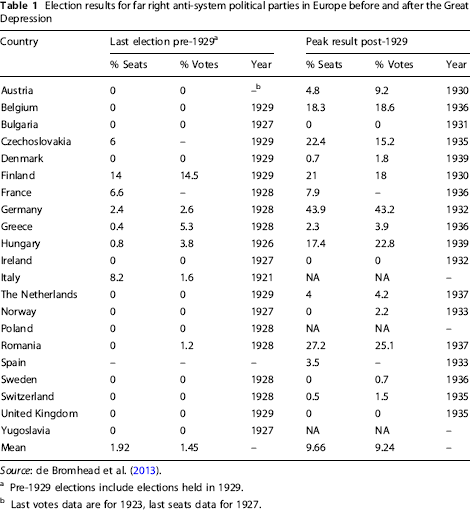
The economic crisis of the 1930s had a profound effect on European politics. The vicious circle of underdevelopment, unemployment and poverty that started in 1929 created massive social problems and thus favoured the strengthening of extremist parties, especially far-right ones (Table 1). The case of Germany was probably the most characteristic and definitely the most important one as far as its long-term consequences were concerned. Before 1929 Adolf Hitler's National Socialist party was nothing more than a marginal political force. In the German federal elections of May 1928 they won only 2.63 % of the vote. Just two and a half years later, in September 1930 they secured 18.25 %. In the elections of July 1932 they came first with 37.27 %, a place that they managed to hold in November of the same year despite the fact that their share of the vote was reduced to 33.09 % (Gonschior 2005). On 30 January 1933 Hitler became chancellor of Germany and gradually began to impose his dictatorial and racist regime. The Weimar Republic was dead. Europe was, little by little, sliding towards the abyss of the Second World War.
Election results for far right anti-system political parties in Europe before and after the Great Depression
Source: de Bromhead et al. (2013).
Pre-1929 elections include elections held in 1929.
Last votes data are for 1923, last seats data for 1927.
The establishment of Benito Mussolini's FASCIST regime in Italy in 1922 had already paved the way towards the dominance of political extremism. However, it was only in the 1930s that anti-democratic parties across Europe became more successful. The negative effects of the Great Depression were reflected in election results all over the continent. From Romania to Austria and Czechoslovakia to Belgium, the trend was more or less the same. Almost everywhere far-right political parties gained significant ground. In most cases, a similar rule applied for extreme-left political parties; however they did not have the success of right-wing ones. During the 1930s FASCIST, FASCIST-like and other authoritarian regimes were established all over Europe. Totalitarianism was thriving in more and more parts of the continent. Democracy was retreating.
The electoral behaviour of European citizens in the post-Depression years was obviously affected by the dreadful economic situation. Being populist, anti-system parties offered easy answers to difficult questions. For many voters these parties seemed to offer a way out of the crisis. However, electoral behaviour was not identical all over Europe. Extremists were, on average, more successful in countries where there was not a long democratic tradition and where the electoral system posed fewer obstacles to representation in the national parliaments. They were also more successful in countries like Germany, Hungary and Austria, which had been defeated in the First World War. This is understandable since far-right extremists were ultra-nationalists and thus they were promising a revision of the peace treaties signed in Paris in 1919-20. Regardless of whether it was justified or not, the feeling of being suppressed by foreign powers made voters more susceptible to right-wing extremism. However, most importantly, the extremists’ success was greatest where economic conditions remained bad for longer periods of time. People who had little or even nothing to lose were naturally more easily attracted by parties that appeared to be ready to destroy the existing social and economic system and put a new one in its place (de Bromhead et al. 2013).
The rise of political extremism, especially in Germany, was among the main causes of the Second World War. In most cases (but not always–-for example Greece under the Metaxas dictatorship was a striking exception; Klapsis 2013), authoritarian regimes aligned with one another. However, this was not necessarily always for purely ideological reasons, but also for practical geopolitical ones. The aid given by Nazi Germany and FASCIST Italy to the Nationalists of Francisco Franco during the Spanish Civil War (1936–39) was only a prelude to what was to follow (Payne 2012, 133–43). Totalitarianism coupled with nationalism and territorial expansionism created an explosive mixture. The collapse of democracies in the 1930s eventually led to the collapse of the post-First World War international system.
Present: the global financial crisis and the rise of political extremism
After the end of the Second World War increasingly stable democratic regimes were established across Western Europe. The fall of dictatorships in Portugal, Greece and Spain in the mid-1970s meant that all Western European countries had become parliamentary democracies. The success of the European Community, which by the mid-1980s had incorporated most liberal democracies in Europe, was seen as an additional victory of liberalism over totalitarianism. The ghosts of right-wing political extremism seemed to belong to the past. Far-right political parties had only marginal (if any) influence on public opinion. It is characteristic that until the 1980s academic literature on the radical right was concerned almost entirely with past experiences (Cakmak and Postaci 2013). In the 1970s and 1980s violent far-left extremism, in the form of terrorist activities organised by groups like the Red Army Faction in Germany, the Red Brigades in Italy and the 17 November in Greece, posed a much greater threat.
After the end of the Cold War democracy spread across Central and Eastern Europe. In countries like Poland, Hungary, Czechoslovakia (later divided into the Czech Republic and Slovakia), Romania and Bulgaria, Communist regimes were abolished and parliamentary democracies were established. However, political extremism was gaining ground in other parts of the continent. In the 1980s and 1990s far-right political parties like the National Front in France and the Flemish Block in Belgium saw their share of the vote rapidly increasing (Betz 1993). Anti-liberalism, Euroscepticism, xenophobia and anti-Semitism were among the main characteristics of similar parties all over Europe, even if they did not share the same success. At the same time, neo-Nazi groups were also spreading across Europe, including to former Communist countries in the East.
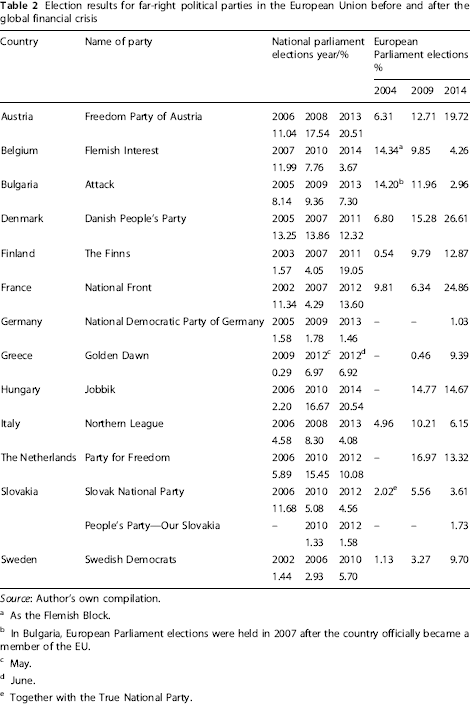
The global financial crisis, which started in the US in 2007-8 and very soon affected the whole world, proved to be a turning point that boosted political extremism in Europe. The crisis affected all EU countries, though not necessarily to the same extent. Economic stagnation led to an increase in unemployment and consequently to a fall in living standards among a great part of the population. As in the 1930s, these developments triggered a political reaction. It is definitely no coincidence that since 2008 far-right political parties have generally gained significant ground in national as well as European Parliament elections (Table 2). In some cases far-right parties have been able to secure third place in national elections and second or even first place in European Parliament elections. The National Front in France, the Freedom Party of Austria, Jobbik in Hungary, the Party for Freedom in the Netherlands and Golden Dawn in Greece are among the most striking examples of far-right success in elections in the last few years. The results of the 2014 European Parliament elections have proved that the phenomenon has a pan-European dimension (Elgot 2014).
Election results for far-right political parties in the European Union before and after the global financial crisis
Source: Author's own compilation.
As the Flemish Block.
In Bulgaria, European Parliament elections were held in 2007 after the country officially became a member of the EU.
May.
June.
Together with the True National Party.
As in the 1930s, today most far-right extremists promise to overthrow the established political system. In general, they describe politicians (excluding themselves, of course) as corrupt and decadent. They take advantage of the mass media (with special emphasis on social media which give them the opportunity to attract the attention of younger audiences) in order to get their messages across. They make extensive use of stereotypes to address the public and they use black-and-white arguments which, despite their poor reasoning, sound reasonable to the average voter. They are conservative on societal issues and sometimes openly homophobic. They reject liberal ideas and they have racist tendencies. They underline the threat of the expansion of Islam in Europe, while at the same time some of them are anti-Semitic. They point to immigrants as one of the main causes (if not the main cause) of all sorts of problems, from unemployment to high criminality. In some cases, they do not disapprove of and talk with respect or even admiration about FASCIST and Nazi leaders of the past. There are also those who do not hesitate to resort to violence in order to intimidate others.
They are also ultra-nationalist and utterly Eurosceptic since they perceive the EU as a supranational organisation which undermines nation states’ power and authority. It is definitely no coincidence that many far-right parties in the EU have pro-Russian leanings (Hockenos 2014), seeing Russia as an ally against European integration. In this context, Moscow has established close connections with and offers indirect or under-the-table support to European far-right parties. This is done in an attempt by Moscow to use them as Trojan horses in order to create problems with the internal cohesion of the EU. Even if Russian President Vladimir Putin does not get to see parties with pro-Russian leanings forming governments, he can still hope that their growing influence will exercise severe pressure on EU governments, especially as far as relations with Russia are concerned (Orenstein 2014).
Naturally, all these parties may differ in their approach to certain subjects. But the general trend is more or less the same. One additional characteristic that binds them together is that they have profited from the economic crisis. As in the 1930s, the current economic crisis has proven beneficial for political extremism. Depression is indeed the key factor behind the rise of political extremism all over Europe. It is not, of course, the only one. Historical experiences, political culture, national/local peculiarities and social structure are among the other factors that need to be taken into consideration. People do not at all times and in all places react in the same way, and thus electoral behaviour can vary. For example, while in Greece neo-Nazis are gaining ground, the same is not happening in Ireland, Spain or Portugal, that is, those countries which have been equally affected by the crisis. On the other hand, extremist political parties are attracting more and more voters in countries like France and the Netherlands, which have not been that seriously affected by the crisis. And there has also been a significant increase in the popularity of and public support for far-right parties in some of the wealthiest and most prosperous members of the EU, like Austria and Sweden.
Conclusion
The interaction between economic crisis and political upheaval has been repeatedly highlighted by scholars and researchers. In the last few years newspaper headlines and articles have been full of comparisons between the 1930s and the 2010s. The fear that the rise of far-right parties might lead to political instability similar to that experienced after the Great Depression of 1929 is constantly being discussed. Nevertheless, the rise of political extremism in Europe cannot be attributed to the economic crisis alone.
Some far-right parties had been quite successful even before the crisis. The National Front in France is perhaps the most striking example. Others, like Golden Dawn, emerged from political obscurity only after the crisis. However, the crisis has definitely been of great significance in creating the right climate for extreme political parties to blossom. It has been the catalyst in this process, but it did not per se create political extremism. The seeds of authoritarianism, nationalism, racism, xenophobia, anti-Semitism and so on had been planted well before the bursting of the US housing bubble and the collapse of Lehman Brothers in 2008. The crisis made the ground more fertile for these seeds to grow. What far-right parties did was to take advantage of a situation that was favourable to them. Their populist message became much more appealing to voters because of the crisis. This is no surprise: the same trend was followed in the 1930s. Interestingly enough, in both the inter-war period and 2008 the crisis broke out in the US but affected the European political landscape much more profoundly than the US one.
Economic crisis tends to push people to their limits and thus make them more susceptible to demagogy and populism. It brings to the surface the fears and anxieties that affect political affiliation and consequently electoral behaviour. Extreme economic situations facilitate extreme political leanings. Equally they facilitate the radicalisation of choices, even when living conditions have not deteriorated: the fact, for example, that even in countries like Sweden or Austria far-right parties have gained votes amongst previously left-leaning working-class electorates (Wodak 2012) is tangible proof of this. Crisis also tends to change the framework of the political debate. In this new context political extremists find it easier to bring their agenda into the limelight. In order to avoid electoral losses, even mainstream politicians are sometimes lured into more conservative and less liberal positions.
The critical questions remain. What lies ahead in Europe's future? Is there a real danger to democracy? Overcoming the crisis will probably not totally eliminate the phenomenon of political extremism but it will minimise its influence. And it will certainly take out one critical element from the complex equation that facilitates the rise of political extremism. Even if the other elements are still there, the catalyst will have been removed. From this point of view, probably the most efficient way to counter political extremism is to give emphasis to economic growth in terms of social justice. The social market economy has been successful in the past and can be used as a model for the future. Historical experience has proven that people who are convinced that they have no future are more likely to follow the path of political extremism. If the economic situation does not improve and if people do not see the positive effects in their lives, and not only in numbers related to state budgets and fiscal deficits, then far-right extremists might have more to gain in the next elections. Macroeconomics is good, but when it comes to the everyday lives of ordinary people microeconomics is even better. In the early 1930s, Hitler's promises for the economic recovery of Germany and for tackling unemployment by creating jobs for every German worker probably had a much more profound influence on German voters than the rest of his rhetoric (Tooze 2006).
There is also another threat that in the long term might prove really dangerous: the prospect of citizens across Europe gradually becoming accustomed to (possibly even violent) anti-democratic behaviours. The answer to this challenge is to use the weapons that anti-democrats most fear: more, not less, democracy, both at a national and a European level. Rule of law, democratic legitimacy, and respect for human rights and otherness are among the cornerstones of the EU and cannot be negotiated. On this ground, firm confrontation of political extremism is achievable if European citizens can be convinced that extremism is not the answer to their problems but a problem in itself.
History does not have to repeat itself. In comparison to the 1930s today's Europe is more effectively defended against political extremism. Democracies are better established and much more deeply rooted than they were eight decades ago. Social safety nets, which were in fact created in the echo of the devastating consequences of the Great Depression, are much more extensive today and can offer minimum security to larger parts of the population than in the 1930s (The Economist 2011). And of course, we have historical experience on our side. We know what happened in the 1930s and we should have learned our lesson and know not to make the same mistakes again.
Footnotes