




Abstract
The article analyses the regional approach in the Eastern Partnership (EaP). It is argued that the EaP is a political region-building project, which has entailed the construction of the EaP region as a political and economic periphery based on a process of assimilating the EaP countries to EU norms and standards. The assimilation project has, however, failed to yield significant success. The article explores the potential (and perhaps by now the missed opportunity) to adopt a more emancipatory approach to the region, including the strengthening of political and economic cooperation and infrastructure links between the EaP countries to reduce their dependence on Russia. But the outlook is bleak: after a decade of the EU's and Russia's region-building projects competing (with neither power being particularly successful in the attempt to assimilate ‘its region’), the region and its states are likely to be fragmented into a multiplicity of territories which are set to develop into de facto dependencies of either Russia or the EU/ the West.
Introduction
Although the Eastern Partnership (EaP) has received significant scholarly attention since its creation in 2009, its multilateral, regional dimension has rarely been put under the spotlight. Most analyses of the EaP place the emphasis on the bilateral aspects of the policy and on measuring the extent of EU rule transfer. The aim of this article is to examine the successes and failures of the regional dimension of the EaP. It argues that the EaP's regional dimension cannot and should not be understood solely as yet another format for EU ‘technical’ rule transfer. Instead, this article analyses the EaP as a political region-building project, which involves more than just the transposition of the EU acquis.
What is a region-building project and what factors mark its success and/or failure? According to Iver Neumann (1999, 115), ‘the existence of regions is preceded by the existence of region-builders … political actors who, as part of some political project, see it in their interest to imagine a certain spatial and chronological identity for a region and to disseminate this imagination to as many other people as possible’. In other words, a region-building project can be understood as a spatial and social construct which is created or reinforced for a political purpose. In order to evaluate the success or failure of the EaP regional dimension, therefore, the first part of this article examines what type of region the EU has attempted to create through the EaP, what identity it has projected onto the ‘region’ and for what political purpose (in particular vis-à-vis the Russian Federation). The second part of the article examines the extent to which the EU has succeeded in implementing its regional project in the EaP countries, and highlights some of the main obstacles and opportunities of region-building. By way of conclusion, the article critically reflects on the wider geopolitical implications of the EaP regional project. Region-building projects tend to lead to processes of de- and re-configuration of social and political order, including the construction of outsiders (e.g. Russia as the ‘other’). To what extent, this article asks, has the EaP gradually reinforced the old dichotomy between the West and Russia and what are the implications of the EaP region-building project for the region in between, especially in light of the current Ukraine crisis?
Constructing the EaP region as a periphery without Russia
The region demarcated by the EaP is, by and large, an artificial policy construct invented by the EU. The Eastern Dimension (ED) was one of the first conceptualisations of a specific grouping within the larger post-Soviet space. The ED was initially a policy designed to ensure the continuation of cross-border cooperation between the enlarged EU and Ukraine, Moldova and Belarus, and it included the Russian Federation as a partner country. The ED was a geopolitical project in the sense that the new member states, and Poland in particular, had been keen to carve out their sphere of interest and expertise in EU foreign policy to balance other member states’ foreign policy dimensions, including the use of EU funds (e.g. in the Mediterranean or the Northern Dimension Initiative). The ED concept was quickly subsumed by the broader European Neighbourhood Policy (ENP), which was the result of internal bargaining among the member states, rather than purposeful geopolitical strategic thinking. The Russian Federation objected to being included in the ENP, perceiving itself not as a ‘neighbour’ but as an equal ‘partner’ of the EU.
What seemed at the time like yet another compromise (developing the ENP in parallel to developing the new Strategic Partnership with Russia), did, however, de facto institutionalise the spatial and social exclusion of Russia from the EU's conceptualisation of the geographical space to the east of its external borders. At the time that the ED was revived in 2009 in the form of the EaP, relations between the EU and Russia had already deteriorated and taken a clear geopolitical/geo-economic turn. The EaP may therefore be seen partly as a reflection or element of the geopolitical shift in EU–Russia relations, and partly as the result of an institutional path-dependency created by the exclusion of Russia from the spatial conceptualisation of the ENP East. The spatial construction of the EaP region (without Russia) essentially reinforced the definition of the region as a periphery (in fact, it became a ‘double-periphery’ being constructed as both Russia's ‘near abroad’ and the EU's ‘backyard’ or ‘neighbourhood’). As such, the EaP countries never ceased to be ‘zones of assimilation between powers’ (Walters 2004, 683).
There is little doubt that the EU has perceived and constructed the EaP region as a periphery. Just like the ENP East, the EaP emphasises the need for the countries in the region to adopt the EU's rules and norms. The Joint Declaration of the Prague EaP Summit of May 2009 clearly states that the goal of the ‘regional approach’ in the EaP is the creation of an additional–-multilateral–-layer of cooperation between the EU and EaP countries to complement the bilateral approach (Council of the European Union 2009). Both the bilateral and the regional approach have the overarching aim to ‘accelerate political association and further economic integration between the European Union and interested partner countries’. The added value of the regional dimension is to provide a joint forum to ‘share information and experience on the partner countries’ steps towards transition, reform and modernisation’ and to ‘facilitate the development of common positions and joint activities’ (Council of the European Union 2009). In other words, what distinguishes the regional approach in the EaP from the bilateral approach is not the end-goal (both aim at the further integration of the EaP countries with the EU by facilitating the export of EU norms and rules/the acquis) but rather the process (rule transfer through multilateral cooperation). The EU has therefore defined the EaP region as an object of transformation, a region whose countries may not (or need not) share more than the desire to work together to better assimilate to the EU. We might term this approach the ‘centre–periphery’ model of region-building. According to Walters, such a model implies the setting up of an asymmetrical relationship (here between the EU and the EaP region), ‘in which the expanding power assumes a right to define what is appropriate and just’ (Walters 2004, 688).
However, it is noteworthy that the 2009 EaP Declaration also contains some–-albeit few–-references to fostering the integration of the EaP region itself, which suggests a different kind of region-building model. The Declaration mentions the goal to ‘further promote stability and multilateral confidence building’ which ‘could help to develop closer ties among the partner countries themselves’ (Council of the European Union 2009). The end-goal of this type of region-building approach is not primarily assimilation to the EU. Rather, the aim is to encourage cooperation and ties among the countries in the EaP region, including, inter alia, the peaceful settlement of conflicts. This approach carries a greater emancipatory potential (the emancipatory model of region-building), because it defines the countries in the region as ‘subjects’ or equal and active participants in the region-building exercise, rather than as passive ‘objects’ of other powers’ region-building projects.
This brief review of the EaP as a region-building project has demonstrated that the spatial construction of the region by the EU (be it as a result of internal bargaining or the geopolitical shift in EU–Russia relations) has reinforced the identity of the region and its countries as a periphery, and as ‘objects’ of EU rule transfer. Measuring the success and failure of the regional approach of the EaP thus becomes a more complex undertaking: is the success of region-building the full assimilation of the EaP countries to the EU, and the integration of the region into the EU as a periphery; or is its success the development of an EaP region which can emancipate from being the eternal periphery and object of other powers’ region-building projects?
EaP multilateral institutions and instruments: assimilation or emancipation?
In this section, the article analyses the extent to which the regional approach of the EaP has been a success or failure in terms of assimilation and emancipation. The following institutions and instruments of the EaP multilateral track will be discussed in more detail: (i) meetings at the level of heads of state and government, the Euronest parliamentary assembly; (ii) the Civil Society Forum (CSF); (iii) the multilateral platforms; and (iv) multilateral projects.
Meetings between the heads of state or government of the EaP countries (and the EU) take place on a biannual basis and meetings of the ministers of foreign affairs once a year. The declarations of all EaP summits convened so far (2009, 2011 and 2013) underline the goal of the EaP to further assimilate the EaP countries to the EU, though there has never been a consensus on the speed, comprehensiveness or end-goal of the regional assimilation process (e.g. Azerbaijan and Belarus insist on their status as equal partners in the Eastern Partnership). The EaP countries have never perceived themselves as a bloc within the EaP and nor have they acted as a bloc in negotiations with the EU. Such a bloc formation has been further discouraged by the introduction by the EU of the ‘more-for-more’ principle, which essentially set the EaP countries up in competition with one another over EU resources.
Apart from multilateral forums for cooperation among governments, the EaP also established the EU–Neighbourhood East Parliamentary Assembly (Euronest) and the CSF. While Euronest has been more effective in the past year, exercising important quasi-institutional checks on the governmental dimension of the EaP, the assembly's role in fostering links among the EaP countries is still rather ambivalent. On the one hand, it has not managed to find a solution to the question of the participation of parliamentarians from Belarus, and the interactions between parliamentarians from Azerbaijan and Armenia remain highly politicised. On the other hand, the assembly does provide a political forum for exchange among parliamentarians of the EaP region (as an important counterbalance to the technical assimilation exercise in most other EaP fora), and it does encourage consensus decision-making in (and despite) a highly politicised environment, which is an important success.
Meanwhile, the CSF has continued its struggle to gain more influence vis-à-vis the governments, though many commentators do agree that the forum has been important for the consolidation and better coordination of civil society activities in the EaP overall. Still, the positive effects of the CSF are mainly attributed to supporting the assimilation of the region to the EU and integration at the national level, rather than fostering links among civil society organisations in the EaP region. According to a survey of CSF participants (Kaca et al. 2011), over 70 % of respondents agree with the statement that the CSF is an effective instrument for bringing the EaP countries closer to the EU in terms of democratic and economic standards, and over 80 % agree that the forum has increased contacts between their organisation and other civil society organisations in their country. However, only a small fraction (15 %) of participants had in fact expected benefits from the CSF in terms of undertaking joint projects with organisations from other EaP countries.
The EaP regional approach is implemented through four multilateral platforms which are convened twice a year and involve senior government officials. The main goal of the platforms is to facilitate dialogue among the EaP countries on the implementation of the EU acquis (assimilation) in four key areas: (1) democracy and good governance, (2) economic integration, (3) energy security, and (4) contacts between people. Most activities organised by the platforms involve knowledge exchange and training, such as conferences, workshops and seminars. The highest number of activities have been organised under Platforms 1 and 4. By contrast, talks in Platform 3 have been progressing very slowly, not only because the liberalisation of the energy sector is a highly politicised subject in most EaP countries, but also because of key differences over energy security and supply. The focus of Platform 2 has mainly been on regulatory cooperation and approximation (assimilation to the EU).
It is difficult to judge the impact of the multilateral platforms on the reform processes in the individual EaP countries. For example, Platform 2 dealt extensively with the Deep and Comprehensive Free Trade Agreements (DCFTAs) throughout 2012 and 2013 (including several seminars and workshops), although the actual negotiations took place at the bilateral level. According to one senior official who participated in the Platform 2 activities, the meetings served as an additional source of information on the DCFTAs but the very (bilateral) nature of the DCFTA negotiations was not conducive to coordinating positions among EaP countries. 1 Besides, officials attending Platform 2 meetings were often sent from the economic ministries, which did not necessarily share the same (positive) vision of the DCFTAs as the respective foreign ministries. As tools of approximation, the EaP platforms therefore suffer from the same problems as EaP cooperation at the bilateral level, including, inter alia, adverse domestic and geopolitical factors slowing down economic and political reform.
Author's interview with a senior government official from an EaP country, March 2014.
Between 2007 and 2013, multilateral projects accounted for approximately 10 % of European Neighbourhood and Partnership Instrument (ENPI) funds (12 billion euros), of which approximately half was allocated to regional cooperation projects involving the six EaP countries (European Commission 2013). Between 2012 and 2014, the ENPI supported (and is supporting) some 50 regional projects, including those in EaP countries. 2 At the project level (Flagship/ENPI East), differences in the political and administrative structure of the EaP countries have posed serious challenges to successful implementation. First, regional cooperation projects often suffer delays caused by the differing levels of administrative responsibility of the government officials involved and the respective local/regional/national decision-making levels. If there is one concern shared by most of those involved in regional cooperation projects, it is the lack of compatible local or sub-regional administrative procedures, which creates practical problems for project implementation. 3 Second, and mainly due to very different levels of reform in each of the countries, the implementation of the EU acquis (or other international norms and standards) through regional projects is highly uneven. Third and finally, political animosity and suspicion between some EaP countries has hindered effective regional cooperation. Most obviously, it is the conflict between Armenia and Azerbaijan that renders true regional cooperation among the EaP countries impossible. The EU does, however, seem to have accepted the geopolitical status quo between the two countries. Out of all of the regional projects funded between 2007 and 2013, only a few aim to foster linkages between all six EaP countries, and only a handful of projects make explicit references to the need to overcome political conflicts in order to address common challenges (e.g. the Kura River environmental project with Azerbaijan and Armenia).
Some projects (albeit few) also include the Russian Federation as a project partner. These are mainly projects in the area of the environment, in which Russia participates through the Tempus programme.
Author's interview with civil society representatives, March 2014.
This brief evaluation of the key institutions and instruments of the EaP's multilateral dimension demonstrates that the EU has placed a clear emphasis on the integration of the EaP region with the EU by fostering alignment with the EU's acquis (assimilation rather than emancipation). The extent to which assimilation through the multilateral track has been successful remains difficult to assess, but the challenges here are the same as those for bilateral cooperation and EU rule transfer.
Challenges and future prospects for the regional approach in the EaP
The domestic and geopolitical challenges facing the EU's reform agenda in the EaP region have been discussed in detail elsewhere (in this volume). Below, I focus on three additional factors which pose challenges to the regional approach in the EaP: (i) the absence of a coherent political and economic region, manifest inter alia in the different levels of political and economic reform and human development; (ii) the lack of strong pre-existing economic (and political) ties among the countries in the EaP region; and (iii) a bias within the EU's regional approach towards integrating the EaP countries as a peripheral region.
A regional approach without a region?
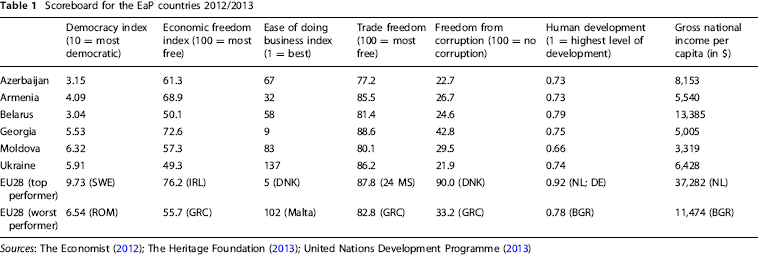
Table 1 illustrates just how different the EaP countries (still) are. For example, as regards political reforms, Belarus and Azerbaijan are in most instances classified as authoritarian regimes and it would seem to be a challenge to apply the same reform policies to those two regimes as to the other four countries (which are mostly hybrid regimes).
Scoreboard for the EaP countries 2012/2013
Sources: The Economist (2012); The Heritage Foundation (2013); United Nations Development Programme (2013)
The level of economic reform also differs remarkably from one EaP country to another. For example, Georgia has drastically liberalised its economy in recent years and scores even better than most EU member states in the Heritage Foundation's Economic Freedom Index (2013) and other indices of economic freedom. The level of corruption, too, differs significantly between the six countries. Applying uniform requirements (and solutions) for economic reform and/or the improvement of the business climate to the EaP region as a whole therefore appears counter-intuitive. Differences regarding the six countries’ levels of human development are also evident. Belarus scores best on human development (though largely due to a centrally managed economy), whereas Moldova scores lowest, and these differences are also visible in the respective levels of income per capita.
A regional approach without considering inter-regional trade?
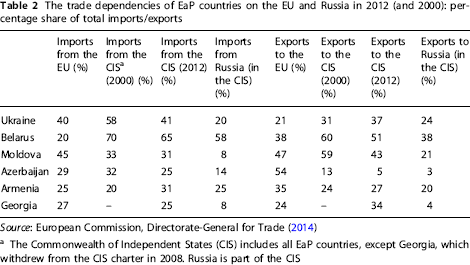
Table 2 shows that apart from the EU, Russia remains the most important trade partner for most EaP countries–-with the exception of Georgia, which hardly trades with Russia. A certain percentage of trade also occurs between the EaP countries, whereby Ukraine is the most important trade partner. For example, Ukraine is Moldova's second most important import partner and third most important export partner, and is among the top 10 most important trade partners of Belarus, Azerbaijan and Georgia. Of all the goods traded among the EaP countries, energy resources form a significant share. Whereas Azerbaijan exports its own petroleum and natural gas resources, Belarus and Ukraine rely on Russian energy resources for the production of their energy exports (Belarus produces refined oil products from Russian crude and Ukraine exports electricity which is generated from gas supplies from Russia). The trade in foodstuffs/agricultural produce is another important pillar of EaP inter-regional trade, which has in fact helped several EaP countries to cushion the negative effects of Russian import bans on agricultural produce (e.g. Moldovan wine). Fostering more trade between the EaP countries should thus be an important dimension of the EaP regional approach, but this has, however, received little attention from the EU so far.
The trade dependencies of EaP countries on the EU and Russia in 2012 (and 2000): percentage share of total imports/exports
Source: European Commission, Directorate-General for Trade (2014)
The Commonwealth of Independent States (CIS) includes all EaP countries, except Georgia, which withdrew from the CIS charter in 2008. Russia is part of the CIS
A regional approach for the EU, not for the EaP?
The charts below show that the EaP region is–-in economic terms–-a periphery to the EU. The EU's trade with the six EaP countries has increased over past years, though in a way that has increased the EaP countries’ dependence on trade with the EU rather than vice versa. The total value of exports from Ukraine to the EU (iron and steel products and agricultural produce) and from Azerbaijan to the EU (mineral fuels) has increased most visibly since 1996 and 2004 respectively, while exports from the other EaP countries to the EU have not experienced a comparable increase. The total value of exports from the EU to Ukraine has increased significantly since 1996, followed (by some distance) by exports to Belarus. The value of exports from the EU to the other EaP countries has not increased significantly. Overall, none of the six EaP countries is of high relevance as a trade partner for the EU. Only Ukraine features among the EU's top 20 export destinations (1.4 % share of total EU exports in 2012) (European Commission 2014). In other words, the EaP region mainly functions as an export market for EU products. Because most EaP countries import more from the EU than they export to the EU, many also run significant trade deficits with the EU (except Belarus and Azerbaijan). More trade within the region (e.g. in agricultural products/manufactured goods) could therefore be an important way for EaP states to address the trade deficit with the EU and also decrease their trade dependence on the EU (Figs. 1, 2).
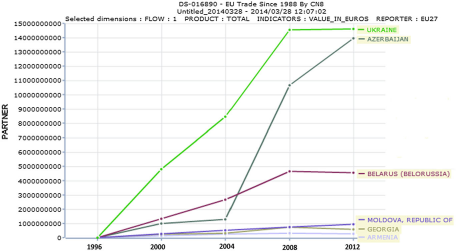
EaP country exports to the EU
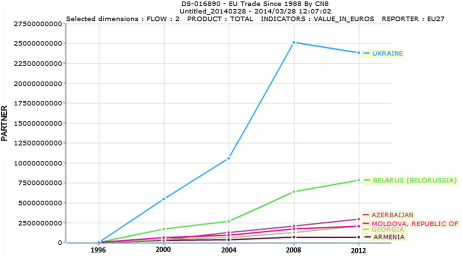
EU exports to EaP countries
Conclusion
The EaP region-building project has certainly played an important role as an additional multilateral layer of cooperation between the EU and the EaP countries. As a tool to support further economic and political reform in the EaP region, the regional approach has encountered similar challenges to those of the bilateral dimension of the EaP, ranging from domestic to geopolitical constraints. I have argued here that more could have been done to foster political and economic linkages between the EaP countries. In addition to developing social and economic infrastructures to facilitate the integration of EaP countries into the EU region as a periphery, more programmes and projects could be created to encourage the development of such links and infrastructures between the EaP countries (at least between those that are not locked into territorial conflict).
More links between the EaP countries could help them to become (slightly) less dependent on the Russian Federation, which is clearly in the interest of the EU. Increased cooperation among the EaP countries appears all the more urgent in view of the 2014 Ukraine crisis: maintaining territorial integrity and independence is a shared interest of all EaP countries, which should create a strong incentive for greater dialogue and cooperation.
However, the dominant trend in the region currently is one of increasing disintegration rather than integration. All region-building projects, including that of the EaP, entail a reconfiguration of space and power relations. And although membership of the EU has never been a goal of the ENP/EaP, the very construction of the EaP region as a political (and economic) region-building project has changed (and challenged) existing parameters of power in the region, which had hitherto been exclusively ‘claimed’ by Russia as its own regional periphery. After a decade of the EU's and Russia's region-building projects competing (with neither power being particularly successful in its attempt to assimilate the region), it now appears that the region and its states have been broken up into a multiplicity of territorial fragments which will become de facto dependencies of either Russia or the EU/the West. In this scenario the EaP countries risk losing the last remaining attribute of ‘subjectivity’ vis-à-vis the outside powers–-their status of sovereign statehood. In the words of Michel Foucher (1998, 238):
From the Baltic Sea to the Black Sea, and perhaps part of the shores of the Adriatic Sea, a kind of ‘Middle Europe’ (Europe médiane, Mitteleuropa), an in-between Europe, is reviving, whose fate will be decided partly from outside the region, in Washington, Moscow, Bonn/Berlin and, perhaps, in London and Paris.