




Abstract
The Euromaidan movement is one of the most prominent developments to have captured the attention of the world in the last few months. This article aims to draw a line under the recent developments in Ukraine. It will first assess the development, as well as the impact, of the movement on Ukraine. Then it moves on to discuss the role of the Russian Federation and the EU in mitigating the domestic crisis. The article concludes with the idea that, as the Ukrainian people have fought for their right to live in a democratic system inspired by European values, the EU should continue to support Ukraine in its democratic and European aspirations. This support should not only be in the form of financial packages, but also shown by accelerating the visa liberalisation dialogue, which would grant Ukrainians access to what they have fought for–-a united Europe.
Introduction
The Euromaidan movement has held the attention of the whole world for the last three months. This movement started as a protest in the main square in Kyiv by around 200 politicians and civil society activists who came together to protest against the government decision to postpone the signature of the EU Association Agreement. President Yanukovych and the Ukrainian government justified this shift in the state's strategy from integration with the EU to integration with the Russia-led Customs Union by linking it to the strong economic pressure applied by the Russian Federation. However, the protesting Ukrainians did not accept this explanation and continued their small-scale demonstration. One week after Euromaidan began, on 29 November, a violent crackdown by the berkut (riot police) on the 300 students present caused protestor numbers to swell by 35,000 students from the three major Kyiv universities. Joined by their family members, friends and professors, Euromaidan grew into a 500,000-strong protest in the capital. However, this did not stop the authorities from perpetrating further violence. After each brutal crackdown on peaceful protesters, Ukrainians replied with ever larger Euromaidan protests. Consequently, the movement grew into a protest which, within a week, included millions of Ukrainians in 46 cities of Ukraine, who were not only voicing their favourable opinion of European integration, but also demanding basic democratic rights.
The 21 February Euromaidan victory, measured in terms of political change, the dismissal of Yanukovych and a return to the path of European integration, has had a tremendous impact on Ukrainian society and politics. At the same time, despite being often portrayed as pro-European and anti-Russian, this movement has developed with the strong involvement of both the EU and Russia. While for the EU, Euromaidan is a pro-democratic movement, Russia has presented it as a movement of right-wing radicals who aim to overthrow the legitimate government. Consequently, the actions of the EU and Russia in regulating the political crisis in Ukraine have often conflicted.
The aim of this paper is to discuss the impact of the Euromaidan movement on Ukrainian society and politics, as well as to assess the actions of Russia and the EU which aimed to regulate the crisis situation. The development of Euromaidan has been closely monitored by both the EU and Russia, as these two actors have aimed to steer the developments in accordance with their values and interests. However, these actors have found themselves on a collision course over Ukraine. While the EU and Russia enjoy a strategic partnership, their actions towards Ukraine can be qualified neither as guided by a common strategy nor as taking place in a spirit of partnership. In this article, the recent aggression of Russia against the territorial integrity of Ukraine is touched upon but not fully discussed, as these events are still unfolding between Ukraine and Russia. Therefore the article cannot give unequivocal recommendations.
Reflections on Ukraine
The Euromaidan movement has had two major impacts on Ukraine. First, it has consolidated Ukrainian society, which has fought for three months for European integration, for the dismissal of the corrupt and violent government, and for the right to live in a democratic state. Second, it has allowed Ukrainians to bring about desired political changes in governance, as well as to make changes to the political system by bringing back the previous Constitution. The latter has allowed most of the powers that were previously in the hands of the president to be returned to the Parliament.
Changing society: Euromaidan as a driver of social change
‘Ukrainians have made a decisive choice in favour of our European values’ (Van Rompuy 2014). In contrast to the Orange Revolution, which was held in the winter of 2004-5 as a protest against fraud in the presidential elections, Euromaidan was a spontaneous apolitical movement marked by its strong ability to organise itself; the resolution of its participants not only to change politicians, but to establish a well-governed state; and by the commitment of the Euromaidan protestors to be active participants in such a change. In contrast to the Orange Revolution, which was a pre-planned event that eventually the gained support of the citizens, the three-month-long Euromaidan movement developed into a subculture built on European values and marked by a high level of solidarity among Ukrainians living in different parts of the country. This community involved people from Western as well as Eastern Ukraine, uniting different religions and nationalities. As the tragic events have shown, there were not only Ukrainians, but also those originally from Belarus, Armenia and Georgia among the Euromaidan protestors who lost their lives. There were Christians and Jews from Western Ukraine, but also others from Central and Eastern Ukraine, as well as Crimea.
According to Fond Democraticnich Iniciatyv (2014) the average Euromaidan protestor, contrary to the Russian propaganda that they were neo-fascist and extremist, was 36 years old, had received a higher education and spoke predominantly Ukrainian, with some Russian. Of the participants, 57.2 % were male and 42.8 % female. Moreover, 49.8 % came from Kyiv, while the remainder came from other regions of Ukraine (Fig. 1). Moreover, according to the survey, more than 92 % of Euromaidan participants did not belong to any political party, but had joined the movement for the following reasons:
70 % because of the aggression against students during the night of 30 November,
53.3 % to protest against the decision not to sign the Association Agreement with the EU,
50 % to change their lives for the better, and
39 % to change those in power in Ukraine.
Through their actions and some dramatic events, Euromaidan participants have changed the way Ukrainians reflect on the state in which they live. At the beginning the aim of the Euromaidan participants was to voice their frustration regarding the government's decision to postpone the signature of the Association Agreement. However, with every brutal crackdown, first on students, and later on other peaceful protestors, followed by the draconian laws voted for by the Parliament, the demonstrations have spilled over into a strong desire among Ukrainians to establish a state governed by the rule of law, to introduce transparency into the decision-making process and to decentralise the powers which had been acquired by Yanukovych.
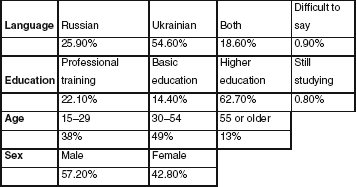
Sociological make-up of Euromaidan activists
The massive protests have also found unprecedented support among the different religions represented in Ukraine. To start with, prior to the official renouncement by the government of the course of European integration, all faiths in Ukraine, including the Moscow Patriarchate, Jews and Muslims, issued an open letter to Ukrainians stating that European integration is the only civilisational choice for Ukraine (Churches and Religious Organisations 2013). During the Euromaidan protests, the Council of Churches and Religious Organisations, which represents all religious groups in Ukraine called upon Yanukovych to stop the bloodshed and violence against the protesters (All-Ukrainian Council of Churches 2014). Finally, Christian priests actively participated in the Euromaidan protests by conducting daily masses on the Maidan, by acting as a wall between the protesters and the riot police, and by praying from the stage during the violent crackdowns.
Euromaidan has become a movement that has united predominantly well-educated Ukrainians who stand for European values and against state-led violence that aims to oppress the basic principles of democracy. For these European values those Ukrainians were ready to stand and fight during the three months of winter. The only two weapons that the Euromaidan participants had were the national anthem and the prayers said during the violent crackdowns by the riot police. The 100 deaths and around 1,500 who were seriously wounded, losing eyes, hands, legs and their health, was the high price Ukrainians paid for upholding European values. This dramatic experience has made Ukrainians and a number of Ukrainian politicians reinforce their commitment to making changes in their country.
Changing the political landscape: democratic transformation
The Euromaidan protests have ended with a victory that has put an end to the political crisis and the centralisation of power in Yanukovych's hands. Previously, the Parliament, which was strictly subordinated to Yanukovych, would vote or ignore the proposed laws depending on his orders. The only way that the political opposition could be heard was by blocking the reading of bills in Parliament. The most prominent political leader and the strongest opponent of the president prior to the protests–-Yulia Tymoshenko–-was eliminated from participation in the political process by her imprisonment. This situation, along with similar cases of political persecution, 1 had significantly damaged trust in the judiciary, which had become yet another instrument of political influence. Consequently, for several years all power had been concentrated in the hands of one person–-Victor Yanukovych.
The other famous cases were those of Yuriy Lutsenko, former minister for internal affairs, and Georgii Finipchuk, former minister for ecology in Tymoshenko's government.
Euromaidan, which developed into a strong movement against the usurpation of powers, became the driver for political change. First, a long-awaited crack opened up in Yanukovych's party, the Party of Regions, allowing the previously paralysed political opposition to form a new majority in the Parliament. Having lost control of his own members of parliament, Yanukovych abandoned his post and fled the country. The Parliament has once again become the main decision-making body by reintroducing the former Constitution, which limits the powers of the president. As a second step, the Parliament appointed an acting head of state and a new prime minister, as well as forming a new government, which had to present its candidates at the Euromaidan to be approved by the protesters.
Reflections on the actions of Russia
The Euromaidan protests in Ukraine have opened up a Pandora's box in relations between the EU and Russia; as a result, they have found themselves on a collision course. The EU's support of the democratic aspirations of Ukrainians has been promoted by the Russian Federation as support for extremists and radicals in Ukraine. In his article on the situation in Ukraine and EU–Russia relations, Russian Minister of Foreign Affairs Sergei Lavrov (2014) accuses the Western partners of incentivising the volatile situation in Ukraine by supporting the anti-government protests, and sarcastically noted that Russian officials were not handing out cookies on the Maidan, in contrast to EU and US officials. During a press conference at the beginning of March, President of the Russian Federation Vladimir Putin (2014) said that ‘They [the Western partners] supported an unconstitutional armed take-over, declared these people legitimate and are trying to support them’. Putin has also expressed certitude that the Euromaidan militants were trained in Poland and Lithuania. Consequently, according to Putin, Euromaidan is a product of Western instructors (Putin 2014).
The geopolitical rivalry between the EU and Russia started prior to Euromaidan, namely with the launch of the Eastern Partnership (EaP). From the beginning it was clear that Russia was not satisfied with such an encroachment on its historical sphere of influence. For Russia, the multilateral EaP platform was seen as a programme that grouped all six EaP countries under the EU's influence. The bilateral Association Agreements, especially the one with Ukraine, were, in Putin's view, jeopardising Russia's Eurasian Economic Union project, in which Ukraine was expected to be one of the main economic partners. A few months later Lavrov (2014) called the EU–Ukraine Association Agreement ‘the apple of discord’ in EU–Russia relations.
Russia's fear of losing the EaP countries has spilled into strong pressure being placed on most of them. In June, Russia concluded an arms deal with Azerbaijan which is valued at the equivalent of the annual state budget of Armenia. This state, which is at war with Azerbaijan over the Nagorno-Karabakh region, was kindly invited by Russia to abandon its course towards European integration and join the Russia-led Customs Union. With its security only guaranteed by Russia, Armenia was forced to follow Russia's proposal. From July Russia introduced trade sanctions against Moldova and Ukraine, tremendously weakening their economies, which were already immature and heavily dependent on Russia.
With regards to Ukraine, Russia has breached its international obligations within various different dimensions of international law. In summer 2013, by introducing trade sanctions against Ukraine, it breached the Budapest Memorandum, which was signed by Ukraine, on the surrender of its nuclear weapons, the UK, the US and Russia in return for security assurances. 2 Under this Memorandum, Russia, together with the US and the UK, guaranteed ‘to refrain from economic coercion designed to subordinate to their own interest the exercise by Ukraine of the right inherent to its sovereignty’ (art. 3). In February 2014, with the recent Russian aggression and military invasion of the Crimean peninsula, Russia again breached the Memorandum, while saying that it reaffirms its obligation ‘to refrain from threat or use of force against the territorial integrity’ (art. 2).
In Ukrainian and Russian, security guarantees and security assurances have the same meaning.
Russia has also violated a bilateral agreement with Ukraine. At the end of February, by allowing the Black Sea Fleet to move around the peninsula, the Russian Federation violated the Agreement on the Status and Conditions of Stationing of the Black Sea Fleet. According to this Agreement, such manoeuvres are only allowed with the permission of Ukraine. Russia was also acting against the principles established with Ukraine in the 1997 Treaty on Friendship, Cooperation and Partnership.
Russia has also breached its obligations under international law. By bringing additional troops into the sovereign territory of Ukraine, Russia has violated the UN Charter and the Helsinki Final Act of the Organization for Security and Cooperation in Europe. These documents defend the inviolability of sovereign territories, both their integrity as well as their political independence, from aggression by a third country.
All of the aforementioned violations have been reinforced by propaganda and a deliberate misinformation campaign conducted by the Russian Federation, which is aiming to justify its acts of aggression. The Russian leadership, as mentioned before, has developed a myth about radicals and extremists in Ukraine who are infringing upon the rights of the Russian-speaking minority. Therefore, Russian troops are there to ‘make the radicals sober’ (Lavrov 2014). Moreover, Putin is the only leader who undermines the legitimacy of the current authorities. Putin considers the National Parliament of Ukraine to be only partially legitimate as the members of parliament were elected, but the majority was illegally reformed after Yanukovych fled the country. He does not acknowledge either the government or the acting president of Ukraine. Putin has defended the legitimacy of Yanukovych as president, even after his departure from Ukraine. Moscow also accepted a letter written by Yanukovych in which he asked Putin to intervene in the state. Putin also supports Prime Minister Aksenov of Crimea as, according to him, Aksenov was elected in accordance with democratic procedures. Neglecting the fact that the parliamentarians in Crimea voted without external scrutiny and in the presence of armed soldiers, Putin continues to insist on the legitimacy of the elections.
Reflections on the EU
The developments in the EU's eastern neighbourhood have been worrying for economic and security reasons. The massive protests in Ukraine, which included almost all of the 46-million-strong population, have inevitably had an impact on the economic security of the EU. The February military intervention of the Russian Federation in Ukraine has made EU member states concerned about the potential outbreak of war on its immediate borders. However, even though the EU has sided with the democratic aspirations of Ukrainians, its ability to ensure the peaceful resolution of the political crisis has been limited.
Euromaidan protesters had high expectations of the EU which it was unable to meet due to the sui generis nature of its foreign policy. While Ukrainians were expecting military intervention from the EU, all they were hearing was diplomatic statements of ‘deep concern’. Numerous official visits from the High Representative Ashton and Commissioner Füle to Kyiv did not seem to bring concrete results. Consequently, the EU's response to events in Ukraine was inadequate in the eyes of Ukrainians. Nevertheless, the EU could not have acted differently. In contrast to the US or Russia, the EU does not have military forces. Moreover, it is composed of 28 member states, all with their own independent foreign policies, national interests and complex interdependencies with the Russian Federation. All of these factors required the EU to resort to different instruments of pressure.
The EU has successfully used some alternative tools to apply pressure. First, two days after snipers shot at the peaceful protesters on the Maidan, the Polish, French and German foreign ministers arrived to see Yanukovych, with the aim of facilitating negotiations and eventually ending the state-led violence. Together with the political opposition early on the morning of 21 February, the parties concluded the Agreement on the Settlement of Crisis in Ukraine (Poland, Ministry of Foreign Affairs 2014), which forced Yanukovych to stand down the military forces in Kyiv. Having agreed to stop the violence, Yanukovych first left Kyiv and then Ukraine. Once he had abandoned the duties of a president who was a de facto dictator, power shifted in Ukraine within a matter of hours.
Second, in a sign of solidarity and support of the European aspirations of Ukrainians, the European Parliament in its resolution has reiterated its support for Ukraine's European future. For the first time in European history protesters have died under EU flags, defending European values. Therefore, the European Parliament resolution recognises the European Council decision that the Association Agreement is not the final goal of EU–Ukraine cooperation, but also stresses that ‘Article 49 TEU refers to all European States, including Ukraine, which may apply to become a Member of the Union’ (European Parliament 2014, paragraph 24). A few weeks later, the European People's Party (EPP), a leading political party in the EU, also reiterated its commitment to Ukraine's prospects of EU membership, provided that it adheres to European values (EPP 2014). Circulating this statement was a symbolic, but rather important, gesture of solidarity with those Ukrainians who fought for our common European values.
Third, the European Council (2014, paragraph 2) has agreed to introduce economic sanctions against those responsible for the violence against peaceful protestors. On 5 March, it published the names of 18 Ukrainian high officials who were ‘responsible for the misappropriation of Ukrainian State funds and … for human rights violations’.
The most recent Council conclusion has reconfirmed the EU's readiness to sign the Association Agreement and to back up the process with financial support (Council of the European Union 2014). The EU has agreed to sign the political part of the agreement by the end of March, and the complete agreement not later than August 2014. The EU has committed to supporting the process of political and economic transformation with a financial package worth €11 billion. This package is aimed at financial, trade and technical assistance.
Conclusion
The Euromaidan movement has irrevocably carved out the future of Ukraine, a future with the EU. The enduring path towards European integration is again back on the national agenda. In its Council Conclusions, the EU has acknowledged the European future of Ukraine, as have the European Parliament and the EPP in their resolutions. The EU has made a significant financial commitment to Ukraine, aimed at facilitating and supporting the process of implementation of the Association Agreement, as well as improving Ukraine's critical economic situation.
In contrast, Russia has proven to be a destabilising factor during the Euromaidan movement, and by conducting military aggression against Crimea it has brought instability to regional security. While, by means of the Euromaidan movement, the Ukrainian people have overcome Russian interference, Ukraine as a state has been unable to oppose Russia's brutal intervention in Crimea due to its weak military capabilities.
Even though the EU cannot intervene in the military conflict between Ukraine and Russia due to its lack of military might, it has other instruments that will help Ukraine to establish a democratic and competitive state. EU support aimed at integrating Ukraine will be implemented through the Association Agreement, as well as through the above-mentioned financial package. At the same time, in order to remunerate the Ukrainians for their strong devotion to European values and demonstrate our solidarity with the European people of Ukraine, the EU should accelerate the visa dialogue with this country. It is difficult to build up Europe in Ukraine while the EU and Ukrainians are separated by fenced borders. The opening of a dialogue aimed at introducing a visa-free regime was suggested in the recent resolutions of both the European Parliament and the EPP. The EU has already established a visa-free regime with Moldova. Ukraine should be next.
Footnotes