




Abstract
European elections via popular vote were introduced in the 1970s to boost popular interest and European integration. However, at the first election in 1979, people voted without consideration for European issues, but instead with the national agenda in mind. This situation has been repeated on all seven occasions, up to the most recent election in 2009. As we head towards the next European elections in 2014 we explore the differences from previous elections and note the financial crisis in the eurozone, the profound politicisation of the EU and the anticipated implementation of the latest treaty, named after the Lisbon summit. In this overall environment we attempt to assess the type of message that political parties on the national level will present to the electorate. Under certain conditions, we will contend, the next European elections may depart from those studied in previous research analyses.
Introduction
Predicting the type of message that political parties in the EU Member States will put to the citizenry in the upcoming 2014 European elections is not a scientifically consistent exercise. Still, we will approach the question by building on an old academic discourse about electoral behaviour in European elections and analyse the changes to the broader political and institutional environment in which the next elections will take place. An assessment of the type of message political parties will present to the voters, compared with the campaign manifestos of the 2009 elections, will be attempted, based on three scenarios of how the ongoing crisis in the eurozone may evolve. Our sole aim is to understand the likely trends that will prevail, rather than making any kind of quantitative prognosis.
Looking back over the history of European elections
The 1970s was the decade when a new wave of Euro-enthusiasm flourished in the expectation of the first European elections under universal suffrage. This enthusiasm was triggered by the decision to implement direct elections which, although provided for in the original treaties of the 1950s, had not progressed, primarily as a result of the resistance of President De Gaulle. His successor, Georges Pompidou, relaxed the French position, allowing the European Communities to open a new chapter on integration. The Hague European Council of December 1969 agreed on the enlargement of the Communities and opened discussions on direct elections, integration and new areas of policy coordination. In the words of Hallstein, President of the European Commission from 1958 to 1967, European elections would create ‘a truly European mandate [and] the emergence of truly European political parties’ (Hallstein 1972, 74). The event that further advanced the popularity of the European project was the European Council of December 1974 in Paris, which officially set the date for the first direct European elections as May-June 1978. 1 In the end, the vote had to be postponed for a year because of delays in ratification of the requisite legislation. The elections were finally held on 7-10 June 1979, electing 410 members. In the words of Spénale, ‘In the eyes of non-member countries, in twenty months’ time, Europe will at last acquire for itself something it regards as a prerequisite for any State seeking to join the Community–-a true system of parliamentary democracy, based on the dual plurality of parties and peoples’ (Spénale 1976). These decisions were positively received by society. As we see in Table 1, in 1977 the prospective direct European elections were accepted by 72% as opposed to the 54% in favour in 1973.
Evolution of positive and negative stances on the first direct European elections
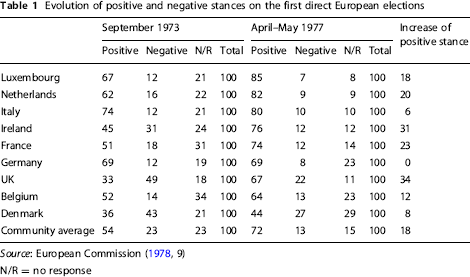
Source: European Commission (1978, 9)
N/R = no response
The issue of direct elections raised considerable controversy in France and President d'Estaing had difficulties getting the support of his Gaullist partners in parliament. Thus his consent was made possible via the clause that stated that France would accept no further increase in the powers of the European Parliament. This was passed without a vote by the French Parliament thanks to Article 49 of the French Constitution.
This momentum in the run-up to the first European elections is what triggered the creation of the European party federations, envisaged as additional bodies that would coordinate with the national parties to help their campaigns prior to the first elections of 1978/1979. They were created in the mid-1970s: the European People's Party (EPP) and the European Liberals in 1976 and the European Socialists in 1974.
The disenchantment
Against expectations, people voted predominantly based on national criteria rather than with the future of the European Communities in mind. They rewarded or punished incumbent national government parties rather than expressing their views on the future of the continent. The theory that best captured the outcome of the first European elections was the ‘second-order national election’ model developed by two German political scientists, Reif and Schmitt (Reif and Schmitt 1980; Reif 1985; Schmitt and Mannheimer 1991). The theory contends that smaller parties do better in European elections and that government parties experience losses, marking a difference between sincere and protest voting. No change in government occurs regardless of the result, thus people exercise different and looser voting criteria than at national elections, something that also explains the lower turnout.
The 30 years between 1979 and 2009 brought about fundamental changes in the course of European history. Although the changes were not only national in either origin or effect, they did not alter electoral behaviour in the European elections. The 9 Member States gradually grew in number, becoming 27 in 2007; Eastern Europe was liberated from Communism and took the difficult path to capitalism and democracy; the Treaty of Maastricht was signed in 1991; and the euro was launched in 1999. All of these factors brought about changes to everyday life in the Member States. Yet, the 2009 European elections still followed the same voting pattern as the 1979 elections; people voted with the national context in mind. The pursuit of European policy congruence has never been a high priority for the majority of voters at the European elections.
Therefore, after the seventh European elections in 2009, the theory formulated by Reiff and Schmitt in 1980 looks to be even more solid. A number of other theories have since attempted to explore the content and context of European elections. The decreasing level of citizen participation has been interpreted as a clear lack of interest and support for European integration (Blondel et al. 1998).
Indeed, Van der Eijk and Franklin (1996) discovered three modes of voting in European Parliament elections, which they characterised as ‘voting with the head’, ‘voting with the heart’ and ‘voting with the boot’. The temporal location of European elections compared with national elections is another topic of interest, both for academics and for policy practitioners (Reif 1985; Marsh and Franklin 1996; Oppenhuis et al. 1996). In different EU countries we find different voting patterns at the European elections and this is one parameter that the parties will take into account when deciding on the flavour of the ‘dish’ they will serve to the electorate.
The core arguments of the second-order model have been confirmed in repeated elections. National political parties competing for the citizens’ votes at European elections have adopted strategies that attract voters based on this model. Therefore, if there had been no serious changes in the EU post-2009, our assumption would be that in the run-up to the eighth European elections the national political parties would do what they had done at the previous seven: serve dishes of a national flavour. We will therefore assess the broader environment in which these elections will take place compared with the EU prior to 2009. Indeed, there are at least three important changes that have taken place on the path towards the next elections.
Greater Euroscepticism
The ongoing financial crisis in a number of countries at the periphery of the eurozone has dominated the political discussion in most, if not all, Member States of the EU. This will influence the electoral behaviour at the next European election in various ways. The impact of the crisis is Union wide, but it is greater in the 17 Member States of the eurozone. This crisis has substantial consequences for European integration, as the Member States have acquired new roles: from being partners in the EU, some have become lenders of billions of euros to other Member States. The media have given this phenomenon wide and often critical coverage over the past three years. Assessing the impact that this crisis will have on voting behaviour at the next election is difficult, as there are divergent trends in different countries and we lack a historical precedent.
Unlike other important international issues that have been managed by national governments, this crisis has had a more direct impact on everyday life, with the crisis in Greece being the most severe in the eurozone (Sklias and Maris 2013). The latest news of a new slowdown in the eurozone economy in the fourth quarter of 2012 (Eurostat 2013) is a recent example of this characteristic. Looking at Figure 1, which measures the overall approval rates for the EU, we can note that it has dropped dramatically, from a five-year average prior to 2009 of about 48% positive and 16% negative, down to 30% positive and 29% negative in late 2012, showing a clear rise in Euroscepticism. The same conclusion can be seen in Figure 2, which notes the evolution of support for the single currency. The first financial crisis did not affect the trust of Europeans in the euro, which remained at about 61% positive and 31% negative for five years (2004–9). By late 2012 the figures had changed to 53% positive and 40% negative, closing the gap from a 30% to a 13% difference between positive and negative views on the euro.
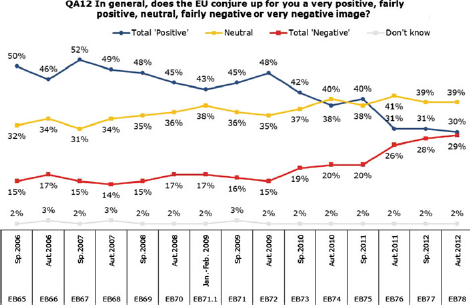
Evolution of the perception of the EU.
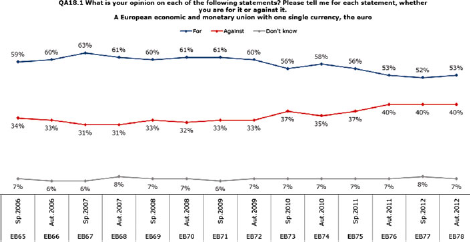
Evolution of the perception of the single currency, the euro.
Euroscepticism is an old topic in the EU, having been extensively researched. According to Hix (2007, 133) ‘citizens either believe that European integration or EU policies have led to policy outcomes that are less desirable than the previous domestic policy status quo, or believe that the EU reduces the likelihood that domestic policies will move in their preferred direction’. Euroscepticism has different patterns in the different Member States, driven by local political discourse and national history. The discussion on the adoption of the EU Constitution has produced similar waves in recent years. Today, Euroscepticism is facing a change in pattern in the different EU Member States. In the eurozone countries that have contributed the financial resources to shore up the countries in crisis, domestic opposition to the ‘bailouts’ has increased Euroscepticism and affected votes in the national parliaments, which have been conducted under intense media scrutiny. In the countries receiving the loans, Euroscepticism has risen as a result of the pressure exercised by the troika of lending institutions over fiscal adjustment programmes, which include severe austerity measures implemented through the conditionality principle. The starkness of the present crisis and the politicisation of the Union's policies to address it provide new opportunities to observe the rise in Euroscepticism (Fig. 3).
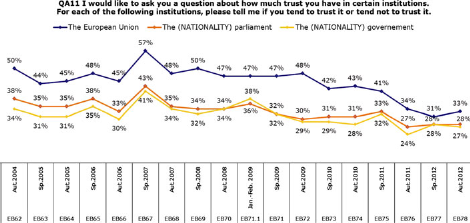
Evolution of trust in institutions.
Greater politicisation
A parallel trend is the substantial increase in the politicisation of the EU, thus increasing the levels of public attention paid to its decisions and its crisis management. Recent academic debate in this area has centred on the desirability of the further politicisation of EU institutions and the consequences of that. Follesdal and Hix (2006, 533–562) have argued that politicisation reflects the normal evolution of the EU and will bring about greater levels of accountability and consequently efficiency in the system. European politicians will work towards predefined policy goals and, at the end of their mandate, citizens will either re-elect them or replace them. It has also been argued that politicisation ‘may increase the imbalance between prospects and achievements, generate disillusionment, discontent and frustration at a level higher than those existing now’ (Bartolini 2006, 45). Current developments seem to reinforce the main thesis of both arguments. Politicisation has grown dramatically, but at the same time uncertainty, tension and Euroscepticism have emerged. The politicisation that we can observe today, as a result of the ongoing crisis, is one that creates Euroscepticism throughout the EU for different reasons. The two phenomena are obviously related, but not as cause and effect. This implies that you cannot predict the impact on Euroscepticism if the crisis is averted or exacerbated in the next 12–24 months.
Opinion polls on the upcoming national election in Germany and public opinion over the two main contenders for the chancellery demonstrate the increased politicisation. The management of the euro crisis has become a competitive advantage for incumbent Angela Merkel over her adversary Peer Steinbrück, giving her the lead in the approval ratings. However, this example does not imply that the same effect can be observed throughout the eurozone, much less throughout the EU (Fig. 4).
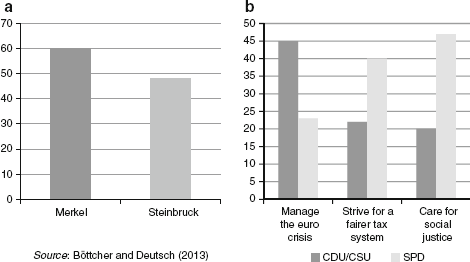
Approval rates for main contenders of the next German national election
The implementation of the Lisbon Treaty
The implementation of the Lisbon Treaty, and particularly Article 17(7) concerning the appointment of the president of the European Commission in accordance with the outcome of the European election, is expected to affect the electoral behaviour of voters and parties. This change was originally designed to give the European election a tangible political result. On all seven previous occasions, people could not see how their vote was linked with political change in Europe, so local or national criteria prevailed. The 2014 elections will be the first to test the effectiveness of this unprecedented institutional reform. In 2009 this change was attempted but not implemented (Peglis 2011). It is therefore impossible to estimate the effectiveness of the reform in raising European awareness of both parties and voters. At present, the ongoing financial crisis in the eurozone is an additional impediment, so implementation of Article 17(7) of the Lisbon Treaty will likely take place but without raising the political stakes of the European elections by promising voters a tangible political result. The growing Euroscepticism, divergent domestic problems and competitive relations between the Member States have not created an ideal environment for the European elections. Following this argument, we would identify for further research the following criteria that will affect the impact of the Lisbon Treaty implementation at the next European election:
the extent that the European parties will actually implement the clause (Barroso 2012) 2 despite the overall Eurosceptic climate today and ‘the end of programmatically unstructured politics’ (Moschonas, forthcoming);
the extent to which the national parties integrate and build on this clause in their domestic campaign (national parties have a dominant, although not monopolistic role, in these elections); and
the positioning and type of campaign of the main contenders for the presidency of the European Commission, in the event that the major Europarties come up with candidates and run campaigns.
As Barroso stated, ‘This would be a decisive step to make the possibility of a European choice offered by these elections even clearer. I call on the political parties to commit to this step and thus to further Europeanise these European elections’ (Barroso 2012).
How will parties speak to the electorate?
Based on the above, in order to assess how national parties will address the electorate in the upcoming election campaigns, we take as a starting point their positioning during the previous election of 2009. The electoral manifestos of the 196 national political parties of the 27 Member States were documented and put in a comparative study, with uniform criteria, under the PIREDEU research project (Providing an Infrastructure for Research on Electoral Democracy in the European Union). 3 The research project classified them under several policy questions. In Table 2 we present the classification on their position regarding European integration. This data will be useful to compare with the data from the analysis of the manifestos for the 2014 European elections (Table 3).
1979 European Parliament election turnout, % by country
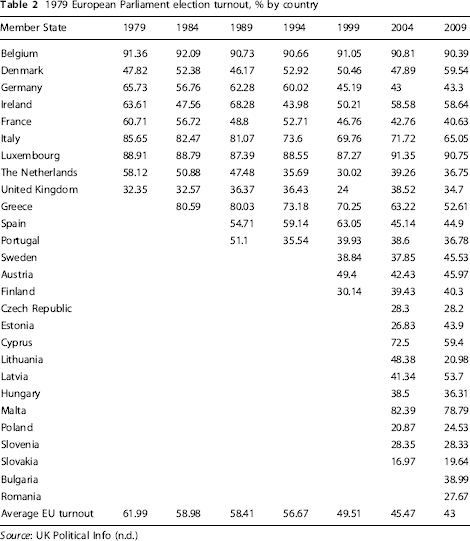
Source: UK Political Info (n.d.)
Categorisation of the manifestos of national parties on their European views at the 2009 European election
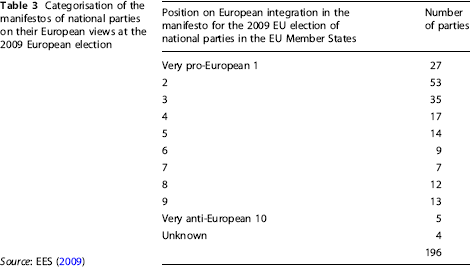
Source: EES (2009)
PIREDEU is a project coordinated by the European University Institute and its Robert Schuman Centre for Advanced Studies. PIREDEU has its origins in the European Election Studies (EES) conducted under various auspices since 1979. More information is available at http://www.piredeu.eu/.
Trends dependent on the evolution of the crisis
Since the elections will take place just over a year from now, the evolution of the crisis in the eurozone is a key factor in assessing parties’ and voters’ strategies on the Europe question. We will put forward three scenarios showing divergent trends and we have prepared the following three figures in order to visualise the answer to the main question of this article.
Scenario A
The situation a year from now will be much worse, with the eurozone and the EU falling deeper into a new cycle of recession and a downward economic spiral.
Uncertainty about the future will prevail among the electorate. On average we would expect voters to blame mainstream parties for the problem and express this disappointment at the ballot box. In this scenario mainstream parties are expected to position their electoral manifestos away from pro-European views and place more emphasis on minimising the negative consequences of the crisis for their respective country (Figs. 5, 6). Mainstream opposition parties, out of strategic rather than policy considerations and fearful of suffering electoral losses, are expected to diverge more from government parties and adopt more neutral views on Europe, aiming to minimise their electoral losses. On the other hand anti-systemic, populist and protest parties from both the left and the right are expected to sharpen their anti-European positioning, but talk more on European issues, as this will be the Achilles heel of the parties in office and mainstream parties in general. Finally, in this scenario we anticipate that mainstream parties will suffer bigger electoral losses to the benefit of the anti-systemic and populist parties. Mainstream opposition parties’ results will depend on their positioning with regard to the escalation of the crisis and will vary from country to country (Fig. 7).
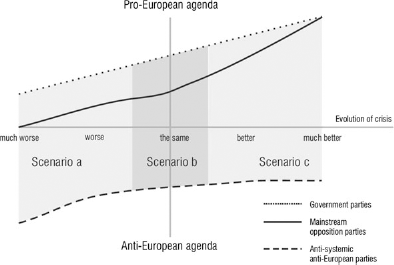
Assessment of the European integration positioning of national parties’ manifestos for the 2014 European elections dependent on the three scenarios of crisis evolution.
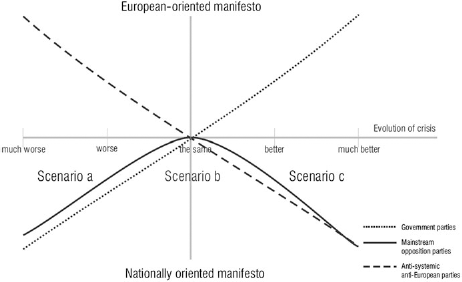
Assessment of whether national parties will offer a dish of national or European flavour during the 2014 European elections dependent on the three scenarios of crisis evolution.
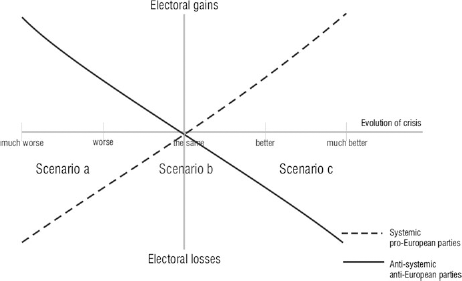
Assessment of the electoral gains and losses of national parties at the 2014 European elections dependent on the three scenarios of crisis evolution.
Scenario B
As the European election approaches, the crisis will neither deteriorate nor resolve and things will be about the same with the suspense continuing. In this scenario, mainstream parties, both in office and in opposition, are expected to talk less about Europe and more along national lines, emphasising protection from the negative consequences of the crisis. Mainstream opposition parties will not be as pro-European as the parties in office when outlining the risks associated with the crisis. Radical parties will strengthen their anti-European positioning. Ultimately, losses are anticipated for mainstream parties and gains anticipated for anti-systemic parties.
Scenario C
The situation 12 months from now will have improved sharply: adjustment programme countries will have returned to positive growth rates, and society will feel that the worst has been left behind. This will dramatically affect the position of national parties regarding the main question of this article. This would be the best scenario. In this scenario national parties in office are expected to be more pro-Europe, as ‘more Europe’ will be projected as the solution to the crisis and their crisis management strategies will be promoted in the campaigns as success stories. Mainstream opposition parties will copy government parties in their pro-European electoral tone, but they will try to move the agenda towards national issues, as they have done in past European elections. Anti-European parties will moderate their anti-European positioning, emphasising persistent national problems and therefore putting forward a more nationally oriented campaign. Electoral gains for system parties will be dependent on other nationally driven criteria, and it will be hard to assess the voting behaviour of citizens towards the anti-European parties. In scenario C, the analysis of the electoral results of the 2014 European elections is more difficult.
Further to the above, the persisting declining trend in voter turnout, may be reversed for the first time, as public interest has increased as a result of the politicisation and the Euroscepticism that have been intensified by the crisis. This is estimated to be the case regardless of which scenario materialises. From this perspective the existing classic second-order national election model may be challenged for the first time as the whole discussion leading up to election day will be dominated by the European question. Finally, from the above analysis we predict an emerging new divergence in the EU. The crisis is driven by increasing levels of interdependence among EU Member States, both institutional and economic, while national electorates are demanding more national solutions from their governments. The growing Europeanisation of problems co-exists with the growing nationalisation of voters’ preferences. This phenomenon describes a possible new institutional crisis in the EU.
Conclusions
The ongoing crisis and its development in the next 12 months is the most important factor determining the strategies of candidate parties. Politicisation is currently prevailing, enhancing Euroscepticism among the European electorate. The Lisbon Treaty and the extent of its implementation will be a supplementary parameter in the campaign. Political parties will position themselves according to how the crisis evolves, and, for the reasons presented, we expect a departure from what we consider to be standard behaviour for both parties and voters in European elections. We are fully aware of the quasi-methodology we have used to draw out the above assumptions. However, the emergence of this crisis has put the EU on a new, uncharted path that requires research in new directions. The 2014 election will most likely provide a departure point from previous analyses on the subject.
Footnotes