




Abstract
This review paper takes stock of the reasons for, and explanations of, convergence and diversity in political campaigning in Europe. Convergence is primarily related to growing homogenisation practices resulting from the Americanisation or globalisation of campaigning, in particular through the common use of new media. Diversity, in contrast, stems from differences in structural and contextual country-specific features, such as different electoral laws, media systems or political culture. The biggest gap that exists in this field of study, despite recent improvements, concerns insufficient attempts to quantify campaign practices that would allow better capture of the degree of either convergence or divergence.
Introduction
One of the major arguments in the recent literature on political communication is that, due to reasons such as globalisation, Americanisation or modernisation, political campaigns in Europe are becoming more and more similar to one another. This tendency is visible both on a macro-level, with political parties running centralised, high-cost and television-oriented campaigns, and on a micro-level, as far as the campaign strategies of candidates are concerned. However, despite recent attempts, relatively little attention has been given to the question of how to quantify the degree of convergence and diversity in political campaigning. In other words, when do we see convergence, and when do we see divergence in political campaigning? This review article starts with the latter question in order to identify the campaign trends in Europe, with a particular focus on analysing and explaining the similarities and differences between the countries. Due to the space limitations of this paper, I refrain from offering an analysis of the consequences of these processes on politics in general and democracy in particular. Before we turn to the methodological and empirical assessments, let us discuss under what theoretical conditions convergence or divergence is likely to take place.
Possible reasons for convergence
The core foundation of globalisation assumes convergence between states and societies in many spheres of human activity, including politics. This is possible thanks to rapid information exchange, for example, and the existence of information societies. In these circumstances, in the light of the mediatisation of politics (Mazzoleni and Schulz 1999), one of the key sources of power is an ability to communicate effectively, including during political campaigns. The literature on political communication for some years debated the influence of American campaigning as a model generator for European campaigns, and looking from inside Europe, as a source of convergence (Negrine and Papathanassopoulos 1996). The elections in the US are closely watched all over the world, becoming close to being treated as a domestic issue. Campaign managers often hold master's degrees in political communication from American universities, and almost all of them travel to observe the US elections, looking for models to be adopted in their own countries (Xifra 2011). It is no wonder that we are observing the process of importing relevant campaign techniques to Europe. Examples are numerous: from adopting the particular language (for example, of war rooms and photo opportunities) to copying web-based techniques to raise donations (following Obama's 2008 example). And if we further suggest that this tendency is visible in all European states, then this observation becomes grounds for a homogenisation, or globalisation, of campaign practices (Lees-Marshment et al. 2009). Accordingly, running an election campaign and winning an election should be, more or less, about the same in all democratic systems.
The current phase of campaigning is very different from what it was in the past. In the pre-modern era (Norris 2000), which corresponds to the rise of mass party organisations (roughly until the 1950s), low-cost campaigns were carried out mainly on a local level by party volunteers, based on the use of posters and partisan press. In the modern era (until the 1980s), television advertisements greatly increased the cost of campaigning and further led to a greater coordination of campaign efforts at the national level. Finally, in the postmodern era (since the 1990s), we have permanent campaigning, when traditional techniques, such as rallying in the streets, are complemented by the increased use of new media. This means, among other things, that parties place more importance on building and using computerised databases, enabling narrowcasting and microtargeting of selected groups of voters through direct mailing, emailing and telephoning, not to mention Internet-based tools (social media in particular, allowing greater user empowerment) and news management. Businesslike practices and tools such as focus groups, opinion polls and opposition research are employed to brand, market and sell the product (Scammell 2007), which in this case could be either a parliamentary candidate or a party leader running for prime minister (Negrine 2007; Norris 2000). Most recently, practically speaking, all candidates have had a Facebook profile and compete to see who has more ‘fans’. Twitter has become a common means of communication with journalists. From a longitudinal perspective, however, Norris observed that ‘the newer forms of digital political communications usually supplement, but do not automatically replace, older forms; hence, in contemporary election campaigns, personal canvassing by party workers continues alongside television broadcasts and party websites, widening sources of information and thus citizen choice’ (Norris 2011).
Obviously, changes in the repertoire of campaign techniques cannot explain everything. Equally important processes on a European scale concern the changing nature of political parties. Political scientists have constructed models for contemporary European parties such as the electoral-professional (Panebianco 1988) and the cartel party (Katz and Mair 1995), which have in common the diminished role of party members in campaigning and instead emphasise the very influential role of professional campaign advisers who design and execute media-based, capital-intensive and permanent campaigns. In many cases, these changes go together with the decreased role of party ideology, which is replaced with growing personalisation and a strategic focus on the frontrunner (Farrell and Webb 2002). These high campaign costs can be borne thanks to the almost universal subsidising of political parties from state budgets. Overall, the scholarship that emerged in the previous decade has thoroughly proven that, indeed, political campaigns do matter for political success, and increasingly so (Farrell and Schmitt-Beck 2002).
Possible reasons for divergence
A number of possible reasons for the divergence of campaign practices have mostly to do with contextual or systemic factors related to the shape of political, legal and media systems, coupled with differences in political cultures. Plasser et al. (1999, 99) offer the following list of reasons that might explain the cross-national differences in campaigning:
The electoral system. Here, the most obvious difference concerns the majoritarian versus proportional electoral system. Less obvious, however, is the place of parties versus candidates in elections. In some countries (Latvia for example) the campaign centres on the candidate rather than on the party, which obviously influences the patterns of campaigning.
Patterns of party competition. Plasser et al. link this dimension both to the strength of party organisations within a given country, including the number of members, and its ability to mobilise voters to cast their votes.
Regulations on election campaigns. These rules primarily concern political financing. Inasmuch as public financing of political parties and election campaigns is common in all EU Member States, the variety of detailed legal solutions is quite high (Ohman 2012). One of the examples concerns the access to paid television advertising and the limits of campaign spending. For example, in Denmark and Ireland, paid television ads are prohibited, whereas in Poland they set up campaign dynamics. However, in addition to rules on financing, we can include the candidate selection procedures here.
The media system. The key factor here concerns the role of the state in media systems, its level of differentiation, as well as some less tangible factors, such as the code of conduct for journalists and in particular their relationship with parties and politicians. For example, in Southern Europe this relationship is quite close but in other areas it is more distant (Hallin and Mancini 2004), having an overall influence on the way campaigns are conducted and reported.
Political culture. One of the key factors in this regard is the direct or indirect modes of campaigning. In some countries (like the UK), direct contact with the voter, for example through door-to-door campaigning, is highly valued and remains a part of the political culture. In other cases (such as in Central and Eastern Europe), campaigns are based on indirect contact with the voter through media campaigning.
The degree of modernisation in society. One of the key factors here concerns the status and condition of the information society in a country. However, given the current focus on Internet-based campaigning, it also has to do with the digital divide. Access to the Internet significantly varies across the EU28. In some countries (like Sweden), almost everybody uses the Internet regularly, whereas at the other end of the spectrum (like Romania), regular use of the Internet is limited to less than 50% of society. Furthermore, there is still a divide between young people and elderly people in the declared use of the Internet, which means that parties can rely on the Internet to reach young people in particular. For example, in the EU27, 93% of those aged 16-24 use the Internet at least once a week, whereas the same activity is typical for only 42% of those aged 55-74 (Seybert 2012). However, Internet-based campaigning has one important advantage: it is relatively inexpensive. The costs of launching a website or maintaining a presence on a social network usually amount to a small portion of what is normally spent on television advertising (Gagatek 2010). For this reason, it has become relatively easier than in the past to organise social campaigns, protest groups or social movements based on Internet activism. Figure 1 makes these differences clearer.
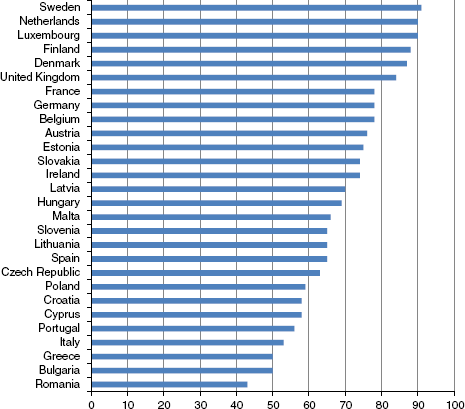
Frequency of Internet access in the EU28 for 2012 (% of individuals who use the Internet at least once a week).
Taking all these factors together, Plasser et al. (1999) concluded that there are strict limits as far as the Americanisation of European campaigns is concerned. However, addressing the question of whether or not there is a European style of campaigning, by surveying political consultants and party managers the authors came to the conclusion that the majority of their respondents treat the US example as a model. Overall, this allowed them to argue that ‘if there is a European style of political marketing, then its core is a modification of the American role model’ (Plasser et al. 1999, 96). A similar conclusion was reached by Tenscher et al. (2012), pointing to a wide variety of professional campaigning in a four-country comparison of the 2009 elections to the European Parliament. What is also important to note, according to these authors, is that there might be quite visible differences in campaign strategies not only between states but within them, due to the different size or even political orientation of the parties. Large vote-seeking parties are expected to be more likely to adopt these new techniques of professionalised campaigning (Gibson and Römmele 2001).
Measuring trends in professionalised campaigning
A combination of insights from political communication and party politics literature shows that recent years have witnessed an interest in analysing the professionalisation of political campaigning. This term has been thoroughly discussed in the literature, being normally understood as a reflection-based process of continuous improvement of campaign practices (either through adopting new techniques or improving on the existing ones). However, the meaning and application of this term has been very broad, depending on various contextual factors, thus transforming it into a catch-all term (Strömbäck 2007). Nevertheless, we see a picture of capital-intensive, permanent campaigning coordinated by central campaign headquarters, to a high degree based on new technologies (in particular on web applications) and the personalisation of the campaign focused on the party leader.
This research into professionalisation can be used to illustrate one of the biggest gaps in the literature on political campaigning, measurement issues. In other words, how can we verify or falsify whether we indeed have professionalised campaigns? And how can we objectively test the degree of convergence and divergence of campaign practices? Only recently, through more attention to the quantification of professionalised campaigning, have we seen some development in this regard.
One of the first attempts to fill the gap was offered by Gibson and Römmele (2001) in their party-centre theory of professionalisation. They identified 12 key party activities in which they expected to see professionalised campaign practices. Among others, these included, use of telemarketing, direct mailing, use of opinion polling and opposition research, and the existence of a specialised campaign unit, heavily reliant on external experts. Overall, the level of professionalised campaigning varies according to party size, ideological profile, internal structure and electoral success. In a subsequent attempt, Gibson and Römmele (2009) developed CAMPROF, a 30-point index which aimed to measure and compare the use of professionalised campaigning. In any attempt to create an index such as CAMPROF, a question that always emerges concerns the applicability of such an index to possibly a large number of countries. For example, one of the items in this index considers whether or not the campaign team is physically located outside the main party headquarters. If that is the case, then this suggests that the campaign is being run using the most professionalised model, whereas if such a team is located within the party headquarters, it scores lower. However, does the fact that a campaign team is located outside party headquarters automatically guarantee its effectiveness, or even professionalism? More importantly, though, CAMPROF focuses on the application of new media; thus, a highly professionalised campaign is based on new technologies.
A more comprehensive index has been offered by Tenscher et al. (2012), who divided factors responsible for professionalised campaigns into two sub-indices: campaign structures and campaign strategies. Among the first sub-index are items such as the size of the election budget, the size of the campaign staff, the degree of opposition research and the degree of externalisation. The campaign strategies sub-index measures, among other items, the relevance of paid media in party campaign activities, and the degree of event and news management. Based on a four-country comparison (Finland, Sweden, Austria and Germany), the research showed that parties’ choices for campaign strategy are independent from the country in which the given party operates, or from its size. Furthermore, as the authors put it, ‘although there are country-specific differences in campaign “hardware” (the structure), the tactics to which the parties resort are quite similar’ (Tenscher et al. 2012, 156), which according to the authors suggests a possible trend towards uniformity of campaign strategies, at least in the four countries the authors analysed.
Conclusion
The above review has shown the great number of tendencies responsible for the convergence of campaign practices, related primarily to the global diffusion of new technologies. At the same time, there exists a large number of systemic and contextual factors that limit room for convergence, such as different electoral systems, party financing regimes and the role of parties versus candidates. The most important point, however, is that the literature has so far failed to offer a convincing way to measure the degree of convergence or divergence of campaign practices. Some limited attempts, although worth applauding, cannot remedy an overall problem of an insufficient quantification of knowledge related to political campaigns. In other words, although it is possible to identify and list certain trends, it is very difficult to indicate their degree with regard to different countries.
The practical need for a greater understanding of the convergence and diversification of campaign practices in Europe will grow when we see true pan-European political campaigns for the first time. At this moment, this is a rather distant prospect, given that the Duff proposal envisioning the creation of a pan-European constituency for the election of a small number of Members of the European Parliament was effectively rejected. Nonetheless, as I argue elsewhere (Gagatek 2011), the convergence of campaign practices would obviously make pan-European campaigning easier, whereas the opposite would make it more difficult. In order to achieve this goal, in the first place more in-depth studies on the similarities and differences in political campaigning in Europe are necessary.
Footnotes