




Abstract
Immigration gains a new dimension when climate and/or environmental change contribute to migration. This article defines and explores concepts related to environmentally induced migration, analyses the relevant policies or lack thereof, and suggests ways to bridge the policy gaps that exist in this area. Environmental events or changes are categorised into rapid- or slow-onset processes, and policies for and responses to each category are further explored and explained. Although some regions are equipped to handle an influx of migrants due to these particular circumstances, the majority of regions investigated have policies that can only partially respond to this phenomenon.
Introduction
In recent years the topic of environmental change and human migration and displacement has come under discussion in Europe. A 2008 report by the European Commission to the European Council, prepared by Javier Solana, High Representative for the Common Foreign and Security Policy, stated that ‘Europe must expect substantially increased migratory pressure’ in the coming decades, highlighting the need for European policies to address the issue [25]. The Council of Europe report exploring laws to address environmentally induced migrants coming to Europe [1,12], emerging empirical research supported by the European Commission such as the ‘Environmental Change and Forced Migration Scenarios Project’ [13] and other recent European-supported research and policy endeavours such as the Foresight Project on Global Environmental Migration (UK) are also evidence of this discussion.
This article draws on patterns of environmentally induced migration which have emerged in recent empirical work supported by the European Commission and others and discusses how institutions and policies influence the forms of human mobility in the face of environmental and climate change. It helps assess institutional and governance needs related to environmental change and human migration. In this article ‘governance’ refers to the regulation of interdependent relations with many levels and actors and also includes an element of power and interest [32,33] in situations and policies. The first section examines concepts and definitions related to climate change-induced migration. The second section addresses questions about the level of preparedness within current institutional and governance frameworks to manage environmentally induced migration in the future. Where the article identifies gaps in governance approaches, the third section suggests ways to begin bridging these gaps and define new modes of governance from European perspectives.
Concepts and definitions: links to governance gaps in environmental migration
Terms and concepts such as environmental or climate change migration, environmentally induced or forced migration, ecological or environmental refugees and climate change refugees are used throughout the emerging literature, with no general agreement on precise definition(s) [9,10,23]. 1
This article uses the working definition of environmentally induced migrants proposed by the IOM: ‘Environmentally induced migrants are persons or groups of persons who, for compelling reasons of sudden or progressive changes in the environment that adversely affect their lives or living conditions, are obliged to leave their habitual homes, or choose to do so, either temporarily or permanently, and who move either within their country or abroad’ [10].
The difficulty of establishing clear definitions of concepts and terms related to climate change-induced migration stems from two issues. First, scholars have pointed out the challenge of isolating environmental factors from other migration drivers [5–7]. As migration is driven by a plethora of factors including climate change [11], it has been difficult to establish the causal relationships and consequences of climate change-induced migration. This heightens the challenge of quantifying such migration and explains the wide range in expert estimates of climate change-induced migrant populations.
It is also difficult to define the range of climate change-induced migration because of the institutional and governance implications of doing so: definitions of the ‘problem’ (that is, as a migration, humanitarian, development, security or environmental issue) allow an assignment of authority to address environmentally induced migration.
How institutions and policies affect environmentally induced migration outcomes
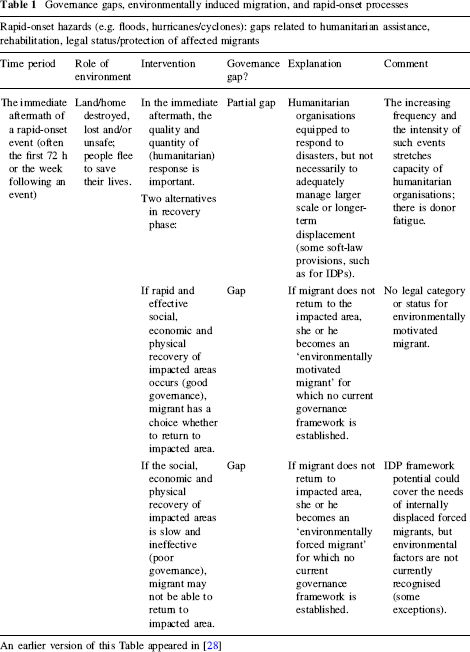
Emerging empirical research indicates that environmental changes, including climate change, currently play a role in migration [13,30]. Table 1 below provides a typology of different forms of environmentally induced migration for rapid- and slow-onset environmental stressors [24]. Distinguishing between rapid- and slow-onset processes provides a useful point of departure for understanding the potential governance needs of migrants, as well as possible gaps in current institutions and policies designed to address human mobility. This section will explore how institutions and policy affect environmentally induced migration, pointing out the role of time, environmental stressors, the quality of policy interventions and gaps in policy and governance.
Governance gaps, environmentally induced migration, and rapid-onset processes
An earlier version of this Table appeared in [28]
Governance gaps: rapid-onset environmental change and migration
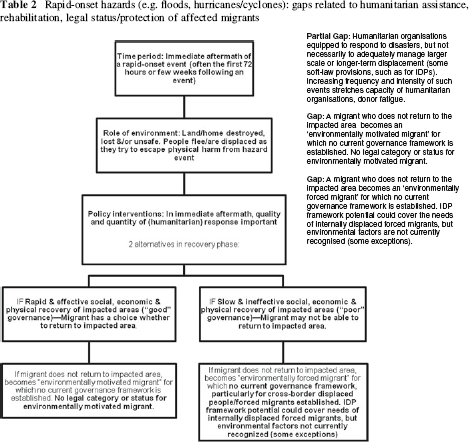
One subset of environmentally induced migration is related to rapid-onset environmental changes—often in the form of natural disasters. This section discusses the current governance gaps related to managing human mobility in the face of rapid-onset environmental change and highlights the importance of effective pre- and post-disaster management. Table 1 provides an overview of these gaps.
Rapid-onset climate events
The occurrence of migration related to rapid-onset processes is perhaps the easiest to identify because the impacts of the environmental event are relatively observable, and in some cases reported by the media. Such events include severe weather such as flooding, windstorms, storm surges, landslides (often related to heavy rains) as well as geological occurrences like earthquakes and volcanic eruptions. When rapid-onset natural disasters occur, often people must flee from the affected area to avoid physical harm or loss of life. In some cases homes are destroyed, making temporary resettlement in shelters a necessary risk-management approach. Often during and after rapid-onset processes, livelihoods are lost or interrupted through destruction of crops, livestock or productive assets. These kinds of impacts can motivate people to move. The way that disasters of this type are managed plays a role in people's mobility decisions.
The time period of interest in governing human mobility and rapid-onset environmental hazards is typically the first 72 hours following an event for humanitarian relief efforts. The focus of these efforts is often around rescue, establishing temporary shelters and providing medical help. During the initial few days following a disaster, humanitarian efforts may shift towards providing clean food and water, stabilising local populations and assessing the situation. Often the media are present in these first few days following an event and play a role in mobilising resources to pay for humanitarian assistance. In cases where people are evacuated or displaced due to a disaster, policy gaps often arise around where these people should go in the weeks, months and sometimes years following the disaster. Two examples of evacuation and subsequent (permanent) displacement include Hurricane Katrina (2005) and the eruption of the Montserrat volcano in the Caribbean [19].
Role of policy interventions and governance gaps (post-disaster recovery, legal status of displaced people)
For rapid-onset processes, humanitarian organisations lead the efforts to assist people affected by and possibly displaced by environmental hazards, in coordination with national governments and donors. The efficacy of governance plays a critical role in whether migrants will return, or whether they will stay away indefinitely.
Migrants will likely need support in establishing livelihoods in new areas, and protection from any number of discriminatory practices. Soft law, such as the Guiding Principles on Internally Displaced People (IDP), may protect these people to some extent, but the lack of recognition of environmental stressors as a legitimate cause of migration may limit effective assistance or protection. Following the 2002 earthquakes in El Salvador and the 2005 Hurricane Katrina, governments like that of the US granted temporary visas for migrants so that they could work and provide remittances and assistance to affected family members. It is unclear whether such practices will become an international norm, hence a partial gap exists.
The immigration laws of most destination countries do not recognise migrants who arrive in part due to environmental impacts, accepting this subgroup only under already existing admission categories. 2 Destination countries in Europe admit persons under family reunification statutes, asylum provisions or labour market provisions. 3 Humanitarian admissions in regions like Europe are mostly limited to refugees and asylum seekers 4 and mostly ignore environmental aspects of human mobility. Some soft-law provisions are in place internationally regarding the protection of IDPs [14], but few systematic approaches are in place and this is often an overlooked policy area [16,22].
Drawing upon [21].
Employment-based admissions are usually based on the labour market needs of the receiving country, not the situation of the home country. Family admissions are usually restricted to persons with immediate relatives (spouses, children, parents and sometimes siblings) in the destination country.
I.e., those who fit the definition in the UN Convention Relating to the Status of Refugees: persons with a well-founded fear of persecution on the basis of race, religion, nationality, membership in a particular social group or political opinion.
In Europe, the ‘Temporary Protection Directive’ establishes temporary protection during ‘mass influxes’ of certain displaced persons. The term ‘mass influx’ refers to situations where masses of people are suddenly displaced and where it is not feasible to treat applicants on an individual basis—defined on a case-by-case basis through qualified majority of the Council (quoted in [17].
Sweden and Finland have included environmental migrants within their immigration policies. Sweden includes within its asylum system persons who do not qualify for refugee status but have a need for protection. Such a person in need of protection ‘has left his native country and does not wish to return there because he or she: has a fear of the death penalty or torture, is in need of protection as a result of war or other serious conflicts in the country, is unable to return to the native country because of an environmental disaster.’ 5 Most recipients of this status are assumed to need only temporary protection. But the Swedish rules foresee that some persons may need permanent solutions. Similarly, under the Finnish Aliens Act, ‘aliens residing in the country are issued with a residence permit on the basis of a need for protection if… they cannot return because of an armed conflict or environmental disaster’ [17].
Aliens Act (2005:716), issued 29 September 2005, with amendments up to and including Swedish Code of Statutes 2009:16; Chapter 4, Refugees and persons otherwise in need of protection.
In summary, many regions of the world are currently partially equipped to manage this subset of environmentally induced migration related to rapid-onset environmental hazards—largely because there are policies and mechanisms in place for prevention and risk reduction, humanitarian assistance and post-disaster rehabilitation. However, these mechanisms are mostly oriented towards the immediate aftermath of a disaster, and practice indicates important gaps which can make it difficult for people who have been displaced by a disaster to return to their homes and resume their normal lives.
Governance gaps: slow-onset processes and migration, displacement, and relocation
For slow-onset processes, the intervening factors that prevent or enable people to return (or avoid migration and displacement in the first place) become more complex. The urgency for flight is temporally less pressing because the rate of environmental change is slower. People may not have a choice to return to their former place of residence due to the physical loss of their land, for example due to coastal erosion or sea-level rise. However, in cases where the physical land is still available people may have the opportunity to return to their original place of living, particularly if they can implement alternative livelihoods. Accelerated or slower environmental change can affect the livelihoods of people to a degree that some or all household members migrate. The relative importance of environmental factors in livelihoods helps determine how important the environment is when migration decisions are made. In some cases, alternative livelihoods or other coping capacities are possible in the affected area. Yet people may still choose to leave the area, anticipating worsening conditions. If alternative livelihoods are not possible in the relevant time frame, or if the impacted area ceases to fulfil its function (such as succumbing to desertification or sinking below sea level), then forced migration could occur. Policy interventions will largely shape the outcome.
Slow-onset climate events and migration
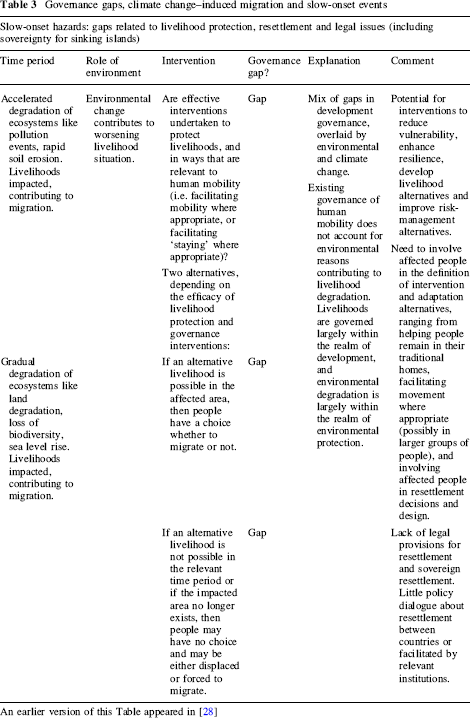
Table 2 examines some of the governance issues related to environmentally induced migration and slow-onset processes.
Rapid-onset hazards (e.g. floods, hurricanes/cyclones): gaps related to humanitarian assistance, rehabilitation, legal status/protection of affected migrants
Slow-onset environmental changes can negatively affect livelihood systems and contribute to migration pressures in the long term. The underlying environmental factors, however, may not be accounted for in migration patterns because they are slow and harder to observe. The occurrence of migration related to slow-onset events is more challenging to identify because the impacts of the environmental event are incremental and seldom reported by the media until they become acute crises. Such events include climate change impacts such as regional changes in rainfall variability and seasons, sea-level rise or the gradual degradation of ecosystems, such as desertification and land degradation and loss of biodiversity. When slow-onset environmental degradation occurs, livelihoods like farming, herding and fishing deteriorate. Yields fall, and the ability to diversify (such as supplementing farm yields with hunting or fishing) may decline. Communities and families may increasingly see migration (to urban areas or across borders) as offering more attractive possibilities to worsening life quality in areas affected by slow-onset environmental change. The way that the degradation is managed plays a role in people's mobility decisions (Table 3).
Role of policy interventions and governance gaps (livelihoods, resettlement and legal issues)
Existing institutions can make effective interventions to protect livelihoods and do so in ways that are relevant to human mobility. Policies can, in theory, facilitate human mobility where appropriate and make staying possible where appropriate. Deciding what is appropriate and under what circumstances is one of the key challenges policymakers face related to human mobility and slow-onset environmental change. This is an area where many governance and policy gaps exist— consisting of a mix of gaps in development governance, overlaid by environmental and climate change.
In summary, currently few regions of the world appear equipped to manage human mobility related to slow-onset environmental degradation—some of which may be caused by climate change. The governance gaps related to this subset of environmentally induced migration arise in part because of policy silos, because of the gradual nature of change itself and because of the challenges of sustaining traditional livelihoods or creating alternative livelihoods. Further, the increasing possibility that some areas of the world could become unable to support livelihoods at all—either because of extreme degradation or because they no longer exist in a habitable form (in the case of permafrost melt, sea-level rise or desertification)— presents a major challenge to the governance of human mobility. Some countries, such as New Zealand, extend the opportunity for work-related visas to endangered low-lying island countries like Tuvalu, but these programmes remain limited in numbers. The New Zealand visa programme reaches fewer than 100 people per year, a quota which often goes unfilled because of concerns among sending communities of depopulating the country of Tuvalu [13].
Governance gaps, climate change-induced migration and slow-onset events
An earlier version of this Table appeared in [28]
Policy approaches for Europe: challenges and new modes of governance
This article so far has outlined gaps and partial gaps for managing environmentally motivated and forced migration and displacement. This section examines some of the challenges in addressing the gaps identified in this article: institutional and policy ‘silos’, identifying where to administer help and assigning authority to address the problems. This is followed by a consideration of potential policy approaches and new modes of governance for environmentally related human mobility.
Short-term, emergency-focused institutions and policies in Europe
Institutional and policy silos in Europe
Some facets of the current governance system may actively encourage approaches that may be too narrow to manage complex issues like environmentally induced migration. For example, the management of human mobility today falls largely within the mandates of international humanitarian organisations and national governments. Humanitarian organisations focus traditionally on crisis and disaster management, often with a short-term perspective and not with the goal (or capacity) to maintain long-term guidance, support and protection. Silos of institutional management will be hard pressed to effectively address the needs of migrants and their families if the wider context of resilience and adaptation is not considered.
The implications for this partial gap are that with climate change as well as the increasing exposure of people and their assets to natural hazards, the capacity of humanitarian organisations could be exceeded. Environmental change today blurs the mandates of humanitarian organisations. Traditionally these organisations have provided relief and disaster assistance; however, today they are increasingly faced with more frequent and intense disasters, as well as longer-term displacement issues. There are some provisions, such as in soft law, for the protection of IDPs, but these are often specifically related to conflict situations where development agencies and organisations are less able to intervene. Humanitarian organisations could face a capacity challenge if the number of rapid-onset processes and the number of people affected by them grow significantly. Kirsch-Wood et al. note that ‘In the last 20 years the recorded number of disasters caused by floods has increased by 300%—from about 50 to more than 200 events. Floods and storms now trigger the bulk of sudden-onset international humanitarian responses. Of the 26 UN Flash Appeals issued since January 2006, 18 appeals have been in response to floods and cyclones’ [15], p 40).
Relatively few nations have either the necessary legislation or the administrative structure and capacity to adequately address the task of resettling displaced populations. In general, an amalgam of public agencies, with jurisdiction over a wide spectrum of environmental, social and economic domains, plan resettlement. This can produce projects with conflicting objectives and activities.
Authority
Several questions related to authority arise for the future: which institutions will have authority to classify environmentally induced migrants and protect the interests of receiving or sending countries? The international community can play a role in shaping norms and standards related to environmentally induced migration (for example, the role it has played in creating principles for IDPs). Yet nation states will largely remain the implementing actors and will retain authority for classifying and administering assistance to environmentally induced migrants, whether motivated or forced.
A number of operational issues arise: how can the voluntary or forced nature of environmentally induced migration be determined, and by whom? Would those who migrate voluntarily be able to qualify for government assistance, even if their choice to move was not part of a government policy or programme? In Mozambique, Vietnam and Egypt, the government relocated people into planned settlement areas, but more needs to be known about how decisions were made and how programmes were sustained over time.
Where to administer help?
The dynamics of migration and coupled socio-ecological systems today make it less clear where and how to administer help: at the source of environmental degradation and where people stay behind, for migrants in transit or in receiving communities. This has the potential to create differentiated groups with different capacities and needs. While large groups of people may migrate in the future, even among such a group there may be little homogeneity, save the unifying environmental stressor that set them on the move. Environmental change will affect which individuals or households in a community become mobile. Characteristics like gender, age and socio-economic status will all affect unfolding patterns of environmentally induced migration. In the face of slow-onset environmental change those who are able to move—those with money, social networks and alternative livelihoods—may migrate independently. The vulnerable poor, those with no capacity to move, the very young and the elderly may be left behind initially and forced to resettle later.
Gender and demographic structure also play a role in environmentally induced migration patterns. Property rights, resource distribution and family roles affect men's and women's migration patterns, particularly when the environment becomes a strong push factor. Young healthy males forced to abandon their farming lands will have different governance demands than a household of young children and ageing parents, headed by a single mother in flight from advancing deserts or a hurricane. One group may need livelihood assistance, another may need resettlement assistance, another may need humanitarian assistance and all may need some kind of differentiated legal protection.
Are new modes of governance needed, and how can European policy help?
Current institutional frameworks for managing migration and environmental change divide institutional management and responsibility along the lines of environmental, migration and humanitarian needs [34]. Many of the environmental stressors governments face within their territories also result from transboundary issues, including river delta management, desertification and climate change. Responses and management often occur within a country's borders and within specific ministerial lines (environment ministry, agricultural ministry, disaster management, immigration services and so on) [27]. This structure is partly suitable to address some forms of environmentally induced migration. For example, following rapid-onset disasters, governments and humanitarian organisations mobilise to provide assistance to environmental-emergency migrants on a largely short-term basis.
For longer-term displacement, however, assistance of different forms and of more durable nature may be required. Institutional responsibility and governance become more blurred for slow-onset processes such as drought. For example, in Niger, the Nile Delta and the Mekong Delta, migration has occurred when slow-onset environmental change altered the ability of people to maintain their livelihoods and a certain quality of life. In these cases, the vulnerability of both those that departed and those that remained behind increased [3,4,8]. Gradual changes in ecological systems and related social shifts will require that governance address the vulnerability of those who migrate or are displaced, as well as those who remain behind. Ideally, this governance would be comprehensive and coordinated to prevent ‘protection gaps’ [16].
To date, though, there are no examples of legislation or policies that address migration of persons from slow-onset climate changes that may destroy habitats or livelihoods in the future. 6 For the most part, movements from slow-onset climate change and other environmental hazards that limit economic opportunities are treated in the same manner as other economically motivated migration. Persons moving outside of existing labour and family migration categories are considered to be irregular migrants. In the absence of a strong humanitarian basis for exempting them from removal proceedings (which is unlikely in the slow-onset situation), these migrants would be subject to the regular systems in place for mandatory return to their home countries. Because their immediate reasons for migrating would be similar to those of other irregular migrants—that is, lack of economic opportunities at home and better economic opportunities abroad—there would be little reason for destination countries to manage these movements outside of their existing immigration rules.
New Zealand's Pacific Access Category (PAC) is sometimes described as climate change and migration legislation. Under PAC, 75 people from Tuvalu, 75 from Kiribati and 250 from Tonga (islands subject to rising sea levels) may immigrate to New Zealand each year. The programme is based on employment, however, not environmental factors. The immigrants must be between 18–45 years old, have an offer of employment in New Zealand, have English skills, meet a minimum income requirement, undergo a health check and have no history of illegal entrance. The programme is not intended to provide access to those who may be most vulnerable to climate change-induced displacement—the elderly or the infirm, for example.
Mapping exercise of available frameworks and good practices
To develop various frameworks and provide a set of options to countries dealing with environmental migration, a mapping exercise of available frameworks and good practice solutions could be undertaken. Such a mapping exercise could start at a national or sub-national level and identify best practices for processes like relocation or resettlement. The mapping could start by gathering answers to the following questions in countries affected by environmental migration [26]:
What are the current institutions, laws and governance in respect to environmentally induced migration?
Are there gaps?
What dynamics do we see with migration?
What does climate change mean for institutional set-up and robustness?
Are there available scenarios based on climate science?
Where are the challenges, barriers and opportunities of environmentally induced migration?
This first attempt at data gathering at the national level could be expanded with case studies of legal institutions in identified hot-spot areas. Site visits could foster a policy dialogue about potential future climate change impacts. The policy dialogue could extend to affected communities in order to involve the communities in the process of responding to climate change–induced migration. Additionally, an assessment for institutions under future climate change scenarios could identify gaps and help to avoid inefficient practices. The gathered information could influence a dialogue at a national and regional level in order to provide institutions with the required policy alternatives and legal governance approaches. The outcomes of the above-mentioned assessment would be the following:
impact scenarios for institutions, legal and governance frameworks;
specific focus of resettlement areas; and
indicators to signal transitions in mobility.
Although many governance mechanisms must be forged at the national level (both because this is the front line and because much of the impact of migration will be experienced within national borders), the capacity of national agents, as noted elsewhere in the literature, particularly in the least developed countries (LDCs), is sometimes severely limited. Both financial and technical support from international governance mechanisms and foreign agencies may be necessary. The assessment of institutional and governance needs could be expanded to encompass the multiple tiers of governance involved, and it would be useful to note the complex process of interaction between these tiers.
Opportunities to enhance resilience of both migrants and those who remain behind
Despite challenges, opportunities exist for institutions and policies to play a mediating role in the form that environmentally induced migration takes. Effective policy interventions may increase the quality and quantity of alternatives available to people faced with environmental pressures, therefore preventing human mobility from becoming a humanitarian crisis. States will implement policies and institutions that will largely make a difference in whether environmental factors including climate change motivate (other options available, including return) or force (few if any options available) migration and displacement. These governance interventions will therefore play a leading role in determining the degree to which migration is a form of adaptation or an indicator of a failure to adapt.
The focus of much political and academic debate is centred on migrants or refugees, rather than on the equally important question of people who remain behind [34]. Some people who remain behind may be able to do so because of resilience capacity, an ability to adapt to changing environmental conditions. These people may be vulnerable, but they are not always helpless. People who do not migrate away from environmental change can be active agents with resilient characteristics. Literature on social capital and networks suggests that there are public and private elements of adaptive action, based on trust, reputation and reciprocal action of those individuals involved. In many cases, adaptation to environmental and climate change will be in the form of collective action at the community level [2]. Adaptive activities can enhance the resilience of communities against rapid- and slow-onset environmental change, particularly if networks of people engage and share their learning experiences.
There may also be circumstances in which people are forced to remain behind or are unable to migrate because of poverty or other kinds of vulnerability, such as lack of education or vocational skills, lack of social networks and so on. The current governance regime does not account for those who remain behind—both those with resilience capacity and those who have no opportunity to move away. This also constitutes a gap in the governance of human mobility. Future studies could compare and contrast motivations for staying and leaving in order to offer insights about the differences that there might be between those who leave and those who stay behind.
Guiding principles and dialogue
By recognising that states will be the main implementing actors, one can establish sets of guiding principles to assist countries in the implementation of policies that govern environmentally induced migration. A more substantial evidence base of cases and lessons learned from practice is needed to support such a set of principles. Policy dialogue, especially at the national level, is needed to understand how the impacts of climate change affect livelihood potential. Mechanisms and policy processes for managing environmental change largely ignore human mobility issues. Existing mechanisms for managing human mobility cover economic migrants and humanitarian crises rather than environmental change. Humanitarian organisations will need greater capacity to respond to disaster-related displacement and migration. Currently, organisations involved in development, disaster and humanitarian assistance only partially participate in dialogues on environmental change and migration. It would be useful to provide a platform for exchange about the experiences of countries which are already using resettlement programmes as a response to environmental stressors. Migration is a livelihood issue reflecting not only where people are emigrating from, but also where they are immigrating to. Little is known about the longer-term capacity of receiving countries to accommodate larger numbers of (environmentally forced or motivated) migrants [29].
Flexible policies and institutions
An opportunity and challenge for governance systems is to create policies and actions that flexibly manage migration and environmental change, which in themselves are highly dynamic and nonlinear processes. This may mean a combination of approaches that have been shown to be effective in the past, including the following: improving education and training that facilitate access to alternative livelihoods in communities affected by environmental change; adopting technical measures that complement better resource and land management; and enhancing access to other types of risk management tools such as risk-sharing and risk-transfer tools like (micro)insurance.
Conclusions
This article has examined how institutions and policies affect environmentally induced migration, and the gaps in current governance frameworks in Europe for rapid- and slow-onset environmental change. The analysis above identified the major gaps in governance for environmental change and human mobility in Europe. Existing strategies of humanitarian relief will help some people fleeing from rapid-onset disasters. However, new governance modes are needed to bridge gaps in protection and assistance for climate change migrants who cannot return after disasters and for people made mobile because of longer-term environmental change. New European governance approaches will need to consider the role of migration in adaptation: not only will support be needed for migrants but also for those who remain behind. These new modes of governance must take into account dynamic social and migrant networks, and emphasise and enhance resilience in flexible rather than control-based ways.
Footnotes