




Abstract
SMEs are often praised by politicians and economists alike as the backbone of the economy and an essential factor for employment. They represent the vast majority of the enterprises in Europe and the largest source of employment. Differently from large enterprises, small and medium enterprises enjoyed better image vis-à-vis the great public, and overtime managed to ensure governmental support in times of crisis. This article analyses both the role of SMEs for economic growth and employment and the extent to which they were affected by the financial crisis.
Why is the SME sector growing?
Few ideas in political life are so widely shared as the support for small and medium-sized enterprises (SMEs). They are embraced by most, if not all, parties, politicians and opinion formers. In many countries, even parties that cherish their Communist past and still hold up Karl Marx as a revered figure believe that SMEs are legitimate and merit political support. This is in sharp contrast to the views of large and multinational enterprises. They are often lambasted or ridiculed in political discourse. Many see in them the pure incarnation of capitalism—indeed, brutal capitalism. Authors like Naomi Klein accuse them of being great manipulators, poisoning the public mind with their crass commercial strategies and their logotypes. Others criticise them on the basis of size and inefficiency: many large multinational companies have emerged as giant bureaucracies with little feeling for genuine entrepreneurship. Very few people seem to have a natural political affinity with them. In many European countries, the once-grand coalitions between the large firms and the big dominating catch-all parties on the Left and the Right have been deteriorating for decades. The views and values embedded in post-war corporate and management strategies merged easily with the political views of the time, especially an excessive Cartesian desire to regulate and organise all aspects of life and commerce. The result was societal Taylorism: governments could operate as big companies and vice versa. That age is over.
Small businesses and entrepreneurs play an increasingly material role in the economy. As shown in Table 1, they represent the vast majority of all firms in Europe. Of the existing 20,500,000 companies in Europe in 2007, all but 43,000 were SMEs. Also, the number of SMEs is growing faster than the number of large enterprises. None of this is surprising. It takes a good deal more time and resources to become a large company than to run an SME.
Number of enterprises by size in EU-27, 2002-2007
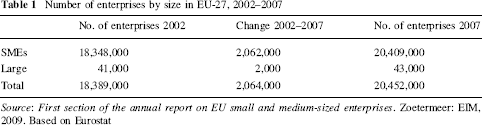
Source: First section of the annual report on EU small and medium-sized enterprises. Zoetermeer: EIM, 2009. Based on Eurostat
The growth rate of SMEs between 1999 and 2006 has varied considerably among EU countries. New members of the EU have experienced much faster growth in the number of SMEs, with Lithuania and Slovakia on top with average annual increases in the 15-plus per cent region. Poland is the only exception to this rule—indeed the only the exception to the overall picture of pan-European growth in the number of SMEs. In the EU-15 group, it is Portugal and Ireland that have experienced the fastest growth—both with an annual average growth rate above 8%. There are also differences between sectors in the economy. The SME ratio varies—indeed quite significantly. The retail sector has the greatest number of SMEs (slightly more than 30% of SMEs can be found in this sector), followed by the construction and manufacturing sub-sectors. The fastest growth has been experienced in the real estate sector and in electricity, gas and water supply—a reflection of increased economic activity in the housing sector and the privatisation of public utilities.
The manufacturing sector has hardly grown at all. At a time when many large manufacturing companies have outsourced production to other countries within Europe, one would have expected a bigger increase. As outsourcing typically has a multiplier effect—the number of companies that expand or start up as a consequence of foreign direct investment (FDI) is higher than the number of companies that close due to the emigration of production—expectations have certainly not been confirmed.
The picture changes somewhat if we consider the role of SMEs in employment: the SME ratio is not as high as it is for the SME share of the number of firms. Still, SMEs are of considerable importance. About two-thirds of the people employed in the private sector in Europe work in an SME. Microfirms, with an average of two workers, represent roughly 30% of total employment in the private sector. The average size of employment in an SME, however, is a staff of four.
The differences between sectors are considerable. The construction sector has the highest share of employment in SMEs. Close to 90% of all workers in the construction sector work in an SME. Hotels and restaurants rank second, followed by the wholesale and retail trade. All these sectors are service sectors. Overall, the service sector has a higher SME ratio in almost all aspects.
There are many variations in the employment share of SMEs across countries. Portugal and Italy are the two countries with the highest share of private employment represented by SMEs. They both score 81%. On the other side of the spectrum we find the United Kingdom and Finland; both score below 60%. Most EU members, however, have an SME employment share between 60 and 70%.
Countries with a high employment share represented by SMEs do not seem to add many new jobs to the SME sector. This is somewhat surprising. In Italy, for instance, the employment share of SMEs is declining. In Portugal the average growth rate has been 0.02% in the past 8 years. In fact, a pattern analysis suggests that the higher the employment share the lower the employment growth is. The United Kingdom is the exception; it has a comparatively low employment share represented by SMEs and the share has fallen. Hungary and Romania (both transition countries) have the highest growth rate.
One explanation for the falling or low growth rates in countries like Italy and Portugal can be found in the profile of SMEs in these countries. In small-business research, many scholars talk about two different kinds of SMEs: gazelles or mice. A ‘gazelle’ is a small but rapidly growing SME. According to several scholars of small-scale entrepreneurship, it is this type of company that has contributed to the net growth of jobs in the past 20 years. While the number of large companies, the ‘elephants’, has declined in the past 20 years and the number of jobs they provide has contracted, job creation has been represented by the gazelles. A ‘mouse’, in contrast, is an SME that starts small, grows slowly (if at all) and hence contributes only marginally to job creation. Italy and Portugal are both countries with SMEs that resemble the mouse category rather than the gazelle category. There are plenty of SMEs, but they can be found in sectors with small growth opportunities and they are more often than in other countries organised on the basis of the family. Many of them are service-oriented firms, not least in the tourism sector. Job creation in SME structures such as these will typically not grow much. There is one pattern in Italy's enterprises that seemingly contradicts this view. According to some observers of high-growth enterprises, Italy has been found to have a high share of gazelles. Their analysis, however, uses other definitions and takes account of companies between 50 and 1,000 employees (companies that are, in other words, larger than the standard definitions of SMEs); the employment effect among fast-growers tends to be bigger in companies that have graduated from the SME category.
In sum, the overall trend is an increasing role for SMEs in Europe's economy. But what are the factors behind this development? There are four explanations of particular importance:
Technological development has reduced transaction costs, and increased the focus on specialisation and on the core activity of a firm. Outsourcing and corporate downsizing have been consequences of technological development.
The profile of production in Western economies has shifted away from the sectors that were characterised by and conducive to large entities. This shift is partly one of a transfer of production from traditional manufacturing to services. The latter is much more conducive to small businesses.
The demand pattern has shifted from standardised goods to diversified goods. Standardisation fits large enterprises; diversification fits small businesses. Large firms are skilled at increasing the productivity of manufacturing, but tend to be less skilled at innovation. This is partly a function of sunk costs. Innovation and new products tend to emerge from smaller companies. Hence, small firms are often agents of change. Smaller companies also tend to be new companies and are less bureaucratic than older companies. They tend to have a stronger focus on innovation as a core strategy for growth.
These developments are not temporary. They are at the centre of a shift in modern economies, and nothing suggests the trend is about to reverse. They are also important to bear in mind when reflecting on the effects of the current economic crisis on SMEs.
SMEs in crisis and recovery
There are interesting cyclical effects of the structure of enterprises. Policy responses to cyclical downturns or crises of the kind the world recently has experienced tend to focus on the financial fragility of SMEs. In contrast to large enterprises, SMEs tend to have a weaker financial position. They have difficulties negotiating contracts with banks for short- or long-term credit. In a time of credit contraction, the problems of access to credit can become acute for a large portion of SMEs. They typically have fewer internal resources and less liquidity. Their financial position is weaker (i.e., lower capitalisation). They are more sensitive to late payments from customers. They have fewer financing options.
At the centre of the current debate is the need to support SMEs during the crisis. But short-term and cyclical financial support to SMEs does not tend to be an effective tool. The same verdict applies to support for large enterprises. Understandably, governments want to take action to ease conditions for companies during times of economic stress. But support often tends to come too late to have the intended effect on companies. Many forms of support have also become permanent and have market-distorting effects—often to the detriment of SMEs. Effective support for SMEs tends rather to enforce long-term structures that facilitate growth and expansion of SMEs, especially in clusters of multiple innovative firms.
The focus on short-term cyclical support also hides one cyclically important aspect of SMEs and a high share of SMEs in total enterprises and total employment. Cyclical downturns typically have smaller effects on SMEs than on large enterprises. Output and employment tend to contract by a smaller factor in SMEs than in large enterprises. Hence, SMEs can act as cushions in downturns, easing the adverse implications for employment and output.
There are three important aspects of SMEs that makes them different from large enterprises in downturns.
First, a smaller share of SMEs is export-oriented. Contractions in global demand thus affect SMEs to a lesser extent than they affect larger enterprises. There is a long-term concern associated with the fact that SMEs are less oriented towards global markets, but in a recession they have the effect of slowing down output and employment contraction. The opposite side of this coin is that a greater proportion of SMEs than of large enterprises basically cater to domestic demand. This is particularly true for the service sector, which is more dominated by SMEs than the manufacturing sector. In any normal recession, domestic demand does not contract as much as production, especially manufacturing. Domestic demand can also be stimulated by measures such as VAT reduction—a measure the UK government, for instance, has deployed in the current recession—or special tax breaks (e.g., for construction work on housing estates). Governments tend to prefer to target their measures at domestic demand directed at local suppliers; hence SMEs tend to get a bigger cushion from counter-cyclical policy measures than do large enterprises.
Second, it is difficult for SMEs to downsize employment as they are already small. The choice is often not between keeping employees or reducing their number—it is between keeping employees or going out of business. As SMEs typically have lower wages than those in larger enterprises, the need to cut employment is less. Small enterprises can also regulate cyclical effects by the amount of time the entrepreneur puts into business.
Thirdly, many SMEs are family based and thus do not want to cut down on employment. Moreover, such companies can use other means to control labour costs in downturns. The entrepreneur and the family members active in the firm are more likely to accept a salary cut. The wage structure is thus more elastic to demand.
What complicates this analysis, however, is that not all recessions have this effect. Recessions such as the current one, which is caused by or associated with financial and banking turbulence, can have disproportionate negative impacts on SMEs. Small businesses are more sensitive to changed financial conditions. Tougher conditions for bank credit affect SMEs more than they affect large enterprises as SMEs do not have the same access to non-bank financing, especially the corporate debt market.
The current recession does not appear to be having as worrisome effects on SMEs as previous local financial crises had in countries such as Sweden in the 1990s, when many SMEs went bankrupt due to lack of access to bank credit. The credit crunch in the autumn of 2008 had visible effects on access to credit, but it is too early to tell what proportions these problems will take. There has not been an interest-rate shock that has pushed credit-dependent SMEs out of business; on the contrary, interest rates have declined. Indicators such as the number of bankruptcy filings suggest that this recession has had a more pronounced effect on SMEs than would a normal cyclical recession. There has been a sharp surge in filings for bankruptcy. It is notoriously difficult to get access to data, especially comparative data, on filings for bankruptcy in Europe. Yet national indicators suggest there has been a sharp increase. In the Netherlands, for instance, the number of bankruptcy filings in the first 6 months of 2009 was twice as high as in the same period in 2008. A large proportion of these bankruptcies concern SMEs. Simply put, the bigger the share of enterprises, the bigger the share of bankruptcies.
It is probably safe to say that the net increase of SMEs in 2009 will be on the negative side: more companies will die than will be born. Yet one should be cautious with estimates at this point as many of the effects of the crisis have not yet fully unfolded.
There is a long-term trend towards a greater share of SMEs in the number of enterprises, output and employment. It is principally structural factors that lie behind this development. Cyclical effects sometimes matter, but only at the margin. Given these structural patterns, the role of SMEs in any recovery, and in economic growth generally, is increasing. There is no data for previous recessions of this kind, but circumstantial evidence suggests recessions only marginally affect the long-term pattern.
It is interesting to reflect on how these marginal effects manifest themselves. Two scenarios are of particular interest.
First, a recession is by definition a contraction of output and value added. It is principally the production sector of an economy that is affected: production for home and/or foreign markets slows down. Production tends to slow down disproportionally in the manufacturing and the export-oriented sectors, sectors that have a higher share of large enterprises. In the current recession, there has been a sharp contraction in industrial production and manufacturing exports. A recovery free from structural change would be characterised by a return of production that was lost during the recession. Hence, in the coming recovery industrial output and manufacturing exports would normally return to pre-crisis levels. Furthermore, the return of production would be the vehicle for growth in the recovery cycle.
This scenario, however, does not correspond with lessons from previous recessions. A recovery is characterised by the return of production lost during the recession, but only up to a point. Recessions are also characterised by intensified structural change. Recessions are periods when economies undergo considerable changes. Differently put, a significant portion of the contraction in output will not return. Such patterns are particularly present in large enterprises. It is such firms that are on the receiving end of structural change. They tend to be oriented towards manufacturing, and their prime method of dealing with changes in competitiveness is to relocate production—either for reasons of cost competitiveness or to move closer to markets with growing demand. Large enterprises often also use recessions for structural change. It is a convenient time to pursue corporate strategies that would be more cumbersome and costly during a good business cycle. It is easier to justify relocation of production in a time of economic distress.
SMEs are also affected by such strategies, but the effects tend not to have a significant impact. Individual SMEs can be badly affected, but the general pattern is one of modest effects.
Second, the corporate strategy in large enterprises during an economic recession is to quickly reduce output and factors of production. SMEs in affected sectors also act quickly—in fact they tend to be more responsive to changes in demand. But they do not reduce employment as ‘fast and furious’ as many large companies do. Moreover, there tends to be a qualitative difference in the way large enterprises and SMEs approach reduction strategies. Large enterprises have few options other than to follow a ‘sleight-of-hand’ approach: a model-based approach to reduction that organisationally works in large corporate bureaucracies. SMEs can be more sensitive to local differences and respond more to actual circumstances.
There is one factor of interest behind reduction strategies in large companies: it is a proven way to achieve increased labour productivity. This effect is achieved in two ways. Companies reduce staff that is less productive and competitive; putting people in early retirement is one common approach. The effect of such reductions can be quickly seen. The other tactic is to increase production and value added in the recovery without adding more staff: output or value added per labour unit increases. Such an increase tends to represent the major productivity effect of a crisis. It also enhances future competitiveness and value added in these companies.
How will this play out in the coming recovery cycle?
The balance in productivity growth will probably shift in favour of a greater relative importance for labour-productivity growth in large enterprises. This is partly an effect of the structure of the economy. But it is also an effect of the relative deterioration in productivity growth in large enterprises in recent years. The long-term pattern has been one of higher productivity and productivity growth in large enterprises than in smaller businesses. In recent years, that pattern has shifted in favour of SMEs. Productivity growth in EU-27 has been higher in SMEs than in large enterprises in recent years. This is an effect of increased productivity growth in SMEs, but declining productivity in large enterprises has also played a part. The trend of higher labour-productivity growth in SMEs is likely to continue in the medium to long term, but the short-term cyclical effect is likely to tilt the balance in favour of large enterprises.
Improvements in productivity are central to the increase of value added. But it is far from the only factor that determines economic growth in the short- to medium-term perspective. There has been a clear trend towards an increasing role for SMEs in recent years. Value added has expanded much faster in SMEs than in large enterprises. The net contribution to value added from SMEs has grown twice as fast in EU-27 as from large enterprises. The ratio has been much larger in some countries, such as the Baltic states. It is only in two countries—the Czech Republic and Sweden—where the net contribution from large enterprises has been larger than from SMEs. This pattern is long term and is not likely to change.
The structural factors behind the increasing role for SMEs are rooted in the economic environment and will not change—neither in the short term nor in the long run. There will be an increase of production lost during the economic crisis. As large enterprises have cut output and employment more than SMEs, the recovery is likely to be proportionally more pronounced in large enterprises than in SMEs. But this will not alter the overall picture. First, large enterprises do not expand staff during a recovery; increased production is achieved by higher productivity. Second, only a fraction of the lost production will return. Industrial contraction has been sharp in some sectors that are subject to long-term structural changes in Europe—especially a relocation of production from Western to Eastern Europe or from Europe to the Far East. The automotive sector is one example. The sector was characterised by considerable overproduction in the years prior to the crisis—in Europe as well as globally. The crisis has seen a correction of the balance between supply and demand, and companies will now be more cautious than before not to produce more than is possible to sell. Furthermore, as the global demand profile is markedly shifting towards Asia, production intended for its fast-growing markets will have to move closer to them. Without any cost advantage in Europe, it is difficult to economically justify downstream production of goods in Europe for export to Asia.
Recessions and crises are a time of major structural changes in the economy. Many factors speak in favour of such change during this current recession as well. Changes due to altered demand profiles and cost advantages have already been discussed. What remains to be dealt with, however, are the changes that are the result of innovation and the new startups that gain market share from older firms. Such structural change is also intensified during times of economic distress. And such structural change is biased in favour of a greater role in recoveries for SMEs. Why?
SMEs tend to be more flexible and sensitive to declining demand. While large enterprises often take sleight-of-hand approaches, SMEs are more sensitive to local variations and medium-term development.
SMEs are considerably more entrepreneurial than large enterprises. Having an entrepreneurial bent is key to the long-term survival of a firm. SMEs can survive in much tougher conditions for international competitiveness than large enterprises can. There is underway, for instance, a successive relocation of manufacturing production by large enterprises in Europe. This trend is particularly pronounced in sectors where Europe has a declining or negative comparative advantage. Large enterprises in these sectors cannot survive if production is not relocated to exploit cost advantages. SMEs, however, are in a different position. They have a greater propensity to innovate and can thus remain competitive despite cost disadvantages.
SMEs tend to have more flexible salary structures. Wages in SMEs are lower than in large enterprises, but the flexibility adds another dimension to the competitiveness of SMEs: there is a direct link between productivity of output and demand constraints. Innovations tend to start in SMEs. As the economy becomes even more based on innovation, SMEs will continue to play a more significant role.
SMEs are more focused on domestic demand than are large enterprises. This implies less volatility in the demand for their products compared to the demand for the products of large enterprises. The concentration on domestic demand is, however, a clear limitation on the growth potential of groups of SMEs. With lower participation in the global economy, SMEs are missing out on potential sales in rapidly growing foreign markets. There has been a significant globalisation of SMEs in recent years, but it has come mainly through SMEs that supply large enterprises with input or complementary products.