




Abstract
Demographic changes must take centre stage on the European agenda if Europe wishes to prevent crippling long-term trends. The author proposes to combat European population decline and ageing, and their attendant evils, by means of the four policy shifts enumerated below. Domestically, Europe must target fertility and immigration. With higher fertility and encouragement of immigrant labour Europe could counterbalance the dearth of workforce and support threatened national identity. Internationally, Europe must build on its technological leadership and bolster political and economic development overseas. In this way Europe would ensure its central role in international development and solve issues at their roots before they escalate.
Introduction
Foreign policy analysts worry today about the growing economic power of India and China, the assertiveness of Russia and the conflict between Western powers and their allies and Islamic terrorists. Yet these analysts often overlook a pivotal shift in international relations happening slowly but inevitably before our eyes–-a completely unprecedented global shift in demographic patterns. European nations are entering a period, unseen for nearly four hundred years, of population decline. Population ageing–-to a degree never known in human history–-is occurring in Europe, Japan and the ‘Asian Tigers’, soon to be followed by China. At the same time, volatile populations near Europe are growing rapidly and will remain full to overflowing with young people, while urbanisation rates in China, India and Africa will soon approach the levels that Europe and North America reached in the 1960s. These trends will create massive shifts in economic and military potential, and create pressures for vast international movements of capital and labour. They pose a particularly crucial challenge and opportunity for Europe: to become a shrunken, poorer and irrelevant population by clinging to isolationism, or to become the pivot for a richer and more integrated Atlantic/Eurasian world if Europe embraces its potential for globalisation.
This article examines four major trends in global population that are likely to pose significant security challenges to Europe in the next two decades. These are (1) disproportionate population growth in large and Muslim countries; (2) shrinkage in population and dramatic shifts in age structure in the European Union; (3) sharply opposing age shifts between First World countries and youthful Third World countries, especially those close to Europe; and (4) increased immigration from Third World to First World countries.
For the most part, these trends cannot be altered by any reasonably practical means over the next several decades. The key to understanding the implications of these trends is that the security and conflict problems caused by population growth are not due mainly to shortages of resources. Rather, they are problems of population distortion–-when populations grow too young, or too quickly or too urbanised–-for prevailing economic and administrative institutions to maintain stable socialisation and labour force absorption [1,5,10].
The big get bigger, Europe gets smaller
Table 1 shows expected population growth in the 25 largest countries in the world over the next four decades. While many of these countries have only modest annual growth rates due to recent successes in reducing fertility, they are still feeling the consequences of massive growth in the decades before 2000, which have left huge cohorts of childbearing women. China, due to its one-child policy, has one of the lowest fertility rates in the world; nonetheless, its population is projected to grow by nearly 120 million in the next 18 years before starting to level off. Together, China and India will likely add more than 400 million people in the next two decades. That is a gain of almost 1.7 million per month; during that same period, the European Union is expected to increase by barely 1 million per year [4,13].
Largest countries in the world 2007, 2025, 2050 (population in millions)
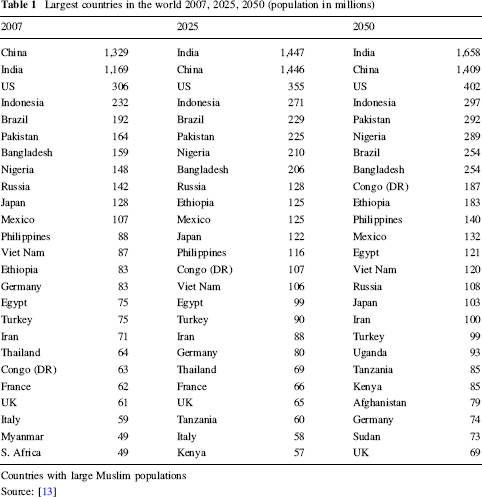
Countries with large Muslim populations
Source: [13]
Thus, even as other nations are reducing their fertility rates closer to replacement levels, the unprecedented fall in Europe's fertility to well below replacement levels means that Europe's share of the global population is undergoing a remarkable decline. As recently as 1950, more than one in five people on the planet lived in Europe (including Russia, Ukraine and Belarus); in 1975, it was still roughly one in six. By 2008, it had fallen to barely one in ten, and by 2050, it will likely be about one in twenty [13, p. 5]. Put in slightly different terms, in 2005, all of Europe comprised 731 million, against a global population outside of Europe of 5.8 billion. By 2030, however, the population of all of Europe is projected to shrink to just 707 million, against 7.6 billion outside of Europe [14]. That is, the population outside of Europe will increase by 1.8 billion over these 25 years, while Europe's population will decrease by about 20 million.
The impact of the shrinking demographic weight of European countries puts them on the horns of a dilemma. If the economies of fast-growing developing countries do not catch up to those of the richer countries, then the standard of life enjoyed by the West will seem more elite and unfair than ever, fuelling resentment among the population of developing countries against the developed West. On the other hand, if economic growth in those countries does exceed that of the West, so that living standards in these countries start to close the gap between rich and poor countries (and between rich and poor regions in developing countries), then the combination of shrinking populations and lagging economies will render Europe more and more economically irrelevant to the world economy in the future. Greater resentment or greater irrelevance–-a difficult choice!
The fact that Europe's population was shrinking relative to that of the rest of the world may have seemed a minor matter up the present–-after all, Europe's economies remained rich and continued to grow, while the developing countries remained far poorer and were hit by recurrent economic crises. Yet that situation has suddenly changed, too. In fact, since 2000 the economies of the leading developing countries have consistently grown faster than the developed economies of the West and Japan. When very large countries with substantial population growth–-such as India, China, Brazil, Indonesia, Mexico and others–-also have considerably greater rates of economic growth than Europe, the centre of gravity of the world's economy will shift rapidly in their direction.
Over the last quarter-century, from 1980 to 2005, the total value of economic growth in the countries that now form the EU-27 was fully one-quarter greater than the total value of all economic growth in Asia (excluding the USSR). Now, however, that situation has suddenly and dramatically altered. In the coming decades, total economic growth in the European Union will be but a fraction of the total growth in Asia. 1
All the calculations in this paragraph are based on data from [7].
The EU-27's GDP in 2007 was 16.8 trillion dollars (in current US dollars). Assuming growth in GDP per capita of 2.5% per year, and given that these states’ total population is forecast to grow by only 6% to 2030, the EU-27 economy would increase by 14.3 trillion dollars (excluding inflation) by 2030. For Asia, 2007 GDP is still less than that of the EU, at 14.1 trillion (again in current US dollars). But due to modest growth in GDP per capita plus large population increases in most countries, total GDP is growing far more rapidly in this region. Even Pakistan and Thailand have achieved recent growth rates of more than 5% per year, while Asia's largest countries–-India and China–-have been growing by 8% or more per year. If Asia can sustain a population-weighted growth rate of total GDP of 6% for the years up to 2030, the increase in Asia's GDP over that period would be 39.8 trillion dollars, or nearly three times the total economic growth in the EU. After 2030, when the population of the EU is projected to decline, the situation grows even worse. From 2030 to 2050, even if growth falls to 5% in Asia (not implausible, as Japan and Korea sustained 5% per annum growth rates for four decades during their industrialisation), then in these decades, even if Europe sustains a 2.5% per year growth in GDP per capita, total economic growth in Asia would be more than four times greater than growth in Europe.
Thus the dilemma–-if Asian GDP does not grow at 5% per year, living standards in Asia will not catch up to those in Europe and Japan. Yet if Asian GDP does grow at that pace, then, given the size of Asia vis-à-vis Europe, the preponderance of economic growth on the Eurasian continent will be occurring outside of Europe. That means that greater degrees of investment and innovation are likely to be drawn to areas outside of Europe, further weakening Europe's economic strength and leadership. In other words, we are on the cusp of a global tipping point, when East and South Asia come to eclipse Europe as the major source of global economic growth.
The United States, where continuing immigration and higher fertility are sustaining growth, will probably not be similarly affected. The US population is expected to grow by over one-third, increasing by nearly 140 million to 2050, during the same time that the EU population is expected to grow by only 20 million.
Russia, Ukraine and Belarus, on the other hand, are facing an even more dramatic population decline than the EU. If current trends continue, these countries are likely to lose a quarter of their population by 2050. Yet while this poses considerable economic threats for Belarus and Ukraine, this is less of a problem for Russia, which obtains much of its GDP from commodities. Since the value of commodity exports does not depend very much on the size of the population, this demographic decline has the paradoxical effect of making Russia substantially richer on a per-capita basis, providing a substantial amount of ‘bonus’ income to its government.
It is also worth noting, as shown in Table 1, how much global population growth in the coming half-century is concentrated in countries with substantial Muslim populations. Today, countries that are predominantly Muslim or have large Muslim minorities constitute 10 of the world's 25 largest countries. By 2050, they will constitute 15 of the top 25 (including Russia, which will have well over 30 million Muslims by that date), and their populations will have increased by 1.32 billion, while the population of the EU increases by 20 million and that of the US 140 million. In the next half-century, it is difficult to think of any foreign policy task more important than improving the relations between Islamic and Western peoples; for by mid-century Europeans will be a far smaller portion of the world's population, and the world will be home to much larger Muslim populations than it is today.
The rich get fewer, and older
If a change in relative rates of population growth were all that was happening, that would be a major matter in and of itself. But it is being greatly compounded by another leap into the unknown–-an ageing of populations in the richer countries (including Korea and Japan, and after 2030 in China too) that has no precedent in human history.
Not only are the European countries stagnating or shrinking, their populations are rapidly getting older as they do so. Table 2 (omitting only the smallest EU states) shows this pattern, and the consequences for the size of the workforce, the retired population and the elderly. This table shows the situation expected when those children already born in 1995 reach retirement age in 2060. Compared to the situation in 2008, this is how things will have changed:
Changing age structures in Europe, projections to 2060
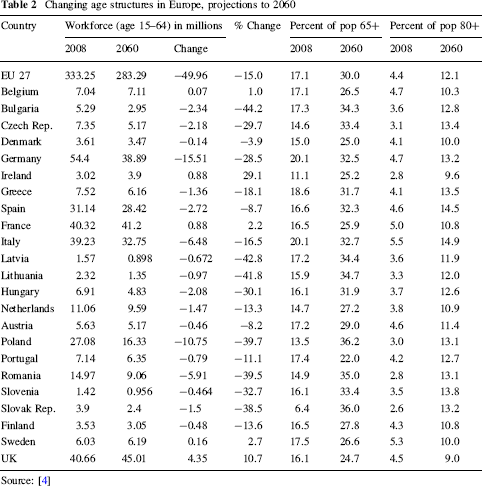
Source: [4]
Total population in the EU-27 is forecast by Eurostat to peak in 2040 and then decline, so that the net increase in population will be only 10 million by 2060 (Eurostat 2008). However, this is based on the perhaps optimistic estimate that the EU will allow nearly 60 million new net migrants in this period, or about 12% of the EU expected population. Without this migration, mainly to Germany, Spain, Italy and the UK, the EU's population would fall by nearly 50 million.
Despite the expected immigration to offset falling numbers, however, the population ageing will be extraordinary. The working age population will decline in absolute terms by some 50 million. Declines will be especially great in Germany, Italy and Poland; the UK and Ireland are the only countries expected to have a significant percentage increase in their workforce. While the overall loss of workforce in the EU to 2060 is forecast to be a modest 15%, this masks great regional variations. Several large countries, like the UK and France, will be growing or stable. However, most other EU countries are facing a decline in their workforce that can only be described as disastrous: declines of nearly 30% in Germany, Hungary and the Czech Republic; losses of 40% or more in many Eastern and Central European states.
Even more striking is the increase in the old and very old that will occur at the same time. Historically, the percentage of people surviving past age 65 has been very low; usually they have formed less than 10% of the population. In most developing countries today, they number well under 5%.
Even in the richest countries, such as the United States, as late as 1990 the above-65 group comprised only 12% of the population. In recent years, the aged population has grown rapidly, reaching a proportion of 15-17% in most EU countries. While this is substantial, it in no way prepares us for what lies ahead. By 2060, roughly one-third of the entire population of the EU will be over 65, and one in eight will be over 80. No large human population in history has ever had to operate with such a substantial portion of its population in those age brackets.
This represents a highly novel and abnormal pattern. In the great sweep of history, there have been long periods in which population growth was stagnant, or even when major epidemics (such as the Black Death) substantially reduced populations in large areas. However, in these periods the cause of population stagnation or decline was high mortality, especially among the young. Birth rates remained high, and when conditions were more propitious to growth, population increase resumed. In modern Europe (and other high-income countries, such as the US, Canada and Japan), it is falling birth rates that have precipitated population decline, as people have chosen to have smaller and smaller families. Women are marrying later, if at all, and having fewer children. In 17 countries of the EU-27, people have adopted a voluntary ‘one-child’ policy, with fertility rates falling below 1.5 [13, pp. 74-77]. The result is an unprecedented ageing of populations, at the very same time that their national economies can be expected to slow and decline dramatically as a percentage of global GDP.
The projections in this paper are based on Eurostat's and the UN's ‘medium’ variant, which assumes an increase in fertility in those European countries with the lowest rates today (which has become visible since 2003), so that they converge closer to the EU average. Thus while these results appear extreme, they are based on moderately optimistic projections of fertility; they are not a ‘worst-case’ scenario.
It is worth stressing how entirely new and unique this situation will be for Europe. In the EU, the working age population steadily increased every year from 1950 to 2007 without any slowdown, rising by 135 million (or 40%). Yet from 2007 on, this trend suddenly went into reverse and will, in fact, be completely undone: the working-age population is likely to return to the same absolute number in 2050 as it was in 1950. Moreover, in 2000 the population aged 60 and older–-for the first time ever–-surpassed the under-15 population and will continue to grow, so that while in 1950 the 0-14 population was about double the over-60 population, by 2050 this too will reverse, so that by 2050 the over-60 population will be slightly more than double the population under 15 [14].
The US will not see anything like this. Although the US population will grow slightly older, its population over 65 is projected to stabilise in 2030 at about 20% of the population and remain at that level until 2050, while Europe's population over 65 reaches more than 30% in most countries. More importantly, the working age population of the US is not projected to decline but instead to grow substantially in this period, increasing by about 50 million or 25%.
Russia's population will grow older as well, with those 60 and over forming about one-third of the population by 2050. Yet because Russia's economy depends more on the value of commodity output rather than on the productivity of its labour force, this may not affect Russia as greatly as the other nations of Europe. The countries more likely to face a similar problem to Europe's are Korea and Japan. These nations are ageing very rapidly. Their working age population is expected to decline by more than one-third by 2050, and their over-60 populations will rise to the remarkable levels of well over 40%. Indeed, in these countries the over-60 population is projected to equal nearly the entire population aged from 15 to 59 by mid-century.
This slowdown in population growth in Europe (and Japan and Korea) has major implications for overall economic growth [2]. Stimulus to the economy from growing numbers of consumers and growing demands for housing will simply be absent. The capital growth generated by larger generations of young people approaching their peak earning years and saving for retirement will cease as well. Capital will instead drain away as retirees draw down their savings.
Overall growth is likely to decline. When Europe's working age population was growing at 0.6% per year, as it did from 1950 to 2005, even modest increases in output per worker of 2.5% per year provided overall growth rates of 3.1% or more per year. With European working age populations instead shrinking by 0.7% per year, as is projected to 2050, the same 2.5% increase in real income per capita will yield only 1.8% in overall growth. In other words, even if Europe's productivity growth remains constant, its overall economic growth rate will likely be cut nearly in half, from 3.1% to around 1.8%, for the next four decades.
An overall growth rate this small allows little margin for accumulation to head off economic downturns, or to invest for the future. As Benjamin Friedman [3] has recently argued, a substantial growth rate allows more groups to share, to some degree, in growth and provides social resources for a variety of services and investments. Overall growth rates below 2% per year, by contrast, allow for little redistribution or investment, and tend to heighten social conflicts over such issues as pensions, migration and labour-employer relations.
At the same time, supporting elderly populations will–-unless drastic steps are taken–- absorb more and more of gross output. While the absolute numbers of those in working ages will be declining, the absolute numbers of those over 65 will be rising: for the EU-27 their numbers are expected to nearly double from today's level, going from 85 million in 2008 to 151 million by 2060 [4, p. 7].
To sustain its elderly population, Europe will have to spend more money on health care and pension support. It is not just that an elderly population will be ill; they may be quite active. But they will then demand the hip and knee replacements, cornea replacements, heart transplants, diabetes treatments, blood-pressure treatments and other procedures and medications necessary to sustain an active and healthy life into older ages. This will occur at a time when the supply of new doctors and nurses is likely to decline.
Nor is simply keeping the elderly population at work a solution. Older workers will generally not welcome entry-level work at entry-level wages, nor physically demanding work. Those gaps in the labour force will have to be filled by younger workers. Moreover, while older workers excel in experience and judgment, they are not as good at thinking outside the box. Path-breaking innovations in science and technology overwhelmingly come from those under age 45; countries with fewer and fewer younger workers will struggle not to lose an edge in innovation as well.
In sum, Europe (as well as Japan and Korea) is facing a brave new world of a declining labour force and dramatically increased older populations. Without radical policies to respond to these unprecedented conditions, these nations can expect sharply reduced economic growth and massive increases in spending for elder care.
Much of this is well known [8]. The security implications are also increasingly clear. Europe (as well as Japan) will have far less income available for military spending. The ability of European nations to recruit new soldiers will sharply decline, and those soldiers will likely be more costly as entry-level labour becomes scarce. Whether military intervention calls for investment in expensive new technologies, or putting significant numbers of ‘boots on the ground’, Europe will be increasingly unable to maintain current levels of military strength.
Facing these problems, many Europeans take heart from the thought that Britain, France and Germany settled into a comfortable status as second-class powers after World War II, focused on economic reconstruction, while the US took over the role of economic and military leader of the world. In a future of declining relative population and low growth, they see a viable option in retreating into a kind of peaceful and prosperous retirement from world conflict and a focus on ecological and philosophical pursuits. Might it not be good to shrink the rate of economic growth to reverse climate change? Might older populations not be more thoughtful and more peaceful?
Unfortunately, these are highly dangerous illusions. In the aftermath of World War II, while it is true that Europe's population as a whole declined relative to global population, Europe was still in a dynamic growth mode, both demographically and economically, compared to most other regions. Europe's workforce grew steadily, its total economic growth remained strong and formed a major portion of global economic growth, and its elderly population was still less than one-sixth of its population. None of these conditions will continue to hold in the next half-century. Instead, the working age population will shrink dramatically, Europe's modest increases in economic output will form but a small fraction of global growth and its elderly population will double both in proportion of the population and absolute numbers. Without major changes in policy to address these new conditions, Europe is headed towards an increasingly smaller, poorer and far less potent role in the world.
Where the growth is: Europe's near frontier
As if the preceding problems were not enough, there is another striking demographic pattern on Europe's borders. While Europe will approach the mid-twenty-first century with populations that are abnormally tilted towards the old, much of the developing world will have populations that are abnormally tilted towards the young.
Many countries in the Near East and North Africa, as well as elsewhere in Africa, Central and Southeast Asia and a few places in Latin America, are stalled in the early stages of the demographic revolution, where death rates have fallen but birth rates remain robust. In these countries, both population growth and the youthfulness of the population are extraordinarily high.
Table 3 lists the fastest growing countries in the world and the youngest. While some of the ‘young’ countries are small, the total number of young people in these countries is not insignificant. The population of the countries on this list is 750 million. Their under-15 population is just over 300 million, or about four times the under-15 population of the EU-27.
The fastest growing and youngest countries 2000-2005 (at least 1 million people)
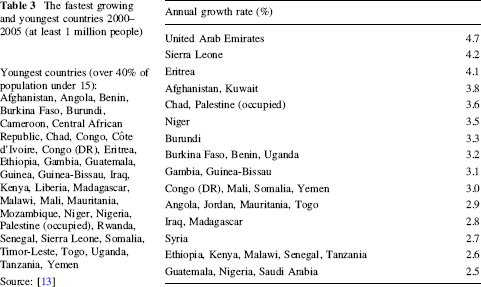
Source: [13]
This huge pool of labour would normally attract capital to put it to use. Unfortunately, conditions for the deployment of capital are poor in many of these countries, given the weak rule of law, high levels of corruption and poor infrastructure. While economic growth has been improving along with quality of governance in these countries, the rate of growth remains far too small to absorb this huge pool of labour. The immediate results are high rates of unemployment and underemployment, leading to two kinds of powerful pressures.
One is pressure on domestic patronage networks to grab available income and exclude outsiders, leading to civil wars and democratic breakdowns [5,9]. It is striking how many of the spots troubled by civil wars or mass killings in the last two decades–-Liberia, Sierra Leone, Congo (DR), Somalia, Rwanda, Afghanistan, Uganda, Iraq–-are on this list of exceptionally young countries.
Unfortunately, since fertility rates remain high and are dropping only very slowly in these countries, the prospects for any significant change in these conditions is low. Only two of the thirty-seven countries on this list of youthful countries are expected to see their under-15 age group fall below one-quarter of the population by 2050. Indeed, current UN projections for 2050 show 17 countries at that date where those aged under 15 will likely make up 30% of the population, and another 20 countries where 25% or more of their population will likely be in that age group [13, pp. 61-65]. To the extent that countries at this stage of the demographic transition show high risks of political instability [10], the world will continue to be less than peaceful in the coming half-century.
The second pressure is for emigration to regions that are capital-rich and relatively labour-poor. Because most of the states with extremely youthful populations are in the Middle East and Africa, the closest such region is Europe, which cannot help but become a magnet for migration for this labour. The forces propelling this movement are like gravity, with populations being irresistibly drawn from high-youth-density regions to low-youth-density regions to take up entry-level and physically demanding jobs.
These countries are also rapidly becoming more urban, as people stream from the countryside to mega-cities such as Lagos, Karachi, Jakarta and Cairo. Because migration tends to happen in steps–-from the countryside to cities, from smaller cities to larger ones and from larger cities to international destinations–-this initial uprooting will likely also increase the flow of international migrants heading from younger, poorer countries to Europe.
Thus, at the same time that Europe's growth rate shrinks and its military capacity declines, the ‘mirror image’ demography south and east of the Mediterranean is likely to produce recurrent waves of political turmoil in Europe's near frontier in Africa and the Middle East, accompanied by powerful pressures–-economic, political and humanitarian–-driving migrants from those regions to seek homes in Europe.
What is to be done?
Although there is widespread awareness of the ‘greying’ of Europe's population, this is often seen simply as a distributional problem, requiring a bit more saving now to pay a bit more for health care and pensions in the future. The wholly novel character of the coming demographic regime in Europe, and the problems arising from its ‘mirror image’ in the near frontier, are in fact a more fundamental problem and will require a more comprehensive approach. Indeed, no one solution can solve a problem of this magnitude. The best solutions, moreover, will deal both with the problem of the slowdown in Europe and the turmoil and migration pressures from excess youth abroad.
There are four routes by which Europe can try to profit from this brave new world. The first is to assert technical leadership and enhance its growth possibilities. The second is to improve the viability and dividends from immigration. The third is to encourage higher fertility within European populations. The fourth is to promote a re-balancing of emigration, sending some of its retired care and health care expenses abroad, while supporting overseas political and economic development.
First, Europe needs to reignite and reinvest in its technological leadership, ramping up investment in productivity-increasing technology. An increase in productivity producing a 1% greater gain in output per capita per year would more than offset the 0.7% decline in the workforce. Increased technological prowess would also help Europe maintain its global economic leadership role, as companies and countries in areas of rapid growth would turn to Europe for technology, and in turn invest in Europe.
However, increasing productivity will require major changes in the way Europe's economy is organised. The most important source of productivity-increasing growth has been new firms and entrepreneurial enterprises [6]. Europe will have to not only develop a more entrepreneurial culture, but also make it easier for individuals to start companies and to flexibly use capital and labour. Depending on large companies and large government programmes to drive the economy and absorb labour is unlikely to provide the kind of rapid productivity and output growth needed to counterbalance population stagnation and decline.
Universities in Europe will also have to increase their research productivity and collaboration with industry. In some countries this is already being done, but in others the university system needs to be invigorated by more competition and by support for training and research in the most technically important fields of biology, materials science and engineering.
Human capital will also have to turn more heavily towards technical and engineering fields. This may mean providing incentives to individuals to seek education in those areas. Nor can human capital be allowed to sit unused with relatively high unemployment rates. In the US and Canada in 2004 roughly 63% of the population over age 16 were employed; in the EU-15, only 52% of people over age 16 were employed. Although some European countries had workforce participation rates of 60% or more–-Denmark, The Netherlands, Norway, Sweden and the UK–-France, Germany and Spain were at only 50%, and Italy at 45% [17]. Increasing Europe's overall employment participation rates to North American or upper European levels would, by itself, offset the decline in the working age population for nearly a decade.
Globalising the investment climate–-with European firms seeking profits abroad where growth is greater, or foreign firms seeking to bring European design or technical know-how into their global product chains–-is also critical. In the future, the European market will not be self-sustaining. A ‘good’ European firm will not be one that is mainly owned by Europeans and has a mainly European workforce and European customers; such firms will likely be niche companies or slow-growing firms serving stable markets. Rather, a ‘good’ firm for Europe will be any company that pays taxes in Europe and provides jobs for workers in Europe, even if ownership, the bulk of the workforce and much of the profit go abroad.
The second route is to increase immigration and seek as quickly as possible to raise immigrants’ productivity and earnings to the average level in European countries. This is not a short-term fix; integration and education of immigrants can take a generation or more. However, the US, Australia and Canada have enjoyed the benefits of making it easy for immigrants–-especially skilled immigrants–-to start businesses, acquire educations and move into the mainstream of life, such that the incomes of many immigrant groups exceed the national norm. Even low-skill migrants can raise the overall productivity of a society if they are willing to work in vital jobs (construction, services) where the local labour force will not or cannot meet demand.
Unfortunately, both in Europe and recently in America, debates on immigration have expressed fear that immigration steals wealth from the countries that attract immigrants. This mistaken view is as pernicious as the idea that protecting trade through high tariffs, or blocking foreign investment, will preserve the prosperity of a country that builds such walls to global exchange around itself. Migrants tend to self-select for entrepreneurial talent, ambition and energy, and provide net gains for national economies that accept them [12]. A Europe that has lost much of its own demographic momentum and energy can ill afford to exclude new generations, even if they come from abroad, in place of the ones they are no longer producing themselves. The Roman Empire survived for a thousand years by making all its peoples full citizens, and appointing generals and even crowning emperors who had been born in Africa or the Middle East. Europe needs to adopt a similarly modern and democratic view.
Many Europeans worry, however, that encouraging more immigration, or more assimilation of immigrants, would threaten their cultures or lead to a Muslim-majority Europe. This is, in fact, most unlikely. Stronger efforts to assimilate migrants through education, job training and citizenship are likely to lead to far-more-secular immigrant populations in the second or third generation. It is only alienated children of immigrants, who do not feel wholly welcome in their adoptive societies that are prone to radicalisation. American Muslims, who face little discrimination and do well economically, have produced no notable Islamic jihadists.
Moreover, even with more immigration, Europe needs to pursue more aggressive pronatal policies that encourage larger families among the existing populations. The current fertility rates in many European countries of 1.5 or less are unsustainable. Fertility rates this low will lead to the loss of 75% of the population over six generations, and 95% over ten. This would lead to the extinction of countries or the replacement of their populations by immigrants. While fertility rates this low are historically unknown, it may be that faced with slowing economic growth and a greater burden of support for their own elders, young people will be reluctant to have larger families of their own, keeping fertility low unless national policies give potential parents a nudge. Pro-natalist policies in France and Sweden have been successful in yielding fertility rates closer to replacement. If replacement-level fertility rates return to European societies, they will be able to absorb far more immigrants without any fear of losing national identity. Strong pro-natalist policies thus enable wiser pro-immigration policies, and this two-fold approach would be a potent tool for overcoming labour shortages and economic strains.
It is interesting to note that the greatest frictions over immigration have arisen in places where the percentage of foreign-born residents is in fact relatively modest. France, Denmark, The Netherlands and the UK are all–-as of 2005–-below the average OECD level for foreign-born residents. Canada, New Zealand, Switzerland and Australia all have immigrant populations double or even higher the OECD average [11]. Thus, there is room in many European nations, especially those with very low birth rates currently, such as those in Eastern Europe, to absorb more immigrants.
A third policy response is to divert people and investments abroad to provide both financial savings to Europe and to create more jobs and opportunities in developing countries to absorb their youth. Encouraging a ‘reverse flow’ of older migrants from developed to developing countries could create great benefits for both. If older migrants take their retirement along the southern coast of the Mediterranean, or in Latin America or Africa, it can greatly reduce the costs of their retirement. Of course, it will be necessary to create and encourage the development of first-world-quality residential and medical facilities in those countries to make them desirable medical and retirement destinations. Yet that is far preferable to the constant drain of medical and nursing talent to rich developed countries that is taking place currently. Medical tourism to many developing countries has already begun as a way for developed-country residents to obtain optional medical procedures at a lower price. Investing in facilities that will make long-term retirement attractive in cheaper locales will reduce the burdens of pensions and medical costs for developing countries while channelling needed jobs and investment to developing countries that have ample labour.
Such investments should be part of an overall effort to support further political and economic development in rapidly growing and volatile countries. Political stability and economic growth that would absorb their young into productive jobs is the best way to create profitable new growth opportunities while reducing the risks of violent conflicts and the pressures for emigration to Europe. Europe's investments in foreign assistance may be one of the first ‘excess’ expenses targeted for reduction in the event of falling economic growth or rising government expenses. Yet that would be a grave mistake; Europe can only achieve rapid economic growth by investing abroad in areas with abundant labour and growing markets, neither of which will be found in Europe in this century. Thus, working to create such areas and making them viable for European investment is one of the most important tasks in sustaining Europe's own economic success.
In the current economic crisis, the developing nations have suffered even greater stock market losses than European bourses. Yet this short-term flight to security should not distract from the long-term trend of global economic growth away from Europe. Indeed, to the extent that China's cash reserves cushion it in this crisis, while the lack of a growing consumption market blunts Europe's recovery, the crisis may accelerate, not slow or reverse, this long-term trend.
A combination of all four methods will no doubt be required to offset the slowdown in European growth: changes in education, labour laws, business flexibility and investments in research to boost productivity; higher levels of immigration of young workers from outside; some means to increase Europeans fertility rates in the coming decades; and an increased flow of pensioners, patients and foreign assistance to developing nations.
Yet we should recognise that one of the biggest obstacles to several of these solutions is the growing antagonism between the West and much of the Muslim world. The way forward for the West lies in greater openness and integration, in greater investment in growth abroad and greater integration of immigrant communities and ease of emigration to fast-growing but youthful societies. None of this is possible with high levels of fear, mistrust and antagonism between the West and the populations of many of the largest and fastest-growing countries of the world. Stopping terrorism is an important but minor aspect of Muslim-Western relations. It is of fundamental importance to realise the degree of cooperation that is needed to respond to the global population trends already in place for the next half-century. Much more than terrorism, these trends will affect the long-term prosperity of the developed but stagnating and rapidly ageing populations of the West, and the fast-growing and extremely youthful population of the developing and largely Muslim nations.
Europe has a potential future as the pivot between Asia and the Atlantic; a global point of conflux for people, capital, ideas and innovation. Yet attaining that future will require a marked shift in several policies to address the challenges of the new world of demographic change that we have entered.
Footnotes