




Abstract
Japan has one of the world's comparatively largest elderly populations. Over time, prevalent traditions of family care have declined while the need for such care, as more patients live to experience chronic and acute illnesses, increases. In order to manage these changes effectively, the Japanese government has experimented with different insurance and health care systems. The author explores long-term care insurance and new medical insurance systems that have been tried thus far with an eye towards their effectiveness and financial impact.
Keywords
Introduction
Population ageing is one of the most crucial demographic and social issues facing contemporary Japan. In order to cope with the situation, a long-term care insurance system was implemented in 2000, and an independent medical insurance system for the old elderly (75 years and over) along with a new medical insurance system for the young elderly (65-74 years) were established in 2008. This article attempts to give a general overview of population ageing and some of the new approaches to health care systems for the elderly in Japan.
Population ageing in Japan
The life expectancy at birth of Japanese females has been the longest in the world for the past 23 years (85.99 years in 2007), and that of males was the third longest in 2007 (79.19 years; [2]). The number of people aged 65 years and over now accounts for 21.9% of the entire population of Japan [6], and what might appear even more striking is that the proportion of the old elderly (75 years and over) accounts for 10.3% of the whole population. This means that there is almost the same percentage of old elderly and young elderly (65-74 years; 11.6%) in Japan.
Population ageing in Japan is expected to advance even further in the future. The proportion of elderly aged 65 years and over in our country is estimated to reach 30.5% in 2025 and 39.6% in 2050 [8], and within this group, the proportion of old elderly is expected to exceed the proportion of young elderly by 2017. The proportion of young and old elderly in the general population is estimated to reach 12.3 and 18.2%, respectively, in 2025, and 14.6 and 24.9% in 2050. On the other hand, the proportion of younger people (aged 20-64 years) is expected to decrease gradually, from 59.7% in 2008 to 55.3% in 2025 and 48.3% in 2050 [8]
The United Nations’ World Population Prospects: The 2006 Revision shows that in 2050, the proportion of elderly aged 65-80 and 80 years and over will be higher in Japan than in all other nations or special regions in a nation (37.7 and 15.5% respectively; see Tables 1, 2). Japan, however, will not be the only nation to see such a drastic increase in its proportion of elderly people: the proportion of those aged 65 and over is also estimated to exceed 30% and those 80 years and over to exceed 12% in several other nations, such as Hong Kong, the Republic of Korea, Singapore, Germany, Italy and Spain.
Japan has had a long tradition of three generations (parents, eldest son and wife and grandchildren) living together in one household. In the past, informal care by the family–-mainly the eldest son and his wife–-was the main source of care for the elderly in Japan. The advancement of industrialisation, however, changed this traditional household structure rapidly. Younger generations moved out of the rural areas into the city or other industrialised areas, and not only men but also some women, who had been the main caregivers for the elderly, started to work as well. As a consequence, households of only one elderly person or couple have increased (Table 3). It is highly probable that these changes in lifestyle and household structure will become permanent in Japan.
In summary, the increase of the elderly population and the change in household structure has raised a serious problem: how will the elderly be supported in the future, and by whom?
Health care systems for the elderly in Japan
Elderly people are prone to a number of chronic diseases and recurring acute illnesses from these diseases. As a result, medical costs for elderly people are almost five times higher than those for young people in Japan [3]. Due to the increase of the elderly population aged 65 years and over, medical costs for elderly people are increasing yearly and now constitute more than 50% of total medical costs in Japan.
Additionally, elderly people can easily lose their independence through various circumstances, either related or unrelated to illness. Therefore, along with the increase in the elderly population, the number of elderly people who need various kinds of help in their lives is constantly increasing.
In order to address these challenges, a long-term care insurance system was implemented in 2000, and new medical insurance systems for the old elderly and the young elderly began in April of 2008.
Proportion of elderly aged 65 years and over
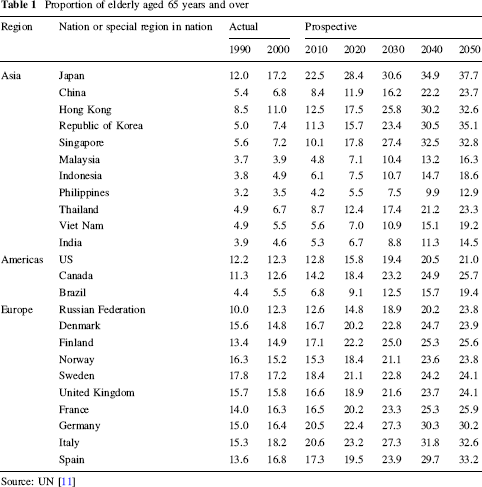
Source: UN [11]
Long-term care insurance for elderly
A long-term care insurance system for elderly people aged 65 years and over was brought into effect in 2000. Under this system, the elderly can receive services funded by long-term care insurance after their physical, cognitive and social abilities are officially evaluated. In addition to the original two categories of home care and institutional care, services for the frail elderly to prevent the onset of disabling conditions, such as exercises to improve muscle strength, nutritional care and oral cavity care to improve digestion and oral hygiene, were added to the service menu of the long-term care insurance system in 2006. The financing of the system is supported by payments from elderly people who receive services (10% of the cost), premiums paid by people aged 40 years and over (45% of the cost) and public funds (45% of the cost).
About 13% of the elderly (3.5 x 10 6 /26.8 x 10 6 elderly aged 65 years and over) received long-term care insurance services each month in 2006 [4]. In 2006, a total of 73% of users received home care services, while 23% received institutional services and 4% preventive services. The total costs for long-term care insurance in 2006 was 6.4 trillion yen, equivalent to almost 20% of total medical costs in Japan.
Proportion of elderly aged 80 years and over
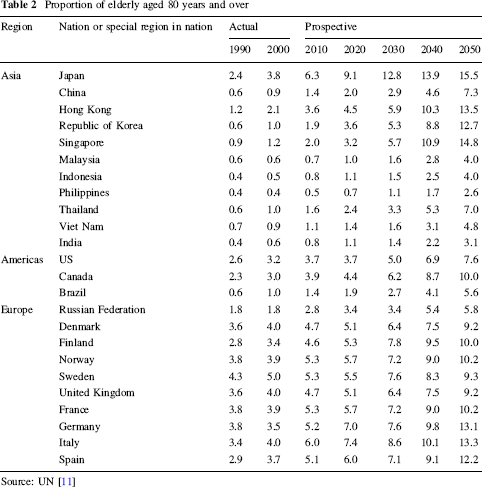
Source: UN [11]
Because the wages of those working in long-term care insurance facilities have been low in order to keep insurance costs low, the number of workers leaving these jobs has significantly increased in the past few years. As a result, it has become difficult for facilities managed by the long-term care insurance system to attract experienced, high-quality workers. This is a major problem the system is facing right now.
New independent medical insurance system for elderly people aged 75 years and over
About 43.4% (14.5 trillion yen) of total medical costs (33.4 trillion yen) was used for the medical care of the elderly aged 70 years and over in 2007 [5]. In 2006, about 11% of total medical costs for this group came from elderly people themselves, 56% was supported by corporate health insurance companies and other health insurance companies to which young people belong, and the remaining 33% was covered by public funds [1]. Since the elderly population is increasing, young people's share in funding the medical costs of the elderly is increasing each year.
Changes in household structure of elderly aged 65 years and over in Japan
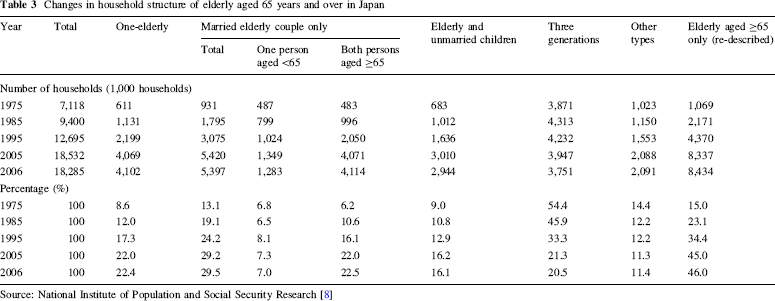
Source: National Institute of Population and Social Security Research [8]
In Japan, every person has had to belong to some kind of medical insurance society, and each society has been required to fund the medical costs of the elderly. As a result, the financial situation of many medical insurance societies has deteriorated year by year. In addition, the complexity of the former system made it hard to understand and analyse in detail.
Under the circumstances, a new independent medical insurance system for the old elderly was called for. This new system was established and put into effect in April 2008. The principal idea behind it is that people are required to move to a new medical insurance system when they reach age 75 and should pay insurance fees according to their income.
Under this new system, 10% (30% for those with exceptionally high incomes) of medical costs are to be paid by the elderly people who receive medical services, while about 10% of the remaining costs are to be covered by their insurance, 40% by funds supported by younger people and 50% by public funds. Although the financial structure of the medical insurance system for the old elderly has become more transparent, much criticism has been directed against the new system. Why is this so? One obvious reason is that contrary to the government's explanation before the system was introduced, insurance fees have become more expensive for 40% of elderly people, especially for those with low incomes. The criticism also comes from the fact that young people's share of the funding, especially those who belong to health insurance societies of big companies, has increased. At the same time, support from public funds has decreased.
The restriction on long-term admission for the elderly, the promotion of home care, especially for elderly patients with terminal-stage malignancies, the promotion of consistent medical fee systems for chronic diseases by family doctors and the limits on frequent consultations with specialists under the new system have also been criticised. A torrent of harsh criticisms has led the government to quickly plan and carry out amendments. Still, it seems that more time is needed for the new insurance system for the old elderly to mature.
New medical insurance system for the young elderly, aged 65-74 years
In addition to the new medical insurance system for the old elderly, a medical insurance system for the young elderly was also established in April 2008. Under the new system also, it is required that all health insurance societies deliver funds for the medical costs of young elderly. As a result, insurance fees have increased in almost all health insurance societies to which young people belong. Therefore, the total burden on young people of supporting the medical costs of the elderly has increased substantially. This is also a target of criticism.
Discussion
Japan's health care systems have been highly commended by the WHO [12]. However, because the pace and extent of population ageing in the country has been so rapid (the highest in the world), keeping up with the current situation and continuing to give the best services to the nation remains a challenge. The increase in the elderly population, especially the old elderly, has raised many serious social and medical issues in Japan and will surely continue to do so.
To look on the bright side, in recent years Japan has also seen an increase in healthy elderly people [7,9]. Consequently, 68.8% of males aged 60-64 years and 49.5% of those aged 65-69 years are still employed, while 16.1% of males aged 60-64 years and 21% of those aged 65-69 years who are unemployed have a desire to work. Similarly, 42.3% of females aged 60-64 years and 28.5% of those aged 65-69 years are still working, while 19.7% of females aged 60-64 years and 18.3% of those aged 65-69 years who are unemployed also wish to work. In addition, 20% of retired elderly people in Japan want to contribute to society as volunteers [10]. The activities of these healthy elderly people should be fully utilised to help cope with the approaching super-ageing of Japanese society.
We do not have yet any good models for balancing economic costs and satisfactory health care systems. Attempts to do so will continue.
Footnotes