




Abstract
The paper reviews recent demographic changes in Europe and puts particular focus on declining birth rates. It is argued that recent demographic patterns are largely driven by changing attitudes and a reorientation of values, but that lack of government support is an important reason why actual demographic behaviour varies across countries. Interestingly, new and modern forms of demographic behaviour, such as cohabitation, out-of-wedlock childbearing and divorce are also associated with higher birth rates, and it is argued that government support and the way welfare provision is organised play a crucial role.
Introduction
Over the past few decades, most developed countries have experienced dramatic demographic change. Perhaps the most noticeable changes are that some countries are now experiencing extremely low birth rates that are well below replacement levels. There is, of course, considerable worry about this trend, since it may have harmful effects on pension systems, the labour market and the sustainability of the welfare system in general. However, the declining birth rate is not the only new demographic trend in contemporary Europe: postponement of marriage and childbearing, delayed independence of young individuals, increased cohabitation and out-of-wedlock childbearing and increasing divorce rates have all become more common in Europe. In general, individuals’ life trajectories have become considerably more complex than was the case only a few decades ago. Importantly, these new patterns of demographic behaviour are closely followed by increased education and employment among women, often leading to conflict between family life and career ambitions, which, in turn, is an important cause of low birth rates.
What is the role of government support in explaining demographic behaviour and, in particular, how is it related to fertility and declining birth rates? It is often argued that new attitudes and a reorientation of values among young people are important drivers behind demographic behaviour, but that in many countries there is a mismatch between individual preferences and the way government provides support to young couples and mothers with young children. While it is often claimed that differences in demographic behaviour result from differences in social norms, it is important to bear in mind that norms are predominantly a result of the social context in which individuals live.
Low birth rates in Europe
Birth rates are commonly measured in terms of the total fertility rate (TFR), which is defined as the average number of children a woman will bear throughout her reproductive life span [10]. Population replacement is achieved by a TFR a little higher than two children per woman. Looking at TFRs across European countries it becomes immediately clear that they vary substantially (Table 1). In fact, low birth rates appear to be particularly serious in the Southern European countries of Italy, Spain, Portugal and Greece, where the TFR ranges from 1.32 to 1.38; the former Communist countries of Central Europe, with an average TFR of 1.28; and, more recently, Germany and Austria, with TFRs of 1.32 and 1.40, respectively. The picture is very different for the Anglo-Saxon countries, here represented by the UK, the US and Australia, where the TFR ranges from 1.81 to 2.1, implying that fertility rates are close to replacement levels. The picture is similar in the Nordic countries: Norway, Finland, Sweden, Denmark and Iceland. The noticeable outlier in continental Europe is France, with a TFR of 2.00 A key question is why there are such differences in fertility rates across countries. To answer this, one might consider whether actual fertility rates are consistent with desired fertility rates. It is natural to think that observed birth rates should depend on the extent to which individuals and couples want children. In societies where the desired fertility rate is low one should expect lower birth rates, whereas they should be higher in societies where desired fertility rates are high. Yet, the declining trend of actual fertility in some countries is not followed by an equally strong decline in desired fertility rates. Moreover, whereas fertility rates vary considerably across European countries, the variation is much smaller for desired fertility. Thus, it is unlikely that low birth rates have come about because couples want fewer children. Instead, the more likely explanation is that couples are not able to realise their fertility desires. Before exploring why this might be so, it will be useful to step back in order to better understand the current demographic situation in Europe.
Total fertility rate (TFR)–-number of children per woman (Source: Eurostat, population and social conditions, http://epp.eurostat.ec.europa.eu/eurostat)
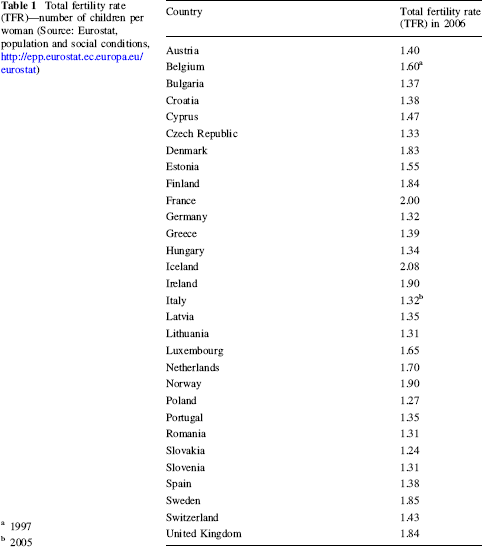
1997
2005
New demographic behaviour
Over the past four decades the demographic behaviour of Europeans has changed in dramatic and unpredictable ways. The traditional life-cycle pattern–-completing one's education followed by obtaining stable employment before finding a partner, getting married and having two or three children–-is in stark contrast to new trends of postponed union formation and childbearing, delayed independence of young individuals, cohabitation replacing marriage, out-of-wedlock childbearing and ever-increasing divorce rates.
These changes have, of course, raised considerable concern among the more conservative elements of society, who normally favour a more traditional family lifestyle. For instance, it is often claimed that union dissolution and divorce have negative effects on individuals’ well-being–-especially if children are involved. In the extreme, it is also claimed that out-of-wedlock childbearing and divorce erode moral values–-seriously threatening the existence of our societies. There is, however, very little empirical evidence to support such views. If anything, the opposite appears to be the case.
These new demographic behaviours are commonly termed the ‘second demographic transition’ (SDT). The concept was first proposed by Dirk van de Kaa and Ron Lesthaeghe in an article published in 1986. Several papers on the subject have been published since then and over the past two decades the concept has become highly influential in explaining modern demographic trends [9]. The term ‘transition’ is, of course, significant–-meaning that we are talking about a shift from a traditional pattern of demographic behaviour to a modern one. The proponents of the SDT thesis argue that the transition is driven by a change in values and attitudes–-in particular, a shift from materialist to post-materialist values [6,7]. As well as a rejection of traditional demographic norms, the SDT thesis also predicts a general delay in the onset of childbearing. Whereas couples used to start their childbearing career in their mid-twenties (or earlier) a few decades ago, the mean age of childbearing is now above 30 in most European countries [3]. Obviously, a delay in the onset in childbearing gives couples less time to complete their childbearing intentions. It is, therefore, often argued that this might lead to lower birth rates. But this is not necessarily the case. Whereas postponing the onset of childbearing has become the trend across Europe, countries differ in terms of whether women are able to complete their fertility intentions through second and third births.
The concept of the SDT has gained considerable currency in describing new demographic behaviour, but it is problematic in a number of ways. One important issue concerns whether the SDT refers to a change in individuals’ values and attitudes towards new demographic behaviour, or whether the SDT refers to actual and realised demographic behaviour. This is an important distinction. It seems obvious that a change in attitudes and values towards demographic behaviour is a necessary condition for new demographic behaviour to actually take place. However, it does not appear to be sufficient condition. That is, new and modern attitudes and values towards family building do not everywhere translate into actual behaviour. Before considering this argument in more detail, it is useful to first consider some other important changes that have taken place alongside the SDT.
Women's independence and demographic trends
Although the proponents of the SDT thesis are adamant that new demographic behaviour comes about first and foremost because of a change in values and attitudes, not much is said about the underlying mechanisms. The literature argues that the SDT first emerged in the Scandinavian countries and will eventually spread to all European countries–-and possibly beyond. The key question is this: what are the main drivers behind changes in values, and why should individuals and couples in other countries adopt new values orientations and consequently change their actual demographic behaviour? There are many possible answers, but the most important candidate is surely a structural one. Over the past four decades European countries have experienced a massive expansion in education. What followed is perhaps the most important development in modern European history: namely, increased autonomy for women–-taking place predominantly through increased education and labour force participation. No doubt, increased education and economic independence through work have influenced the values orientation of women in dramatic ways–-bringing about a revolution in attitudes towards family life and career ambitions–-which ultimately will have impacted their demographic behaviour.
Women currently match men in educational attainment in almost all European countries. There are, of course, some important gender imbalances still in place. There are, for instance, strong gender differences in the subjects pursued at university, and professions dominated by women tend to be lower paid than professions dominated by men. However, compared to 40 years ago, Europe has come a long way in equalising long-standing gender imbalances. A key implication is that women are also pursuing ambitious working careers. The main challenge for European women has become how to best combine family life with that of a working career. Here, there are dramatic differences across Europe and the key lies in how governments provide suitable welfare support to women, especially with regard to how work and family life can be combined.
Family support: a divided Europe
In his influential book The Three Worlds of Welfare Capitalism, Gosta Esping-Andersen [4] separated European countries into three types according to their welfare systems: the social democratic countries of Scandinavia, characterised by generous and universal benefits; the Continental countries, which include among others Germany and France, characterised by generous benefits that are, however, closely linked to careers; and the Anglo-Saxon group, characterised by a stronger market orientation in welfare provision and extensive means testing. Ferrara [5] later suggested that the Southern European group of Portugal, Spain, Italy and Greece be distinguished within the Continental group, since these countries are characterised by a weak welfare state. In these countries, social support for families depends on extended families ties. Thus, family networks and kinship are largely assumed to take care of intergenerational support needs. In many ways, this is the antithesis of the Scandinavian welfare system, where childcare and care for the elderly is almost exclusively provided by the state. Whereas different typologies have been suggested, depending on which dimensions of welfare are considered, the original typology of Esping-Andersen and Ferrara remains a reasonably good predictor of demographic behaviour in Europe.
It is not very surprising that SDT behaviour is most prevalent and widespread in those countries where welfare support is generous, universal and provided by the state, that is, in Scandinavia. It is certainly true that Scandinavians tend to hold post-materialist values orientations, which should, according to the SDT proponents, translate into new demographic behaviour. Without making any bold statements about causality, it remains a fact that Scandinavians, more than other Europeans, are able to translate modern values orientations into actual behaviour. A likely reason is that the universal welfare state enables them to do so. Certainly, there appears to be a correlation between a welfare system and the proliferation of SDT behaviour. This raises an important question: is SDT behaviour associated with higher birth rates? Recent work by Thomas Sobotka [11] suggests that this is indeed the case. Sobotka constructs several SDT indices which are plotted against the TFR for a range of European countries, and the results indicate that countries with a high SDT score tend to have higher fertility levels. This is an interesting finding since the SDT is associated with a postponement of the onset of childbearing. Hence, recuperation and progression towards completing second and third births might be stronger in SDT countries, where they are likely to be driven by generous support to families with young children.
In light of this, it is useful to consider the Mediterranean countries as a contrast to the Scandinavian case. In the former, state-provided welfare is much more limited, not only in terms of generosity, but also in the way it enables women to combine work and family. To take Norway and Italy as two extreme examples: the former offers 54 weeks of maternity leave at 80% of salary–-in Italy it is less than half of this. Provision of childcare is another factor: whereas in Norway there is now close to full provision of state-funded childcare for infants (i.e., children aged one to three years)–-Italy is lagging terribly behind. Equally important, the Scandinavian welfare state is also generous to single mothers. But the key aspect of the Scandinavian welfare model is that women are able to pursue their career ambitions without fearing a protracted break from work due to childbearing. Put differently, pursuing an ambitious working career is not necessarily at odds with their family ambitions. This is in stark contrast to the situation of Mediterranean mothers. One interesting observation is that the educational level of Mediterranean women is not that much lower than that of their Scandinavian counterparts, which would suggest that they also hold a post-materialist values orientation. This line of reasoning is supported by Liefbroer and Fokkema [9], who find that in terms of attitudes and values orientation, European women do not differ dramatically. For instance, they report high acceptance levels of SDT behaviour on a range of dimensions among young Italian women already in 1994. Of course, acceptance of new ideas is very different from actually living out these ideas.
In contrast to the educational levels they have achieved, Mediterranean women fare much worse in terms of employment rates. Within the EU-15 they have the lowest participation rates, which is a clear indication of a mismatch between their educational choice and their career goals. There may be many reasons behind this pattern, but there is little doubt that, given poor state support for caring for children as well as the elderly, many Mediterranean women struggle with enormous care responsibilities. Paradoxically, postponement of fertility leading to lower overall fertility might have created a vicious downward circle in Mediterranean countries. Given poor state support in terms of providing care, young parents have traditionally relied on their parents (i.e., the grandparents) to care for their children. But the delayed onset of childbearing results in a larger age gap between generations. Whereas grandparents used to be an important resource and replacement for external childcare (which is in any case lacking), the grandparents themselves end up being in need of care–-imposing a double burden on prospective mothers.
Do social norms matter?
It is sometimes argued that disparity in demographic behaviour is driven by differences in social norms. A social norm is often thought of as a prescription–-something one ought to do (or something one should not do)–-to which sanctions are attached. In other words, it is costly not to follow the norm. There is little doubt that social norms do matter for demographic behaviour [1]. Recent evidence from the third round of the European Social Survey, which includes a range of age-specific norm questions related to demographic events, indicates strong discrepancies among countries. How then can the issue of social norms and government support be synthesised in correlation with low birth rates? It is important to understand that social norms and the institutional setting–-which includes the welfare system–-follow each other closely. Take the Scandinavian model as an example: it is clear that this way of supporting young couples and families through benefits (broadly speaking) also facilitates new social norms to emerge. One interesting example is the age at which young people leave their parental home. In Scandinavian countries most young people leave home in their early twenties–-in Italy, by contrast, they do so (on average) in their early thirties. Although it is tempting to conclude that such differences are due simply to social norms, these social norms are themselves driven by the nature of the institutional arrangements. In other words, the emergence and the strength of social norms depend on the degree to which they are made possible through institutional settings. Of course, once social norms take hold, they also tend to solidify institutions. There are many examples where social norms appear strong. For instance, young Scandinavians would be looked down on if they carried on living with their parents until their 30th birthday, whereas it would be totally normal for a young Italian to do so. Another example concerns social norms for combining work and family life. In Scandinavian countries it is very common that children begin attending formal childcare when they reach their first birthday–-and there is no social stigma attached to this practice. An important benefit, of course, is that mothers can return to the labour force rather quickly following childbirth. The situation is very different in Mediterranean countries, where there is often a considerable stigma attached to undertaking full-time work when one has very young children. These country differences are of course driven by social norms. But again, the social norm is here a result of the fact that in Scandinavian countries there is almost full funding of formal childcare for children aged between one and three years of age. The provision of childcare for young children in Mediterranean countries is rather poor in comparison, making it much more difficult to return to full-time work.
Putting it all together
The evidence suggests that the number of children women and couples want to have does not vary much across European countries. Moreover, there is less difference in attitudes and values orientation towards family life than one would expect. Yet, considering actual demographic behaviour and, in particular birth rates, striking differences across Europe can be seen. The key is that through educational expansion, women (and men) have developed new and modern attitudes towards family life–-rejecting the idea of the traditional male breadwinner model. However, for women to successfully combine work and family life requires state intervention that facilitates these new attitudes and values orientations. In this sense, the Scandinavian welfare state has done very well, whereas other European countries are saddled with traditional institutions, which are not well suited for such new attitudes and values orientations. The prime examples are countries where welfare provision relies directly on family relatives. Childcare is an important example where grandparents play a key role. But with the new demographic patterns, these traditional care arrangements have become increasingly burdensome, both for the older generation but also for the middle (parental) generation. These demographic developments beg the question whether existing styles of welfare provision and the social norms they entail can be adapted to these new demographic challenges. There are strong indications that this is not the case.
Footnotes