




Abstract
West African Pidgin (“Pidgin”) is a cluster of related, mutually intelligible, restructured Englishes with up to 140 million speakers in Nigeria, Cameroon, Ghana, Sierra Leone, Equatorial Guinea, and The Gambia. Spoken by just few thousand people two centuries ago, “modernisation” and “shallow social entrenchment” have driven the transformation of Pidgin into a “super-central” world language. Demographic growth, migration, the expansion of West African cultural industries and economies, and people-to-people contacts are likely to expand Pidgin further. Already the largest language of West Africa, Pidgin may be spoken by 400 million people by 2100. The rise of Pidgin goes against the grain. World languages like English, French, Chinese, or Arabic mostly spread through colonisation, elite engineering, and state intervention. The trajectory of Pidgin, therefore, holds great potential for exploring the dynamics of large-scale natural language evolution in the twenty-first century.
Introduction
The population of Africa is projected to quadruple in the next eighty years, reaching over four billion and around 40 per cent of the world's population by 2100 (United Nations Population Division, 2022). As a result of this demographic shift, the fastest growing languages of the world are African lingua francas spoken (or soon to be spoken) by over 100 million speakers each in vast areas across national boundaries in Africa. Among these are Swahili, Hausa, Arabic, Lingala, Manden (Bamana-Maninka-Jula), and Oromo (Prah, 2012).
The most notable among these languages is West African Pidgin (generally referred to as “Pidgin” by its speakers), a cluster of six closely related, mutually intelligible dialectal varieties numbering up to 140 million speakers (see Map 1). Pidgin is composed of two groups. The first group, which I refer to as “West African Pidgin proper” in Map 1 comprises Naija (the emerging self-designation for Nigerian Pidgin), Cameroon Pidgin, and Ghanaian Pidgin. The second group encompasses Krio (Sierra Leone) along with its two direct offshoots – Pichi (Equatorial Guinea) and Aku (The Gambia) (more on the demarcation of the six varieties in the subsection Sierra Leonean Founders and Domestic Spreaders).
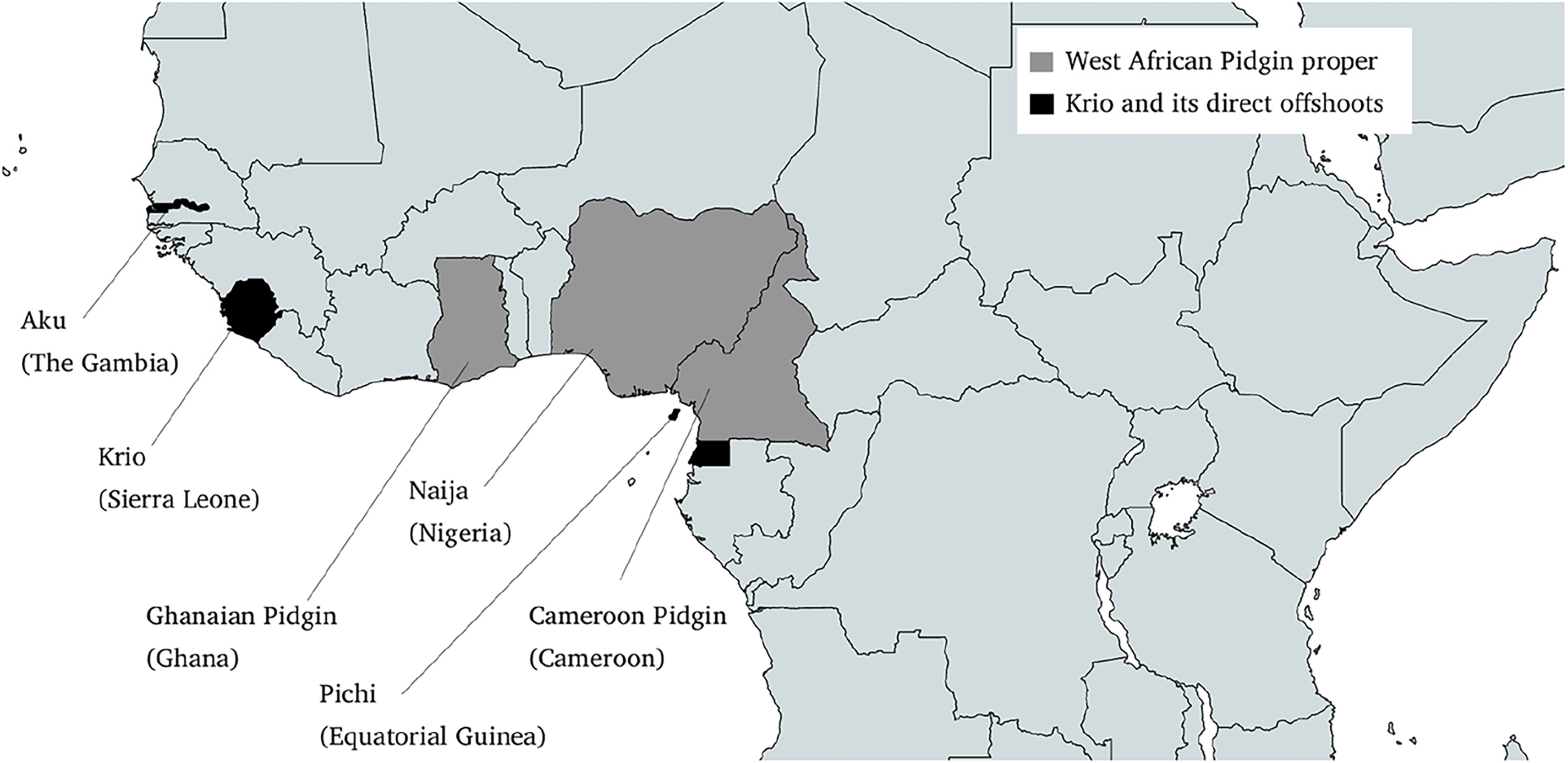
Countries where West African Pidgin is spoken.
The Pidgin varieties of West Africa are a subgroup of African Caribbean English Creole (ACEC), a trans-Atlantic, intercontinental cluster that constitutes a world language in its own right (Yakpo, Forthcoming). ACEC emerged in the seventeenth century from contact between African languages and English in the Caribbean and West Africa and is now spoken in some 30 countries across the Atlantic basin. Apart from the African varieties listed above, well-known Caribbean varieties of ACEC include Jamaican Creole, Creolese (Guyana), Trinidad Creole English, and Sranan (Suriname) (Hancock, 1969, 1987; Smith, 2015). Genetic links with African American English and Gullah (South Carolina and Georgia) have also been suggested (Winford, 2017).
The West African ACEC varieties are noteworthy because they primarily function as lingua francas, enabling communication outside the home. By contrast, the Caribbean ACEC varieties primarily function as vernaculars, i.e., languages acquired in the home during childhood. Another remarkable characteristic of the West African varieties concerns demography. The rapid growth of Africa's population in the twenty-first century is likely to entail a corresponding growth in speaker numbers and the use of Pidgin as a vernacular language, particularly in urban areas. The pace and extent to which Pidgin is, and will be, acquired by new speakers are probably unlike that of any other language in recorded history. Further growth of Pidgin beyond its home region is likely to ensue from increased migration out of Pidgin-speaking countries into Africa and the world in the coming decades, as well as Africa’s growing economic and cultural role in general and of the demographic behemoth Nigeria in particular. Yet, the rapid growth of Pidgin in the wake of demographic and socio-economic change in Africa constitutes a blind spot in sociolinguistic research about the continent. Scholars who write on these developments still receive scant attention in mainstream linguistics (e.g., see the seminal Akande and Salami, 2021).
Pidgin is a typical “super-central” world language (de Swaan, 2001). It is a lingua franca that allows speakers of less widely spoken “central” and “peripheral” languages to communicate across large geographic spaces, though not necessarily on a global scale. Pidgin is, however, a world language against the grain. A language's position in the global linguistic order is seen to be influenced by the degree of standardisation, officialisation, use in institutionalised high culture, and as a written medium. Additionally, its position is viewed to be impacted by its use in formal education, law, international business, technology, science, and the economic and geopolitical power of its speakers (Ammon, 2010; Chan, 2016; de Swaan, 2001).
However, none of the attributes above aptly characterise the rise of Pidgin. No variety of Pidgin has been standardised, nor is it employed as a language of administration, education, elite culture, state media, official politics, or the formal economy. Instead, the expansion of Pidgin is entirely self-organised, negotiated in local social networks, fuelled by the informal economy, driven by a buoyant popular culture expressed through music, film, radio, and social media, and articulated in complex multilingual configurations. Likewise, the countries in which Pidgin is spoken are not considered rich or powerful by mainstream economics and politics. Instead, the rise of Pidgin is part of a bundle of socio-economic and sociolinguistic factors that I group together under the terms “modernisation” and “shallow social entrenchment.”
Overall, the trajectory of Pidgin, therefore, offers great potential for exploring the dynamics of the self-organised evolution of language regimes that characterise twenty-first century globalisation as opposed to earlier times when national elites self-consciously engineered such regimes through bureaucratic intervention.
In the next section, I first explore the sociohistorical trajectory of the rise of Pidgin and discuss the aptness of the term “world language” for its present role while exploring “modernisation” and “shallow social entrenchment” as factors in its recent expansion in the following section. I then take a closer look at demography as a driver of growth that may result in speaker numbers of up to 400 million by 2100 in the next section before concluding this article with some final observations.
The Sociolinguistic Dynamics of West African Pidgin: Past and Present
The rapid growth of Pidgin in the twentieth and twenty-first centuries has ushered in an estimated 140 million speakers, making it the largest language cluster in West Africa and one of the largest in Africa as shown in the next subsection. In the following subsections, I discuss the historical and sociolinguistic backdrop to this development before turning to the emergence of Pidgin as a super-central world language with important social, political, and economic functions.
Up to 140 Million Speakers of West African Pidgin?
The present transcontinental distribution of ACEC across the Atlantic is rooted in the mass deportation of Africans by European and Euro-American slave traders during the invasions of the Americas and Africa by Western European nations. The exponential growth of ACEC has for the most part taken place through the expansion of West African Pidgin in the twentieth and twenty-first centuries and has been accelerating in the last few decades. Today, around 95 per cent of the speaker population of ACEC speaks Pidgin (Yakpo, 2020: 64), and demographic growth in West Africa is likely to shrink the Caribbean percentage further. Due to the demographic weight of Nigeria, in turn, speakers of Naija account for around 70 per cent of the current Pidgin-speaking population. Simultaneously, the Krio varieties constitute no more than 8 per cent of the Pidgin speaker stock due to the smaller population of Sierra Leone, Equatorial Guinea, and The Gambia combined. However, there are no comprehensive census data on the use of Pidgin as a vernacular and lingua franca. Approximate speaker numbers must be extrapolated from existing estimates and recent demographics.
Table 1 contains estimated speaker numbers and ranges for the six Pidgin varieties contained in the sources cited, adjusted for the most recent UN population figures (2022). Speaker number estimates were obtained by applying the percentages provided by the sources in the fourth column to the 2022 UN population figures.
Estimated Speaker Numbers of West African Pidgin.
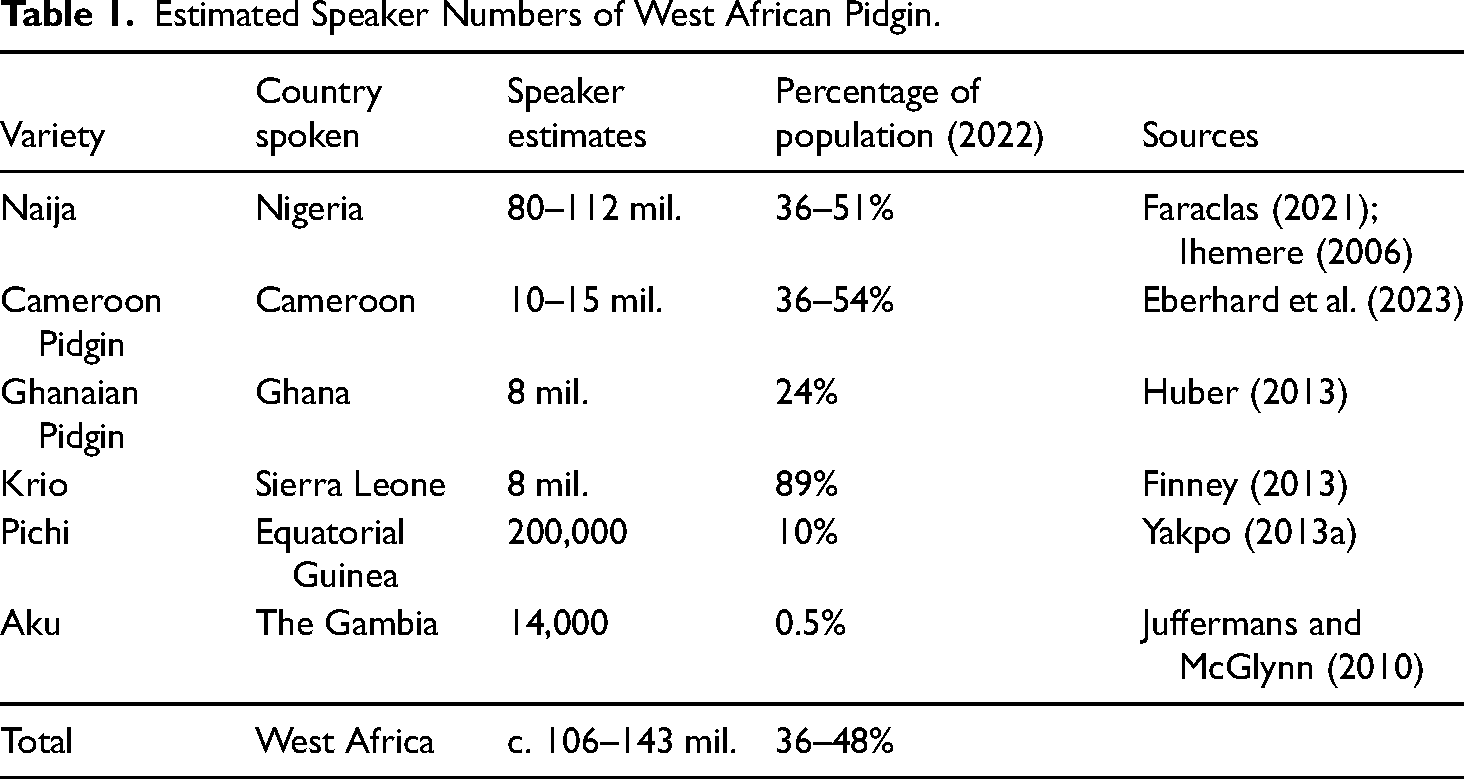
Based on the estimates in Table 1, the six varieties presently number anywhere between 106 and 143 million speakers. There are, however, substantial differences in the percentage of speakers in each country, ranging from about 50 per cent in Nigeria and Cameroon to below one per cent in The Gambia. Overall, Pidgin forms the largest language cluster of West Africa, exceeding the two largest indigenous international languages of the region – Hausa (an estimated 100 million speakers, see Wolff, forthcoming) and Manden (Bamana-Maninka-Jula) (at least 20 million speakers, see Vydrin, 2013: 76).
Sierra Leonean Founders and Domestic Spreaders
All varieties of Pidgin ultimately trace most of their roots back to Krio. However, each has evolved distinctively, adapting to the linguistic and social ecologies of their respective regions. In what follows, I will outline the evolutionary process leading to the speciation of the various Pidgin varieties of West Africa.
Beginning in 1787, the British Crown relocated formerly enslaved people of African descent from North America, Jamaica, and various parts of West Africa to the area now known as Freetown, the capital of Sierra Leone (Fyfe, 1962). The restructured and creolised “Englishes” spoken by these groups merged with those of resident Sierra Leoneans during the nineteenth century. This process ushered in the English-lexicon creole language “Krio” (Hancock, 1969), which accompanied the ethnogenesis of the people that go by the same name of “Krio.”
During the nineteenth century, Krios established small communities numbering several thousand in major towns along the West African coast all over British-occupied West Africa (Fyfe, 1962). Krios garnered social prestige due to their entrepreneurial success in the colonial economy, access to European education, cultural proximity to the English colonisers through the practice of Christianity, and a Europeanised material culture (Lynn, 1992). The Krio people of Freetown acted as founders for both creolised and standardised Englishes in the region (for the latter, see Bobda, 2003). Soft social boundaries between Krio communities, African host populations (see, e.g., Aranzadi, 2016), and other African communities of strangers, e.g., soldiers in the service of colonial armies and Afro-Brazilian returnees (Dakubu, 1997: 155; von Hesse and Yarak, 2018), facilitated the acquisition of the Krio language by non-Krios. The creolised English of these Krio founders thus became the acquisition target for African frontline workers in the colonial economy who interacted with the Krios (Yakpo, 2022).
As it spread beyond Sierra Leone, Krio followed two diverging paths. The populations from Sierra Leone that implanted Pichi (Yakpo, 2019: 6–11) and Aku (Dalphinis, 1980) in Equatorial Guinea and The Gambia remained socio-economically and culturally compact. As a result, Aku and Pichi were transmitted to subsequent generations without all too much influence from surrounding languages and have remained similar enough to Krio to still be considered dialectal variants of the same (Yakpo, 2022).
This differs from the impact that Krio had in Cameroon, Nigeria, and Ghana. Krio people arrived in the mid-nineteenth century in Limbe, Douala, and other coastal towns of present-day “anglophone” Cameroon from neighbouring Bioko Island (Equatorial Guinea) and Sierra Leone. In the same period, Krios from Freetown also settled in Lagos and Port Harcourt – two major towns of southern Nigeria (Huber, 1999: 125). Tens of thousands of colonial migrant labourers then moved from Nigeria to Ghana in the early twentieth century, bringing with them a second generation, Krio-influenced variety of Pidgin (Huber 1999: 126–129). In Cameroon, Nigeria, and Ghana, Krio communities gradually melted into the African urban population during the twentieth century, such that domestic coastal populations became the main “spreaders” of the spin-off varieties of Krio. These varieties “indigenised” under the influence of the African languages spoken alongside them and speciated into the continuum of Pidgin varieties today known as Naija, Cameroon Pidgin, and Ghanaian Pidgin (Yakpo, 2024). Consequently, these three varieties have for quite some time been seen as a group termed “West African Pidgin” in the literature, separate from Krio and its direct offshoots (see Map 1) (e.g., Dwyer, 1966).
The differences between Pidgin proper and Krio and its direct offshoots are chiefly phonological. For example, Pidgin features diphthongs where Krio has monophthongs, as in h
West African Pidgin as a Super-Central World Language
The exposition thus far has shown that individual Pidgin varieties are spoken in six West African countries. The notion of “world language” suggests a lingua franca with numerous first- and second-language users that enables international and interlingual communication across large spaces (Ammon, 2010; de Swaan, 2001). World languages are ranked by global reach, with English as the only “hyper-central” language due to its extensive use resulting from colonialism, indigenisation, and second-language learning (de Swaan, 2001). “Super-central” languages like Arabic, French, Chinese, German, or Swahili have large speaker numbers (usually over 100 million) and serve as lingua francas within specific regions, connecting speakers of more localised “central” languages.
The question, therefore, arises whether Pidgin constitutes a single cluster, and if its political, economic, and sociocultural importance merits the label of a “world language.” Relevant in this context are linguistic criteria such as the degree of structural similarity and mutual intelligibility between varieties used across geographic and political boundaries, as well as socio-functional ones, e.g., the size and nature of the speaker community, standardisation and officialisation, the economic strength of speaker nations, and use in business and science (Ammon, 2010). In the following, I discuss these criteria critically with respect to Pidgin.
Linguistic studies on Pidgin varieties show substantial overlaps in grammar. Hancock (1987) analyses 50 features across ACEC and identifies a distinct West African cluster, which is supported by a phylogenetic analysis by Daval-Makussen and Bakker (2011). A phylogenetic analysis of the English-derived basic lexicon also groups all Pidgin varieties together separate from English due to shared phonological and semantic innovations (Yakpo, 2009: 12). Shared structural features between the African varieties are a tone system that includes tonal case distinctions, e.g.,
Pidgin speakers are typically multilingual, possessing varying degrees of competence in the colonial official languages English, French, and Spanish (the latter two, in Cameroon and Equatorial Guinea, respectively), as well as in African ancestral languages. The colonial languages function as socially superordinate “superstrates” due to their use in official functions like education and administration. The African languages function as more symmetrical “adstrates” (for a detailed discussion of the terms, see Kouwenberg and Singler, 2008). African adstrates share the fate of Pidgin in being denied official functions. However, Pidgin speakers often also view the African adstrates as “superior” to Pidgin because they index ethnic, cultural, regional, and territorial entities, perceived as venerable and fixed, while Pidgin indexes a “de-ethnicized urban identity” (Ajagbe et al., 2022), perceived as recent and variable. Plurilingual practices involving Pidgin, the superstrate and adstrates are often so conventionalised that languages like Ghanaian Pidgin, English, and Akan (in Ghana), or Cameroon Pidgin, English, French, and Duala (in Cameroon) can constitute a unified code, fulfilling linguistic functions within a conversation typically covered by a single language in more monolingual societies (for examples, see Osei-Tutu, 2016).
Pidgin varieties are structurally very similar and display flexible boundaries with English. Moreover, Pidgin and the African languages spoken in the region have many commonalities. These elements contribute to a significant level of mutual intelligibility across all Pidgin varieties. The only study so far to assess mutual intelligibility of ACEC varieties includes Ghanaian Pidgin and Naija, showing that most Ghanaians judged Naija to be “extremely” or “moderately easy” to understand (Bartens et al., forthcoming). In turn, half of the Nigerians surveyed thought the same of Ghanaian Pidgin. I have also been witness to, and participated in, numerous successful interdialectal conversations between speakers of closely related varieties like Cameroon Pidgin and Naija, and varieties further apart like Pichi and Ghanaian Pidgin. Uses of Pidgin for interdialectal communication have also been reported for West African diaspora communities (e.g., in Germany, see Mair, 2022).
The concept of a “Dachsprache” (roofing language) in the dialectological literature describes a standardised centre that enables communication across national, social, and geographic boundaries (Muljačić, 1993). Pidgin lacks such a standardised centre. However, the relatively recent implantation of Krio and Pidgin in West Africa has not allowed for significant differentiation despite borders. Second, British colonisers initiated extensive forced labour and population movements between colonies (Martino, 2016), followed by post-independence migration, especially to Nigeria and Ghana (Yeboah, 1986). The more recent expansion of transport infrastructure, mediated digital communication, and rapid urbanisation have further diminished the impact of geographic separation (see the section The Expansion of West African Pidgin).
Additionally, Nigeria's emergence as a Pidgin “epicentre” (Mair, 2022) due to its demographic, economic, and cultural influence has promoted unidirectional familiarity and intelligibility of Naija by non-Nigerians, as confirmed by Bartens et al.’s (forthcoming) survey. Consequently, Naija may be considered an informal “Dachsprache” for Pidgin, even though it constitutes a self-organised system rather than a standardised one.
Another criterion for the importance of a world language in the literature is economic weight, measured in the size of the GDP of speaker countries (e.g., Ammon, 2010), an indicator typical of the state-administered, recorded, capital-intensive economies of the North. Most people in West Africa are, however, economically active in the unrecorded “informal” business sector, characterised by low capital intensity, small-scale production and trade, and face-to-face interaction (Mbaye, 2015). Invigorated by the free movement of people in the Economic Community of West African States, Pidgin has become the most important language for small-scale cross-border trade between “anglophone” West African countries (Ajagbe et al., 2022).
Ghanaian, Nigerian, and Cameroonian traders and migrant workers, who I befriended during fieldwork in Equatorial Guinea in the 2000s, told me they had transitioned smoothly from their home varieties of Pidgin to Pichi, the Equatorial Guinean offshoot of Sierra Leone Krio, by sticking to a common grammatical template and substituting English lexicon with Spanish where necessary. Conversely, Pichi speakers are acutely aware of the international reach of their language. My informant Agustín Nguema Eñeso expressed his experiences of travel in West Africa in the following way: À gó Nigeria, tɔ́k Píchì dɛ̀n gò híà, à gó Ghana, à gó Sierra Leone, nà Píchì. Yù dè mék àm plés bày plés dɛ̀n dè tɔ́k àm “(if) I go to Nigeria, (and I) speak Pidgin, they’ll understand, I go to Ghana, to Sierra Leone, it's Pichi. You do it from place to place, they’ll speak it.” (Yakpo, 2016: 222).
A further indicator of the importance of a world language found in the literature is the influence of its elite culture, the size of its literary and scientific text corpus, and the prestige of institutionalised artistic production in the language (de Swaan, 2001, 2020). A Google search for the content of university programmes in “World Languages and Cultures” illustrates this. However, popular culture, rather than “high culture,” is one of the most important factors in the spread of Pidgin. The last two decades or so have seen the meteoric rise of a regional Pidgin-mediated popular culture in music, film, radio, and social media (see the subsection Shallow Social Entrenchment for further discussion).
The digital media revolution has also led to an explosion in the use of Pidgin vernacular orthographies (Heyd, 2016). An English-oriented written koine has long been in use in West Africa in literature, comic strips, poetry, music lyrics, and advertising (for an early overview, see Amoako, 1992: 114–128). The Lagos office of the BBC started producing written and audio-visual content in West African Pidgin in 2017, a move that has enjoyed considerable success in the region (e.g., see BBC News Pidgin, 2024). In countries where advanced knowledge of written and spoken colonial languages is limited to small elites, Pidgin has, paradoxically, also become the most widely used language for political campaigning by these very elites (for Nigeria, see Egbokhare, 2021: 70).
The widespread use of Pidgin contrasts starkly with its political and legal status. Countries where Pidgin is spoken exhibit ideological and policy continuities from colonialism that devalue Pidgin vis-a-vis the superstrate (Yakpo, 2016). In all six countries, the colonial language has remained the sole de facto official language. No Pidgin variety has undergone state-driven standardisation, serves as a language of administration or education, possesses a widely accepted standard orthography, nor has been claimed as a language of national identity by a significant portion of the elites (Yakpo, 2020). Although all six Pidgin-speaking countries have provided some constitutional recognition to African languages, Pidgin is excluded. Only Krio (Sierra Leone) received some policy-making attention until the outbreak of civil war in 2002. The process of implementation has, however, stalled, and Krio has continued to grow through self-organised processes alone, like elsewhere.
Officialisation (Ammon, 2010), which relies on state-organised language regimes, does not, therefore, seem to be a reliable measure for the vibrancy of a world language either. In West Africa, media formats are predominantly run by private TV and radio stations and distributed through social media with minimal government oversight. Driven by profit, the private media and advertising industry have been quick to adapt to reality by prioritising widely spoken African languages, and Pidgin in particular (for advertising, see Ofulue and Yakpo, 2021).
In sum, most existing literature does not sufficiently account for the ongoing reconfiguration of language regimes through socio-economic, technological, and cultural change. Sources do not factor in the emergence of more pluricentric linguistic ecologies besides the continuing forces of linguistic homogeneisation inherited from colonial globalisation. It is in such ecologies that Pidgin has thrived and outgrown other languages that are either linked to the exercise of a distant state power (i.e., colonial languages like English and French in West Africa) or interlocked with more traditional categories like ethnicity, geographic origin, and religious denomination (e.g., African ancestral languages like Yoruba and Hausa in Nigeria).
Moreover, existing sources do not account for the role of demographic change in the twenty-first century and a pronounced shift in global population and speaker majorities (see the section Demography as a Driver of Growth). Given the above, the concept of “world language” warrants a critical revision to reflect present realities, embracing Pidgin and other emerging world languages. In the following, I will investigate the social causes of the expansion of Pidgin as a world language against the grain in greater detail.
The Expansion of West African Pidgin
The developments outlined in the preceding section warrant exploring the socio-economic and sociolinguistic factors that have been influencing the expansion of Pidgin to new speaker populations. I propose two broad hypotheses, broken down into sub-themes listed below, and discussed further in this section. I suggest that macro-level (1) “modernisation” factors and meso-level (2) sociolinguistic factors are at work. I characterise the latter with the shorthand “shallow social entrenchment.”
“Modernisation” factors
- High infrastructure density - High urbanisation rate - Low median age - High secondary school enrolment - High female labour force participation - Large “informal” business sectors “Shallow social entrenchment” factors
- Absence of ethnolinguistic and social class ownership of Pidgin - Pidgin as the default medium in loose social networks - Pidgin as a youth sociolect (“glotto-juvenescence”) - Use of Pidgin by socio-economic elites - Absence of a competing lingua franca - Absence of standardisation/officialisation - Pidgin as a language of cultural industries
“Modernisation” and “shallow social entrenchment” are unevenly distributed geographically and therefore contribute to differential rates of expansion of Pidgin varieties between and within countries. I discuss factors (1) and (2) in the following subsections respectively.
“Modernisation”
I suggest that the expansion of Pidgin correlates positively with a set of “modernisation” factors relating to demography, technology, and political economy.
For example, the technological variable of road density has been identified as a significant factor in language death (Bromham et al., 2022) and a shift to larger languages. Road density is higher in southern Nigeria and Ghana than in their respective northern parts. Accordingly, Naija and Ghanaian Pidgin have spread faster to the smaller cities and rural areas in the south than in the north. These Pidgin varieties were, of course, first implanted in the south (see the subsection Sierra Leonean Founders and Domestic Spreaders). Proximity to the coast could, therefore, also be seen as an expansion factor on its own (see Faraclas, 2021), though linked to road density due to generally higher economic “development” in the south than in the north of these two countries (e.g., see Raheem et al., 2014).
Further, the high rate of urbanisation experienced by all Pidgin-speaking countries in the last few decades has led to more urban multilingualism and language contact than ever before in the region. In Africa, galloping urbanisation has been accompanied by the emergence and spread of “new urban languages” (Beck, 2010) and youth sociolects (Nassenstein and Hollington, 2015) based on existing lingua francas, and is often accompanied by intergenerational shift to these varieties. Speakers based in economic capital cities like Lagos, Accra, and Douala have functioned as accelerators of the spread of Pidgin through rural–urban circular migration, (temporary) employment in urban areas, and the consumption and production of popular culture in and from these cities (Yakpo, 2020).
The demographic variable of a low median age, e.g., 19 years in Nigeria and Sierra Leone, 18 in Cameroon, and 21 in Ghana (Index Mundi, 2023), correlates with a young population (e.g., 60 per cent under the age of 20 in Sierra Leone and Cameroon), high population growth, high rates of rural–urban migration, high rates of (social) media use and the spread of youth sociolects of Pidgin as discussed above.
A high female labour force participation, e.g., 67 per cent in Cameroon vs 22 per cent in Urdu-speaking Pakistan (The World Bank, 2022), is potentially linked to greater economic independence of women and higher female mobility, which favour higher interlingual exogamy and a greater likelihood that women acquire and socialise their children in Pidgin. Women's predominance in informal economies favours this pattern.
All Pidgin-speaking countries have large “informal” business sectors, much of which are run by women (Fapohunda, 2012). Traders and producers in the sector must rely on mobility, reactivity, extensive and open networks, and effective communication, all of which favours the use of lingua francas rather than functionally more restricted languages. The “modernisation” factors covered above are therefore linked in feedback loops with the spread of Pidgin.
“Shallow Social Entrenchment”
I propose that the expansion of Pidgin correlates positively with its “shallow social entrenchment.” All varieties are still geographically linked with their original homelands on the coast of Pidgin-speaking countries from whence they spread inland, and the extent of social neutrality differs from country to country. Cameroon Pidgin, for example, has emerged as an index of a strong regional identity, not ethnic, but closely associated with the “anglophone” south-west of Cameroon. Nonetheless, all Pidgin varieties have outgrown their former association with the Krio diaspora of Sierra Leone (see the subsection Sierra Leonean Founders and Domestic Spreaders). Speakers of Pidgin, therefore, no longer project a compact ethnolinguistic identity nor does any social class claim ownership of it.
Notwithstanding regional differences, all Pidgin varieties exhibit a high “sociolinguistic vitality” (Mann, 2000). Institutional support for Pidgin may be lacking in all countries, but Pidgin fulfils both practical functions for interlingual communication and subsistence, as well as social functions of informality, intimacy, self-expression, and communion. This combination of the practical economic value and social functions of Pidgin increases the motivation to acquire and use it. Due to weak norm enforcement, Pidgin also predominates in loose, social networks, and in outgroup communication with strangers. These two features provide another reason why Pidgin spreads faster than other African languages that are typically used in the denser networks of rural, intraethnic, and family systems.
Further, a youthful population benefiting from a growing secondary school enrolment ratio (see “modernisation” factors in the subsection Modernisation) has promoted the development and spread of youth sociolects of Pidgin on school and university campuses, and in the streets and yards of the ethnically heterogeneous cities (see, e.g., the sociolinguistic profiles of Naija speakers in Mazzoli, 2017). This process, which one may call “glotto-juvenescence” (Greek, “relating to language” + Latin, “being or becoming young”), has led to youth sociolects becoming the numerically preponderant varieties and the main source of lexical and structural innovation and change in Pidgin.
The glotto-juvenescence of Ghanaian Pidgin, for example, has ushered in the emergence of a variety called “Student Pidgin” in the literature (Dako and Bonnie, 2014). Since this variety emerged in the cities of the more urbanised, economically dynamic south of Ghana, knowledge of Student Pidgin has become an emblem of familiarity with urban life, which strengthens its covert prestige (for a similar situation re. the Surinamese ACEC Sranan, see Yakpo and Muysken, 2017). Student Pidgin is gradually replacing older varieties of Ghanaian Pidgin by becoming the target variety for youth learners. Naija has also undergone glotto-juvenescence (Isiaka, 2020).
Another influence on the expansion of Pidgin is the absence of a competing lingua franca. Ghanaian Pidgin has largely remained an L2 (second or additional language) lingua franca for almost all its speakers. Ghana's existing lingua franca is Akan, which functions as the default language of interregional and interlingual communication, including in the capital Accra (Yankson, 2018). Ghanaian Pidgin therefore still mainly functions as a youth sociolect, although it has recently been acquiring more general lingua franca functions.
In contrast, Naija has become the uncontested lingua franca across the traditional “Pidgin zone” of the Nigerian south (Mann, 2000: 464) in the absence of a competing lingua franca – save in exceptionally monolingual pockets, e.g., the cities of Ibadan and parts of Lagos where Yoruba dominates (Egbokhare et al., 2019). In the so-called Middle Belt and the northerly federal states of Nigeria the competing lingua franca Hausa, has not been displaced by Naija. Nevertheless, Naija has been radiating outwards from the country's capital Abuja and other large cities of the Middle Belt and the north in more recent times (Caron, 2019). Naija is also the dominant language in army and police barracks across Nigeria, where it is acquired and used by northerners and southerners alike (Agbo and Plag, 2020: 355). In the linguistically very heterogeneous Niger Delta states, and urban southern Nigeria in general, millions of speakers have also been acquiring Naija as an L1 (first or native language) (Egbokhare, 2021). A similar situation holds for Cameroon Pidgin, which has assumed lingua franca functions in the western and central parts of the country but not in the north, where the lingua franca Fulfulde dominates (Ebongue, 2017). The accelerated spread of Krio in Sierra Leone after the civil war – almost the entire population presently uses it as an L1 or L2 (Finney, 2013) – has also taken place in the absence of an alternative lingua franca.
Absent or weak standardisation implies that shared speech norms arise through bottom-up emergent processes instead of top-down elite engineering and administrative action. This allows translanguaging and other norm-defying speech styles (e.g., the youth sociolects discussed above) to be integrated into the core grammar and pragmatics of Pidgin. This contrasts with the standardised European colonial languages, where such practices are contained in the social periphery (see, e.g., Wiese, 2015). At the same time, Pidgin speech styles are not embedded in the social hierarchies of African ancestral language systems, either. Egbokhare (2021) argues that the absence of standardisation and weak norm enforcement are important reasons for the vitality of Pidgin.
As a consequence of the factors described above, Pidgin has become the main language of cultural industries in most Pidgin-speaking countries. Pidgin has become the primary language of the Nigerian-Ghanaian musical genre known as “Afrobeats.” The genre has long outgrown its region and features global pop icons like Burna Boy (Pareles, 2022), and has been incorporated into the popular music styles of Cameroon (e.g., Libianca, 2023), Equatorial Guinea (e.g., Deymond, 2021), and Sierra Leone (e.g., Mello Seven, 2023). Similarly, the Lagos-based Nigerian “Nollywood” movie industry, ranked second in global output of films after India's “Bollywood” and before “Hollywood,” (Collins, 2022) increasingly produces films in Pidgin in order to capture audiences beyond national markets. The catalogues of Netflix, Prime Video, and prominent art film festivals, for example, include numerous movies whose primary language is Naija or a Pidgin koine when non-Nigerian actors are involved (e.g., the award winning “Mami Wata,” see Salau, 2023, and the action film “Brotherhood,” 2022).
The use of Pidgin as a medium of film and music, supported by the visual imagery of glossy videoclips and consumerist celebrity culture is boosting the informal status of Pidgin, particularly among the young. This represents quite a radical departure from the language ideologies of older generations, which still tend to view Pidgin as a deficient form of English (see, e.g., d’Epie Alobwede, 1998).
Demography as a Driver of Growth
“Shallow social entrenchment” and “modernisation” were discussed as factors affecting the recent expansion of Pidgin (see the section The Expansion of West African Pidgin). In the following, I discuss demographic growth in greater detail since it functions as an important driver of the various socio-economic and cultural trends I have outlined in the preceding sections.
The United Nations and other reliable sources have converged on the projection that Africa's population will increase by 50 per cent from 1.4 billion in 2022 to 2.1 billion in 2050 (United Nations Population Division, 2022). Probabilistic projections for the end of the century are less reliable due to the complex amalgam of sociocultural, economic, and political factors that impact on demographic growth (for an overview, see Paice, 2021: 5). But a middle-of-the-road UN figure for 2100 is 3.9 billion Africans, hence roughly 40 per cent of a global population of 10.3 billion.
The projections for the six Pidgin-speaking countries for 2050 and 2100 under the UN medium growth scenario are a total 502 and 732 million for 2050 and 2100 respectively, up from 294 million in 2022, as shown in Table 2. The “youth factor” in the growth of Pidgin is taken into account by providing the projected median age of populations at the three cut-off dates in Table 2. If the projections turn out to be valid, the population of Pidgin-speaking countries will increase by 70 per cent by 2050 and by 150 per cent by 2100. Even with the gradual slowdown of African demographic growth over the course of this century shown in Table 2, the combined median age of these six countries in 2100 (35 years) will still be 12 and 15 years below that of Asia (47 years) and Europe (50 years), respectively. Further, current urbanisation trends are expected to accelerate. Africa is predicted to harbour the largest and highest number of cities in the world in 2100, with some predictions of the Pidgin hub Lagos growing to 88 million (Hoornweg and Pope, 2017).
Population Projections for West African Pidgin-Speaking Countries (in Million).
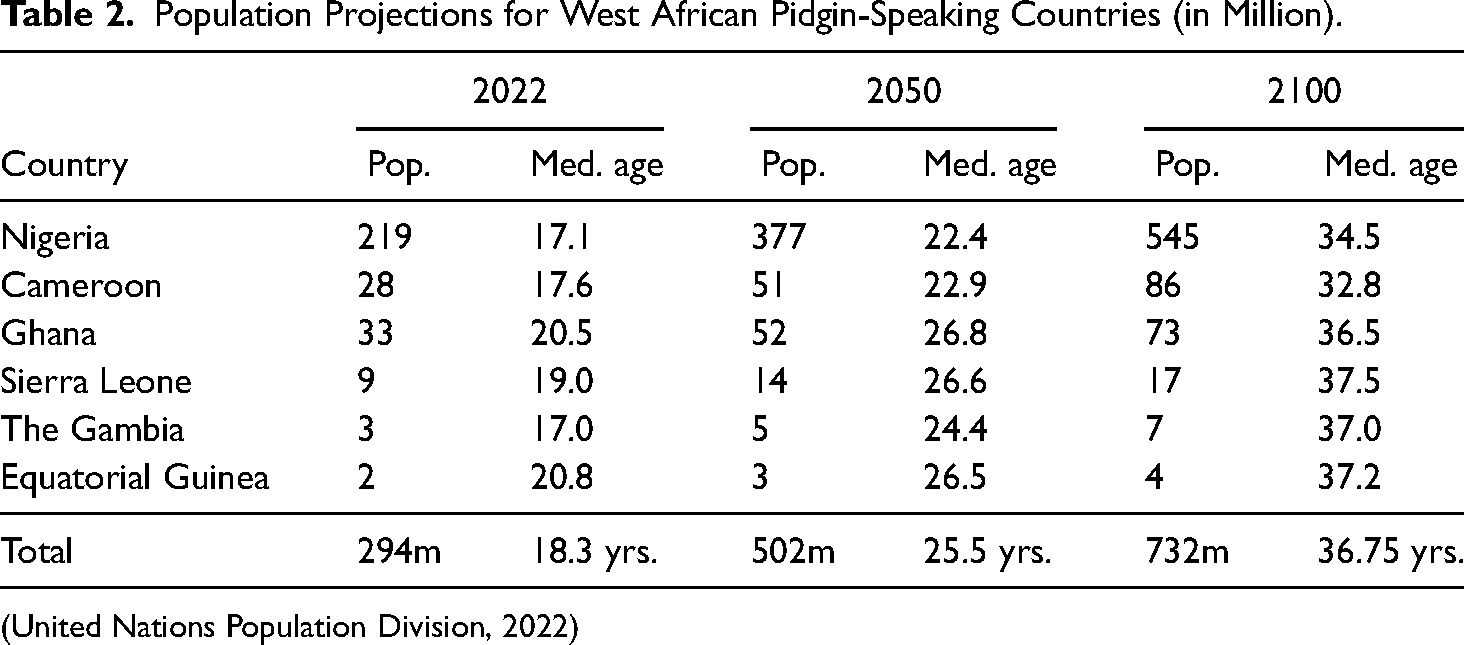
The anticipated ripple effects of such demographic growth include the migration of young Africans out of Pidgin-speaking Africa in search of economic opportunity and to provide much-needed labour and skills for ageing societies elsewhere – Nigerians already constitute the most highly educated group of the immigrant and resident population in the USA (Jackson-Obot, 2020). Migratory outflows depend at least as much on socio-political and economic factors as does long-term population growth. The numbers can therefore only be tentative. Equally, policy reactions to African immigration on the massive scale required by the shrinking populations of the northern hemisphere are unpredictable. Nigeria will make up 75 per cent of the total projected West African Pidgin-speaking population in Table 2 in 2050 and 2100, respectively, and will likely cover most net migration in the coming periods as well. According to government sources, 17 million first- and second-generation Nigerians were estimated to reside outside of the country in 2017, most of whom were elsewhere in Africa (Fidelis, 2017), in line with existing trends of intra-African migration (International Organization for Migration, 2022).
The UN provides an estimated total out-migration of 82 million people from the six Pidgin-speaking countries by 2050 (United Nations Population Division, 2022). A sophisticated probabilistic study by Vollset et al. (2020) that takes into account socio-demographic factors, crude population growth, and probabilities of conflict and climate change produces a more modest combined emigration of approximately 44 million people out of the six Pidgin-speaking countries in 2050, with the lion's share (70 per cent) of emigrants being Nigerian. The number is predicted to reach 75 million in 2100, with Nigerians accounting for 80 per cent of emigrants.
Under the conservative assumption that the percentages of Pidgin speakers in Table 1 will not change over time, and taking the lower estimates for Nigeria and Cameroon (36 per cent) into account, the total number of speakers would reach 270 million at the end of this century. With the higher estimates, this number could swell to above 360 million by 2100.
Such counts are, however, only based on crude demographic growth, hence disregarding the continuation of the growth of Pidgin through language shift and acquisition as an additional language (Egbokhare, 2021). It is more likely that the sociolinguistic and socio-economic dynamics outlined in the section The Expansion of West African Pidgin will come to bear even more in the coming decades and that the acquisition of Pidgin will therefore accelerate. In such a scenario, it is not unrealistic to expect up to 400 million speakers of Pidgin by 2100.
It is not clear to what extent the use of Pidgin will expand outside of West Africa. Naija functions as the predominant authenticating code in Nigerian diaspora communities, often alongside Nigerian English (Affia, 2023; Honkanen, 2021). Speakers also report using Pidgin alongside English for identity purposes, social communion, and practical communication when congregating abroad with nationals of other “anglophone” West African countries (Mair, 2022). A study of Ghanaian immigrants in Italy, by contrast, shows that a mixed Akan–English code, rather than Ghanaian Pidgin, serves as an identity marker (Guerini, 2014). Equally, Pidgin does not seem to have substantially penetrated “francophone” West Africa.
Despite the expected growth within Pidgin-speaking West Africa, one cannot, therefore, predict to what degree Pidgin will, in the coming decades, be acquired by speakers outside of the six home countries of Pidgin through migration, social and economic interaction, people-to-people contacts, intermarriage, and cultural diffusion. Such growth is likely to revolve around existing West African migration hubs in (urban) North America, Western Europe, and East and Southern Africa, as well as emerging ones in Latin America and East and South East Asia (for the African presence in China, see Bodomo, 2015).
Finally, it is crucial to underline the prominence of Nigeria in the growth scenarios of Pidgin. Already today, speakers of Naija make up two-thirds of the total speaker population of Pidgin (see Table 1). Nigeria's dynamic Naija-infused popular culture, media, and brand of evangelical Christianity radiate far beyond West Africa, prompting Mair (2022) to characterise the country as an “informal epicentre” in the world system of Englishes. Even if Naija were still spoken by the lower estimate of 36 per cent of Nigeria's total population in 2100 (see Table 1), the total speaker number would reach 200 million by that time. Due to the factors described in the section The Expansion of West African Pidgin, it seems more likely, however, that Naija will continue to expand its percentage over the course of this century and reach upward of 300 million speakers within Nigeria by 2100.
Conclusion
Pidgin is on a trajectory of significant growth. I identified a set of socio-economic (“modernisation”) and sociolinguistic (“shallow social entrenchment”) factors that appear to be fuelling its expansion. A cautious appraisal of tendencies of demographic growth, urbanisation, migration trends, and socio-economic change leads to the plausible conclusion that Pidgin will be spoken by between 300 and 400 million people by 2100. If this prediction turns out to be true, Pidgin will be among the most widely spoken languages of the Western Hemisphere. Pidgin speaker numbers would also rival those of other fast-growing world languages spoken around the globe (e.g., Hindi-Urdu, Malay-Indonesian, Swahili, French, and Portuguese).
Probably never, in recorded history, has a language once spoken by a few thousand people just over two centuries ago expanded so rapidly. This circumstance is even more striking since Pidgin has spread exclusively by self-organised processes without conquest, enslavement, colonisation, population displacement, genocide, elite engineering, administrative action, and state intervention by a section of its speakers.
The trajectory of West African Pidgin contrasts sharply with the way that European colonial languages were entrenched in Africa. English, French, Portuguese, and Spanish were enforced as the only languages of the colonial administration and post-primary schooling. They also served as the language of command for European colonials and their African auxiliaries in colonial armies, the police, mission stations, prisons, plantations, mines, and domestic service. Further, mastery of the colonial language constituted the only channel of restricted upward social mobility for Africans, buttressed by ideologies that disparaged African languages (for Côte d’Ivoire, see N’Guessan, 2007). Post-independence elites in almost all of Africa have perpetuated colonial language regimes and are heavily invested in them, although only a small fraction of African populations use colonial languages as vernaculars (Mufwene, 2011).
Pidgin's rise as a “super-central” world language therefore goes against the grain. At the same time, it fits into the trend towards decentred, neoliberal globalisation aptly captured by the metaphor of “liquid modernity” (Bauman, 2000). Africans have been experiencing the dismantling of the legal-bureaucratic state since the “structural adjustment programmes” of the 1980s (e.g., Stein and Nissanke, 1999). This has involved the retrenchment of bureaucracies, the dismantling of public enterprises, education and health systems, and the erosion of traditional political parties and trade unions, state media, mainline churches, and extended families. The shrinking of the state has also gone hand in hand with the devastation of rural economies, migration to cities and other countries, as well as the proliferation of informal economies. In the resulting climate of uncertainty, Pidgin has come to constitute a valuable asset for mobilising economic and social resources in the struggle for livelihoods.
For a typical speaker below twenty years of age, the seductiveness of Pidgin goes beyond practicality, however. It also lies in the self-determination over the creative and identity-affirming powers of speech that the standardised colonial languages remain unresponsive to in an era of “breath-taking speed of change” (Bauman, 2000: 155).
The trajectory of Pidgin therefore holds tremendous potential for studying the large-scale, bottom-up language evolution that has come to characterise the present. Given the magnitude of the developments illustrated here, linguists, educators, activists, and policy makers are well advised to engage deeply with West African Pidgin.
Footnotes
Declaration of Conflicting Interests
The author(s) declared no potential conflicts of interest with respect to the research, authorship, and/or publication of this article.
Funding
The author(s) disclosed receipt of the following financial support for the research, authorship, and/or publication of this article: This work was supported by the University of Hong Kong Seed Fund for Basic Research, (grant number 2302101922).