




Abstract
German population trends show continued demographic decline and ageing. This can be explained by changes in fertility, mortality and immigration rates. Low fertility leads to smaller numbers of infants every year, which, compounded by low mortality and, consequently, larger numbers of elderly, shifts the population ratio. Incoming migrants used to counterbalance this ratio but this is no longer sufficient to replace youth not born in Germany. This article explores direct and indirect policy solutions to the demographic changes on the state, societal and regional levels.
Demography is one of the few sciences that are focused mainly on the future. The long-term nature of demographic processes allows demographers to predict population trends with a rather satisfying degree of likelihood. It is obvious that demographic change will determine the future social and economic situation of ageing societies. Demographic change in Germany is comprised of two trends: long-term population decline and demographic ageing. Demographic change is often reduced to ageing, because population decline is still playing a minor role. ‘Ageing’ has two meanings, however, that are sometimes confused: the prolongation of life expectancy (individual ageing) and the ageing of a population (demographic ageing). Demographic change seems to be an inevitable side effect of the socio-economic change and modernisation of a society. But, while ever-increasing life expectancy is proof of the remarkable progress of a civilisation, demographic ageing leads to complex problems (especially in combination with population decline). This worldwide trend [6] confronts a society with manifold challenges.
At the end of 2007 Germany had a population of 82.2 million, of whom 42.0 million were females. Of these, 65.6 million lived in West Germany; in East Germany, including Berlin, there were 16.6 million inhabitants. Foreigners made up 7.3 million persons (8.8%). Of the total population, 25% were below age 20, 55% were between the ages of 20 and 60, and 20% belonged to the age group above 60.
Demographic processes
Fertility
The main reason for demographic ageing in Germany is the decline in fertility. This process, in combination with mortality, makes up natural population change. Historically, there were considerable fluctuations in the number of births per woman, fluctuations caused by crises during which German women/couples decided to delay having children until better times. However, two periods of substantial decline in fertility can be distinguished. The first demographic transition began in Germany at the end of the nineteenth century, around the year 1885. Women at that time had four to five children on average. This mean number declined during World War I to 1.9 (1918). During the Great Depression (the beginning of the 1930s) it fell again, to 1.7. An aggressive population policy during the Third Reich led to a (rather moderate) rise to 2.2 at the beginning of the 1940s, prior to the decrease due to World War II.
The baby boom was a historic shift at the beginning of the 1950s. Fertility rates rose to 2.5 children on average in 1965. This was the ‘golden age of marriage’, with well-defined social roles for husbands and wives and high economic growth. However, this fertility peak did not last long and fertility fell starting at the end of the 1960s until the middle of the 1970s to a level around 1.4. This second decline in fertility was driven by the reduced meaningfulness of extended families, increasing (voluntary) childlessness and the postponement of marriage and first births. It was part of a major societal change, which is referred to as the second demographic transition [2]. Until Germany's reunification in 1990, rates of fertility did not change much, but instead oscillated between 1.2 and 1.4. After 1990, however, fertility fell in East Germany to a historic low of 0.77–-a consequence of radical changes during the course of the economic and societal transformation, but also in large part the result of postponement of first birth. In 2007, the mean number of children was 1.37–-both in West and East Germany, following a period of steady recuperation.
To sum up: there have been historical fluctuations in levels of fertility, but in the long run they have been falling since the end of the nineteenth century, with two major periods of decline, and have now fluctuated at a low level for many years. Statistically, each woman would have needed to give birth to 2.1 children for a one-to-one replacement in the next generation. This minimum level was first breached in 1920, and since the baby boom German fertility rates have been consistently below this level. Since 1970 every successive generation would have shrunk because almost every year the number of births has been exceeded by the number of deaths (natural decrease)–-if it were not for immigration, which has helped to put off population decline. At present, there is nothing to indicate that there will be a significant rise in fertility, which would slow the pace of ageing.
Mortality
Due to progress in medicine, the expansion of the health care system, improved living conditions and healthier lifestyles, mortality in Germany has decreased steadily since the end of the nineteenth century. Newborn girls are at an advantage: in 1901, 37.9% of all males died by the age of one, and 33.4% of the females. This has changed completely: in 2007, the numbers were 0.4% for males and 0.3% for females. Females still have a higher propensity to survive. Their life expectancy at birth in 1871-1880 was only 38.4 years and rose until today (life table of 2005-2007), when it stands at 82.2. For males it rose from 35.6 to 76.9 years.
Mortality rates sank in all age groups, but to a different degree. At the beginning of the twentieth century (1901), a high proportion of the deaths were of those younger than 10 years old. Only 23% of males and 28% of females reached an age above 60. In 2005-2007, around 88% of males who died and 93% of females were above this age. After World War II, progress in delaying mortality manifested itself mainly in higher age groups and thus contributed to the ageing process. Excess mortality (the difference between males and females) has risen since World War II in both parts of Germany, from 4 years around 1950 to 5.2 years (West Germany) and 6.2 years (East Germany), according to the life table of 2005-2007. In other words, females have profited more from progress in delaying mortality.
Mortality diminished in both parts of the country; however, after 1945 an East-West life-expectancy-at-birth gap emerged. This gap stood at 2.8 years (for females) and 3.5 years (for males) in 1990 [7]. In the years following, it has closed more and more and has disappeared for females, whereas there is still a slight gap for males. The progress of East Germany is seen as the consequence of a combination of improvements in living conditions, a better long-term care infrastructure and general socio-economic and infrastructural conditions.
The crucial factor for demographic ageing is the number of persons surviving to an old age. Both the number and percentage of elderly people increased significantly during the twentieth century, due to progress in mortality reduction and decline in fertility. This is especially true for females. Demographic ageing has been less strong than it should have been, considering the natural decrease. The main reason is immigration since the 1950s.
Migration
Migration is the second, spatial side of population change. In Germany, an increase or decrease in the overall population can often be traced back to immigration or emigration. International migration (crossing national borders) proceeded quite differently in East and West Germany. East Germany (GDR) was confronted with very high levels of emigration towards West Germany (FRG) until 1962. The building of the Berlin Wall lessened it significantly. However, emigration still took place on a small scale until reunification. West Germany, in contrast, was for a time Europe's main destination for immigrants and was thus able to counterbalance its natural decrease until 2003. Since then, immigration has been too low to compensate.
In the 1950s, it was mainly German refugees and displaced persons who entered German territory. The initial out-migration of Germans was outnumbered from 1956 on by the recruiting of Gastarbeiter, foreign workers from southern European countries. A long phase of in-migration followed and largely determined the change in West Germany's population. The recruiting of foreign workers came to a stop in 1973. Thereafter, immigration was dominated by the influx of the foreign workers’ family members. Since the middle of the 1980s immigration has diversified. An increasing number of asylum seekers, ethnic Germans from Poland, Romania and the former USSR, and refugees from the former Yugoslavia came to West Germany. The peak was in 1992, when 1.5 million persons moved to Germany (720,000 moved out). After 1993 immigration decreased due to legal limitations but also because of the readmission of refugees. In 1997-1998, the net migration of foreigners was even negative (but was compensated for by German immigration). Since 2001 in-migration has decreased further. In 2007, there were 681,000 persons who moved to Germany and 637,000 who moved out; that is, a net migration of 44,000 persons–-a slight increase compared to 2006 (23,000).
Internal migration occurs within a country's borders. The smaller the geographical scale, the more internal migration influences the demographic and socio-economic development of a region. Therefore, knowledge of its structure and trends is essential for regional policy. Internal migration evolves as a reaction to the living conditions prevailing in a region, but also to individual perceptions of these. It differs in direction, strength and selectivity, suggesting that the causes vary by region. Above all, age selectivity plays an important role in regional development.
Internal migration in Germany is mainly determined by regional labour and housing markets. Long-distance moves such as East-West migration are often characterised by long-term changes in life course. The main reasons for long-distance migration spring from regional disparities in the labour market or educational opportunities. But the distance from the region of origin also matters for the choice of destination. Especially in the 1990s, internal migration was also influenced by the movement of ethnic Germans who were, after initially arriving in Friedland (Lower Saxony), reallocated all over the country. The main trends during the last decades have been the North-South and the East-West shifts. In particular, the southern states (Baden-Württemberg and Bavaria) are preferred destinations: Bavaria had a net migration of 626,000 between 1991 and 2007. On a smaller scale, suburbanisation has dominated for many decades. It involves mainly families who move from the cities to their own houses in the ‘greener’ hinterland. Over the years, suburbanisation has spread continually and has slowly encroached on rural regions adjacent to urban areas.
However, the overall dominant trend was the migration from East to West Germany [8]. Between 1950 and 1989 net migration from the former GDR to the West was 4.4 million. In the 1990s, after reunification, migration increased at first rapidly, then fell until 1997 and increased again. In recent years it has stabilised at a lower level (in 2007, it was 55,000). Between 1990 and 2007 East Germany lost 1.42 million persons due to emigration to the West–-and also because the flows from West to East were below average. Especially when analysed by age and gender, the out-migration was clearly driven by economic considerations. The majority of those who moved from the East to the West were young persons between 18 and 30 years of age, with a clear preponderance of females. Net female out-migration is almost twice as large as that of males, and this trend implies future demographic imbalances, especially for rural regions. In sum, out-migration from East Germany is a severe problem for regional and economic development.
Current and future demographic trends
Population increase and decline
Both fertility and mortality rates have decreased rapidly since the beginning of the nineteenth century. Thus, Germany experienced enormous demographic growth through immigration until 2003. However, since 1972 there has been a natural decrease, and since 2004 Germany's population has decreased slightly due to insufficient immigration. Further, there has been an East-West divide in population dynamics for many decades. West Germany's population increased in size until recently but also underwent long-term demographic ageing. In East Germany, both long-term population ageing and decline occurred. Its population decreased between the end of 1991 and the end of 2006 by 1.3 million (from 14.6 to 13.3 million); natural decrease was a much larger factor than emigration (both East-West and international). West Germany's overall population stock increased by 3.8 million (from 61.9 to 65.7 million) with a net migration of 3.7 million and a natural decrease of 0.4 million.
Based on the 11th coordinated population projection of the Federal Statistical Office, Germany's population will decline over the next few decades (Fig. 1). According to the baseline scenario (moderate assumptions of fertility and mortality, a net migration of 100,000 per year) the decline will be 14 million (16.6%) between 2005 and 2050. By 2050, the population will have fallen back to the level of 1950. The strong natural decrease will determine the decline even if immigration were to increase. In East Germany the population decline will be larger because of out-migration and the fertility shock in the 1990s. However, there are more detailed spatial differences that will increase in the future. In the long run, population decline will spread more and more to regions of West Germany, even though there will still be several regions with an increasing population.
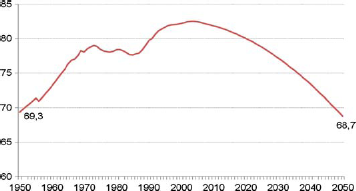
Population change in Germany, 1950-2050 (millions).
Demographic ageing
Despite the projected population decline, Germany's dominant trend will be demographic ageing. Demographic ageing happens when the number and share of the elderly increase. Ageing is grounded in Germany's demographic history. When fertility began to decline 100 years ago, one consequence was that the share of younger age groups began to shrink. This was the beginning of ageing ‘from the bottom’. When they become parents, these cohorts have a reduced total number of births even when their fertility level remains the same. Since fertility remains at a low level, mortality becomes more and more important for ageing. Elderly people survive longer every year, and thus their numbers are increasing steadily: this is the ageing ‘from above’. Immigration cannot significantly rejuvenate the composition of the population–-unless it is highly selective, as in the case of the East-West migration in Germany. Mai and Scharein [9] calculated that migration intensified East Germany's ageing by one-third. The fourth factor in ageing is current age composition. Since demographic processes never proceed constantly, they lead to an irregular age composition over the long term. Thus the age composition can either intensify ageing (as in Germany since World War II) or mitigate it. In any case, the ageing process cannot be reversed and its medium-term progress will be relatively constant. Even a strong increase in fertility will have no impact for many decades; immigration has similarly little impact (at least on a national level).
Germany's population has been ageing for many decades, but the highest rate will be reached within the next 20 years, with a shift from younger to older age groups (Fig. 2). Until 2050, only age groups above age 60 will grow significantly, while younger ones will decrease in size. Whereas the share of younger persons below age 20 was 43% in 1871, it decreased to 20% in 2006 and will decrease further to 15% in 2050. The share of people aged 60 and above rose from 0.4% in 1871 to 25% in 2006. By 2050, it is likely that 40% of the population will be older than 60. This would be a fivefold increase. Future ageing in Germany will be dominated especially by the increasing number of the oldest old (above age 80). This is important not least because these age groups are the main recipients of long-term care. In 1871 there were very few oldest-old people in Germany. By 2006, their share had risen to 5% and will triple by 2050. At that time, their share will be the same as that of the younger age group, those below 20. Moreover, the oldest old are the age group that will increase most in size until 2050; in that year, they will number more than 10 million (from 3.8 million in 2006). Although males are steadily catching up, in 2050 there will still be more elderly females because of their higher life expectancy. In 2050, there will be 95 males per 100 females in the age group 60-70, but only 70 males in the age group 85-90 and a mere 57 males per 100 females in the age group above 90.
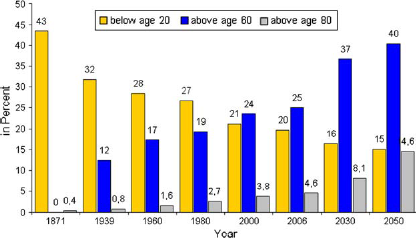
Share of age groups below 20, above 60 and above 80 (1871-2050, by %).
Social and economic implications
Past demographic changes led to strong shifts in age composition, a process that will continue in the future. Shrinking age cohorts on one hand and the above-average number of baby boomers on the other will destabilise the age composition. These structural imbalances, implying an enormously increasing number of elderly people, represent the actual risk involved in demographic ageing. The declining population is alarming as well. However, these matters on a regional rather than on a national level (see below).
Demographic change in Germany will be relatively constant in the short term. However, the way to cope with its challenges can be strongly influenced. The impact of demographic change affects almost every social and political sector. Direct countermeasures aim mainly to quantitatively influence population development. One way is to establish a family friendly policy that encourages young couples to have more children. Constraints that make it difficult for women and men to find a balance between work and family life have to be reduced. Second, population development can be changed by migration. Immigration to Germany could be better managed, but German society will need to deal better with the increasing demands of integration. It is difficult, however, to control the extent and structure of immigration in a favourable way. Large-scale demographic change cannot be reversed within a short time span through higher immigration or fertility, but it can be reduced using these demographic instruments.
Indirect responses seem to have more promise for coping with the demographic challenges, at least in the short term. These aim to adjust public policies in several ways to take demographic change into account, and to prepare society for demographic change. The challenges are met qualitatively–-only a mixture of different measures seems to be successful. Still, many social and political aims are connected to demographic development. It is crucial to ease this relation in the future. What, then, are the main consequences and how can society react to them adequately?
State level and economy
The social security system will suffer from a decline in contributors while the number of recipients and public expenditure will rise. This relationship is steadily shifting and at some point sustainability will be threatened. The federal pension insurance scheme is facing big challenges, and new types of investments at the private level will replace it in part. The same applies to the health insurance system. An even greater challenge is the increase in the number of persons requiring long-term care and the rising need for both stationary and ambulatory services, whereas the family care available will potentially decrease. These growing imbalances in social security pose the question of intergenerational justice. Private intergenerational transfers could partly counterbalance these social disparities, but they themselves are distributed unevenly and thus could amplify the imbalances.
One of the most immediate problems will manifest itself in the economy and labour market. The labour force is shrinking and ageing. It will be crucial to restructure the personnel policies and organisation of corporations and bring them in line with the ageing workforce. The problem of labour force shortages will become more important. One way to compensate for the ageing workforce is the immigration of skilled employees. It is crucial to extend employment of women and to lengthen the average active working life through earlier entry into the labour market as well as through reducing incentives for early retirement. Other ways include campaigns for better education and the retraining and reintegration of the elderly into the labour market.
Demographic change will also threaten economic growth factors such as capital stock and technical progress, because the most innovative age groups will decrease in size. It is not clear to what extent augmentation of productivity can compensate. In Germany, knowledge and human capital are the most important economic resources and, therefore, the training and productivity of elderly employees is a crucial factor in coping with the change. On the other hand, age composition is just one growth factor. Moreover, the elderly are also potential consumers and target groups for marketing. The need for age-related commodities, apartments and houses or social and care services will certainly rise.
Societal level
On a societal level, the population will become more and more heterogeneous because of steady immigration and a growing number of resident inhabitants with a migrational background. Social structure is altered by the reduction of social networks and relationships. Life courses become more individual, new forms of living together evolve. These trends do not have a direct impact on demographic change but are by-products of it and partially determine its consequences. On the individual level, demographic change offers new possibilities of interaction and exchange between generations. It will be more likely that several generations will live together concurrently. However, future generations will not be able to cope with their familial tasks to the same extent that they do today. As a consequence, assistance within the family will decline since it depends on spatial proximity. The importance of non-familial networks will rise and partly mitigate the impact of demographic change; however, elderly people especially could suffer in the future from the lack of assistance.
But ageing also brings opportunities for society. Elderly people still have the potential to lead an autonomous lifestyle (social relationships, mobility, employment, education), to contribute to social networks and transfers and to be socially and politically engaged. An important factor in autonomous ageing is health. It can be assumed, however, that the future elderly will have better opportunities for leading an independent life.
Regional level
Demographic change manifests in distinct spatial patterns. On the regional level, ageing is a universal trend with slight regional differences. In contrast, there are larger East-West disparities in population decline, with increasing and decreasing regional populations. These disparities will become larger in the future. Regions with significant population decline (and also more rapid ageing) face severe socio-economic problems. Certain challenges, therefore, of demographic change can be handled only on the regional level. Demographic change has to be a crucial element of a sustainable regional policy, since ageing and population decline can inhibit the growth prospects of a region.
First, demographic change will affect communal earnings because a decrease in population normally means a decrease in tax revenues. However, projecting the actual extent to which communities will be affected is difficult, because the federal budgetary system is complex and includes many determinants. It is essential that this loss of revenue be compensated for by a reduction of costs. It can be assumed that especially peripheral and economically underdeveloped regions are concerned about rising costs and decreasing revenues.
Second, the supply of infrastructure (from the communal expenditures) plays a key role. Material and social infrastructure represents the state's basic provision for its inhabitants. In order to calculate the (current and future) number of consumers, knowledge of population development is the main factor. Likewise important is the age composition of the population, because many facilities are linked to consumers of a certain age group. The adaptation of the infrastructure to a decrease (or increase) in consumers and utilisation is barely self-financing and will, therefore, be the main problem. The main areas of communal adaptation will be mobility (the adaptation of public transport and infrastructure to the needs of the elderly, alternatives in low-density regions), network-bound infrastructure (energy, water and sewage, heat supply), educational facilities (universities, schools, kindergartens), services for the elderly (especially the long-term care sector), the housing market (e.g., the 14.6% vacancy rate in Eastern Germany), cultural and leisure facilities and health care (hospitals, the supply of ambulatory care in low-density regions). Such facilities cannot just be shut down if a certain lower limit is reached, because, besides their actual purpose, they fulfil important functions in regional development and improving the quality of life in a given location. However, particularly rapidly depopulating regions located peripherally will probably not be able to sustain a sufficient supply of infrastructure.
In order to assist these regions and to steer regional adaptation in general, several policy programmes have been implemented. In the course of the Stadtumbau Ost programme, 193,000 flats were torn down in East Germany by 2006 [5]. In addition, cities will have to cope with many problems. The term ‘perforated city’ [4] indicates that regional demographic change shows differences even on this level. There are neighbourhoods where the population is increasing and those where it is decreasing. The term refers also to the holes in a city's structure that evolve due to deconstruction and abridgement. Another challenge is the growing heterogeneity of the population of (big) cities. Their social diversity will increase. In combination with social segregation, this means growing pressure to adapt. Either cities continue to shrink, or they have to shoulder increasing integration tasks.
Outlook: threat or opportunity?
In general, the notion of demographic change should be more differentiated. It is crucial for politics and planning where and to what extent future ageing and shrinking will occur. At any rate, it should be kept in mind that demographic change is in part the consequence of a remarkable achievement of civilisation: the increase in life expectancy. The degree of negative impacts depends primarily on the way society and politics react to the change.
But change is also an opportunity–-an opportunity for societal advancement and readjustment. The abilities and potential of the elderly are greater than realised, as well as the possibility of intergenerational relationships. But this requires that the elderly be enabled to maintain their autonomy and competencies as long as possible (‘active ageing’; [1]). Society and the economy have to move beyond traditional and inflexible ideas about the phases of life and ageing. On a regional level there are opportunities to advance as well: regions can gain more open space for recreation and leisure, cities could become more family friendly, and the quality of life and housing could increase. But the precondition is a paradigm shift away from growth.
The preceding discussion should not conceal the fact that a sustainable population depends on children, no matter how successful adaptation policies are. But, if there are changes at both ends of age composition, the adaptation to demographic change should not be a problem.
Footnotes