




Abstract
Rural agriculture uses more than one-third of the earth's land and employs more than 40% of the population, a figure that approaches 75% in developing countries. As a result, rural demographic change is of vital importance. This article monitors four driving factors in rural demographic change including the ratio of youth to the aged, the ratio of males to female, fertility levels and migration. Alongside conclusive findings, the authors bring to light the relevance of AIDS-related deaths, urbanisation, and city planning in demographic research.
Introduction
According to available estimates, during the period from 1950 to 2005 the rural population of less-developed countries increased from 1.4 billion to 3 billion [11], thus more than doubling in number. This demographic shift has had profound effects on rural-development efforts and achievements. In some cases, rural population growth played a positive role: it stimulated technological progress, allowed economies of scale in production and infrastructure and thus opened the way to rural economic growth, which in turn has lead to declines in mortality and fertility levels in accordance with the familiar concept of demographic transition. But in some other instances, rural population growth has contributed to rural stagnation or even impoverishment, leading to declines in per-capita incomes, environmental degradation, emigration under distress of able-bodied adults to urban centres and the breakdown of traditional models of social and economic behaviour that developed in the former demographic regime but proved to be unsuited to the new conditions.
Demographers, economists, development specialists and other experts have spent much time and effort studying how rural development is being shaped by demographic change–- and, vice versa, how evolving rural demographic realities influence patterns of farming, trends in poverty and food security and the success of rural-development interventions. Much remains to be done to fully understand these interactions. Nonetheless, a successful development policy cannot ignore the underlying demographic dynamics.
Despite the popular perception that the globalised modern world is predominantly urban, approximately one-third of our planet's land surface is used for agriculture, which employs more than 40% of the global workforce. In less developed countries, the vast majority–-often 75% or more–-of inhabitants continue to live in rural areas where agriculture is the main source of livelihood. It follows that the task of monitoring, analysing and interpreting rural population change remains a highly relevant one. At present, 47% of the global population are people living in rural areas of developing countries. These rural inhabitants ‘matter’, despite the increasing integration of local farming systems into global spheres of influence through migration and trade. Moreover, rural communities in developing countries are home to some of the most disadvantaged and marginalised people in today's world: the landless, the chronically poor, women who are heads of households, people affected by chronic diseases such as HIV/AIDS, tuberculosis or malaria, disadvantaged youth, the elderly and persons with disabilities. Thus, what happens demographically in rural settings in Latin America, Asia and Africa has far-reaching implications for initiatives aimed at reducing poverty, improving production and distribution of food and agricultural products, and achieving a better quality of life for all human beings.
This article provides a broad overview of rural demographic trends within the main regions of the developing world, looking at underlying driving forces as well as possible future scenarios. It pays particular attention to demographic dependency ratios; to the issue of the ‘feminisation’ of rural populations; as well as to age-related structural changes such as rural population ageing. Furthermore, the article seeks to explore how population mobility from and to rural areas affects rural communities, agrarian outcomes, growth of urban areas and international migration patterns.
The different characteristics of rural and urban populations
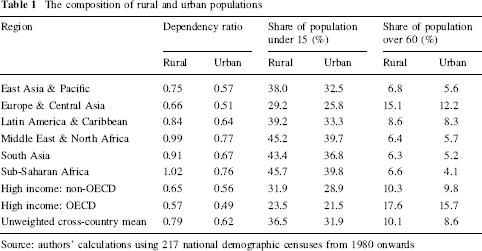
Rural populations do not follow the same dynamics as urban populations because usually the underlying demographic determinants are different between these population groups. The first big difference is fertility rates, which tend to be considerably higher in rural areas. The preferred indicator of fertility, the total fertility rate (TFR), is rarely calculated separately for urban and rural populations. When it is, as in the case of Latin America [4], it has been shown that on average rural women have two children more than urban women during their fertile lifetime (age 15–-49). Another indicator more readily available, such as the crude birth rate, also shows that the number of births per 1,000 persons is higher in rural areas. Table 1 shows indirect evidence of the higher fertility rates in rural areas: the proportion of children (0-15 years old) in the total population is on average higher in the rural areas of every developing and developed region. Several causal factors explain these observed global differences. In some cases nuptiality at earlier ages in rural areas plays an important role, but, in general, health services, including reproductive health services, are less accessible in rural areas; and education levels, which have consistently been found to be negatively correlated with fertility [8] tend to be lower in rural areas. Another important factor is the preference of rural families for more children as a source of security in old age and a source of family labour.
The composition of rural and urban populations
Source: authors’ calculations using 217 national demographic censuses from 1980 onwards
The other big difference between urban and rural populations is, surprisingly, the higher proportion of older people in the latter regions. As Table 1 shows, in all developing and developed regions the proportion of older people is lower among urban populations. This study delves further into the issue of ageing below, noting that this is actually an unexpected finding because lower life expectancy is to be expected in rural areas. Data on the differences in life expectancy for rural and urban populations is generally not available, but lower life expectancies should be more common in rural areas due to lower access to health services and, in many cases, more risky and physically demanding lifestyles. 1
Although estimates of life expectancy that distinguish urban and rural populations are rare, estimates of child mortality, an important component of life expectancy, abound for rural and urban areas. It is almost always the case that child mortality is higher in rural areas.
As a result of the higher share of both children and older adults in rural populations, these tend to have higher dependency ratios. The dependency ratio measures the number of dependent individuals (i.e., those younger than 15 and older than 64) for every working age adult. It is a demographic indicator of great economic significance. In many economic studies it has been shown that the dependency ratio is an important determinant of poverty. 2 That is, the demographic differences alone explain part of the observed disparities between urban and usually higher rural poverty. Conversely, it has been shown that a greater share of working age population is correlated with faster economic growth [3]. As countries move along the demographic transition they first experience increasing dependency ratios and, later, a falling dependency ratio. Sub-Saharan Africa, which is the region that lags in demographic transition, is, as a whole, experiencing falling dependency ratios, which could promote economic development as they enter a phase of ‘demographic bonus’, defined by a growing share of working-age adults. In spite of this, rural populations, due mainly to the emigration of working-age adults, lag behind in the size of the ‘demographic bonus’ as well.
See López and Váldes [6], for example, and references found therein.
Feminisation
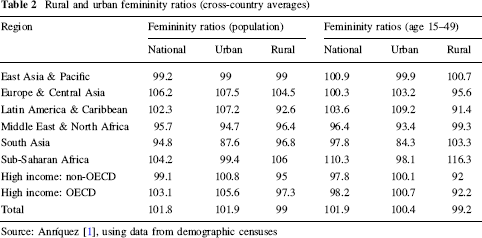
The gender composition of rural populations has been the focus of some concern, particularly in light of the fact that a steep decline in the availability of male able-bodied adults could act as a hindrance to agricultural and rural development. This concern has increased in the wake of the AIDS pandemic–-anecdotal evidence highlights the household costs of losing the male head of the household to the disease. In spite of these worries, there is no single trend in rural populations’ gender bias. Table 2 shows that in Latin America, Central Asia, Europe and the developed world; urban femininity ratios (number of women for every 100 men) are higher, while in Africa, the Middle East and South Asia, rural femininity ratios are higher. We also observe that on average only in sub-Saharan Africa and Europe/Central Asia are there more females than males in rural areas.
Rural and urban femininity ratios (cross-country averages)
Source: Anriquez [1], using data from demographic censuses
A limitation of the femininity ratio is that it is not an age-neutral indicator. Male mortality throughout the lifespan is generally higher than female mortality, which explains the larger numbers of women than men in older cohorts. To minimise this age bias, one must look specifically at the prime adult-age cohort (15-49 years). In the last column of Table 2 we observe that in rural Europe/Central Asia there are more males than females of prime age. This suggests that in this region, the overall high femininity ratios exist due to older population cohorts. There are slightly more prime-age females than males in rural areas of East Asia and South Asia, but proportionally many more females than males in rural areas of sub-Saharan Africa.
Unfortunately, not much is known about the role of AIDS-caused gender bias in the composition of the rural population in sub-Saharan Africa. Given the still inadequate vital-statistics systems in the region, and more pronouncedly so in rural areas, it is not known if AIDS mortality is hitting males or females harder. The scattered evidence using indirect methods (mostly by comparing ex-post and ex-ante enumerations) suggests that as the epidemic progresses, the gap between male and female mortality is reduced; that is, female mortality levels increase proportionally [7]. Similarly, if the experience of the US, where the changes in HIV-related mortality patterns have been properly documented, can be extrapolated, at the initial stages of the epidemic male mortality increases more noticeably, while later it is female mortality that shows a greater spike. In conclusion, the preliminary and incomplete evidence suggests that AIDS is contributing to reduce the gender bias in rural areas of sub-Saharan Africa, not to increase it.
Thus, most probably, the main cause for the gender bias among rural sub-Saharan populations is the predominance of men among emigrants from rural areas. In Latin America, which lies at the opposite extreme with the lowest rural prime-age adult femininity ratio, the fact that most rural emigrants are and were females, leaving the males behind to tend the agricultural operations, has been amply documented (see, for example, [4]).
Rural population ageing
Population ageing–-the increase in the proportion of ‘older people’, conventionally defined as those aged 60 years and over–-is happening across the globe. Although the process of ageing is advancing at a faster pace in developed countries, it is in developing countries where the most striking differences between urban and rural ageing are found. The ageing process is the outcome of several factors, including declining fertility levels and advances in medicine, nutrition and technology. It represents a major societal achievement, but also a challenge that will affect all aspects of twenty-first-century society.
Population ageing is usually measured by country indicators. However, it is often the case that population ageing proceeds at a markedly unequal pace in different parts of a country. Consequently, ageing-related issues are more urgent in some areas–-and socioeconomic categories–-than in others. Due to historical and socio-economic differences between urban and rural settings, rural/urban differentials in population ageing are often significant. Both fertility and mortality tend to be lower in urban areas, as the demographic transition–-that is, the shift from high to low levels of these two variables–-usually starts sooner in urban settings. In the absence of other influences on the age structure, therefore, ageing should be generally more advanced in urban areas. In reality, however, urban populations are not necessarily more aged than rural ones. The reason lies in another factor, namely rural-to-urban migration. This migration is usually age selective and comprises mostly young adults who migrate to cities to seek urban employment (and often to escape rural poverty, too). As a result, the populations left behind in the countryside usually have a higher proportion of older people and their age structures can be greatly skewed towards an ‘aged’ pattern.
The fact that rural areas tend to have older populations than urban settings can be illustrated by data from population censuses taken in 1985-1996 [9]. Of the 67 developing countries for which appropriate data (specified by age and urban/rural residence) is readily available, in 53 cases the proportion of elderly in rural areas was greater than the corresponding figure for cities, and in 10 countries (mostly in sub-Saharan Africa) the proportion of elderly in rural areas was at least twice as high as that in urban areas. In other words, although a situation of higher levels of ageing in the rural sector is not universal, it nevertheless typifies a vast majority of developing countries, including some of the most populous ones. A similar picture emerges from more recent data for African countries, as shown in Fig. 1.
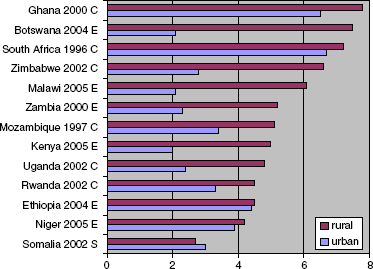
Percentage of population aged 60+ by rural/urban residence: selected African countries
What is known about the implications of rural population ageing for agriculture and rural development? The short answer is, not much, because little research has been done so far to assess the consequences of ageing in the context of agriculture. Nevertheless, studies and projects conducted by the Food and Agriculture Organisation of the United Nations in various rural settings reveal that rural ageing places an enormous burden on scarce household resources and community services. Older persons in rural areas are often in poor health after a life of hard physical labour and frequently suffer from high levels of stress and uncertainty about their future. Older rural residents are particularly vulnerable to poverty and malnutrition as they are often incapable of making independent use of productive resources such as land and water. They tend to be dependent on their families and/or neighbours, particularly when they have no savings, income, pension or access to remittances. In many countries, the emigration of young adults and the high rates of AIDS-related mortality among younger adults have altered the demographic structure of rural households and communities. Growing numbers of older persons are acting as heads of households, farm managers and guardians of young children–-all during a stage of their lives when they need to be receiving care themselves.
In rural communities short of young workers, older residents must look after crops and livestock. In many cases, they are unable to farm effectively on their own, and have no possibility of hiring labour or using animal power or mechanised equipment. Older persons often have relatively little formal education and are frequently discriminated against in areas to which they require access: rural credit facilities, agricultural extension services and supplies such as modern farm implements and improved seeds and fertilisers. Older women and ageing widows are often denied access to agricultural land, with negative consequences for their economic and social well-being. Factors such as these can reduce the agricultural productivity of an area, leading to higher overall levels of poverty and malnutrition.
The ageing of rural populations creates new challenges, but also numerous opportunities for innovative adaptations. For instance, many older rural residents have extensive knowledge and experience and can serve as invaluable sources of information about traditional agricultural practices, indigenous approaches to healing and health maintenance and coping with various challenges in food production and resource conservation. Their intergenerational role is crucially important, particularly when they are charged with caring for and guiding young people whose parents have moved to cities or have died prematurely. Since rural population ageing–-and the aspects and effects of this process–-will continue in most developing countries in the foreseeable future, agricultural and rural development will be increasingly dependent on the contributions made by older persons. Policy-makers must find ways to ensure that older rural women and men live free from economic hardship and are able to lead healthy, productive lives.
Emigration from rural areas
As shown above, one of the main driving forces of rural population dynamics is the emigration of working-age adults. Headlines in the developing world usually capture international migrants–-their perceived threat to the social welfare of the developed world or their promise as agents of development in their homelands. However, international migrants represent a miniscule fraction of the migratory movements in the developing world. The bulk of rural migrants in the developing world are, instead, moving into urban areas. Take, for example, Mexico, the country with one of the largest levels of documented international migration: between 1995 and 2000 only 5 to 9% of the total number of Mexican migrants were international migrants. 3 It follows that for most countries in the developing world, international migration represents 1% or less of total migration in each country.
INEGI [5]. The estimates depend on who is considered a domestic migrant; the first number counts those who changed municipality, while the second only those who changed their province of residence.
Most of these domestic migrants are rural-to-urban migrants. The speed at which this movement is happening varies considerably by developing regions. In Latin America, where most urbanisation rates lie between 70 and 90%, the massive process of rural-to-urban migration was named the ‘rural exodus’ and occurred in most of the region, depending on the country, during the 1940s to 1990s. In China and India, the evidence indicates that this process is happening now, even though in China emigration to towns is controlled by the state. In most of sub-Saharan Africa, the process on the scale previously described has yet to take place, and in some countries, notably Zambia, a reverse urban-to-rural migration has been documented, following a steep economic downturn. Bezemer and Hazell [2] provide rough estimates of the scale of the rural-urban migration phenomenon by looking at the projected share of employment in agriculture by developing region. In their projections to 2015 they find that in China alone 50 to 70 million jobs will migrate to the cities between 2000 and 2015. Most of the migration away from agriculture will occur in Asia, while in sub-Saharan Africa agriculture is still expected to provide six out of every ten jobs in 2015.
Lessons can be learnt from the experience of countries that are going through, or have experienced the ‘rural exodus’. In China, after the reforms of 1978, some of the restrictions on population mobility were relaxed to accommodate the growing demand for unskilled labour in booming towns and cities. What followed were accelerated rural-urban migration and the massive growth of urban areas. Since the 1970s millions have moved into China's cities, providing labour to fuel the country's fast industrial growth. The rural population declined from 73% in 1990 to 64% in 2000 and 58% in 2007 [11]. In recent years, there has also been a wave of non-permanent rural-urban migrations, the so-called floating population–-a result of China's strict household registration system (under which most rural migrants are not allowed to be registered as urban dwellers), but also an outcome of migrant household strategies [12]. The Chinese experience provides a telling example that even under a political regime that tries to maintain restrictions on spatial mobility, rural emigration and city growth cannot be controlled.
Latin America provides a different example. In most countries of the region, only one major city serves as a destination of the rural exodus. This process caused a massive displacement of poverty into city slums; the chaotic expansion of that city, resulting in a third or more of the national population living in one major city (‘high urban primacy’, as geographers call it). This process was partially the result of colonial development and partially resulted from a lack of government vision, which tended to concentrate public investments in the major city, leaving the regions and rural areas behind. This brief overview of the urbanisation process in Latin America highlights the importance of promoting the development of secondary cities and medium-sized towns.
Conclusions
The demographic processes described in this article highlight some of the challenges and opportunities that will manifest themselves in the coming decades. Most of Asia will have to deal with massive internal population movements as many rural inhabitants leave their homes in search of urban jobs and lifestyles. The question is whether this will lead to increased megalopolisation and higher levels of urban primacy, or to a more balanced geographic distribution of human resources. The outcome is likely to depend on policies that promote incentives and create economic opportunities for migrants, rather than impose constraints on spatial mobility.
Sub-Saharan Africa will enter a period of demographic growth, as it moves through the second stage and later into the third stage of its demographic transition. This offers the subcontinent an important window of opportunity for development, as the share of working-age adults will increase. However, in contrast to the historical experiences of Europe and Latin America, sub-Saharan Africa will undergo its demographic transition with substantially lower levels of capital, poorer infrastructure and overall lower levels of human capital accumulation. The challenge for Africa will be to provide its growing working-age population with adequate social services and economic opportunities.
Population ageing will certainly be a major demographic trend in the developed world; however, even in the developing regions, ageing will present important opportunities and challenges, particularly in Latin America, which has the oldest population among developing regions. Unfortunately, very few developing countries have adequate institutional capacity and policies to deal effectively with ageing-related issues. While population ageing needs to be addressed at multiple levels, in many countries the situation of the rural elderly is particularly urgent. Policies that eliminate discrimination against the elderly and promote their inclusion as productive members of the society will be of great consequence for the well-being of rural populations in developing countries.
Footnotes