




Abstract
In one of Philipp Jakob Sachs von Lewenhaimb's (1627–1672) books, one may find perhaps the first illustration of a child with the split hand/split foot malformation. A short historical note and some clinical genetic data are given.
Keywords
Garrison [1] called the 17th century “the age of individual scientific endeavor.” That was the age of Shakespeare, Milton, Velasquez, Rembrandt, Bach, Purcell, Cervantes, Moliere, Newton, Leibnitz, Bacon, Descartes, Spinoza and Locke. England, Holland and Italy contributed mostly to the advancement of medicine, i.e. Harvey, Leeuwenhoek, Malpighi, Redi, Sylvius, Willis and Sydenham.
Germany was torn and destroyed during the Thirty Years’ War (1618–1648). The war was fought primarily in Germany and, at various points, involved most of the European countries.
The results of the war were devastating: it is estimated that the reduction of the population in the German states was about 15–30% due to famine and infectious diseases. Castles, towns and villages were totally destroyed.
But, in spite of this background, “on the 1st January 1652, four physicians founded the Academia Naturae Curiosorum in the Free Imperial City of Schweinfurt. The Academy Statutes, which were first printed in Latin in 1662, comprise 18 articles. The purpose of the Academia is presented in a preamble: The glory of God, the enlightenment of the art of healing and the benefit resulting from this for our fellow men be the goal and the only guide of the Academy of Sciences” [2].
One of the founding members, Philipp Jakob Sachs von Lewenhaimb (1627–1672), published the first complete monograph which paved the way to the founding of the Ephemeriden, the world's first medico-scientific journal, in 1670. The journal was dedicated to Emperor Leopold I (1640–1705), who “guided the fortunes of the Holy Empire of German Nations for more than 40 years. He was well-known for his lively interest in the arts and sciences of his era.” In 1677, the emperor recognized the importance of the journal and the academy, and awarded the academy the title of “Sacri Romani Imperii Academia Naturae Curiosorum” (the Leopoldina).
Philipp Jakob Sachs, of Breslau, was a German physician, naturalist and, later, editor of Ephemerides Academiae Naturae Curiosorum, the first ever learned journal in the field of medicine and natural history.
In one of his books [3, 4], we can find an illustration of a child with the “split hand–split foot malformation (lobster claw), with normal right hand, left hand polydactyly, short middle metacarpal and split-feet.”
Perhaps the child also had some degree of abnormal abduction of the hip joints, short arms and a short neck (Fig. 1) [4].
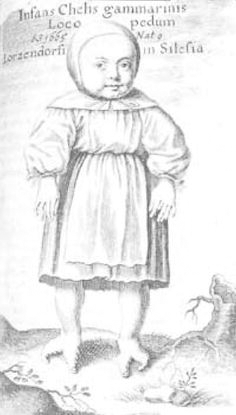
Child with deformed feet from Ref. [4]
Ectrodactyly [5] (lobster claw syndrome or Karsch–Neugebauer syndrome) is a rare congenital absence deformity of the limbs primarily involving the middle rays of the hands and feet. This split gives the hands/feet the appearance of lobster claws. Split hand/split foot syndrome is genetically heterogeneous and can be caused by mutations in several genes [6, 7]. Association with mental retardation, facial clefts, ectodermal dysplasia and other anomalies were reported [8]. Three variants with long-bone deficiency were defined on the basis of genetic linkage studies and a two-gene model has been proposed by Naveed et al. [9]. The associated polydactyly seen in the picture may suggest a specific subtype reported by van Regemorter et al. in 1982 [10].
Autosomal dominant inheritance with irregular penetrance is common to most types, nevertheless, autosomal recessive and cross-linked variants were also suggested [8].
Finally, in the picture, we can see a broken tree, many years prior to Nicholas Andre's illustration…