






Abstract
During adolescence and young adulthood, individuals show personality changes and experience various life transitions. Whereas personality might affect the timing of life transitions, life transitions might also induce personality maturation. We examined Big Five personality maturation from age 12 to 25 using a 9–year longitudinal study of Dutch youths from two cohorts (
Keywords
Introduction
During adolescence and young adulthood, youth learn more about who they are and develop a more mature personality (Erikson, 1974; Klimstra, Hale, Raaijmakers, Branje, & Meeus, 2009; Roberts, Walton, & Viechtbauer, 2006). A ‘more mature personality’ can be operationalized as increases in the mean levels and stability of the Big Five traits (Caspi, Roberts, & Shiner, 2005; Klimstra et al., 2009; Specht et al., 2014). Within the same period, youth experience life transitions such as initiating romantic relationships, attending college or university, leaving the parental home, and starting a job after finishing their education. These transitions may stimulate personality maturation (Bleidorn, Hopwood, & Lucas, 2018; Roberts & Mroczek, 2008; Roberts, Wood, & Smith, 2005), although their impact might vary in terms of which particular personality traits relate to specific transitions (Bleidorn et al., 2018). Furthermore, personality traits might also predict whether and when individuals experience particular transitions (e.g. Denissen, Asendorpf, & Van Aken, 2008; Van Scheppingen et al., 2016).
Until now, only a few studies have longitudinally examined the development of personality across the entire period of adolescence and young adulthood. Therefore, our study investigated personality development between the ages of 12 to 25, using data of two overlapping cohorts that were collected over six waves, covering a period of 9 years. Furthermore, we related personality development over this timespan to the incidence and timing of four salient life transitions that are relevant for the age range that we studied (Arnett, 2000; Lüdtke, Roberts, Trautwein, & Nagy, 2011; Roberts et al., 2006): starting a first romantic relationship, leaving the parental home, having a first job after finishing full–time education, and cohabiting or marrying.
Personality Development
Big Five traits
We examined personality as comprising five broad traits, also called the Big Five (Caspi et al., 2005; McCrae & Costa, 1987).
Research has consistently shown that personality is stable, but also changeable (Roberts, Wood, & Caspi, 2008). Stability and change can occur at the same time and have different forms (Roberts et al., 2006). Personality maturation is indicated by normative increases in the mean levels of the Big Five traits (Caspi et al., 2005; Specht et al., 2014) but also by increases in stability (Klimstra et al., 2009). In this study, we examined mean–level changes and changes in two stability measures: rank–order stability and profile stability.
Personality maturation in adolescence and young adulthood
Longitudinal studies have found systematic evidence for mean–level increases in Big Five traits in adolescence and young adulthood, although results are mixed both in terms of which traits develop the most and the exact period of development. A meta–analysis from age 10 to older than 70 showed increases in Extraversion, Emotional Stability, and Openness to Experience during adolescence, yet showed strongest mean–level increases during young adulthood, specifically in Conscientiousness, Emotional Stability, Social Dominance (a facet of Extraversion), and Openness to Experience (Roberts et al., 2006). In subsequently published studies conducted with adolescents, increases in mean levels of Agreeableness, Conscientiousness, and Openness to Experience appeared most consistently (Borghuis et al., 2017; Branje, Van Lieshout, & Gerris, 2007; Soto, 2016), while increases in Extraversion (Branje et al., 2007) and Emotional Stability (Klimstra et al., 2009) were only found in some studies. Additionally, U–shaped patterns were found for Conscientiousness and Openness, with mean–level decreases in early adolescence and increases in late adolescence (Denissen, Van Aken, Penke, & Wood, 2013). Mean–level increases during young adulthood have been found for all the Big Five traits: Agreeableness and Conscientiousness (Borghuis et al., 2017; Lüdtke et al., 2011; Neyer & Lehnart, 2007; Vaidya, Grey, Haig, Mroczek, & Watson, 2008), Emotional Stability (Lüdtke et al., 2011; Neyer & Lehnart, 2007; Vaidya et al., 2008), Openness (Vaidya et al., 2008), and Extraversion (Vaidya et al., 2008). Overall, increases in all Big Five traits have been found in studies among adolescents or young adults, although the exact period of development differs across studies.
Clear increases were also found in rank–order stabilities, from early to late adolescence (Klimstra et al., 2009), but also thereafter (Lüdtke et al., 2011), until age 30 and older (Roberts & DelVecchio, 2000; Specht et al., 2011). Profile stability also increased from early to late adolescence (Klimstra et al., 2009) and was mostly positive and high from age 18 to 26 (Roberts, Caspi, & Moffitt, 2001). In sum, there is clear evidence for personality maturation from adolescence into young adulthood in terms of mean–level changes, rank–order stability, and profile stability.
The first goal of this study was to replicate and extend these findings on personality maturation, in terms of both mean–level development and stability, with two cohorts that were both followed for a period of 9 years. This study utilizes an extension of the data set used by Klimstra et al. (2009), who examined personality development across the first 5 years out of the 9 years included in the current study. Klimstra et al. found increasing mean levels of Agreeableness and Emotional Stability during adolescence and some evidence for increases in Extraversion and Openness from early to middle adolescence. No increases in Conscientiousness were observed. Also, interindividual differences and personality profiles became increasingly stable across adolescence. Klimstra et al. followed the younger cohort from ages 12 to 16 and the older cohort from ages 16 to 20, thereby covering development of the Big Five traits from age 12 to 20. The current study examined the younger cohort from ages 12 to 21 and the older cohort from ages 16 to 25, thus covering the ages 12 to 25 (i.e. an additional 5 years). This extension of data with an additional 5 years allowed us to replicate Klimstra et al.'s older cohort findings for ages 16 to 20 with our younger cohort and to extend their findings with our older cohort from ages 20 to 25. By checking robustness of findings across cohorts, we believe our findings will be more informative and persuasive (Duncan, Engel, Claessens, & Dowsett, 2014). This current study also importantly adds to the study of Klimstra and colleagues, as well as other earlier work, by examining the links of the mean levels and changes and profile stabilities of the Big Five traits with the incidence and timing of life transitions.
Personality and Life Transitions
Trait–to–transition effects
Two important theoretical perspectives have linked personality to life transitions. The Five Factor Theory (FFT) mainly suggests predictive effects of personality traits on the incidence and timing of life transitions or
Several studies have found support for predictive effects of personality on one's living situation, relationship formation, and school–to–work transitions. Adolescents and young adults with a more mature personality type (resilient: relatively high scores on all the Big Five traits) generally took on adult roles earlier than those with a less mature personality typology. For example, resilient adolescents had a first intimate relationship at an earlier age than overcontrolling adolescents who are relatively low on Extraversion and Emotional Stability (Meeus, Van de Schoot, Klimstra, & Branje, 2011). Furthermore, late adolescents and young adults who had a more mature personality in early childhood took on adult social roles such as leaving their parental home, starting a first relationship, and getting a part–time job at an earlier age than undercontrolling (relatively low on Conscientiousness and Agreeableness) or overcontrolling individuals (Denissen et al., 2008). When looking at the specific Big Five traits, higher Openness predicted leaving the parental home, while higher Emotional Stability, and lower Agreeableness and Conscientiousness, increased the chances of young adults’ cohabitation compared with living with one's parents or with roommates (Jonkmann, Thoemmes, Lüdtke, & Trautwein, 2014). Other research, however, has found that none of the Big Five traits predicted leaving the parental home and that only higher levels of Extraversion predicted cohabitation (Specht et al., 2011). In addition, personality traits were not predictive for whether someone would get married, except for lower Emotional Stability in women (Specht et al., 2011). Furthermore, attending college, in contrast to starting vocational training or a job, was predicted by higher Emotional Stability and Openness, and not by the other traits (Lüdtke et al., 2011). Finally, those starting their first job in the period of study were initially less conscientious than other participants, while they did not differ on the other traits (Specht et al., 2011).
In sum, trait–to–transition effects were found for all life transitions, most consistently for personal relationships and for Emotional Stability. To the best of our knowledge, no study has yet examined profile stability of personality traits as predictor of life transitions. As previous studies focused predominantly on specific transitions in limited time periods or even cross–sectionally, and did not examine profile stability of personality in relation to life transitions, more knowledge is needed about the relative effect of personality on different transitions across an extended period of time.
Transition–to–trait effects
In contrast to the FFT, the social investment perspective emphasizes
People higher in Agreeableness, Conscientiousness, Emotional Stability, and social dominance might be more likely to engage in social investment. Having a certain personality may thus select people into life transitions, and in turn, these same personality traits might be deepened by experiencing those life transitions. This principle is referred to as the corresponsive principle of personality development (Caspi et al., 2005; Roberts et al., 2008) and describes how individuals develop a more stable personality and thus increase in their profile stabilities of personality traits.
Trait–to–transition and transition–to–trait effects are also explained by the cumulative continuity principle. According to this principle, niche building processes contribute to the stabilization of personality in that people create, seek out, and end up in environments related to their personality traits (Caspi et al., 2005). These environments subsequently promote trait–related behaviour and reinforce existing traits. The cumulative continuity principle also emphasizes the role of developing, committing to, and maintaining an identity in personality stabilization. An increasing understanding of the self could promote personality stabilization because it serves as a foundation for making life choices, makes people interpret life experiences in accordance with their personalities and identities, and leads other people to respond in ways consistent with the person's personality.
A related idea concerns person–environment fit as a way to describe both stability and change in personality traits (Robins, Fraley, Roberts, & Trzesniewski, 2001). Individuals may choose roles that fit them, which further confirms their personalities and thus adds to stability in either high or low levels of traits. Alternatively, they might choose experiences that fit how they want to become and, in this way, promote personality change. Although the effects of life transitions on personality might be small, both change and increasing stability in personality traits are thus thought to be related to life transitions in adolescence and young adulthood (Specht et al., 2011; Neyer & Asendorpf, 2001).
Support has been found for socialization effects of life transitions on personality traits, although findings were inconsistent at times. Starting a first serious intimate relationship was linked to a subsequent increase in Emotional Stability (Lehnart, Neyer, & Eccles, 2010; Neyer & Lehnart, 2007), Extraversion (Neyer & Asendorpf, 2001; Neyer & Lehnart, 2007), and Conscientiousness (Neyer & Asendorpf, 2001), and not to Agreeableness (Neyer & Asendorpf, 2001; Neyer & Lehnart, 2007), though these studies only included participants aged 20 and older. Other research found no effects for Openness and Agreeableness, and increases in Extraversion, Conscientiousness, and Emotional Stability, yet only when the first romantic relationship started between ages 23 and 25, and not when it started between ages 21 and 23 (Wagner, Becker, Lüdtke, & Trautwein, 2015). Still other research has failed to find a relation between entering a first partnership and personality development (Vaidya, Grey, Haig, & Watson, 2002). Concerning living situation, individuals who transitioned to living with roommates increased more in Openness and Agreeableness and decreased more in Conscientiousness than those who stayed with their parents (Jonkmann et al., 2014). No socialization effects of leaving the parental home on Emotional Stability and Extraversion were found (Jonkmann et al., 2014), though another study showed that women increased in Emotional Stability after moving out of the parental home yet found no effects for the other Big Five traits (Specht et al., 2011). Individuals who lived with a romantic partner strongly increased in Conscientiousness compared with those living with parents, alone or with roommates, and did not change differently on the other Big Five traits (Jonkmann et al., 2014). Specht et al. (2011) did not find this effect of cohabitation on Conscientiousness, however, had null findings for the other traits as well. Furthermore, marriage has been linked to decreases in Extraversion and Openness and no differences in the other Big Five traits compared with those who did not get married (Specht et al., 2011), though other research found no associations between marriage and personality change (Neyer & Asendorpf, 2001).
Regarding study and work, being in university compared with not being in university at age 20, but also being in work life compared with not being in work life at age 20, predicted higher Conscientiousness a few years later (Leikas & Salmela–Aro, 2015). University experience was only associated with later higher Conscientiousness when youths entered university before or at age 20 (Leikas & Salmela–Aro, 2015). In another study, individuals who took a vocationally oriented path increased in Conscientiousness at a faster rate but showed smaller increases in Agreeableness than their peers who solely focused on their studies (Lüdtke et al., 2011). Additionally, people who started their first job increased in Conscientiousness significantly more than those who did not start their first job, while no such effects for the other traits were found (Leikas & Salmela–Aro, 2015; Specht et al., 2011). Being in work life has also been associated with later lower Neuroticism (Leikas & Salmela–Aro, 2015). In line with these findings and with social investment theory, individuals in cultures with earlier job–role transitions reported faster increases in Conscientiousness and more pronounced age–related decreases in Neuroticism (Bleidorn et al., 2013). No effects of being in work life on Extraversion and Openness were found (Leikas & Salmela–Aro, 2015), and still other research found no links between status changes from school or university to work life and personality change (Neyer & Asendorpf, 2001). It is possible that other factors, such as educational level, played a role in those findings on study and work in relation to personality change.
In sum, life transitions tend to be related to a stronger maturation of personality traits, most consistently to increases in Conscientiousness and Emotional Stability. Again, however, evidence for life transitions preceding personality trait change is preliminary, as concluded by a recent review (Bleidorn et al., 2018). In addition, to the best of our knowledge, no studies yet investigated life transitions in relation to profile stability of personality traits. More information is needed about the associations of personality traits with different transitions across an extended period of time, as effects may depend on the timing of life transitions.
The Present Study
This study builds on the literature by capturing personality development across age 12 to 25, using three different indices. In accordance with previous research, we expected to find mean–level increases in the Big Five traits. Increases might be more pronounced in the older cohort, as former studies have found the most change during young adulthood. Based on the corresponsive principle (e.g. Caspi et al., 2005), cumulative continuity principle (e.g. Roberts et al., 2008), and person–environment fit concept (e.g. Robins et al., 2001), we expected increases over time in rank–order stability and profile stability.
Subsequently, we longitudinally examined the relations of personality development with the incidence and timing of several salient life transitions that are common during this period. We thereby extend previous studies on personality and life transitions that were often cross–sectional and mainly examined single life transitions. When life transitions occur may be important in the context of this study (Elder, 1998; Neugarten, 1968). People might already differ in personality before the transition and will experience transitions at different moments (Luhmann, Orth, Specht, Kandler, & Lucas, 2014). Regarding trait–to–transition effects, we expected that higher mean levels of the personality traits would be associated with the incidence of life transitions and earlier ages at which life transitions occur. Consistent with previous findings, we mainly expected trait–to–transition effects for mean–level Emotional Stability and for the personal relationship transitions. Based on previous findings, we also hypothesized the incidence and earlier timing of life transitions to be related to increases in mean levels of personality traits, mainly of Conscientiousness and Emotional Stability (i.e. transition–to–trait effects). In accordance with theory on the corresponsive and cumulative continuity principle and on person–environment fits, we also predicted that the incidence and timing of life transitions would be associated with increasing profile stabilities of personality traits over time. Our hypotheses were not preregistered.
Method
Participants
The data for this longitudinal study were drawn from the Conflicts And Management Of Relationships (Meeus, 2016, p. 1991) data set. This data set consists of 1342 participants recruited from various randomly selected high schools located in the province of Utrecht, The Netherlands. We used data of the 951 respondents who completed the Life History Calendar (LHC) assessing life transitions (Caspi et al., 1996). Waves 1 (2001) through 5 (2005) were collected with a 1–year interval. Wave 6 was collected 5 years after Wave 5 (in 2010). The respondents came from two cohorts; the first cohort (
Procedure
Before the data were collected, adolescents and their parents were informed about the aims of the study and provided written informed consent. Confidentiality of responses was assured. Each wave, respondents filled out questionnaires at school or (in later waves) at home. Trained research assistants provided verbal instructions in addition to the written instructions. Participants were rewarded with the equivalent of US $13 (€10) per assessment they performed at school. The study was approved by the board of the local research institute.
Measures
Personality traits
We measured the Big Five personality traits Extraversion, Agreeableness, Conscientiousness, Emotional Stability, and Openness to Experience in each wave, using the shortened Dutch version of the Quick Big Five questionnaire (Vermulst & Gerris, 2005). This measure consists of 30 Likert items, for example ‘talkative’ (Extraversion), ‘sympathetic’ (Agreeableness), ‘systematic’ (Conscientiousness), ‘worried’ (Emotional Stability; reversed coded), and ‘creative’ (Openness to Experience). The participants indicated to which extent these items applied to them, using a 7–point response scale ranging from 1 (
Life transitions
Information about the life transitions was obtained during the sixth measurement wave, by administering an adapted version of the LHC (Caspi et al., 1996; Meeus, 2009), a 45–minute interview in which respondents provided information on a month–by–month horizontal timeline from age 12 to the present. Respondents answered questions that captured the incidence and timing of transitions in different life domains: living situation (parental home, own household, etc.), intimate relationships (frequency, timing, marriages, and children), education (duration, level, timing, and diploma), and occupation (full–time and part–time jobs and unemployment). A team of interviewers was trained in administering the questionnaires and conducting this LHC interview.
For this study, we constructed variables for four different life transitions: first–time leaving the parental home, first romantic relationship, first job after finishing full–time education, and first cohabitation or marriage. For each transition, we constructed a variable for the incidence of the transition at Wave 6 (yes or no) and for the timing, which consisted of the age at which the transition occurred, with a missing value if the transition did not occur yet. Descriptive statistics and intercorrelations of the ages at which participants experienced the life transitions can be found in Tables A1 and A2. A caveat is that those who never experienced the particular transition were not included in the mean–age results, which resulted (mainly for the younger cohort) in some lower mean ages that one would expect. What should be kept in mind is that these are the mean ages of the people who experienced the life transition. Furthermore, those who reported on one or more romantic relationships had a first relationship that lasted an average of 21 months for the younger cohort and 33 months for the older cohort. Finally, an ‘average timing’ variable for the timing of all transitions together was constructed, which is the sum of deviations from the mean age at which every transition occurred. This variable is an indicator of how early or late someone experiences the four transitions. More information on the measures can be found in the codebooks, which are made openly accessible online at https://osf.io/vx3hn/?view_only=80481aba9511434aa0f0237ad4e6a033.
Attrition and missingness
Compared with the participants who did not complete the LHC and were excluded from this study (
Across variables, a maximum of 2.2% of the values was missing, except for the Big Five traits measured in the first wave (a maximum of 12.7%). Little's (1988) Missing Completely At Random test revealed a χ2/
Strategy of analyses
The research questions were examined using
We studied relations between mean–level personality development and life transitions in separate LGCMs, by relating the intercept and slope of each Big Five trait with the incidence of each transition, the age at which the transition occurred, and the average timing of transitions (see Figure 1). This resulted in 45 models for each cohort. In the analyses concerning personality and age at which a transition occurred, only those who had experienced the particular transition at the time of assessment were included. Because so many models were tested, we applied post hoc corrections for multiple testing. We statistically corrected for the false discovery rate (FDR) of multiple testing using the Benjamini–Hochberg procedure with a FDR of 0.05 (Benjamini & Hochberg, 1995; Carbocation Corporation, 2016). We distinguished between the hypothesized trait–to–transition effects and the hypothesized transition–to–trait effects, and we tested within the different cohorts. Regarding the trait–to–transition effects, this means that we followed the procedure two times: for all intercepts of the models in the younger cohort and for all intercepts in the older cohort. For the transition–to–trait effects, all slope effects of the models in the younger cohort were combined in one group to account for multiple testing, and for the older cohort also, all slope effects were tested together.
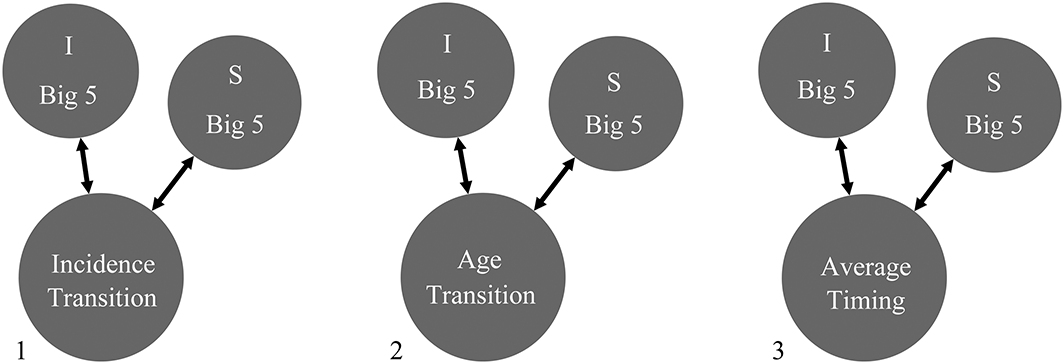
Overview of the different kinds of tested models. Separate models per cohort, per Big Five personality trait, and for 1 and 2 also per transition. I = intercept of the latent growth curve model for the Big Five trait, S = slope of the latent growth curve model for the big five trait. All models were controlled for educational level.
Finally, we used analysis of covariance (ANCOVA) to test for interactions between the incidence of transitions and time on profile stability. Because looking at rank–order stabilities within groups that either did or did not experience a life transition does not inform us about the stability of the position of an individual in the total sample, nor on his or her personal development, we did not examine associations between rank–order stability and life transitions. We performed all analyses separately for both cohorts, and we controlled for educational level in the analyses testing for relations between personality and life transitions. For the models regarding mean–level development, this concerned controlling for educational level on the growth factors. For the analyses involving profile stabilities, educational level was added as a covariate in the ANCOVA. All scripts used to perform the analyses of this study are made openly available online at https://osf.io/vx3hn/?view_only=80481aba9511434aa0f0237ad4e6a033.
Power estimates were computed for all LGCMs in which mean–level personality development was estimated and regressed on the incidence or average timing of the life transitions, or on the age at which life transitions were experienced (see Table A3 in the Appendix). We conducted power analyses at the model level, based on the RMSEA (MacCallum, Browne, & Sugawara, 1996; Preacher & Coffman, 2006). This method provides power estimates that indicate the sensitivity of the model to detect model misspecification based on the complexity of the model (
Results
Personality development
Mean–level development
Observed means and standard deviations of the Big Five personality traits at the different time points are presented in Table 1. Intercorrelations of the Big Five traits at the different time points are shown in Table A4 for the younger cohort and Table A5 for the older cohort. Modelling personality development with linear and quadratic slopes fit the data best for all Big Five traits. Fit indices were all satisfactory except for the CFI for Agreeableness in the younger cohort (0.936). CFI for the other models ranged between 0.960 and 0.996, and RMSEA varied between 0.033 and 0.080. Growth factors for each model can be found in Table 1. Mean levels mainly increased between ages 12 and 25. In the younger cohort, the slopes of Emotional Stability and Extraversion were not significant, and in the older cohort, the slope of Openness was not significant. All the other slopes were significant. As can be seen in Figure 2, estimated growth curves of the two cohorts were replicated quite well for Agreeableness, Openness, and Conscientiousness, with strongest increases in Agreeableness and Openness in adolescence and strongest increases in Conscientiousness in young adulthood.
Observed values and growth factors of the big five personality traits latent growth curve models
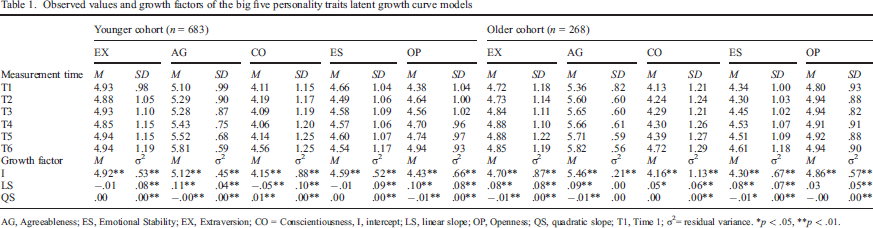
AG, Agreeableness; ES, Emotional Stability; EX, Extraversion; CO = Conscientiousness, I, intercept; LS, linear slope; OP, Openness; QS, quadratic slope; T1, Time 1; σ2= residual variance.
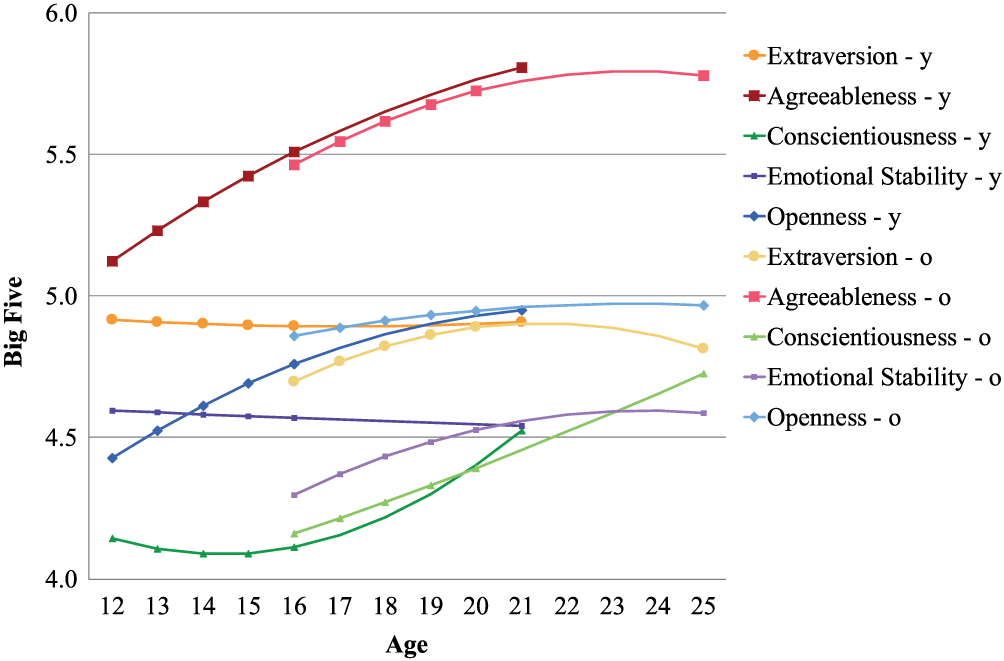
Mean–level development of the big five traits as resulted from latent growth curve modelling. Every Big Five trait was estimated in distinct models and separately for each cohort. The different modelled growth curves are integrated in this graph. y = the younger cohort and o = the older cohort. *p < .05 for the slope.
Rank–order stabilities
To assess rank–order stability, we computed Pearson correlations from W1 (Wave 1) to W5 and from W5 to W6 (see Table 2). Fisher
Rank–order stabilities and profile stabilities, over time, and cohort
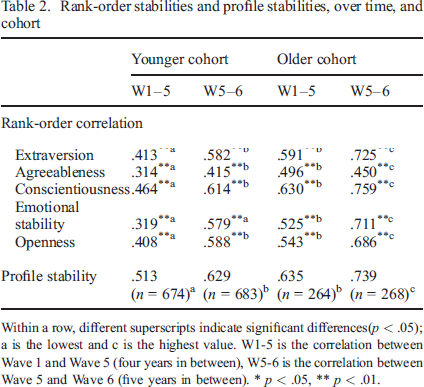
Within a row, different superscripts indicate significant differences(
Profile stability
The mean
Links between personality and life transitions
To examine the relations between mean–level personality development and life transitions, in separate LGCMs, we added links from the intercept and slope of every Big Five trait to the incidence of each transition, the age at which the transition occurred, and the average timing of transitions. Fit indices were satisfactory for 147 of in total 180 models (per cohort, Big Five trait, and life transition variable, and with or without educational level; CFI 0.950–1.000, RMSEA 0.000–0.080). Of the 33 models with a CFI smaller than 0.950, RMSEA higher than 0.080, or both, 16 concerned models including Agreeableness in the younger cohort, with CFI ranging from 0.913 to 0.948 and all satisfactory RMSEA values (≤0.063). Additionally, all models including age left parental home in the older cohort were unsatisfactory, with CFI ranging from 0.892 to 0.956 and RMSEA from 0.080 to 0.119. Other models that did not fit the data well were 12 various models including age at which a life transition was experienced or average timing of transitions (CFI 0.864–0.972, RMSEA 0.059–0.137).
Mean–level personality development and the incidence and timing of life transitions
Personality and the incidence of life transitions
After the correction for multiple testing, of the 40 LGCMs including associations between the incidence of the four life transitions and the intercept and slopes of the particular trait, only two significant trait–to–transition effects, and no significant transition–to–trait effects were found (see Table 3).
Associations between incidence of the life transitions and growth factors of the big five traits, controlled for educational level
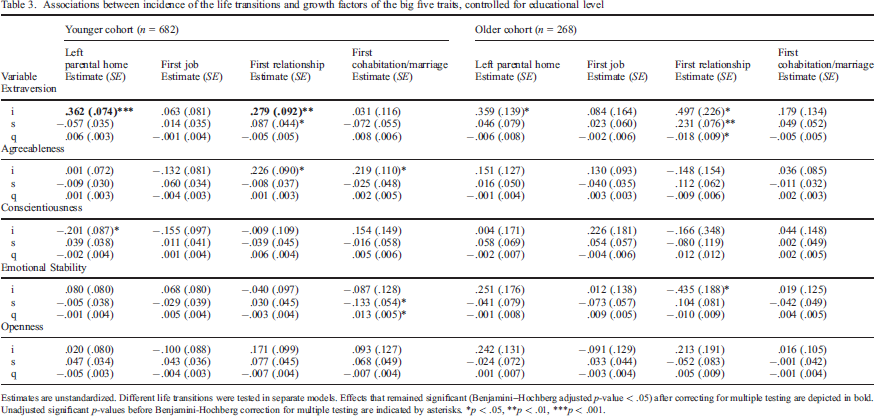
Estimates are unstandardized. Different life transitions were tested in separate models. Effects that remained significant (Benjamini–Hochberg adjusted
In the younger cohort (
Personality and the age at which transitions occur
Associations between the intercepts and slopes of the separate Big Five traits and the age at which transitions occurred revealed a significant effect in only one out of 40 models (see Table 4), concerning a trait–to–transition effect in the younger cohort. A higher intercept of Extraversion was related to a younger age of starting the first job (
Personality and the average timing of transitions within individuals
The associations of the intercepts and slopes of the Big Five traits with the average timing of the four transitions revealed that, in 10 models, only one covariance was significant (see Table 4). In the younger cohort, a higher intercept of Extraversion (
Profile stabilities of personality traits and the incidence of life transitions
Interactions between the incidence of life transitions and profile stabilities over time in the ANCOVA revealed that, out of eight tested effects, the only significant interaction was between time and the incidence of the first romantic relationship in the older cohort (see Table 5). People who never experienced a first relationship (
Associations Between Timing of Life Transitions and Growth Factors of the Big Five Traits, Controlled for Educational level
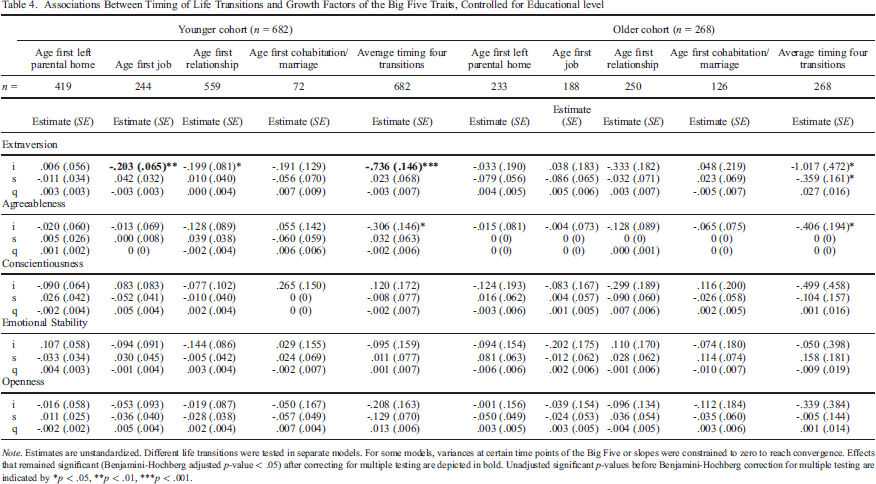
Effects that remained significant (Benjamini–Hochberg adjusted
Profile stabilities of the big five traits for the incidence of the different life transitions
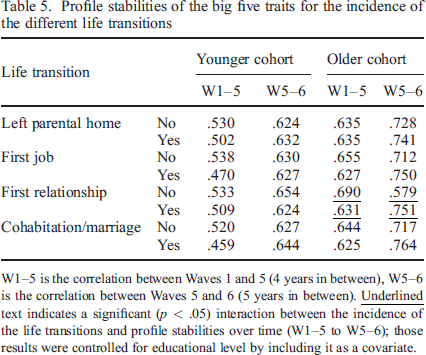
W1–5 is the correlation between Waves 1 and 5 (4 years in between), W5–6 is the correlation between Waves 5 and 6 (5 years in between).
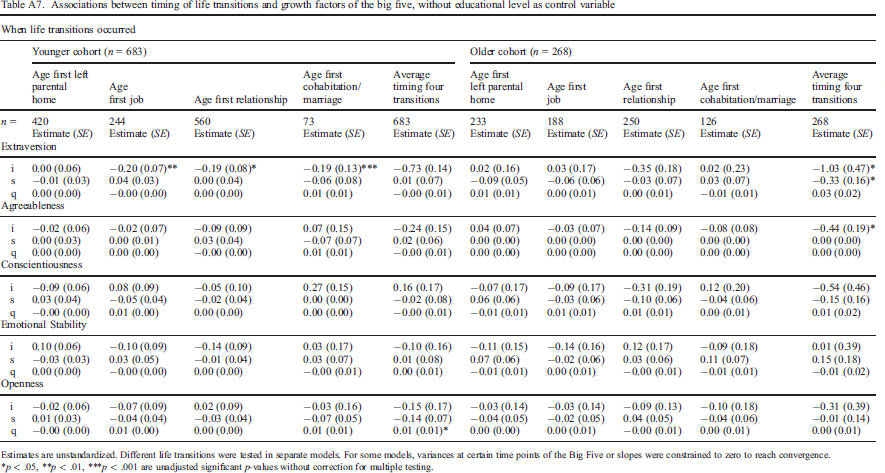
All analyses including mean–level personality changes and profile stabilities in relation to life transitions were also performed without educational level as a control variable. For profile stabilities, these results were the same and thus not shown in a new table. The mean–level results without educational level are not corrected for multiple testing and are shown in Tables A6 and A7 in the Appendix. These results were largely similar to the findings when including educational level as a control variable.
Discussion
The current study examined how personality traits develop across the volatile period of adolescence and young adulthood and how this process is related to the incidence and timing of salient life transitions such as starting a romantic relationship, leaving the parental home, and starting a first job after finishing one's education. Our 9–year longitudinal study with overlapping cohorts allowed us to extend earlier work by examining personality development from early adolescence well into adulthood. Our results showed that personality mainly matured from ages 12 to 25, not only in terms of mean–level increases but also with regard to increases in rank–order stability, reflecting how settled interindividual differences are, and profile stability, reflecting how organized the personality profile is (Klimstra et al., 2009). Moreover, the increases in mean levels, rank–order stability, and profile stability were largely consistent across the two cohorts. Regarding mean–level personality and life transitions, only a very small number of associations were found after correction for multiple testing, and all concerned relations between the mean levels of Extraversion and the incidence and timing of life transitions. No effects were found for life transitions and mean–level change in personality traits. Concerning profile stability of personality and life transitions, we only found that individuals without the experience of a romantic relationship at age 25 decreased in their profile stabilities over time, while those who experienced the first relationship increased in profile stability. Thus, our findings offer very limited evidence for transition–to–trait or social investment effects.
Personality maturation
As was expected, mean levels of the Big Five traits increased between ages 12 and 25, yet the timing of development differed for different traits. Consistent with the study of Klimstra et al. (2009) examining personality development from ages 12 to 20 using largely the same sample, Agreeableness increased from early and middle to late adolescence in both cohorts. However, our study extends this earlier work by showing that change in Agreeableness levelled off in early adulthood. Consistent with Klimstra et al., Openness increased from early to late adolescence in the younger cohort, but results showed that change levelled off in early adulthood and was not significant in the older cohort. Whereas Klimstra et al. found no increases in Conscientiousness from age 12 to 20, our results showed that Conscientiousness was quite stable from early to middle adolescence but increased in both cohorts from middle adolescence into young adulthood (age 25). The mean–level development of the two cohorts from age 16 to 21 was replicated quite well for Agreeableness, Openness, and Conscientiousness. Findings for Extraversion and Emotional Stability were less consistent across cohorts, as they were stable in the younger cohort, but increased from middle to late adolescence in the older cohort. In contrast, Klimstra et al. found increasing mean levels of Emotional Stability during adolescence, and some evidence for increases in Extraversion from early to middle adolescence. Overall, these findings are in agreement with other previous studies showing consistent increases in Agreeableness, Conscientiousness, and Openness, whereas change in Extraversion and Emotional Stability is less consistent (Branje et al., 2007; Roberts et al., 2006; Soto, 2016; Vaidya et al., 2008). These higher levels of personality traits with age indicate more personality maturation (Roberts et al., 2006). Our extension from age 20 to 25 shows that Conscientiousness clearly continued to increase in young adulthood, while changes for the other traits levelled off or slightly decreased.
Rank–order correlations of all personality traits were medium to large (Cohen, 1988) and increased from adolescence into young adulthood in both cohorts. The rank–order stability for each trait was also higher in the older cohort than in the younger cohort when comparing Waves 1–5 of the two cohorts and when comparing Waves 5–6 of both cohorts with each other. Only the rank–order correlation of Agreeableness in the older cohort at Waves 5–6 was not different from the correlation at Waves 5–6 in the younger cohort, neither from Waves 1–5 in the older cohort. As we expected in terms of replication, rank–order correlations for each trait at Waves 5–6 in the younger cohort were not different from the rank–order correlations at Waves 1–5 in the older cohort. These findings show that differences between individuals become more set over time (Caspi & Roberts, 2001; Klimstra et al., 2009). These increases in rank–order stability across adolescence and young adulthood were consistent with results of previous studies (Lüdtke et al., 2011; Roberts & DelVecchio, 2000; Specht et al., 2011). These stabilizing relative positions on personality traits can be interpreted as maturation, especially as it goes together with mean–level increases, which was the case for most personality traits in the two age cohorts. However, for some individuals with less adaptive personalities, this might not be the case. For example, high or increasing rank–order stabilities for Emotional Stability might imply that some individuals get more stuck in their low or even decreasing levels of Emotional Stability, thus it would not indicate maturation for them. Similarly, for traits that show stable or decreasing mean levels, increasing rank–order stabilities in a sample might indicate stagnation or lack of maturity.
Profile stabilities were large (Cohen, 1988) and also increased with age in both cohorts, and the older cohort had higher profile stabilities than the younger cohort when looking at the same waves. This pattern is similar as for the rank–order correlations, and also here, we found, as a replication effect, that profile stability in Waves 5–6 in the younger cohort was not different from the profile stability in Waves 1–5 in the older cohort. These findings are in accordance with the theoretical idea that, within persons, the constellation of traits should become more stable and organized in a more consistent manner over time (Caspi & Roberts, 2001; Klimstra et al., 2009). This conclusion is strengthened by the fact that our study found increasing profile stability in two age cohorts between ages 12 to 25 and did not find differences in stability in the overlapping periods of the two cohorts from ages 16 to 21. Showing the robustness of the findings across two cohorts that overlap in age makes our results more informative and persuasive (Duncan et al., 2014).
Personality and life transitions
Although we hypothesized that the process of personality maturation is related to experiencing the salient life transitions of starting the first romantic relationship, leaving the parental home, starting a first job, and cohabitation or marriage (e.g. Arnett, 2000; Bleidorn et al., 2018; Denissen et al., 2008), evidence for these associations was very limited, and effects were in general small to medium. After correcting for multiple testing, in four out of 90 models including mean–level personality change and life transition variables, only four significant effects were found. These were all trait–to–transition effects for Extraversion in the younger cohort, showing that higher mean levels of Extraversion were related to the higher incidence of leaving the parental home and of starting the first romantic relationship and to an earlier average timing of life transitions. In addition, of those in the younger cohort who had experienced the first job after finishing full–time education, those higher in Extraversion experienced the transition at an earlier age. In the older cohort, some insignificant effects had similar effect sizes as the smallest significant effect and also concerned Extraversion, namely the associations between a higher intercept of Extraversion with the incidence of the first romantic relationship and an earlier average timing of transitions. No transition–to–trait effects for mean–level personality were found. Only some insignificant transition–to–trait effects, again for Extraversion, with a similar or larger effect size as the smallest significant effect in the younger cohort, were found in the older cohort, which concerned the associations between the incidence of a first relationship and earlier average timing with a larger slope of Extraversion.
The lack of transition–to–trait findings is in line with the previous finding that the transition to parenthood was not related to subsequent changes in Big Five personality traits (Van Scheppingen et al., 2016). It could be that for every individual, there are specific life transitions that potentially impact their personality and that specific transitions do not universally affect individuals’ personality, so that transition–to–traits effects are difficult to find. The effects we found, although scarce, are in agreement with the general line of prior findings, and fitting the assumption that individual differences in personality traits can predict how people shape their life course and whether and when they experience life transitions (Costa & McCrae, 1997; Denissen et al., 2008). People with higher levels on Extraversion might be more ready for new steps towards adulthood and may therefore initiate new transitions at earlier ages, on average, than individuals with lower levels on Extraversion.
Extraversion and life transitions
That the few significant findings all concerned Extraversion could be explained by the higher levels of sociability in extraverted people (Breil et al., 2019). Individuals higher in Extraversion appear to be less sensitive to social rejection than less extraverted people (Evans et al., 2016), which could make it easier for extraverted people to show themselves and initiate contact. Youth with higher levels of Extraversion also selected more friends than people lower in this trait (Selfhout et al., 2010). It has been shown that sociable people were more likely to start their first romantic relationship in the following years (Neyer & Lehnart, 2007). Extraversion was also found to be a predictor of intimacy and to be positively related to relationship satisfaction (White, Hendrick, & Hendrick, 2004). When people have more relationships and experience more intimacy, the likelihood of initiating the first romantic relationships might be increased. More generally, being less sensitive for social rejection and having many social contacts could make people less hesitant to start new transitions such as leaving the parental home. Thus, Extraversion might be indicative of the initiation and quantity aspect of social relationships and of facing new transitions. Extraverted people may also see life events more positively and controllable (Kandler, 2012), which could further facilitate starting new events and adopting new roles.
In a broader sense, a clear conceptual distinction is made between Extraversion on the one hand, and the other four Big Five traits on the other hand (Van Lieshout, 2000). To use opportunities and to fulfil demands in life, an individual needs to be activated. This activation versus passivity is associated with Extraversion, while the other Big Five traits are related to regulation and resiliency within situations (Van Lieshout, 2000). Especially when individuals are faced with new situations or expectations that draw upon their capacities and personality, the extent in which people are activated becomes clear. Thus, Extraversion seems to be important for the initiation of new life transitions. Other traits are expectedly more related to how transitions are experienced, or to how people behave within the new roles.
The first romantic relationship
We found that individuals without the experience of a romantic relationship at age 25 decreased in their profile stabilities over time, while those who experienced the first relationship increased in profile stability. We also found some indications that in this same age group, those with higher levels of Extraversion more often had experienced the first romantic relationship and that this experience was followed by increases in Extraversion. It might be that existing differences affected who experienced this life transition. In turn, these earlier romantic relationship experiences confirmed their personality, resulting in earlier personality stabilization. This is in line with the corresponsive and cumulative continuity principle (Caspi et al., 2005; Roberts et al., 2008) and could explain the over–time increasing difference in profile stability between the groups with and without romantic relationship experience. The corresponsive principle of personality development proposes that the personality traits that are deepened by certain life experiences, are precisely those traits that have led people to those experiences (Caspi et al., 2005; Roberts et al., 2008). The cumulative continuity principle is similar and comprises the idea that individuals want to be in or create environments related to their personality traits, and that within these environments, existing traits, and trait–related behaviour are reinforced (Caspi et al., 2005). In this way, personalities, with either low or high trait levels, increase in stability. Having a romantic relationship can be a secure base and function as a reward structure, bringing about increasing Extraversion and personality stability (Neyer & Lehnart, 2007). Our finding thus suggests that lacking experience with a romantic relationship throughout adolescence and young adulthood might hamper the development of a stable personality.
Timing and normativity of life transitions
Not many associations were in line with the idea that greater maturity is related to having experienced more transitions. Some of the null results might be explained by the timing and normativity of life transitions. Given that most youths nowadays follow tertiary education and often have changing romantic relationships, several of the transitions included in this study (e.g. first jobs and first cohabitation or marriage) are not very common to occur before age 21 (Table A1). If one experiences a life transition relatively early or late within the normative time window in which this transition is culturally or socially expected to occur, this might have a different relation to personality than a transition that is so early or late that it falls outside of this normative period. Particularly, an early timing of life transitions within a normative period could be related to a more mature personality development. Hence, the timing might relate to the direction and strength of the association with personality traits.
This normativity of life transitions might explain some of the differences in results obtained for the younger and older cohort. For example, experiencing the first romantic relationship is very common in adolescence and normative to experience before age 25, which could explain why those in the older cohort without romantic relationship experiences decreased in their profile stabilities over time, while those who experienced a first relationship increased in profile stability.
We found more associations between personality and life transitions in the younger cohort than in the older cohort. A potential conceptual explanation concerns the lower stability of personality traits and stronger mean–level change at these ages, compared with the ages of the older cohort. Psychological and social influences tend to diminish as individuals grow older because people increasingly set, pursue, and maintain personal goals, and therefore become more developmentally regulated (Baltes, Lindenberger, & Staudinger, 2006). In other words, people's plasticity seems to decrease across the life span. Another potential reason for more associations between personality and life transitions in the younger than in the older cohort is that models in the younger cohort included more participants and had more power (Table A3). Several effects in the older cohort had a similar effect size as the smallest significant effect in the younger cohort but were insignificant. Because some life transitions were less common, sample sizes were also sometimes too low to distinguish a model that fits closely from a model that does not fit closely, especially for age of first cohabitation or marriage (Table A3). In conclusion, it is important to consider the timing of life transitions in relation to personality (Elder, 1998; Luhmann et al., 2014), and it might be interesting for future research to further examine the role of timing and normativity in the associations between personality and life transitions.
No effects for conscientiousness and emotional stability
Contrary to our general expectations and the social investment perspective, higher mean levels of Conscientiousness and Emotional Stability did not predict higher incidence and earlier timing of life transitions. Our findings suggest that although mean levels of Emotional Stability and Conscientiousness increase during adolescence and young adulthood, they are not predicted by life transitions. Because low scores on these traits are strongly associated with psychopathology (Kotov, Gamez, Schmidt, & Watson, 2010), it is important to look at other predictive factors for changes in Emotional Stability and Conscientiousness, beyond life transitions.
Strengths, limitations, and future research
Strengths of the current study include the 9–year longitudinal design with a large sample, in which two cohorts were followed from ages 12 to 21 and ages 16 to 25, respectively. In this way, we replicated and extended previous findings on personality maturation and showed the robustness of the findings by comparing the two cohorts and different age periods, which makes our results more informative and persuasive (Duncan et al., 2014). We obtained an extensive overview by examining the Big Five personality traits, three indicators of personality maturation, and the relations of two of those indicators with the incidence, timing of incidence, and average timing of four important life transitions.
Besides these strengths, the current study also has limitations. First, we used self–report questionnaires to assess personality traits and life transitions, and the life transitions were measured retrospectively. Including other reporters could increase the validity of the current findings. Still, adolescents themselves may be the best observers of their personality changes because they increasingly participate in different contexts, situations, and roles outside the family context (Branje et al., 2007). Furthermore, some variables are quite subjective, such as the incidence of the first romantic relationship. People might have different ideas of when a first relationship was serious or long enough to report on. Moreover, to test our research questions, we used a large number of tests, which we corrected for. Although the way we modelled the data offers an extensive overview and a longer–term developmental perspective of personality development and its associations, shorter–term effects of life transitions may have been obscured. Considering personality before and after every life transition separately, although beyond the scope of this study, may reveal more evidence of transition–to–trait effects. Furthermore, because we did not include the different transitions together in the same models for respectively incidence and age at which transitions were experienced, we cannot conclude that the effects we found are unique.
Additionally, several transitions were quite strongly correlated to each other (see Tables A1 and A2 in the Appendix). Therefore, it might be interesting for future studies to further investigate the impact of different transitions, together. We also only included the first time participants experienced the life transitions. These are mostly not life–long, so it would be interesting to also examine later changes and life transitions in future research. Finally, our variables on life transitions concerned incidence, age, and average timing. However, knowing when a life transition occurred does not inform us on
Conclusion
In conclusion, this study found consistent evidence for age–related increases in mean levels, rank–order correlations, and profile stability of the Big Five traits across adolescence and young adulthood. These results, particularly those for rank–order stability and profile stability, were very consistent and replicated across the overlapping age period of the two cohorts. There was little support for our hypothesized links between personality and life transitions. When looking at the few effects we found, Extraversion was predictive of the incidence and timing of life transitions. Evidence for socialization effects of life transitions on personality was very limited. We only found that individuals who at age 25 did not yet experience their first romantic relationship decreased in their profile stabilities over time, while those with relationship experiences increased in profile stability. This might indicate the importance of first romantic relationship experiences in young adults’ personality maturation. Considering the experience of life transitions as an indicator of social integration, our findings suggest that higher mean levels on Extraversion might help individuals to find their way in society.
Supporting info item
Supporting info item, per2251-sup-0001-Open_Practices_Disclosure_Form - Personality Development from Age 12 to 25 and its Links with Life Transitions
Supporting info item, per2251-sup-0001-Open_Practices_Disclosure_Form for Personality Development from Age 12 to 25 and its Links with Life Transitions by Van Dijk Marloes P.A., Hale William W., Hawk Skyler T., Meeus Wim and Branje Susan in European Journal of Personality
Footnotes
Supporting Information
Additional supporting information may be found online in the Supporting Information section at the end of the article.
Acknowledgement
This paper has been financially supported by a grant from the Netherlands Organisation for Scientific Research (406–11–104).
Appendix
Associations between timing of life transitions and growth factors of the big five, without educational level as control variable
| When life transitions occurred | ||||||||||
|---|---|---|---|---|---|---|---|---|---|---|
| Younger cohort ( |
Older cohort ( |
|||||||||
| Age first left parental home | Age first job | Age first relationship | Age first cohabitation/marriage | Average timing four transitions | Age first left parental home | Age first job | Age first relationship | Age first cohabitation/marriage | Average timing four transitions | |
| 420 | 244 | 560 | 73 | 683 | 233 | 188 | 250 | 126 | 268 | |
| Estimate ( |
Estimate ( |
Estimate ( |
Estimate ( |
Estimate ( |
Estimate ( |
Estimate ( |
Estimate ( |
Estimate ( |
Estimate ( |
|
| Extraversion | ||||||||||
| i | 0.00 (0.06) | −0.20 (0.07) ** | −0.19 (0.08) * | −0.19 (0.13) *** | −0.73 (0.14) | 0.02 (0.16) | 0.03 (0.17) | −0.35 (0.18) | 0.02 (0.23) | −1.03 (0.47) * |
| s | −0.01 (0.03) | 0.04 (0.03) | 0.00 (0.04) | −0.06 (0.08) | 0.01 (0.07) | −0.09 (0.05) | −0.06 (0.06) | −0.03 (0.07) | 0.03 (0.07) | −0.33 (0.16) * |
| q | 0.00 (0.00) | −0.00 (0.00) | 0.00 (0.00) | 0.01 (0.01) | −0.00 (0.01) | 0.01 (0.01) | 0.00 (0.01) | 0.00 (0.01) | −0.01 (0.01) | 0.03 (0.02) |
| Agreeableness | ||||||||||
| i | −0.02 (0.06) | −0.02 (0.07) | −0.09 (0.09) | 0.07 (0.15) | −0.24 (0.15) | 0.04 (0.07) | −0.03 (0.07) | −0.14 (0.09) | −0.08 (0.08) | −0.44 (0.19) * |
| s | 0.00 (0.03) | 0.00 (0.01) | 0.03 (0.04) | −0.07 (0.07) | 0.02 (0.06) | 0.00 (0.00) | 0.00 (0.00) | 0.00 (0.00) | 0.00 (0.00) | 0.00 (0.00) |
| q | 0.00 (0.00) | 0.00 (0.00) | −0.00 (0.00) | 0.01 (0.01) | −0.00 (0.01) | 0.00 (0.00) | 0.00 (0.00) | 0.00 (0.00) | 0.00 (0.00) | 0.00 (0.00) |
| Conscientiousness | ||||||||||
| i | −0.09 (0.06) | 0.08 (0.09) | −0.05 (0.10) | 0.27 (0.15) | 0.16 (0.17) | −0.07 (0.17) | −0.09 (0.17) | −0.31 (0.19) | 0.12 (0.20) | −0.54 (0.46) |
| s | 0.03 (0.04) | −0.05 (0.04) | −0.02 (0.04) | 0.00 (0.00) | −0.02 (0.08) | 0.06 (0.06) | −0.03 (0.06) | −0.10 (0.06) | −0.04 (0.06) | −0.15 (0.16) |
| q | −0.00 (0.00) | 0.01 (0.00) | 0.00 (0.00) | 0.00 (0.00) | −0.00 (0.01) | −0.01 (0.01) | 0.01 (0.01) | 0.01 (0.01) | 0.00 (0.01) | 0.01 (0.02) |
| Emotional Stability | ||||||||||
| i | 0.10 (0.06) | −0.10 (0.09) | −0.14 (0.09) | 0.03 (0.17) | −0.10 (0.16) | −0.11 (0.15) | −0.14 (0.16) | 0.12 (0.17) | −0.09 (0.18) | 0.01 (0.39) |
| s | −0.03 (0.03) | 0.03 (0.05) | −0.01 (0.04) | 0.03 (0.07) | 0.01 (0.08) | 0.07 (0.06) | −0.02 (0.06) | 0.03 (0.06) | 0.11 (0.07) | 0.15 (0.18) |
| q | 0.00 (0.00) | −0.00 (0.00) | 0.00 (0.00) | −0.00 (0.01) | 0.00 (0.01) | −0.01 (0.01) | 0.00 (0.01) | −0.00 (0.01) | −0.01 (0.01) | −0.01 (0.02) |
| Openness | ||||||||||
| i | −0.02 (0.06) | −0.07 (0.09) | 0.02 (0.09) | −0.03 (0.16) | −0.15 (0.17) | −0.03 (0.14) | −0.03 (0.14) | −0.09 (0.13) | −0.10 (0.18) | −0.31 (0.39) |
| s | 0.01 (0.03) | −0.04 (0.04) | −0.03 (0.04) | −0.07 (0.05) | −0.14 (0.07) | −0.04 (0.05) | −0.02 (0.05) | 0.04 (0.05) | −0.04 (0.06) | −0.01 (0.14) |
| q | −0.00 (0.00) | 0.01 (0.00) | 0.00 (0.00) | 0.01 (0.01) | 0.01 (0.01) * | 0.00 (0.00) | 0.00 (0.01) | −0.00 (0.01) | 0.00 (0.01) | 0.00 (0.01) |
Estimates are unstandardized. Different life transitions were tested in separate models. For some models, variances at certain time points of the Big Five or slopes were constrained to zero to reach convergence.
References
Supplementary Material
Please find the following supplemental material available below.
For Open Access articles published under a Creative Commons License, all supplemental material carries the same license as the article it is associated with.
For non-Open Access articles published, all supplemental material carries a non-exclusive license, and permission requests for re-use of supplemental material or any part of supplemental material shall be sent directly to the copyright owner as specified in the copyright notice associated with the article.
