






Abstract
Individual differences in goal engagement and goal disengagement processes have been demonstrated to be related to goal attainment, health, and emotional well–being. However, there is a dearth of studies on the developmental conditions of individual differences in these processes. Social learning processes contribute to the formation of individual dispositions even in adulthood. As one pathway of learning, we investigated observational learning of goal regulation processes in romantic relationships in two experimental studies. Study 1 (N = 67 couples, M = 32.65 years) replicated a previous finding that observing partners imitated their partner's goal regulation processes in the same task and extended it by showing transfer effects to another task. Study 2 (N = 60 couples, M = 25.9 years) demonstrated that—given a lack of praise of the modelled actions—partners still imitated goal regulation processes but to a smaller extent. These findings lend support for observational learning as a pathway to individual differences in the application of goal regulation processes. © 2020 The Authors. European Journal of Personality published by John Wiley & Sons Ltd on behalf of European Association of Personality Psychology
Introduction
Theories of self–regulation postulate that goals structure people's lives and fill them with meaning (Carver & Scheier, 1998; Heckhausen & Schulz, 1995). Yet, goal pursuit is not without conflict. If we encounter or anticipate barriers or resource diminution in goal pursuit, goal regulation processes are activated. Two categories of processes are broadly distinguished (Brandstätter, 2018; Haase, Heckhausen, & Wrosch, 2013; Heckhausen & Wrosch, 2016): Goal engagement refers to processes of tenacious goal pursuit, correcting or compensating endeavours and increased resource recruitment to attain the original goal. Goal disengagement denotes processes of detaching from the original goal accompanied by adjusting relative goal value, reappraising the loss, and recruiting resources for attainable goals. Numerous studies have demonstrated the importance of flexibly employing both goal regulation processes for psychological and physical health across the lifespan (for an overview, see Heckhausen, 2011). In the same vein, research has shown reliable individual differences in the use of regulatory processes among individuals who confront similar obstacles in goal pursuit (Brandstätter, 2018; Heckhausen, Wrosch, & Schulz, 2010). However, there is a paucity of research examining the development of these individual differences in dispositional goal regulation processes across the lifespan (Heckhausen, 2011; Heckhausen, Wrosch, & Schulz, 2010; Heckhausen & Wrosch, 2016). Besides individual characteristics, social context might play a role in the formation and change of individual differences in goal engagement and goal disengagement. On the one hand, close others have been demonstrated to be relevant in the shaping of one another's skills and traits (Rusbult, Finkel, & Kumashiro, 2009) and influencing each other's goal pursuit (Fitzsimons & Finkel, 2018). On the other hand, observational learning has been shown to be an influential learning process, allowing one to learn from others who are perceived as relevant, without experiencing the situation oneself (Bandura, 1971, 1986). In the present studies, we combine these two lines of research and investigate the role of social context, particularly romantic partners, in providing an observational learning context for the application of regulatory processes in adulthood. In two experimental studies, we examined whether observing one's partner's regulatory strategy would lead to imitation when being confronted with difficulties in goal pursuit in the same situation and transferred to dealing with difficulties in a different situation (Study 1). Moreover, we assessed the role of vicarious feedback on the imitation of goal regulatory processes as a boundary condition (Study 2).
Individual differences in goal regulation processes
There are plenty of situations where people encounter the same obstacle in their pursuit of goals that vary in their level of concreteness or specificity (e.g. when wanting to watch a particular movie at the movie theatre but there are no longer any seats available, when an application for a favorized job is rejected, or when wanting to have a child but encountering infertility), but where individuals differ in their response to these obstacles (Wrosch, Scheier, Miller, Schulz, & Carver, 2003). Research with a focus on individuals’ goal regulation capacities has demonstrated the relevance of goal engagement and goal disengagement for different health outcomes in adulthood (e.g. better well–being, higher life satisfaction, less depression, positive affect, physical health) when faced with obstacles in goal pursuit (e.g. Bailly, Gana, Hervé, Joulain, & Alaphilippe, 2014; Brandtstädter, Wentura, & Greve, 1993; Rühs, Greve, & Kappes, 2017; Wrosch, Miller, Scheier, & de Pontet, 2007; Wrosch & Sabiston, 2012; Wrosch, Scheier, & Miller, 2013). Despite the importance of goal regulation processes for health and well–being, there are almost no theoretical considerations and empirical data on the development of individual differences in goal regulation processes across the lifespan (Heckhausen et al., 2010; Heckhausen, Wrosch, & Schulz, 2019). In particular, goal disengagement processes are rarely considered despite the frequent occurrence of being faced with unattainable goals (on average, one unattainable goal in a central domain of life each year; Wrosch, et al., 2003). If developmental questions are considered, studies tend to focus on age–related changes in engagement and disengagement processes due to assumed age–related changes in resources (e.g. Brandtstädter & Renner, 1990; Heckhausen, 1999; Riediger, Freund, & Baltes, 2005). Research also considers individual differences such as dispositional optimism and action versus state orientation as predictors of individual differences in goal regulation processes (Hanssen et al., 2015; Heckhausen & Wrosch, 2016).
Romantic partners as a learning context
Besides an individual's perspective, a social systems approach is warranted to understand the development of regulation processes (Aldwin, Skinner, Zimmer–Gembeck, & Taylor, 2011; Heckhausen et al., 2010). In principal, different social partners (e.g. co–workers, friends, parents, neighbours) can influence developmental processes. In the present studies, we focus on romantic partners in young adulthood, who might provide an intimate learning environment for each other when it comes to methods for coping with emotions and barriers in goal pursuit across a longer period of time. Romantic relationships are particularly important for most people (Baumeister & Leary, 1995; Reis, Collins, & Berscheid, 2000), and they allow access to a steady and reoccurring learning environment. This is because partners typically spend a lot of time together and share the same environment (Dixon, 1999; Meegan & Berg, 2002). Moreover, they may rely on each other in times of need (Berg & Upchurch, 2007). Another relevant prerequisite for learning in social relationships might be interdependency (Giesen, Herrmann, & Rothermund, 2014). Giesen, Löhl, Rothermund, and Koranyi (2018) demonstrated that romantic couples interact interdependently by default in a task involving observational learning, whereas interdependency has to be intentionally invoked in a pair of strangers to achieve a comparable result.
Concerning adult age, there is a growing awareness of the important role of the romantic partner in shaping the experience and regulation of emotions (e.g. Bloch, Haase, & Levenson, 2014; Hoppmann, Gerstorf, Willis, & Schaie, 2011) and the regulation of goal pursuit and attainment (e.g. Berg et al., 2008; Eckenrode, 2013; Fitzsimons & Finkel, 2018; Hoppmann & Gerstorf, 2013; Righetti & Kumashiro, 2012). These studies mainly focus on the interpersonal regulation of an emotion eliciting event for one partner or joint goal pursuit and its consequences for well–being. They demonstrate the relevance of mutual support in pursuing goals for attaining goals, relationship satisfaction, and well–being, and they study conditions for the success of these endeavours (e.g. Berli, Bolger, Shrout, Stadler, & Scholz, 2018; Cappuzzello & Gere, 2018). However, there is a dearth of studies examining the conditions under which regulatory skills themselves develop and, in particular, the role of the romantic partner and their regulatory skills in this development.
Contribution of observational learning to dispositions
Besides rather direct partner influences (see, e.g. Rusbult et al., 2009), partners might also influence each other more indirectly through observational learning (Bandura, 1971, 1986). That is, partners could observe how their partner deals with difficulties in goal pursuit and, hence, become more likely to either engage in goal pursuit or disengage from their own goal(s) due to imitating their partner. The role of observational learning in shaping individual differences in dispositional regulatory processes has been examined, for instance, in parent–child dyads concerning the development of emotion regulation (Denham, Mitchell–Copeland, Strandberg, Auerbach, & Blair, 1997). In this vein, observational learning is assumed to be one pathway of familial influences (Morris, Silk, Steinberg, Myers, & Robinson, 2007). Concerning adult development of goal regulatory processes and, in particular, the role of observational learning, research is scarce. To the best of our knowledge, no study has examined the concordance between romantic partners’ goal regulation processes over time. However, as Heckhausen and Wrosch (2016) point out, there is a conceptual overlap between coping strategies and goal regulation processes (e.g. active coping with goal engagement or positive reframing with goal disengagement). Hence, research on coping strategies in couples could inform about the role of observational learning processes for regulatory responses. These correlational studies have found that romantic partners are similar in their dispositional use of coping strategies (Ben–Zur, Gilbar, & Lev, 2001; Giunta & Compas, 1993; Revenson, 2003) and show convergence of strategy use over time (Holahan et al., 2007). However, this similarity can result from other processes, such as direct encouragement. Therefore, Tuskeviciute, Snyder, Stadler, and Shrout (2018) examined partners’ concordance of active coping behaviour, support seeking, and use of alcohol, food, and drugs as means of coping on a day–to–day basis. They found that individuals were more likely to use each of these strategies if they perceived their partner doing so or when their partner reported doing so on the same day even when controlling for their partner's direct encouragement to apply the strategy and their disposition to use the strategy.
Yet, these findings are still based on correlational data; thus, mechanisms other than imitation could be at play. An experimental approach would demonstrate that the process of imitation of goal regulation processes actually takes place in romantic relationships. One study experimentally examined the role of observational learning in the application of goal regulation processes more directly (Thomsen, Kappes, Schwerdt, Sander, & Poller, 2017). It demonstrated the effect of observing the partner's response to barriers in goal pursuit on their subsequent coping with blocked goals in the same task. Partners observing goal engagement were more likely to continue with the original goal, whereas partners observing goal disengagement were more likely to disengage. However, this effect might only reflect a direct imitation of behaviour in the same task instead of imitation of goal regulation processes. The latter requires an understanding of mental states and underlying goals for the observed behaviour (Nurmsoo, Robinson, & Butterfill, 2010). Moreover, it is unclear whether observed goal regulation processes are generalized as representing a way of coping in similar situations and are therefore applied in conceptually similar situations as well or are restricted to the same situation. Applying the observed regulation process to other situations would be a prerequisite of observational learning processes that result in longer lasting changes of the application of goal regulation processes.
The present research
The present research had three goals. First, it set out to replicate the modelling effect obtained in Thomsen et al. (2017), that is, whether observing a partner coping with obstacles in goal pursuit influences the observer's behaviour in the same task. Second, in order to test whether underlying goals are represented and generalized by the observer and applied in a conceptually similar situation, it examined whether observed goal regulation processes are transferred to a task for which no modelling behaviour has previously been observed (transfer effect). Third, assuming that actions are not blindly copied by romantic partners, we began testing boundary conditions for the imitation of observed goal regulation processes and focused on the effect of praising the model's strategy as a boundary condition.
In Study 1, we employed an experimental design mirroring the paradigm of Thomsen et al. (2017). Participants worked on logic puzzle tasks that were—unbeknownst to the participant—not solvable. Their goal was to solve the puzzles, but participants were confronted with difficulties in solving it (after being successful in a prior training task suggesting that the puzzles were solvable). Once they experienced this difficulty, goal regulation processes should activate either goal engagement (i.e. tenacious goal pursuit) or goal disengagement from the present task. They were given a time limit and told that they could switch to another puzzle after specified intervals. Frequency of switching a puzzle indicated goal (dis–)engagement processes. Romantic partners were randomly assigned to the role of the model or the observer in the experimental groups, whereas the partners in the control group worked alone on all tasks. The model was instructed to either model goal engagement processes (never switch when given the opportunity) or to model disengagement processes (always switch when given the opportunity). Upon finishing the puzzle task, the model was praised once for the use of their respective strategy. Subsequently, the observing partner worked on the same task(s).
The previous study by Thomsen et al. (2017) does not allow conclusions to be drawn about the transfer of the observed goal regulation process on different tasks. Although couples sometimes share the same goals and related barriers to goal pursuit, they also encounter barriers to nonshared goals, for instance, at work or with nonshared friends. Tuskeviciute et al. (2018) demonstrated the increased likelihood of employing the same coping strategy as their partner for a different problem on the same day in a correlational design. In Study 1, we included a second task with barriers in goal pursuit to test transfer effects. We assumed that the model's regulation behaviour in the puzzle task would be positively linked to the observer's behaviour in the transfer task.
Study 2 repeated the design of Study 1 (without control group), but—in contrast to Thomsen et al. (2017) and Study 1—the models were not rewarded for their strategy, that is, they received no praise but were only thanked for their participation. Although meaningful others might provide orientation in coping with barriers in goal pursuit, there are indications that observed goal regulation processes are not blindly imitated and transferred to other situations where difficulties in goal pursuit arise. One factor might be the perceived success of the observed goal regulation process. This factor refers to the distinction between acquisition processes and the performance of observed behaviour as different parts of observational learning (Bandura & Jeffery, 1973; Greer, Dudek–Singer, & Gautreaux, 2006). Motivational processes are particularly relevant for the performance of behaviour; positive consequences for the model increase the likelihood of imitation, and negative consequences decrease its likelihood. Bandura (1965) demonstrated the role of observed rewards and punishment of the model's behaviour and its influence on the imitation of the observed behaviour, that is, whether the behaviour is actually performed (see also Giesen, Scherdin, & Rothermund, 2017). Given that in everyday life, direct feedback on the reasonable application of goal regulation processes is often absent or ambiguous, we investigated the effect of absent praise as a boundary condition on the imitation of goal regulation processes in Study 2.
Study 1
Hypotheses
We hypothesized that observers in the engagement group would switch less often than participants in the control group, whereas observers in the disengagement group would switch more often (Hypothesis 1). Moreover, we assumed that this pattern would also occur in the transfer task (Hypothesis 2). The hypotheses were not officially preregistered.
Methods
Participants
Participants were 67 opposite–sex couples (M = 32.65 years, SD = 15.32, 17–75 years) resulting in 50 couples in the two experimental groups (i.e. 24 observing partners in the disengagement group and 26 observers in the engagement group) 1 and 17 couples in the control group (resulting in 34 participants providing data on their task switches). Most participants (86%) had at least Abitur (qualification to enter university). Half of them (51.5%) were living together, and 22.7% had at least one child. Couples were eligible to participate if they were 18 years or older and had been in a relationship for at least 12 months (relationship duration: M = 8.7 years, Med = 3.4 years, SD = 12.1 years, 1.0–57.5 years). Participants did not differ between conditions with regard to age and relationship duration, Fs(2, 83)≤ 1.53, ps≥ .224. Moreover, participants did not differ between conditions concerning cohabitation, having at least one child, and having at least Abitur, Χs2(2)≤ 3.16, ps≥ .206.
Participants were recruited via flyers on campus, bars, restaurants, and sports clubs and via social media. They could decide to take part in a lottery to win one of three restaurant coupons (worth 20 euro) or gain course credits (only for psychology students).
Thomsen et al. (2017) obtained a very large effect size (ηp2 = .47) in their study, but given that it was a first study, we based our power analysis on a comparatively more conservative effect size. A power analysis employing G*Power (Erdfelder, Faul, & Buchner, 1996) indicated that we needed a minimum of N = 51 participants in total to achieve 80% power in order to detect a large–sized main effect (ηp2 = .14) of group (disengagement versus control versus engagement; between–subjects) in a repeated measures design (task type: modelling task versus transfer task; within–subjects) when employing the traditional .05 criterion of statistical significance.
Measures
Modelling task
Participants played an abstract puzzle game. In such a task, a player has to use 4 out of 12 pieces with different geometric shapes to cover the shape on the player board without overlaps or open spaces. For the present study, shapes were created that did not fit the shape on the player board (see Thomsen et al., 2017, for more details). Moreover, we conducted a validation study (N = 30 couples, M = 25.8 years, SD = 5.7) to test whether observers’ switching behaviour in this paradigm might reflect demand effects cued by the modelling partner, who was instructed to behave in a particular way and was partially privy to the study's goals. We also tested whether models in the validation study perceived their behaviour as reflecting goal regulation processes and whether observers were sensitive to their partner's goals and constraints on their actions and resultant goal regulation processes (for details, see Supporting Information). The validation study showed a positive correlation between an uninstructed partner's goal regulation and the observing partner's own behaviour in the same task, r(28) = .53, p = .002. This strong positive correlation suggests that the instruction of the model cannot account for the modelling effects in the paradigm of Thomsen et al. (2017). Moreover, we obtained a correlation between the model's task switches and self–reported goal regulation processes [engagement processes: r(26) = −.51, p = .006; disengagement processes: r(26) = .57. p = .002]. Hence, fewer task switches were associated with increased self–reported engagement with the puzzle task(s), while switching more often was linked to self–reported disengagement processes. Finally, observing partners were able to recognize their partners’ intentions, as suggested by the positive correlations between models’ self–report of goal regulation processes and partners’ reports of perceived goal regulation processes [engagement processes: r(26) = .57, p = .002; disengagement processes: r(26) = .58, p = .001]. These findings suggest that when models reported more intense (dis–)engagement processes, their partners were able to identify them.
Transfer task
We employed seven Wimmelbilder to test the transfer effect. Wimmelbilder are pictures crowded with objects. The objective is to find specific items. Subjects were asked to find 10 objects for each picture, while one of these was not displayed on the picture. Its list position varied from position five to eight.
Control variables
Modelling partners were asked to indicate how much they felt the instructed behaviour matched their typical behaviour and how convincing they could be when modelling the instructed behaviour (1 = not at all to 5 = very good).
Procedure
Ethical approval was obtained from the university's institutional review board (IRB) 2 ; research was conducted according to the Declaration of Helsinki. We implemented the same procedure as in Thomsen et al. (2017). After receiving information about the study, participants gave (partially) informed written consent. Participants were informed that the study would be about their attentional abilities in the absence or presence of their partner. The partners were informed that they would work on a logic puzzle task one after another and that they were not allowed to talk with each other while working on the tasks to ensure concentration. They were told that each puzzle (of 10) was solvable (but was actually not) and that they would be asked whether they wanted to switch to another puzzle or continue with the same puzzle every 90 s. Each partner was given the opportunity to switch six times; thus, the number of task switches could range between zero and six. Participants were randomly assigned to three groups: engagement group, disengagement group, and control group. The role of being the model or the observer was randomly assigned to both partners in the engagement and disengagement group stratified by gender. Unbeknownst to their partner, models in the experimental groups received detailed instructions on how to behave in the upcoming task (engagement group: “always continue with the same puzzle” versus disengagement group: “always switch to the next puzzle”). The model received positive feedback after completion of the task, which applauded their abilities and supported their respective strategy. Then the observer played the puzzle task under the same conditions. Couples in the control group worked on this task in separate rooms simultaneously, without observing their partner beforehand. Participants subsequently worked on the Wimmelbilder in separate rooms. Finally, subjects were asked to complete a questionnaire and then thanked and fully debriefed in oral and written form. The study took about 60 (control group) or 75 min (engagement and disengagement group).
Results
All data and material of both studies are openly accessible (https://osf.io/m68ht/?view_only=b37bc1a645734b518f54ae8ae9efddf5). We report Cohen's d as an effect size measure for differences between group means. Moreover, we report bias–corrected and accelerated 95% confidence intervals (BCa 95% CIs) for mean differences in post hoc group comparisons derived from 1000 bootstrap samples as a robust test of group differences. Findings from these analyses are deemed significant if the confidence interval does not include zero.
To test the modelling effect in the puzzle task and the transfer effect on the subsequent task, we conducted a repeated measures ANOVA with group (engagement versus control versus disengagement) as a between–subjects factor, type of task (puzzle versus Wimmelbilder) as a within–subjects factor, and number of task switches as the dependent variable. 3 We obtained a significant main effect of group, F(2, 81) = 34.92, p < .001, ηp2 = .46, which was qualified by an interaction with task, F(2, 81) = 5.05, p = .009, ηp2 = .11. To dissect this interaction, we conducted separate ANOVAs for each task. We obtained a significant main effect of group in the puzzle task, F(2, 81) = 35.64, p < .001, ηp2 = .47. Post hoc comparisons between groups demonstrated a replication of the modelling effect. Observers in the disengagement group (M = 4.71, SD = 1.40) switched significantly more often than participants in the control group (M = 3.82, SD = 1.34), mean difference = 0.88, BCa 95% CI [0.16, 1.58], d = 0.65. In contrast, observers in the engagement group (M = 1.46, SD = 1.56) switched significantly less often than participants in the control group, mean difference = −2.36, BCa 95% CI [−3.10, −1.64], d = −1.76 (Figure 1).
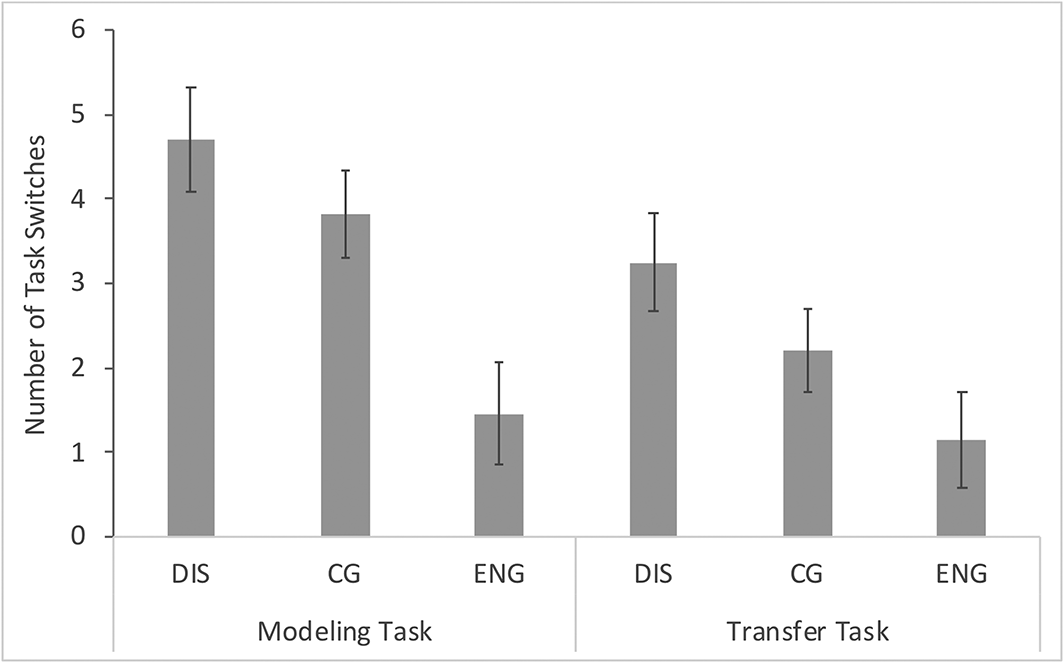
Number of task switches in the modelling task (logic puzzle) and the transfer task (Wimmelbilder) in Study 1. DIS = disengagement group, ENG = engagement group, CG = control group. Error bars = 95% confidence interval.
Regarding the transfer effect, we obtained a significant main effect of group with the Wimmelbilder, F(2, 81) = 13.60, p < .001, ηp2 = .25. As hypothesized, observers in the disengagement group (M = 3.25, SD = 1.45) switched to a new task more often than participants in the control group (M = 2.21, SD = 1.67), mean difference = 1.04, BCa 95% CI [0.23, 1.90], d = 0.67. In comparison, observers in the engagement group (M = 1.15, SD = 0.97) switched less often than control group participants, mean difference = −1.05, BCa 95% CI [−1.78, −0.37], d = −0.78 (Figure 1). As hypothesized, this pattern replicates that of the modelling task. However, the effect size for the difference between engagement and control group is smaller.
Considering the control variables, models reported overall that the instruction fit their typical behaviour in such situations somewhat or to a good degree [M = 3.44, SD = 1.13; no significant difference between groups, t(46) = −1.58, p = .122] and that they were able to implement the instruction well [M = 3.81, SD = 0.87; no significant difference between groups, t(46) = −1.24, p = .223]. We conducted separate correlations for the two experimental groups between switching behaviour in the two tasks and the control variables. Observers in the engagement group switched less often in the puzzle task the more their partner felt that the instruction matched their typical behaviour, r(23) = −.43, p = .033. Moreover, observers in the disengagement group switched more often in the transfer task the more their partner felt that they were able to implement the instruction, r(21) = .48, p = .021. In both cases, the observer imitated the model more when the model felt more able to conform to the instruction. There were no other significant correlations, ps > .247.
Brief Discussion
Study 1 replicated the findings of Thomsen et al. (2017). Partners observed their partners’ goal regulation processes and applied them in the same task when being confronted with difficulties in goal pursuit. This corroborates the correlational finding of Tuskeviciute et al. (2018) that partners imitate their partners’ coping behaviour on a day–to–day basis with an experimental approach. Moreover, Tuskeviciute et al. (2018) showed that partners applied a particular coping behaviour for different problems than the one their partner was dealing with. In line with this finding, the transfer effects to a previously unobserved task in the present study indicate that the observed goal regulation process is also applied to a different setting. This finding also indicates that the observed action is interpreted in terms of goal regulation processes by the observer and then generalized to a conceptually similar task. The findings of the validation study corroborate this interpretation given that observing partners were able to identify their partner's goal regulation processes.
The findings of the control variables suggest that our study potentially underestimates the effect of modelling because it is partially dependent on the degree of the models conforming to the instruction. However, the small sample size undermines the calculation of a moderation analysis to test the effect more profoundly. The finding points to a further potential boundary condition of observational learning—authenticity of the model. That is, if models perform a behaviour that is not congruent with their beliefs or attitudes, observers might be sensitive to this incongruence and deem the observed behaviour as less trustworthy and, thus, be less prone to imitate it. This might be comparable with the effects of reliability of the model as investigated in children's social learning (e.g. Crivello, Phillips, & Poulin–Dubois, 2018; Koenig & Harris, 2005). However, future research should systematically investigate the effect of authenticity in adult observational learning.
Study 2
Hypotheses
In Study 2, we tested not rewarding the model for their behaviour upon encountering difficulties in goal pursuit as a boundary condition for modelling and transfer effects. Even though a lack of praise was assumed to reduce imitation behaviour, we still expected imitation of goal regulation processes, because the romantic partner might still be a point of reference for one's own behaviour in an ambiguous situation concerning the best course of action. Hence, we hypothesized that observing partners in the engagement group would still switch less often than observing partners in the disengagement group even though their partners would not be praised for their actions. The hypotheses were not officially preregistered, but the hypotheses and design were determined before data collection and analyses as part of a grant proposal.
Methods
Participants
Fifty–seven opposite–sex couples and three same–sex couples took part in this study (M = 25.9 years, SD = 5.3 years, 18–46 years; 61 women). Most of the participants (97%) had Abitur (qualification for university entry). Half of the participants were living with their partner, and 10% had at least one child. Their relationship was on average 4.7 years long (Med = 2.6 years, SD = 4.5 years, 0.8–27.3 years). Two additional couples were excluded from the analysis because in one, the model did not comply with the instructions and the other couple aborted data collection due to private issues. Participants did not differ between conditions with regard to age and relationship duration, ts(58)≤|−1.17|, ps≥.248. Moreover, participants did not differ between conditions concerning cohabitation, having at least one child, and having at least Abitur, Χs2(1)≤0.33, ps≥.796. Participants were recruited via flyers on campus, at bars, restaurants, and sports clubs and via social media. Couples received 12 euro and one of three restaurant coupons for participation.
There were very large effect sizes of the difference in switching frequency between the disengagement and engagement group in Thomsen et al. (2017; d = 2.39) and in Study 1 (puzzle: d = 2.20; Wimmelbilder: d = 1.72). However, we assumed that differences between the groups without praising the model would be smaller, which is why we based the power analysis on a large effect size (d = 0.81 or ηp2 = .14, respectively) instead of the much larger effect in previous studies. We conducted a power analysis for a repeated measures ANOVA (group: engagement versus disengagement, between–subjects; task: puzzle versus Wimmelbilder, within–subjects) employing G*Power (Erdfelder et al., 1996). The analysis indicated that we needed a minimum of N = 40 participants in total to achieve 80% power for detecting a large–sized main effect of experimental group (d = 0.81 or ηp2 = .14, respectively) between groups (disengagement versus engagement) in a repeated measures ANOVA (type of task: modelling task versus transfer task; within–subjects) when employing the traditional .05 criterion of statistical significance.
Material
We employed the same measures for the modelling as well as the transfer task as in Study 1.
Procedure
Again, ethical approval was obtained from the university's IRB; research was conducted according to the Declaration of Helsinki. The procedure paralleled that of Study 1 (without control group). Participants were randomly assigned to the engagement or disengagement group and being in the role of the model or observer. Importantly, instead of receiving praise for the displayed strategy, the model was only thanked for playing the game.
Results
To test group differences in goal regulation processes in the modelling and the transfer task, we conducted a repeated measures ANOVA with task (modelling versus transfer) as a within–subject factor, group (disengagement versus engagement) as a between–subject factor, and number of task switches as the dependent variable. We obtained a significant main effect of task, F(1, 58) = 21.43, p < .001, ηp2 = .27, with overall fewer task switches in the Wimmelbilder task (M = 1.97) than in the puzzle task (M = 2.80). Importantly, we found a main effect of group, F(1, 58) = 7.58, p = .008, ηp2 = .12 (Figure 2). Participants in the disengagement group switched more often than participants in the engagement group (puzzle: MDisengagement = 3.28, SD = 1.87, MEngagement = 2.32, SD = 1.49, mean difference = 0.95, BCa 95% CI [0.14, 1.74], d = 0.57; Wimmelbilder: MDisengagement = 2.52, SD = 1.70, MEngagement = 1.42, SD = 1.31, Mean Difference = 1.10, BCa 95% CI [0.30, 1.86], d = 0.73). 4
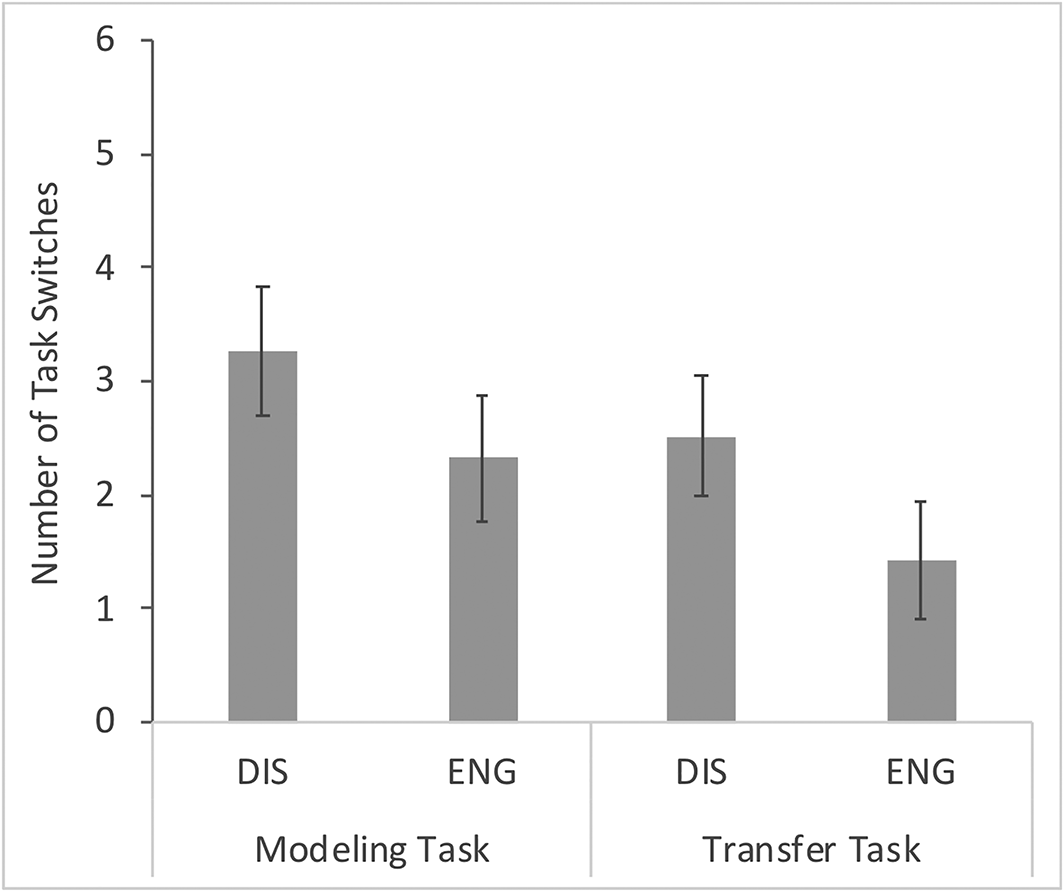
Number of task switches in the modelling task (logic puzzle) and the transfer task (Wimmelbilder) in Study 2. DIS = disengagement group, ENG = engagement group. Error bars = 95% confidence interval.
Given that we did not vary the effect of praise versus no praise within one study, we exploratorily tested the two studies’ differences in effect sizes between the engagement and disengagement group for the modelling task and the transfer task. 5 The effect size for the difference between the disengagement and the engagement group in the number of task switches in the modelling task in Study 1, d = 2.20, was significantly different from the effect size in Study 2, d = 0.57, z = 3.65, p < .001. For the transfer task, the difference between effect sizes (Study 1: d = 1.72; Study 2: d = 0.73) was also significant, z = 2.65, p = .008. In both tasks, the difference between the disengagement and engagement group in the number of task switches was significantly smaller when the model was not praised.
Brief Discussion
In Study 2, we tested the relevance of praising the model's goal regulation for the extent of imitation in the modelling and transfer task. We found that observers still imitated their partner's goal regulation process although to a smaller extent when their partner was not explicitly praised for their strategy. Exploratory analyses indicated that a lack of vicarious feedback in the form of praise particularly reduced the extent of imitation in the same task but influenced imitation in the transfer task to a smaller degree.
General Discussion
In the present studies, we examined whether observing a partner coping with obstacles in goal pursuit influences the observer's behaviour in the same task and whether this effect is transferred to another task where no goal regulation has been observed beforehand as an indication of generalization of the observed action. Moreover, we investigated vicarious feedback in the form of praising the model as a boundary condition for the imitation of goal regulation processes in the modelled and the transfer task.
We found that observers were more likely to pursue the original goal upon encountering difficulties in both tasks if they had observed their partner pursuing a goal tenaciously. In contrast, observers more often disengaged in both tasks if they had observed their partner doing so. These results replicate previous findings (Thomsen et al., 2017) and extend them in showing that modelling effects of goal regulation processes in romantic relationships transfer to other tasks at least in the short term, emphasizing that generalization occurred and goal regulation processes were applied in a similar situation. We do not necessarily assume that these effects hold for a longer time upon a one–time experience, and we certainly do not claim that observational learning is the only pathway to change dispositional goal regulation processes in adulthood. However, initiating imitation would be a prerequisite to implementing long–term changes in dispositional goal regulation processes via observational learning. Cumulative experience of observing certain goal regulation processes of their partner and applying them themselves (successfully) could work in shaping persistent change in dispositional use of goal regulation processes instigated by observational learning processes. The increasing concordance of coping strategy use (Holahan et al., 2007) provides correlational evidence for this assumption. However, longitudinal experimental designs are needed to empirically test this assumption.
Our findings concur with other studies showing the important role of intimate relationships in shaping each other (Eckenrode, 2013; Rusbult et al., 2009). While Tuskeviciute et al. (2018) used a correlational design and showed that a pathway of the romantic partner's influence on coping behaviour transpires via observational learning, our studies provide empirical support for this pathway with an experimental approach. However, the present research cannot make a statement about a special role of romantic partners in imitating goal regulation processes and underlying processes if that is the case. Future research should investigate observational learning in other social relationships (e.g. colleagues or friends). Here, it could also be interesting to examine which specific aspects of a relationship with others are relevant for observational learning (e.g. subjective closeness, trust, interdependency, or time spent together) that are fulfilled by default in romantic relationships (such as interdependency, see Giesen et al., 2018).
Interestingly, in Study 1, the effect size in the transfer task was smaller than in the modelling task. One explanation could be the absence of the demand effect in the transfer task imposed by the presence of the partner in the modelling task, such as not wanting to make their partner feel stupid by choosing a different strategy (i.e. the model was in the same room when the observer worked on the modelled task but in a separate room when the observer worked on the transfer task). However, this explanation seems unlikely because the model was praised for their strategy by the experimenter in Study 1; therefore, choosing a different strategy would conflict with the partner and the experimenter. Moreover, in Study 2, the effect size without praising the model was much smaller in the modelling task, but there is no reason to assume that observing partners would be more willing in this situation to embarrass their partner by choosing a different strategy. Additionally, the effect size in the transfer task was descriptively larger than in the modelling task in Study 2 although the partner was absent when working on this task as well. Finally, the effect size in the transfer task of Study 1 was still very large (and of medium size in Study 2); thus, demand effects in the presence of the partner would—if at all—only partially contribute to the finding of imitation effects. Another explanation for a smaller effect in the transfer task might be that people differ in their interpretation of similarity of the situation to apply a learned action in this situation or the degree of generalization of an observed action. Future studies could investigate factors influencing the interpretation of a situation as conceptually similar. Moreover, when working on the modelled task, observing partners—as their partners before—were not successful in solving one of the puzzles, which might have reduced their willingness to apply the observed action to another task. This would be an effect of directly experiencing (negative) consequences of the imitation of an observed action, which might influence application in future situations.
Observing vicarious consequences of an action has been demonstrated to be influential for the performance of an observed action, that is, its imitation, independent of its acquisition (Bandura, 1965). To gain a deeper understanding about this boundary condition for the observational learning process, we investigated the role of vicarious feedback in the form of not praising the model for their goal regulation process. We found that observers were still imitating their partner's actions, that is, there was still a difference between the two experimental groups. Thus, observers were using their partner's behaviour to orient their own response to difficulties in goal pursuit. This is relevant given that consequences of actions are not always immediately visible and partners might provide direction for how to cope with difficulties particularly in new but also familiar problem situations. Unfortunately, the absence of a control group without a model in Study 2 does not allow conclusions to be drawn as to whether the lack of praise of the model affects the imitation of both goal regulation processes to the same extent.
Moreover, given exploratory testing, we observed smaller effect sizes for the imitation of goal regulation processes in settings with a lack of praise compared with praise particularly in the same task. This finding tentatively corroborates observational learning theory, which postulates that performance of observationally learned responses is regulated by incentive processes (Bandura & Jeffery, 1973). However, Fryling, Johnston, and Hayes (2011) pointed out that, while observations of aversive consequences seem to be very relevant for performance, observations with reinforcement versus no consequences at all do not seem to make a difference. The present studies suggest that praise plays a role for performance as well. Future studies should examine the relevant conditions when praise (or rather desirable consequences) influences the observers’ performance.
Interestingly, the effect size difference between conditions with and without praise was much more pronounced in the modelling compared with the transfer task. That might be the result of methodological constraints. Given that average task switches were smaller in the transfer task, similar effect size differences with and without the model's praise might be more difficult to uncover due to floor effects. However, we still obtained medium–sized effect sizes in the transfer task (descriptively even larger than for the modelling task), suggesting that the modelled action was generalized and transferred to another situation upon encountering difficulties in goal pursuit. Lack of praise might be more relevant for the imitation of an action in the same task but—given generalization—be less relevant when applying the action to another task where vicarious feedback has not been observed, thus allowing the possibility that the action (here, a particular goal regulation process) might be applicable and expedient in a different situation.
Another interesting aspect is the fact that the models received external feedback for their behaviour. The question arises as to which consequences observers see as valid for motivating the imitation of goal regulation processes. An avenue for future research could be measuring the observer's perceived success of the model. As explained, immediate and direct feedback on the usefulness of the respective goal regulation process might often not be available. However, observers might still try to determine the success of the goal regulation process. Future research could focus on investigating factors that influence this interpretational process and its consequences for imitation.
Moreover, future studies could examine further boundary conditions for imitation of both goal regulation processes. Candidates could be, for instance, the salience of the modelled behaviour, the consistency of the model (i.e. does she/he always behave in this way in the same situation), the importance of the goal, or relationship quality. In the present studies, we collected data on relationship duration and quality to describe the sample. Unfortunately, the sample sizes were too small to conduct meaningful moderation analyses to exploratorily examine the role of relationship quality on the extent of imitation. Moreover, relationship quality was very high in the present studies precluding a profound analysis of its effect on imitation given the lack of the full spectrum of relationship qualities.
Furthermore, future studies should investigate the markers or cues observers use to interpret goal regulation processes. One prerequisite might be the ability to identify behavioural intentions (Nurmsoo et al., 2010; for an exploratory test, see Supporting Information). This concerns the question of the perceptibility of the process, that is, how easily can an observer interpret the modelled coping with difficulties as an expression of a particular goal regulation process and what are the factors suggesting its generalizability to other situations. Behaviourally stopping to pursue a goal does not necessarily mean that a person does not still value the goal or think about the goal and, thus, did not disengage from the goal entirely (Wrosch, Scheier, Carver, & Schulz, 2003). In turn, someone might still behaviourally pursue a goal but does not place much meaning in it. Relatedly, for example, recognition of the emotional expressions and experiences of a model and observer's empathy have been identified as a pathway in observational learning of fear reactions (e.g. Askew, Reynolds, Fielding–Smith, & Field, 2016; Olsson et al., 2016). This also relates to the understudied issue of the role of emotional processes as part of goal regulation processes (for a recent theoretical integration, see Moors, Boddez, & De Houwer, 2017). Studying the role of emotions in the observational learning process of goal regulation processes could further elucidate their role in goal regulation processes in general. Given the assumption of different functions of emotions and their role in goal regulation processes (e.g. Frijda, 2010; Koppe & Rothermund, 2017; Kunzmann, Kappes, & Wrosch, 2014; Lench & Levine, 2008), individuals could learn to associate recognized emotions of the model with a certain goal regulation process and stimulus constellation.
Limitations
While the present research has many strengths, it also has several limitations that point to future research directions. First, we employed only one type of modelling task. Although Thomsen et al. (2017) found similar imitation effects in a child sample with a different modelling task, future studies could use a different task to allow generalizations of the effect.
Second, a related limitation concerns the question of ecological validity, that is, in the present studies, the goals were assigned by the experimenter and the outcome was of no major consequence. Although we think that goal engagement and disengagement processes are at play in the specific tasks (as emphasized by the self–reported goal regulatory processes in the validation study) and are exemplary for general goal regulatory processes, we also acknowledge that research that links these kinds of processes in the lab with processes in day–to–day life with personal goals is needed, within a longitudinal experimental design.
Third, we tested transfer effects only after imitation of the goal regulation process in the modelled task. Hence, it is unclear if the transfer effect would be larger or smaller if observed regulation processes had to be applied directly to a new situation.
Fourth, a limitation to the interpretation of Study 2 consists of its lack of a simultaneous randomization of all groups, that is, sampling from the same population and assigning them to the different experimental groups with and without praising the model. However, we took care to sample from a comparable population, which is evident in the same recruitment strategy and similar sample characteristics of the studies. Moreover, means in the modelling task's switching frequency of the experimental groups in Thomsen et al. (2017) and Study 1 were comparable.
Conclusions
The present research contributes to investigating the development of dispositions in the application of goal regulation processes. The studies replicate the finding that observational learning is a possible pathway in the application of goal regulation processes and provides first empirical support that the modelling effect also generalizes to other tasks where no modelling behaviour has previously been observed. It emphasizes the role of social context in shaping regulation processes, in particular, romantic partners. It also provides evidence for boundary conditions (here, praise) of the imitation of goal regulation processes that need to be considered when studying the role of observational learning of goal regulation processes in romantic relationships.
Acknowledgements
The second study was funded by a grant from the authors’ university as part of the university's programme to support submissions of grant proposals. The funding committee had no role in study design, in the collection, analysis, and interpretation of data, in the writing of the report, and in the decision to submit the paper for publication.
Supporting info item
Supporting info item, per2244-sup-0001 - Imitation of Goal Engagement and Disengagement Processes in Romantic Relationships
Supporting info item, per2244-sup-0001 for Imitation of Goal Engagement and Disengagement Processes in Romantic Relationships by Kappes Cathleen, Thomsen Tamara and Fajkowska Małgorzata in European Journal of Personality
Data S1 Supporting Information
Supporting info item
Supporting info item, per2244-sup-0002-Open_Practices_Disclosure_Form - Imitation of Goal Engagement and Disengagement Processes in Romantic Relationships
Supporting info item, per2244-sup-0002-Open_Practices_Disclosure_Form for Imitation of Goal Engagement and Disengagement Processes in Romantic Relationships by Kappes Cathleen, Thomsen Tamara and Fajkowska Małgorzata in European Journal of Personality
Open Practices Disclosure Form
Footnotes
Notes
References
Supplementary Material
Please find the following supplemental material available below.
For Open Access articles published under a Creative Commons License, all supplemental material carries the same license as the article it is associated with.
For non-Open Access articles published, all supplemental material carries a non-exclusive license, and permission requests for re-use of supplemental material or any part of supplemental material shall be sent directly to the copyright owner as specified in the copyright notice associated with the article.
