




Abstract
The present study examined the career goal management strategies of Italian young adults. Based on the dual-process framework of goal management, assimilation and accommodation, which are considered adaptive personal resources, were hypothesized to be associated with young adults’ career goal engagement and career goal disengagement. Perceived employability and career adaptability were also hypothesized to play a mediating role in these associations. A two-time study was carried out among Italian university students (N = 294). The results confirmed that assimilation was positively associated with career goal engagement and perceived employability mediated this relationship. Additionally, assimilation was found to be negatively associated with career goal disengagement, whereas accommodation was positively associated with career goal disengagement. These findings have implications in career counseling and university programs related to young adults’ university-to-work transitions.
Introduction
Setting and pursuing career goals is a critical developmental process for young adults, who are completing university (Chamandy & Gaudreau, 2019). Specifically, the university-to-work transition is a turning point in early career stages in which goals play an ambivalent role. On the one hand, goals are important to give direction and continuity to proactive behaviors that allow individuals to attain their desired outcomes (De Vos et al., 2009). On the other hand, goals turn into sources of dissatisfaction when they are perceived to be unattainable or have become less desirable (Wrosch, Scheier, Miller et al., 2003). Consistently, a number of previous studies have suggested the importance of engaging or disengaging with career goals as adaptive behaviors in today's workplace, in consideration of perceived occupational uncertainties and finite opportunities for goal attainment (e.g. Lechner et al., 2016). In other words, utilizing the most adaptive goal management strategy means being able to effectively use one's personal resources to pursue or abandon goals in accordance with current circumstances.
In line with the dual-process approach to career goal management developed by Haratsis, Hood, and Creed (2015), the current study explored how personal resources, namely, assimilation and accommodation, affect goal management strategies during the transition from university to labor market. Assimilation was expected as associated with optimistic attitudes towards achieving career goals, and, consequently, lead to goal engagement strategies’ implementation. Contrarily, accommodation was expected to facilitate goal disengagement strategies in case of too difficult or unattainable career goals. Furthermore, we were interested in exploring the role of perceived employability and career adaptability, respectively as an appraisal of, and attitude toward, career goals, in mediating the relationship between personal resources and career goal management strategies.
Dual-process approach to career goal management
Haratsis, Hood, and Creed (2015) proposed a model of career goal management in young adults, based on the dual-process framework of goal management developed by Brandtstädter and Rothermund (2002). Brandtstädter and Rothermund (2002) argued that when setting and pursuing personal goals, people face with the dilemma of satisfying two contradictory demands: (1) the need for a sufficiently stable and focused goal that should resist distracting influences; and (2) the need to be open and flexible to new and unexpected circumstances. When the career goal is considered as attainable, people focus on active engagement with that goal (Brandtstädter & Rothermund, 2002; Frazier et al., 2007). Conversely, when the career goal is perceived as too demanding or unrealistic, individuals respond with goal disengagement, as a self-protective strategy that prevents future failure and career distress (Creed et al., 2017; Wrosch, Scheier, Carver, & Schulz, 2003).
Research has shown that goal engagement is important for career goal or job attainment and facilitates higher levels of well-being in younger and older adults (Haase et al., 2008; Praskova et al., 2013). Individuals who engage with their career goals possess judgment or confidence that they can perform context-specific actions and engage in specific activities for goal pursuit (Praskova et al., 2013). When engaging with their career goals, young adults invest in time and effort to attain goals such as exerting extra effort in schoolwork and consulting career counselors, especially when hindrances occur (Lechner et al., 2016; Van Dam et al., 2015). However, goal engagement becomes maladaptive and dysfunctional in disadvantaged circumstances when it is futile and continued unsuccessfully (Heckhausen et al., 2010; Lechner et al., 2016). For young adults, career goal disengagement is considered essential for developmental regulation in university-to-work transition (Dietrich et al., 2012; Heckhausen, 2010).
In their study, Haratsis, Hood, and Creed (2015) confirmed that career goal engagement was fostered by assimilation, whereas career goal disengagement was positively associated with accommodation. In addition, a negative relationship between assimilation and career goal disengagement was found. No relationship between accommodation and career goal engagement was confirmed. Similarly, Praskova and McPeake (2022) demonstrated that greater career goal discrepancy, which refers to the difference between one's current progress and the ideal progression in achieving the goal, was associated with less assimilative and more accommodative tendencies. In terms of outcomes, both assimilative and accommodative strategies showed to be associated to well-being and career satisfaction (i.e. Haratsis et al., 2016).
The mediating role of perceived employability and career adaptability
Despite some promising evidence, there is a lack of literature about the process through which adaptive resources (assimilation and accommodation) affect goal management strategies (career goal engagement and disengagement). Assimilative and accommodative resources were found to be related to self-perceptions, optimism, locus of control, goal attainability, goal importance, goal substitutability, and satisfaction outcomes (Gaudreau & Blondin, 2004; Haratsis, Hood & Creed, 2015; Haratsis et al., 2016; Nurmi et al., 2002). However, no previous studies explored the role of two important constructs in research on young adults’ future career development: perceived employability and career adaptability.
University students and graduates’ perception of employability has been defined as the perceived ability regarding their possibilities for sustainable employment appropriate to their qualification level (Caricati et al., 2016; Rothwell et al., 2008). From a goal-setting perspective, it can be posited as a belief about future goal attainment (Praskova et al., 2015) and has been considered a result of the career self-management process (e.g. Bridgstock, 2009; Okay-Somerville & Scholarios, 2017) that leads to positive outcomes such as psychological well-being, higher university-to-work transition readiness, and career satisfaction (Baluku et al., 2021; Petruzziello & Mariani, 2022; Petruzziello et al., 2022), Consistently, previous studies showed that career goal-performance discrepancy was negatively related with perceived employability (Creed et al., 2017). In that sense, we expected that the perception of employability mediates the relationship between assimilation and goal engagement strategies.
Furthermore, career adaptability has been described as an important resource to “shape adaptive strategies and actions aimed at achieving adaptation goals” (Savickas & Porfeli, 2012, p. 663). It regards a determinant of employment quality and career success during university-to-work transition (Koen et al., 2012; Van Dam et al., 2015). Career adaptability disposes the individual's attitude regarding a goal towards planning and adjusting tendencies, especially in unforeseen circumstances when making choices about one's vocational future (Hartung & Cadaret, 2017). Monteiro et al. (2019) considered career adaptability as a cycles of destabilization that lead to adjust successfully to developmental tasks or job transitions. We argue that career adaptability is congruent with the process of accommodation, which involves individuals adjusting their aspiration levels to given situational constraints (Dietrich et al., 2012). Career-adaptable individuals are actively involved in a never-ending process of evaluating and assessing the self and the environment (Savickas, 2013), so they demonstrate better goal-regulatory behaviors (Goodman, 1994). In relation to this, Tolentino et al. (2013) found a positive relationship between career adaptability and flexible goal adjustment. They suggested that “career adaptable individuals are more likely to readjust their personal preferences and goal orientation in face of situational constraints and changes” (Tolentino et al., 2013, p. 417). Additionally, Spurk et al. (2020) argued that career adaptability could decrease individuals’ efforts in proactive career behaviors due to an over-optimistic perception that important career goals can be achieved. For these reasons, we expect that career adaptability could play a mediating role in the relationship between accommodative resources and career goals disengagement strategies.
The present study
The primary aim of this study was to examine the relationships between adaptive personal resources and career goal management strategies using the dual-process framework of goal management among Italian young adults. Based on the framework's assertion of a dynamic interplay between pursuing and adjusting goals among individuals, we expected:
Assimilation is positively associated with career goal engagement (1a) and negatively associated with career goal disengagement (1b).
Accommodation is negatively associated with career goal engagement (2a) and positively associated with career goal disengagement (2b).
The secondary aim of this study was to understand the indirect effects of adaptive personal resources on career goal management strategies. In relation to this, perceived employability and career adaptability have been identified as important resources in university-to-work transitions (Chong & Leong, 2017; Okay-Somerville & Scholarios, 2017). Despite their importance in young adults’ career goal management, previous research has not yet examined these constructs as mediators in the associations between adaptive resources and career goal management strategies. Thus, we formulated the following explorative hypotheses:
Perceived employability mediates the relationship, respectively, between assimilation and career goal engagement (3a), and, between assimilation and career goal disengagement (3b).
Career adaptability mediates the relationship between accommodation and career goal disengagement.
The hypotheses are summarized in Figures 1 and 2.
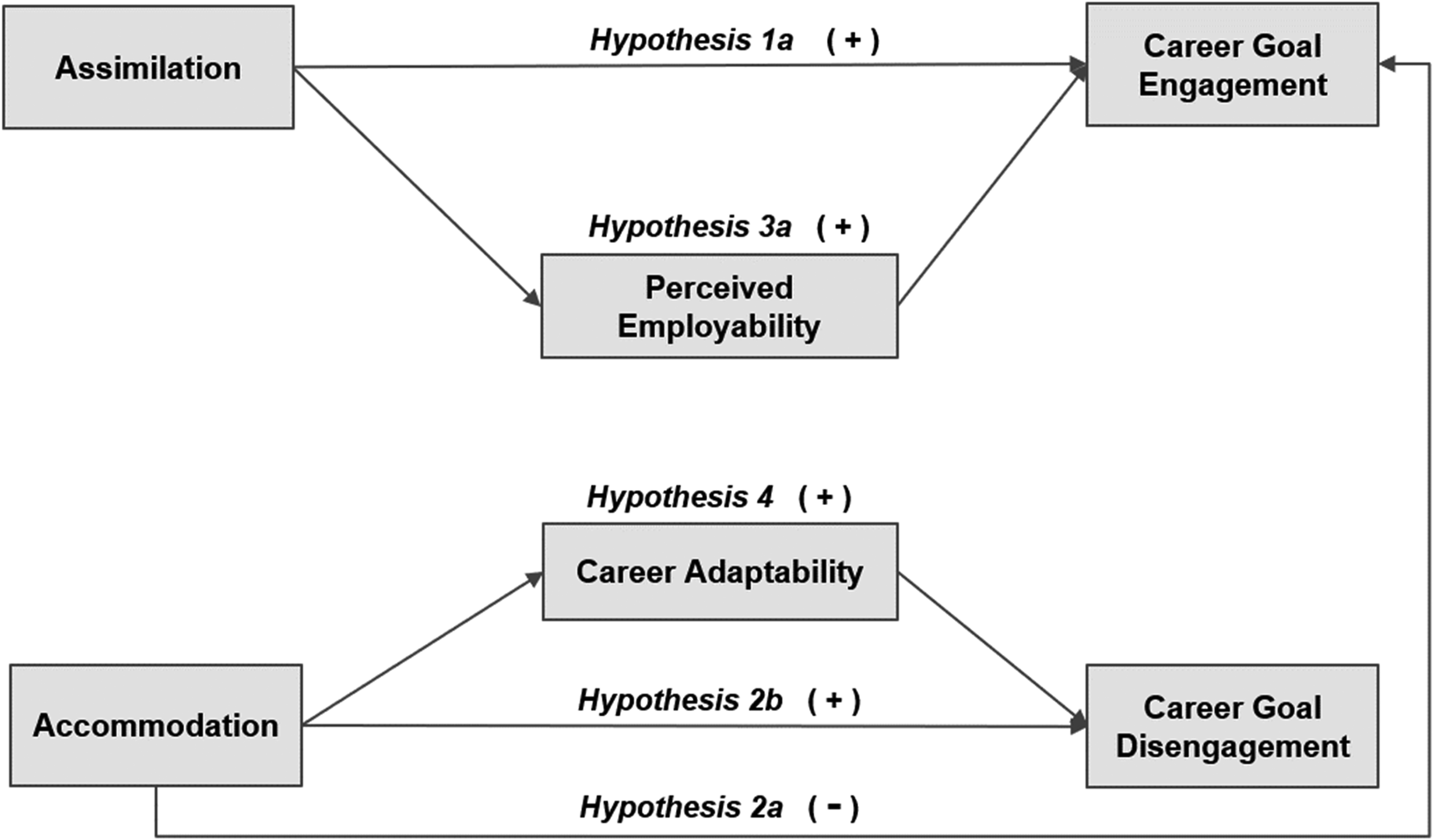
Research model based on the dual-process framework of goal management.
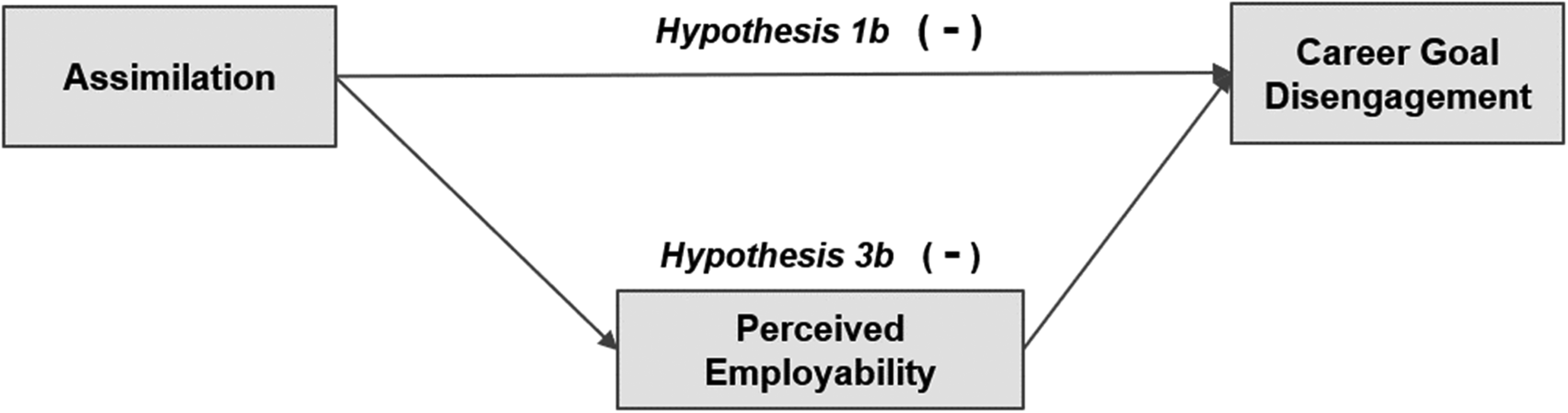
Research model of assimilation and career goal disengagement.
Method
Participants
The study's sample consisted of 294 students from University of Bologna. The participants comprised of 55.4% men and 43.9% women. 81% were attending a bachelor's degree, 13.6% a master's degree, and 4.8% a five-year-long single-cycle degree. The university year levels were as follows: first year bachelor (12.9%); second year bachelor (21.1%); third year bachelor (51.4%); first year master (2%); second year master (11.9%). The disciplinary fields were Humanities and Social Sciences (29.9%) and Science and Technology (69.4%). Two participants in the sample chose not to indicate their gender, degree type, year level, and disciplinary field. According to the a priori G*Power calculation, 107 participants were needed in this study to detect a medium effect size, that is Cohen's f2= .15, with 95% power (α = .05; Cohen, 1988).
Procedure
A two-time survey with a one-month interval was conducted. The data were collected through convenience sampling among students who were attending a soft skills training. The consent of the participants was preliminarily requested, in accordance with Italian privacy law. Only the people who gave their consent became the participants of this study. During the data collection, the participants were instructed to complete a comprehensive Italian questionnaire that contained questions about their socio-demographic information and the measures of the study.
Measures
Assimilation and accommodation
The Italian version (Chiesa & Antonio, in press) of the scale developed by Haratsis, Creed, and Hood (2015) was used to measure participants’ assimilative and accommodative resources. A 6-point Likert scale that ranged from 1 (strongly disagree) to 6 (strongly agree) was used as a response scale to item statements, for example “In general, when I have to do something that's really important to me, and it's really difficult, I usually double my efforts.” A Cronbach's alpha of .88 was reported at T1, and a Cronbach's alpha of .91 was reported at T2. The accommodation subscale reported a Cronbach's alpha of .87 (T1) and .88 (T2).
Career engagement
The Italian version (Petruzziello et al., 2021) of the career engagement scale developed by Hirschi et al. (2014) was employed to measure career goal engagement. A 5-point Likert scale that ranged from 1 (never or almost never) to 5 (always or very often) was used as a response scale to item statements, for example “To what extent have you in the past six months voluntarily participated in further education, training or other events to support your career.” In this study, the Cronbach's alpha values of the scale were .84 (T1) and .88 (T2).
Goal disengagement
The Italian version (Petruzziello & Mariani, 2022) of the goal disengagement scale developed by Wrosch, Scheier, Miller et al. (2003) was adopted in this study. The goal disengagement scale was composed of four items with two subscales: reduction of effort (α = .68) and relinquishment of commitment (α = .74; Wrosch, Scheier, Miller et al., 2003). The response scale ranged from 1 (never or almost never) to 5 (always or very often) for item statements such as “If I have to stop pursuing an important goal in my life, it's easy for me to reduce my effort toward the goal.” In this study, the Cronbach's alpha values of the scale were .72 (T1) and .68 (T2).
Perceived employability
Two items from the Italian version (Caricati et al., 2016) of the scale developed by Berntson and Marklund (2007) were used. Some sample items were: “My competence is sought-after in the labor market”; “My experience is in demand on the labor market.” The response scale ranged from 1 (strongly disagree) to 5 (strongly agree). In the present study, Cronbach's alpha values for the first and second measurements were .60 and .64, respectively.
Career adaptability
The Italian version (Chiesa & Antonio, in press) of the career adaptability subscale from the Career Futures Inventory (Rottinghaus et al., 2005) was adopted in the present study. A 5-point Likert scale that ranged from 1 (strongly disagree) to 5 (strongly agree) was employed as a response scale to item statements such as “I can adapt to change in my career plans.” In the present study, the scale reported Cronbach's alpha values of .78 (T1) and .82 (T2).
Statistical analysis
For the preliminary analysis, descriptive statistics were run and the minimum effect size index of .30 was considered to establish a meaningful correlation among the variables (Cohen, 1988). In relation to the reliability of all the psychological scales used in this study, previous research used the range from .45 to .98 to define acceptable or sufficient values of Cronbach's alpha (Taber, 2018). Each variable was measured twice in this study, that is Time 1 (T1) and Time 2 (T2). For the analysis, all the measures were converted to standard scores.
Following the suggestion of Smith and Beaton (2008) on measuring the change in psychosocial conditions across two time points, we utilized the standardized residual scores to longitudinally measure each variable. We regressed the Time 2 scores on the equivalent Time 1 scores to obtain the Time 1–Time 2 changes through standardized residual scores, which became the unit of analysis for each variable in the study. Positive residual scores indicated an increase in the measured variable, whereas negative scores indicated a decrease in the measured variable. To test hypotheses 1 and 2, we used multiple linear regression analyses to explore the associations among the variables. To test for the mediating effects of perceived employability and career adaptability, we utilized the bootstrapping technique, a nonparametric resampling procedure that involves repeated sampling and estimating the indirect effect in each resampled data set (Preacher & Hayes, 2008). The 95% bias-corrected confidence interval was obtained with 5000 bootstrap resamples in which a significant indirect effect via mediators was determined if the 95% CI does not contain zero. Multiple programs and software were used to run all the statistical analyses, including IBM-SPSS 26.0, AMOS 26.0, and PROCESS 3.4 macro for SPSS (Hayes, 2013).
Results
Table 1 summarizes the descriptive statistics of the psychological variables at Time 1 and Time 2. Four variables measured at Time 2 had one missing score each, so these missing scores were supplied with the mean score of each variable at Time 2 for the data analysis. The median scores for Assimilation and Accommodation in both Time 1 and Time 2 fell in the lower range of scores for the scale, which suggested that the participants generally had low levels of assimilative and accommodative resources. However, the sample was characterized by medium to high levels of career goal engagement, perceived employability, and career adaptability. Whereas the median score of career goal disengagement fell in the lower range of scores for the scale. Table 1 also shows the results of Pearson's correlation analysis.
Descriptive statistics and Pearson correlation indexes among the variables.
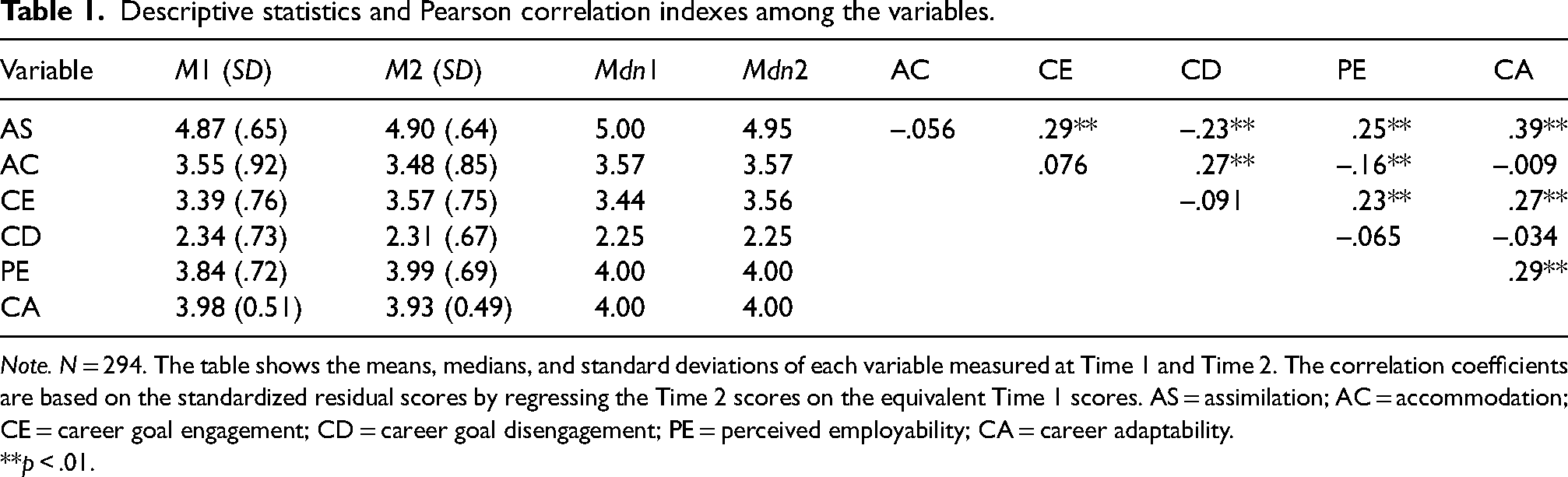
Note. N = 294. The table shows the means, medians, and standard deviations of each variable measured at Time 1 and Time 2. The correlation coefficients are based on the standardized residual scores by regressing the Time 2 scores on the equivalent Time 1 scores. AS = assimilation; AC = accommodation; CE = career goal engagement; CD = career goal disengagement; PE = perceived employability; CA = career adaptability.
**p < .01.
Direct effects of assimilation and accommodation
Testing the effect of assimilation on career goal engagement, the ANOVA model was found to be significant, F(1, 292) = 27.26, p < .001, with 8% of the variance in career goal engagement explained by the model. In accordance with Hypothesis 1a, assimilation was found to have a positive relationship with career goal engagement (β = .29, p < .001). Regarding the effect of assimilation on career goal disengagement, the result of the ANOVA model was also significant, F(1, 292) = 15.88, p < .001, with 5% of the variance in career goal disengagement explained. A statistically significant and negative relationship was found between assimilation and career goal disengagement (β = −.23, p < .001). Consequently, Hypothesis 1b was supported.
Testing the effect of accommodation on career goal engagement, the ANOVA model was found to be not significant, F(1, 292) = 1.67, p = .20. No relationship was found between accommodation and career goal engagement (β = .076, p = .20). Thus, Hypothesis 2a was not confirmed. Conversely, the result of the ANOVA model about the effect of accommodation on career goal disengagement was significant, F(1, 292) = 21.99, p < .001, with 7% of the variance explained. Accommodation was found to have a positive effect on career goal disengagement (β = .27, p < .001). Thus, Hypothesis 2b was confirmed.
Mediating effects of perceived employability and career adaptability
Table 2 shows the bootstrapping results of all the mediation models tested in this study. The results indicated that Assimilation had a significant positive effect on perceived employability, a = .26, SE = 0.057, p < .001, 95% CI = 0.15 to 0.37, and perceived employability had a positive effect on career goal engagement, b = .16, SE = 0.057, p = .005, 95% CI = 0.051 to 0.28. The total effect of the model was significant, c = .29, SE = 0.056, p < .001, 95% CI = 0.18 to 0.40. The bootstrapped unstandardized indirect effect for perceived employability was .042 (SE = 0.018, 95% CI = 0.012 to 0.082), which was statistically significant. These results supported Hypothesis 3a, that means, perceived employability mediated the positive relationship between assimilation and career goal engagement. Contrarily, perceived employability was not found to affect career goal disengagement, b = –.001, SE = 0.059, p = .98, 95% CI = –0.12 to 0.11. Though the total effect of the model was significant, c = –.25, SE = 0.057, p < .001, 95% CI = –0.36 to –0.14, the bootstrapped unstandardized indirect effect for perceived employability was –.0003 (SE = 0.016, 95% CI = –0.032 to 0.032), which was nonsignificant. Perceived employability had no mediating effect in the relationship between assimilation and career goal disengagement. Thus, Hypothesis 3b was disconfirmed.
Mediation models: Bootstrapping results.
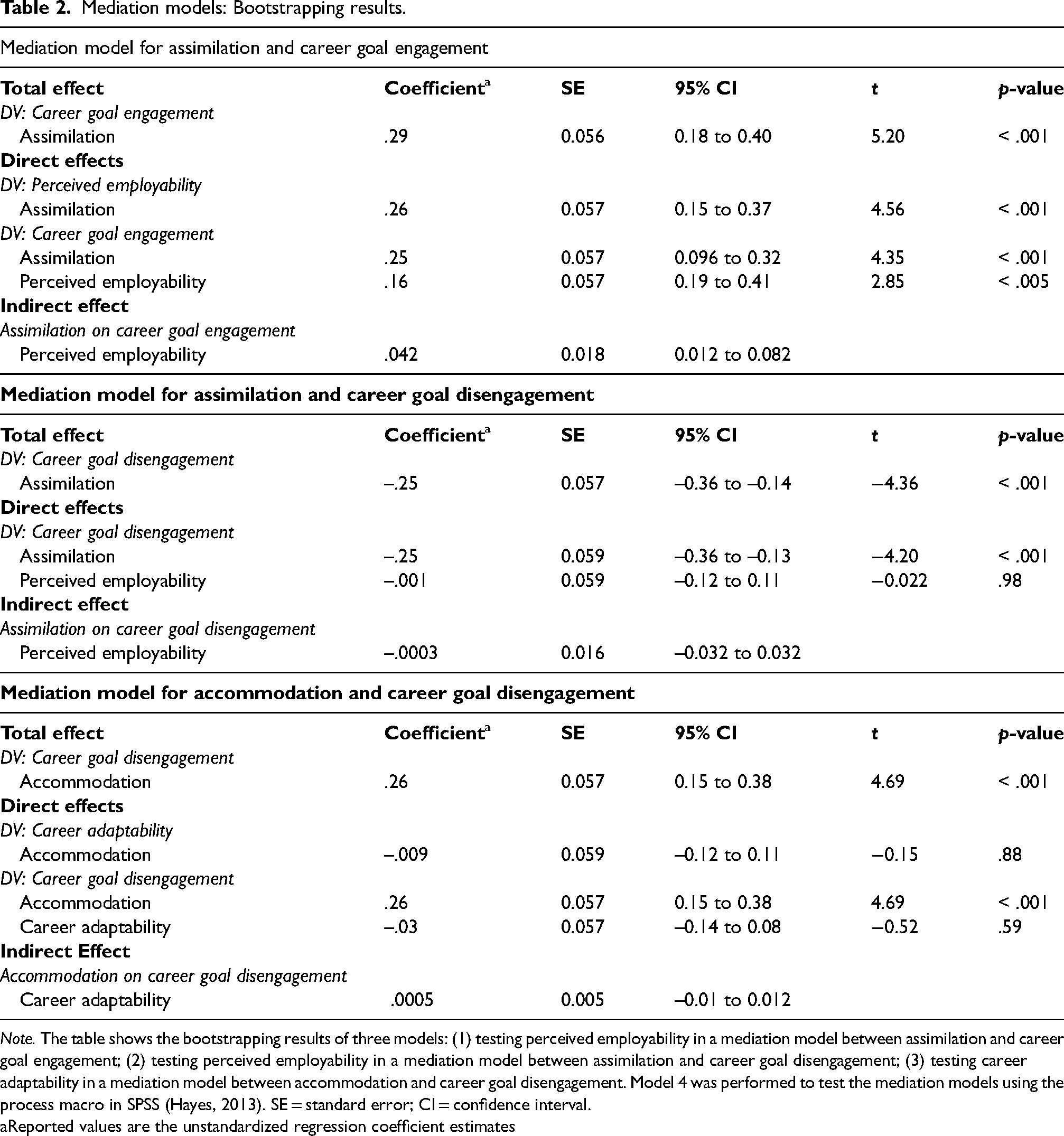
Note. The table shows the bootstrapping results of three models: (1) testing perceived employability in a mediation model between assimilation and career goal engagement; (2) testing perceived employability in a mediation model between assimilation and career goal disengagement; (3) testing career adaptability in a mediation model between accommodation and career goal disengagement. Model 4 was performed to test the mediation models using the process macro in SPSS (Hayes, 2013). SE = standard error; CI = confidence interval.
Reported values are the unstandardized regression coefficient estimates
The results also demonstrated that accommodation had no significant effect on career adaptability, a = –.009, SE = 0.059, p = .88, 95% CI = –0.12 to 0.11, and career adaptability had no significant effect on career goal disengagement, b = –.03, SE = 0.057, p = .61, 95% CI = –0.14 to 0.08. Though the total effect of the model, c = .26, SE = 0.057, p < .001, 95% CI = 0.15 to 0.38, was statistically significant, the indirect effect for career adaptability was .0005 (SE = 0.005, 95% CI = –0.009 to 0.012), which implied a nonsignificant effect. Thus, Hypothesis 4 was not supported, that means, career adaptability had no mediating effect between accommodation and career goal disengagement.
Discussion
The purpose of this study was to examine the relationship between adaptive personal resources (i.e. assimilation and accommodation) and career goal management strategies (i.e. career goal engagement and career goal disengagement) among young adults. We found support for the hypothesized positive association between assimilation and career goal engagement (Hypothesis 1a) and for the negative association between assimilation and career goal disengagement (Hypothesis 1b). These findings reinforce the dual-process framework of goal management assumptions that young adults who use assimilation are more likely to engage with their career goals instead of disengaging with it (Brandtstädter & Rothermund, 2002; Haratsis, Hood, & Creed, 2015). Assimilation involves individuals changing their own behaviors and modifying their environment for the achievement of their goals (Heckhausen & Schulz, 1995). Additionally, young adults who are assimilating are less likely to disengage with their career goals. They do not perceive a goal as unattainable and instead challenge themselves with the difficult goal pursuit, so they can develop their competencies and capital for career success (Van Dam et al., 2015; Wrosch, Scheier, Carver, & Schulz, 2003).
In relation to our second hypothesis, Hypothesis 2a was rejected because no significant association was found between accommodation and career goal engagement, whereas, in consistence with Hypothesis 2b, accommodation was found to be positively associated with career goal disengagement. Similar to the study of Haratsis, Hood, and Creed (2015), these findings could imply that the utilization of accommodative resources does not necessarily impede young adults’ engagement with their career goals. As Brandtstädter and Rothermund (2002) argued, individuals who withdraw from unattainable goals can reengage with more achievable and substitute goals. Thus, the strategy of engaging with career goals is not eliminated by individuals who are accommodating. However, accommodation disengages individuals to unattainable career goals by adjusting personal aspirational level or goal hierarchy (Brandtstädter & Rothermund, 2002; Heckhausen & Schulz, 1995). Choosing to adjust when faced with unobtainable goals implies an adaptive and beneficial behavior for young adults in relation to their well-being and satisfaction (Dietrich et al., 2012; Heckhausen, 2010).
We also found an interesting result in support of Hypothesis 3a. Perceived employability mediated the relationship between assimilation and career goal engagement. With reference to previous studies, assimilation enables young adults to create or maintain high perceptions of employability (Creed et al., 2017; Lechner et al., 2016). Additionally, the demonstrated association between perceived employability and career goal engagement could indicate that perceptions of being able to gain and maintain a job may motivate young adults to engage with their career goals. However, the results did not support Hypothesis 3b. Perceived employability played no mediating role in the association between assimilation and career goal disengagement. This could be interpreted in light of graduates’ positive self-perceptions of career opportunities despite the struggles or difficulties of finding a job when entering the labor market (Jackson & Tomlinson, 2020; Jackson & Wilton, 2017). In this sense, assimilative resources increase the young adults’ persistence in goal pursuit instead of goal disengagement, even when the goal is considered particularly challenging.
Contrary to Hypothesis 4, career adaptability had no mediating effect on the relationship between accommodation and career goal disengagement. Career adaptability has been regarded in the literature as an important career resource for young adults as they navigate unfamiliar environments during their university-to-work transition (Koen et al., 2012; Rudolph et al., 2017; Savickas, 2013). The results of the correlation analysis suggest that career adaptability may play a similar role as perceived employability in the assimilation process and lead to a preference for career goal engagement strategies instead of career disengagement ones.
Theoretical and practical implications
This study contributes to career literature by reaffirming the theoretical relevance of the dual-process framework of goal management (Brandtstädter & Rothermund, 2002). The findings highlight the importance of considering assimilation and accommodation as two parallel processes of career goal management. On the one hand, the results confirmed the importance of assimilative resources in enhancing the young adult's engagement toward their own career goals. In addition, the study contributes to clarify the perceived employability's mediating role in the relationship between assimilation and career goal engagement. On the other hand, we found that assimilation and accommodation have an effect on career goal disengagement, but we failed to characterize the role of perceived employability and career adaptability in the career disengagement process.
The study has practical implications for the career counseling and university-to-work preparation of young adults. Previous researchers have noted young adults’ preference for using assimilation instead of accommodation (Haratsis, Creed, & Hood, 2015; Heckhausen & Schulz, 1995). Thus, career counselors can focus on helping young adults become more cognizant of their accommodative resources. This is in line with Life Design counseling (Savickas et al., 2009), which recognizes the importance of “designing a life that is experienced as satisfactory by individuals on the one hand and that can be redesigned as needs, interests, and life experiences change on the other hand” (Di Fabio & Maree, 2012, p. 100). Considering the significant relationship between accommodation and career goal disengagement, young adults can benefit from using accommodative resources to promote adaptive strategies of disengagement from unrealistic and unachievable career goals. Furthermore, career counselors can highlight the benefits to one's well-being and satisfaction when promoting the practical solution of disengagement from unobtainable career goals (Dietrich et al., 2012; Heckhausen, 2010). Additionally, this study's finding on the significant mediating role of perceived employability in the relationship between assimilation and career goal engagement has implications for university programs and employment centers that educate and improve young adults’ understanding of their career prospects. As labor market trends and economic situations continue to change over time, universities can provide a realistic picture to students of the constraints or challenges they should be aware of in their career endeavors. In doing so, they can help young adults form sensible perceptions of their employability, which will be important for successful goal pursuit, especially among young adults with high assimilative resources.
Limitations and future directions
Though this study revealed interesting results, certain limitations should be considered. Firstly, the psychometric properties of the perceived employability scale can be further improved by enhancing the scale items. Given the significant mediating role of perceived employability in the association between assimilation and career goal engagement, a robust measure of perceived employability can help reinforce the significance and generalizability of this study's findings.
Secondly, the data was collected using self-reported measures. Similar studies can consider using a combination of objective measures, qualitative data, and psychological scales to measure the constructs. For example, interviews can be conducted to deepen the significant findings on the relationships between personal resources (i.e. assimilation, accommodation) and career goal management strategies (i.e. career goal engagement and disengagement). Another example is the use of attendance records in job fairs or career guidance workshops to quantify behaviors related to the career goal engagement and disengagement of young adults.
Thirdly, though significant relationships were found between the study variables, it is hard to draw causal conclusions from the current study design. Thus, other research designs can be adopted such as the use of a longer time interval, for example a timespan of six months to one year, to further probe the significance of the examined relationships in this study. Additionally, in consideration of the dynamic process of assimilation and accommodation among individuals, future studies are also recommended to measure the variables at more than two timepoints and utilize a dynamic path analysis.
Fourthly, the sample was not representative of young adults’ educational backgrounds given that all participants came from a single university in Italy. Future directions from this research can broaden the sample pool and assess the mediating effect of perceived employability in the examined relationships by also taking into account an interactive effect with the individual's educational background.
Lastly, with respect to this study's nonsignificant findings, the mediating role of career adaptability can be reexamined by positing it similarly as perceived employability and regarding it as a mediator in the relationship between assimilation and career goal engagement. As for the relationship between accommodation and career goal engagement, further studies are recommended to assess and extend this relationship by considering career goal disengagement as a mediator between accommodation and career goal (re)engagement. The conditions for career goal disengagement to influence career goal reengagement can also be analyzed by considering the moderating effects of contextual variables, for example school support, family support, and social comparisons.
Conclusion
This study showed the significant effects of assimilation and accommodation on young adults’ career goal engagement and career goal disengagement based on the dual-process framework of goal management. Furthermore, perceived employability was shown to have a mediating effect on the positive relationship between assimilation and career goal engagement. Implications of this study include the planning and implementation of career interventions that can educate and encourage young adults with the adaptive use of their assimilative and accommodative resources in light of the attainability and realistic pursuit of their career goals. As they confront different challenges when entering the world of work, the use of assimilative and accommodative resources can stimulate young adults to utilize both career goal engagement and disengagement as effective and beneficial strategies in their career development. The results of this study can also inform educational policies and practices, for example, in the enhancement of a curriculum or an initiative to increase the exposure and experience of young adults and their envisioned work environment. The tenacity of young adults to pursue their goals, as well as their acknowledgement of when to withdraw from unrealizable goals, can depend on their awareness and knowledge of accessible jobs and careers in their environment. Thus, organizations that are tasked with the professional training of young adults can incorporate activities and programs on their agenda that provide informative or functional experiences for young adults in relation to their chosen career goals. Through these endeavors, young adults can be better guided in making rational decisions and actions to either engage or disengage with their chosen career goals.
Footnotes
Declaration of conflicting interests
The authors declared no potential conflicts of interest with respect to the research, authorship, and/or publication of this article.
Funding
The authors received no financial support for the research, authorship, and/or publication of this article.
