






Abstract
Getting along (i.e. to be liked) and getting ahead (i.e. to be popular) are two fundamental psychological motives that have important consequences for adolescents’ well–being. Especially antisocial behavioural tendencies, which are less well covered by the Big Five than by the HEXACO model, have been shown to differentially predict likeability and popularity. In this study, possible differential relations between personality and likeability and popularity were investigated using the HEXACO Simplified Personality Inventory and sociometric measures of likeability and popularity among 552 (12 to 14 years old) adolescents. Results showed that agreeableness was the most important likeability predictor, whereas extraversion (positive), openness to experience, honesty–humility, and agreeableness (all three negative) were the most important popularity predictors. Facet–level analyses revealed that selected HEXACO facets (greed avoidance, fearfulness, social boldness, gentleness, prudence, perfectionism, aesthetic appreciation, and altruism) most strongly—and in opposite directions—differentiated in the prediction of likeability and popularity. Furthermore, none of the expected interactions but several masking and cancellation effects were observed. The results, which are also discussed in light of interpersonal circumplex, resource control strategies, hierarchical differentiation, and socioanalytic frameworks, suggest that—among early adolescents—differential personality predictors may make it difficult to both get along and get ahead. © 2020 The Authors. European Journal of Personality published by John Wiley & Sons Ltd on behalf of European Association of Personality Psychology
Keywords
Getting along and/or Getting Ahead: Differential Hexaco Personality Correlates of Likeability and Popularity among Early Adolescents
Early adolescence (i.e. 10 through 14 years) is a time of great uncertainty, in which adolescents have to navigate a—by times—harsh and unpredictable social environment (Card, 2010; Pronk & Zimmer–Gembeck, 2010). During this period, in which adolescents start their transition from a parent–dependent childhood to a peer–interdependent adulthood, fulfilling peer belongingness needs constitutes an important adaptive developmental problem (e.g. Bland & DeRobertis, 2017). This adaptive problem can be tackled by adolescents through two reputational pathways, one through likeability and the other through popularity (Cillessen & Marks, 2011; Sandstrom & Cillessen, 2006). Likeability (or social preference, i.e. ‘the degree to which an individual is liked and accepted by peers’; Hubers et al., 2016, p. 1444) and popularity (i.e. ‘the degree to which an individual is perceived as being socially dominant and visible within the peer group’; Hubers et al., 2016) have been found to play an important role during adolescence, being—for instance—related to feelings of self–esteem (De Bruyn & Van den Boom, 2005) and to internalizing and externalizing behaviours (Sandstrom & Cillessen, 2006).
The adaptive ‘belongingness’ problem is relatively straightforward: likeability and popularity are scarce resources, and consequently, not all adolescents can be most liked and popular among their peers. That is, the extent to which adolescents are likeable and popular will vary. A substantial part of this variance is stable, showing systematic cross–temporal and cross–situational interindividual variation (Pullmann, Raudsepp, & Allik, 2006; Sandstrom & Cillessen, 2006), and thus stable traits are likely to play an important role in the prediction of likeability and popularity. Although multiple traits have been hypothesized and found to increase likeability and popularity during early and late (i.e. 15 through 19 years) adolescence and early adulthood (i.e. 20 through 24 years), such as physical attractiveness, athleticism, intelligence, and having a sense for fashion (e.g. Anderson, John, Keltner, & Kring, 2001; Back, Schmukle, & Egloff, 2011; Dijkstra, Cillessen, Lindenberg, & Veenstra, 2010; LaFontana & Cillessen, 2002; Stopfer, Egloff, Nestler, & Back, 2013), in this study, we focus on personality traits.
Studies that have investigated personality predictors of likeability and popularity among adolescents have either relied on the Big Five (or Five Factor) model of personality (e.g. Hubers et al., 2016; Van der Linden, Scholte, Cillessen, Te Nijenhuis, & Segers, 2010) or on a set of separate—theoretically derived—personality predictors (e.g. Cillessen & Borch, 2006; Dijkstra et al., 2010; LaFontana & Cillessen, 2002; Sandstrom & Cillessen, 2006; Wolters, Knoors, Cillessen, & Verhoeven, 2014). Some of these studies have hinted that variables associated with antisocial behaviours, which are closely aligned to HEXACO honesty–humility and agreeableness (e.g. Allgaier, Zettler, Wagner, Püttmann, & Trautwein, 2015; Lee, Ashton, & Shin, 2005), may differentially predict likeability and popularity (Dijkstra et al., 2010; LaFontana & Cillessen, 2002; Sandstrom & Cillessen, 2006). However, up until now, no study has investigated the relations between HEXACO personality and both likeability and popularity among early adolescents.
One of the reasons for this lack of research has been the fact that—until recently—no instrument was available to measure HEXACO personality among early adolescents. In this study, we will use the recently developed HEXACO Simplified Personality Inventory (HEXACO–SPI; De Vries & Born, 2013; De Vries & Van Prooijen, 2019)—which was constructed to be used among (early and late) adolescents and among adults with lower language proficiency levels—to investigate the differential relations of HEXACO traits with sociometric measures of likeability and popularity among early adolescents. This study adds to previous research by (i) investigating the relations between honesty–humility and both likeability and popularity when controlling for the other five HEXACO personality domain–level traits, (ii) investigating whether gender, agreeableness, and extraversion interact with honesty–humility in the prediction of likeability and popularity, (iii) investigating whether broad traits and facets differentially relate to these two sociometric measures, and (iv) investigating whether masking and cancellation effects occur within HEXACO domains in the facet–level associations with likeability and popularity.
Getting along and/or getting ahead
Evolutionary speaking, the two main adaptive developmental problems that generations of adolescents have had to solve during the transitional period between childhood and adulthood are to (i) establish secure bonds with other adolescents in order to form a support network (in–group) that protects against threats of others (e.g. out–group members and, in ancestral times, predators) and (ii) bond with at least one member of the opposite sex in order to secure future offspring. Gaining a reputation as being likeable and/or being popular can be considered two separate pathways to ‘solve’ these adaptive problems. Both for in–group members and for potential partners, being likeable may signal that one is compliant and helpful, and being popular may signal that one is able to obtain resources and get things done. Both likeability and popularity have been found to be important predictors of social self–esteem (De Bruyn & Van den Boom, 2005), which, in turn, has been associated with higher levels of happiness and well–being (Baumeister, Campbell, Krueger, & Vohs, 2003; Östberg, 2003). Consequently, having the ability and/or motivation to get along may ensure that one is liked, and the ability and/or motivation to get ahead may ensure that one becomes popular, which may serve to secure important social, sexual, and material resource goals. In turn, apart from increasing happiness and well–being, such social, sexual, and material resources may confer important evolutionary fitness benefits in terms of in–group protection and mate attraction (e.g. Cheng, Tracy, Foulsham, Kingstone, & Henrich, 2013; Hawley, Little, & Pasupathi, 2002; Hogan & Shelton, 1998; Von Rueden, Gurven, & Kaplan, 2010).
During adolescence, marked differences in behaviours emerge between those who are liked and those who are popular (Cillessen & Borch, 2006). During this time, especially popularity becomes increasingly important (LaFontana & Cillessen, 2010). Whereas correlations between likeability and popularity have been found to be moderate to high in early adolescence, they have tended to decrease in late adolescence (Cillessen & Marks, 2011). That is, preadolescent children do not strongly distinguish between those who are liked and those who are popular, but from early adolescence onwards, this distinction becomes increasingly important as popularity is decreasingly determined by being liked and increasingly determined by the status associated with being able to assert oneself and to get things done. Consequently, and in line with the increasing distinction between likeability and popularity, personality predictors of likeability and popularity may increasingly diverge, creating different pathways for adolescents who are more likely to be liked and those who are more likely to be popular.
Personality predictors of likeability and popularity
What are those personality predictors of likeability and popularity among adolescents? Starting with likeability, the most consistent Big Five/Five–Factor Model (FFM) personality predictors have been found to be extraversion and agreeableness (De Vries, 2011; Hubers et al., 2016; Van der Linden et al., 2010; Wolters et al., 2014; Wortman & Wood, 2011). Of these two, extraversion was found to have the strongest relation with likeability in studies by Hubers et al. (2016) and Van der Linden et al. (2010; De Vries, 2011), in which adolescents who were on average 15 years old were studied. Agreeableness was more strongly correlated with likeability in Wolters et al. (2014), in which adolescents of on average 12 years old were studied. In studies that did not use the Big Five/FFM, likeability was predicted by prosocial behaviours and lack of aggressive or disruptive behaviours (LaFontana & Cillessen, 2002; Sandstrom & Cillessen, 2006; Wolters et al., 2014). 1
With respect to popularity, apart from some mixed relations with agreeableness and conscientiousness, the most consistent Big Five/FFM predictor was found to be extraversion (De Vries, 2011; Hubers et al., 2016; Van der Linden et al., 2010; Wolters et al., 2014; Anderson et al., 2001 for the relation among young adults). In contrast with findings on likeability, however, antisocial and aggressive behaviours were found to be positively (instead of negatively) related to popularity (LaFontana & Cillessen, 2002; Sandstrom & Cillessen, 2006; Wolters et al., 2014). That is, the more popular adolescents are, the more they show antisocial behaviours, whereas the more likeable adolescents are, the less they show antisocial behaviours.
Antisocial behaviours come in many shapes and sizes and have been operationalized in terms of—and/or linked to—psychopathy, Machiavellianism, egoism, unethical behaviours, counterproductive behaviours, delinquency, and criminality in adults (e.g. Muris, Merckelbach, Otgaar, & Meijer, 2017; Neumann, Hare, & Pardini, 2015). The differences in relations of antisocial behaviours with likeability and popularity are especially interesting because antisocial behavioural tendencies are not as well–covered in the Big Five/FFM model as in the HEXACO model of personality. In comparisons between the HEXACO model and the Big Five/FFM model, the HEXACO model—through its addition of honesty–humility—has been found to outperform the Big Five/FFM model in the prediction of psychopathy, Machiavellianism, and narcissism (i.e. the Dark Triad; Paulhus & Williams, 2002; Lee & Ashton, 2005, 2014), egoism (De Vries, De Vries, De Hoogh, & Feij, 2009), unethical business decisions (Ashton & Lee, 2008), and counterproductive work behaviours (Pletzer, Bentvelzen, Oostrom, & De Vries, 2019; Pletzer, Oostrom, Bentvelzen, & De Vries, 2020). In research on the relations between HEXACO personality and antisocial/aggressive behaviours, HEXACO honesty–humility was typically found to be the best (negative) predictor of adolescent bullying (Provenzano, Dane, Farrell, Marini, & Volk, 2018; Volk, Provenzano, Farrell, Dane, & Shulman, 2019; Volk, Schiralli, Xia, Zhao, & Dane, 2018), proactive aggression (Book, Visser, Volk, Holden, & D'Agata, 2019; Dinić & Wertag, 2018; Sokolovska, Dinić, & Tomašević, 2018), relational aggression (Knight, Dahlen, Bullock–Yowell, & Madson, 2018), antisocial behaviours at school (Allgaier et al., 2015), and sadism (Plouffe, Saklofske, & Smith, 2017).
Whereas adolescents who show antisocial behaviours are often not well–liked, they may—through their use of physical and verbal aggression—be able to gain social and material resources and—through these resources—positions of social dominance in their peer group (cf. resource control theory; Hawley, 2003). In a cross–cultural (Canadian/Chinese) study, Volk et al. (2019) found that not only did honesty–humility have a direct negative relation with social dominance but also indirectly through bullying. That is, lower levels of honesty–humility were associated with higher levels of bullying and higher levels of social dominance. Consequently, whereas honesty–humility may be unrelated or positively related to likeability, it may—in contrast—be negatively related to popularity.
Boundary conditions
Some boundary conditions to the negative relation between honesty–humility and popularity may be present. First, boys (and men) are more likely to exhibit (overt) antisocial behaviours than girls (and women) (e.g. Vaillancourt, 2005; Van de Schoot, Van der Velden, Boom, & Brugman, 2010), and consequently, such behaviours may be deemed more acceptable for boys than for girls. In line with this argument, Cillessen and Borch (2006) found an interaction between gender and overt antisocial behaviours (overt aggression) in the relation with popularity such that the positive relation between antisocial behaviours and popularity was stronger for boys than for girls. However, not all studies have been conclusive with respect to such an interaction effect. Although Parkhurst and Hopmeyer (1998) found a similar interaction, mixed findings (e.g. either null or opposite) results have also been noted (Lease, Kennedy, & Axelrod, 2002; Rose, Swenson, & Waller, 2004). Thus, this study will test whether the relation between antisocial tendencies, as conceptualized using the honesty–humility domain scale, interacts with gender in the prediction of popularity, and we expect that among girls this negative relation is weaker than among boys.
Second, resource control theory (Hawley, 2003) suggests that adolescents who use both coercive and prosocial controlling behaviours are more likely to ascend the social dominance hierarchy. In a study by Zeigler–Hill, Southard, and Besser (2014), bistrategic and coercive control were most strongly associated with the dark triad traits narcissism, Machiavellianism, and psychopathy (Paulhus & Williams, 2002), traits that are very strongly associated with the low pole of honesty–humility. Prosocial control was most strongly associated with (Big Five) agreeableness. The bistrategic resource control theory thus may suggest that a combination of low honesty–humility (proactive antisocial behaviours) and high agreeableness (absence of reactive aggressive behaviours and presence of prosocial behaviours) may work best to obtain valued resources, and through these resources, to become popular. Thus, an expectation from this line of reasoning may be that honesty–humility and agreeableness interact in the prediction of popularity, with the highest level of popularity for those who are low on honesty–humility and high on agreeableness.
Third, the relation between (low) honesty–humility and popularity may be especially strong for those high on extraversion. With low levels of extraversion, an adolescent will not draw much attention and consequently will be highly unlikely to become popular. As a case in point, in LaFontana and Cillessen's (2002) and Wolters et al.'s (2014) study, social withdrawal (low extraversion) was (strongly) negatively related to popularity. When somebody does not draw much attention, being high or low on honesty–humility may not make much of a difference; in both cases, the behaviour is not likely to draw attention. However, when a person is high on extraversion, self–enhancing and antisocial low honesty–humility behaviours are more likely to get noticed and to be influential (De Vries, 2018). For instance, in a study by Oh, Lee, Ashton, and De Vries (2011), honesty–humility and extraversion were found to interact such that dishonest extraverts were found to be most likely to show delinquent behaviours. More specific to this study, Wolters et al. (2014) found extraversion to interact with both prosocial and antisocial behaviours in the prediction of adolescent popularity, such that among those high in extraversion, the relations between prosocial and antisocial behaviours and popularity were stronger. Consequently, we expect that extraversion moderates the relation between honesty–humility, with stronger negative relations between honesty–humility and popularity for boys who are higher on extraversion.
Differential prediction
Apart from the boundary conditions noted above, to get a better grip on the reasons and underlying processes involved in getting along and/or getting ahead, a more fine–grained investigation of the facets that are related to likeability and popularity is warranted. In studies investigating trait predictors of likeability and popularity, researchers have generally focused on either a limited number of broad traits or a limited number of more specific behaviours. Studies that have compared the predictive validity of specific behavioural tendencies (e.g. facets) with those of broad traits (e.g. domains) have been notoriously lacking. This would not be a problem if all facets, when compared with their respective domains, have a similar, or weaker, relation with the criterion of interest. However, it may constitute an important problem if facets of the same domain have differential relations with a criterion variable. In such cases, facets may tell us more than broad domains about the exact nature and meaning of the relations observed.
In the debate about whether domains or facets are more useful for the prediction of criteria (i.e. the bandwidth–fidelity dilemma; Cronbach & Gleser, 1957), some researchers have found evidence for the superiority of domains in the prediction of criteria (i.e. supporting the usefulness of ‘broad bandwidth’ traits; Ones & Viswesvaran, 1996; Salgado et al., 2015), whereas others have found evidence for the superiority of facets (i.e. supporting the usefulness of ‘high fidelity’ facets; Ashton, 1998; De Vries, De Vries, & Born, 2011; Paunonen & Ashton, 2001; Soto & John, 2019). In the former case, the relations of facets with a criterion are generally weaker than those of the domain with the criterion, and consequently, all underlying behaviours of a generic trait may be important prerequisites for the criterion investigated. In the latter, some facets show stronger relations, and others show weaker relations with the criterion. In this—differential prediction—case, some behaviours may consequently be more important than others.
Differential prediction may come about through masking or cancellation effects (Hastings & O'Neill, 2009; Pletzer et al., 2020; Tett & Christiansen, 2007). A distinction can be made between ‘weak’ and ‘strong’ masking and cancellation effects. In general, the most important conditions of a masking effect are that the domain variable is significantly related to a criterion and that at least one of its facets has a stronger relation than the domain with the criterion and one of its facets has a weaker relation than the domain with the criterion. A weak masking effect occurs if these conditions are met and (i) the correlation of a facet (f1) with the criterion is significantly stronger than the correlation of a second facet (f2) with the criterion (C), that is rf1–C > rf2–C and (ii) the correlation of one of the two facets with the criterion is significantly different from the correlation of its domain (d) with the criterion, that is either rf1–C > rd–C or rf2–C < rd–C. A strong masking effect occurs if all the above conditions are met, that is rf1–C > rf2–C, rf1–C > rd–C and rf2–C < rd–C.
Weak and strong cancellation effects are similar to the masking effects described above with one exception: in contrast with masking effects in which the domain is significantly (positively or negatively) related to the criterion, in a cancellation effect, there is no significant relation between the domain and the criterion whereas at least one facet has a significant positive (or negative) relation with the criterion. A weak cancellation effect would be one in which the above is true (i.e. no significant correlation of domain with criterion and at least one facet that is significantly correlated with the criterion), rf1–C > rf2–C is true and either rf1–C > rd–C or rf2–C < rd–C is true. Finally, in a strong cancellation effect, all the above conditions are true (domain not significantly related to the criterion, one facet significantly related to the criterion, plus rf1–C > rf2–C, rf1–C > rd–C, and rf2–C < rd–C). To improve our understanding of the underlying facets—and thus more specific behavioural tendencies—that may explain likeability and popularity, investigating such masking and cancellation effects is of paramount importance.
The present study
In the present study, we investigated the relations between HEXACO personality and both likeability and popularity among early adolescents. The hypotheses were not preregistered, but—based on the literature described above—we expected extraversion to be positively related to likeability and popularity, agreeableness to be positively related to likeability, and honesty–humility to be negatively related to popularity. Because the likeability and popularity measures were derived from nominations that participants received from their classmates, it can be argued that these measures may depend—to some extent—on within–classroom friendship connections. If so, any empirical relations between personality on the one hand and likeability and popularity on the other hand may be affected by friendship and may therefore be only indirect. To examine this possibility, we asked our participants to also indicate which classmates were their friends. When examining the empirical relations between personality and likeability and popularity, we also checked for the effect of friendship nominations by including it as a control variable when analysing the relations between personality on the one hand and likeability and popularity on the other.
Additionally, we investigated whether gender, agreeableness, and extraversion moderated the relation between honesty–humility and popularity. Although, based on the literature, we only expected the relation between honesty–humility and popularity to be moderated, with a stronger relation between honesty–humility and popularity among boys, among those high on agreeableness, and among those high on extraversion, and we also tested for these same interaction effects in the relation between honesty–humility and likeability. Furthermore, consistent with the idea that there are two different pathways to fulfil belongingness needs, we explored whether—and to what extent—personality facets differentially predict likeability and popularity. We also explored whether masking and cancellation effects occurred in the prediction of likeability and popularity, providing a better understanding of the underlying behaviours involved in becoming likeable and popular. The strength of this study is that we relied on self–ratings of personality among adolescents using the recently developed HEXACO–SPI (De Vries & Born, 2013; De Vries & Van Prooijen, 2019) and on peer nominations of both likeability and popularity, thus providing independent assessments of the key variables in our study.
Method
Data, syntax, and supplemental files of this project are available at https://bit.ly/2Xq04f3.
Participants
Data were collected in 29 seventh grade and eighth grade classrooms of two Dutch secondary schools. The first school (‘X’) was located in a medium–sized city in the north–western part of the country, and the second school (‘Y’) was located in a large city in one of the country's western provinces. In both schools, teaching was at the level of senior general secondary education or university preparatory education. In compliance with Institutional Review Board guidelines, passive parental consent and active participant consent were obtained. Specifically, the parents or guardians of all potential participants (N = 752) received an informed consent letter to which they could respond if they did not want their child to participate in the study. Not all potential participants received parental permission or actively opted out of the study before testing (n = 107; 14.2%). Another 93 (12.4%) potential participants provided initial consent, but opted out of the study during testing (e.g. lack of motivation or time constraints). The final sample consisted of 552 adolescents (49.3% male participants; Mage = 13.4 years, SDage = 0.8 years). The post hoc determined statistical power (β) with probability (α) of .05 in a sample (N) of 552 respondents to find a small to medium effect size (p) of .15 (Funder & Ozer, 2019) was .97. In school X, most participants were born in the Netherlands and had parents who were born in the Netherlands (n = 237; 83%). In school Y, this was true only for a minority of the participants (n = 96; 36%).
Instruments
Likeability and popularity
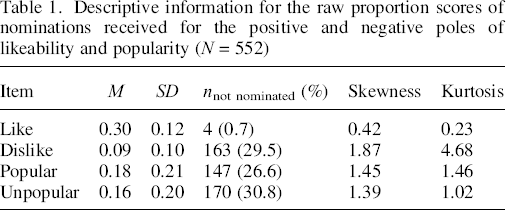
Likeability was measured following standard procedures by asking participants to nominate classmates they liked most and classmates they liked least. Popularity was similarly measured following standard procedures by asking participants to nominate both popular and unpopular classmates. In line with Cillessen and Marks’ (2011) recommendations, no definitions for these terms were provided, and in both cases, unlimited nominations were allowed. Proportion scores were calculated for all four peer nominations by dividing the number of nominations received by number of nominating classmates. The distributions of all proportion scores were left–skewed—with many participants not being nominated—and kurtotic (Table 1), although this was less apparent for received like most nominations. Therefore, and in line with standard procedures in the developmental peer relations literature, final likeability scores were calculated as the within–class standardized difference between the within–class standardized proportion score for received like most nominations and the within–class standardized proportion score for received like least nominations. That is, the nomination proportion scores were within–class standardized before and after subtraction. Note that this procedure gives equal weight to the received like least and like most proportion scores, irrespective of the actual numbers of received nominations underlying each score. This is because differences between the like most versus like least scores in terms of the number of underlying nominations might well be nominator–related rather than nominee–related. Participants might, for example, be more willing to nominate their classmates on positive attributes than on negative attributes. Popularity scores were computed in an analogous way. For all participants, popularity nominations were obtained first, followed by likeability nominations. A more detailed description of the proportion scores distributions is provided in section I of the Supporting Information.
Descriptive information for the raw proportion scores of nominations received for the positive and negative poles of likeability and popularity (N = 552)
Friendship nominations
In the same way participants provided likeability and popularity nominations, they provided unlimited nominations of classmates whom they considered to be a friend using the single item “Who in the classroom are your friends?”. Received friendship nominations were within–class standardized.
Hexaco–Simplified Personality Inventory
The HEXACO–SPI was constructed to provide an easy to comprehend questionnaire to measure the six HEXACO dimensions that constitute the HEXACO acronym, that is Honesty–humility, Emotionality, eXtraversion, Agreeableness, Conscientiousness, and Openness to experience. The HEXACO–SPI is especially useful in research among children and people with a more restricted vocabulary (e.g. first–generation non–natives or natives with low educational levels). During its construction, the HEXACO–SPI was tested for comprehensibility among 11–year–old to 13–year–old children (De Vries & Born, 2013). In this stage, with a few exceptions, only items with 100% comprehensibility were retained. This simplification resulted in a 38% reduction of the sentence length in the HEXACO–SPI (i.e. an average of 7.7 words per item vs. 12.4 words in the original HEXACO–PI–R). The HEXACO–SPI consists of 104 items, of which 96 items measure the six main HEXACO dimensions (16 items each), 4 items measure the interstitial Altruism facet, and 4 items measure the interstitial Proactivity facet (see De Vries, Wawoe, & Holtrop, 2016, for a discussion of the Proactivity facet). Each of the six main domain scales consists of four facets, each with four items. All items are answered on a 1–5 (strongly disagree to strongly agree) scale. The full questionnaire is reported in Table S1. A principal component analysis on the 24 factor–pure HEXACO–SPI facets showed that all facets had high convergent loadings on their designated factor and—except for the Openness to Experience facet Unconventionality—low loadings on other (non–designated) factors (Table S2). The alpha reliabilities of the domain scales, which are reported in Table 2, ranged from .70 (for Agreeableness) to .84 (for Extraversion), with an average of .78. The alpha reliabilities of the 26 facets (i.e. including the interstitial facets Altruism and Proactivity) ranged from .33 (for Forgiveness) to .80 (for Social Self–Esteem), with an average of .59 (Table 4).
Correlations and descriptives (with alpha reliabilities on the diagonal) of background, HEXACO–Simplified Personality Inventory, and sociometric variables (N = 552)
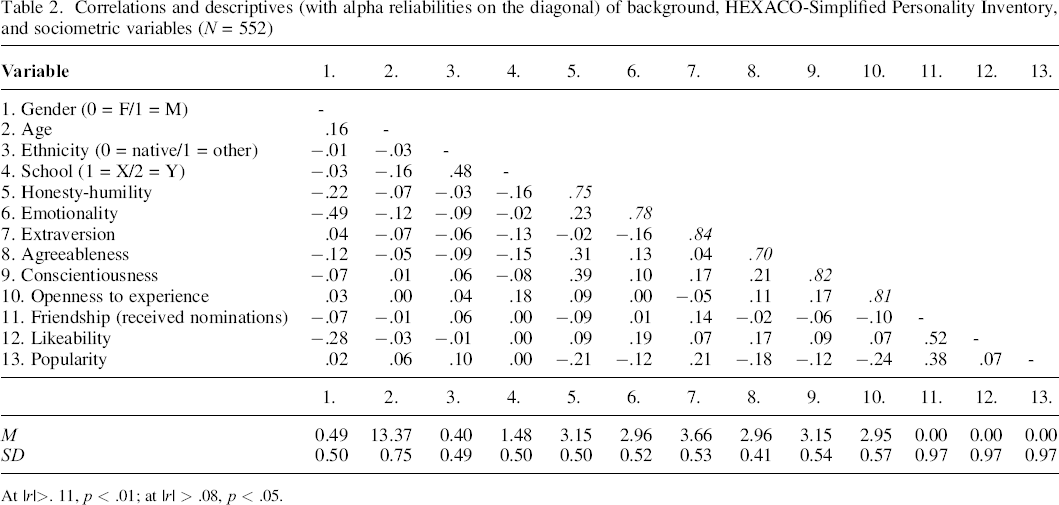
At |r|>. 11, p < .01; at |r| > .08, p < .05.
Procedure
Participants provided responses to the questionnaire in their school's computer classroom in the presence of two trained research assistants. One 50–min period was available for filling out the questionnaire. A computerized—web–based—questionnaire and a written research protocol ensured consistent data collection across classrooms and schools. Questionnaires were made accessible to participants via unique and personalized login codes to ensure correct and confidential response recording. The research assistants took care that participants did not talk to each other or looked at each other's responses during the procedure. Participants started by answering a series of peer nominations—not all used in the present study, but including the likeability, popularity, and friendship nominations—and ended with the HEXACO–SPI (section II of the Supporting Information).
Statistical analyses
To obtain the final likeability and popularity variables, a within–classroom standardization procedure was used. This is a standard operating procedure within sociometric status research in adolescent samples (e.g. LaFontana & Cillessen, 2002) as a solution to problems associated with the skewness and kurtosis of nominations for most and least popular and likeable peers (i.e. for some of the questions many adolescents did not receive any nominations; see Table 1 and section I in the Supporting Information for more details). Furthermore, the classroom–level and school–level variance of the peer nomination variables is not only influenced by nonindependence of individual responses (i.e. nominee–related variance) but also by classroom differences in nomination behaviour (i.e. nominator–related variance, like preparedness to nominate classmates). A consequence of this procedure is that the classroom and school–level variance of the resulting (standardized) variables is effectively reduced to 0. The intraclass correlations and design effects for both likeability and popularity indicated that the classroom– and school–level variance for both variables was indeed negligible (intraclass correlations < 0.05) and that the classroom– and school–level influences on the standard error estimates were also negligible (design effects < 2; Peugh, 2010). As such, the data were analysed with hierarchical regression analyses.
With respect to the differential prediction of the facets, the different masking and cancellation effects were investigated using the Meng, Rosenthal, and Rubin (1992) difference test of correlated correlations with a correction for the correlation of a facet with its own domain using the formula rc = (k*r − 1)/(k − 1), in which rc is the corrected correlation, r the correlation between the domain and its facet, and k the number of facets (Pletzer et al., 2020).
Results
Table 2 reports the descriptives and correlations of all variables (Table S3 for correlations with single likeability and popularity items). Likeability and popularity were (very) weakly correlated (r = .07, p = .08). Friendship nominations correlated very strongly (e.g. with r's of approximately .40 or higher; Funder & Ozer, 2019) with both likeability and popularity. Furthermore, gender correlated strongly (with an r of approximately .30; Funder & Ozer, 2019) with likeability (with girls being more likeable; Mgirls = 0.27, SDgirls = 0.86; Mboys = −0.27, SDboys = 1.01; t (corrected df = 530.5) = 6.73, p < .01). Small–to–medium–sized correlations (between respectively r = .10 and r = .20; Funder & Ozer, 2019) were found for emotionality and agreeableness with likeability and for extraversion (positive), honesty–humility, emotionality, agreeableness, conscientiousness, and openness to experience (all latter five negative) with popularity.
Table 3 shows the results of the hierarchical regressions of likeability and popularity on the background variables plus respectively popularity or likeability (but excluding received friendship nominations) in Step 1; on background, sociometric, and personality variables in Step 2; and on all variables, including interaction terms, in Step 3. Because received friendship nominations were very strongly related to both likeability and popularity, and thus the existence of ‘friendship cliques’ (i.e. reciprocal positive nominations) may affect the results, we also conducted separate multiple regression analyses (without interaction terms) in which we included received friendship nominations. The regression coefficients were slightly weaker (ranging from small–sized to medium–sized effect; Funder & Ozer, 2019), but the average of the absolute values of the standardized regression coefficients of the significant personality predictors in Table 3 was reduced by only 0.026 (range from 0.00 to 0.04; please compare with Table S4, which also includes regressions of the single (respectively low and high) likeability and popularity items on the predictors). To further explore the potential effects of reciprocity, we examined whether the variables of interest in this study were related to the likeability and popularity nominations that students gave to (rather than received from) their classmates (Table S3). No relation was found between received and given high likeability nominations, and there even was a negative relation between received and given high popularity nominations. In our view, these findings are inconsistent with a reciprocity interpretation of the likeability and popularity measures that were used in this study. Furthermore, Table S3 also reveals that there were hardly any relations between the HEXACO personality dimensions and given likeability and popularity nominations. When taken together, it can be concluded that the findings in this study cannot be interpreted in terms of friendship clique members’ tendency to reciprocally nominate each other in positive ways.
Regression weights (beta coefficients and relative weights) of sociometric criteria on background and HEXACO–Simplified Personality Inventory variables (N = 552)
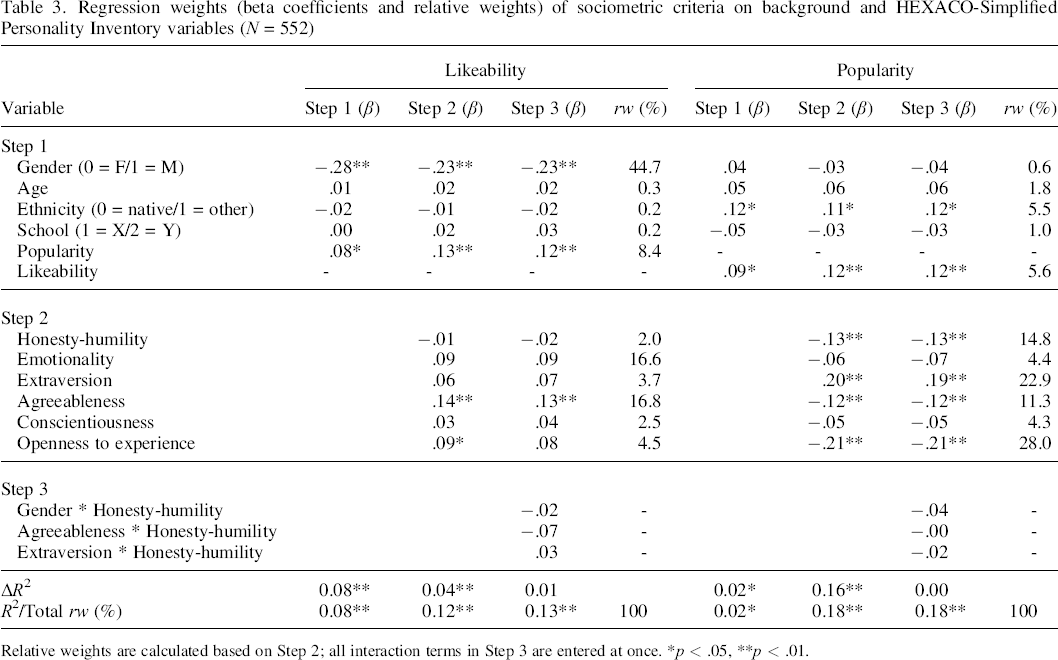
Relative weights are calculated based on Step 2; all interaction terms in Step 3 are entered at once.
p < .05,
p < .01.
To test for the three hypothesized interaction effects, we first standardized honesty–humility, gender, agreeableness, and extraversion; then multiplied honesty–humility with respectively gender (g), agreeableness (a), and extraversion (x); and then standardized the resulting variable. None of the three resulting interaction terms were strongly related to each other (resp. rga = −.11, p = .01; rgx = −.01, p = .81; and rax = −.04, p = .36), and the results of Step 3, reported in Table 3, in which all three interaction terms are entered at once, are virtually identical to the results when the interaction terms were entered separately (Table S5). In both cases, none of the interactions were significant. We also explored a number of other possible interaction effects (e.g. gender with the other personality traits, friendship with personality, and extraversion with agreeableness) in the prediction of likeability and popularity but only two of the 24 additional interaction terms were significant at p < .05 and none were when using a Bonferroni correction procedure (Table S5).
Table 3 also reports the relative weights (i.e. the unique contribution) of each variable conducted in Step 2 of the regression analyses (Johnson, 2000; Johnson & LeBreton, 2004). Likeability was best predicted by gender (girls were more likeable), popularity, and agreeableness, whereas popularity was best predicted by nation of birth (non–natives were more popular), likeability, extraversion, and reversed openness to experience, honesty–humility, and agreeableness. In the second step, personality explained an additional 4% of the variance in likeability and an additional 16% of the variance in popularity. The third step, which included the three interaction terms, did not explain any incremental variance in the two sociometric nomination variables and was consequently not included in the relative weights analysis.
To check for differential predictive validity effects, we compared the predictive validity of the HEXACO–SPI personality facets in the explanation of likeability and popularity. Table 4 reports the results of this analysis. A correlated correlations difference test (Meng et al., 1992) showed that all domain scales and all but four facets (i.e. except social self–esteem, organization, diligence, and proactivity) differed in size of correlations with respectively likeability and popularity. Especially notable was the fact that, except for extraversion, all domain scale correlations with respectively likeability and popularity were in opposing directions (i.e. positive with likeability and negative with popularity). Although the alpha reliabilities of the facets were generally lower than those of the domain scales (see Method section and Table 4), among all of the domains, there was at least one facet that showed a larger correlational difference. That is, the facets greed avoidance, fearfulness, social boldness, gentleness, prudence (and perfectionism), and aesthetic appreciation showed a larger significant difference (with d > 0.20) between correlations with likeability and popularity than their respective HEXACO domain scales. When combining seven facets that showed the strongest—domain–specific—correlational differences (the above minus perfectionism, but also including the interstitial altruism facet) in one ‘combination’ scale, 2 the difference in correlated correlations was even larger (i.e. r = .17 with likeability vs. r = −.43 with popularity; z = 10.61, p < .01, d = 0.45). That is, a combination of selected personality facets showed a medium–large difference between the correlations with respectively likeability and popularity.
Differences in correlations of HEXACO variables with likeability and popularity (N = 552)
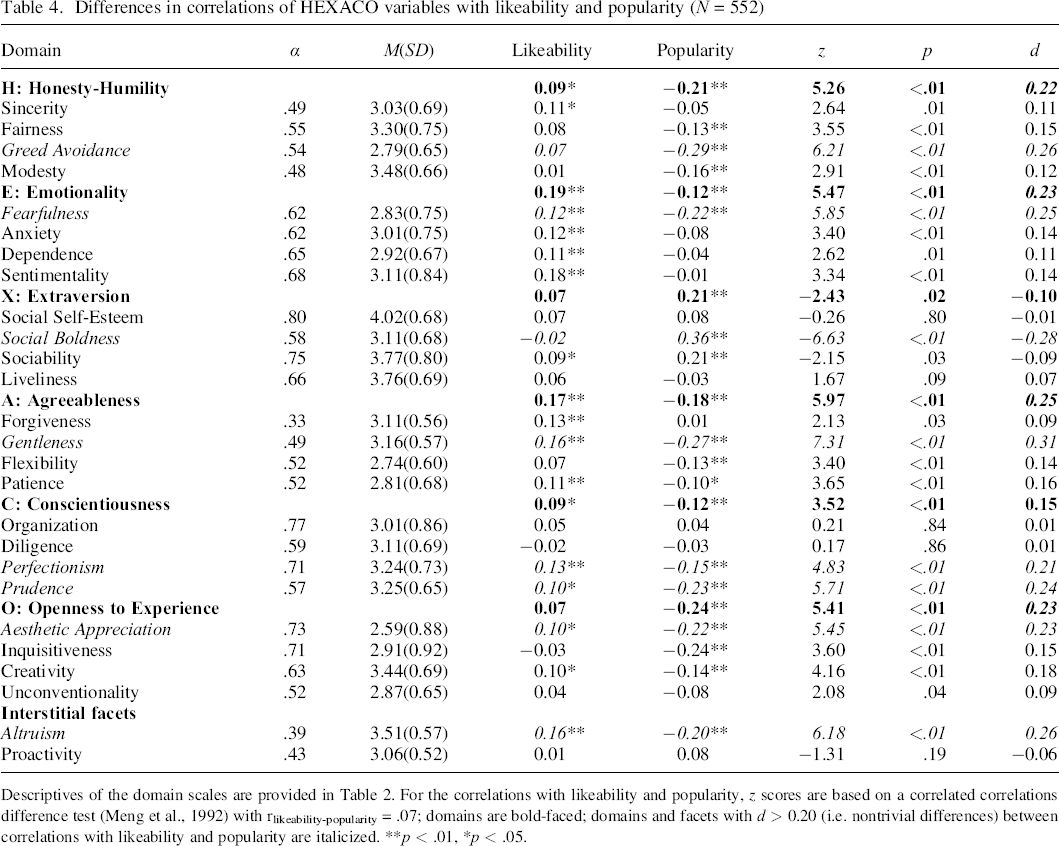
Descriptives of the domain scales are provided in Table 2. For the correlations with likeability and popularity, z scores are based on a correlated correlations difference test (Meng et al., 1992) with rlikeability–popularity = .07; domains are bold–faced; domains and facets with d > 0.20 (i.e. nontrivial differences) between correlations with likeability and popularity are italicized.
p < .01,
p < .05.
Apart from the differential predictive validity of domains and facets for the explanation of likeability and popularity, we also tested the presence of weak and strong masking and cancellation effects. Five of the six HEXACO–SPI domains showed the presence of strong masking effects in the prediction of popularity, and three of the six HEXACO–SPI domains showed weak masking or cancellation effects in the prediction of likeability. In terms of effect sizes, most of the masking and cancellation effects (i.e. the differences in correlations between the two facets) were small to medium in size (i.e. rdifference between .10 and .20; Funder & Ozer, 2019), although some effect sizes were (very) large. In Table 5, we report all facets that showed within–domain differential predictive (masking or cancellation) effects in the explanation of likeability and popularity. Note that in all tests of difference of correlated correlations (Meng et al., 1992), the test–score (zdiff) was corrected for the correlation of a facet with its own domain (Pletzer et al., 2020; see also the Method section). The first five of the seven facets in the ‘combination scale’ noted above (i.e. greed avoidance, fearfulness, social boldness, gentleness, and prudence) also emerged as facets that showed the highest correlations with popularity in the strong masking effects. The strongest masking effect was observed for extraversion, in which (very) large differences (rdifference > .27) were observed between facets (notably social boldness and liveliness; rdifference = .39) in the prediction of popularity.
Masking and cancellation effects in the relations of the HEXACO–Simplified Personality Inventory domain and facets scales with likeability and popularity (N = 552)
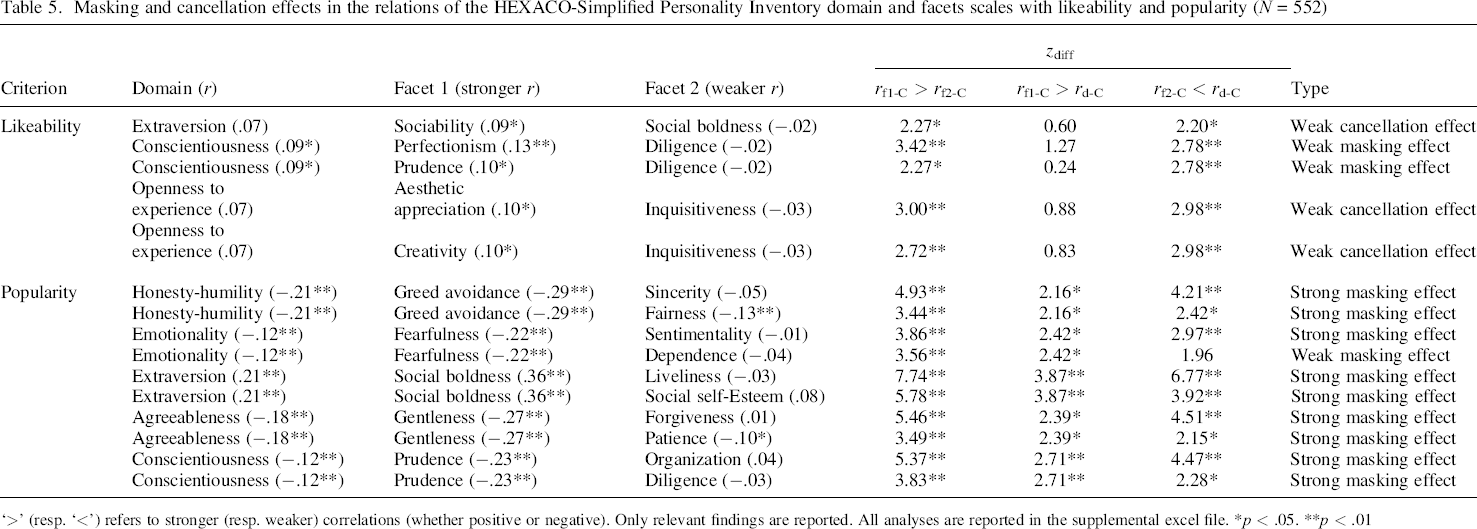
‘>’ (resp. ‘<’) refers to stronger (resp. weaker) correlations (whether positive or negative). Only relevant findings are reported. All analyses are reported in the supplemental excel file.
p < .05.
p < .01
Discussion and Conclusions
To get along and get ahead, adolescents must have the motivation and the behavioural repertoire to increase their likeability and popularity. However, traits that result in such behaviours and that enhance adolescents’ popularity are not necessarily the same traits that enhance their likeability. An important conclusion from the present study is that most HEXACO personality traits differentially predict likeability and popularity. Of all HEXACO domain and facet scales, 5 out of 6 domain scales and 19 out of 26 facet scales showed an opposing relation with likeability and popularity.
Our research partly confirmed the expectations derived from the available literature. That is, agreeableness was positively related to likeability, extraversion was positively related to popularity, and honesty–humility was negatively related to popularity. However, extraversion was unrelated to likeability, and none of the three expected interaction effects materialized in our study. The positive relation of agreeableness with likeability and of extraversion with popularity aligns well with findings on the relations between personality and the interpersonal circumplex axes. That is, in the interpersonal circumplex, (Big Five) agreeableness is most closely aligned with the communion/affiliation axis and extraversion most closely with the agency/dominance axis (McCrae & Costa, 1989; Trapnell & Wiggins, 1990). Note that Big Five agreeableness is different from HEXACO agreeableness, with the former also containing some variance associated with HEXACO emotionality and honesty–humility (Ashton, Lee, & De Vries, 2014). In terms of our findings, the relation of Big Five agreeableness with the communion/affiliation axis would imply that not only HEXACO agreeableness but also HEXACO emotionality and honesty–humility are related to this axis. In fact, the correlational analysis (Table 2) suggests that both emotionality and honesty–humility are significantly (at p < .05) related to likeability, although the effect size for honesty–humility is small at best (r = .09). Although, in the regression equation (Table 3), both were not significantly associated with likeability, for emotionality, this appeared to be due to a gender confound, with emotionality significantly associated with likeability (β = .19, p < .01) when gender was not included.
Because the axes of the interpersonal circumplex are slightly rotated with respect to agreeableness and extraversion (Trapnell & Wiggins, 1990), and because agreeableness in the HEXACO model is somewhat different from agreeableness in the Big Five model, one might expect a slight positive relation between extraversion and likeability (cf. communion/affiliation) and a slight negative relation between agreeableness and popularity (cf. agency/dominance), and this is exactly what was found in this research (although the relation was not significant for extraversion; Wortman and Wood, 2011 for a discussion of the relation between agentic and communal aspects of extraversion in its relation to likeability). Consequently, the findings not only offer confirmation of the importance of agreeableness and extraversion for respectively likeability and popularity but they also offer indirect support of the convergence of likeability and popularity with the communion/affiliation and agency/dominance axes of the interpersonal circumplex.
The finding that early adolescents’ honesty–humility was negatively related to their popularity aligns with findings on the negative relations between honesty–humility and antisocial behaviours among adults (e.g. De Vries & Van Kampen, 2010) and on the positive relations between early adolescents’ antisocial behaviours and popularity (Lafontana & Cillessen, 2002; Sandstrom & Cillessen, 2006; Wolters et al., 2014). Why are early adolescents low on honesty–humility more likely to become popular? When looking at the honesty–humility facets, some possible motives may be derived. The three most important facet–level predictors were greed avoidance, modesty, and fairness. Consequently, it appears that early adolescents are especially likely to become popular when they are motivated to obtain power and status (low greed avoidance), when they truly believe they are better than others and thus deserve to have a position of high status (low modesty), and when they are unscrupulous in taking a larger ‘part of the pie’ than others (low fairness), which in some cases may be interpreted in terms of high dominance. That is, the motive to get ahead through whatever means possible seems to—according to these findings—pay off and translate itself into increased popularity nominations. The results are in line with findings that people high on psychopathy, which is strongly negatively related to honesty–humility (De Vries, Lee, & Ashton, 2008; Lee & Ashton, 2014), are relatively more frequently found in high power positions (i.e. in the boardroom; Babiak, Neumann, & Hare, 2010).
Why do some studies then find that popular early adolescents are more likely to exhibit both antisocial and prosocial behaviours (Dijkstra, Lindenberg, Verhulst, Ormel, & Veenstra, 2009; LaFontana & Cillessen, 2002; Wolters et al., 2014)? Our research did not support an interaction between honesty–humility and agreeableness in the prediction of popularity, nor did it establish an interaction between honesty–humility and extraversion (cf. Wolters et al., 2014) or between honesty–humility and gender (cf. Van de Schoot et al., 2010) in the prediction of popularity. Although we did not find the expected interaction effects in our data, it may still be true that our adolescent respondents showed different (antisocial and prosocial) behaviours in their relations with different groups of classmates. That is, adolescents (and maybe especially boys) low on honesty–humility may be more likely to act prosocially and extravert toward in–group members, while acting antisocially and less extravert (e.g. giving the silent treatment) toward out–group members. Honesty–humility is defined as the tendency to cooperate with others, even when others may be exploited without suffering retaliation (Ashton & Lee, 2007). Whereas people high on honesty–humility are more likely to cooperate with others irrespective of group membership, people low on honesty–humility are more likely to make a distinction in their behaviours toward in–groups and out–groups, showing cooperating behaviours toward in–group members and exploitative behaviours toward out–group members. In a study by Sibley, Harding, Perry, Asbrock, and Duckitt (2010), respondents low on honesty–humility were more likely to be prejudiced toward derogated out–groups. A reason for this prejudice toward derogated out–groups was that people low on honesty–humility are more likely to have a social dominance orientation, reflecting a positive attitude toward unequal status hierarchies between groups (Pratto, Sidanius, Stallworth, & Malle, 1994). That is, in contrast to people high on honesty–humility, people low on honesty–humility may be more likely to prefer to repress, and thus to exploit, members from out–groups, while at the same time remaining a loyal—cooperative—member of the in–group.
The finding that likeability and popularity were differentially predicted by personality traits points to two different pathways to self–esteem and well–being as hypothesized in the introduction: one through getting along and one through getting ahead. The first pathway—through likeability—may ensure that one is loved by others. This pathway is especially likely to be followed by adolescents who are agreeable, altruistic, emotional, prudent, perfectionistic, sincere, and artistic (i.e. creative and appreciating aesthetics). The second pathway—through popularity—may ensure that one is seen as powerful by others. This pathway is especially likely to be followed by adolescents who are socially bold, status–oriented (low greed avoidant), ‘hard’ (low altruism and low gentleness), fearless, sociable, impulsive (low on prudence and perfectionism), and not much interested in science or art (low on inquisitiveness, aesthetic appreciation, and creativity). That is, the findings suggest that there is, among adolescents, a more prototypical ‘soft’ pathway, which may ensure that one is loved (liked), and a more prototypical ‘hard’ pathway, which may ensure that one is seen as powerful (popular). 3
Our research also shows that it is especially important to measure personality using facets in the prediction of popularity. The analyses showed strong masking effects among five of the six HEXACO domains in the prediction of popularity and some additional weak masking and cancellation effects in the relations with likeability. When comparing the explained variance of the domain scales with those of the facets, the facets strongly outperformed the domains, confirming once again the advantages of high–fidelity over high–bandwidth measurement. That is, when combined with the background variables, the six strongest correlating facets explained 26% (ΔR2 = 0.24 on top of the background variables) of the variance in popularity compared with 18% (ΔR2 = 0.16) of the variance for the domains. Given the independent measures of personality and (sociometric) popularity, this is a very substantial finding. Although Wortman and Wood (2011) noted the importance of examining facet–level personality relations with likeability, such a strong superiority of facets over domains did not occur when comparing the most strongly correlating facets with the domains in the prediction of likeability. The six strongest facets (sincerity, sentimentality, gentleness, perfectionism, and aesthetic appreciation) explained 11% (ΔR2 = 0.03) of the variance in likeability compared with 12% (ΔR2 = 0.04) of the variance for the domains. That is, these six facets explained slightly less variance in likeability than the domains. Clearly, investigating masking and cancellation effects can be important in unravelling which, if any, specific behaviours are important in the prediction of outcomes. For some outcomes, there may be great differences in the predictive validity of personality facets within the same domain/construct, whereas for other outcomes, this may be much less true.
Apart from these main findings, there were also some other noteworthy findings. First, the relation between likeability and popularity was lower (r = .07) than in previous research among adolescents of the same age (Cillessen & Marks, 2011; LaFontana & Cillessen, 2002; Sandstrom & Cillessen, 2006; Wolters et al., 2014). Further examination of the data revealed that this relation differed between both schools that participated in this study. At school X, the correlation was relatively closer to values that have been reported in the literature (r = .17, p < .01), whereas the correlation was virtually zero at school Y (r = −.03, p = .61). We checked whether school moderated the relations of the HEXACO personality traits with likeability and popularity, but none of the 12 additional moderated regression analyses investigated (i.e. by including six separate interaction effects for each of the two dependent variables as a third step in Table 2) yielded a significant interaction effect (at p < .05; results can be obtained from the first author or by checking the data on Open Science Framework). Second, and in line with findings by Pronk et al. (2017, 2018), girls were more likeable than boys, but there was no relation of gender with popularity. Whereas emotionality and honesty–humility were significantly and positively related to likeability in the correlation matrix (see Wortman and Wood (2011) for positive relations of honesty–humility adjectives—such as humble versus manipulative and conceited—with likeability), because girls were also more emotional and (somewhat) higher on honesty–humility than boys (De Vries, Ashton, and Lee (2009) and Lee and Ashton (2018) for very similar findings with the HEXACO–PI–R), and because agreeableness and honesty–humility share some variance (Ashton et al., 2014), emotionality and honesty–humility did not significantly predict likeability in the regression equation.
Third, at the domain level, agreeableness had the strongest differential relations: positive with likeability and negative with popularity. The negative relation with popularity is especially interesting. Among adults, lower levels of (Big Five; footnote 4) agreeableness have been found to be associated with higher income (Hill, Turiano, Mroczek, & Burrow, 2016; Judge, Livingston, & Hurst, 2012; Matz & Gladstone, 2018). Such outward manifestations of ‘success’—if true among adolescents as well—may, in turn, be associated with higher levels of admiration and popularity among peers. Fourth, another unexpected finding was the relatively strong negative relation of openness to experience with popularity. Adolescents have been found to be relatively low on openness to experience (Pullmann et al., 2006), and thus boys and girls who are low on openness to experience may be more popular among their peers because they are more prototypical, less likely to be ‘nerdy’ (inquisitive) or ‘arty/dreamy’ (creative/appreciating aesthetics), and thus more likely to be seen to fit in (e.g. LaFontana & Cillessen, 2002) and to represent—and even lead—their peers (e.g. Van Knippenberg, 2011). Future researchers might like to more closely investigate under what conditions (low) agreeableness and (low) openness to experience play a role in popularity.
The findings in this study may also address several theoretical frameworks that have generated highly independent streams of research that most often do not refer to each other, that is the interpersonal circumplex (Gurtman, 2009; Leary, 1957), resource control strategies (centring around prosocial and antisocial controlling behaviours; Hawley, 2003; Hawley et al., 2002), hierarchical differentiation (centring around prestige and dominance; Cheng et al., 2013; Von Rueden et al., 2010), and socioanalytic (Hogan & Roberts, 2004; Hogan & Shelton, 1998) frameworks. As noted above, the finding that agreeableness is positively related to likeability and extraversion to popularity agrees with the (slightly rotated) alignment of these two personality dimensions with the communion and agency axes of the interpersonal circumplex (McCrae & Costa, 1989; Trapnell & Wiggins, 1990). It also agrees with findings from the resource control strategies framework (Hawley, 2003; Hawley et al., 2002), which showed that people high on agreeableness were most likely to be prosocial controllers and least likely to be coercive controllers and that people high on extraversion were most likely to be prosocial and/or bistrategic (those employing prosocial and coercive strategies) controllers (Zeigler–Hill et al., 2014). Furthermore, high scores on the dark triad variables, Narcissism, Machiavellianism, and Psychopathy, were more prevalent among bistrategic and coercive controllers (Zeigler–Hill et al., 2014). This aligns with the strong negative relations between honesty–humility and the dark triad variables (Lee & Ashton, 2014) and the negative relation of honesty–humility with popularity in our study.
Comparing the findings with those of the hierarchical differentiation framework (Cheng et al., 2019; Von Rueden et al., 2010) results in a somewhat mixed perspective. In agreement with our findings, Cheng, Tracy, and Henrich (2010) found narcissism (akin to a combination of low honesty–humility and high extraversion; Lee & Ashton, 2005, 2014) to be more strongly positively related to dominance than to prestige and agreeableness to be negatively related to dominance and positively related (albeit not significant in Study 2) to prestige. However, in their study, extraversion and agency were related to both prestige and dominance, whereas communion was unrelated to both. The somewhat different findings are likely the result of the operationalization of prestige in terms of competence rather than likeability; that is, items in the prestige scale that referred to expertise and success were retained whereas items that referred to helping behaviours were removed from the final scale used in the studies (Cheng et al., 2010; Supporting Information).
With respect to the socioanalytic framework, as far as we know, no direct test of the relations between personality and getting ahead and getting along has been conducted, so it is impossible to compare socioanalytic findings with our own. However, Blickle, Wendel, and Ferris (2010) found extraversion to be positively related to political skill (which can be considered a measure of the ‘getting ahead’ motive), whereas in another study (Blickle et al., 2008), agreeableness was unrelated to political skill. In both of these studies, people high on political skill and either extraversion or agreeableness had higher job performance than those low on either one of them, showing that combinations of getting along (agreeableness) and getting ahead (extraversion) may lead to greater actual success (and thus ‘actual’ getting ahead). Although clearly more work needs to be done to investigate the similarities and differences of the four different frameworks, the results of different studies—including our own—do indicate the potential of an overarching theoretical model that combines—and integrates—findings from these four different perspectives.
Some limitations of our study were (i) that some effect sizes were small and (ii) that the cross–sectional design did not allow making causal inferences. With respect to the small to medium–size effects observed (i.e. between r = .10 and r = .20; Funder & Ozer, 2019), this was mostly true for the domain scales, but not for some facet scales, especially in the prediction of popularity. Some of these effect sizes were large [e.g. correlations of popularity with social boldness (.36), greed avoidance (−.29), and gentleness (−.27)]. Furthermore, having independent—and different types of—measures to capture the main variables and having a relatively young sample of adolescents are very likely to put a ceiling on the effect sizes that one may expect (see for instance De Vries, 2012, for a discussion of the ceiling on effect sizes when using different raters). Additionally, even among young participants, personality and sociometric likeability and popularity have been found to be fairly stable (Pullmann et al., 2006; Sandstrom & Cillessen, 2006), even when transitioning from one school type to another (Sandstrom & Cillessen, 2006). That is, given the relatively strong findings for the facet scales, given the independence of the predictor and criteria measures used, given the ceiling on effect sizes in studies using relatively young children in such designs, and given the stability of the variables involved, we are fairly confident that the results provide a valid—and maybe even somewhat conservative—representation of the predictor–criteria relations.
Still, future research should preferably follow adolescents over several years and preferably also when transitioning to an entirely new social (classroom) environment to get the best possible estimation of the (longitudinal) relations between personality, likeability, and popularity. Such research might also answer the question whether narcissistic (high extraversion and low honesty–humility) adolescents stay popular over a longer period of time. Research on self–enhancement and narcissism among adults, for instance, has shown that narcissism is associated with positive affect (e.g. self–esteem) and popularity in the short run, but increased task disengagement, higher perceived untrustworthiness, and lower levels of popularity in the long run (Kwan, John, Kenny, Bond, & Robins, 2004; Leckelt, Küfner, Nestler, & Back, 2015; Robins & Beer, 2001). Future research might also like to focus more on whether different classroom conditions foster environments in which relations between personality and likeability or popularity differ from the ones observed in this study. For instance, among adults it was found that in competitive and affiliative contexts, extraversion was related to status (akin to popularity in our study), whereas agreeableness was only related to status in affiliative contexts (Lawless DesJardins, Srivastava, Küfner, & Back, 2015).
To conclude, this study offers a comprehensive and in–depth investigation of the relations between HEXACO personality, likeability, and popularity among early adolescents using the recently developed HEXACO–SPI. The present study shows the importance of agreeableness during adolescence to ‘get along’ and the importance of extraversion and low honesty–humility, but also low agreeableness and low openness to experience, to ‘get ahead’. Moreover, this study shows that masking and cancellation effects influence the prediction of popularity and—to a lesser degree—likeability and that the personality predictors of likeability and popularity are fairly distinct. Consequently, there seem to be two ‘pathways’ to self–esteem and well–being for adolescents. Although some adolescents may still fail to be sufficiently loved or seen as powerful during this psychologically demanding transitional period, the differential predictors of likeability and popularity—and thus of the two different pathways—may ensure that there are different ways for most adolescents to ensure that they are not—socially—left behind.
Acknowledgements
This study was partially funded by take–off Grant 14458 of the Stichting voor de Technische Wetenschappen (currently the domain Applied and Engineering Sciences of the Netherlands Organization for Scientific Research; NWO–AES), awarded to Jeroen Pronk.
Supporting info item
Supporting info item, per2243-sup-0001-Supp Material - Getting along And/Or Getting Ahead: Differential Hexaco Personality Correlates of Likeability and Popularity among Adolescents
Supporting info item, per2243-sup-0001-Supp Material for Getting along And/Or Getting Ahead: Differential Hexaco Personality Correlates of Likeability and Popularity among Adolescents by de Vries Reinout E., Pronk Jeroen, Olthof Tjeert, Goossens Frits A. and Carlson Erika in European Journal of Personality
Figure S1. Histogram of high likeability nominations, corrected for the number of classmates (proportion score)
Figure S2. Histogram of low likeability nominations, corrected for the number of classmates (proportion score)
Figure S3. Histogram of high popularity nominations, corrected for the number of classmates (proportion score)
Figure S4. Histogram of low popularity nominations, corrected for the number of classmates (proportion score)
Figure S5. Histogram of combined likeability nominations (proportion scores of received high likeability nominations minus proportion scores of received low likeability nominations)
Figure S6. Histogram of combined popularity nominations (proportion scores of received high popularity nominations minus proportion scores of received low popularity nominations)
Table S1. Dutch and English items of the HEXACO Simplified Personality Inventory (HEXACO-SPI)
Table S2. Six-factor HEXACO-SPI Principal Component Analysis (PCA) solution (N = 552)
Table S3. Correlations between received and given likeability and popularity nominations and background and personality variables (N = 552)
Table S4. Regression analysis of four separate sociometric items and combination nominations (see Table 2) on background and HEXACO-SPI variables (N = 552)
Table S5. Interaction effects of combination of variables when entered in multiple regression analyses together with the background and HEXACO-SPI variables (N = 552)
Open Practices Disclosure Form
Open Practices Disclosure Form, PER2243_Open_Practices_Disclosure_Form - Getting along And/Or Getting Ahead: Differential Hexaco Personality Correlates of Likeability and Popularity among Adolescents
Open Practices Disclosure Form, PER2243_Open_Practices_Disclosure_Form for Getting along And/Or Getting Ahead: Differential Hexaco Personality Correlates of Likeability and Popularity among Adolescents by de Vries Reinout E., Pronk Jeroen, Olthof Tjeert, Goossens Frits A. and Carlson Erika in European Journal of Personality
Open Practices Disclosure Form
Footnotes
Notes
References
Supplementary Material
Please find the following supplemental material available below.
For Open Access articles published under a Creative Commons License, all supplemental material carries the same license as the article it is associated with.
For non-Open Access articles published, all supplemental material carries a non-exclusive license, and permission requests for re-use of supplemental material or any part of supplemental material shall be sent directly to the copyright owner as specified in the copyright notice associated with the article.
