






Abstract
Self–control is associated with a variety of positive life outcomes, including relationship satisfaction, health, educational achievement, and avoiding criminal behaviour. A largely unanswered question concerns the extent to which self–control changes across the lifespan and in response to major life events. The present research used prospective four–wave data from 539 Dutch individuals to examine the self–control trajectory of first–time parents (n = 246) as compared with individuals who did not have children during the research period (n = 293). New parents (especially mothers) reported higher levels of self–control before birth (i.e. during pregnancy) than did nonparents. New mothers showed significant non–linear decreases in self–control, which were especially strong from pregnancy until 6 months after childbirth. New fathers’ self–control remained largely stable. Furthermore, pregnancy–related stress was associated with lower self–control levels during pregnancy in both first–time mothers and fathers. Higher levels of work–family conflict and family–related stress were associated with lower self–control after childbirth in new fathers, but not in new mothers. These results indicate that major life transitions may be linked to changes in adult self–control. Discussion focuses on the implications of the results for theory and research on the development of self–control in adulthood.
Dispositional self–control can be defined as ‘the ability to override or change one's inner responses, as well as to interrupt undesired behavioral tendencies (such as impulses) and refrain from acting on them’ (Tangney, Baumeister, & Boone, 2004, p. 274). High self–control has been related to a variety of positive life outcomes, such as better health, academic success, and relationship satisfaction (de Ridder, Lensvelt–Mulders, Finkenauer, Stok, & Baumeister, 2012; Tangney et al., 2004). Because success in various life domains depends on self–control, a critical issue concerns the extent to which self–control changes across the lifespan and in response to life events (Moffitt et al., 2011). A better understanding of the implications of life events (e.g. the transition to the first job, marriage, or parenthood) for the development of self–control would not only inform theory on self–control development but also help designing interventions to promote self–control during critical transitional periods.
In this study, we examined the ways in which the transition to parenthood is associated with change in self–reported self–control. The transition to parenthood can be seen as one of the most impactful normative life events in early adulthood (Cowan & Cowan, 2000; LeMasters, 1957). After the birth of the first child, new mothers and fathers face tremendous changes and challenges, many of which require self–regulatory behaviour. To examine whether and how the transition to parenthood is associated with change in self–control, we used prospective multi–wave longitudinal data from Dutch couples to examine changes in self–control in first–time parents as compared with couples who did not have children during the research period.
Stability and Change in Self–Control
A large body of research suggests that individuals differ in self–control, as measured by self–report scales (e.g. Tangney et al., 2004), and by behavioural measures such as delay of gratification tasks (e.g. Mischel, 1974). Research on child development has shown that relatively stable individual differences already emerge between the ages of 6 and 12 months and that children show age–related increases in self–control (e.g. Kochanska, Murray, & Harlan, 2000; Vaughn, Kopp, & Krakow, 1984). In contrast, there is only little research on the development of self–control in adulthood. This is surprising, because self–control is a crucial resource to become a well–adjusted adult. That is, it allows people to adjust to social norms, to live a healthy and successful life, and to inhibit behaviours that interfere with goals to do so (Ainslie, 1975; Baumeister & Heatherton, 1996; Mischel, 1974). Practising self–control should become increasingly important during early adulthood, when people are expected to commit to adult social roles, such as spouse, parent, or job holder (Denissen, van Aken, Penke, & Wood, 2013). These roles typically require new behavioural responses or the inhibition of previous habits and routines (Bleidorn, Hopwood, & Lucas, 2018). Normative social role transitions, such as the transition to parenthood, may thus present young adults with a strong press to practise self–control.
According to theoretical perspectives on self–regulated personality development, incremental practice of self–control might eventually lead to increases in this trait (e.g. Denissen et al., 2013; Hennecke, Bleidorn, Denissen, & Wood, 2014). Major life transitions, such as parenthood, might come with increased demands to act in a more self–controlled way. To the degree that new parents more often control their impulses and behaviour, they might eventually perceive increases in their dispositional self–control. In a similar vein, the social investment principle has argued that adjusting to new role demands during major life transitions plays a key role in explaining personality maturation (Roberts & Wood, 2006). Taken together, if people successfully adjust to new role demands during major life transitions, behavioural changes might eventually translate into increases in trait self–control.
Recent longitudinal research on self–control supports the hypothesis of maturational trends in self–control during adolescence and early adulthood (Burt, Sweeten, & Simons, 2014). Furthermore, a recent study found that both men and women showed significant increases in self–control across the first 4 years of marriage (Pronk, Buyukcan–Tetik, Iliás, & Finkenauer, 2017). However, little is known about whether self–control changes are related to the transition to parenthood. In what follows, we first discuss theory and previous research on parenthood and personality change before we outline more specific hypotheses for the course of self–control over the transition to parenthood.
Previous Research on Parenthood and Personality Change
The birth of the first child can be seen as one of the most profound life transitions during early adulthood (Cowan & Cowan, 2000; LeMasters, 1957). Ample research has shown that the birth of the first child is associated with changes in different aspects of the lives of new parents, including their romantic relationship (Belsky & Rovine, 1990; Cowan & Cowan, 2000; van Scheppingen, Denissen, Chung, Tambs, & Bleidorn, 2018), their job hours and job satisfaction (Condon, Boyce, & Corkindale, 2004; Kaufman & Uhlenberg, 2000), and their general well–being (Dyrdal & Lucas, 2013; Umberson, Pudrovska, & Reczek, 2010).
To the best of our knowledge, no study to date has examined self–control change during the transition to parenthood. Recently, however, several longitudinal studies have examined the associations between parenthood and the Big Five personality traits (e.g. van Scheppingen et al., 2016; Denissen, Luhmann, Chung, & Bleidorn, 2018) as well as self–esteem (Bleidorn et al., 2016; van Scheppingen et al., 2018). We refer to the results of this line of research in deriving hypotheses concerning both cross–sectional and longitudinal associations between self–control and parenthood.
A large body of cross–sectional research suggests that parents and nonparents differ with regard to a wide variety of psychological characteristics, including their personality traits (e.g. Berg, Rotkirch, Väisänen, & Jokela, 2013; Dijkstra & Barelds, 2009; Jokela, Alvergne, Pollet, & Lummaa, 2011). Results from longitudinal studies indicate that such differences already exist before birth of the child. Pre–existing differences might partly be explained by selection effects meaning that personality may predict the probability to become a parent (Hutteman, Bleidorn, Penke, & Denissen, 2013; Jokela, Kivimäki, Elovainio, & Keltikangas–Järvinen, 2009; Jokela, Hintsa, Hintsanen, & Keltikangas–Järvinen, 2010; van Scheppingen et al., 2016, but see Specht, Egloff, & Schmukle, 2011). Studies that focused on adult couples in long–term relationships (i.e. the sample of the current study) found that couples’ decision to plan having offspring may be predicted by personality traits that reflect higher levels of maturity and positive adjustment (e.g. Berg et al., 2013; Hutteman et al., 2013). For example, Hutteman et al. (2013) found that high self–esteem predicted adult couples’ intentions to have children 1 year later. In addition, Berg et al. (2013) found that planned pregnancies in adulthood were associated with traits reflecting high maturity (i.e. high agreeableness, high emotional stability, and high conscientiousness).
Differences between parents–to–be and nonparents might additionally reflect anticipation effects. Many couples plan parenthood well in advance and may change their behaviour, thoughts, and feelings as a consequence of this decision. For example, parents–to–be might decide to become in shape, start investigating if the family income can accommodate extra family members, think about suitable housing, and so on. Furthermore, behaviours, thoughts, and feelings might change when dealing with pregnancy or thinking about the future parental role during this phase, which might lead to anticipatory changes in personality. As such, parents–to–be may undergo personality changes in anticipation of the transition to parenthood.
To the best of our knowledge, only two existing studies have examined anticipation effects in personality traits approaching the transition to parenthood. Using two–wave longitudinal data with a 4–year time interval, van Scheppingen et al. (2016) have found a small anticipatory increase in fathers’ openness in the years before childbirth, as compared with a control group of nonparents. Second, Denissen et al. (2018) have used data from up to eight measurements of the Big Five personality traits across 9 years and found that parents increased in emotional stability in the years before childbirth. However, neither study found evidence for anticipatory changes in any other personality traits. Taken together, past research suggests that pre–existing personality differences between parents and nonparents partly reflect selection effects whereas anticipation effects seem to play a minor role for most traits.
In contrast to the robust evidence for pre–existing differences between parents and nonparents, research on the impact of childbirth on parents’ personality change has yielded mixed results. For instance, using two–wave longitudinal data, Specht et al. (2011) found decreases over a period of 4 years in parents’ conscientiousness during the transition to parenthood in a nationally representative sample of German adults. Denissen et al. (2018) replicated this decrease in conscientiousness after childbirth. This latter study also found that, in the years after childbirth, parents decreased in emotional stability, offsetting the positive anticipation effect on this trait. In contrast, two other studies with two–wave designs did not find evidence for change in any of the Big Five personality traits during the transition to parenthood (Neyer & Asendorpf, 2001; van Scheppingen et al., 2016). For self–esteem, a recent five–wave longitudinal study of newlyweds found sudden declines in the year after childbirth and gradual decreases in the following 3 years after (Bleidorn et al., 2016). Another five–wave study with measurements more frequently timed during pregnancy and after childbirth found that new mothers’ self–esteem declined during pregnancy, increased sharply in the 6 months after childbirth, but decreased again in following years after childbirth (van Scheppingen et al., 2018).
In sum, the current state of evidence on personality change and parenthood is mixed. Some of these differences between studies might be due to differences in sample composition, design, and timing of measurement. For example, two–wave longitudinal designs are restricted to linear change models whereas studies with multiple assessments can model non–linear or discontinuous trajectories (Luhmann, Orth, Specht, Kandler, & Lucas, 2014). Moreover, personality changes in first–time parents might be better captured at more specific levels of personality than are the broad Big Five traits, such as self–control. The present study contributed to the literature by examining parents’ self–control trajectories before and after childbirth using prospective four–wave data. Furthermore, we included a comparison group of nonparents, which allowed us to test if new parents differed with respect to their initial self–control levels before childbirth.
The Course of Self–Control over the Transition to Parenthood
We hypothesized that the transition to parenthood is reciprocally associated with self–control, such that parents may already score higher on self–control before childbirth and are also more likely to adjust their levels of self–control in response to the new demands associated with the parent role (i.e. socialization effects).
Specifically, we predicted that new parents score higher on self–control than do nonparents before the birth of the first child. That is, people who are high in self–control may be more likely to have children because they feel more capable to regulate their behaviour to deal with the expected challenges and changes during pregnancy and after childbirth. Moreover, people who are high in self–control tend to be in more stable relationships and have more job security (Tangney et al., 2004), which further increases the likelihood to enter into parenthood. Furthermore, pre–birth differences might be partly caused by anticipation effects. For example, mothers–to–be might already change in self–control during pregnancy, when they are expected to adjust and regulate health–related behaviours (e.g. quit smoking and eat healthier; Crozier et al., 2009).
After childbirth, key characteristics of the parent role require new parents to regulate their behaviour and control their impulses (e.g. get up early despite being sleep–deprived in order to nurse the baby; Hunter, Rychnovsky, & Yount, 2009). To master these new routines successfully, parents often have to inhibit previous habits and execute new behavioural responses. Furthermore, new parents have to find a balance between new responsibilities related to the parent role and continuing responsibilities related to other roles they are occupying, such as spouse, friend, or job holder (Hutteman et al., 2014). Changing routines and balancing different social roles require new parents to make many decisions between sometimes conflicting desires and goals, which is strongly linked to self–regulatory behaviour (Inzlicht & Berkman, 2015).
The new opportunities and pressures for practising self–control may not necessarily lead to immediate increases in self–control in response to childbirth. Rather, the new demands and challenges associated with the parent role may at first be overwhelming and taxing (Twenge, Campbell, & Foster, 2003). Furthermore, new parents may experience a loss of autonomy and inability to pursuit personal goals and pleasures (Twenge et al., 2003). These challenges might be especially taxing in the early stages of parenthood when the child demands the most of parents’ time and attention (Dyer, 1963; LeMasters, 1957; White & Klein, 2002). As described by theories on self–regulation, if the parent role is experienced as overwhelming and stressful, new parents may not have enough resources to act in a self–controlled fashion and might perceive declines in self–control in the early stages of parenthood (Denissen et al., 2013; Denissen et al., 2018; Hutteman et al., 2014).
However, in line with theories on self–regulation and the social investment principle (e.g. Denissen et al., 2013; Roberts & Wood, 2006), once new parents begin to adapt to these new challenges and role demands, their self–control might recover or even increase over time. Although research on the effectiveness of short–term (i.e. average of 2 weeks) self–control training has yielded inconclusive results (for recent meta–analyses, see Beames, Schofield, & Denson, 2017; Friese, Frankenbach, Job, & Loschelder, 2017), long–term training programs in schools have proven to enhance behaviours related to self–control in children and adolescents (for a meta–analysis, see Piquero et al., 2016). The latter findings point to the possibility that self–control improves via regular exercise over longer periods of time (Denissen et al., 2013). Because parenthood provides several opportunities to extensively practise self–regulatory behaviour over many years, this may eventually lead to increases in trait self–control.
The changes and challenges associated with parenthood might have a stronger impact on new mothers’ self–control, as compared with new fathers’ self–control. Especially in the first few months after childbirth, mothers often adopt the role of the primary caregiver. Several studies have shown that childbirth is associated with more pronounced changes in the daily routines of women compared with men (e.g. Baxter, Hewitt, & Haynes, 2008). Moreover, research on parenthood and self–esteem change suggests that, compared with fathers’ self–esteem, mothers’ self–esteem might be particularly responsive to the stressful aspects of this transition as indicated by stronger and more sudden declines in response to childbirth (Bleidorn et al., 2016).
In addition to gender differences, the impact of parenthood on self–control may further depend on how stressful this transition is experienced by new parents. For example, some parents may experience more stress during pregnancy than others, especially if they are concerned about the health of the baby or the mother. After childbirth, the level of perceived stress might depend on how demanding new parents experience the task of taking care of the newborn baby (Hutteman et al., 2014). In addition, parents’ self–control trajectories might depend on how difficult it is to find a balance between the parent role and other roles, such as the work role (Belsky, 1984; Twenge et al., 2003).
In summary, the transition to parenthood provides a highly relevant context to study self–control because of its inherent and various opportunities to exercise self–regulatory behaviour. We predict that both selection and socialization effects contribute to the association between self–control and parenthood. Specifically, we predicted that new parents have higher self–control levels than have nonparents before childbirth. In addition, we predicted that self–control will change in response to pregnancy and childbirth. While the initial demands of parenthood may lead to initial declines in self–control, we expected to find gradual increases in self–control over longer periods and with increased practice of self–regulatory behaviour.
The Present Study
In the current study, we examined new parents’ self–control trajectories across four assessment waves from pregnancy until 18 months after childbirth and compared these changes with self–control change in a sample of nonparents. In doing so, we aimed to answer three research questions. First, we tested whether parents–to–be and nonparents differed in their self–control levels before childbirth. We predicted that parents–to–be score higher on self–control than do nonparents.
Second, we used a longitudinal control–group design to test whether and how the birth of the first child is associated with changes in new parents’ self–control. We predicted that new parents’ self–control would decline in response to the initial stressors associated with parenthood, and that this decline would be especially strong in new mothers. After the initial stressful phase of parenthood, however, we predicted that self–control would recover or even increase as first–time parents adapt to the new behavioural demands and role challenges. We tested this hypothesis by using a measure of dispositional self–control as assessed in the parent and nonparent sample across four measurement waves. We replicated the analyses in the parent sample using a daily diary measure of self–control. Specifically, we examined daily self–control, as assessed over 7 days, across three assessment daily diary burst that were embedded in the longitudinal design (i.e. T1, T2, and T4). An alternative measure of dispositional self–control was obtained by aggregating daily self–control across 7 days at each time point.
Third, we examined whether pregnancy–related, work–related, and family–related stressors moderated individual differences in self–control new parents’ trajectories. We predicted that first–time parents who experienced more stress during the transition to parenthood would be characterized by lower self–control levels during pregnancy, more pronounced sudden declines in self–control in response to childbirth, and a slower recovery in the months following the transition to parenthood.
Methods
Sample and procedure
We used data from a prospective four–wave study designed to examine personality change during the transition to parenthood. This study was designed as part of a grant proposal (NWO, VENI project number 451–13–025). We did not pre–register this specific paper, but the hypotheses in our current study are closely linked to the hypotheses formulated in our grant proposal. We are the first to conduct analyses on this dataset. To date, no other published works are based on the same dataset. For a detailed description of all measures collected as part of this project, see osf.io/c3hb4/. The data are available from the last author on request.
The total sample consisted of 539 Dutch individuals (52.5% female, M age = 27.01 years, SD = 4.61 years) and included two subsamples: participants who expected their first child (new parents) and participants who did not have children and reported that they were not expecting to have a child within 3 years from the first assessment wave (nonparents).
Recruitment took place between April and July 2014. To be included in the study, both parents–to–be and nonparents had to be in a romantic heterosexual relationship and between 19 and 45 years old, which is the normative age range to have children in the Netherlands (Dutch Central Bureau for Statistics, 2016). People were asked to participate in the study with their romantic partner but were also allowed to participate without their partner. Parents–to–be were recruited through midwife practices, hospitals, and small businesses that offered pregnancy or baby–related services in the south of the Netherlands (e.g. baby stores and prenatal exercise classes). The nonparent sample was a convenience sample, recruited via the social network of students and employees of Tilburg University. Similar to parent couples, the majority of nonparent couples lived in the south of the Netherlands. After receiving oral and written information about the study, both parents–to–be and nonparents agreed to participate in the study by providing written consent.
Both first–time parents and nonparents completed four online assessments over a period of 19.5 months. For the parent sample, the assessments were scheduled according to participants’ due date. Specifically, new parents completed the first assessment 6 weeks before the due date (T1) and at three follow–up assessments when the child was 6 (T2), 12 (T3), and 18 months old (T4), respectively. At T1, T2, and T4, the parent sample also completed a 1–week daily diary study. Nonparents completed four assessments according to a fixed schedule with time intervals that were equal to the parent sample (i.e. a 7.5–month time interval between T1 and T2 and a 6–month interval between T2–T3 and T3–T4). Nonparents did not participate in the diary study. At the end of the study, new parents were reimbursed with 50 euros and nonparents with 30 euros. In addition, both parents and nonparents received individual feedback about their personality development during the study period.
New parents
Across the study period, 246 first–time parents (108 couples and 30 individuals without their romantic partner) participated (53.7% female). At T1, the average length of parents’ romantic relationship was 7.09 years (SD = 3.74). Most parents reported to be married or registered partners (55.9%) or reported to only cohabit (43.1%). Almost all parents were in paid employment (95.8%). New mothers had a mean age of 29.15 years (SD = 3.64 years) at T1; new fathers had a mean age of 31.13 years (SD = 3.56 years). The vast majority of parents (90.8%) completed tertiary education (i.e. 34.3% vocational education, 38.0% higher professional education, and 27.8% academic higher education). Table S1 shows the number of parents at each measurement wave. From the parent sample, 18.3% (31 mothers and 12 fathers) dropped out between T1 and T2. After the following time points, dropout rates were 10.6% (four mothers and 10 fathers) between T2 and T3 and 17.1% (19 mothers and 17 fathers) between T3 and T4. Mothers who dropped out had lower self–control levels at the first assessment than had mothers who remained in the study (d = 0.40). In the father sample, dropouts and participants who remained in the study showed no differences in their initial self–control levels.
Nonparents
Across the study period, 293 individuals participated (139 couples and 15 individuals without their romantic partner, 51.5% female). At T1, the average length of nonparents’ romantic relationship was 4.79 years (SD = 3.49). Of the nonparents, 9.5% were married or in a registered partnership, 55.1% only cohabited, and 35.4% did not live together. Most nonparents were in paid employment (71.4%). Women had a mean age of 25.01 years (SD = 3.91 years); men had a mean age of 27.43 years (SD = 4.86). Of the nonparents who completed tertiary education (76.6%), 24.7% completed vocational education, 28.3% higher professional education, and 47.1% academic higher education. Table S1 shows the number of nonparents at each measurement wave. Twenty–three per cent (42 women and 35 men) of the nonparents dropped out between T1 and T2. Dropout rates were lower after the following time points, with 4.8% (two women and five men) between T2 and T3 and 4.4% (four women and three men) between T3 and T4. In the control group, women who dropped out did not differ in initial self–control levels from women who remained in the study. Compared with men who remained in the study, men who dropped out had lower self–control levels at T1 (d = 0.40).
Measures
Dispositional self–control
At each assessment wave, participants completed a Dutch version of the Brief Self–Control Scale (Tangney et al., 2004). This 13–item scale assesses people's ability to control their impulses, to alter their emotions and thoughts, and to interrupt undesired behavioural tendencies and refrain from acting on them. Example items are ‘I have a hard time breaking bad habits’ (reverse coded), ‘I often act without thinking through all the alternatives’ (reverse coded), and ‘I am able to work effectively toward long–term goals’. Responses were measured on a 5–point Likert scale ranging from 1 (strongly disagree) to 5 (strongly agree). This widely used measure (for a meta–analysis, see De Ridder et al., 2012) was developed to provide an up–to–date indicator of individual differences in dispositional self–control. The original English measure (Tangney et al., 2004; De Ridder et al., 2012) and the Dutch short form (e.g. Finkenauer, Engels, & Baumeister, 2005) have been used in various previous studies, which reported adequate reliabilities and scale properties. In the present study, Cronbach's α ranged from .82 to .85 across assessment waves.
Daily self–control
Daily self–control was assessed at three daily diary bursts embedded in the longitudinal design (T1, T2, and T4). During each 7–day burst, parents were asked to respond to 13 self–control items derived and adapted from the dispositional self–control measure (e.g. ‘Today, I often acted without thinking through all the alternatives’). Responses were measured on a 5–point Likert scale ranging from 1 (strongly disagree) to 5 (strongly agree). Across the seven daily assessments, Cronbach's αs for daily self–control ranged from .67 to .80 at T1, .73 to .87 at T2, and .79 to .85 at T4. We aggregated each parents’ responses across the 7–day period and analysed stability and change across the three bursts.
Both dispositional and aggregated daily self–control scores were transformed to the T–score metric using the grand mean and standard deviation of the overall sample across measurement waves. T–scores are standard scores with a mean of 50 and standard deviation of 10 and can be used to index effect sizes. According to Cohen (1988), a difference of 2 T–score points represents a small effect, a difference of 5 points represents a medium effect, and a difference of 8 points represents a large effect.
Pregnancy–related stress
The parent subsample completed a short version of the Pregnancy Experience Scale (DiPietro, Christensen, & Costigan, 2008) at T1, which consists of two subscales designed to assess positive experiences and negative stressors during pregnancy. Because we focused on stress in the current study, we only used the negative stressors scale. The negative stressors subscale consists of 10 items for mothers and five items for fathers. First–time parents were presented with a list of pregnancy–related experiences (e.g. ‘Thoughts about whether the baby is healthy’) and asked to rate the degree to which each of them made them feel ‘unhappy, negative, or upset’. Cronbach's αs were .72 for mothers and .67 for fathers.
Family–related stress
Family demands were assessed at T2 with four items (e.g. ‘How often do family duties and responsibilities make you feel tired?’ Yang, Chen, Choi, & Zou, 2000). Participants rated the degree to which they experienced these family–related stressors on a 5–point Likert scale ranging from 1 (almost none/never) to 5 (very much/always). Cronbach's αs were .66 for fathers and .70 for mothers.
Work–related stress
At T2, parents who were in paid employment (95.8%) reported about the degree to which they experienced work–related stress using two items: ‘I often feel that I am being run ragged’ and ‘I am given entirely too much work to do’ (Yang et al., 2000) on a 5–point Likert scale that ranged from 1 (completely disagree) to 5 (completely agree). Cronbach's αs were .69 for fathers and .72 for mothers.
Work–family conflict
At T2, employed parents reported about their work–family conflict using four items (e.g. ‘How much does your job situation interfere with your family life?’) on a 5–point Likert scale that ranged from 1 (a lot/very often) to 5 (not at all/never). Cronbach's αs were .77 for fathers and .71 for mothers.
Parents also reported on their family–related stress, work–related stress, and work–family conflict at T4 (i.e. 18 months after childbirth). Descriptive statistics (e.g. rank–order stability and reliability) of these measures at T4 can be found in the Supporting Information. To examine mean–level changes between stress measured at T2 and T4 assessments, we estimated a latent growth curve (LGC) model with an intercept centred at T2 and a fixed slope representing change from T2 to T4. The results indicated no significant changes in family–related stress (bfathers = 0.04, 95% CI [−0.07, 0.15], p = .518; bmothers = 0.09, 95% CI [−0.02, 0.20], p = .110), work–related stress (bfathers = −0.06, 95% CI [−0.35, 0.23], p = .701; bmothers = 0.15, 95% CI [−0.13, 0.43], p = .292), and work–family conflict (bfathers = 0.13, 95% CI [−0.06, 0.31], p = .173, bmothers = 0.12, 95% CI [−0.09, 0.33], p = .247) across these two time points. We therefore examined the association between stress assessed at T2 and self–control stability and change.
Analyses
All analyses were performed using Mplus version 7 (Muthén & Muthén, 1998–2012) and full information maximum likelihood estimation. Prior to analysis, multivariate outliers across the four assessment waves were identified on the basis of consistently high scores on three influence statistics: the log likelihood distance influence (Cook & Weisberg, 1982), Cook's distance (>1; Cook & Weisberg, 1982), and Mahalanobis distance (p < .001; Rousseeuw & Van Zomeren, 1990). On the basis of these criteria, we found two influential cases in the mother sample and one influential case in the non–mother sample. These three individuals were removed from all further analyses. We did not find any multivariate outliers in the father and non–father samples.
First, we used logistic regression to examine whether dispositional self–control (measured at T1) was associated with the occurrence of childbirth in both men and women. Second, we used an LGC model to examine the degree and shape of change in new parents’ and nonparents’ dispositional self–control (Figure S1). We used model comparison tests and the Bayesian information criterion (BIC; Schwarz, 1978) to identify the best–fitting change models in the parent and the nonparent samples, separately for men and women, with lower BIC values indicating a better fit to the data. In addition, we evaluated the overall model fit using the comparative fit index (CFI) > 0.90 and root mean square error of approximation (RMSEA < 0.08; Hu & Bentler, 1998).
In each sample, we started with an intercept–only model and tested whether adding latent growth parameters improved model fit. In all LGC models, we first fixed the variances of the level and change parameters. For each model (i.e. intercept–only, linear slope, and quadratic slope), we then tested if freeing the variance of growth parameters improved model fit. In a final step, we combined the best–fitting models for both subsamples in a multiple group LGC model and tested whether parents’ and nonparents’ trajectories were significantly different from each other. In the new parent subsample, we additionally examined the growth trajectory of self–control when using the aggregated diary measure. Furthermore, we examined if parents’ self–control trajectories were related to the levels of stress that new parents experienced during pregnancy and after childbirth. Specifically, we included four moderator variables (i.e. pregnancy–related, work–related, and family–related stress, and work–family conflict) as predictors of self–control level and change in the LGC models (Figure S1).
Power analysis
Prior data collection, we used G*Power (Erdfelder, Faul, & Buchner, 1996) to determine the sample size needed for a conventional within–subject design accounting for dependent data. On the basis of previous research on personality and life events (Bleidorn et al., 2018), we expected changes in parents’ traits to be small across 18 months. Results of this analysis indicated a minimum sample size of 400 individuals to detect small effects with 80% power. We anticipated 30% dropout across the four assessment waves and therefore attempted to recruit at least 130 participants for each subsample (i.e. mothers, fathers, non–mothers, and non–fathers, resulting in a total sample size of N = 520).
Even though we succeeded in recruiting a total sample of N = 539, dropout turned out to be larger than expected (approximately 40% dropout at T4; Table S1). Therefore, we conducted a power analysis in which we adjusted for the actual sample size and missing data pattern. Specifically, we used Monte Carlo simulations in Mplus to estimate a linear LGC model in both subsamples of fathers and mothers across T1–T4. We hypothesized a population with a small linear slope of 2 T–scores across the four assessment waves. The remaining parameters (i.e. intercepts, variances, and covariances) and missing data patterns were determined using information from the estimated LGC models of self–control from both mothers and fathers. To simulate a sample with observations that were missing at random, we included a covariate that predicted the outcomes and the missing data pattern (Muthén & Muthén, 2002). We then estimated an LGC model, conducted 10,000 replications, and computed both the average parameter value and the standard error across replications. The results of these Monte Carlo simulations indicated that we had sufficient power (i.e. >.80) to detect small linear changes of 2 T–scores for both mothers and fathers. For fathers, the power to detect such a difference was larger than .99. For mothers, power was .95. Output files of these simulations can be found at osf.io/jmxh7/.
Results
Descriptives
Our analyses were based on all available responses. Table 1 shows the means and standard deviations of dispositional self–control for new parents and nonparents for each assessment. New mothers’ dispositional self–control levels were almost 3 T–scores higher than were non–mothers self–control levels at T1. A similar difference of almost 3 T–scores was found between new fathers and non–fathers, with non–fathers having the lowest score compared with that of all other groups.
T–scores for dispositional self–control across the four assessments for new parents and nonparents
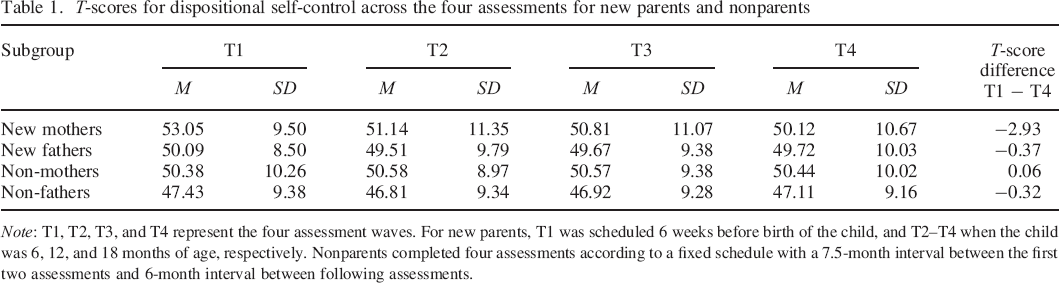
Note: T1, T2, T3, and T4 represent the four assessment waves. For new parents, T1 was scheduled 6 weeks before birth of the child, and T2–T4 when the child was 6, 12, and 18 months of age, respectively. Nonparents completed four assessments according to a fixed schedule with a 7.5–month interval between the first two assessments and 6–month interval between following assessments.
Table S2 shows the rank–order stability across the four assessment waves and the correlations within parent and nonparent dyads. The rank–order stability of dispositional self–control across T1–T4 was high in both the parent sample (.71–.88) and the nonparent sample (.78–.83). Aggregated daily self–control (only measured in the parent sample at T1, T2, and T4) had a rank–order stability of .61 between T1 and T2 and .81 between T2 and T4. Dispositional self–control showed a marginally significant positive correlation within parent dyads at T1 (.15), and a significant positive correlation at T2–T4 (.26 to .34), whereas the within–dyad correlations for nonparents were close to zero (−.11 to .08).
Measurement invariance tests
Prior to our main analyses, we tested for strict measurement invariance across time and groups (i.e. mothers, fathers, non–mothers, and non–fathers) using multiple–group confirmatory factor analyses (Meredith, 1993). Tables S3 and S4 show that the multiple–group confirmatory factor analyses imposing strict measurement invariance across time and groups fit the data well (CFI > 0.97, RMSEA < 0.06) and did not worsen model fit (∆CFI < 0.01). These results indicated that self–control had the same meaning across time and groups (see the Supporting Information for details; Mplus output files are available at osf.io/jmxh7/).
Pre–birth differences between new parents and nonparents
Figure 1 shows the differences in dispositional self–control between new parents and nonparents before childbirth. Controlling for age and relationship length, 1 we found that self–control was positively related to the transition to motherhood, odds ratio = 1.030, 95% CI [1.002, 1.059], p = .035. However, self–control did not predict transition fatherhood after adding age and relationship length as control variables, odds ratio = 1.024, 95% CI [0.991, 1.057], p = .151. Mplus output files for these analyses are available at osf.io/jmxh7/.
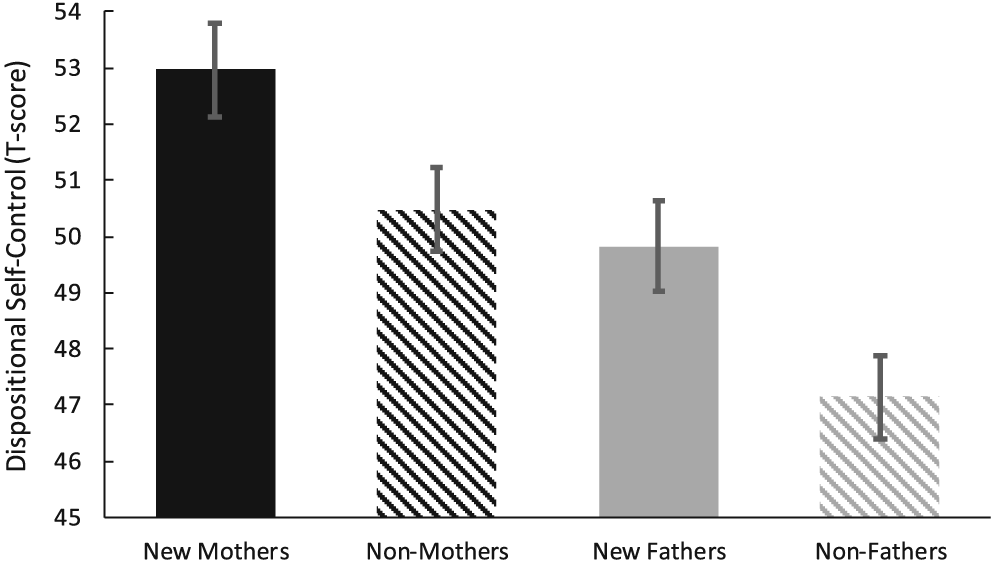
Differences in dispositional self–control between new parents and nonparents at the first assessment wave (T1). For new parents, T1 was scheduled 6 weeks before the pregnancy due date.
Unconditional latent growth curve models
New parents
Table 2 shows the parameter estimates for the best–fitting models for the parent sample. The best–fitting model for fathers was the intercept–only model, which indicated that fathers did not show mean–level change in dispositional self–control during the transition to parenthood.
Parameter estimates of the best–fitting latent growth model for new parents’ and nonparents’ dispositional self–control
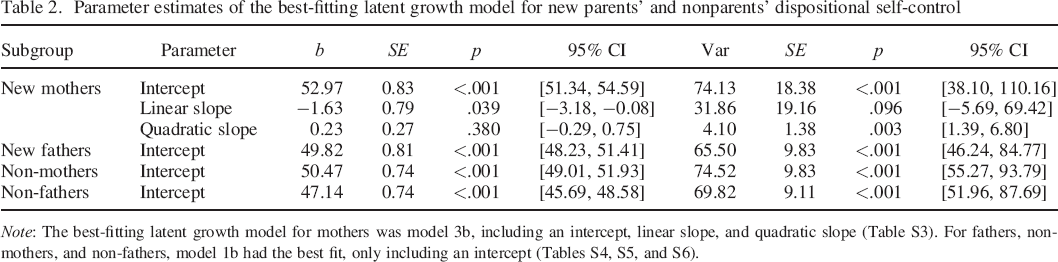
Note: The best–fitting latent growth model for mothers was model 3b, including an intercept, linear slope, and quadratic slope (Table S3). For fathers, non–mothers, and non–fathers, model 1b had the best fit, only including an intercept (Tables S4, S5, and S6).
For new mothers, the best–fitting LGC model included an intercept, a linear slope, and a quadratic slope (Figure S1). Model fit improved by freeing the variance of the intercept, linear slope, and quadratic slope. The linear slope was negative, indicating a negative linear trend of −0.63 T–scores per 6–month interval throughout the transition to parenthood. The variance of the linear slope was marginally significant. The quadratic slope was not significantly different from zero—but the variance was significant, indicating significant individual differences in quadratic growth (see Figure 2, and Tables S5 and S6 for all fit indices). Figure 2 indicates that changes in mothers’ dispositional self–control were especially strong between T1 and T2. This is in line with the basic descriptive data (Table 1), which also show the largest mean–level differences in mothers’ self–control between T1 and T2, as compared with smaller differences between T2–T3 and T3–T4. 2
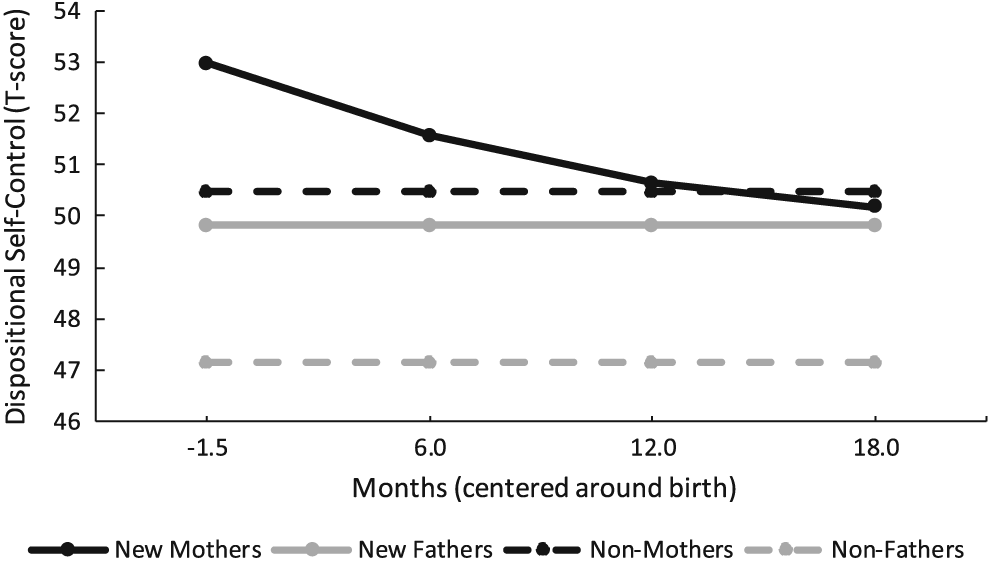
Estimated change in dispositional self–control for new parents and nonparents. For new parents, the four assessments were scheduled according to the pregnancy due date. Nonparents completed four assessments according to a fixed schedule with a 7.5–month interval between the first two assessments, and 6–month interval between following assessments.
Nonparents
The parameter estimates for the best–fitting models for the nonparent sample can be found in Table 2 (see Tables S7 and S8 for all fit indices). For both non–fathers and non–mothers, self–control trajectories were best described by an intercept–only model, suggesting that self–control showed no mean–level changes and no variability in change (Figure 2). Mplus output files for all unconditional LGC models are available at osf.io/jmxh7/.
Comparing change in new parents and nonparents
We did not test for differences in self–control change between fathers and non–fathers because neither group showed significant change in self–control throughout the study period. With the age and relationship duration controlled, new mothers showed significantly stronger decreases in self–control than did non–mothers (Wald = 4.17, p = .041). 3 First–time mothers did not differ significantly from non–mothers in the quadratic slope estimate (Wald = 1.19, p = .275). Mplus output files for all multiple–group comparisons are available at osf.io/jmxh7/.
Comparing change in dispositional self–control and aggregated daily self–control
We compared descriptive statistics between dispositional self–control and aggregated daily self–control. All Mplus output files can be viewed at osf.io/jmxh7/. Across time points, dispositional self–control was positively correlated with aggregated daily self–control measure (r = .56, .65, and .67 at T1, T2, and T4, respectively). All correlations were significant at p < .001.
Because we were limited to three longitudinal assessment waves for daily self–control, we chose to only interpret the non–parametric estimates (Table 3, Figure 3). For new mothers, the daily self–control trajectory was similar to the dispositional self–control trajectory estimated with the LGC model. Specifically, new mothers had higher daily self–control levels than had fathers at T1. Furthermore, mothers declined in daily self–control, particularly between T1 and T2. Figure S2 shows that, unlike dispositional self–control, daily self–control also decreased in the subsample of fathers (especially between T1 and T2). We could not compare daily self–control between new parents and nonparents, because this measure was only assessed in the parent sample.
T–scores for aggregated daily self–control across the three assessments for new parents
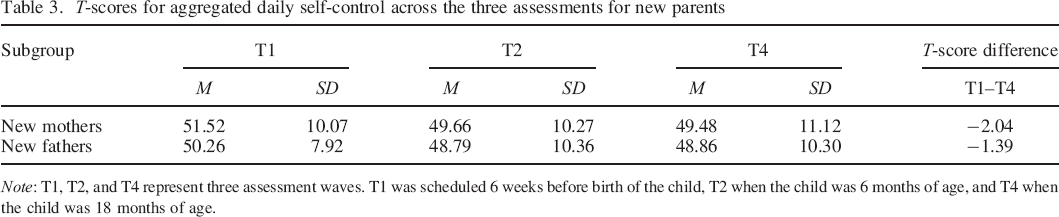
Note: T1, T2, and T4 represent three assessment waves. T1 was scheduled 6 weeks before birth of the child, T2 when the child was 6 months of age, and T4 when the child was 18 months of age.
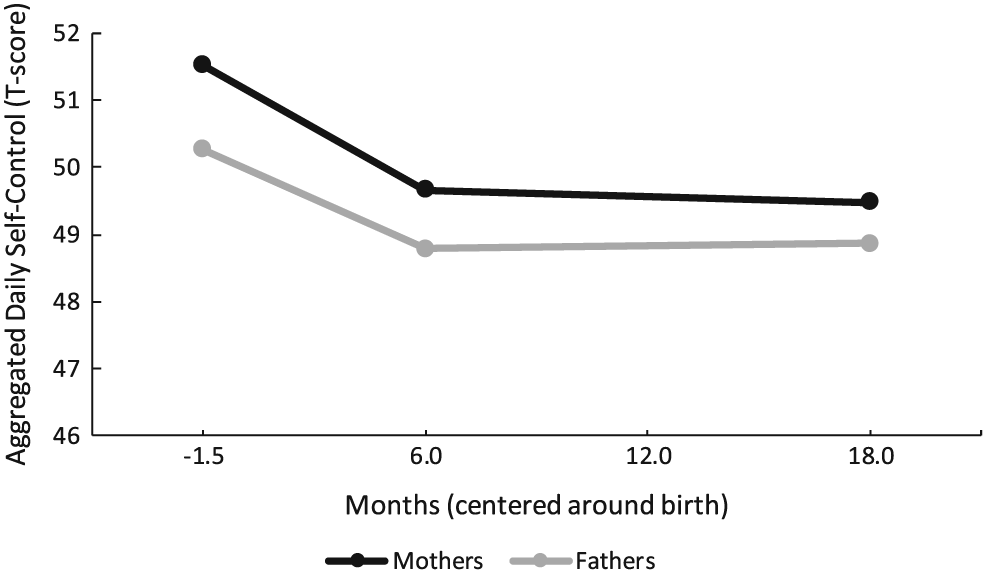
Non–parametric estimates of aggregated daily self–control for new parents. The three assessments were scheduled according to the pregnancy due date (i.e. 1.5 months before due date, and 6 and 18 months after birth of the child).
Conditional latent growth curve models
Because new mothers showed significant individual differences in self–control levels and change, we examined whether these differences were related to (i) pregnancy–related stress, (ii) work–related stress, (iii) family–related stress, and (iv) work–family conflict (Figure S1). Because fathers only showed individual differences in their self–control level, we only predicted these level differences by the four covariates. All covariates were transformed to z–scores. An overview of all parameter estimates of these models can be found in Table 4.
Pregnancy–related, work–related, and family–related stressors, and work–family conflict predicting new parents’ dispositional self–control in the best–fitting latent growth curve model
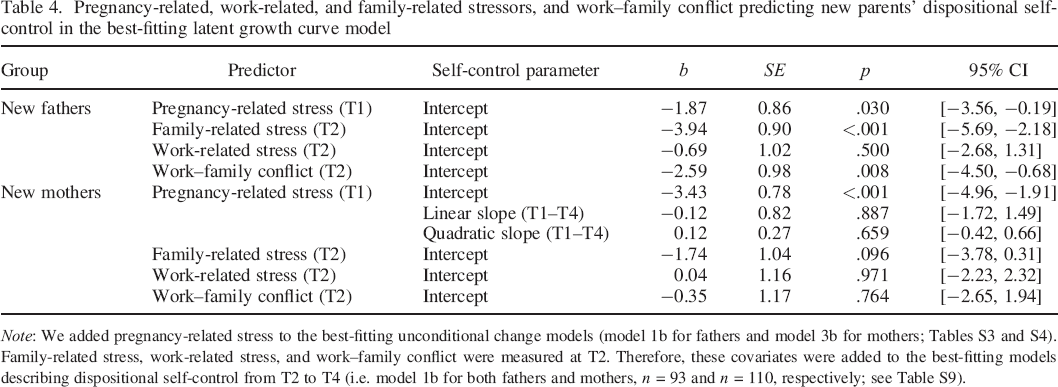
Note: We added pregnancy–related stress to the best–fitting unconditional change models (model 1b for fathers and model 3b for mothers; Tables S3 and S4). Family–related stress, work–related stress, and work–family conflict were measured at T2. Therefore, these covariates were added to the best–fitting models describing dispositional self–control from T2 to T4 (i.e. model 1b for both fathers and mothers, n = 93 and n = 110, respectively; see Table S9).
Pregnancy–related stressors
Pregnancy–related stress was negatively related to mothers’ (b = −3.43, 95% CI [−4.96, −1.91], p < .001) and fathers’ (b = −1.87, 95% CI [−3.56, −0.19], p = .030) self–control levels at T1, suggesting that parents who experienced more pregnancy–related stress scored lower on self–control during pregnancy. However, pregnancy–related stress was not related to linear or quadratic changes in mothers’ self–control from T1 to T4.
Work–related and family–related stressors
Parents’ work–related stress, family–related stress, and work–family conflict were measured after pregnancy at T2. To examine whether these variables predicted individual differences in subsequent self–control change, we estimated LGC models of self–control including three time points (i.e. T2, T3, and T4), with the intercept centred at T2. Based on the BIC, an intercept–only model fitted the data better than did a linear change model for both mothers and fathers, indicating no linear changes and no individual differences in change in self–control from T2 to T4 (Table S9). We therefore focused on testing the associations between these stressors and levels self–control in the intercept–only model. 4
Fathers’ family–related stress and fathers’ work–family conflict assessed at T2 were negatively related to fathers’ self–control levels (b = −3.94, 95% CI [−5.69, 2.18], p < .001; and b = −2.59, 95% CI [−4.50, −0.68], p = .008, respectively). Family–related stress and work–family conflict were not associated with mothers’ self–control, however. Additionally, no correlations were found between mothers’ and fathers’ self–control levels and their perceived work–related stress at T2.
We additionally checked if family–related stress, work–related stress, and work–family conflict at T4 (i.e. 18 months after childbirth) predicted parents’ self–control levels in the best–fitting LGC model involving three time points (i.e. model 1b for both fathers and mothers). Associations found at T4 were very similar to associations found at T2, suggesting consistent negative relationships between family demand, work–family conflict, and fathers’ self–control levels 6–18 months after childbirth (see Table S10 for details). Mplus output files for all conditional LGC growth curve models are available at osf.io/jmxh7/.
Discussion
The present study examined how self–control changes during the transition to parenthood. We used a prospective four–wave study to examine self–control before and after childbirth and also included a comparison group of nonparents, which allowed us to test if new parents differed with respect to their initial self–control levels before childbirth. We furthermore examined the role of various sources of stress in explaining parents’ self–control trajectories.
Four main findings stand out. First, new parents (especially mothers) scored higher on self–control than did nonparents before birth of their first child. Second, new mothers showed significant non–linear decreases in self–control, whereas fathers’ and nonparents’ self–control remained largely stable. Third, pregnancy–related stress was concurrently associated with lower self–control levels in mothers and fathers, and family–related stress and work–family conflict were concurrently associated with lower self–control levels in fathers. Fourth, pregnancy–related, work–related, and family–related stressors did not moderate changes in parents’ self–control during and after the transition to parenthood. Later, we discuss the implications of these results with respect to theory and research on self–control and life events.
Pre–birth differences between new parents and nonparents
Consistent with our hypotheses and previous research on parenthood and personality traits related to self–control (e.g. conscientiousness; van Scheppingen et al., 2016), we found that new parents (especially mothers) scored higher on self–control than had nonparents at the first assessment wave. Specifically, controlling for age and relationship duration, mothers reported significantly higher self–control levels before childbirth than did all other groups. Even though fathers also scored higher on self–control than had non–fathers (Figure 1), these differences became insignificant when controlling for age and relationship duration. The higher levels of fathers’ self–control may therefore be related to pre–existing differences in age and relationship duration, or other related variables (e.g. being married).
Higher levels of mothers’ self–control before childbirth may represent selection effects. This interpretation is in line with the findings from previous longitudinal studies, which indicate that new parents and nonparents show personality differences years before childbirth (e.g. van Scheppingen et al., 2016). Women who are high in self–control, or other strongly related traits (e.g. conscientiousness), may feel more capable and prepared to plan having offspring.
Higher self–control levels before childbirth might also reflect changes in self–control in anticipation of the parent role (i.e. before or during pregnancy). Because couples usually plan parenthood well in advance, personality changes may already take place in the years before childbirth (Denissen et al., 2018; van Scheppingen et al., 2016). Specifically, the desire to have children may be associated with the desire or goal to increase in traits that would fit the parent role, such as self–control, which might lead to anticipatory changes in this trait (Denissen et al., 2013). In addition to changes before pregnancy, the demands of pregnancy may also contribute to personality change. These changes might be especially strong for self–control in mothers–to–be, as they have to establish a healthier lifestyle and quit unhealthy habits such as smoking or alcohol consumption (Crozier et al., 2009), which may relate to temporary increases in experienced self–control. Future longitudinal studies with multiple self–control assessments before and during pregnancy are needed to disentangle the role of selection and anticipation effects in explaining the higher self–control levels in new parents (especially mothers) as compared with nonparents.
An exploratory finding was that self–control was more strongly correlated in parent dyads compared with nonparent dyads at the post–birth assessments. This might be explained by shared experiences related to the phase just after childbirth (e.g. temperament of the child and parenting challenges), which may have joint influences on both parents within a dyad. 5 An alternative explanation for the higher self–control correlations after childbirth could be that pregnancy merely temporarily attenuates structurally higher self–control correlations within couples. That is possible if pregnancy comes along with several unique self–control demands for women (e.g. to control their eating habits), so women's self–control levels might be less related to their partners’ self–control during pregnancy. Conversely, if the higher correlations at T2–T4 might represent a return to structurally higher levels, these might be caused by selection effects or shared environmental influences in earlier stages of the romantic relationship. For example, self–control similarity may increase the likelihood for couples to move in together. Future research comparing romantic couples during different relationship and parenthood transitions over a longer period of time could inform about the role of selection effects and shared environmental influences on couples’ similarity in personality traits.
Socialization effects
Our second research question was whether the birth of the first child was associated with changes in new parents’ self–control. The present results indicate that the transition to parenthood is negatively associated with change in parents’ (especially mothers’) self–control.
Mothers’ dispositional self–control was best described by a non–linear trajectory. Consistent with our hypotheses, this trajectory indicated an initial decline in mothers’ dispositional self–control in the first 6 months after childbirth. In contrast to our hypotheses, however, mothers’ self–control continued to show gradual decreases in the following year. Whereas these gradual decreases were unexpected, they were in line with some previous studies that showed decreases in new parents’ conscientiousness (Denissen et al., 2018; Specht et al., 2011) and mothers’ self–esteem (Bleidorn et al., 2016; van Scheppingen et al., 2018) in the years after childbirth.
We found no evidence for changes in fathers’ dispositional self–control during or after the transition to parenthood when using a standard trait questionnaire. However, when examining change using a daily self–control measure, fathers showed similar declines as mothers during the transition to parenthood. This difference between aggregated daily self–control and trait self–control might indicate that fathers are not aware of changes in their general self–control when reflecting on the preceding period, and that trait changes in fathers are better detected using a daily self–control measure. The changes in aggregated daily self–control might be related to implicit or automatic processes instead of reflective processes (Back & Nestler, 2016; Wrzus & Roberts, 2017). Yet it is important to note that this is the first study using this daily self–control measure. In contrast to the general dispositional self–control measure, the scale properties and reliability of the daily measure have not undergone extensive testing. For example, compared with the dispositional measure, responses on the daily self–control measure might be more strongly affected by the amount of temptations or distractions that a person has experienced during a specific day or week. Future research is needed to examine the correspondence between dispositional self–control and aggregated daily self–control (cf. Rauthmann, Horstmann, & Sherman, 2018).
The declines in mothers’ self–control were consistent across both indicators of trait self–control, providing strong support for non–linear decreases in mothers’ trait self–control in the first 1.5 years of motherhood. At least three pathways might contribute to the perceived decreases in mothers’ self–control. First, the apparent decreases in mothers’ self–control may be partly explained by temporarily high self–control levels during pregnancy. Exerting self–control during pregnancy may be more manageable and easier to master than the challenges that typically accrue after childbirth. During pregnancy, mothers’ main focus is on the health and development of the foetus, and mothers usually have relatively clear guidelines on how to adjust their behaviour. For example, most interventions and courses for new parents focus on preparing for labour and childbirth and rarely focus on parents’ adjustment after childbirth (Cowan & Cowan, 1995). Mastering the demands related to pregnancy may therefore lead to temporary higher mean levels of self–control and thus to perceived decreases in self–control when faced with the potentially more challenging demands of nurturing and caring for a newborn.
Second, the period after childbirth may feel less controllable and predictable. Mastering the demands of parenthood can be challenging, especially for new mothers. Mothers often adopt the role of the primary caregiver and may thus be more impacted by the changes associated with parenthood than fathers are (Baxter et al., 2008; Bleidorn et al., 2016). Several studies support the notion that especially the initial period after childbirth is experienced as stressful by the majority of mothers (Belsky, 1984; Twenge et al., 2003). In line with theories on self–regulation (e.g. Denissen et al., 2013), lacking the resources to adjust to new routines and behavioural demands of having a newborn baby may explain why mothers perceive declines in their self–control or other traits related to self–regulation (e.g. conscientiousness; van Scheppingen et al., 2016).
A third explanation for the perceived decrease in mothers’ self–control is that, instead of really decreasing in self–control, mothers’ reference values (i.e. goals and desired end states; Denissen et al., 2013) for self–control may have shifted after entering the mother role. Specifically, even though some new mothers might actually increase in self–control during this role transition, they may still experience low levels of self–control, because they are not reaching the levels that are required to live up to the new role demands and societal expectations.
Taken together, perceived self–control during pregnancy, the overwhelming challenges of new motherhood, and the shift in reference values may all contribute to mothers’ non–linear self–control trajectory during the transition to parenthood. 6 Importantly, mothers’ self–control levels did not decrease below the mean of the entire sample (i.e. the mean T–score of 50; Figure 2) at the last assessment wave. In addition, at every time point, less than 15% of all mothers had a T–score below 40 (i.e. one standard deviation below the sample mean). These findings indicate that even though mothers showed significant linear and quadratic changes, and individual differences in change, most mothers’ self–control did not seem to become critically low compared with that of the other groups during the 1.5 years of the study.
Moderators of self–control change during the transition to parenthood
Our third question was whether pregnancy–related, work–related, and family–related stressors were related to individual differences in new parents’ self–control levels and changes. We found that pregnancy–related stressors were associated with initial levels of self–control in both mothers and fathers. These findings indicated that new parents that report more stressful experiences during pregnancy (e.g. worries about the baby's development) experience lower levels of self–control.
Work–related stress was unrelated to new parents’ self–control. Family–related stress was related to self–control levels in fathers, indicating that fathers who felt more stressed about family–related tasks experienced lower levels of self–control 6–18 months after childbirth. The effect of family–related stress on mothers’ self–control was only marginally significant. Similarly, work–family conflict was negatively related to fathers'—but not mothers'—self–control after childbirth. For work–family conflict, this gender difference might at least partly reflect Dutch family policies and gender roles. For example, during the time of data collection, Dutch fathers were entitled to 2 days of paid parental leave, as compared with 16 weeks of paid leave for mothers (Ray, Gornick, & Schmitt, 2010). Whereas fathers high in self–control might manage to find work–family balance, fathers with low self–control may feel more stressed and short of time to fulfil the demands of both the parent role and the work role just after childbirth.
Pregnancy–related, family–related and work–related stress, and work–family conflict were not significantly related to changes in new mothers’ self–control. This is in contrast with the study of Hutteman et al. (2014), who found that the stress of having a newborn baby was associated with decreases in mothers’ agreeableness, conscientiousness, and emotional stability. An explanation for this finding could be that self–control change does not depend on how stressful this transition is experienced. However, because of the moderate size of our sample and attrition in the parent sample, we cannot rule out that there are more moderation effects. More research on larger samples with multiple assessments of self–control, stress, and other experiences related to parenthood is needed to examine which factors may explain individual differences in parents’ self–control trajectories.
Limitations and future directions
Using unique prospective four–wave longitudinal data of parents and nonparents, this study is one of the first to examine if and how adult self–control changes during a major life transition. Nevertheless, the results must be considered with regard to some important limitations. First, because of the time frame of the study (i.e. from pregnancy to 1.5 years after childbirth), we were unable to test if and how self–control changes in anticipation of pregnancy. This also limited the interpretation of our findings on new mothers’ self–control change, in that we were not able to rule out if these changes reflected a return to pre–pregnancy levels (i.e. elastic change; Roberts, 2017). Furthermore, it might be that the period of 18 months was too short for positive self–control changes to unfold. Future research is needed to test anticipation effects and possible increases in parents’ self–control after the first 18 months of parenthood.
Second, even though we started with a sample of more than 500 individuals, the higher attrition rate in the parent sample may limit the generalizability of some of the results. In particular, the dropout towards the end of the study might have limited our statistical power to detect individual differences in change and potential moderators of change in self–control. However, compared with individual differences in change, our post hoc power analysis in which we adjusted for the actual sample size and missing data pattern indicated that our study was adequately powered to detect small mean–level changes following childbirth. In addition, new mothers who dropped out of the study tended to have lower levels of self–control than did mothers who remained in the study, suggesting that our finding of mean–level decreases in self–control are unlikely to be explained by non–random dropout.
Third, daily and dispositional self–control was assessed via a self–report, with relatively long time intervals (i.e. 6 months) between assessment waves. Furthermore, pregnancy–related, work–related, and family–related stressors were only assessed in the parent sample at two assessment waves. More research using multiple methods (e.g. self–report and partner report, and behavioural measures across daily, monthly, and annual assessment protocols) would be needed to describe change in both parents and nonparents from multiple perspectives and timescales.
These limitations emphasize the importance to interpret the results with caution until replicated in future research. The ideal study on personality change and major life transitions should be prospective including multiple measurement occasions closely timed before, during, and after a specific transition. Additionally, personality assessments years before and after the event as well as a control group would be needed to distinguish between transition–related change and age–related maturation (Bleidorn et al., 2018; Luhmann et al., 2014).
Meeting all these criteria in one study is probably unfeasible, and therefore, studies with different designs meeting at least some of these criteria should be conducted to eventually provide a complete picture of how personality traits develop during life transitions and across the lifespan (Luhmann et al., 2014). Regarding the transition to parenthood, we especially encourage future studies on personality change to follow large samples of parents and nonparents over longer periods of time, including multiple assessments of personality closely timed before and after birth of the child. For example, following up couples from earlier stages of the romantic relationship onwards could inform whether increases in self–control are more strongly related to a desire or goal to become a parent instead of the transition to parenthood (Denissen et al., 2013).
Conclusion
Because self–control predicts a large number of positive life outcomes in adulthood (Tangney et al., 2004), it is important to study if and how self–control can change across the lifespan and in response to major life events. Our study showed that new parents and nonparents differ with respect to their self–control levels and trajectories in several important ways. First, parents (especially mothers) scored higher on self–control than did nonparents before birth, and self–control scores in parent dyads were significantly correlated after childbirth, as compared with nonsignificant correlations in nonparent dyads. Second, our study suggests that the transition to parenthood is associated with decreases in new parents’ (especially new mothers’) self–control. These decreases in mothers’ self–control were especially strong during the first 6 months of parenthood. Third, pregnancy–related stress was associated with lower levels of new parents’ self–control during pregnancy. Fourth, family–related stress and work–family conflict were concurrently related to fathers’ self–control levels after childbirth. This study is one of the first to indicate that major life transitions are related to changes in adult self–control. An important venue for future research is to further examine if and how self–control changes across the adult lifespan and in response to other major life events.
Acknowledgement
This study was funded by a grant to Wiebke Bleidorn by the Netherlands Organization for Scientific Research (Nederlandse Organisatie voor Wetenschappelijk Onderzoek, VENI project number 451–13–025).
Supporting info item
Supporting info item, per2172-supp-0002-per2172_PER_Open_Practices_Disclosure_Form - Stability and Change in Self–Control during the Transition to Parenthood
Supporting info item, per2172-supp-0002-per2172_PER_Open_Practices_Disclosure_Form for Stability and Change in Self–Control during the Transition to Parenthood by van Scheppingen Manon A., Denissen Jaap J.A., Bleidorn Wiebke and Wrzus Cornelia in European Journal of Personality
Supporting info item
Supporting info item, PER_2172-sup-0001-st1-st10_sf1 - Stability and Change in Self–Control during the Transition to Parenthood
Supporting info item, PER_2172-sup-0001-st1-st10_sf1 for Stability and Change in Self–Control during the Transition to Parenthood by van Scheppingen Manon A., Denissen Jaap J.A., Bleidorn Wiebke and Wrzus Cornelia in European Journal of Personality
Footnotes
Notes
References
Supplementary Material
Please find the following supplemental material available below.
For Open Access articles published under a Creative Commons License, all supplemental material carries the same license as the article it is associated with.
For non-Open Access articles published, all supplemental material carries a non-exclusive license, and permission requests for re-use of supplemental material or any part of supplemental material shall be sent directly to the copyright owner as specified in the copyright notice associated with the article.
