Research article
Select search scope: search across all journals or within the current journal

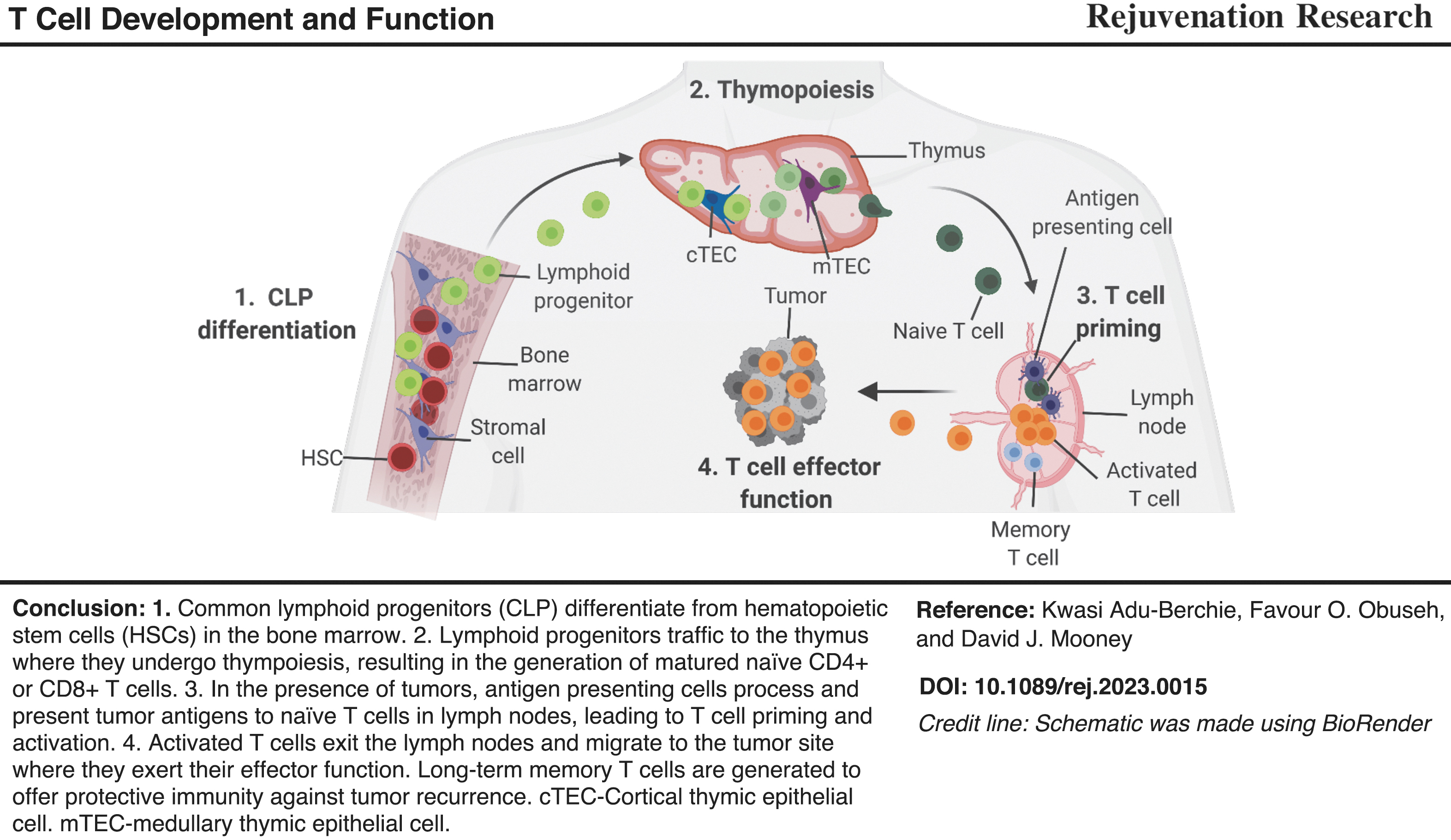
T cells play critical roles in the immune system, including in responses to cancer, autoimmunity, and tissue regeneration. T cells arise from common lymphoid progenitors (CLPs) that differentiate from hematopoietic stem cells in the bone marrow. CLPs then traffic to the thymus, where they undergo thymopoiesis through a number of selection steps, resulting in mature single positive naive CD4 helper or CD8 cytotoxic T cells. Naive T cells are home to secondary lymphoid organs like lymph nodes and are primed by antigen-presenting cells, which scavenge for both foreign and self-antigens. Effector T cell function is multifaceted, including direct target cell lysis and secretion of cytokines, which regulate the functions of other immune cells (refer to “Graphical Abstract”). This review will discuss T cell development and function, from the development of lymphoid progenitors in the bone marrow to principles that govern T cell effector function and dysfunction, specifically within the context of cancer.
Acarbose (ACA), a well-studied and effective inhibitor of α-amylase and α-glucosidase, is a postprandial-acting antidiabetic medicine. The membrane of the erythrocyte is an excellent tool for analyzing different physiological and biochemical activities since it experiences a range of metabolic alterations throughout aging. It is uncertain if ACA modulates erythrocyte membrane activities in an age-dependent manner. As a result, the current study was conducted to explore the influence of ACA on age-dependent deteriorated functions of transporters/exchangers, disrupted levels of various biomarkers such as lipid hydroperoxides (LHs), protein carbonyl (PCO), sialic acid (SA), total thiol (-SH), and erythrocyte membrane osmotic fragility. In addition to a concurrent increase in Na+/H+ exchanger activity and concentration of LH, PCO, and osmotic fragility, we also detected a considerable decrease in membrane-linked activities of Ca2+-ATPase (PMCA) and Na+/K+-ATPase (NKA), as well as concentrations of SA and -SH in old-aged rats. The aging-induced impairment of the activities of membrane-bound ATPases and the changed levels of redox biomarkers were shown to be effectively restored by ACA treatment.
Abnormal remodeling of collagen and extracellular matrix caused by the accumulation of senescent fibroblasts in the dermis is the most likely cause of skin aging. Therefore, the application of “senolysis,” in which only senescent cells are cleared from the body, has a potential in the development of antiaging treatments for skin. However, markers that label senescent fibroblasts only reflect the state of senescence, and it is important to develop markers as therapeutic targets to aid senolysis application. We investigated the potential of serotonin 2A receptor (HTR2A), which is involved in melanin production in response to ultraviolet light, as a senescent cell marker. The results showed that HTR2A is upregulated in aging dermal fibroblasts but is expressed at low levels in proliferating young cells. Flow cytometry demonstrated the presence of many HTR2A-positive cells in the aging cell population and few in the young cells. Furthermore, antibody-dependent cytotoxicity assays revealed that HTR2A preferentially sensitizes senescent fibroblasts and specifically damages only senescent cells by natural killer cells that recognize it. In conclusion, selective labeling of the novel senescent cell marker, HTR2A, could preferentially eliminate senescent cells and may contribute to the future development of novel skin senolysis approaches.
Cerebral ischemia-reperfusion (CIR) injury occurs as a secondary injury during the treatment of ischemic stroke (IS). There is a high death rate and morbidity due to IS throughout the world. Even though Naoxintong Capsule (NXT) is effective in the treatment of CIR, its mechanisms of action are unclear. The study aims to explore the clear mechanism associated with NXT therapy for CIR. We established the model of middle cerebral artery occlusion to evaluate the neurological function and assess the infarct size. Brain tissue metabolomics was used to identify different metabolites, and metabolic profiling systems enriched metabolic pathways. Then, the potential targets of NXT in the treatment of CIR were explored by proteomic, transcriptomic, and metabolomic methods. NXT improves CIR symptoms. We found potential 11 proteins and corresponding metabolites involved in NXT treatment of CIR. Most of these metabolites are regulated to restore after treatment. According to network pharmacology, we found 6 hub genes, including Glb1, Gmps, Pfas, Atic, Gaa, and Acox1, and their associated core metabolites and pathways. This study reveals the complex mechanism of NXT in treating CIR, and provides a new strategy for future researchers to screen related targets and pathways.